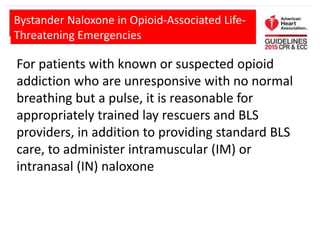
For patients with known or suspected opioid
addiction who are unresponsive with no normal
breathing but a pulse, it is reasonable for
appropriately trained lay rescuers and BLS
providers, in addition to providing standard BLS
care, to administer intramuscular (IM) or
intranasal (IN) naloxone
Bystander Naloxone in Opioid-Associated Life-
Threatening Emergencies
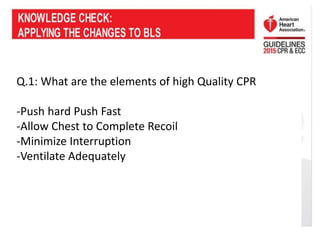
Q.1: What are the elements of high Quality CPR
-Push hard Push Fast
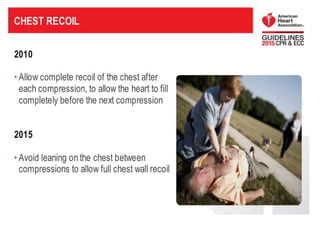
-Allow Chest to Complete Recoil
-Minimize Interruption
-Ventilate Adequately
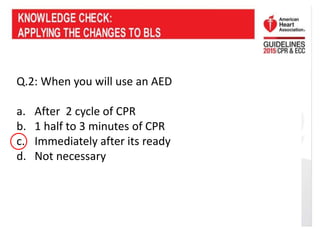
Q.2: When you will use an AED
a. After 2 cycle of CPR
b. 1 half to 3 minutes of CPR
c. Immediately after its ready
d. Not necessary
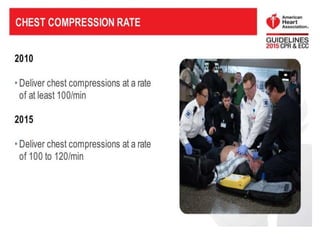
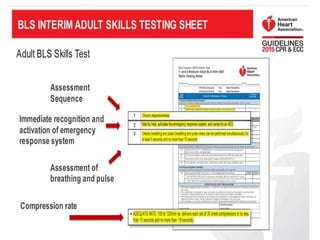
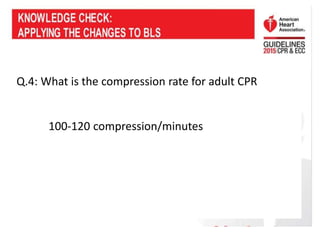
Q.4: What is the compression rate for adult CPR
100-120 compression/minutes
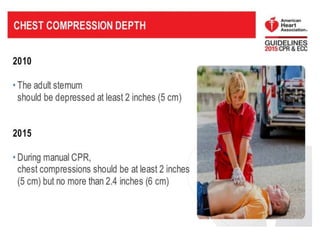
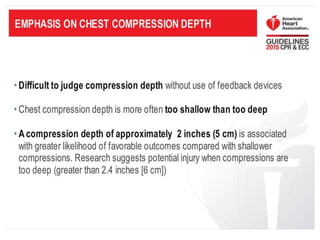
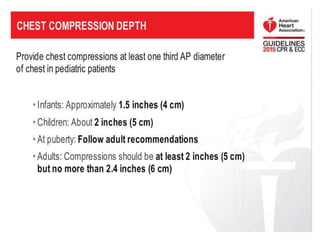
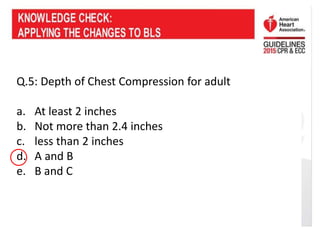
Q.5: Depth of Chest Compression for adult
a. At least 2 inches
b. Not more than 2.4 inches
c. less than 2 inches
d. A and B
e. B and C
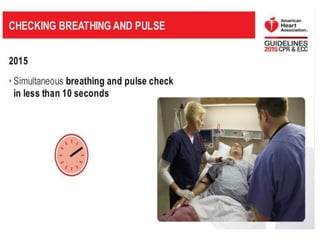
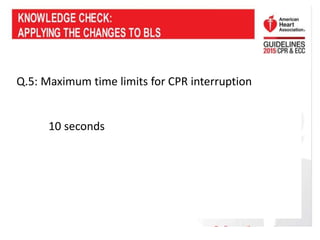
Q.5: Maximum time limits for CPR interruption
10 seconds
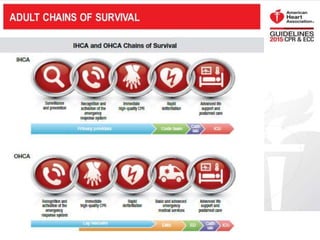
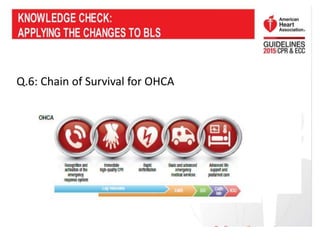
Q.6: Chain of Survival for OHCA
Bls update 2015

Bls update 2015

  • 13.
    For patients withknown or suspected opioid addiction who are unresponsive with no normal breathing but a pulse, it is reasonable for appropriately trained lay rescuers and BLS providers, in addition to providing standard BLS care, to administer intramuscular (IM) or intranasal (IN) naloxone Bystander Naloxone in Opioid-Associated Life- Threatening Emergencies
  • 26.
    Q.1: What arethe elements of high Quality CPR -Push hard Push Fast -Allow Chest to Complete Recoil -Minimize Interruption -Ventilate Adequately
  • 27.
    Q.2: When youwill use an AED a. After 2 cycle of CPR b. 1 half to 3 minutes of CPR c. Immediately after its ready d. Not necessary
  • 29.
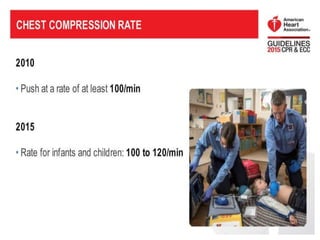
    Q.4: What isthe compression rate for adult CPR 100-120 compression/minutes
  • 30.
    Q.5: Depth ofChest Compression for adult a. At least 2 inches b. Not more than 2.4 inches c. less than 2 inches d. A and B e. B and C
  • 31.
    Q.5: Maximum timelimits for CPR interruption 10 seconds
  • 32.
    Q.6: Chain ofSurvival for OHCA