BY- PINKY RATHEE
M.Sc. Nursing
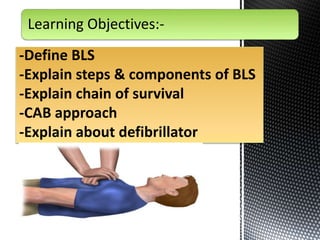
-Define BLS
-Explain steps & components of BLS
-Explain chain of survival
-CAB approach
-Explain about defibrillator
Learning Objectives:-
It refers to the care provided by healthcare
providers and public safety professionals to
patients who are experiencing respiratory arrest,
cardiac arrest or airway obstruction.
BLS includes psychomotor skills for performing
high-quality cardiopulmonary resuscitation (CPR),
using an automated external defibrillator (AED) and
relieving an obstructed airway for patients of all
ages.
Basic Life Support (BLS)
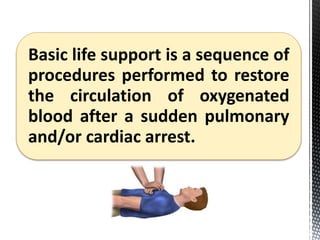
Basic life support is a sequence of
procedures performed to restore
the circulation of oxygenated
blood after a sudden pulmonary
and/or cardiac arrest.
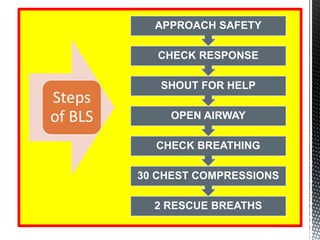
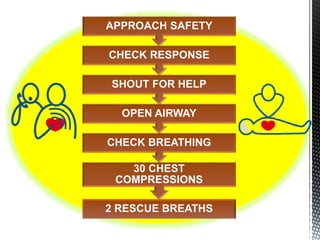
2 RESCUE BREATHS
30 CHEST COMPRESSIONS
CHECK BREATHING
OPEN AIRWAY
SHOUT FOR HELP
CHECK RESPONSE
APPROACH SAFETY
Steps
of BLS
APPROACH SAFETY-
2 RESCUE BREATHS
30 CHEST
COMPRESSIONS
CHECK BREATHING
OPEN AIRWAY
SHOUT FOR HELP
CHECK RESPONSE
APPROACH SAFETY
SCENE
VICTIM
RESCUER
Safety Of Self
Safety Of Patient
Movement of a
trauma victim only
when:-
 absolutely
necessary [unstable
cervical spine]
 injured spinal cord
ENSURE SAFETY- scene
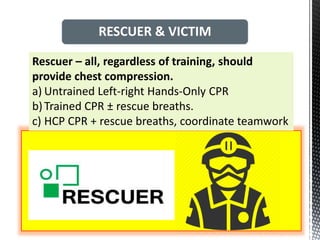
Rescuer – all, regardless of training, should
provide chest compression.
a) Untrained Left-right Hands-Only CPR
b)Trained CPR ± rescue breaths.
c) HCP CPR + rescue breaths, coordinate teamwork
RESCUER & VICTIM
2 RESCUE BREATHS
30 CHEST
COMPRESSIONS
CHECK BREATHING
OPEN AIRWAY
SHOUT FOR HELP
CHECK RESPONSE
APPROACH SAFETY
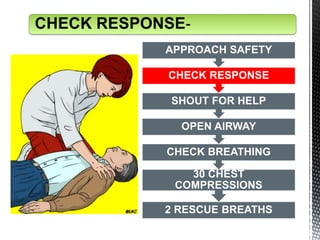
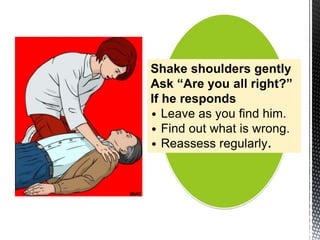
CHECK RESPONSE-
Shake shoulders gently
Ask “Are you all right?”
If he responds
• Leave as you find him.
• Find out what is wrong.
• Reassess regularly.
2 RESCUE BREATHS
30 CHEST
COMPRESSIONS
CHECK BREATHING
OPEN AIRWAY
SHOUT FOR HELP
CHECK RESPONSE
APPROACH SAFETY
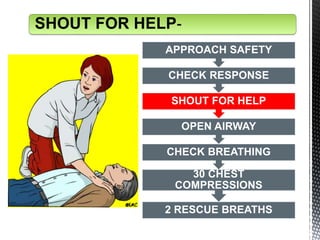
SHOUT FOR HELP-
2 RESCUE BREATHS
30 CHEST
COMPRESSIONS
CHECK BREATHING
OPEN AIRWAY
SHOUT FOR HELP
CHECK RESPONSE
APPROACH SAFETY
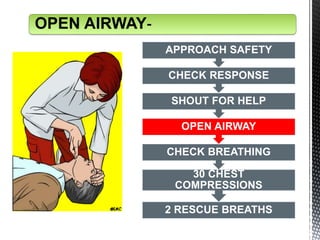
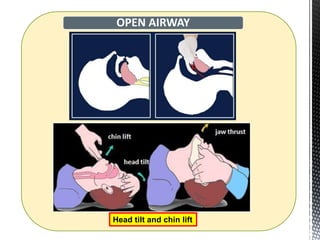
OPEN AIRWAY-
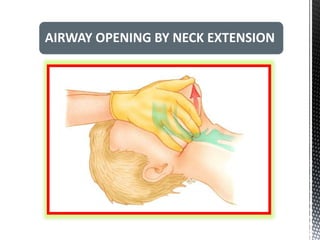
AIRWAY OPENING BY NECK EXTENSION
Head tilt and chin lift
OPEN AIRWAY
2 RESCUE BREATHS
30 CHEST
COMPRESSIONS
CHECK BREATHING
OPEN AIRWAY
SHOUT FOR HELP
CHECK RESPONSE
APPROACH SAFETY
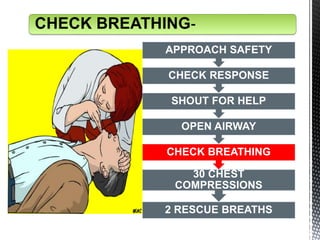
CHECK BREATHING-
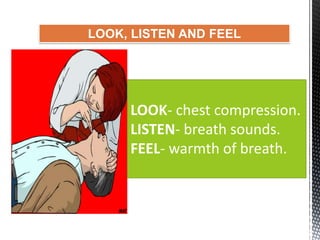
LOOK, LISTEN AND FEEL
LOOK- chest compression.
LISTEN- breath sounds.
FEEL- warmth of breath.
2 RESCUE BREATHS
30 CHEST
COMPRESSIONS
CHECK BREATHING
OPEN AIRWAY
SHOUT FOR HELP
CHECK RESPONSE
APPROACH SAFETY
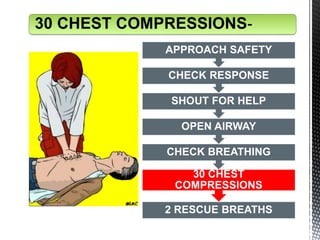
30 CHEST COMPRESSIONS-
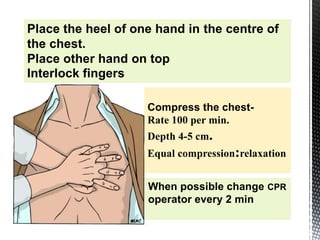
Place the heel of one hand in the centre of
the chest.
Place other hand on top
Interlock fingers
When possible change CPR
operator every 2 min
2 RESCUE BREATHS
30 CHEST
COMPRESSIONS
CHECK BREATHING
OPEN AIRWAY
SHOUT FOR HELP
CHECK RESPONSE
APPROACH SAFETY
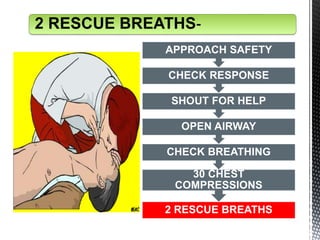
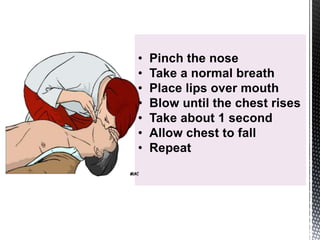
2 RESCUE BREATHS-
2 RESCUE BREATHS
30 CHEST
COMPRESSIONS
CHECK BREATHING
OPEN AIRWAY
SHOUT FOR HELP
CHECK RESPONSE
APPROACH SAFETY
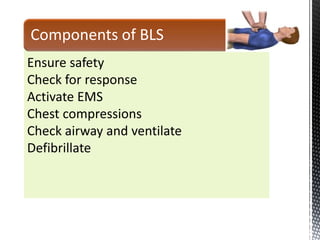
Components of BLS
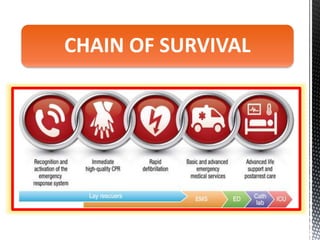
CHAIN OF SURVIVAL
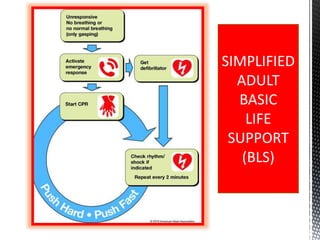
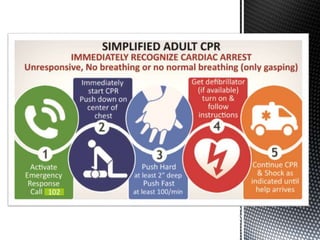
SIMPLIFIED
ADULT
BASIC
LIFE
SUPPORT
(BLS)
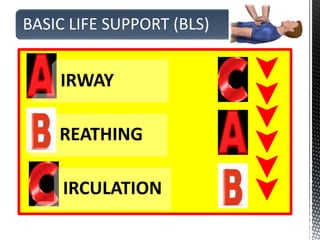
BASIC LIFE SUPPORT (BLS)
IRWAY
REATHING
IRCULATION
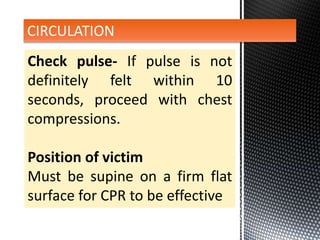
Check pulse- If pulse is not
definitely felt within 10
seconds, proceed with chest
compressions.
Position of victim
Must be supine on a firm flat
surface for CPR to be effective
CIRCULATION
“Push hard push fast”. Push at a rate of 100-120 per min.
Compression depth- at least 2 inches(5cm) not more than
2.5 inches
Release completely to allow the chest to fully recoil.
A compression-ventilation ratio should be - 30:2 .
During compression, elbows should not bend.
Never use the palm of your hand, use the heel of your
hand.
CHARACTERISTICS OF GOOD COMPRESSION
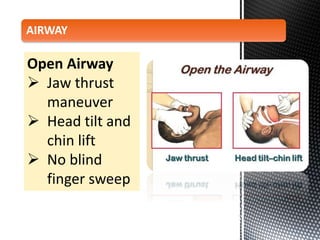
Open Airway
 Jaw thrust
maneuver
 Head tilt and
chin lift
 No blind
finger sweep
AIRWAY
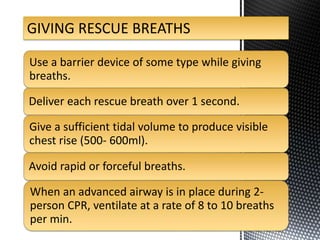
Use a barrier device of some type while giving
breaths.
Deliver each rescue breath over 1 second.
Give a sufficient tidal volume to produce visible
chest rise (500- 600ml).
Avoid rapid or forceful breaths.
When an advanced airway is in place during 2-
person CPR, ventilate at a rate of 8 to 10 breaths
per min.
GIVING RESCUE BREATHS
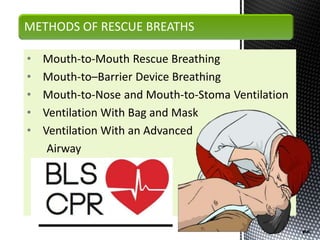
• Mouth-to-Mouth Rescue Breathing
• Mouth-to–Barrier Device Breathing
• Mouth-to-Nose and Mouth-to-Stoma Ventilation
• Ventilation With Bag and Mask
• Ventilation With an Advanced
Airway
METHODS OF RESCUE BREATHS
102
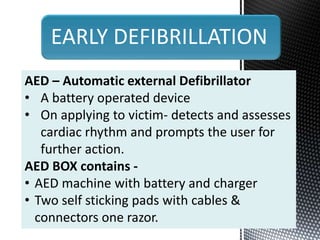
EARLY DEFIBRILLATION
AED – Automatic external Defibrillator
• A battery operated device
• On applying to victim- detects and assesses
cardiac rhythm and prompts the user for
further action.
AED BOX contains -
• AED machine with battery and charger
• Two self sticking pads with cables &
connectors one razor.
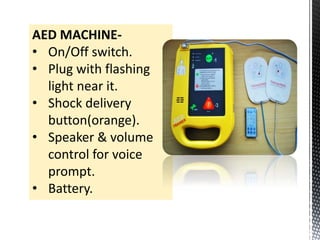
AED MACHINE-
• On/Off switch.
• Plug with flashing
light near it.
• Shock delivery
button(orange).
• Speaker & volume
control for voice
prompt.
• Battery.
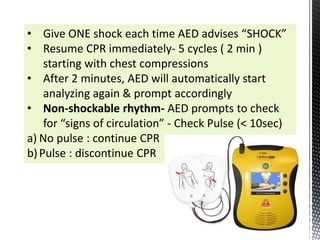
• Give ONE shock each time AED advises “SHOCK”
• Resume CPR immediately- 5 cycles ( 2 min )
starting with chest compressions
• After 2 minutes, AED will automatically start
analyzing again & prompt accordingly
• Non-shockable rhythm- AED prompts to check
for “signs of circulation” - Check Pulse (< 10sec)
a) No pulse : continue CPR
b)Pulse : discontinue CPR
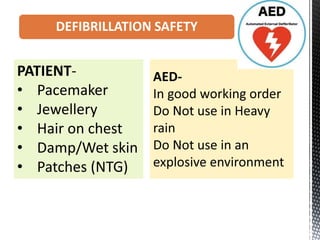
PATIENT-
• Pacemaker
• Jewellery
• Hair on chest
• Damp/Wet skin
• Patches (NTG)
DEFIBRILLATION SAFETY
 Clinical nursing procedures; annamma Jacob; 3rd edition.
 http://circ.ahajournals.org/content/122/18_suppl_3/S862
 http://ajcc.aacnjournals.org/content/17/5/426.abstract
 http://en.wikipedia.org/wiki/Precordial_thump
REFERENCES
Basic life support,Cardi0-pulmonary resuscitation

Basic life support,Cardi0-pulmonary resuscitation

  • 1.
  • 2.
    -Define BLS -Explain steps& components of BLS -Explain chain of survival -CAB approach -Explain about defibrillator Learning Objectives:-
  • 3.
    It refers tothe care provided by healthcare providers and public safety professionals to patients who are experiencing respiratory arrest, cardiac arrest or airway obstruction. BLS includes psychomotor skills for performing high-quality cardiopulmonary resuscitation (CPR), using an automated external defibrillator (AED) and relieving an obstructed airway for patients of all ages. Basic Life Support (BLS)
  • 4.
    Basic life supportis a sequence of procedures performed to restore the circulation of oxygenated blood after a sudden pulmonary and/or cardiac arrest.
  • 5.
    2 RESCUE BREATHS 30CHEST COMPRESSIONS CHECK BREATHING OPEN AIRWAY SHOUT FOR HELP CHECK RESPONSE APPROACH SAFETY Steps of BLS
  • 6.
    APPROACH SAFETY- 2 RESCUEBREATHS 30 CHEST COMPRESSIONS CHECK BREATHING OPEN AIRWAY SHOUT FOR HELP CHECK RESPONSE APPROACH SAFETY SCENE VICTIM RESCUER
  • 7.
    Safety Of Self SafetyOf Patient Movement of a trauma victim only when:-  absolutely necessary [unstable cervical spine]  injured spinal cord ENSURE SAFETY- scene
  • 8.
    Rescuer – all,regardless of training, should provide chest compression. a) Untrained Left-right Hands-Only CPR b)Trained CPR ± rescue breaths. c) HCP CPR + rescue breaths, coordinate teamwork RESCUER & VICTIM
  • 9.
    2 RESCUE BREATHS 30CHEST COMPRESSIONS CHECK BREATHING OPEN AIRWAY SHOUT FOR HELP CHECK RESPONSE APPROACH SAFETY CHECK RESPONSE-
  • 10.
    Shake shoulders gently Ask“Are you all right?” If he responds • Leave as you find him. • Find out what is wrong. • Reassess regularly.
  • 11.
    2 RESCUE BREATHS 30CHEST COMPRESSIONS CHECK BREATHING OPEN AIRWAY SHOUT FOR HELP CHECK RESPONSE APPROACH SAFETY SHOUT FOR HELP-
  • 12.
    2 RESCUE BREATHS 30CHEST COMPRESSIONS CHECK BREATHING OPEN AIRWAY SHOUT FOR HELP CHECK RESPONSE APPROACH SAFETY OPEN AIRWAY-
  • 13.
    AIRWAY OPENING BYNECK EXTENSION
  • 14.
    Head tilt andchin lift OPEN AIRWAY
  • 15.
    2 RESCUE BREATHS 30CHEST COMPRESSIONS CHECK BREATHING OPEN AIRWAY SHOUT FOR HELP CHECK RESPONSE APPROACH SAFETY CHECK BREATHING-
  • 16.
    LOOK, LISTEN ANDFEEL LOOK- chest compression. LISTEN- breath sounds. FEEL- warmth of breath.
  • 18.
    2 RESCUE BREATHS 30CHEST COMPRESSIONS CHECK BREATHING OPEN AIRWAY SHOUT FOR HELP CHECK RESPONSE APPROACH SAFETY 30 CHEST COMPRESSIONS-
  • 19.
    Place the heelof one hand in the centre of the chest. Place other hand on top Interlock fingers When possible change CPR operator every 2 min
  • 20.
    2 RESCUE BREATHS 30CHEST COMPRESSIONS CHECK BREATHING OPEN AIRWAY SHOUT FOR HELP CHECK RESPONSE APPROACH SAFETY 2 RESCUE BREATHS-
  • 22.
    2 RESCUE BREATHS 30CHEST COMPRESSIONS CHECK BREATHING OPEN AIRWAY SHOUT FOR HELP CHECK RESPONSE APPROACH SAFETY
  • 23.
  • 25.
  • 26.
  • 27.
    BASIC LIFE SUPPORT(BLS) IRWAY REATHING IRCULATION
  • 28.
    Check pulse- Ifpulse is not definitely felt within 10 seconds, proceed with chest compressions. Position of victim Must be supine on a firm flat surface for CPR to be effective CIRCULATION
  • 29.
    “Push hard pushfast”. Push at a rate of 100-120 per min. Compression depth- at least 2 inches(5cm) not more than 2.5 inches Release completely to allow the chest to fully recoil. A compression-ventilation ratio should be - 30:2 . During compression, elbows should not bend. Never use the palm of your hand, use the heel of your hand. CHARACTERISTICS OF GOOD COMPRESSION
  • 30.
    Open Airway  Jawthrust maneuver  Head tilt and chin lift  No blind finger sweep AIRWAY
  • 31.
    Use a barrierdevice of some type while giving breaths. Deliver each rescue breath over 1 second. Give a sufficient tidal volume to produce visible chest rise (500- 600ml). Avoid rapid or forceful breaths. When an advanced airway is in place during 2- person CPR, ventilate at a rate of 8 to 10 breaths per min. GIVING RESCUE BREATHS
  • 32.
    • Mouth-to-Mouth RescueBreathing • Mouth-to–Barrier Device Breathing • Mouth-to-Nose and Mouth-to-Stoma Ventilation • Ventilation With Bag and Mask • Ventilation With an Advanced Airway METHODS OF RESCUE BREATHS
  • 34.
  • 35.
    EARLY DEFIBRILLATION AED –Automatic external Defibrillator • A battery operated device • On applying to victim- detects and assesses cardiac rhythm and prompts the user for further action. AED BOX contains - • AED machine with battery and charger • Two self sticking pads with cables & connectors one razor.
  • 36.
    AED MACHINE- • On/Offswitch. • Plug with flashing light near it. • Shock delivery button(orange). • Speaker & volume control for voice prompt. • Battery.
  • 37.
    • Give ONEshock each time AED advises “SHOCK” • Resume CPR immediately- 5 cycles ( 2 min ) starting with chest compressions • After 2 minutes, AED will automatically start analyzing again & prompt accordingly • Non-shockable rhythm- AED prompts to check for “signs of circulation” - Check Pulse (< 10sec) a) No pulse : continue CPR b)Pulse : discontinue CPR
  • 38.
    PATIENT- • Pacemaker • Jewellery •Hair on chest • Damp/Wet skin • Patches (NTG) DEFIBRILLATION SAFETY
  • 39.
     Clinical nursingprocedures; annamma Jacob; 3rd edition.  http://circ.ahajournals.org/content/122/18_suppl_3/S862  http://ajcc.aacnjournals.org/content/17/5/426.abstract  http://en.wikipedia.org/wiki/Precordial_thump REFERENCES