BasicLifeSupport
ADULT
BASIC LIFE SUPPORT
(BLS)
Dr. Zain Ul Abidin
MBBS
KHI, PK.
BasicLifeSupport
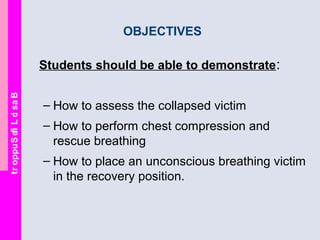
OBJECTIVES
Students should be able to demonstrate:
– How to assess the collapsed victim
– How to perform chest compression and
rescue breathing
– How to place an unconscious breathing victim
in the recovery position.
BasicLifeSupport
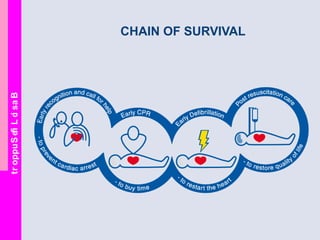
CHAIN OF SURVIVAL
BasicLifeSupport
CARDIAC ARREST
Cessation of mechanical cardiac activity
with no clinical evidence of cardiac output.
SIGNS OF CARDIAC ARREST:
Unresponsiveness
Absence of detectable pulse
Apnea/Agonal respiration.
BasicLifeSupport
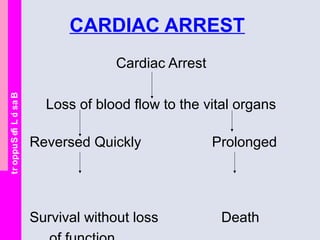
CARDIAC ARREST
Cardiac Arrest
Loss of blood flow to the vital organs
Reversed Quickly Prolonged
Survival without loss Death
BasicLifeSupport
BASIC LIFE SUPPORT (BLS)
SEQUENCES OF PROCEDURES PERFORMED TO RESTORE
THE CIRCULATION OF OXYGENATED BLOOD AFTER A
SUDDEN PULMONARY AND/OR CARDIAC ARREST
CHEST COMPRESSIONS AND PULMONARY VENTILATION
PERFORMED BY ANYONE WHO KNOWS HOW TO DO IT,
ANYWHERE, IMMEDIATELY, WITHOUT ANY OTHER
EQUIPMENT
Protective devices
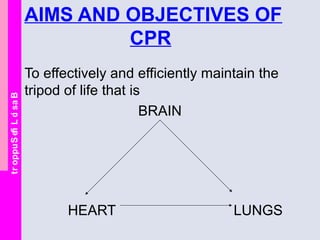
BasicLifeSupport AIMS AND OBJECTIVES OF
CPR
To effectively and efficiently maintain the
tripod of life that is
BRAIN
HEART LUNGS
BasicLifeSupport
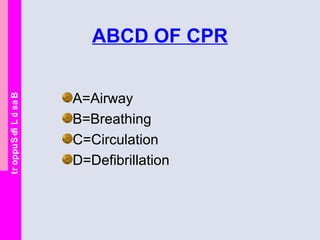
ABCD OF CPR
A=Airway
B=Breathing
C=Circulation
D=Defibrillation
BasicLifeSupport
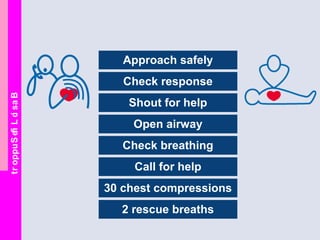
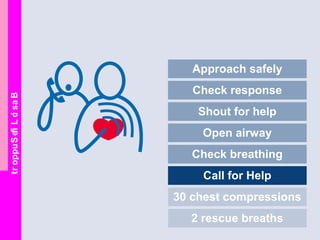
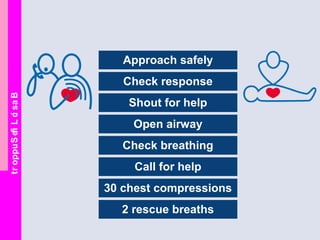
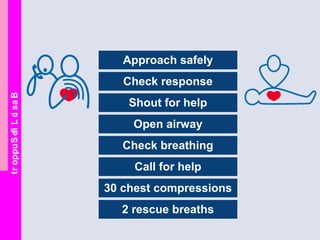
Approach safely
Check response
Shout for help
Open airway
Check breathing
Call for help
30 chest compressions
2 rescue breaths
BasicLifeSupport
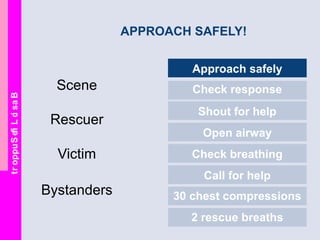
APPROACH SAFELY!
Scene
Rescuer
Victim
Bystanders
Approach safely
Check response
Shout for help
Open airway
Check breathing
Call for help
30 chest compressions
2 rescue breaths
BasicLifeSupport
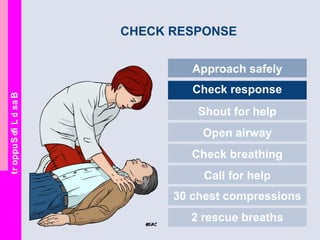
CHECK RESPONSE
Approach safely
Check response
Shout for help
Open airway
Check breathing
Call for help
30 chest compressions
2 rescue breaths
BasicLifeSupport
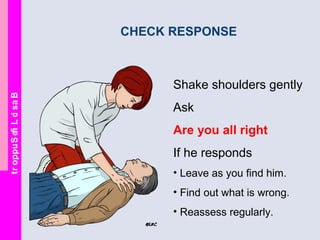
Shake shoulders gently
Ask
Are you all right
If he responds
• Leave as you find him.
• Find out what is wrong.
• Reassess regularly.
CHECK RESPONSE
BasicLifeSupport
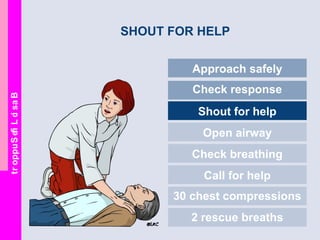
SHOUT FOR HELP
Approach safely
Check response
Shout for help
Open airway
Check breathing
Call for help
30 chest compressions
2 rescue breaths
BasicLifeSupport
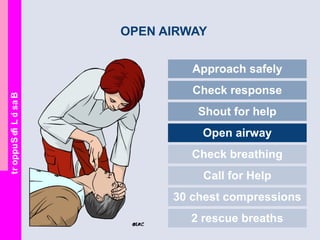
OPEN AIRWAY
Approach safely
Check response
Shout for help
Open airway
Check breathing
Call for Help
30 chest compressions
2 rescue breaths
BasicLifeSupport
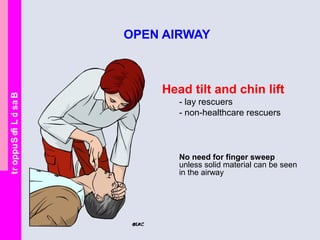
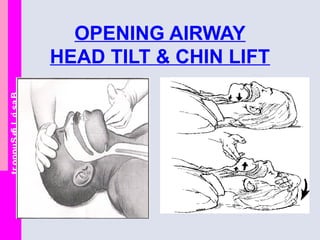
OPEN AIRWAY
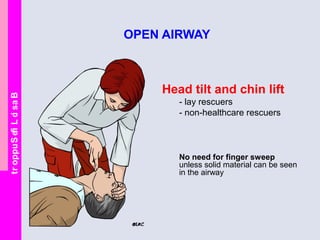
Head tilt and chin lift
- lay rescuers
- non-healthcare rescuers
No need for finger sweep
unless solid material can be seen
in the airway
BasicLifeSupport
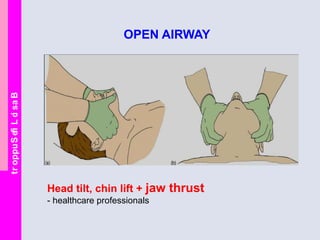
OPEN AIRWAY
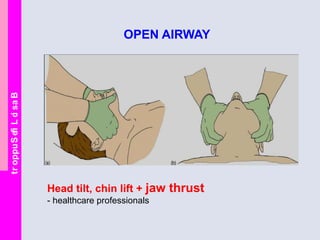
Head tilt, chin lift + jaw thrust
- healthcare professionals
BasicLifeSupport
OPENING AIRWAY
HEAD TILT & CHIN LIFT
BasicLifeSupport
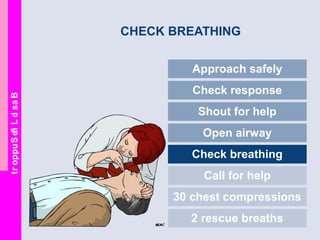
CHECK BREATHING
Approach safely
Check response
Shout for help
Open airway
Check breathing
Call for help
30 chest compressions
2 rescue breaths
BasicLifeSupport
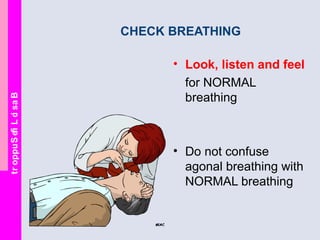
CHECK BREATHING
• Look, listen and feel
for NORMAL
breathing
• Do not confuse
agonal breathing with
NORMAL breathing
BasicLifeSupport
AGONAL BREATHING
• Occurs shortly after the heart stops
in up to 40% of cardiac arrests
• Described as barely, heavy, noisy or
gasping breathing
• Recognise as a sign of cardiac arrest
Erroneous information can result in withholding CPR from cardiac arrest victim
BasicLifeSupport
Approach safely
Check response
Shout for help
Open airway
Check breathing
Call for Help
30 chest compressions
2 rescue breaths
BasicLifeSupport
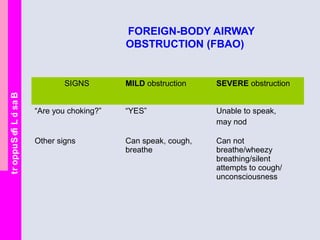
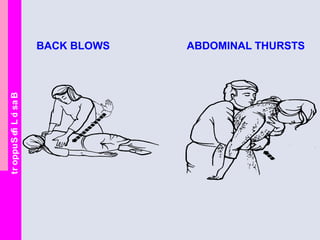
FOREIGN-BODY AIRWAY
OBSTRUCTION (FBAO)
SIGNS MILD obstruction SEVERE obstruction
“Are you choking?” “YES” Unable to speak,
may nod
Other signs Can speak, cough,
breathe
Can not
breathe/wheezy
breathing/silent
attempts to cough/
unconsciousness
BasicLifeSupport
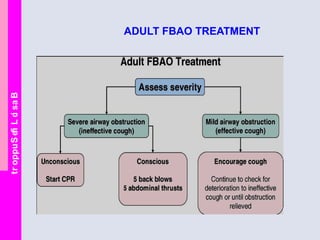
ADULT FBAO TREATMENT
BasicLifeSupport
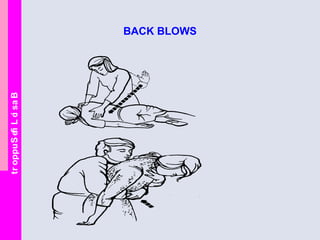
BACK BLOWS
BasicLifeSupport
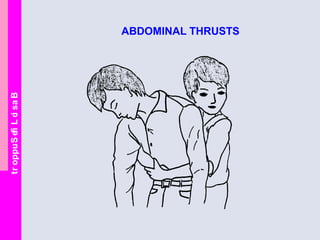
ABDOMINAL THRUSTS
BasicLifeSupport
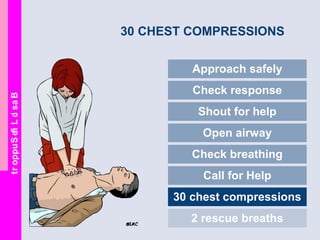
30 CHEST COMPRESSIONS
Approach safely
Check response
Shout for help
Open airway
Check breathing
Call for Help
30 chest compressions
2 rescue breaths
BasicLifeSupport
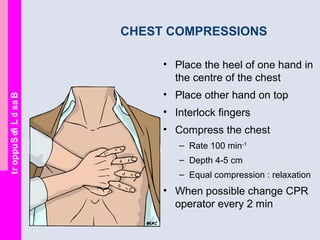
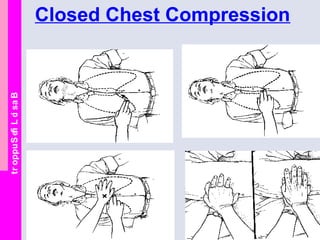
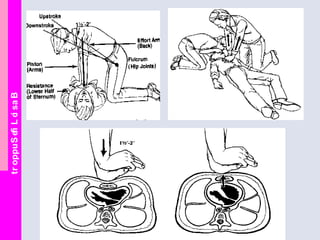
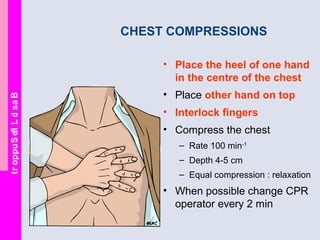
• Place the heel of one hand in
the centre of the chest
• Place other hand on top
• Interlock fingers
• Compress the chest
– Rate 100 min-1
– Depth 4-5 cm
– Equal compression : relaxation
• When possible change CPR
operator every 2 min
CHEST COMPRESSIONS
BasicLifeSupport Closed Chest Compression
BasicLifeSupport
BasicLifeSupport
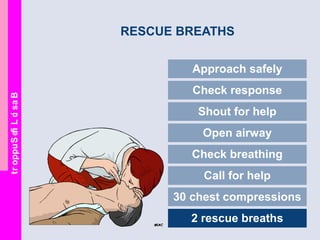
RESCUE BREATHS
Approach safely
Check response
Shout for help
Open airway
Check breathing
Call for help
30 chest compressions
2 rescue breaths
BasicLifeSupport
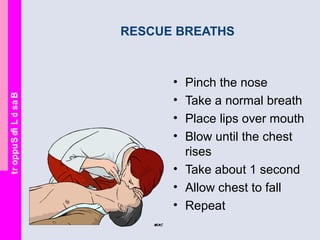
RESCUE BREATHS
• Pinch the nose
• Take a normal breath
• Place lips over mouth
• Blow until the chest
rises
• Take about 1 second
• Allow chest to fall
• Repeat
BasicLifeSupport
RESCUE BREATHS
RECOMMENDATIONS:
- Tidal volume
500 – 600 ml
- Respiratory rate
give each breaths over about 1s with enough
volume to make the victim’s chest rise
- Chest-compression-only
continuously at a rate of 100 min
BasicLifeSupport
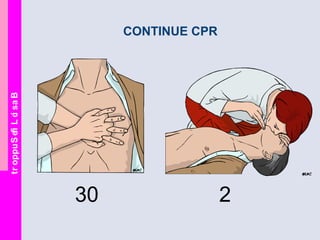
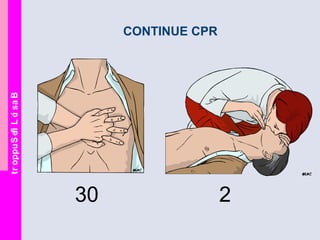
CONTINUE CPR
30 2
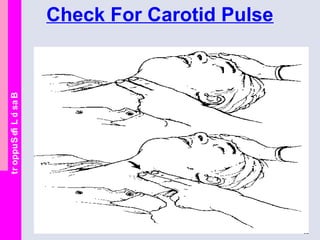
BasicLifeSupport Check For Carotid Pulse
BasicLifeSupport
Approach safely
Check response
Shout for help
Open airway
Check breathing
Call for help
30 chest compressions
2 rescue breaths
BasicLifeSupport
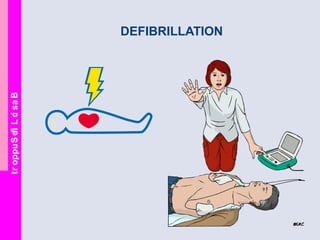
DEFIBRILLATION
BasicLifeSupport
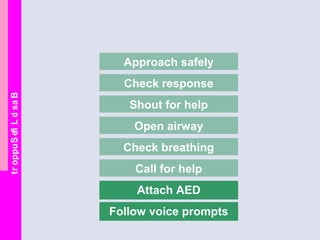
Call for help
Approach safely
Check response
Shout for help
Open airway
Check breathing
Attach AED
Follow voice prompts
BasicLifeSupport
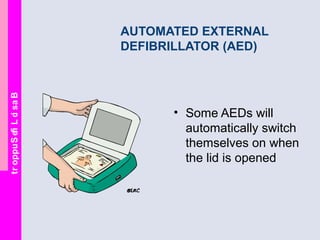
AUTOMATED EXTERNAL
DEFIBRILLATOR (AED)
• Some AEDs will
automatically switch
themselves on when
the lid is opened
BasicLifeSupport
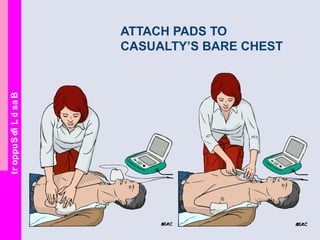
ATTACH PADS TO
CASUALTY’S BARE CHEST
BasicLifeSupport
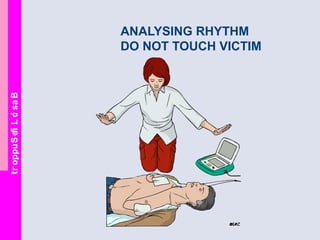
ANALYSING RHYTHM
DO NOT TOUCH VICTIM
BasicLifeSupport
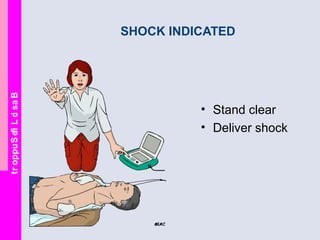
SHOCK INDICATED
• Stand clear
• Deliver shock
BasicLifeSupport
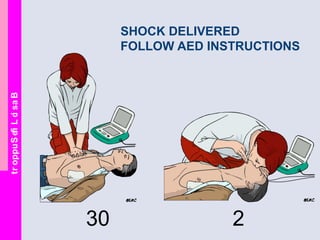
SHOCK DELIVERED
FOLLOW AED INSTRUCTIONS
30 2
BasicLifeSupport
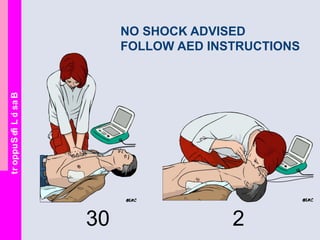
NO SHOCK ADVISED
FOLLOW AED INSTRUCTIONS
30 2
BasicLifeSupport
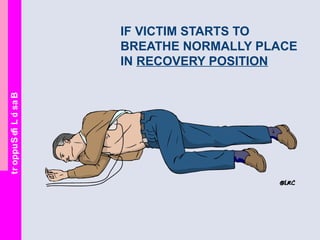
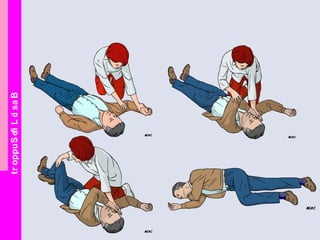
IF VICTIM STARTS TO
BREATHE NORMALLY PLACE
IN RECOVERY POSITION
BasicLifeSupport
BasicLifeSupport
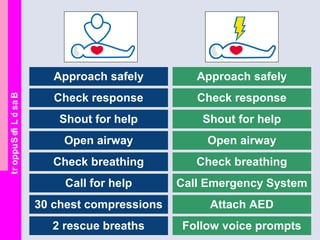
Approach safely
Check response
Shout for help
Open airway
Check breathing
Call for help
30 chest compressions
2 rescue breaths
Approach safely
Check response
Shout for help
Open airway
Check breathing
Call Emergency System
Attach AED
Follow voice prompts
BasicLifeSupport
CONTINUE RESUSCITATION UNTIL
– Qualified help arrives and takes over
– The victim starts breathing normally
– Rescuer becomes exhausted
BasicLifeSupport
REPETITION
1. Name adult basic life support sequences of actions.
2. What is the manoeuvre for keeping the airway open
called?
3. What is the numeral combination of chest compression and
rescue breaths in adult basic life support?
4. Where do you place your hands while performing chest
compressions?
5. How would you describe „agonal breathing“?
6. Name 2 techniques applied in severe airway obstruction?
BasicLifeSupport
Approach safely
Check response
Shout for help
Open airway
Check breathing
Call for help
30 chest compressions
2 rescue breaths
BasicLifeSupport
REPETITION
1. Name adult basic life support sequences of actions.
2. What is the manoeuvre for keeping the airway open
called?
3. What is the numeral combination of chest compression and
rescue breaths in adult basic life support?
4. Where do you place your hands while performing chest
compressions?
5. How would you describe „agonal breathing“?
6. Name 2 techniques applied in severe airway obstruction?
BasicLifeSupport
OPEN AIRWAY
Head tilt and chin lift
- lay rescuers
- non-healthcare rescuers
No need for finger sweep
unless solid material can be seen
in the airway
BasicLifeSupport
OPEN AIRWAY
Head tilt, chin lift + jaw thrust
- healthcare professionals
BasicLifeSupport
REPETITION
1. Name adult basic life support sequences of actions.
2. What is the manoeuvre for keeping the airway open
called?
3. What is the numeral combination of chest compression and
rescue breaths in adult basic life support?
4. Where do you place your hands while performing chest
compressions?
5. How would you describe „agonal breathing“?
6. Name 2 techniques applied in severe airway obstruction?
BasicLifeSupport
CONTINUE CPR
30 2
BasicLifeSupport
REPETITION
1. Name adult basic life support sequences of actions.
2. What is the manoeuvre for keeping the airway open
called?
3. What is the numeral combination of chest compression and
rescue breaths in adult basic life support?
4. Where do you place your hands while performing chest
compressions?
5. How would you describe „agonal breathing“?
6. Name 2 techniques applied in severe airway obstruction?
BasicLifeSupport
• Place the heel of one hand
in the centre of the chest
• Place other hand on top
• Interlock fingers
• Compress the chest
– Rate 100 min-1
– Depth 4-5 cm
– Equal compression : relaxation
• When possible change CPR
operator every 2 min
CHEST COMPRESSIONS
BasicLifeSupport
REPETITION
1. Name adult basic life support sequences of actions.
2. What is the manoeuvre for keeping the airway open
called?
3. What is the numeral combination of chest compression and
rescue breaths in adult basic life support?
4. Where do you place your hands while performing chest
compressions?
5. How would you describe “agonal breathing”?
6. Name 2 techniques applied in severe airway obstruction?
BasicLifeSupport
AGONAL BREATHING
• Occurs shortly after the heart stops
in up to 40% of cardiac arrests
• Described as barely, heavy, noisy or
gasping breathing
• Recognise as a sign of cardiac arrest
Erroneous information can result in withholding CPR from cardiac arrest victim
BasicLifeSupport
REPETITION
1. Name adult basic life support sequences of actions.
2. What is the manoeuvre for keeping the airway open
called?
3. What is the numeral combination of chest compression and
rescue breaths in adult basic life support?
4. Where do you place your hands while performing chest
compressions?
5. How would you describe „agonal breathing“?
6. Name 2 techniques applied in severe airway obstruction?
BasicLifeSupport
BACK BLOWS ABDOMINAL THURSTS

Basic Life Support (BLS)