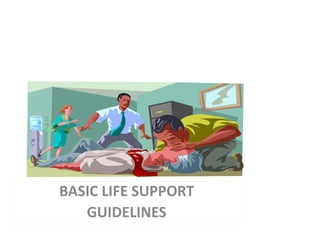
BASIC LIFE SUPPORT
GUIDELINES
RESUSCITATION
 Means Cardiopulmonary
resuscitations
 Anywhere Anybody can do
CPR…
 Considered when an individual
cannot adequately breathe and
maintain circulation to vital
organs.
WHY& WHEN TO DO IT ?
 Without CPR , irreversible
brain damage occurs within
3-4 minutes
 Should be done immediately
by a bystander
 TIME is the crucial factor
here to decide the survival
Minutes counts...
 when the heart stops,
damage occurs to the
Brain within < 5
minutes
 start BLS early
CPR…
BLS
ACLS
ALS
ANLS
CPCR – Cardio Pulmonary
Cerebral resuscitation
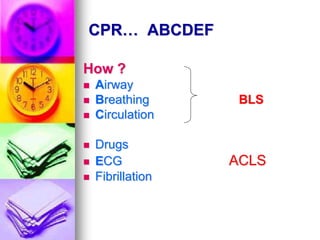
CPR… ABCDEF
How ?
 Airway
 Breathing BLS
 Circulation
 Drugs
 ECG ACLS
 Fibrillation
The Sequence of BLS
 Establish Unresponsiveness
 If no response call for help
 Start BLS------- A- Airway
B- Breathing
C- Circulation
CPR…
RECOGNITION
Is crucial in BLS
Determine
 Unresponsiveness
 Breathlessness
 Pulselessness
No victim should undergo
CPR
until the need
for resuscitation
is established.
2. Check the Victim and see if he
responds
Gently SHAKE his shoulder
Ask loudly “Are you all
right?”
3A. Responds by answering or
moving
 Leave him in the position.
 Reassess him regularly.
3B. If no response
 SHOUT for help (Call for
defibrillator)
 Turn to his back and open airway.
 HEAD TILT  Hand on forehead.
 Remove any visible obstruction.
 CHIN LIFT  finger tips under the
point of chin.
Avoid head tilt in
Trauma
CPR…
Activation of EMS
Call for help
Call for ambulance
services
Emergency
BLS ALGORHYTHM
CHECK RESPONSIVENESS
OPEN AIRWAY
CHECK BREATHING
ventilation
A
B
CIRCULATION
C
CPR…
Airway - First basic skill
 Head tilt
 Chin lift
 Jaw thrust
 Airways
 ET intubation
 Newer airways
CPR…
AIRWAY
Head tilt
Jaw thrust
Chin lift
CPR…
Breathing – Second basic skill
 LOOK for chest movement
 LISTEN for breath sounds
 FEEL for air on your cheek
 2 slow effective rescue breathing
LOOK, LISTEN
AND FEEL
LOOK
LISTEN
FEEL
5A. Breathing Normally
 Turn him into recovery Position.
 Send or go for help.
 Check for continued breathing.
Recovery position.
To maintain a good airway
To minimize the risk of aspiration
Recovery Position
 To Maintain a good airway.
 To Minimize the risk of aspiration.
5B. Not Breathing
Rescue breathing
 Ensure head tilt and
chin lift.
 Pinch the Nose.
 Two Slow effective
breaths.
Rise and fall of the
Chest
Rescue Breathing
 Required if breathing is absent
or inadequate
 Give 2 slow breaths sufficient
to make the chest rise
 Adult: Over 2 seconds
 Child & Infant: Over 1 – 1 ½
seconds
Rescue Breathing Techniques
 Mouth-to-Mouth
 Mouth-to-Barrier
 Mouth-to-Nose
 Mouth-to Mask
 Bag-mask
device
Any difficulty achieving an
effective breath.
 Recheck Victims mouth.
 Recheck head tilt and chin lift.
 Make up to 5 attempts.
 Even in unsuccessful, move on
to assessment of circulation.
NO - Circulation
 Absent carotid pulse.
 Lay Rescuer.
 Normal Breathing.
 coughing
 Movement.
Sign of Cardiac arrest.
No More than 10 Sec.
CAROTID PULSE
 Identify Adam’s apple (Thyroid
Cartilage).
 Slide down to the groove.
 Palpate pulse in the groove.
 Never Palpate on both sides
simultaneously.
7A. Circulation Present
 Continue rescue breathing.
 Recheck rescue breathing.
 Normally breathing  Recovery
Position.
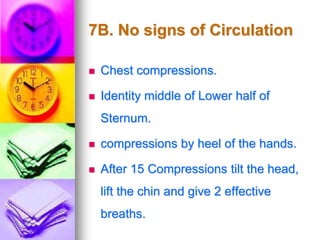
7B. No signs of Circulation
 Chest compressions.
 Identity middle of Lower half of
Sternum.
 compressions by heel of the hands.
 After 15 Compressions tilt the head,
lift the chin and give 2 effective
breaths.
Chest Compressions
No pulse present
START CHESTCOMPRESSIONS
Compression Rate:
Adult, Child, & Infant – 100/min
TECHNIQUE OF EXTERNAL
CARDIAC COMPRESSION
 Rescuer to one side of the patient
 Patient’s chest exposed and
xiphisternum identified
 Xiphisternum –Bony prominence in
the mid line at the junction of lower
borders of the ribs
 The index and middle fingers of the
lower hand placed on the
xiphisternum and heel of the other
hand is placed adjacent to them on
the sternum
Heel of the second hand placed
on the back of the hand on the
sternum
Fingers may be interlocked
Sternum depressed vertically4-
5cm and then released rapidly
Repeated at a rate of 80-
100/minwith compression and
relaxation each taking the same
length of time
Locate rib cage
Position your hands over middle of lower
half of sternum and fingers away from
Chest
Compression of Chest
Arms Vertical
Arms Straight
Press
Depress
4-5Cm
CPR
15 x 2 x
Chest compressions Breathing
One Rescuer
Two rescuers
Depth of Compression
 Adult: 1 ½ - 2 inches or enough
to generate a pulse
 Child & Infant: 1/3 – ½ the depth
of the chest or enough to generate
a pulse
Continue Resuscitation
Until
 Qualified help arrives and takes
over.
 Victim shows signs of life.
 You become exhausted.
Reassessment (10 seconds)
 Should be performed after the first
minute of CPR and every few
minutes thereafter
 If no pulse- resume CPR
 If pulse and breathing present-
place in recovery position
 If pulse present but no breathing-
provide rescue breathing
BLS Algorithm
CHECK RESPONSIVENESS
OPEN AIRWAY
CHECK BREATHING
BREATHE
ACCESS CIRCULATION
10 seconds only
CIRCULATION PRESENT
Continue Rescue Breathing
NO CIRCULATION
Compress Chest
Shake & Shout
Head tilt / Chin lift
Look, Listen and Feel
2 Effective Breaths
Signs of a Circulation
100 Per Minute 15:2 Ratio
Check Circulation every Minute
CPR…
 Nutshell
Adult Paediatric
Breath rate 10 – 12
bpm
20 bpm
Pulse check Carotid Brachial
Compression
rate
100/min >100/min
Compression
method
Hands
interlaced
Two or three
fingers or heel
of one hand
CV ratio 15 : 2 5 : 1
FB
obstruction
Heimlich
maneuver
Back blows
and chest
thrusts
ACLS
 Special equipments and
techniques
 ECG monitoring
 Defibrillation
 iv access
 Drug therapy
 Post resuscitation care
NOW HE IS SAFE IN HELPING
HANDS

8009885.ppt BASIC LIFE SUPPORT ANAESTHESIA

  • 1.
  • 2.
  • 3.
    CPR…  Considered whenan individual cannot adequately breathe and maintain circulation to vital organs.
  • 4.
    WHY& WHEN TODO IT ?  Without CPR , irreversible brain damage occurs within 3-4 minutes  Should be done immediately by a bystander  TIME is the crucial factor here to decide the survival
  • 5.
    Minutes counts...  whenthe heart stops, damage occurs to the Brain within < 5 minutes  start BLS early
  • 6.
    CPR… BLS ACLS ALS ANLS CPCR – CardioPulmonary Cerebral resuscitation
  • 7.
    CPR… ABCDEF How ? Airway  Breathing BLS  Circulation  Drugs  ECG ACLS  Fibrillation
  • 8.
    The Sequence ofBLS  Establish Unresponsiveness  If no response call for help  Start BLS------- A- Airway B- Breathing C- Circulation
  • 9.
    CPR… RECOGNITION Is crucial inBLS Determine  Unresponsiveness  Breathlessness  Pulselessness
  • 10.
    No victim shouldundergo CPR until the need for resuscitation is established.
  • 12.
    2. Check theVictim and see if he responds Gently SHAKE his shoulder Ask loudly “Are you all right?”
  • 14.
    3A. Responds byanswering or moving  Leave him in the position.  Reassess him regularly.
  • 15.
    3B. If noresponse  SHOUT for help (Call for defibrillator)  Turn to his back and open airway.  HEAD TILT  Hand on forehead.  Remove any visible obstruction.  CHIN LIFT  finger tips under the point of chin. Avoid head tilt in Trauma
  • 16.
    CPR… Activation of EMS Callfor help Call for ambulance services Emergency
  • 17.
    BLS ALGORHYTHM CHECK RESPONSIVENESS OPENAIRWAY CHECK BREATHING ventilation A B CIRCULATION C
  • 18.
    CPR… Airway - Firstbasic skill  Head tilt  Chin lift  Jaw thrust  Airways  ET intubation  Newer airways
  • 19.
  • 20.
    CPR… Breathing – Secondbasic skill  LOOK for chest movement  LISTEN for breath sounds  FEEL for air on your cheek  2 slow effective rescue breathing
  • 21.
  • 22.
    5A. Breathing Normally Turn him into recovery Position.  Send or go for help.  Check for continued breathing.
  • 23.
    Recovery position. To maintaina good airway To minimize the risk of aspiration
  • 24.
    Recovery Position  ToMaintain a good airway.  To Minimize the risk of aspiration.
  • 25.
    5B. Not Breathing Rescuebreathing  Ensure head tilt and chin lift.  Pinch the Nose.  Two Slow effective breaths. Rise and fall of the Chest
  • 26.
    Rescue Breathing  Requiredif breathing is absent or inadequate  Give 2 slow breaths sufficient to make the chest rise  Adult: Over 2 seconds  Child & Infant: Over 1 – 1 ½ seconds
  • 27.
    Rescue Breathing Techniques Mouth-to-Mouth  Mouth-to-Barrier  Mouth-to-Nose  Mouth-to Mask  Bag-mask device
  • 28.
    Any difficulty achievingan effective breath.  Recheck Victims mouth.  Recheck head tilt and chin lift.  Make up to 5 attempts.  Even in unsuccessful, move on to assessment of circulation.
  • 29.
    NO - Circulation Absent carotid pulse.  Lay Rescuer.  Normal Breathing.  coughing  Movement. Sign of Cardiac arrest. No More than 10 Sec.
  • 30.
    CAROTID PULSE  IdentifyAdam’s apple (Thyroid Cartilage).  Slide down to the groove.  Palpate pulse in the groove.  Never Palpate on both sides simultaneously.
  • 32.
    7A. Circulation Present Continue rescue breathing.  Recheck rescue breathing.  Normally breathing  Recovery Position.
  • 33.
    7B. No signsof Circulation  Chest compressions.  Identity middle of Lower half of Sternum.  compressions by heel of the hands.  After 15 Compressions tilt the head, lift the chin and give 2 effective breaths.
  • 34.
    Chest Compressions No pulsepresent START CHESTCOMPRESSIONS Compression Rate: Adult, Child, & Infant – 100/min
  • 35.
    TECHNIQUE OF EXTERNAL CARDIACCOMPRESSION  Rescuer to one side of the patient  Patient’s chest exposed and xiphisternum identified  Xiphisternum –Bony prominence in the mid line at the junction of lower borders of the ribs  The index and middle fingers of the lower hand placed on the xiphisternum and heel of the other hand is placed adjacent to them on the sternum
  • 36.
    Heel of thesecond hand placed on the back of the hand on the sternum Fingers may be interlocked Sternum depressed vertically4- 5cm and then released rapidly Repeated at a rate of 80- 100/minwith compression and relaxation each taking the same length of time
  • 37.
  • 38.
    Position your handsover middle of lower half of sternum and fingers away from Chest
  • 39.
    Compression of Chest ArmsVertical Arms Straight Press Depress 4-5Cm
  • 41.
    CPR 15 x 2x Chest compressions Breathing One Rescuer
  • 42.
  • 43.
    Depth of Compression Adult: 1 ½ - 2 inches or enough to generate a pulse  Child & Infant: 1/3 – ½ the depth of the chest or enough to generate a pulse
  • 44.
    Continue Resuscitation Until  Qualifiedhelp arrives and takes over.  Victim shows signs of life.  You become exhausted.
  • 45.
    Reassessment (10 seconds) Should be performed after the first minute of CPR and every few minutes thereafter  If no pulse- resume CPR  If pulse and breathing present- place in recovery position  If pulse present but no breathing- provide rescue breathing
  • 46.
    BLS Algorithm CHECK RESPONSIVENESS OPENAIRWAY CHECK BREATHING BREATHE ACCESS CIRCULATION 10 seconds only CIRCULATION PRESENT Continue Rescue Breathing NO CIRCULATION Compress Chest Shake & Shout Head tilt / Chin lift Look, Listen and Feel 2 Effective Breaths Signs of a Circulation 100 Per Minute 15:2 Ratio Check Circulation every Minute
  • 47.
    CPR…  Nutshell Adult Paediatric Breathrate 10 – 12 bpm 20 bpm Pulse check Carotid Brachial Compression rate 100/min >100/min Compression method Hands interlaced Two or three fingers or heel of one hand CV ratio 15 : 2 5 : 1 FB obstruction Heimlich maneuver Back blows and chest thrusts
  • 48.
    ACLS  Special equipmentsand techniques  ECG monitoring  Defibrillation  iv access  Drug therapy  Post resuscitation care
  • 49.
    NOW HE ISSAFE IN HELPING HANDS