BY
Kerolus E. Shehata
•PGY-III IM Resident, Ain Shams University
•ECFMG certified
If you can’t give a life, you can save a life!!
OBJECTIVES
1) How to assess the collapsed victim.
2) How to perform chest compression
and rescue breathing in adults.
3) What are the differences between
adult & paediatric BLS.
4) How to place an unconscious breathing
victim in the recovery position.
BACKGROUND
 Approximately 700,000 cardiac arrests
per year in Europe.
 Percentage of victims who survive till
hospital discharge is currently 5-10%.
 Bystander CPR is a vital intervention
before arrival of emergency services.
 Early resuscitation and prompt defibrillation
(within 1 - 2 minutes) can result in > 60 %
Q. What is the difference
between BLS & ACLS ?
Q. What is the difference
between BLS & ACLS ?
A: BLS implies that NO
equipment is employed other
than protective devices.
A: BLS implies that NO
equipment is employed other
than protective devices.
Why do we do CPR?
Do we need to learn
about CPR?
Every minute will make a lifetime of differenceEvery minute will make a lifetime of difference
How does CPR work?
 The brain may sustain damage after blood flow has been
stopped for about 4 min. and irreversible damage after
about 7 min.
 The heart also rapidly loses the ability to maintain a
normal rhythm.
 CPR is effective only if performed within 7 minutes of the
stoppage of blood flow.
 Effective CPR enables enough oxygen to reach the brain
to delay brain stem death, and allows the heart to
remain responsive to defibrillation attempts.
Will CPR restart the heart?
 Chances are very low. Compression can’t
reverse the causes e.g. Hypoxia in children
& arrhythmias in adults
 To restart, you need an electric shock by
AED.
 CPR pump a small amount of blood that is
barely sufficient to keep your brain alive.
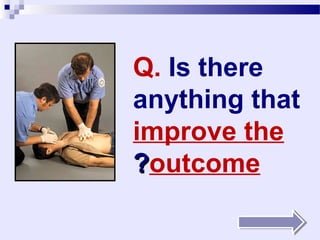
Q. Is there
anything that
improve the
outcome??
CHAIN OF SURVIVAL
Q. What will you do if you find
this?
Approach safely
Check response
Shout for help
Open airway
Check breathing
Call 123
30 chest compressions
2 rescue breaths
First & most important thing: Don’t Panic!!
APPROACH SAFELY
1. Scene
2. Rescuer
3. Victim
4. Bystanders
Approach safely
Check response
Shout for help
Open airway
Check breathing
Call 123
30 chest compressions
2 rescue breaths
Don’t start CPR in an unsafe environment…we don’t want a second victim
Risks To The Rescuer
 Aim to eliminate or minimize risks.
 Beware of environmental dangers e.g.
 Traffic
 Electricity
 Gas
 Water
 Radiation
Can I get an infection??
 15 documented cases of CPR related infection
mainly Neisseria meningitides.
 TB (only isolated reports).
 Not hepatitis B or C or CMV.
 transmission of HIV during CPR has never
been reported.
Check for a response
Approach safely
Check response
Shout for help
Open airway
Check breathing
Call 123
30 chest compressions
2 rescue breaths
• Shake the shoulders gently.
• Shout loudly “Are you alright?”
How to check the victim’s response?
If the victim responds
1. Leave him/her as it is.
2. Activate the EMS (123)
3. Try to find out what is wrong.
4. Reassess regularly.
If there is NO response
SHOUT FOR HELP!!
Approach safely
Check response
Shout for help
Open airway
Check breathing
Call 123
30 chest compressions
2 rescue breaths
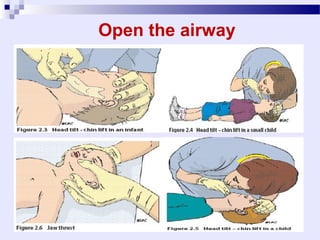
Open the airway
Approach safely
Check response
Shout for help
Open airway
Check breathing
Call 123
30 chest compressions
2 rescue breaths
How to Open The
Airway?
 Head tilt & Chin lift
 If cervical spine injury suspected: jaw thrust
Check for breathing & Circulation
Approach safely
Check response
Shout for help
Open airway
Confirm arrest
Call 123
30 chest compressions
2 rescue breaths
How to check for breathing &
circulation?
 Look, Listen and Feel for
NORMAL breathing.
 Check the Carotid pulse.
 Assess for not more than
10 sec. before deciding
absent breathing.
 Do not confuse agonal
breathing with normal
breathing.
AGONAL BREATHING
 Occurs shortly after the heart stops
in up to 40% of cardiac arrests.
 Brain stem reflex.
 Described as heavy, noisy or gasping
breathing.
 Recognise as a sign of cardiac arrest.
If the patient is breathing normally & you
can feel a pulse:
 Turn him into the recovery position (if applicable).
 Call for help.
 Reassess regularly till arrival of EMS.
If you can feel a pulse, but the patient is
not breathing:
 Give 1 rescue breath every 5 seconds.
 Recheck the pulse every 2 minutes.
Approach safely
Check response
Shout for help
Open airway
Check breathing
Call 123
30 chest compressions
2 rescue breaths
If you confirm Cardiac arrest
Call 123 & Start CPR
Give 30 effective chest
compressions
Approach safely
Check response
Shout for help
Open airway
Check breathing
Call 123
30 chest compressions
2 rescue breaths
 Place the heel of one hand on the lower half
of sternum (Sterno-xyphoid junction).
 Place other hand on top.
 Interlock your fingers.
 keep your arms straight and lock your elbows
so you can compress the chest fully using your
weight while conserving your energy.
 Compress the chest:
 Rate at least 100/min.
 Depth 5-6 cm (1/3 A-P diameter of chest)
 Allow chest recoil.
 When possible change CPR operator/5 cycles.
How to perform effective chest
compressions?
Give 2 effective rescue breaths
Approach safely
Check response
Shout for help
Open airway
Check breathing
Call 123
30 chest compressions
2 rescue breaths
How to deliver effective rescue breaths?
 Open the airway.
 Close the victim’s nose.
 Take a normal breath.
 Seal your lips over the
victim’s mouth.
 Blow until the chest rises.
 Pause for 1 second.
 Allow chest to fall.
 Repeat one more time.
Continue Chest compressions & Rescue
breaths at a rate of:
230
Continue resuscitation
until…
Qualified help arrives and takes
over with AED & ACLS protocol.
The victim shows signs of life.
You become exhausted.
The Victim has a DNR order.
New Guidelines for a high quality CPR
1. Sufficient rate and depth without excessively
ventilating.
2. few interruptions of chest compressions.
3. completely relaxing pressure between
compressions.
• The order of interventions was changed from ABC to CAB
EXCEPT in:
1. Newborn in whom hypoxia is MCC of cardiac arrest.
2. Those believed to be in a respiratory arrest (drowning, drug
overdose…etc.).
Complications of CPR
1. Most common: Rib fractures & sternal
fracture.
2. Pneumothorax
3. Bleeding: Hemopericardium, hemothorax
& anterior mediastinal bleeding.
4. Contusion of: Heart & Lung.
5. Lacerations of: Liver & Spleen.
Approach safely
Check response
Shout for help
Open airway
Check breathing
Call 123
30 chest compressions
2 rescue breaths
A quick Recap
Compression only (Hands only)
(Cardio-cerebral) resuscitation
• Chest compressions without artificial respiration.
• Easier: the method of choice for the untrained
rescuer
• In adults with out-of-hospital cardiac arrest,
compression-only CPR by the lay public has a
higher success rate than standard CPR.
• The exceptions: cases of drownings, drug
overdose (with respiratory arrest) and arrest in
children.
• Rate: the same as standard CPR (at least 100/min.)
CPR during pregnancy
• During pregnancy when a
woman is lying on her back, the
uterus may compress the
inferior vena cava and thus
decrease venous return. It is
therefore recommended that
the uterus be pushed to the
woman's left.
• If this is not effective, either roll
the woman 30° or healthcare
professionals should consider
emergency Caesarean section.
Pediatric BLS
Steps:
Open the airway
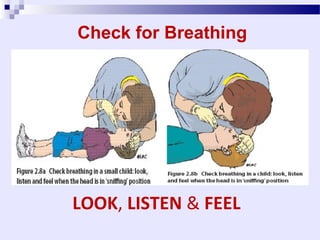
Check for Breathing
LOOK, LISTEN & FEEL
Check for Pulsation
Carotid, Brachial or Femoral
Chest compression
In children: If pulse < 60, start CPR to enhance the perfusion.
Give 15 effective chest compression
2 fingers technique 2 thumbs technique
2 hands technique 1 hand technique
Give 2 effective Rescue Breaths
Mouth to mouth
& nose technique
Mouse to mouth
technique
If the victim starts to breathe
normally, Put him/her in the
Recovery Position
1 2
3 4
Steps of positioning the victim in the Recovery position
 Aim of the Recovery Position.
1. Gravity assistance to the clearance of physical obstruction of the airway
by the tongue.
2. Gives a clear route by which fluid (e.g. vomitus) can drain from the
airway.
3. There is a room for the chest to rise and fall freely.
 All forms of the recovery position
share basic principles:
1) The mouth is downward so that fluid can drain from the patient's airway.
2) The chin is upward to keep the epiglottis opened.
3) Arms and legs are locked to stabilize the position of the patient.
Basic life support

Basic life support

  • 1.
    BY Kerolus E. Shehata •PGY-IIIIM Resident, Ain Shams University •ECFMG certified If you can’t give a life, you can save a life!!
  • 2.
    OBJECTIVES 1) How toassess the collapsed victim. 2) How to perform chest compression and rescue breathing in adults. 3) What are the differences between adult & paediatric BLS. 4) How to place an unconscious breathing victim in the recovery position.
  • 3.
    BACKGROUND  Approximately 700,000cardiac arrests per year in Europe.  Percentage of victims who survive till hospital discharge is currently 5-10%.  Bystander CPR is a vital intervention before arrival of emergency services.  Early resuscitation and prompt defibrillation (within 1 - 2 minutes) can result in > 60 %
  • 4.
    Q. What isthe difference between BLS & ACLS ? Q. What is the difference between BLS & ACLS ? A: BLS implies that NO equipment is employed other than protective devices. A: BLS implies that NO equipment is employed other than protective devices.
  • 5.
    Why do wedo CPR? Do we need to learn about CPR? Every minute will make a lifetime of differenceEvery minute will make a lifetime of difference
  • 6.
    How does CPRwork?  The brain may sustain damage after blood flow has been stopped for about 4 min. and irreversible damage after about 7 min.  The heart also rapidly loses the ability to maintain a normal rhythm.  CPR is effective only if performed within 7 minutes of the stoppage of blood flow.  Effective CPR enables enough oxygen to reach the brain to delay brain stem death, and allows the heart to remain responsive to defibrillation attempts.
  • 8.
    Will CPR restartthe heart?  Chances are very low. Compression can’t reverse the causes e.g. Hypoxia in children & arrhythmias in adults  To restart, you need an electric shock by AED.  CPR pump a small amount of blood that is barely sufficient to keep your brain alive.
  • 9.
    Q. Is there anythingthat improve the outcome??
  • 10.
  • 11.
    Q. What willyou do if you find this?
  • 12.
    Approach safely Check response Shoutfor help Open airway Check breathing Call 123 30 chest compressions 2 rescue breaths First & most important thing: Don’t Panic!!
  • 13.
    APPROACH SAFELY 1. Scene 2.Rescuer 3. Victim 4. Bystanders Approach safely Check response Shout for help Open airway Check breathing Call 123 30 chest compressions 2 rescue breaths
  • 14.
    Don’t start CPRin an unsafe environment…we don’t want a second victim
  • 15.
    Risks To TheRescuer  Aim to eliminate or minimize risks.  Beware of environmental dangers e.g.  Traffic  Electricity  Gas  Water  Radiation
  • 16.
    Can I getan infection??  15 documented cases of CPR related infection mainly Neisseria meningitides.  TB (only isolated reports).  Not hepatitis B or C or CMV.  transmission of HIV during CPR has never been reported.
  • 17.
    Check for aresponse Approach safely Check response Shout for help Open airway Check breathing Call 123 30 chest compressions 2 rescue breaths
  • 18.
    • Shake theshoulders gently. • Shout loudly “Are you alright?” How to check the victim’s response?
  • 19.
    If the victimresponds 1. Leave him/her as it is. 2. Activate the EMS (123) 3. Try to find out what is wrong. 4. Reassess regularly.
  • 20.
    If there isNO response SHOUT FOR HELP!! Approach safely Check response Shout for help Open airway Check breathing Call 123 30 chest compressions 2 rescue breaths
  • 21.
    Open the airway Approachsafely Check response Shout for help Open airway Check breathing Call 123 30 chest compressions 2 rescue breaths
  • 22.
    How to OpenThe Airway?  Head tilt & Chin lift  If cervical spine injury suspected: jaw thrust
  • 23.
    Check for breathing& Circulation Approach safely Check response Shout for help Open airway Confirm arrest Call 123 30 chest compressions 2 rescue breaths
  • 24.
    How to checkfor breathing & circulation?  Look, Listen and Feel for NORMAL breathing.  Check the Carotid pulse.  Assess for not more than 10 sec. before deciding absent breathing.  Do not confuse agonal breathing with normal breathing.
  • 25.
    AGONAL BREATHING  Occursshortly after the heart stops in up to 40% of cardiac arrests.  Brain stem reflex.  Described as heavy, noisy or gasping breathing.  Recognise as a sign of cardiac arrest.
  • 26.
    If the patientis breathing normally & you can feel a pulse:  Turn him into the recovery position (if applicable).  Call for help.  Reassess regularly till arrival of EMS. If you can feel a pulse, but the patient is not breathing:  Give 1 rescue breath every 5 seconds.  Recheck the pulse every 2 minutes.
  • 27.
    Approach safely Check response Shoutfor help Open airway Check breathing Call 123 30 chest compressions 2 rescue breaths If you confirm Cardiac arrest Call 123 & Start CPR
  • 28.
    Give 30 effectivechest compressions Approach safely Check response Shout for help Open airway Check breathing Call 123 30 chest compressions 2 rescue breaths
  • 29.
     Place theheel of one hand on the lower half of sternum (Sterno-xyphoid junction).  Place other hand on top.  Interlock your fingers.  keep your arms straight and lock your elbows so you can compress the chest fully using your weight while conserving your energy.  Compress the chest:  Rate at least 100/min.  Depth 5-6 cm (1/3 A-P diameter of chest)  Allow chest recoil.  When possible change CPR operator/5 cycles. How to perform effective chest compressions?
  • 31.
    Give 2 effectiverescue breaths Approach safely Check response Shout for help Open airway Check breathing Call 123 30 chest compressions 2 rescue breaths
  • 32.
    How to delivereffective rescue breaths?  Open the airway.  Close the victim’s nose.  Take a normal breath.  Seal your lips over the victim’s mouth.  Blow until the chest rises.  Pause for 1 second.  Allow chest to fall.  Repeat one more time.
  • 33.
    Continue Chest compressions& Rescue breaths at a rate of: 230
  • 34.
    Continue resuscitation until… Qualified helparrives and takes over with AED & ACLS protocol. The victim shows signs of life. You become exhausted. The Victim has a DNR order.
  • 35.
    New Guidelines fora high quality CPR 1. Sufficient rate and depth without excessively ventilating. 2. few interruptions of chest compressions. 3. completely relaxing pressure between compressions. • The order of interventions was changed from ABC to CAB EXCEPT in: 1. Newborn in whom hypoxia is MCC of cardiac arrest. 2. Those believed to be in a respiratory arrest (drowning, drug overdose…etc.).
  • 36.
    Complications of CPR 1.Most common: Rib fractures & sternal fracture. 2. Pneumothorax 3. Bleeding: Hemopericardium, hemothorax & anterior mediastinal bleeding. 4. Contusion of: Heart & Lung. 5. Lacerations of: Liver & Spleen.
  • 37.
    Approach safely Check response Shoutfor help Open airway Check breathing Call 123 30 chest compressions 2 rescue breaths A quick Recap
  • 38.
    Compression only (Handsonly) (Cardio-cerebral) resuscitation • Chest compressions without artificial respiration. • Easier: the method of choice for the untrained rescuer • In adults with out-of-hospital cardiac arrest, compression-only CPR by the lay public has a higher success rate than standard CPR. • The exceptions: cases of drownings, drug overdose (with respiratory arrest) and arrest in children. • Rate: the same as standard CPR (at least 100/min.)
  • 39.
    CPR during pregnancy •During pregnancy when a woman is lying on her back, the uterus may compress the inferior vena cava and thus decrease venous return. It is therefore recommended that the uterus be pushed to the woman's left. • If this is not effective, either roll the woman 30° or healthcare professionals should consider emergency Caesarean section.
  • 40.
  • 41.
  • 42.
  • 43.
  • 44.
    Check for Pulsation Carotid,Brachial or Femoral
  • 45.
    Chest compression In children:If pulse < 60, start CPR to enhance the perfusion.
  • 46.
    Give 15 effectivechest compression 2 fingers technique 2 thumbs technique
  • 47.
    2 hands technique1 hand technique
  • 48.
    Give 2 effectiveRescue Breaths Mouth to mouth & nose technique Mouse to mouth technique
  • 49.
    If the victimstarts to breathe normally, Put him/her in the Recovery Position
  • 50.
    1 2 3 4 Stepsof positioning the victim in the Recovery position
  • 51.
     Aim ofthe Recovery Position. 1. Gravity assistance to the clearance of physical obstruction of the airway by the tongue. 2. Gives a clear route by which fluid (e.g. vomitus) can drain from the airway. 3. There is a room for the chest to rise and fall freely.  All forms of the recovery position share basic principles: 1) The mouth is downward so that fluid can drain from the patient's airway. 2) The chin is upward to keep the epiglottis opened. 3) Arms and legs are locked to stabilize the position of the patient.