1
ANGINA PECTORIS
PREPARED BY:
M.AMMU
B.PHARM FINAL YEAR
PREPARED BY:
M.AMMU
B.PHARM FINAL YEAR
2
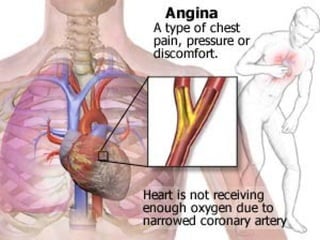
ANGINA PECTORISANGINA PECTORIS
Definition :Definition :
coronary blood flow which results in a decreased oxygencoronary blood flow which results in a decreased oxygen
supply to meet an increased myocardial demand for oxygensupply to meet an increased myocardial demand for oxygen
in response to physical exertion or emotionalin response to physical exertion or emotional AnginaAngina
pectoris is a clinical syndrome usually characterized bypectoris is a clinical syndrome usually characterized by
episodes of pain or pressure in the anterior chest . Theepisodes of pain or pressure in the anterior chest . The
cause is usually insufficient stress.cause is usually insufficient stress.
3
PathophysiologyPathophysiology
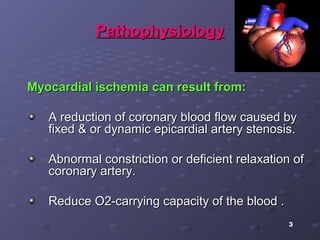
Myocardial ischemia can result from:Myocardial ischemia can result from:
A reduction of coronary blood flow caused byA reduction of coronary blood flow caused by
fixed & or dynamic epicardial artery stenosis.fixed & or dynamic epicardial artery stenosis.
Abnormal constriction or deficient relaxation ofAbnormal constriction or deficient relaxation of
coronary artery.coronary artery.
Reduce O2-carrying capacity of the blood .Reduce O2-carrying capacity of the blood .
4
5
Factors are associatedFactors are associated
with typical anginawith typical angina
painpain
1.1. Physical exertion (increase myocardial o2Physical exertion (increase myocardial o2
demand).demand).
2.2. Exposure to cold ( cause elevation of BPExposure to cold ( cause elevation of BP
increase oxygen demand )increase oxygen demand )
3.3. Eating heavy mealsEating heavy meals
4.4. Stress or any emotion-provoking situationStress or any emotion-provoking situation
6
Type of anginaType of angina
1.1. Stable anginaStable angina: predictable & consistent pain that: predictable & consistent pain that
occurs on exertion and relieved by rest.occurs on exertion and relieved by rest.
2.2. Unstable angina or preinfarction or cresendo anginaUnstable angina or preinfarction or cresendo angina::
symptoms occur more frequently and longer thansymptoms occur more frequently and longer than
stable angina.stable angina.
3.3. Intractable or refractoryIntractable or refractory anginaangina: sever incapacitating: sever incapacitating
chest pain.chest pain.
7
Type of anginaType of angina
4.4. Variant angina or prinzmetals anginaVariant angina or prinzmetals angina : pain at: pain at
rest with reversable ST-segment elevation,rest with reversable ST-segment elevation,
caused by coronary artery vasospasm.caused by coronary artery vasospasm.
5.5. Silent ischemiaSilent ischemia: objective evidence of ischemia: objective evidence of ischemia
(as ECG changes with a test), but pt report no(as ECG changes with a test), but pt report no
symptom.symptom.
8
Risk Factors for atherosclerosisRisk Factors for atherosclerosis
1.1. Family history of premature coronaryFamily history of premature coronary
artery disease.artery disease.
2.2. DM, systemic HTN.DM, systemic HTN.
3.3. Cigarette smoking.Cigarette smoking.
4.4. Hypercholesterolemia.Hypercholesterolemia.
5.5. Others as obesity, increase levels ofOthers as obesity, increase levels of
lipoprotein,fibrinogen, s.triglycerides.lipoprotein,fibrinogen, s.triglycerides.
9
Clinical manifestationsClinical manifestations
1.1. May produce pain vary in severity from feelingMay produce pain vary in severity from feeling
of indigestion to chocking in retrosternal areaof indigestion to chocking in retrosternal area
, radiate to neck , jaw shoulders , inner, radiate to neck , jaw shoulders , inner
aspects of upper armsaspects of upper arms
2.2. Feeling of weakness or numbness in the armsFeeling of weakness or numbness in the arms
, wrists and the hands, wrists and the hands
3.3. Shortness of breathShortness of breath
10
Clinical manifestationsClinical manifestations
4.4. Pallor, DiaphoresisPallor, Diaphoresis
5.5. Dizziness or light headednessDizziness or light headedness
6.6. Nausea and vomitingNausea and vomiting
11
Diagnostic findingsDiagnostic findings
Often made by evaluating the clinicalOften made by evaluating the clinical
manifestations of ischemia and the pts historymanifestations of ischemia and the pts history
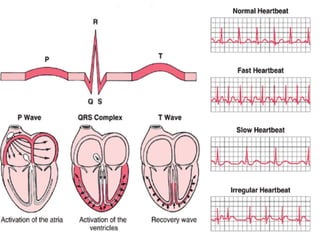
1.1. 12-Lead ECG and blood laboratory12-Lead ECG and blood laboratory
values help in making diagnosisvalues help in making diagnosis
2.2. C-reactive protein ( CRP) is a marker forC-reactive protein ( CRP) is a marker for
inflammation of vascular endothelium whichinflammation of vascular endothelium which
caused by CADcaused by CAD
12
13
Diagnostic findingsDiagnostic findings
3.3. An elevated blood level of homocysteine ,anAn elevated blood level of homocysteine ,an
amino acid proposed as anamino acid proposed as an
independent risk factor for cardiovascularindependent risk factor for cardiovascular
disease , but no studies supported thedisease , but no studies supported the
relationship between elevation ofrelationship between elevation of
homocysteine and atherosclarosishomocysteine and atherosclarosis
14
The objective is to decrease oxygenThe objective is to decrease oxygen
demand of myocardium and to increasedemand of myocardium and to increase
oxygen supplyoxygen supply
1.Nitroglycerin1.Nitroglycerin : administered to reduce: administered to reduce
myocardial oxygen consumptionmyocardial oxygen consumption
Medical management forMedical management for
the pt with anginathe pt with angina
pectorispectoris
NITRATE PREPARATIONS
1.SUBLINGUAL GLYCERYL TRINITRATE (GTN)
2.BUCCAL GLYCERYL TRINITRATE
3.TRANSDERMAL GLYCERYL TRINITRATE
4.ORAL ISOSORBIDE DINITRATE
5.ORAL ISOSORBIDE MONONITRATE
6.INTRAVENOUS GTN- FOR ACUTE MYOCARDIAL
INFARCTION/LEFT VENTRICULAR FAILURE -10 -200 µg /MIN
INTRAVENOUS INFUSION, TITRATING TO CLINICAL RESPONSE
AND BLOOD PRESSURE.
16
2.Beta-adrenergic blocking agents2.Beta-adrenergic blocking agents ::
( propranolol ,metoprolol , atenolol) appear to( propranolol ,metoprolol , atenolol) appear to
reduce myocardial oxygen consumption, resultreduce myocardial oxygen consumption, result
in a reduction in heart rate, decreased BP , andin a reduction in heart rate, decreased BP , and
reduced myocardial contractility .reduced myocardial contractility .
17
3-Calcium channel blocking agents3-Calcium channel blocking agents ::
some decrease sinoatrial nodesome decrease sinoatrial node
automaticity and node conductionautomaticity and node conduction
,resulting in slower heart rate,resulting in slower heart rate
e.g. Nifedipine, Verapamil, Dilitiazem,e.g. Nifedipine, Verapamil, Dilitiazem,
18
4- Antiplatelet and4- Antiplatelet and
anticoagulantanticoagulant
medicationsmedications
AspirinAspirin:: prevents platelet activation andprevents platelet activation and
reduces the incidence of MI and deathreduces the incidence of MI and death
with CADwith CAD
HeparinHeparin : prevents the formation of new: prevents the formation of new
blood clotsblood clots
19
Oxygen administrationOxygen administration ::
usually initiated at the onset of chest pain tousually initiated at the onset of chest pain to
increase the amount of oxygen delivered to theincrease the amount of oxygen delivered to the
myocardium and to decrease the pain.myocardium and to decrease the pain.
20
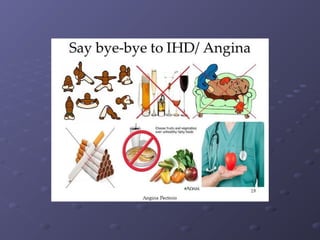
PreventionPrevention
Self care action plan changing habits.Self care action plan changing habits.
 Stop smokingStop smoking
 Increase level of exerciseIncrease level of exercise
 Cut down on fatty foodsCut down on fatty foods
 Eat more oats, which decrease cholesterolEat more oats, which decrease cholesterol
21
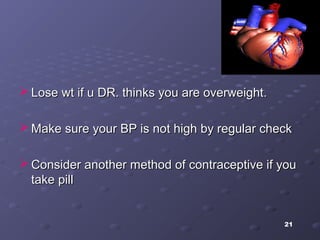
 Lose wt if u DR. thinks you are overweight.Lose wt if u DR. thinks you are overweight.
 Make sure your BP is not high by regular checkMake sure your BP is not high by regular check
 Consider another method of contraceptive if youConsider another method of contraceptive if you
take pilltake pill
23
Nsg process for pt withNsg process for pt with
Angina pectorisAngina pectoris
AssessmentAssessment
The nurse gather information about the ptsThe nurse gather information about the pts
symptoms and activities . The nurse may asksymptoms and activities . The nurse may ask
about the period that angina last , and if anyabout the period that angina last , and if any
medication relieve the angina.medication relieve the angina.
24
DiagnosisDiagnosis
1.1. Ineffective myocardial tissueIneffective myocardial tissue
perfusion secondary to CAD asperfusion secondary to CAD as
evidence by chest pain or equivalentevidence by chest pain or equivalent
symptomssymptoms
2.2. Anxiety related to fear of deathAnxiety related to fear of death
25
DiagnosisDiagnosis
3.3. Noncompliance , ineffective management ofNoncompliance , ineffective management of
therapeutic regimen related to failure totherapeutic regimen related to failure to
accept necessary lifestyle changesaccept necessary lifestyle changes
26
Planning and goalsPlanning and goals
The major goal include immediateThe major goal include immediate
treatment when angina occur ,treatment when angina occur , preventingpreventing
of angina , reduction of anxiety andof angina , reduction of anxiety and
absence of complicationsabsence of complications
27
NSG interventionsNSG interventions
1.1. Treating anginaTreating angina : when pt experiences angina: when pt experiences angina
the nurse should direct pt to stop activities andthe nurse should direct pt to stop activities and
sit or rest in bed in semi-fowler positionsit or rest in bed in semi-fowler position
2.2. Reducing anxietyReducing anxiety : The nurse should explore: The nurse should explore
and implicate that the diagnosis has for the ptand implicate that the diagnosis has for the pt
providing information about the illness ,providing information about the illness ,
treatment and methods of preventing itstreatment and methods of preventing its
progressionprogression
28
3.3. Preventing painPreventing pain : when the pt has pain with: when the pt has pain with
minimal activity , the nurse alternates the ptsminimal activity , the nurse alternates the pts
activities with rest periodsactivities with rest periods
29
EvaluationEvaluation
Expected pts outcomes may includeExpected pts outcomes may include
1.1. Reports that pain is relieved promptlyReports that pain is relieved promptly
2.2. Reports decreased anxietyReports decreased anxiety
30
3.3. Understands ways to avoid complications andUnderstands ways to avoid complications and
demonstrates freedom from complicationsdemonstrates freedom from complications
4.4. Adheres to self-care programAdheres to self-care program
31

Angina pectoris

  • 1.
    1 ANGINA PECTORIS PREPARED BY: M.AMMU B.PHARMFINAL YEAR PREPARED BY: M.AMMU B.PHARM FINAL YEAR
  • 2.
    2 ANGINA PECTORISANGINA PECTORIS Definition:Definition : coronary blood flow which results in a decreased oxygencoronary blood flow which results in a decreased oxygen supply to meet an increased myocardial demand for oxygensupply to meet an increased myocardial demand for oxygen in response to physical exertion or emotionalin response to physical exertion or emotional AnginaAngina pectoris is a clinical syndrome usually characterized bypectoris is a clinical syndrome usually characterized by episodes of pain or pressure in the anterior chest . Theepisodes of pain or pressure in the anterior chest . The cause is usually insufficient stress.cause is usually insufficient stress.
  • 3.
    3 PathophysiologyPathophysiology Myocardial ischemia canresult from:Myocardial ischemia can result from: A reduction of coronary blood flow caused byA reduction of coronary blood flow caused by fixed & or dynamic epicardial artery stenosis.fixed & or dynamic epicardial artery stenosis. Abnormal constriction or deficient relaxation ofAbnormal constriction or deficient relaxation of coronary artery.coronary artery. Reduce O2-carrying capacity of the blood .Reduce O2-carrying capacity of the blood .
  • 4.
  • 5.
    5 Factors are associatedFactorsare associated with typical anginawith typical angina painpain 1.1. Physical exertion (increase myocardial o2Physical exertion (increase myocardial o2 demand).demand). 2.2. Exposure to cold ( cause elevation of BPExposure to cold ( cause elevation of BP increase oxygen demand )increase oxygen demand ) 3.3. Eating heavy mealsEating heavy meals 4.4. Stress or any emotion-provoking situationStress or any emotion-provoking situation
  • 6.
    6 Type of anginaTypeof angina 1.1. Stable anginaStable angina: predictable & consistent pain that: predictable & consistent pain that occurs on exertion and relieved by rest.occurs on exertion and relieved by rest. 2.2. Unstable angina or preinfarction or cresendo anginaUnstable angina or preinfarction or cresendo angina:: symptoms occur more frequently and longer thansymptoms occur more frequently and longer than stable angina.stable angina. 3.3. Intractable or refractoryIntractable or refractory anginaangina: sever incapacitating: sever incapacitating chest pain.chest pain.
  • 7.
    7 Type of anginaTypeof angina 4.4. Variant angina or prinzmetals anginaVariant angina or prinzmetals angina : pain at: pain at rest with reversable ST-segment elevation,rest with reversable ST-segment elevation, caused by coronary artery vasospasm.caused by coronary artery vasospasm. 5.5. Silent ischemiaSilent ischemia: objective evidence of ischemia: objective evidence of ischemia (as ECG changes with a test), but pt report no(as ECG changes with a test), but pt report no symptom.symptom.
  • 8.
    8 Risk Factors foratherosclerosisRisk Factors for atherosclerosis 1.1. Family history of premature coronaryFamily history of premature coronary artery disease.artery disease. 2.2. DM, systemic HTN.DM, systemic HTN. 3.3. Cigarette smoking.Cigarette smoking. 4.4. Hypercholesterolemia.Hypercholesterolemia. 5.5. Others as obesity, increase levels ofOthers as obesity, increase levels of lipoprotein,fibrinogen, s.triglycerides.lipoprotein,fibrinogen, s.triglycerides.
  • 9.
    9 Clinical manifestationsClinical manifestations 1.1.May produce pain vary in severity from feelingMay produce pain vary in severity from feeling of indigestion to chocking in retrosternal areaof indigestion to chocking in retrosternal area , radiate to neck , jaw shoulders , inner, radiate to neck , jaw shoulders , inner aspects of upper armsaspects of upper arms 2.2. Feeling of weakness or numbness in the armsFeeling of weakness or numbness in the arms , wrists and the hands, wrists and the hands 3.3. Shortness of breathShortness of breath
  • 10.
    10 Clinical manifestationsClinical manifestations 4.4.Pallor, DiaphoresisPallor, Diaphoresis 5.5. Dizziness or light headednessDizziness or light headedness 6.6. Nausea and vomitingNausea and vomiting
  • 11.
    11 Diagnostic findingsDiagnostic findings Oftenmade by evaluating the clinicalOften made by evaluating the clinical manifestations of ischemia and the pts historymanifestations of ischemia and the pts history 1.1. 12-Lead ECG and blood laboratory12-Lead ECG and blood laboratory values help in making diagnosisvalues help in making diagnosis 2.2. C-reactive protein ( CRP) is a marker forC-reactive protein ( CRP) is a marker for inflammation of vascular endothelium whichinflammation of vascular endothelium which caused by CADcaused by CAD
  • 12.
  • 13.
    13 Diagnostic findingsDiagnostic findings 3.3.An elevated blood level of homocysteine ,anAn elevated blood level of homocysteine ,an amino acid proposed as anamino acid proposed as an independent risk factor for cardiovascularindependent risk factor for cardiovascular disease , but no studies supported thedisease , but no studies supported the relationship between elevation ofrelationship between elevation of homocysteine and atherosclarosishomocysteine and atherosclarosis
  • 14.
    14 The objective isto decrease oxygenThe objective is to decrease oxygen demand of myocardium and to increasedemand of myocardium and to increase oxygen supplyoxygen supply 1.Nitroglycerin1.Nitroglycerin : administered to reduce: administered to reduce myocardial oxygen consumptionmyocardial oxygen consumption Medical management forMedical management for the pt with anginathe pt with angina pectorispectoris
  • 15.
    NITRATE PREPARATIONS 1.SUBLINGUAL GLYCERYLTRINITRATE (GTN) 2.BUCCAL GLYCERYL TRINITRATE 3.TRANSDERMAL GLYCERYL TRINITRATE 4.ORAL ISOSORBIDE DINITRATE 5.ORAL ISOSORBIDE MONONITRATE 6.INTRAVENOUS GTN- FOR ACUTE MYOCARDIAL INFARCTION/LEFT VENTRICULAR FAILURE -10 -200 µg /MIN INTRAVENOUS INFUSION, TITRATING TO CLINICAL RESPONSE AND BLOOD PRESSURE.
  • 16.
    16 2.Beta-adrenergic blocking agents2.Beta-adrenergicblocking agents :: ( propranolol ,metoprolol , atenolol) appear to( propranolol ,metoprolol , atenolol) appear to reduce myocardial oxygen consumption, resultreduce myocardial oxygen consumption, result in a reduction in heart rate, decreased BP , andin a reduction in heart rate, decreased BP , and reduced myocardial contractility .reduced myocardial contractility .
  • 17.
    17 3-Calcium channel blockingagents3-Calcium channel blocking agents :: some decrease sinoatrial nodesome decrease sinoatrial node automaticity and node conductionautomaticity and node conduction ,resulting in slower heart rate,resulting in slower heart rate e.g. Nifedipine, Verapamil, Dilitiazem,e.g. Nifedipine, Verapamil, Dilitiazem,
  • 18.
    18 4- Antiplatelet and4-Antiplatelet and anticoagulantanticoagulant medicationsmedications AspirinAspirin:: prevents platelet activation andprevents platelet activation and reduces the incidence of MI and deathreduces the incidence of MI and death with CADwith CAD HeparinHeparin : prevents the formation of new: prevents the formation of new blood clotsblood clots
  • 19.
    19 Oxygen administrationOxygen administration:: usually initiated at the onset of chest pain tousually initiated at the onset of chest pain to increase the amount of oxygen delivered to theincrease the amount of oxygen delivered to the myocardium and to decrease the pain.myocardium and to decrease the pain.
  • 20.
    20 PreventionPrevention Self care actionplan changing habits.Self care action plan changing habits.  Stop smokingStop smoking  Increase level of exerciseIncrease level of exercise  Cut down on fatty foodsCut down on fatty foods  Eat more oats, which decrease cholesterolEat more oats, which decrease cholesterol
  • 21.
    21  Lose wtif u DR. thinks you are overweight.Lose wt if u DR. thinks you are overweight.  Make sure your BP is not high by regular checkMake sure your BP is not high by regular check  Consider another method of contraceptive if youConsider another method of contraceptive if you take pilltake pill
  • 23.
    23 Nsg process forpt withNsg process for pt with Angina pectorisAngina pectoris AssessmentAssessment The nurse gather information about the ptsThe nurse gather information about the pts symptoms and activities . The nurse may asksymptoms and activities . The nurse may ask about the period that angina last , and if anyabout the period that angina last , and if any medication relieve the angina.medication relieve the angina.
  • 24.
    24 DiagnosisDiagnosis 1.1. Ineffective myocardialtissueIneffective myocardial tissue perfusion secondary to CAD asperfusion secondary to CAD as evidence by chest pain or equivalentevidence by chest pain or equivalent symptomssymptoms 2.2. Anxiety related to fear of deathAnxiety related to fear of death
  • 25.
    25 DiagnosisDiagnosis 3.3. Noncompliance ,ineffective management ofNoncompliance , ineffective management of therapeutic regimen related to failure totherapeutic regimen related to failure to accept necessary lifestyle changesaccept necessary lifestyle changes
  • 26.
    26 Planning and goalsPlanningand goals The major goal include immediateThe major goal include immediate treatment when angina occur ,treatment when angina occur , preventingpreventing of angina , reduction of anxiety andof angina , reduction of anxiety and absence of complicationsabsence of complications
  • 27.
    27 NSG interventionsNSG interventions 1.1.Treating anginaTreating angina : when pt experiences angina: when pt experiences angina the nurse should direct pt to stop activities andthe nurse should direct pt to stop activities and sit or rest in bed in semi-fowler positionsit or rest in bed in semi-fowler position 2.2. Reducing anxietyReducing anxiety : The nurse should explore: The nurse should explore and implicate that the diagnosis has for the ptand implicate that the diagnosis has for the pt providing information about the illness ,providing information about the illness , treatment and methods of preventing itstreatment and methods of preventing its progressionprogression
  • 28.
    28 3.3. Preventing painPreventingpain : when the pt has pain with: when the pt has pain with minimal activity , the nurse alternates the ptsminimal activity , the nurse alternates the pts activities with rest periodsactivities with rest periods
  • 29.
    29 EvaluationEvaluation Expected pts outcomesmay includeExpected pts outcomes may include 1.1. Reports that pain is relieved promptlyReports that pain is relieved promptly 2.2. Reports decreased anxietyReports decreased anxiety
  • 30.
    30 3.3. Understands waysto avoid complications andUnderstands ways to avoid complications and demonstrates freedom from complicationsdemonstrates freedom from complications 4.4. Adheres to self-care programAdheres to self-care program
  • 31.