ANGINA PECTORIS
Presented By:
Mr. Nandish.S
Asso. Professor
Mandya Institute of Nursing Sciences
DEFINITION :
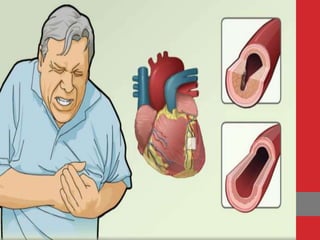
 It is a clinical manifestation / syndrome characterized by episodes of
pain or pressure in the anterior chest.
 It refers to chest pain occurring intermittently over a long period with
same pattern of onset, duration and intensity.
 The cause is insufficient coronary blood flow, resulting in decreased
oxygen supply when there is increased myocardial demand for
oxygen.
INCIDENCE :
 It is varied widely across population from 0.73% to 14.4% in women
and 0.76 % to 15.1% in men.
 In India, its seen in men between 45 years and 75 years, whereas in
women, it is more frequent after the age of 75 years.
 In US, it is estimated that over 10 million people are suffering from
chest pain and 50,000 new cases are found every year.
TYPES :
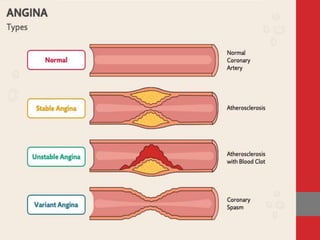
1. STABLE ANGINA:
 It is predictable and consistent pain that occurs on exertion.
 It can be controlled with medications on an outpatient basis.
 Episodic pain lasting 5 – 15 minutes.
 Medications are timed, when angina is likely to occur.
Ex : patient can take medications 1 hour before engaging in activity.
2. UNSTABLE ANGINA:
 It is also called as Preinfarction Angina.
 It is caused due to rupture of thickened plaque.
 It is new onset angina, which increase in frequency, duration and
severity.
 It is unpredictable may not be relieved at rest or Nitroglycerin.
3. SILENT ANGINA / ISCHEMIA
 Here patients reports no chest pain & remain asymptomatic.
 Only evidence is ECG changes with stress test.
 Diabetes Mellitus & Hypertension are associated with this type.
4. VARIANT ANGINA:
 It is also called as “PRINZMETAL’s Angina.
 It is caused due to coronary vasospasm.
 It occurs primarily at rest with reversible ST Segment elevation.
 It is triggered by smoking.
5. NOCTURNAL ANGINA:
 It occurs only at night irrespective of person’s position and sleeping
status.
ETIOLOGY & RISK FACTORS :
MODIFIABLE RISK FACTORS :
Tobacco use / cigarette smoking
High blood cholesterol / triglycerides
Lack of Exercise / Physical Exertion
Obesity
Consumption of Heavy meal
Sexual activity (person with CAD)
Stress
Strong emotions
NON MODIFIABLE RISK FACTORS :
 Family History
 Aging
 Temperature extremes (Cold & Hot stimulus)
 Diabetes Mellitus
 Hypertension
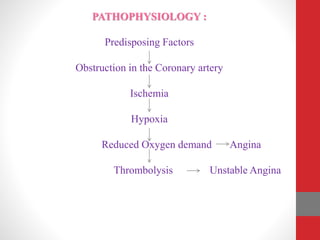
PATHOPHYSIOLOGY :
Predisposing Factors
Obstruction in the Coronary artery
Ischemia
Hypoxia
Reduced Oxygen demand Angina
Thrombolysis Unstable Angina
CLINICAL SYMPTOMS :
Cardiovascular System:
- Angina pectoris : it is a strange feeling, sensation of chest pain,
pressure or squeezing, choking, constrictive, heavy due to insufficient
blood flow to the heart muscle. This sensation may also occur in the
neck and radiate to various locations including jaw, shoulders & down
the arms.
- Ischemia : it is restriction or decreased blood supply to the tissue.
- Decreased cardiac output.
- Bradycardia
- Hypertension
continued ……
- Diaphoresis
- ECG Changes (ST segment & T wave changes)
- Dysarrhythmias
Respiratory system :
- Shortness of breath
- Dyspnoea
- Chest heaviness
- Fatigue
Others :
- Decreased urinary output
- Nausea & Vomiting
- Cold, clammy skin & pale in appearance
DIAGNOSTIC STUDIES :
- History Collection & Physical Examination
- CBC
- Cardiac Markers (Troponin I, CK-MB)
- Chest X -Ray
- ECG
- Stress Test
- Echocardiogram
- Cardiac Catheterization
PREVENTION :
• Cessation of smoking
• Periodic monitoring of health (BP, Blood Glucose, Blood
Cholesterol)
• Consumption of healthy, balanced diet.
• Daily exercise
• Reduce the stress level
• Avoiding alcohol completely or restricting to one drink a day.
MEDICAL MANAGEMENT :
Vasodilators : Nitroglycerine
Beta Blockers : Propranolol
Calcium channel Blockers: Nifedipine, Verapamil
Anticoagulants : Heparin
Opiate analgesics : Morphine sulphate
Thrombolytics : Streptokinase, Urokinase
Antihypertensive drugs : Methyl dopamine, Sodium Nitroprusside,
Amlodipine
SURGICAL MANAGEMENT :
- PTCA (Percutaneous Transluminal Coronary Angioplasty)
- CABG (Coronary Artery Bypass Graft)
NURSING MANAGEMENT :
- Impaired gas exchange related to decreased blood flow
- Pain, acute, chest related to hypoxia
- Impaired physical mobility related to weakness
- Imbalanced nutrition, less than body requirement related to food
restriction.
- Sleep pattern disturbance related to hospitalization.
- Anxiety related to lack of awareness regarding disease condition and
treatment modalities
THANK YOU

Angina Pectoris.pptx

  • 1.
    ANGINA PECTORIS Presented By: Mr.Nandish.S Asso. Professor Mandya Institute of Nursing Sciences
  • 3.
    DEFINITION :  Itis a clinical manifestation / syndrome characterized by episodes of pain or pressure in the anterior chest.  It refers to chest pain occurring intermittently over a long period with same pattern of onset, duration and intensity.  The cause is insufficient coronary blood flow, resulting in decreased oxygen supply when there is increased myocardial demand for oxygen.
  • 4.
    INCIDENCE :  Itis varied widely across population from 0.73% to 14.4% in women and 0.76 % to 15.1% in men.  In India, its seen in men between 45 years and 75 years, whereas in women, it is more frequent after the age of 75 years.  In US, it is estimated that over 10 million people are suffering from chest pain and 50,000 new cases are found every year.
  • 6.
    TYPES : 1. STABLEANGINA:  It is predictable and consistent pain that occurs on exertion.  It can be controlled with medications on an outpatient basis.  Episodic pain lasting 5 – 15 minutes.  Medications are timed, when angina is likely to occur. Ex : patient can take medications 1 hour before engaging in activity.
  • 7.
    2. UNSTABLE ANGINA: It is also called as Preinfarction Angina.  It is caused due to rupture of thickened plaque.  It is new onset angina, which increase in frequency, duration and severity.  It is unpredictable may not be relieved at rest or Nitroglycerin. 3. SILENT ANGINA / ISCHEMIA  Here patients reports no chest pain & remain asymptomatic.  Only evidence is ECG changes with stress test.  Diabetes Mellitus & Hypertension are associated with this type.
  • 8.
    4. VARIANT ANGINA: It is also called as “PRINZMETAL’s Angina.  It is caused due to coronary vasospasm.  It occurs primarily at rest with reversible ST Segment elevation.  It is triggered by smoking. 5. NOCTURNAL ANGINA:  It occurs only at night irrespective of person’s position and sleeping status.
  • 9.
    ETIOLOGY & RISKFACTORS : MODIFIABLE RISK FACTORS : Tobacco use / cigarette smoking High blood cholesterol / triglycerides Lack of Exercise / Physical Exertion Obesity Consumption of Heavy meal Sexual activity (person with CAD) Stress Strong emotions
  • 10.
    NON MODIFIABLE RISKFACTORS :  Family History  Aging  Temperature extremes (Cold & Hot stimulus)  Diabetes Mellitus  Hypertension
  • 11.
    PATHOPHYSIOLOGY : Predisposing Factors Obstructionin the Coronary artery Ischemia Hypoxia Reduced Oxygen demand Angina Thrombolysis Unstable Angina
  • 12.
    CLINICAL SYMPTOMS : CardiovascularSystem: - Angina pectoris : it is a strange feeling, sensation of chest pain, pressure or squeezing, choking, constrictive, heavy due to insufficient blood flow to the heart muscle. This sensation may also occur in the neck and radiate to various locations including jaw, shoulders & down the arms. - Ischemia : it is restriction or decreased blood supply to the tissue. - Decreased cardiac output. - Bradycardia - Hypertension continued ……
  • 13.
    - Diaphoresis - ECGChanges (ST segment & T wave changes) - Dysarrhythmias Respiratory system : - Shortness of breath - Dyspnoea - Chest heaviness - Fatigue Others : - Decreased urinary output - Nausea & Vomiting - Cold, clammy skin & pale in appearance
  • 14.
    DIAGNOSTIC STUDIES : -History Collection & Physical Examination - CBC - Cardiac Markers (Troponin I, CK-MB) - Chest X -Ray - ECG - Stress Test - Echocardiogram - Cardiac Catheterization
  • 18.
    PREVENTION : • Cessationof smoking • Periodic monitoring of health (BP, Blood Glucose, Blood Cholesterol) • Consumption of healthy, balanced diet. • Daily exercise • Reduce the stress level • Avoiding alcohol completely or restricting to one drink a day.
  • 19.
    MEDICAL MANAGEMENT : Vasodilators: Nitroglycerine Beta Blockers : Propranolol Calcium channel Blockers: Nifedipine, Verapamil Anticoagulants : Heparin Opiate analgesics : Morphine sulphate Thrombolytics : Streptokinase, Urokinase Antihypertensive drugs : Methyl dopamine, Sodium Nitroprusside, Amlodipine
  • 20.
    SURGICAL MANAGEMENT : -PTCA (Percutaneous Transluminal Coronary Angioplasty) - CABG (Coronary Artery Bypass Graft)
  • 21.
    NURSING MANAGEMENT : -Impaired gas exchange related to decreased blood flow - Pain, acute, chest related to hypoxia - Impaired physical mobility related to weakness - Imbalanced nutrition, less than body requirement related to food restriction. - Sleep pattern disturbance related to hospitalization. - Anxiety related to lack of awareness regarding disease condition and treatment modalities
  • 22.