Chapter 15
                  The 1920’s
• The 1920’s was an era of rapid change and
  clashing values. Many Americans believed
  society was losing its traditional values and
  they took action to preserve these values.
  Other Americans embraced new values
  associated with a freer lifestyle and the
  pursuit of individual goals.
The War’s Impact
• Racial Unrest: As hundreds of thousands of
  white American soldiers from Europe returned
  home looking for a job, clashes occurred with
  the African Americans who had moved north
  during the war to take those jobs. Frustration
  and racism combined to produce violence. In
  the summer of 1919, over 20 race riots broke
  out across the nation.
Red Summer

• The worst violence occurred in Chicago. On a
  hot July day, African Americans found
  themselves at a White only beach.
• http://chicagotonight.wttw.com/2011/10/12/r
  ed-summer
The Red Scare
• Americans had become very anti-German as
  the war progressed, and when the
  Communists withdrew Russia from the
  war, they seemed to be helping Germany.
  American anger at Germany quickly expanded
  into anger at Communists as well. Americans
  began to associate communism with being
  unpatriotic and disloyal.
Nativism Resurges

• The fear and prejudice many felt toward
  Germans and Communists expanded to
  include all immigrants. This triggered a
  general rise in racism and in nativism, the
  desire to protect the interests of old-stock
  Americans against those of immigrants.
Why?
•   Immigration returns
•   Economic recession
•   Racial and cultural tensions
•   Fear and prejudice toward Germans and
    Communists
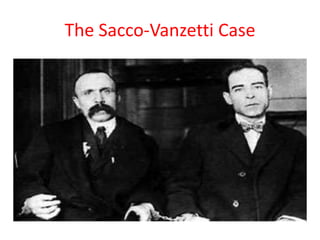
The Sacco-Vanzetti Case
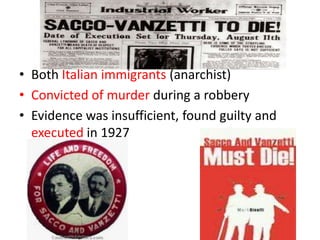
• Both Italian immigrants (anarchist)
• Convicted of murder during a robbery
• Evidence was insufficient, found guilty and
  executed in 1927
Return of the KKK
• At the forefront to restrict immigration, the
  new KKK targeted not only African
  Americans, but also Catholics, Jews and other
  groups believed to represent “un American”
  values.
• By 1924 membership in the Klan
  exploded, reaching nearly 4 million.
Controlling Immigration
• After WWI, American immigration policies
  changed in response to the postwar recession
  and nativist pleas to “Keep America American”.
• In 1921, President Harding signed the Emergency
  Quota Act, which established a temporary quota
  system.
• Only 3% on the total number of people in any
  ethnic group already living in the US could be
  admitted in a single year.
• http://www.usimmigrationsupport.org/immigrati
  on-us.html
The New Morality
• Some groups that wanted to restrict
  immigration also wanted to preserve what
  they considered to be traditional values. They
  clashed with a new morality that glorified
  youth and personal freedom.
• It became a clash of Old ideas vs. New ideas
• Old vs. Youth
• Country life vs. City life
• Old school vs. New school
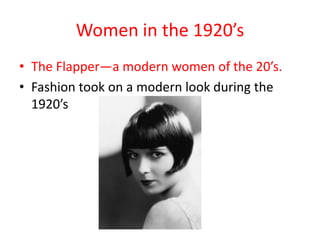
Women in the 1920’s
• The Flapper—a modern women of the 20’s.
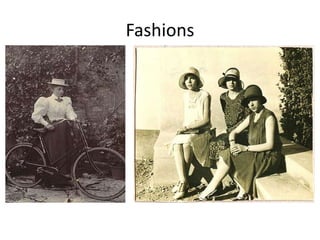
• Fashion took on a modern look during the
  1920’s
Fashions
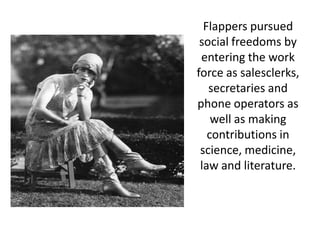
Flappers pursued
 social freedoms by
 entering the work
force as salesclerks,
   secretaries and
phone operators as
    well as making
   contributions in
 science, medicine,
 law and literature.
Margaret Sanger
• She believed that the standard of
  living could be improved if families
  limited the number of children they
  had and founded the American Birth
  Control League in 1921—later this
  organization became Planned
  Parenthood.
New Dance Moves
• Rebelling against older, more formal dancing
  styles, the Charleston became all the rave with
  the younger generation.
• http://youtu.be/yNAOHtmy4j0
Thoroughly Modern Millie
• http://youtu.be/KVNcLUE87HQ
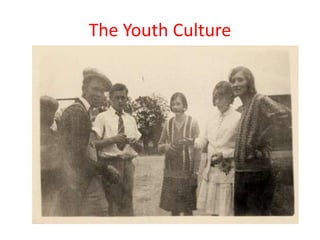
The Youth Culture
• http://local.aaca.org/bntc/slang/slang.htm
Fundamentalist Movement
• Millions of Americans feared that the country
  was losing its traditional values. Many of these
  people, especially those in small rural
  towns, responded by joining a religious
  movement know as Fundamentalism.
Fundamentalists Beliefs
• Bible was literally true and without error.
• They defended the ideas that human beings
  derived their moral behavior from God
• They rejected Charles Darwin’s theory of
  evolution
• They believed in creationism-the belief that
  God created the world as described in the
  Bible
The Scopes Trial
• A historic trial that pinned evolutionists and
  creationists against each other.
• Main Characters:
• John T. Scopes—science teacher who taught
  evolution
• William Jennings Bryan—prosecutor,
  represented the creationists
• Clarence Darrow—most famous trial lawyer at
  the time, defended Scopes
Inherit the Wind
•   Film about the Scopes Trial
•   http://youtu.be/S_DQUAuNUvw
•   http://youtu.be/A6Gk5H3c5f8
•   http://youtu.be/l5Kdc0LLSW8
Prohibition
• The 18th Amendment- making the
  manufacturing, selling and distributing of
  liquor illegal.
• Enforcing the new law proved to be very
  difficult. Americans blatantly ignored the law.
  Speakeasies, bootlegging and hip flasks
  became part of common speech.
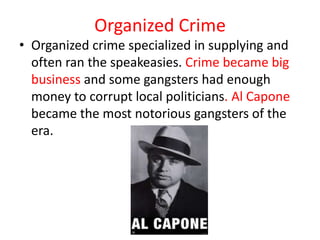
Organized Crime
• Organized crime specialized in supplying and
  often ran the speakeasies. Crime became big
  business and some gangsters had enough
  money to corrupt local politicians. Al Capone
  became the most notorious gangsters of the
  era.
Chapter 15 Sec. 2
        Cultural Innovations
• An era of exciting and innovative
  cultural trends, the 1920’s
  witnessed changes in art and
  literature. This period also saw a
  dramatic increase in the country’s
  interest in sports and other forms
  of popular culture.
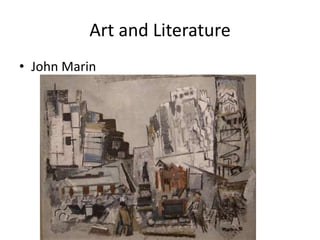
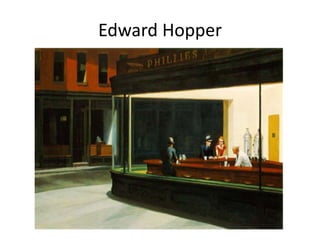
Art and Literature
• John Marin
Edward Hopper
Poets and Writers
• Ernest Hemingway “For Whom the Bell Tolls”
•                      “ A Farewell to Arms”
• F. Scott Fitzgerald “The Great Gatsby”
Popular Culture
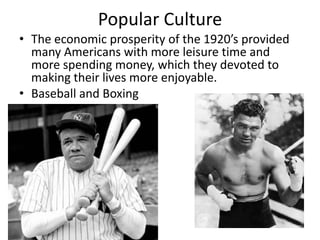
• The economic prosperity of the 1920’s provided
  many Americans with more leisure time and
  more spending money, which they devoted to
  making their lives more enjoyable.
• Baseball and Boxing
Charles Lindbergh
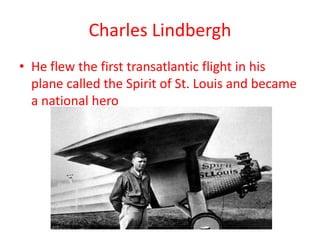
• He flew the first transatlantic flight in his
  plane called the Spirit of St. Louis and became
  a national hero
The Harlem Renaissance
• After WWI, black populations swelled in large
  northern cities—particularly in the New York
  City neighborhood of Harlem. It was there
  that African Americans created an
  environment that stimulated artistic
  development, racial pride, a sense of
  community and political organization. The
  result was a flowering of AA arts that became
  known as the Harlem Renaissance.
Writers
• One of the most prolific, original, and versatile
  writers of the Harlem Renaissance was
  Langston Hughes. He became a leading voice
  of the African American experience in the US.
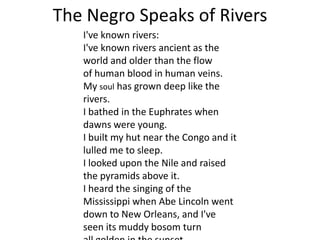
The Negro Speaks of Rivers
   I've known rivers:
   I've known rivers ancient as the
   world and older than the flow
   of human blood in human veins.
   My soul has grown deep like the
   rivers.
   I bathed in the Euphrates when
   dawns were young.
   I built my hut near the Congo and it
   lulled me to sleep.
   I looked upon the Nile and raised
   the pyramids above it.
   I heard the singing of the
   Mississippi when Abe Lincoln went
   down to New Orleans, and I've
   seen its muddy bosom turn
Jazz, Blues and the Theater
• Jazz-a new style of music influenced by
  Dixieland music and ragtime, with its ragged
  rhythms and syncopated melodies.
• http://youtu.be/9idqeiACqn4
• http://youtu.be/E2VCwBzGdPM
• Duke Ellington
• Louis Armstrong
African American Politics
• The racial pride that sparked the artistic
  achievements of the Harlem Renaissance also
  fueled the political and economic aspirations
  of many African Americans.
• A dynamic black leader from Jamaica, of
  millions of African Marcus Garvey captured
  the imagination Americas with his call for
  “Negro Nationalism” which glorified the black
  culture and traditions of the past.
Marcus Garvey
A Growing Economy in the 1920’s
• The US experienced stunning economic
  growth during the 1920’s.
• The automobile was just one part of a rising
  standard of living that Americans experienced
  in the 1920’s.
• Henry Ford
Henry Ford & The Assembly Line
• The assembly line divided operations into
  simple tasks that unskilled workers could do
  and cut unnecessary motion to a minimum.
• He also cut the workweek for his employees
  from six days to five and increased his workers
  wages to $5 a day and reduced the work day
  to an 8 hour day. He made his cars affordable
  for those who built them.
“Return to Normalcy”
•   This was Warren Harding’s campaign slogan.
•   2 presidents during the 1920’s:
•   Warren Harding
•   Calvin Coolidge

Chapter 15 1920's

  • 1.
    Chapter 15 The 1920’s • The 1920’s was an era of rapid change and clashing values. Many Americans believed society was losing its traditional values and they took action to preserve these values. Other Americans embraced new values associated with a freer lifestyle and the pursuit of individual goals.
  • 2.
    The War’s Impact •Racial Unrest: As hundreds of thousands of white American soldiers from Europe returned home looking for a job, clashes occurred with the African Americans who had moved north during the war to take those jobs. Frustration and racism combined to produce violence. In the summer of 1919, over 20 race riots broke out across the nation.
  • 3.
    Red Summer • Theworst violence occurred in Chicago. On a hot July day, African Americans found themselves at a White only beach. • http://chicagotonight.wttw.com/2011/10/12/r ed-summer
  • 4.
    The Red Scare •Americans had become very anti-German as the war progressed, and when the Communists withdrew Russia from the war, they seemed to be helping Germany. American anger at Germany quickly expanded into anger at Communists as well. Americans began to associate communism with being unpatriotic and disloyal.
  • 5.
    Nativism Resurges • Thefear and prejudice many felt toward Germans and Communists expanded to include all immigrants. This triggered a general rise in racism and in nativism, the desire to protect the interests of old-stock Americans against those of immigrants.
  • 6.
    Why? • Immigration returns • Economic recession • Racial and cultural tensions • Fear and prejudice toward Germans and Communists
  • 7.
  • 8.
    • Both Italianimmigrants (anarchist) • Convicted of murder during a robbery • Evidence was insufficient, found guilty and executed in 1927
  • 9.
    Return of theKKK • At the forefront to restrict immigration, the new KKK targeted not only African Americans, but also Catholics, Jews and other groups believed to represent “un American” values. • By 1924 membership in the Klan exploded, reaching nearly 4 million.
  • 11.
    Controlling Immigration • AfterWWI, American immigration policies changed in response to the postwar recession and nativist pleas to “Keep America American”. • In 1921, President Harding signed the Emergency Quota Act, which established a temporary quota system. • Only 3% on the total number of people in any ethnic group already living in the US could be admitted in a single year. • http://www.usimmigrationsupport.org/immigrati on-us.html
  • 12.
    The New Morality •Some groups that wanted to restrict immigration also wanted to preserve what they considered to be traditional values. They clashed with a new morality that glorified youth and personal freedom. • It became a clash of Old ideas vs. New ideas • Old vs. Youth • Country life vs. City life • Old school vs. New school
  • 13.
    Women in the1920’s • The Flapper—a modern women of the 20’s. • Fashion took on a modern look during the 1920’s
  • 14.
  • 15.
    Flappers pursued socialfreedoms by entering the work force as salesclerks, secretaries and phone operators as well as making contributions in science, medicine, law and literature.
  • 16.
    Margaret Sanger • Shebelieved that the standard of living could be improved if families limited the number of children they had and founded the American Birth Control League in 1921—later this organization became Planned Parenthood.
  • 17.
    New Dance Moves •Rebelling against older, more formal dancing styles, the Charleston became all the rave with the younger generation. • http://youtu.be/yNAOHtmy4j0
  • 18.
    Thoroughly Modern Millie •http://youtu.be/KVNcLUE87HQ
  • 19.
  • 20.
  • 21.
    Fundamentalist Movement • Millionsof Americans feared that the country was losing its traditional values. Many of these people, especially those in small rural towns, responded by joining a religious movement know as Fundamentalism.
  • 22.
    Fundamentalists Beliefs • Biblewas literally true and without error. • They defended the ideas that human beings derived their moral behavior from God • They rejected Charles Darwin’s theory of evolution • They believed in creationism-the belief that God created the world as described in the Bible
  • 23.
    The Scopes Trial •A historic trial that pinned evolutionists and creationists against each other. • Main Characters: • John T. Scopes—science teacher who taught evolution • William Jennings Bryan—prosecutor, represented the creationists • Clarence Darrow—most famous trial lawyer at the time, defended Scopes
  • 24.
    Inherit the Wind • Film about the Scopes Trial • http://youtu.be/S_DQUAuNUvw • http://youtu.be/A6Gk5H3c5f8 • http://youtu.be/l5Kdc0LLSW8
  • 25.
    Prohibition • The 18thAmendment- making the manufacturing, selling and distributing of liquor illegal. • Enforcing the new law proved to be very difficult. Americans blatantly ignored the law. Speakeasies, bootlegging and hip flasks became part of common speech.
  • 26.
    Organized Crime • Organizedcrime specialized in supplying and often ran the speakeasies. Crime became big business and some gangsters had enough money to corrupt local politicians. Al Capone became the most notorious gangsters of the era.
  • 27.
    Chapter 15 Sec.2 Cultural Innovations • An era of exciting and innovative cultural trends, the 1920’s witnessed changes in art and literature. This period also saw a dramatic increase in the country’s interest in sports and other forms of popular culture.
  • 28.
  • 29.
  • 30.
    Poets and Writers •Ernest Hemingway “For Whom the Bell Tolls” • “ A Farewell to Arms” • F. Scott Fitzgerald “The Great Gatsby”
  • 31.
    Popular Culture • Theeconomic prosperity of the 1920’s provided many Americans with more leisure time and more spending money, which they devoted to making their lives more enjoyable. • Baseball and Boxing
  • 32.
    Charles Lindbergh • Heflew the first transatlantic flight in his plane called the Spirit of St. Louis and became a national hero
  • 33.
    The Harlem Renaissance •After WWI, black populations swelled in large northern cities—particularly in the New York City neighborhood of Harlem. It was there that African Americans created an environment that stimulated artistic development, racial pride, a sense of community and political organization. The result was a flowering of AA arts that became known as the Harlem Renaissance.
  • 34.
    Writers • One ofthe most prolific, original, and versatile writers of the Harlem Renaissance was Langston Hughes. He became a leading voice of the African American experience in the US.
  • 35.
    The Negro Speaksof Rivers I've known rivers: I've known rivers ancient as the world and older than the flow of human blood in human veins. My soul has grown deep like the rivers. I bathed in the Euphrates when dawns were young. I built my hut near the Congo and it lulled me to sleep. I looked upon the Nile and raised the pyramids above it. I heard the singing of the Mississippi when Abe Lincoln went down to New Orleans, and I've seen its muddy bosom turn
  • 36.
    Jazz, Blues andthe Theater • Jazz-a new style of music influenced by Dixieland music and ragtime, with its ragged rhythms and syncopated melodies. • http://youtu.be/9idqeiACqn4 • http://youtu.be/E2VCwBzGdPM • Duke Ellington • Louis Armstrong
  • 37.
    African American Politics •The racial pride that sparked the artistic achievements of the Harlem Renaissance also fueled the political and economic aspirations of many African Americans. • A dynamic black leader from Jamaica, of millions of African Marcus Garvey captured the imagination Americas with his call for “Negro Nationalism” which glorified the black culture and traditions of the past.
  • 38.
  • 39.
    A Growing Economyin the 1920’s • The US experienced stunning economic growth during the 1920’s. • The automobile was just one part of a rising standard of living that Americans experienced in the 1920’s. • Henry Ford
  • 40.
    Henry Ford &The Assembly Line • The assembly line divided operations into simple tasks that unskilled workers could do and cut unnecessary motion to a minimum. • He also cut the workweek for his employees from six days to five and increased his workers wages to $5 a day and reduced the work day to an 8 hour day. He made his cars affordable for those who built them.
  • 41.
    “Return to Normalcy” • This was Warren Harding’s campaign slogan. • 2 presidents during the 1920’s: • Warren Harding • Calvin Coolidge