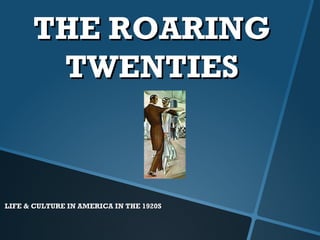
THE ROARINGTHE ROARING
TWENTIESTWENTIES
LIFE & CULTURE IN AMERICA IN THE 1920SLIFE & CULTURE IN AMERICA IN THE 1920S
CHANGINGWAYS OF LIFECHANGINGWAYS OF LIFE
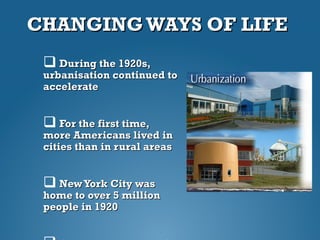
 During the 1920s,During the 1920s,
urbanisation continued tourbanisation continued to
accelerateaccelerate
 For the first time,For the first time,
more Americans lived inmore Americans lived in
cities than in rural areascities than in rural areas
 NewYork City wasNewYork City was
home to over 5 millionhome to over 5 million
people in 1920people in 1920
URBAN VS. RURALURBAN VS. RURAL
 Throughout the 1920s,Throughout the 1920s,
Americans foundAmericans found
themselves caught betweenthemselves caught between
urban and rural culturesurban and rural cultures
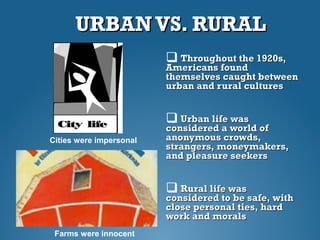
 Urban life wasUrban life was
considered a world ofconsidered a world of
anonymous crowds,anonymous crowds,
strangers, moneymakers,strangers, moneymakers,
and pleasure seekersand pleasure seekers
 Rural life wasRural life was
considered to be safe, withconsidered to be safe, with
close personal ties, hardclose personal ties, hard
work and moralswork and morals
Cities were impersonal
Farms were innocent
PROHIBITIONPROHIBITION
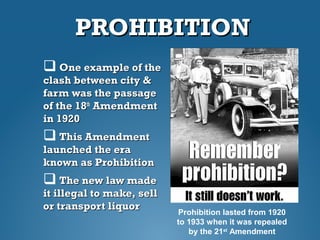
 One example of theOne example of the
clash between city &clash between city &
farm was the passagefarm was the passage
of the 18of the 18thth
AmendmentAmendment
in 1920in 1920
 This AmendmentThis Amendment
launched the eralaunched the era
known as Prohibitionknown as Prohibition
 The new law madeThe new law made
it illegal to make, sellit illegal to make, sell
or transport liquoror transport liquor
Prohibition lasted from 1920
to 1933 when it was repealed
by the 21st
Amendment
SUPPORT FOR PROHIBITIONSUPPORT FOR PROHIBITION
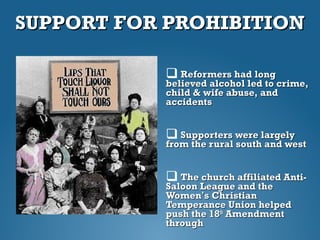
 Reformers had longReformers had long
believed alcohol led to crime,believed alcohol led to crime,
child & wife abuse, andchild & wife abuse, and
accidentsaccidents
 Supporters were largelySupporters were largely
from the rural south and westfrom the rural south and west
 The church affiliated Anti-The church affiliated Anti-
Saloon League and theSaloon League and the
WomenWomen’’s Christians Christian
Temperance Union helpedTemperance Union helped
push the 18push the 18thth
AmendmentAmendment
throughthrough
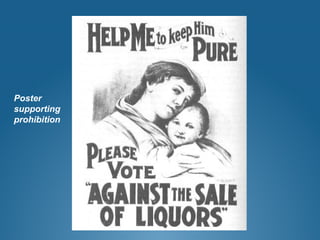
Poster
supporting
prohibition
SPEAKEASIES AND BOOTLEGGERSSPEAKEASIES AND BOOTLEGGERS
 Many Americans did notMany Americans did not
believe drinking was a sinbelieve drinking was a sin
 Most immigrant groupsMost immigrant groups
were not willing to give upwere not willing to give up
drinkingdrinking
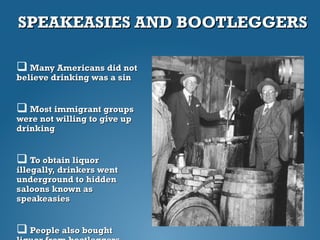
 To obtain liquorTo obtain liquor
illegally, drinkers wentillegally, drinkers went
underground to hiddenunderground to hidden
saloons known assaloons known as
speakeasiesspeakeasies
 People also boughtPeople also bought
ORGANIZED CRIMEORGANIZED CRIME
 Prohibition contributedProhibition contributed
to the growth of organizedto the growth of organized
crime in every major citycrime in every major city
 Chicago becameChicago became
notorious as the home of Alnotorious as the home of Al
Capone – a famousCapone – a famous
bootleggerbootlegger
 Capone took control ofCapone took control of
the Chicago liquorthe Chicago liquor
business by killing off hisbusiness by killing off his
competitioncompetitionAl Capone was finally convicted
on tax evasion charges in 1931
GOVERNMENT FAILS TOGOVERNMENT FAILS TO
CONTROL LIQUORCONTROL LIQUOR
 Eventually,Eventually,
ProhibitionProhibition’’s fate wass fate was
sealed by thesealed by the
government, whichgovernment, which
failed to budgetfailed to budget
enough money toenough money to
enforce the lawenforce the law
 The task ofThe task of
enforcing Prohibitionenforcing Prohibition
fell to 1,500 poorlyfell to 1,500 poorly
paid federal agents ---paid federal agents ---
clearly an impossibleclearly an impossible
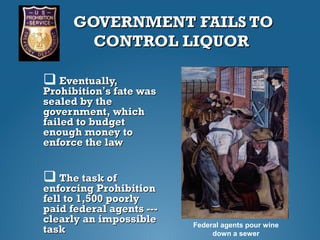
tasktask Federal agents pour wine
down a sewer
SUPPORT FADES, PROHIBITIONSUPPORT FADES, PROHIBITION
REPEALEDREPEALED
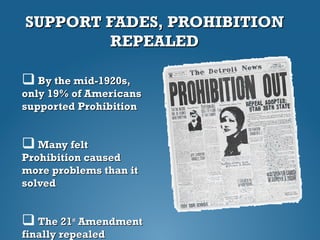
 By the mid-1920s,By the mid-1920s,
only 19% of Americansonly 19% of Americans
supported Prohibitionsupported Prohibition
 Many feltMany felt
Prohibition causedProhibition caused
more problems than itmore problems than it
solvedsolved
 The 21The 21stst
AmendmentAmendment
finally repealedfinally repealed
SCIENCE ANDSCIENCE AND
RELIGION CLASHRELIGION CLASH
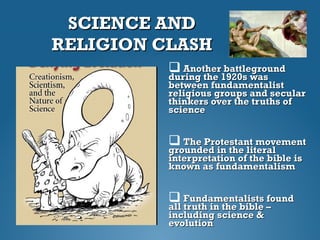
 Another battlegroundAnother battleground
during the 1920s wasduring the 1920s was
between fundamentalistbetween fundamentalist
religious groups and secularreligious groups and secular
thinkers over the truths ofthinkers over the truths of
sciencescience
 The Protestant movementThe Protestant movement
grounded in the literalgrounded in the literal
interpretation of the bible isinterpretation of the bible is
known as fundamentalismknown as fundamentalism
 Fundamentalists foundFundamentalists found
all truth in the bible –all truth in the bible –
including science &including science &
evolutionevolution
SCOPES TRIALSCOPES TRIAL
 In March 1925,In March 1925,
Tennessee passed theTennessee passed the
nationnation’’s first law thats first law that
made it a crime tomade it a crime to
teach evolutionteach evolution
 The ACLU promisedThe ACLU promised
to defend any teacherto defend any teacher
willing to challengewilling to challenge
the law – John Scopesthe law – John Scopes
diddid
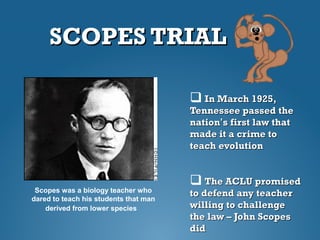
Scopes was a biology teacher who
dared to teach his students that man
derived from lower species
SCOPES TRIALSCOPES TRIAL
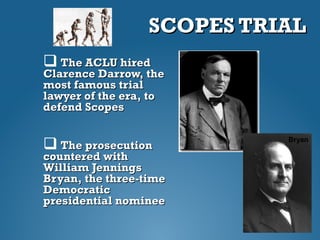
 The ACLU hiredThe ACLU hired
Clarence Darrow, theClarence Darrow, the
most famous trialmost famous trial
lawyer of the era, tolawyer of the era, to
defend Scopesdefend Scopes
 The prosecutionThe prosecution
countered withcountered with
William JenningsWilliam Jennings
Bryan, the three-timeBryan, the three-time
DemocraticDemocratic
presidential nomineepresidential nominee
Darrow
Bryan
SCOPES TRIALSCOPES TRIAL
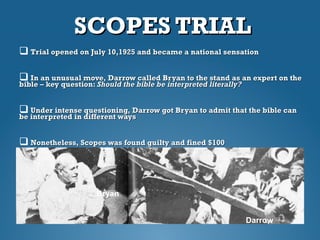
 Trial opened on July 10,1925 and became a national sensationTrial opened on July 10,1925 and became a national sensation
 In an unusual move, Darrow called Bryan to the stand as an expert on theIn an unusual move, Darrow called Bryan to the stand as an expert on the
bible – key question:bible – key question: Should the bible beShould the bible be interpreted literally?interpreted literally?
 Under intense questioning, Darrow got Bryan to admit that the bible canUnder intense questioning, Darrow got Bryan to admit that the bible can
be interpreted in different waysbe interpreted in different ways
 Nonetheless, Scopes was found guilty and fined $100Nonetheless, Scopes was found guilty and fined $100
Bryan
Darrow
THE TWENTIES WOMANTHE TWENTIES WOMAN
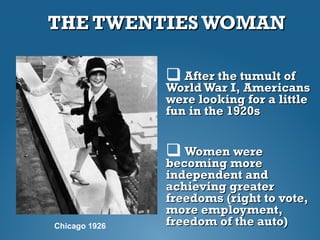
 After the tumult ofAfter the tumult of
WorldWar I, AmericansWorldWar I, Americans
were looking for a littlewere looking for a little
fun in the 1920sfun in the 1920s
 Women wereWomen were
becoming morebecoming more
independent andindependent and
achieving greaterachieving greater
freedoms (right to vote,freedoms (right to vote,
more employment,more employment,
freedom of the auto)freedom of the auto)Chicago 1926
THE FLAPPERTHE FLAPPER
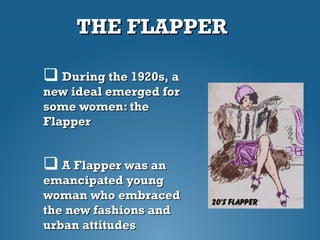
 During the 1920s, aDuring the 1920s, a
new ideal emerged fornew ideal emerged for
some women: thesome women: the
FlapperFlapper
 A Flapper was anA Flapper was an
emancipated youngemancipated young
woman who embracedwoman who embraced
the new fashions andthe new fashions and
urban attitudesurban attitudes
NEW ROLES FOR WOMENNEW ROLES FOR WOMEN
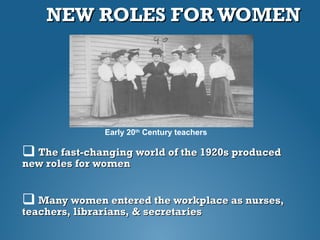
 The fast-changing world of the 1920s producedThe fast-changing world of the 1920s produced
new roles for womennew roles for women
 Many women entered the workplace as nurses,Many women entered the workplace as nurses,
teachers, librarians, & secretariesteachers, librarians, & secretaries
Early 20th
Century teachers
THE CHANGING FAMILYTHE CHANGING FAMILY
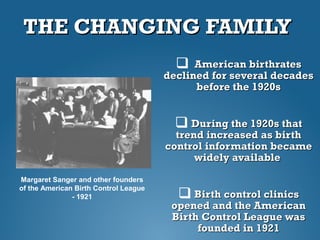
 American birthratesAmerican birthrates
declined for several decadesdeclined for several decades
before the 1920sbefore the 1920s
 During the 1920s thatDuring the 1920s that
trend increased as birthtrend increased as birth
control information becamecontrol information became
widely availablewidely available
 Birth control clinicsBirth control clinics
opened and the Americanopened and the American
Birth Control League wasBirth Control League was
founded in 1921founded in 1921
Margaret Sanger and other founders
of the American Birth Control League
- 1921
MODERN FAMILY EMERGESMODERN FAMILY EMERGES
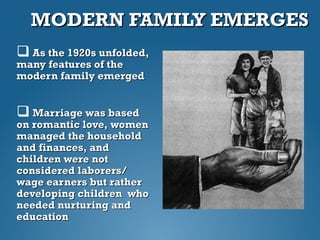
 As the 1920s unfolded,As the 1920s unfolded,
many features of themany features of the
modern family emergedmodern family emerged
 Marriage was basedMarriage was based
on romantic love, womenon romantic love, women
managed the householdmanaged the household
and finances, andand finances, and
children were notchildren were not
considered laborers/considered laborers/
wage earners but ratherwage earners but rather
developing children whodeveloping children who
needed nurturing andneeded nurturing and
educationeducation
A TIME OF RACISMA TIME OF RACISM
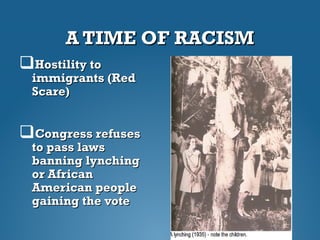
Hostility toHostility to
immigrants (Redimmigrants (Red
Scare)Scare)
Congress refusesCongress refuses
to pass lawsto pass laws
banning lynchingbanning lynching
or Africanor African
American peopleAmerican people
gaining the votegaining the vote
A TIME OF RACISMA TIME OF RACISM
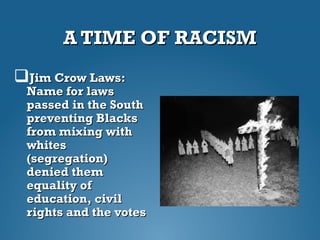
Jim Crow Laws:Jim Crow Laws:
Name for lawsName for laws
passed in the Southpassed in the South
preventing Blackspreventing Blacks
from mixing withfrom mixing with
whiteswhites
(segregation)(segregation)
denied themdenied them
equality ofequality of
education, civileducation, civil
rights and the votesrights and the votes
A TIME OF RACISMA TIME OF RACISM
Ku Klux Klan:Ku Klux Klan:
organisation toorganisation to
maintain whitemaintain white
supremacysupremacy
5 million members5 million members
by 1925by 1925
Targeted blacks butTargeted blacks but
also Jews, Catholics,also Jews, Catholics,
immigrants andimmigrants and
immoral peopleimmoral people
EDUCATION AND POPULAREDUCATION AND POPULAR
CULTURECULTURE
 During the 1920s, developments in education hadDuring the 1920s, developments in education had
a powerful impact on the nationa powerful impact on the nation
 Enrollment in high schools quadrupled betweenEnrollment in high schools quadrupled between
1914 and 19261914 and 1926
 Public schools met the challenge of educatingPublic schools met the challenge of educating
millions of immigrantsmillions of immigrants
EXPANDING NEWS COVERAGEEXPANDING NEWS COVERAGE
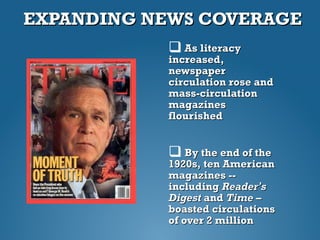
 As literacyAs literacy
increased,increased,
newspapernewspaper
circulation rose andcirculation rose and
mass-circulationmass-circulation
magazinesmagazines
flourishedflourished
 By the end of theBy the end of the
1920s, ten American1920s, ten American
magazines --magazines --
includingincluding ReaderReader’’ss
DigestDigest andand Time –Time –
boasted circulationsboasted circulations
of over 2 millionof over 2 million
RADIO COMES OF AGERADIO COMES OF AGE
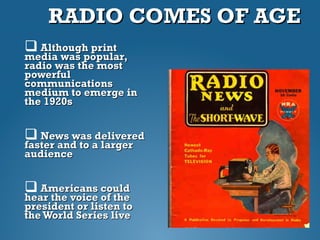
 Although printAlthough print
media was popular,media was popular,
radio was the mostradio was the most
powerfulpowerful
communicationscommunications
medium to emerge inmedium to emerge in
the 1920sthe 1920s
 News was deliveredNews was delivered
faster and to a largerfaster and to a larger
audienceaudience
 Americans couldAmericans could
hear the voice of thehear the voice of the
president or listen topresident or listen to
the World Series livethe World Series live
AMERICAN HEROES OF THEAMERICAN HEROES OF THE
20s20s
 In 1929, Americans spentIn 1929, Americans spent
$4.5 billion on entertainment$4.5 billion on entertainment
(includes sports)(includes sports)
 People crowded intoPeople crowded into
baseball games to see theirbaseball games to see their
heroesheroes
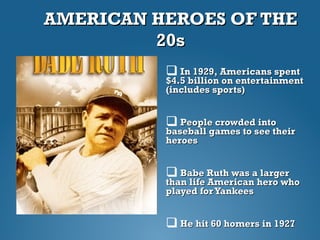
 Babe Ruth was a largerBabe Ruth was a larger
than life American hero whothan life American hero who
played forYankeesplayed forYankees
 He hit 60 homers in 1927He hit 60 homers in 1927
ENTERTAINMENT AND ARTSENTERTAINMENT AND ARTS
 Even before sound, moviesEven before sound, movies
offered a means of escapeoffered a means of escape
through romance and comedythrough romance and comedy
 First sound movies:First sound movies: JazzJazz
SingerSinger (1927)(1927)
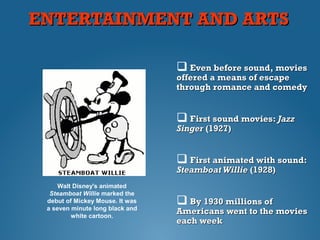
 First animated with sound:First animated with sound:
Steamboat WillieSteamboat Willie (1928)(1928)
 By 1930By 1930 millions ofmillions of
Americans went to the moviesAmericans went to the movies
each weekeach week
Walt Disney's animated
Steamboat Willie marked the
debut of Mickey Mouse. It was
a seven minute long black and
white cartoon.
MUSIC AND ARTMUSIC AND ART
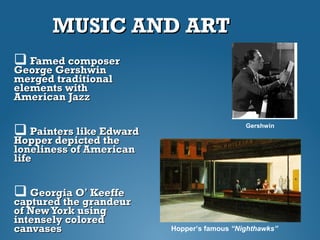
 Famed composerFamed composer
George GershwinGeorge Gershwin
merged traditionalmerged traditional
elements withelements with
American JazzAmerican Jazz
 Painters like EdwardPainters like Edward
Hopper depicted theHopper depicted the
loneliness of Americanloneliness of American
lifelife
 Georgia OGeorgia O’’ KeeffeKeeffe
captured the grandeurcaptured the grandeur
of NewYork usingof NewYork using
intensely coloredintensely colored
canvasescanvases
Gershwin
Hopper’s famous “Nighthawks”
WRITERS OF THE 1920sWRITERS OF THE 1920s
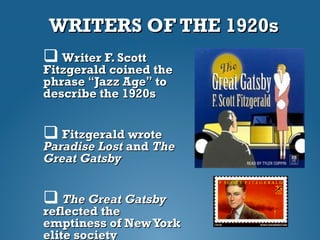
 Writer F. ScottWriter F. Scott
Fitzgerald coined theFitzgerald coined the
phrasephrase ““Jazz AgeJazz Age”” toto
describe the 1920sdescribe the 1920s
 Fitzgerald wroteFitzgerald wrote
Paradise LostParadise Lost andand TheThe
Great GatsbyGreat Gatsby
 The Great GatsbyThe Great Gatsby
reflected thereflected the
emptiness of NewYorkemptiness of NewYork
elite societyelite society
WRITERS OF THE 1920WRITERS OF THE 1920
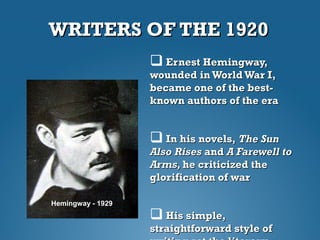
 Ernest Hemingway,Ernest Hemingway,
wounded in WorldWar I,wounded in WorldWar I,
became one of the best-became one of the best-
known authors of the eraknown authors of the era
 In his novels,In his novels, The SunThe Sun
Also RisesAlso Rises andand A Farewell toA Farewell to
Arms,Arms, he criticized thehe criticized the
glorification of warglorification of war
 His simple,His simple,
straightforward style ofstraightforward style of
Hemingway - 1929
THE HARLEM RENAISSANCETHE HARLEM RENAISSANCE
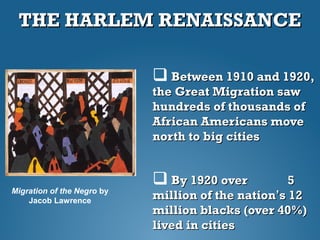
 Between 1910 and 1920,Between 1910 and 1920,
the Great Migration sawthe Great Migration saw
hundreds of thousands ofhundreds of thousands of
African Americans moveAfrican Americans move
north to big citiesnorth to big cities
 By 1920 over 5By 1920 over 5
million of the nationmillion of the nation’’s 12s 12
million blacks (over 40%)million blacks (over 40%)
lived in citieslived in cities
Migration of the Negro by
Jacob Lawrence
AFRICAN AMERICAN GOALSAFRICAN AMERICAN GOALS
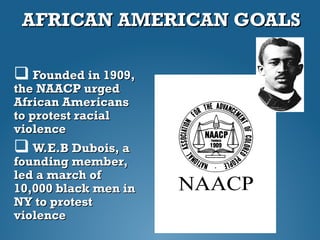
 Founded in 1909,Founded in 1909,
the NAACP urgedthe NAACP urged
African AmericansAfrican Americans
to protest racialto protest racial
violenceviolence
 W.E.B Dubois, aW.E.B Dubois, a
founding member,founding member,
led a march ofled a march of
10,000 black men in10,000 black men in
NY to protestNY to protest
violenceviolence
MARCUS GARVEY - UNIAMARCUS GARVEY - UNIA
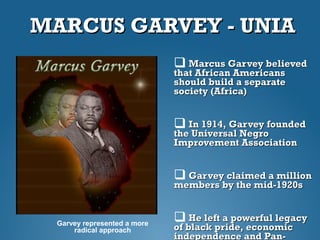
 Marcus Garvey believedMarcus Garvey believed
that African Americansthat African Americans
should build a separateshould build a separate
society (Africa)society (Africa)
 In 1914, Garvey foundedIn 1914, Garvey founded
the Universal Negrothe Universal Negro
Improvement AssociationImprovement Association
 Garvey claimed a millionGarvey claimed a million
members by the mid-1920smembers by the mid-1920s
 He left a powerful legacyHe left a powerful legacy
of black pride, economicof black pride, economic
independence and Pan-independence and Pan-
Garvey represented a more
radical approach
HARLEM, NEWYORKHARLEM, NEWYORK
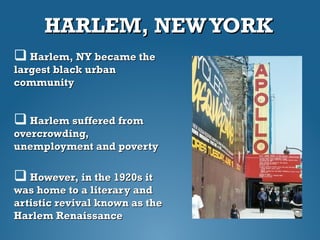
 Harlem, NY became theHarlem, NY became the
largest black urbanlargest black urban
communitycommunity
 Harlem suffered fromHarlem suffered from
overcrowding,overcrowding,
unemployment and povertyunemployment and poverty
 However, in the 1920s itHowever, in the 1920s it
was home to a literary andwas home to a literary and
artistic revival known as theartistic revival known as the
Harlem RenaissanceHarlem Renaissance
AFRICAN AMERICANAFRICAN AMERICAN
WRITERSWRITERS
 The HarlemThe Harlem
Renaissance was primarilyRenaissance was primarily
a literary movementa literary movement
 Led by well-educatedLed by well-educated
blacks with a new sense ofblacks with a new sense of
pride in the African-pride in the African-
American experienceAmerican experience
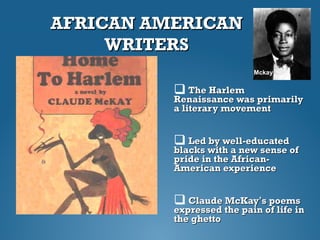
 Claude McKayClaude McKay’’s poemss poems
expressed the pain of life inexpressed the pain of life in
the ghettothe ghetto
Mckay
LOUIS ARMSTRONGLOUIS ARMSTRONG
 Jazz was born in the earlyJazz was born in the early
2020thth
centurycentury
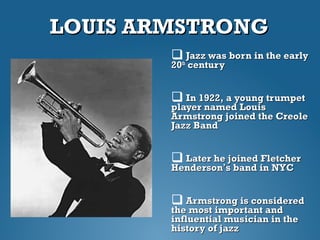
 In 1922, a young trumpetIn 1922, a young trumpet
player named Louisplayer named Louis
Armstrong joined the CreoleArmstrong joined the Creole
Jazz BandJazz Band
 Later he joined FletcherLater he joined Fletcher
HendersonHenderson’’s band in NYCs band in NYC
 Armstrong is consideredArmstrong is considered
the most important andthe most important and
influential musician in theinfluential musician in the
history of jazzhistory of jazz
EDWARD KENNEDYEDWARD KENNEDY ““DUKEDUKE””
ELLINGTONELLINGTON
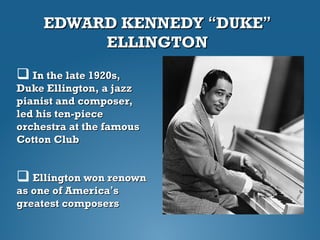
 In the late 1920s,In the late 1920s,
Duke Ellington, a jazzDuke Ellington, a jazz
pianist and composer,pianist and composer,
led his ten-pieceled his ten-piece
orchestra at the famousorchestra at the famous
Cotton ClubCotton Club
 Ellington won renownEllington won renown
as one of Americaas one of America’’ss
greatest composersgreatest composers
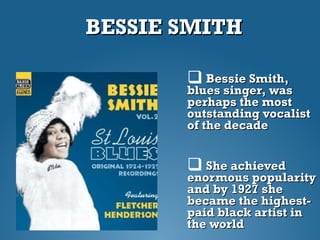
BESSIE SMITHBESSIE SMITH
 Bessie Smith,Bessie Smith,
blues singer, wasblues singer, was
perhaps the mostperhaps the most
outstanding vocalistoutstanding vocalist
of the decadeof the decade
 She achievedShe achieved
enormous popularityenormous popularity
and by 1927 sheand by 1927 she
became the highest-became the highest-
paid black artist inpaid black artist in
the worldthe world

Roaring twenties

  • 1.
    THE ROARINGTHE ROARING TWENTIESTWENTIES LIFE& CULTURE IN AMERICA IN THE 1920SLIFE & CULTURE IN AMERICA IN THE 1920S
  • 2.
    CHANGINGWAYS OF LIFECHANGINGWAYSOF LIFE  During the 1920s,During the 1920s, urbanisation continued tourbanisation continued to accelerateaccelerate  For the first time,For the first time, more Americans lived inmore Americans lived in cities than in rural areascities than in rural areas  NewYork City wasNewYork City was home to over 5 millionhome to over 5 million people in 1920people in 1920
  • 3.
    URBAN VS. RURALURBANVS. RURAL  Throughout the 1920s,Throughout the 1920s, Americans foundAmericans found themselves caught betweenthemselves caught between urban and rural culturesurban and rural cultures  Urban life wasUrban life was considered a world ofconsidered a world of anonymous crowds,anonymous crowds, strangers, moneymakers,strangers, moneymakers, and pleasure seekersand pleasure seekers  Rural life wasRural life was considered to be safe, withconsidered to be safe, with close personal ties, hardclose personal ties, hard work and moralswork and morals Cities were impersonal Farms were innocent
  • 4.
    PROHIBITIONPROHIBITION  One exampleof theOne example of the clash between city &clash between city & farm was the passagefarm was the passage of the 18of the 18thth AmendmentAmendment in 1920in 1920  This AmendmentThis Amendment launched the eralaunched the era known as Prohibitionknown as Prohibition  The new law madeThe new law made it illegal to make, sellit illegal to make, sell or transport liquoror transport liquor Prohibition lasted from 1920 to 1933 when it was repealed by the 21st Amendment
  • 5.
    SUPPORT FOR PROHIBITIONSUPPORTFOR PROHIBITION  Reformers had longReformers had long believed alcohol led to crime,believed alcohol led to crime, child & wife abuse, andchild & wife abuse, and accidentsaccidents  Supporters were largelySupporters were largely from the rural south and westfrom the rural south and west  The church affiliated Anti-The church affiliated Anti- Saloon League and theSaloon League and the WomenWomen’’s Christians Christian Temperance Union helpedTemperance Union helped push the 18push the 18thth AmendmentAmendment throughthrough
  • 6.
  • 7.
    SPEAKEASIES AND BOOTLEGGERSSPEAKEASIESAND BOOTLEGGERS  Many Americans did notMany Americans did not believe drinking was a sinbelieve drinking was a sin  Most immigrant groupsMost immigrant groups were not willing to give upwere not willing to give up drinkingdrinking  To obtain liquorTo obtain liquor illegally, drinkers wentillegally, drinkers went underground to hiddenunderground to hidden saloons known assaloons known as speakeasiesspeakeasies  People also boughtPeople also bought
  • 8.
    ORGANIZED CRIMEORGANIZED CRIME Prohibition contributedProhibition contributed to the growth of organizedto the growth of organized crime in every major citycrime in every major city  Chicago becameChicago became notorious as the home of Alnotorious as the home of Al Capone – a famousCapone – a famous bootleggerbootlegger  Capone took control ofCapone took control of the Chicago liquorthe Chicago liquor business by killing off hisbusiness by killing off his competitioncompetitionAl Capone was finally convicted on tax evasion charges in 1931
  • 9.
    GOVERNMENT FAILS TOGOVERNMENTFAILS TO CONTROL LIQUORCONTROL LIQUOR  Eventually,Eventually, ProhibitionProhibition’’s fate wass fate was sealed by thesealed by the government, whichgovernment, which failed to budgetfailed to budget enough money toenough money to enforce the lawenforce the law  The task ofThe task of enforcing Prohibitionenforcing Prohibition fell to 1,500 poorlyfell to 1,500 poorly paid federal agents ---paid federal agents --- clearly an impossibleclearly an impossible tasktask Federal agents pour wine down a sewer
  • 10.
    SUPPORT FADES, PROHIBITIONSUPPORTFADES, PROHIBITION REPEALEDREPEALED  By the mid-1920s,By the mid-1920s, only 19% of Americansonly 19% of Americans supported Prohibitionsupported Prohibition  Many feltMany felt Prohibition causedProhibition caused more problems than itmore problems than it solvedsolved  The 21The 21stst AmendmentAmendment finally repealedfinally repealed
  • 11.
    SCIENCE ANDSCIENCE AND RELIGIONCLASHRELIGION CLASH  Another battlegroundAnother battleground during the 1920s wasduring the 1920s was between fundamentalistbetween fundamentalist religious groups and secularreligious groups and secular thinkers over the truths ofthinkers over the truths of sciencescience  The Protestant movementThe Protestant movement grounded in the literalgrounded in the literal interpretation of the bible isinterpretation of the bible is known as fundamentalismknown as fundamentalism  Fundamentalists foundFundamentalists found all truth in the bible –all truth in the bible – including science &including science & evolutionevolution
  • 12.
    SCOPES TRIALSCOPES TRIAL In March 1925,In March 1925, Tennessee passed theTennessee passed the nationnation’’s first law thats first law that made it a crime tomade it a crime to teach evolutionteach evolution  The ACLU promisedThe ACLU promised to defend any teacherto defend any teacher willing to challengewilling to challenge the law – John Scopesthe law – John Scopes diddid Scopes was a biology teacher who dared to teach his students that man derived from lower species
  • 13.
    SCOPES TRIALSCOPES TRIAL The ACLU hiredThe ACLU hired Clarence Darrow, theClarence Darrow, the most famous trialmost famous trial lawyer of the era, tolawyer of the era, to defend Scopesdefend Scopes  The prosecutionThe prosecution countered withcountered with William JenningsWilliam Jennings Bryan, the three-timeBryan, the three-time DemocraticDemocratic presidential nomineepresidential nominee Darrow Bryan
  • 14.
    SCOPES TRIALSCOPES TRIAL Trial opened on July 10,1925 and became a national sensationTrial opened on July 10,1925 and became a national sensation  In an unusual move, Darrow called Bryan to the stand as an expert on theIn an unusual move, Darrow called Bryan to the stand as an expert on the bible – key question:bible – key question: Should the bible beShould the bible be interpreted literally?interpreted literally?  Under intense questioning, Darrow got Bryan to admit that the bible canUnder intense questioning, Darrow got Bryan to admit that the bible can be interpreted in different waysbe interpreted in different ways  Nonetheless, Scopes was found guilty and fined $100Nonetheless, Scopes was found guilty and fined $100 Bryan Darrow
  • 15.
    THE TWENTIES WOMANTHETWENTIES WOMAN  After the tumult ofAfter the tumult of WorldWar I, AmericansWorldWar I, Americans were looking for a littlewere looking for a little fun in the 1920sfun in the 1920s  Women wereWomen were becoming morebecoming more independent andindependent and achieving greaterachieving greater freedoms (right to vote,freedoms (right to vote, more employment,more employment, freedom of the auto)freedom of the auto)Chicago 1926
  • 16.
    THE FLAPPERTHE FLAPPER During the 1920s, aDuring the 1920s, a new ideal emerged fornew ideal emerged for some women: thesome women: the FlapperFlapper  A Flapper was anA Flapper was an emancipated youngemancipated young woman who embracedwoman who embraced the new fashions andthe new fashions and urban attitudesurban attitudes
  • 17.
    NEW ROLES FORWOMENNEW ROLES FOR WOMEN  The fast-changing world of the 1920s producedThe fast-changing world of the 1920s produced new roles for womennew roles for women  Many women entered the workplace as nurses,Many women entered the workplace as nurses, teachers, librarians, & secretariesteachers, librarians, & secretaries Early 20th Century teachers
  • 18.
    THE CHANGING FAMILYTHECHANGING FAMILY  American birthratesAmerican birthrates declined for several decadesdeclined for several decades before the 1920sbefore the 1920s  During the 1920s thatDuring the 1920s that trend increased as birthtrend increased as birth control information becamecontrol information became widely availablewidely available  Birth control clinicsBirth control clinics opened and the Americanopened and the American Birth Control League wasBirth Control League was founded in 1921founded in 1921 Margaret Sanger and other founders of the American Birth Control League - 1921
  • 19.
    MODERN FAMILY EMERGESMODERNFAMILY EMERGES  As the 1920s unfolded,As the 1920s unfolded, many features of themany features of the modern family emergedmodern family emerged  Marriage was basedMarriage was based on romantic love, womenon romantic love, women managed the householdmanaged the household and finances, andand finances, and children were notchildren were not considered laborers/considered laborers/ wage earners but ratherwage earners but rather developing children whodeveloping children who needed nurturing andneeded nurturing and educationeducation
  • 20.
    A TIME OFRACISMA TIME OF RACISM Hostility toHostility to immigrants (Redimmigrants (Red Scare)Scare) Congress refusesCongress refuses to pass lawsto pass laws banning lynchingbanning lynching or Africanor African American peopleAmerican people gaining the votegaining the vote
  • 21.
    A TIME OFRACISMA TIME OF RACISM Jim Crow Laws:Jim Crow Laws: Name for lawsName for laws passed in the Southpassed in the South preventing Blackspreventing Blacks from mixing withfrom mixing with whiteswhites (segregation)(segregation) denied themdenied them equality ofequality of education, civileducation, civil rights and the votesrights and the votes
  • 22.
    A TIME OFRACISMA TIME OF RACISM Ku Klux Klan:Ku Klux Klan: organisation toorganisation to maintain whitemaintain white supremacysupremacy 5 million members5 million members by 1925by 1925 Targeted blacks butTargeted blacks but also Jews, Catholics,also Jews, Catholics, immigrants andimmigrants and immoral peopleimmoral people
  • 23.
    EDUCATION AND POPULAREDUCATIONAND POPULAR CULTURECULTURE  During the 1920s, developments in education hadDuring the 1920s, developments in education had a powerful impact on the nationa powerful impact on the nation  Enrollment in high schools quadrupled betweenEnrollment in high schools quadrupled between 1914 and 19261914 and 1926  Public schools met the challenge of educatingPublic schools met the challenge of educating millions of immigrantsmillions of immigrants
  • 24.
    EXPANDING NEWS COVERAGEEXPANDINGNEWS COVERAGE  As literacyAs literacy increased,increased, newspapernewspaper circulation rose andcirculation rose and mass-circulationmass-circulation magazinesmagazines flourishedflourished  By the end of theBy the end of the 1920s, ten American1920s, ten American magazines --magazines -- includingincluding ReaderReader’’ss DigestDigest andand Time –Time – boasted circulationsboasted circulations of over 2 millionof over 2 million
  • 25.
    RADIO COMES OFAGERADIO COMES OF AGE  Although printAlthough print media was popular,media was popular, radio was the mostradio was the most powerfulpowerful communicationscommunications medium to emerge inmedium to emerge in the 1920sthe 1920s  News was deliveredNews was delivered faster and to a largerfaster and to a larger audienceaudience  Americans couldAmericans could hear the voice of thehear the voice of the president or listen topresident or listen to the World Series livethe World Series live
  • 26.
    AMERICAN HEROES OFTHEAMERICAN HEROES OF THE 20s20s  In 1929, Americans spentIn 1929, Americans spent $4.5 billion on entertainment$4.5 billion on entertainment (includes sports)(includes sports)  People crowded intoPeople crowded into baseball games to see theirbaseball games to see their heroesheroes  Babe Ruth was a largerBabe Ruth was a larger than life American hero whothan life American hero who played forYankeesplayed forYankees  He hit 60 homers in 1927He hit 60 homers in 1927
  • 27.
    ENTERTAINMENT AND ARTSENTERTAINMENTAND ARTS  Even before sound, moviesEven before sound, movies offered a means of escapeoffered a means of escape through romance and comedythrough romance and comedy  First sound movies:First sound movies: JazzJazz SingerSinger (1927)(1927)  First animated with sound:First animated with sound: Steamboat WillieSteamboat Willie (1928)(1928)  By 1930By 1930 millions ofmillions of Americans went to the moviesAmericans went to the movies each weekeach week Walt Disney's animated Steamboat Willie marked the debut of Mickey Mouse. It was a seven minute long black and white cartoon.
  • 28.
    MUSIC AND ARTMUSICAND ART  Famed composerFamed composer George GershwinGeorge Gershwin merged traditionalmerged traditional elements withelements with American JazzAmerican Jazz  Painters like EdwardPainters like Edward Hopper depicted theHopper depicted the loneliness of Americanloneliness of American lifelife  Georgia OGeorgia O’’ KeeffeKeeffe captured the grandeurcaptured the grandeur of NewYork usingof NewYork using intensely coloredintensely colored canvasescanvases Gershwin Hopper’s famous “Nighthawks”
  • 29.
    WRITERS OF THE1920sWRITERS OF THE 1920s  Writer F. ScottWriter F. Scott Fitzgerald coined theFitzgerald coined the phrasephrase ““Jazz AgeJazz Age”” toto describe the 1920sdescribe the 1920s  Fitzgerald wroteFitzgerald wrote Paradise LostParadise Lost andand TheThe Great GatsbyGreat Gatsby  The Great GatsbyThe Great Gatsby reflected thereflected the emptiness of NewYorkemptiness of NewYork elite societyelite society
  • 30.
    WRITERS OF THE1920WRITERS OF THE 1920  Ernest Hemingway,Ernest Hemingway, wounded in WorldWar I,wounded in WorldWar I, became one of the best-became one of the best- known authors of the eraknown authors of the era  In his novels,In his novels, The SunThe Sun Also RisesAlso Rises andand A Farewell toA Farewell to Arms,Arms, he criticized thehe criticized the glorification of warglorification of war  His simple,His simple, straightforward style ofstraightforward style of Hemingway - 1929
  • 31.
    THE HARLEM RENAISSANCETHEHARLEM RENAISSANCE  Between 1910 and 1920,Between 1910 and 1920, the Great Migration sawthe Great Migration saw hundreds of thousands ofhundreds of thousands of African Americans moveAfrican Americans move north to big citiesnorth to big cities  By 1920 over 5By 1920 over 5 million of the nationmillion of the nation’’s 12s 12 million blacks (over 40%)million blacks (over 40%) lived in citieslived in cities Migration of the Negro by Jacob Lawrence
  • 32.
    AFRICAN AMERICAN GOALSAFRICANAMERICAN GOALS  Founded in 1909,Founded in 1909, the NAACP urgedthe NAACP urged African AmericansAfrican Americans to protest racialto protest racial violenceviolence  W.E.B Dubois, aW.E.B Dubois, a founding member,founding member, led a march ofled a march of 10,000 black men in10,000 black men in NY to protestNY to protest violenceviolence
  • 33.
    MARCUS GARVEY -UNIAMARCUS GARVEY - UNIA  Marcus Garvey believedMarcus Garvey believed that African Americansthat African Americans should build a separateshould build a separate society (Africa)society (Africa)  In 1914, Garvey foundedIn 1914, Garvey founded the Universal Negrothe Universal Negro Improvement AssociationImprovement Association  Garvey claimed a millionGarvey claimed a million members by the mid-1920smembers by the mid-1920s  He left a powerful legacyHe left a powerful legacy of black pride, economicof black pride, economic independence and Pan-independence and Pan- Garvey represented a more radical approach
  • 34.
    HARLEM, NEWYORKHARLEM, NEWYORK Harlem, NY became theHarlem, NY became the largest black urbanlargest black urban communitycommunity  Harlem suffered fromHarlem suffered from overcrowding,overcrowding, unemployment and povertyunemployment and poverty  However, in the 1920s itHowever, in the 1920s it was home to a literary andwas home to a literary and artistic revival known as theartistic revival known as the Harlem RenaissanceHarlem Renaissance
  • 35.
    AFRICAN AMERICANAFRICAN AMERICAN WRITERSWRITERS The HarlemThe Harlem Renaissance was primarilyRenaissance was primarily a literary movementa literary movement  Led by well-educatedLed by well-educated blacks with a new sense ofblacks with a new sense of pride in the African-pride in the African- American experienceAmerican experience  Claude McKayClaude McKay’’s poemss poems expressed the pain of life inexpressed the pain of life in the ghettothe ghetto Mckay
  • 36.
    LOUIS ARMSTRONGLOUIS ARMSTRONG Jazz was born in the earlyJazz was born in the early 2020thth centurycentury  In 1922, a young trumpetIn 1922, a young trumpet player named Louisplayer named Louis Armstrong joined the CreoleArmstrong joined the Creole Jazz BandJazz Band  Later he joined FletcherLater he joined Fletcher HendersonHenderson’’s band in NYCs band in NYC  Armstrong is consideredArmstrong is considered the most important andthe most important and influential musician in theinfluential musician in the history of jazzhistory of jazz
  • 37.
    EDWARD KENNEDYEDWARD KENNEDY““DUKEDUKE”” ELLINGTONELLINGTON  In the late 1920s,In the late 1920s, Duke Ellington, a jazzDuke Ellington, a jazz pianist and composer,pianist and composer, led his ten-pieceled his ten-piece orchestra at the famousorchestra at the famous Cotton ClubCotton Club  Ellington won renownEllington won renown as one of Americaas one of America’’ss greatest composersgreatest composers
  • 38.
    BESSIE SMITHBESSIE SMITH Bessie Smith,Bessie Smith, blues singer, wasblues singer, was perhaps the mostperhaps the most outstanding vocalistoutstanding vocalist of the decadeof the decade  She achievedShe achieved enormous popularityenormous popularity and by 1927 sheand by 1927 she became the highest-became the highest- paid black artist inpaid black artist in the worldthe world