Prof S S Jahagirdar, NKOCET

AIR POLLUTION
AND CONTROL
(Elective-I)
Problems set for
UNIT-IV
AIR POLLUTION METEOROLOGY

Page | 1
BE (Civil)

L-

ROLL NO-

Air pollution (Elective -I)
Unit-IV
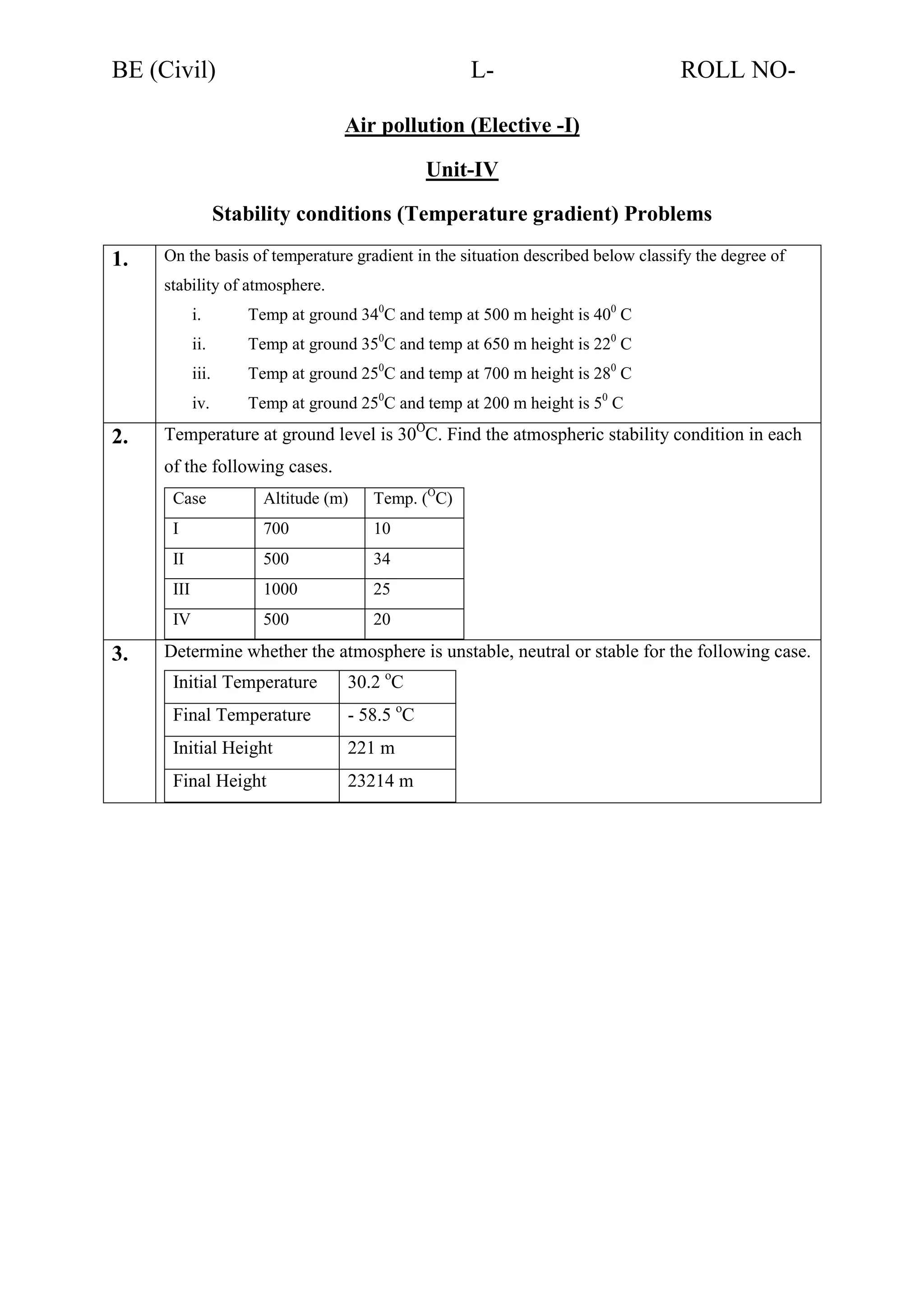
Stability conditions (Temperature gradient) Problems
1.

On the basis of temperature gradient in the situation described below classify the degree of
stability of atmosphere.
i.
ii.

Temp at ground 350C and temp at 650 m height is 220 C

iii.

Temp at ground 250C and temp at 700 m height is 280 C

iv.

2.

Temp at ground 340C and temp at 500 m height is 400 C

Temp at ground 250C and temp at 200 m height is 50 C

Temperature at ground level is 30OC. Find the atmospheric stability condition in each
of the following cases.
Case

Temp. (OC)

I

700

10

II

500

34

III

1000

25

IV

3.

Altitude (m)

500

20

Determine whether the atmosphere is unstable, neutral or stable for the following case.
Initial Temperature

30.2 oC

Final Temperature

- 58.5 oC

Initial Height

221 m

Final Height

23214 m
BE (Civil)

L-

ROLL NO-

Air pollution (Elective -I)
Unit-IV
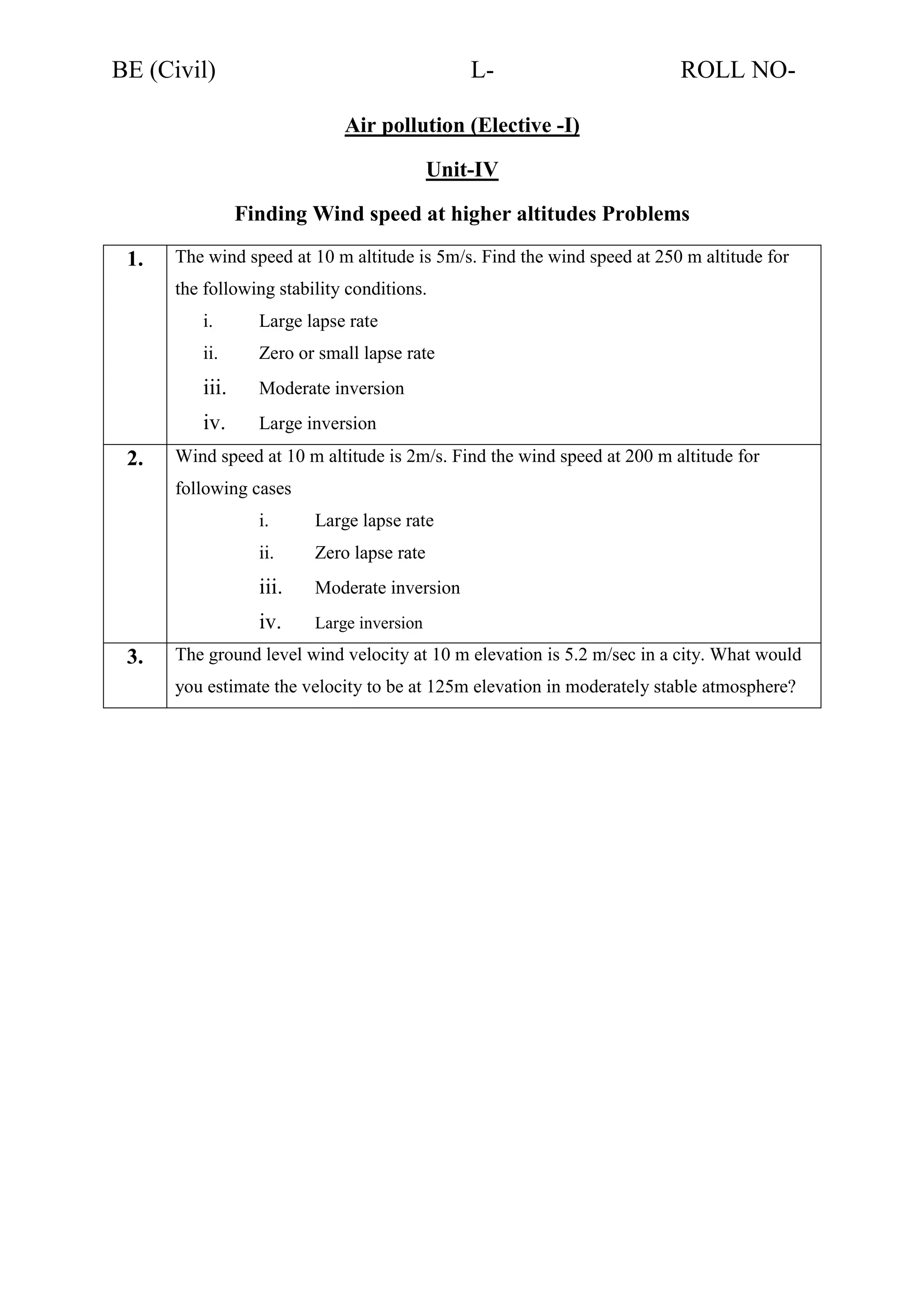
Finding Wind speed at higher altitudes Problems
1.

The wind speed at 10 m altitude is 5m/s. Find the wind speed at 250 m altitude for
the following stability conditions.
i.
ii.

Zero or small lapse rate

iii.

Moderate inversion

iv.
2.

Large lapse rate

Large inversion

Wind speed at 10 m altitude is 2m/s. Find the wind speed at 200 m altitude for
following cases
i.
ii.

Zero lapse rate

iii.

Moderate inversion

iv.
3.

Large lapse rate

Large inversion

The ground level wind velocity at 10 m elevation is 5.2 m/sec in a city. What would
you estimate the velocity to be at 125m elevation in moderately stable atmosphere?
BE (Civil)

L-

ROLL NO-

Air pollution (Elective -I)
Unit-IV
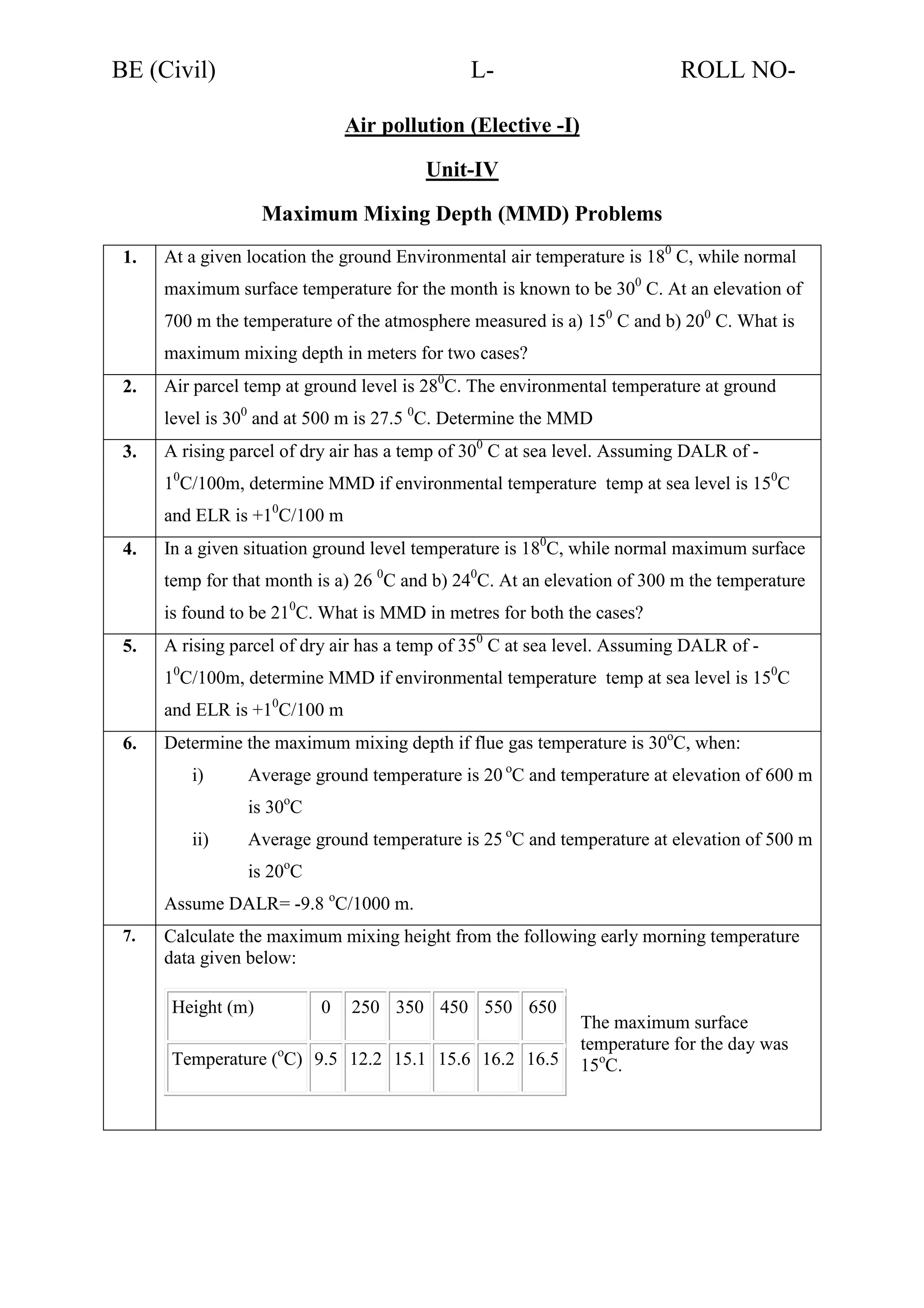
Maximum Mixing Depth (MMD) Problems
1.

At a given location the ground Environmental air temperature is 180 C, while normal
maximum surface temperature for the month is known to be 300 C. At an elevation of
700 m the temperature of the atmosphere measured is a) 150 C and b) 200 C. What is
maximum mixing depth in meters for two cases?

2.

Air parcel temp at ground level is 280C. The environmental temperature at ground
level is 300 and at 500 m is 27.5 0C. Determine the MMD

3.

A rising parcel of dry air has a temp of 300 C at sea level. Assuming DALR of 10C/100m, determine MMD if environmental temperature temp at sea level is 150C
and ELR is +10C/100 m

4.

In a given situation ground level temperature is 180C, while normal maximum surface
temp for that month is a) 26 0C and b) 240C. At an elevation of 300 m the temperature
is found to be 210C. What is MMD in metres for both the cases?

5.

A rising parcel of dry air has a temp of 350 C at sea level. Assuming DALR of 10C/100m, determine MMD if environmental temperature temp at sea level is 150C
and ELR is +10C/100 m

6.

Determine the maximum mixing depth if flue gas temperature is 30oC, when:
i)

Average ground temperature is 20 oC and temperature at elevation of 600 m
is 30oC

ii)

Average ground temperature is 25 oC and temperature at elevation of 500 m
is 20oC

Assume DALR= -9.8 oC/1000 m.
7.

Calculate the maximum mixing height from the following early morning temperature
data given below:
Height (m)

0

250 350 450 550 650

Temperature (oC) 9.5 12.2 15.1 15.6 16.2 16.5

The maximum surface
temperature for the day was
15oC.
BE (Civil)

L-

ROLL NO-

Air pollution (Elective -I)
Unit-IV
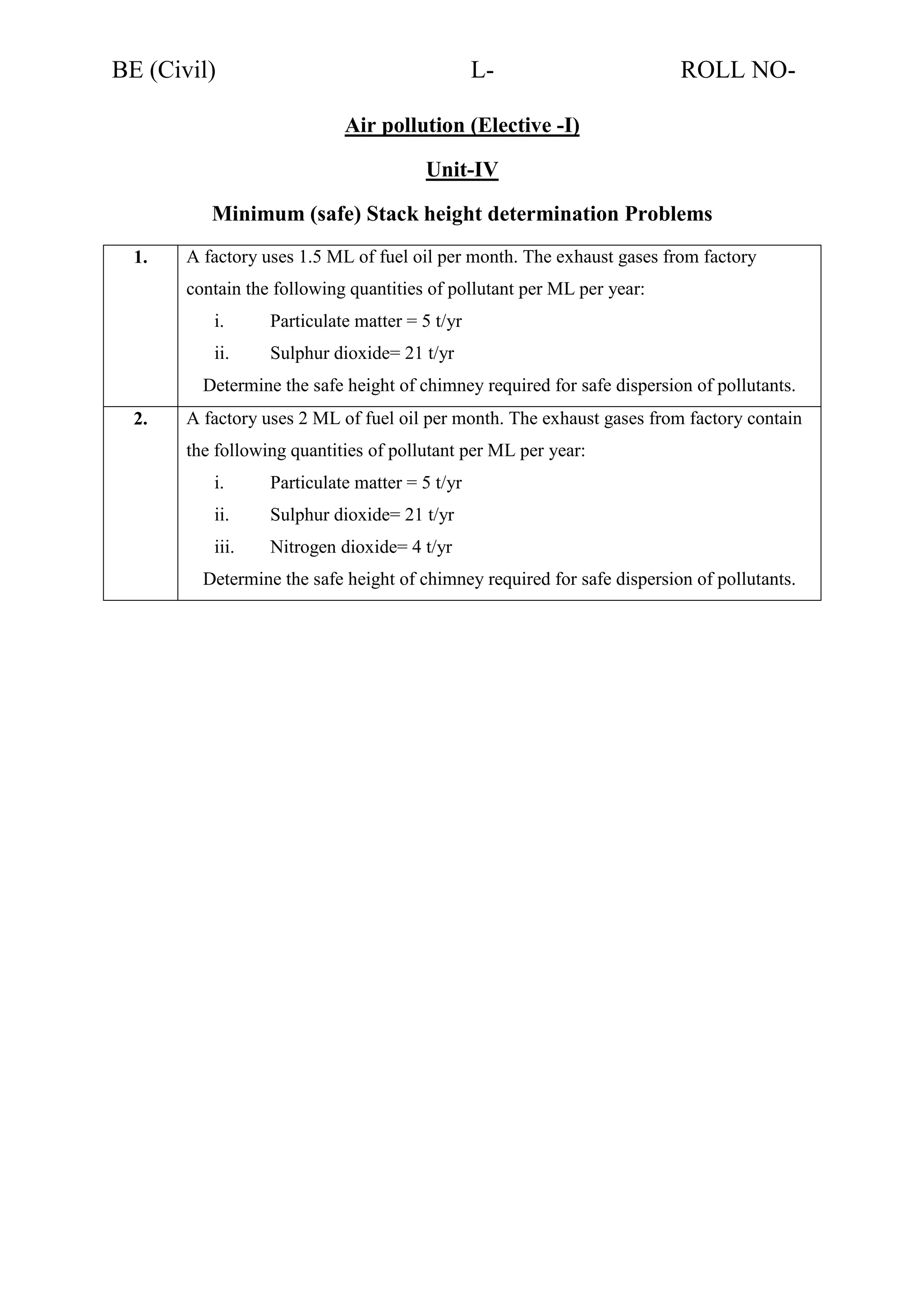
Minimum (safe) Stack height determination Problems
1.

A factory uses 1.5 ML of fuel oil per month. The exhaust gases from factory
contain the following quantities of pollutant per ML per year:
i.

Particulate matter = 5 t/yr

ii.

Sulphur dioxide= 21 t/yr

Determine the safe height of chimney required for safe dispersion of pollutants.
2.

A factory uses 2 ML of fuel oil per month. The exhaust gases from factory contain
the following quantities of pollutant per ML per year:
i.

Particulate matter = 5 t/yr

ii.

Sulphur dioxide= 21 t/yr

iii.

Nitrogen dioxide= 4 t/yr

Determine the safe height of chimney required for safe dispersion of pollutants.
BE (Civil)

L-

ROLL NO-

Air pollution (Elective -I)
Unit-IV
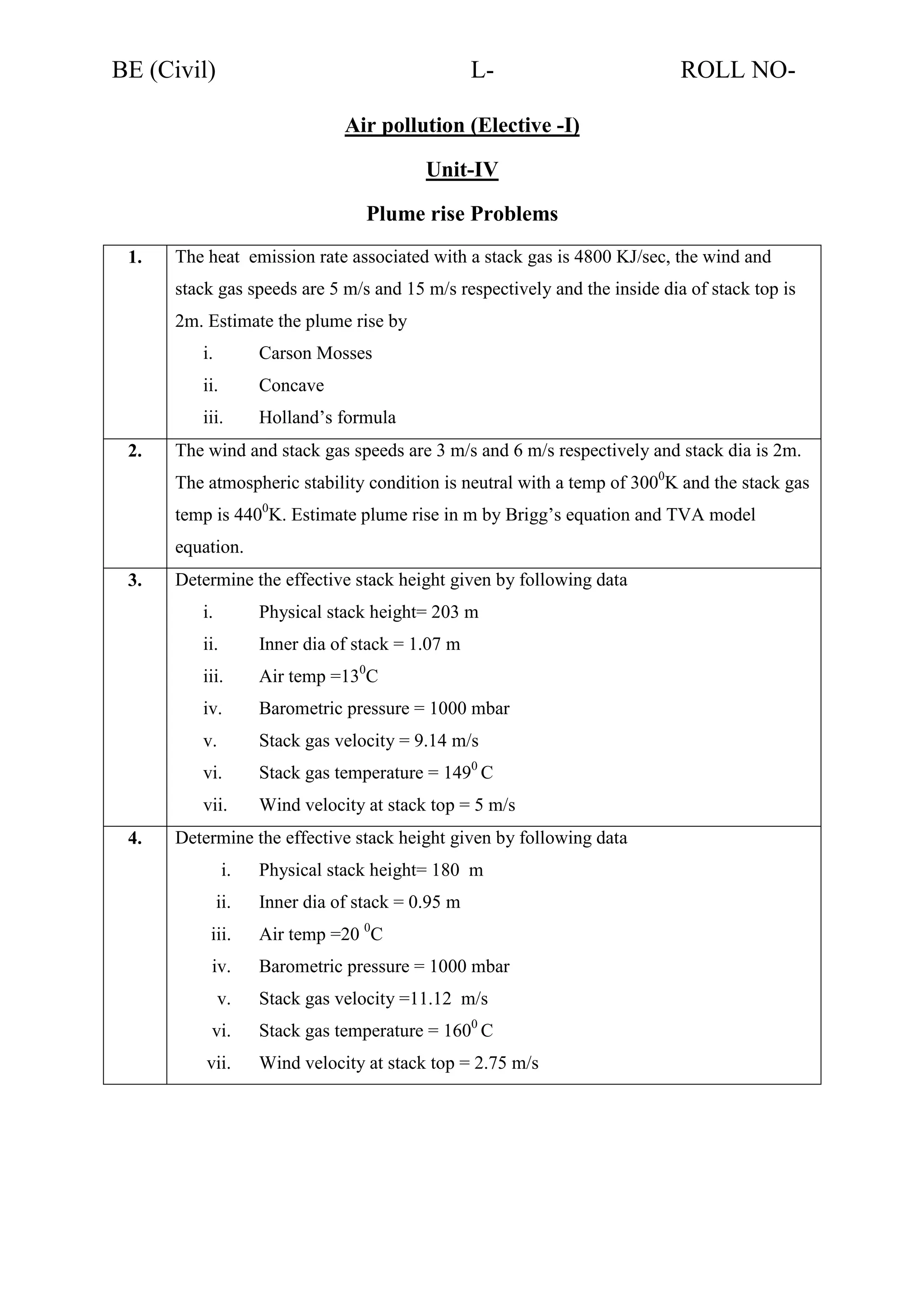
Plume rise Problems
1.

The heat emission rate associated with a stack gas is 4800 KJ/sec, the wind and
stack gas speeds are 5 m/s and 15 m/s respectively and the inside dia of stack top is
2m. Estimate the plume rise by
i.
ii.

Concave

iii.
2.

Carson Mosses

Holland’s formula

The wind and stack gas speeds are 3 m/s and 6 m/s respectively and stack dia is 2m.
The atmospheric stability condition is neutral with a temp of 3000K and the stack gas
temp is 4400K. Estimate plume rise in m by Brigg’s equation and TVA model
equation.

3.

Determine the effective stack height given by following data
i.
ii.

Inner dia of stack = 1.07 m

iii.

Air temp =130C

iv.

Barometric pressure = 1000 mbar

v.

Stack gas velocity = 9.14 m/s

vi.

Stack gas temperature = 1490 C

vii.
4.

Physical stack height= 203 m

Wind velocity at stack top = 5 m/s

Determine the effective stack height given by following data
i.

Physical stack height= 180 m

ii.

Inner dia of stack = 0.95 m

iii.

Air temp =20 0C

iv.

Barometric pressure = 1000 mbar

v.

Stack gas velocity =11.12 m/s

vi.

Stack gas temperature = 1600 C

vii.

Wind velocity at stack top = 2.75 m/s
BE (Civil)

L-

ROLL NO-

Air pollution (Elective -I)
Unit-IV
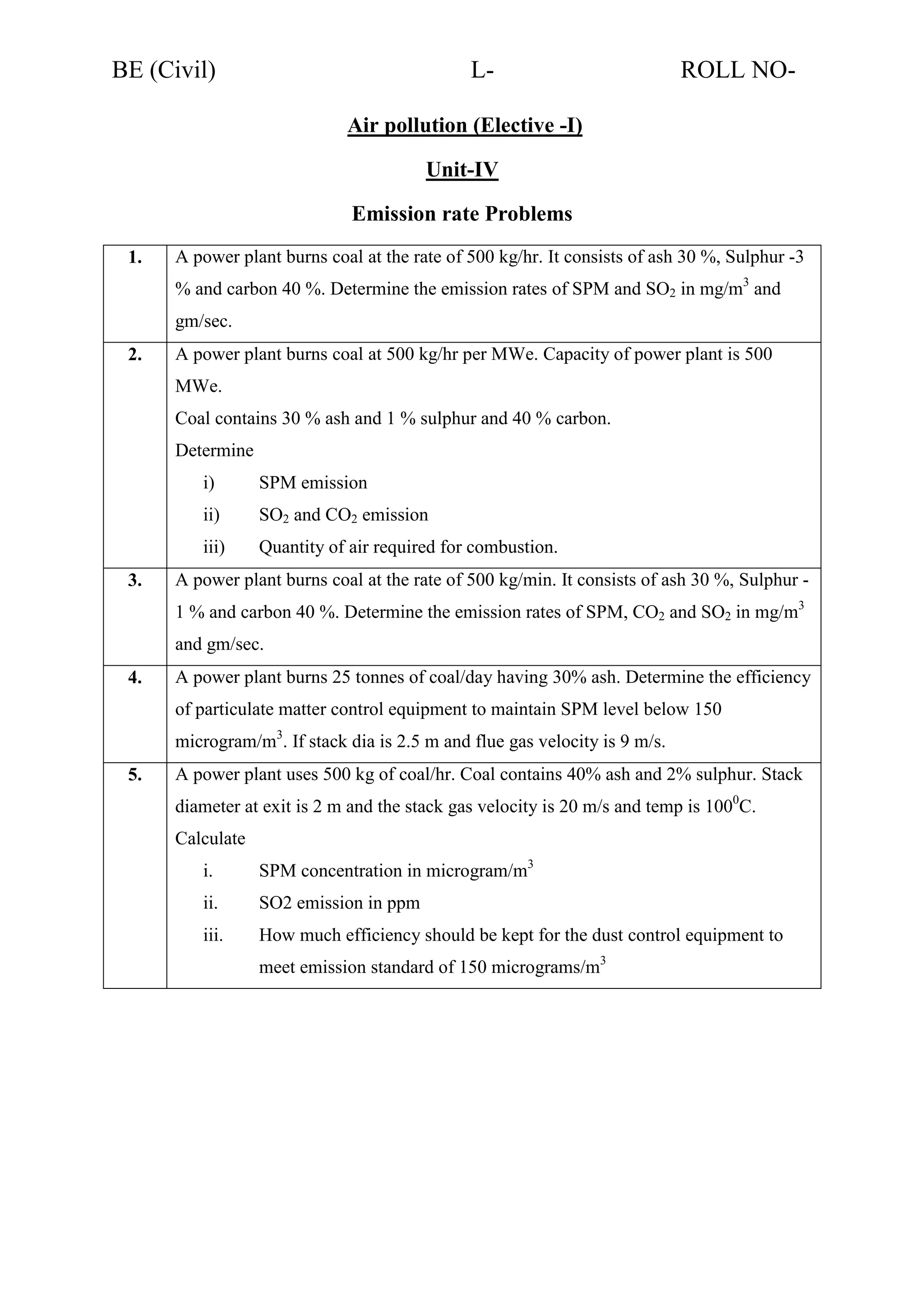
Emission rate Problems
1.

A power plant burns coal at the rate of 500 kg/hr. It consists of ash 30 %, Sulphur -3
% and carbon 40 %. Determine the emission rates of SPM and SO2 in mg/m3 and
gm/sec.

2.

A power plant burns coal at 500 kg/hr per MWe. Capacity of power plant is 500
MWe.
Coal contains 30 % ash and 1 % sulphur and 40 % carbon.
Determine
i)
ii)

SO2 and CO2 emission

iii)
3.

SPM emission

Quantity of air required for combustion.

A power plant burns coal at the rate of 500 kg/min. It consists of ash 30 %, Sulphur 1 % and carbon 40 %. Determine the emission rates of SPM, CO2 and SO2 in mg/m3
and gm/sec.

4.

A power plant burns 25 tonnes of coal/day having 30% ash. Determine the efficiency
of particulate matter control equipment to maintain SPM level below 150
microgram/m3. If stack dia is 2.5 m and flue gas velocity is 9 m/s.

5.

A power plant uses 500 kg of coal/hr. Coal contains 40% ash and 2% sulphur. Stack
diameter at exit is 2 m and the stack gas velocity is 20 m/s and temp is 1000C.
Calculate
i.

SPM concentration in microgram/m3

ii.

SO2 emission in ppm

iii.

How much efficiency should be kept for the dust control equipment to
meet emission standard of 150 micrograms/m3
BE (Civil)

L-

ROLL NO-

Air pollution (Elective -I)
Unit-IV
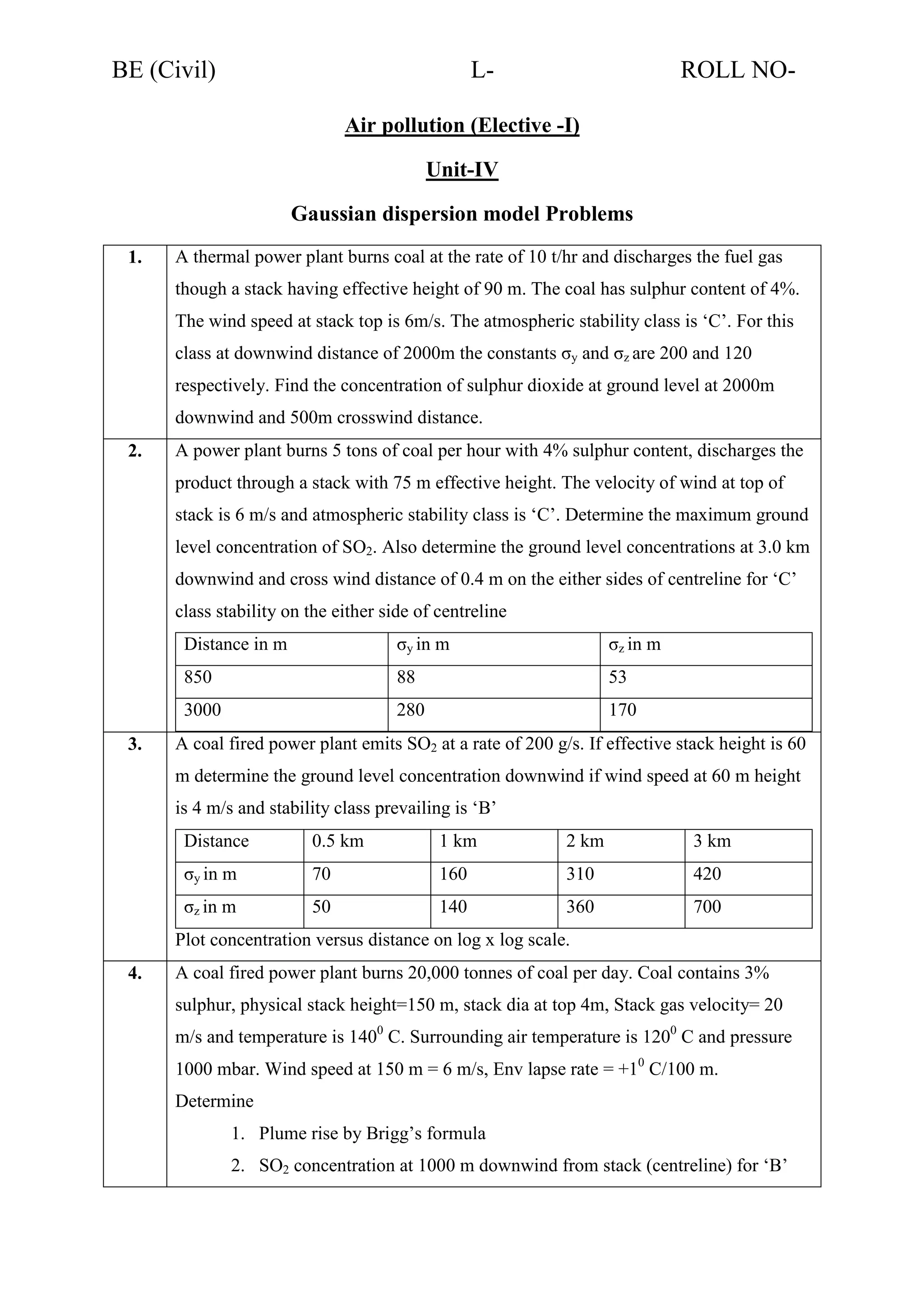
Gaussian dispersion model Problems
1.

A thermal power plant burns coal at the rate of 10 t/hr and discharges the fuel gas
though a stack having effective height of 90 m. The coal has sulphur content of 4%.
The wind speed at stack top is 6m/s. The atmospheric stability class is ‘C’. For this
class at downwind distance of 2000m the constants σy and σz are 200 and 120
respectively. Find the concentration of sulphur dioxide at ground level at 2000m
downwind and 500m crosswind distance.

2.

A power plant burns 5 tons of coal per hour with 4% sulphur content, discharges the
product through a stack with 75 m effective height. The velocity of wind at top of
stack is 6 m/s and atmospheric stability class is ‘C’. Determine the maximum ground
level concentration of SO2. Also determine the ground level concentrations at 3.0 km
downwind and cross wind distance of 0.4 m on the either sides of centreline for ‘C’
class stability on the either side of centreline
Distance in m

σz in m

850

88

53

3000
3.

σy in m

280

170

A coal fired power plant emits SO2 at a rate of 200 g/s. If effective stack height is 60
m determine the ground level concentration downwind if wind speed at 60 m height
is 4 m/s and stability class prevailing is ‘B’
Distance

0.5 km

1 km

2 km

3 km

σy in m

70

160

310

420

σz in m

50

140

360

700

Plot concentration versus distance on log x log scale.
4.

A coal fired power plant burns 20,000 tonnes of coal per day. Coal contains 3%
sulphur, physical stack height=150 m, stack dia at top 4m, Stack gas velocity= 20
m/s and temperature is 1400 C. Surrounding air temperature is 1200 C and pressure
1000 mbar. Wind speed at 150 m = 6 m/s, Env lapse rate = +10 C/100 m.
Determine
1. Plume rise by Brigg’s formula
2. SO2 concentration at 1000 m downwind from stack (centreline) for ‘B’
BE (Civil)

L-

ROLL NO-

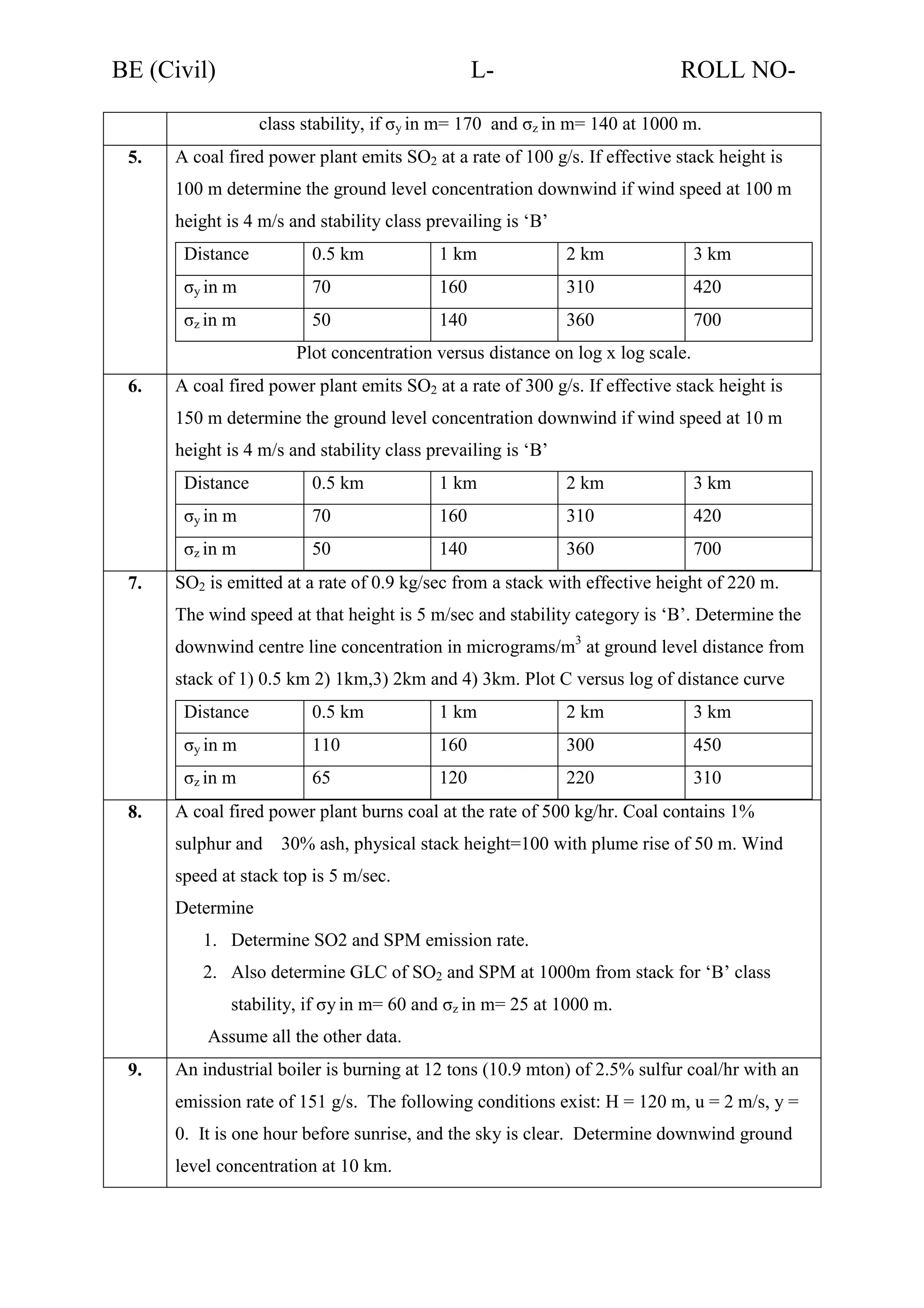
class stability, if σy in m= 170 and σz in m= 140 at 1000 m.
5.

A coal fired power plant emits SO2 at a rate of 100 g/s. If effective stack height is
100 m determine the ground level concentration downwind if wind speed at 100 m
height is 4 m/s and stability class prevailing is ‘B’
Distance

0.5 km

1 km

2 km

3 km

σy in m

70

160

310

420

σz in m

50

140

360

700

Plot concentration versus distance on log x log scale.
6.

A coal fired power plant emits SO2 at a rate of 300 g/s. If effective stack height is
150 m determine the ground level concentration downwind if wind speed at 10 m
height is 4 m/s and stability class prevailing is ‘B’
Distance

1 km

2 km

3 km

σy in m

70

160

310

420

σz in m
7.

0.5 km

50

140

360

700

SO2 is emitted at a rate of 0.9 kg/sec from a stack with effective height of 220 m.
The wind speed at that height is 5 m/sec and stability category is ‘B’. Determine the
downwind centre line concentration in micrograms/m3 at ground level distance from
stack of 1) 0.5 km 2) 1km,3) 2km and 4) 3km. Plot C versus log of distance curve
Distance

1 km

2 km

3 km

σy in m

110

160

300

450

σz in m
8.

0.5 km

65

120

220

310

A coal fired power plant burns coal at the rate of 500 kg/hr. Coal contains 1%
sulphur and

30% ash, physical stack height=100 with plume rise of 50 m. Wind

speed at stack top is 5 m/sec.
Determine
1. Determine SO2 and SPM emission rate.
2. Also determine GLC of SO2 and SPM at 1000m from stack for ‘B’ class
stability, if σy in m= 60 and σz in m= 25 at 1000 m.
Assume all the other data.
9.

An industrial boiler is burning at 12 tons (10.9 mton) of 2.5% sulfur coal/hr with an
emission rate of 151 g/s. The following conditions exist: H = 120 m, u = 2 m/s, y =
0. It is one hour before sunrise, and the sky is clear. Determine downwind ground
level concentration at 10 km.
BE (Civil)
10.

L-

ROLL NO-

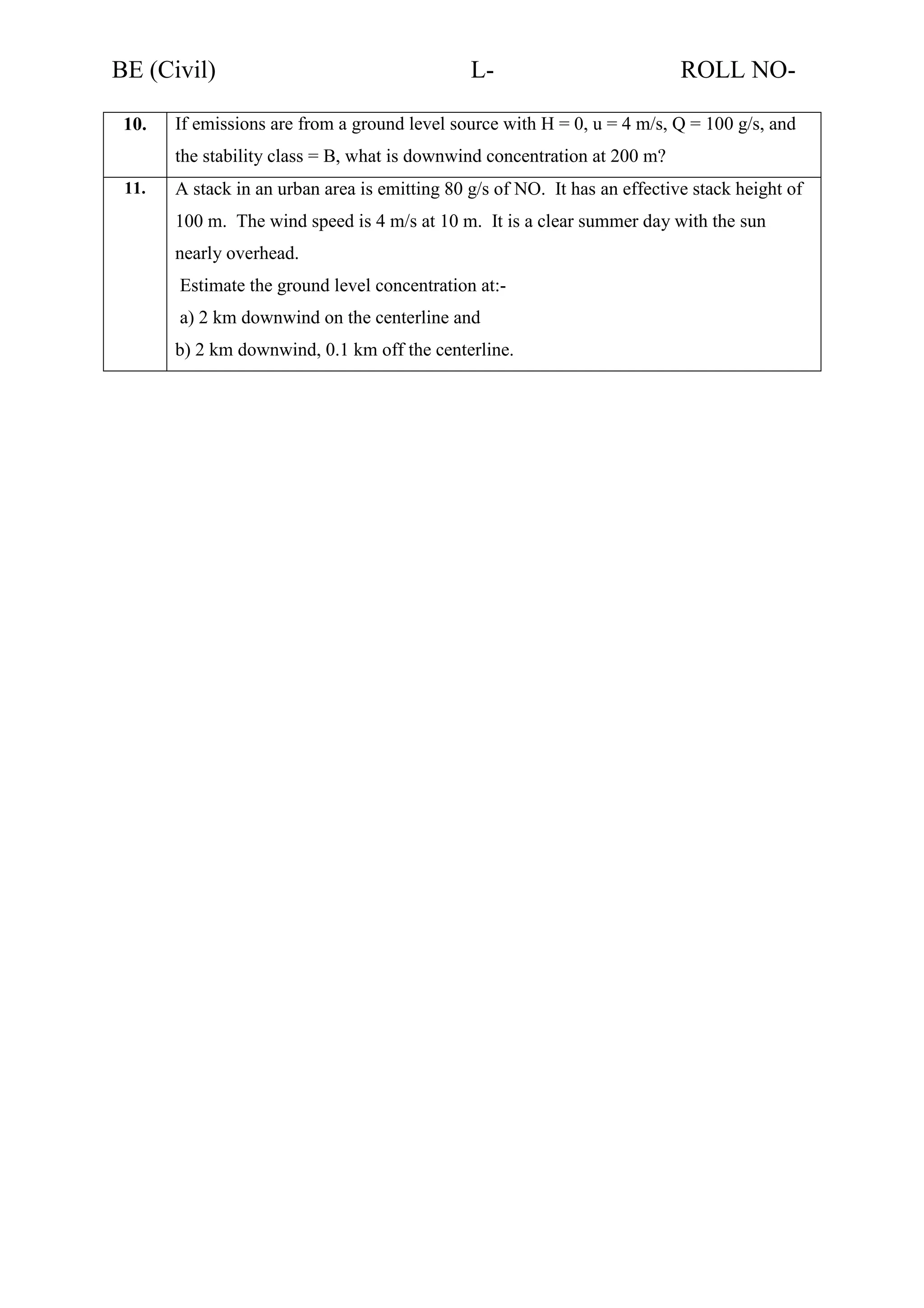
If emissions are from a ground level source with H = 0, u = 4 m/s, Q = 100 g/s, and
the stability class = B, what is downwind concentration at 200 m?

11.

A stack in an urban area is emitting 80 g/s of NO. It has an effective stack height of
100 m. The wind speed is 4 m/s at 10 m. It is a clear summer day with the sun
nearly overhead.
Estimate the ground level concentration at:a) 2 km downwind on the centerline and
b) 2 km downwind, 0.1 km off the centerline.

AIR POLLUTION CONTROL Unit iv problem set

  • 1.
    Prof S SJahagirdar, NKOCET AIR POLLUTION AND CONTROL (Elective-I) Problems set for UNIT-IV AIR POLLUTION METEOROLOGY Page | 1
  • 2.
    BE (Civil) L- ROLL NO- Airpollution (Elective -I) Unit-IV Stability conditions (Temperature gradient) Problems 1. On the basis of temperature gradient in the situation described below classify the degree of stability of atmosphere. i. ii. Temp at ground 350C and temp at 650 m height is 220 C iii. Temp at ground 250C and temp at 700 m height is 280 C iv. 2. Temp at ground 340C and temp at 500 m height is 400 C Temp at ground 250C and temp at 200 m height is 50 C Temperature at ground level is 30OC. Find the atmospheric stability condition in each of the following cases. Case Temp. (OC) I 700 10 II 500 34 III 1000 25 IV 3. Altitude (m) 500 20 Determine whether the atmosphere is unstable, neutral or stable for the following case. Initial Temperature 30.2 oC Final Temperature - 58.5 oC Initial Height 221 m Final Height 23214 m
  • 3.
    BE (Civil) L- ROLL NO- Airpollution (Elective -I) Unit-IV Finding Wind speed at higher altitudes Problems 1. The wind speed at 10 m altitude is 5m/s. Find the wind speed at 250 m altitude for the following stability conditions. i. ii. Zero or small lapse rate iii. Moderate inversion iv. 2. Large lapse rate Large inversion Wind speed at 10 m altitude is 2m/s. Find the wind speed at 200 m altitude for following cases i. ii. Zero lapse rate iii. Moderate inversion iv. 3. Large lapse rate Large inversion The ground level wind velocity at 10 m elevation is 5.2 m/sec in a city. What would you estimate the velocity to be at 125m elevation in moderately stable atmosphere?
  • 4.
    BE (Civil) L- ROLL NO- Airpollution (Elective -I) Unit-IV Maximum Mixing Depth (MMD) Problems 1. At a given location the ground Environmental air temperature is 180 C, while normal maximum surface temperature for the month is known to be 300 C. At an elevation of 700 m the temperature of the atmosphere measured is a) 150 C and b) 200 C. What is maximum mixing depth in meters for two cases? 2. Air parcel temp at ground level is 280C. The environmental temperature at ground level is 300 and at 500 m is 27.5 0C. Determine the MMD 3. A rising parcel of dry air has a temp of 300 C at sea level. Assuming DALR of 10C/100m, determine MMD if environmental temperature temp at sea level is 150C and ELR is +10C/100 m 4. In a given situation ground level temperature is 180C, while normal maximum surface temp for that month is a) 26 0C and b) 240C. At an elevation of 300 m the temperature is found to be 210C. What is MMD in metres for both the cases? 5. A rising parcel of dry air has a temp of 350 C at sea level. Assuming DALR of 10C/100m, determine MMD if environmental temperature temp at sea level is 150C and ELR is +10C/100 m 6. Determine the maximum mixing depth if flue gas temperature is 30oC, when: i) Average ground temperature is 20 oC and temperature at elevation of 600 m is 30oC ii) Average ground temperature is 25 oC and temperature at elevation of 500 m is 20oC Assume DALR= -9.8 oC/1000 m. 7. Calculate the maximum mixing height from the following early morning temperature data given below: Height (m) 0 250 350 450 550 650 Temperature (oC) 9.5 12.2 15.1 15.6 16.2 16.5 The maximum surface temperature for the day was 15oC.
  • 5.
    BE (Civil) L- ROLL NO- Airpollution (Elective -I) Unit-IV Minimum (safe) Stack height determination Problems 1. A factory uses 1.5 ML of fuel oil per month. The exhaust gases from factory contain the following quantities of pollutant per ML per year: i. Particulate matter = 5 t/yr ii. Sulphur dioxide= 21 t/yr Determine the safe height of chimney required for safe dispersion of pollutants. 2. A factory uses 2 ML of fuel oil per month. The exhaust gases from factory contain the following quantities of pollutant per ML per year: i. Particulate matter = 5 t/yr ii. Sulphur dioxide= 21 t/yr iii. Nitrogen dioxide= 4 t/yr Determine the safe height of chimney required for safe dispersion of pollutants.
  • 6.
    BE (Civil) L- ROLL NO- Airpollution (Elective -I) Unit-IV Plume rise Problems 1. The heat emission rate associated with a stack gas is 4800 KJ/sec, the wind and stack gas speeds are 5 m/s and 15 m/s respectively and the inside dia of stack top is 2m. Estimate the plume rise by i. ii. Concave iii. 2. Carson Mosses Holland’s formula The wind and stack gas speeds are 3 m/s and 6 m/s respectively and stack dia is 2m. The atmospheric stability condition is neutral with a temp of 3000K and the stack gas temp is 4400K. Estimate plume rise in m by Brigg’s equation and TVA model equation. 3. Determine the effective stack height given by following data i. ii. Inner dia of stack = 1.07 m iii. Air temp =130C iv. Barometric pressure = 1000 mbar v. Stack gas velocity = 9.14 m/s vi. Stack gas temperature = 1490 C vii. 4. Physical stack height= 203 m Wind velocity at stack top = 5 m/s Determine the effective stack height given by following data i. Physical stack height= 180 m ii. Inner dia of stack = 0.95 m iii. Air temp =20 0C iv. Barometric pressure = 1000 mbar v. Stack gas velocity =11.12 m/s vi. Stack gas temperature = 1600 C vii. Wind velocity at stack top = 2.75 m/s
  • 7.
    BE (Civil) L- ROLL NO- Airpollution (Elective -I) Unit-IV Emission rate Problems 1. A power plant burns coal at the rate of 500 kg/hr. It consists of ash 30 %, Sulphur -3 % and carbon 40 %. Determine the emission rates of SPM and SO2 in mg/m3 and gm/sec. 2. A power plant burns coal at 500 kg/hr per MWe. Capacity of power plant is 500 MWe. Coal contains 30 % ash and 1 % sulphur and 40 % carbon. Determine i) ii) SO2 and CO2 emission iii) 3. SPM emission Quantity of air required for combustion. A power plant burns coal at the rate of 500 kg/min. It consists of ash 30 %, Sulphur 1 % and carbon 40 %. Determine the emission rates of SPM, CO2 and SO2 in mg/m3 and gm/sec. 4. A power plant burns 25 tonnes of coal/day having 30% ash. Determine the efficiency of particulate matter control equipment to maintain SPM level below 150 microgram/m3. If stack dia is 2.5 m and flue gas velocity is 9 m/s. 5. A power plant uses 500 kg of coal/hr. Coal contains 40% ash and 2% sulphur. Stack diameter at exit is 2 m and the stack gas velocity is 20 m/s and temp is 1000C. Calculate i. SPM concentration in microgram/m3 ii. SO2 emission in ppm iii. How much efficiency should be kept for the dust control equipment to meet emission standard of 150 micrograms/m3
  • 8.
    BE (Civil) L- ROLL NO- Airpollution (Elective -I) Unit-IV Gaussian dispersion model Problems 1. A thermal power plant burns coal at the rate of 10 t/hr and discharges the fuel gas though a stack having effective height of 90 m. The coal has sulphur content of 4%. The wind speed at stack top is 6m/s. The atmospheric stability class is ‘C’. For this class at downwind distance of 2000m the constants σy and σz are 200 and 120 respectively. Find the concentration of sulphur dioxide at ground level at 2000m downwind and 500m crosswind distance. 2. A power plant burns 5 tons of coal per hour with 4% sulphur content, discharges the product through a stack with 75 m effective height. The velocity of wind at top of stack is 6 m/s and atmospheric stability class is ‘C’. Determine the maximum ground level concentration of SO2. Also determine the ground level concentrations at 3.0 km downwind and cross wind distance of 0.4 m on the either sides of centreline for ‘C’ class stability on the either side of centreline Distance in m σz in m 850 88 53 3000 3. σy in m 280 170 A coal fired power plant emits SO2 at a rate of 200 g/s. If effective stack height is 60 m determine the ground level concentration downwind if wind speed at 60 m height is 4 m/s and stability class prevailing is ‘B’ Distance 0.5 km 1 km 2 km 3 km σy in m 70 160 310 420 σz in m 50 140 360 700 Plot concentration versus distance on log x log scale. 4. A coal fired power plant burns 20,000 tonnes of coal per day. Coal contains 3% sulphur, physical stack height=150 m, stack dia at top 4m, Stack gas velocity= 20 m/s and temperature is 1400 C. Surrounding air temperature is 1200 C and pressure 1000 mbar. Wind speed at 150 m = 6 m/s, Env lapse rate = +10 C/100 m. Determine 1. Plume rise by Brigg’s formula 2. SO2 concentration at 1000 m downwind from stack (centreline) for ‘B’
  • 9.
    BE (Civil) L- ROLL NO- classstability, if σy in m= 170 and σz in m= 140 at 1000 m. 5. A coal fired power plant emits SO2 at a rate of 100 g/s. If effective stack height is 100 m determine the ground level concentration downwind if wind speed at 100 m height is 4 m/s and stability class prevailing is ‘B’ Distance 0.5 km 1 km 2 km 3 km σy in m 70 160 310 420 σz in m 50 140 360 700 Plot concentration versus distance on log x log scale. 6. A coal fired power plant emits SO2 at a rate of 300 g/s. If effective stack height is 150 m determine the ground level concentration downwind if wind speed at 10 m height is 4 m/s and stability class prevailing is ‘B’ Distance 1 km 2 km 3 km σy in m 70 160 310 420 σz in m 7. 0.5 km 50 140 360 700 SO2 is emitted at a rate of 0.9 kg/sec from a stack with effective height of 220 m. The wind speed at that height is 5 m/sec and stability category is ‘B’. Determine the downwind centre line concentration in micrograms/m3 at ground level distance from stack of 1) 0.5 km 2) 1km,3) 2km and 4) 3km. Plot C versus log of distance curve Distance 1 km 2 km 3 km σy in m 110 160 300 450 σz in m 8. 0.5 km 65 120 220 310 A coal fired power plant burns coal at the rate of 500 kg/hr. Coal contains 1% sulphur and 30% ash, physical stack height=100 with plume rise of 50 m. Wind speed at stack top is 5 m/sec. Determine 1. Determine SO2 and SPM emission rate. 2. Also determine GLC of SO2 and SPM at 1000m from stack for ‘B’ class stability, if σy in m= 60 and σz in m= 25 at 1000 m. Assume all the other data. 9. An industrial boiler is burning at 12 tons (10.9 mton) of 2.5% sulfur coal/hr with an emission rate of 151 g/s. The following conditions exist: H = 120 m, u = 2 m/s, y = 0. It is one hour before sunrise, and the sky is clear. Determine downwind ground level concentration at 10 km.
  • 10.
    BE (Civil) 10. L- ROLL NO- Ifemissions are from a ground level source with H = 0, u = 4 m/s, Q = 100 g/s, and the stability class = B, what is downwind concentration at 200 m? 11. A stack in an urban area is emitting 80 g/s of NO. It has an effective stack height of 100 m. The wind speed is 4 m/s at 10 m. It is a clear summer day with the sun nearly overhead. Estimate the ground level concentration at:a) 2 km downwind on the centerline and b) 2 km downwind, 0.1 km off the centerline.