SAMPLING METHODS
PRESENTED BY
AJITH KUMAR
mohamed sathak engineering college
Ramanatha puram
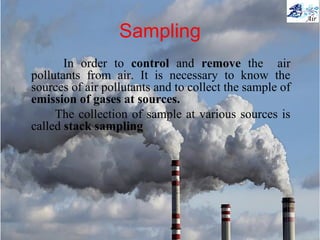
Sampling
In order to control and remove the air
pollutants from air. It is necessary to know the
sources of air pollutants and to collect the sample of
emission of gases at sources.
The collection of sample at various sources is
called stack sampling
Objectives of sampling
 To measure quality and quantity of pollutant
produced by the source.
 To determine the effect of emission througout the
year and monthly variation in the year
 To determine the effect of emission in different
zones/area of the country.
 To know the nature of the pollutant source.
 To estimate the single or mutiple pollutant sources.
 To determine the method of control of air pollutants.
 To implement the local air pollution- control system.
Objectives of sampling
Selection of sampling location
 The sampling point should be as far as possible from
any disturbing influence, such as elbows, bends,
transition pieces, baffles.
 The sampling point, wherever possible should be at a
distance of 5-10 diameters down-stream from any
obstruction and 3-5 diameters up-stream from similar
disturbance.
 The size of the sampling point may be made in the
range of 7-10 cm, in diameter.
Number of stations• Minimum number is three.
 The location is dependent upon the wind rose diagram that
gives predominant wind directions and speed.
 One station must be at upstream of predominant wind
direction and other two must at downstream pre dominant
wind direction.
 More than three stations can also be established depending
upon the area of coverage.
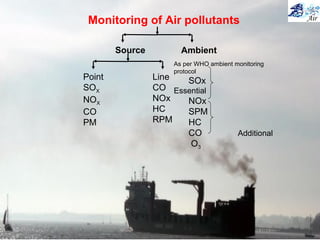
Monitoring of Air pollutants
Source Ambient
As per WHO ambient monitoring
protocol
SOx
Essential
NOx
SPM
HC
CO Additional
O3
Point
SOX
NOX
CO
PM
Line
CO
NOx
HC
RPM
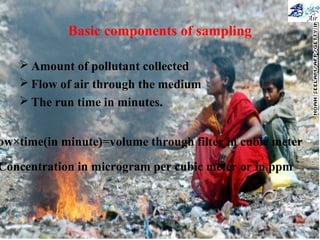
Basic components of sampling
 Amount of pollutant collected
 Flow of air through the medium
 The run time in minutes.
ow×time(in minute)=volume through filter in cubic meter
Concentration in microgram per cubic meter or in ppm
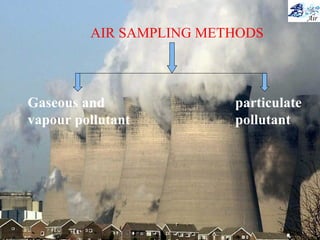
AIR SAMPLING METHODS
particulate
pollutant
Gaseous and
vapour pollutant
particulate pollutant
Air sampling techniques for particulate
pollutants
 SEDIMENTATION
 FILTRATION
 IMPINGEMENT
 PERCIPITATION
1) THERMAL PRECIPITAION
2) ELECTROSTATIC PRECIPITATION
SEDIMENTATION
Used to collect settle able particulate that settle out of
the atmosphere as a result of the gravitation force
Particulate pollutant having size of 10 mirco meter
can be collected with 99% efficiency
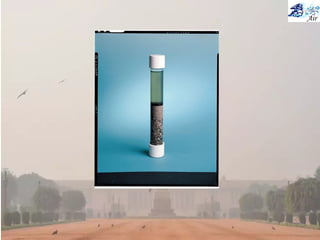
The sampler consists of simple dust jar fitted with a
funnel
A liquid is added to collector to prevent the solids
blown out from the jar by air
Collected dust is evaporated to dryness and then
weighed in mg
Sampling period is 30 days
FILTRATION
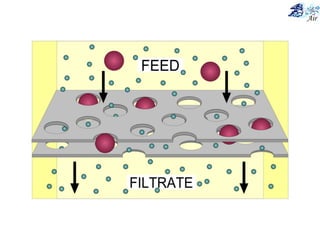
 Technique used in the collection of air pollutants of
size smaller than 10 micro meter in diameter
 The particulates are removed from the air sample
by suction apparatus through a porous filter where
particulates are deposited
 The glass fiber filter of porous size less than 0.1
micro meter is used in high volume sampler
 Sampling period: 24 hours
 Air volume sucked: 2000 cubic meter
 Particulate concentration: micro gram per cubic
meter
IMPINGEMENT
 Based on the inertial technique in which particles
are collected from the high velocity air steam
directed toward the obstacles placed across the path
of air stream
 Particulates collide with the obstacle and air
changes its direction
 If the obstacle are adhesive surface then particles
are impacted on it and this is known as dry
impingement
 If obstacle is wet by any liquid then it is called wet
impingement
PRECIPITATION
THERMAL PRECIPITATION :-
 Thermal precipitation is based on the principle that
the particles move towards the lower temperature
region when subjected to a strong temperature
gradient
 The temperature gradients are normally of the
order of 3000 C per centimeter
 This technique is used to collect the particle of size
0.001 micrometer with high efficiency
ELECTROSTATIC PRECIPITATION:-
 Theses precipitators are an electrically charged to
force radioactive particulates to migrate out the air
steam onto a collection surface
 In this precipitators two electrodes are used
positive and negative
 When the air stream with particulates pass through
the electrodes particles pick up negative charge and
migrate towards inner post of the precipitators
where got discharged and deposited on the positive
electrodes
gaseous pollutants
Air sampling techniques for gaseous pollutants
 ABSORPTION SAMPLING
 ADSORPTION SAMPLING
 CONDENSATION SAMPLING
ABSORPTION SAMPLING
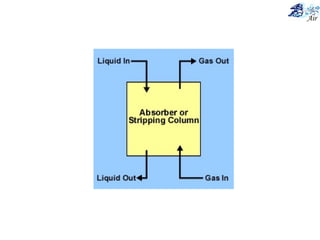
 Gaseous pollutants are absorbed in a solvent when
both the pollutant and absorbent are in close
contact
 Liquid react with the gaseous pollutant to form
a non gaseous pollutant
ALKALINE FOR ACIDIC GASES
ACIDIC SOLUTION FOR ALKALINE GASES
OILS FOR HYDROCARBONS
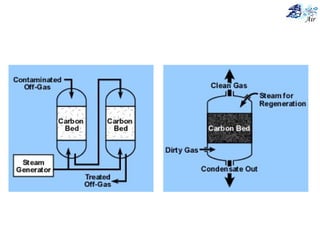
ADSORPTION SAMPLING
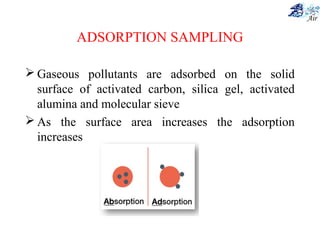
 Gaseous pollutants are adsorbed on the solid
surface of activated carbon, silica gel, activated
alumina and molecular sieve
 As the surface area increases the adsorption
increases
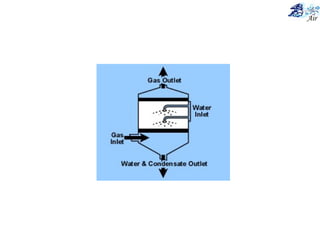
CONDENSATION SAMPLING
 The conversion of a vapour or gas to a liquid
 Method used to collect the radioactive gases,
hydrocarbons and non reactive vapors
 Air pollutant can be trapped by condensation
reaction
 As the gaseous pollutant pass through the different
temperature range of condensers where the
temperature is below the boiling point the gaseous
pollutant will trap in the liquid
SOME NEW METHODS OF AIR
SAMPLING
Bubble Sampling
 Air drawn into the impinger is forced through a nozzle,
which is covered by a liquid such as high purity water.
 The pollutant dissolves in the liquid and is subsequently
analysed, usually by colorimetric techniques.
Sorbent Sampling
 Sorbents are normally contained in a small glass tube with
sealed ends.
 Air is drawn through the sorbent, which captures molecules
of the gas or vapour to be sampled.
 The trapped contaminants are released using solvent
washing or heat to a gas chromatograph (GC) for analysis.
One of the best known sorbents is charcoal.
THANK YOU

SAMPLING IN AIR POLLUTION

  • 1.
    SAMPLING METHODS PRESENTED BY AJITHKUMAR mohamed sathak engineering college Ramanatha puram
  • 2.
    Sampling In order tocontrol and remove the air pollutants from air. It is necessary to know the sources of air pollutants and to collect the sample of emission of gases at sources. The collection of sample at various sources is called stack sampling
  • 3.
    Objectives of sampling To measure quality and quantity of pollutant produced by the source.  To determine the effect of emission througout the year and monthly variation in the year  To determine the effect of emission in different zones/area of the country.  To know the nature of the pollutant source.  To estimate the single or mutiple pollutant sources.
  • 4.
     To determinethe method of control of air pollutants.  To implement the local air pollution- control system. Objectives of sampling
  • 5.
    Selection of samplinglocation  The sampling point should be as far as possible from any disturbing influence, such as elbows, bends, transition pieces, baffles.  The sampling point, wherever possible should be at a distance of 5-10 diameters down-stream from any obstruction and 3-5 diameters up-stream from similar disturbance.  The size of the sampling point may be made in the range of 7-10 cm, in diameter.
  • 6.
    Number of stations•Minimum number is three.  The location is dependent upon the wind rose diagram that gives predominant wind directions and speed.  One station must be at upstream of predominant wind direction and other two must at downstream pre dominant wind direction.  More than three stations can also be established depending upon the area of coverage.
  • 7.
    Monitoring of Airpollutants Source Ambient As per WHO ambient monitoring protocol SOx Essential NOx SPM HC CO Additional O3 Point SOX NOX CO PM Line CO NOx HC RPM
  • 8.
    Basic components ofsampling  Amount of pollutant collected  Flow of air through the medium  The run time in minutes. ow×time(in minute)=volume through filter in cubic meter Concentration in microgram per cubic meter or in ppm
  • 9.
  • 10.
  • 11.
    Air sampling techniquesfor particulate pollutants  SEDIMENTATION  FILTRATION  IMPINGEMENT  PERCIPITATION 1) THERMAL PRECIPITAION 2) ELECTROSTATIC PRECIPITATION
  • 12.
    SEDIMENTATION Used to collectsettle able particulate that settle out of the atmosphere as a result of the gravitation force Particulate pollutant having size of 10 mirco meter can be collected with 99% efficiency The sampler consists of simple dust jar fitted with a funnel A liquid is added to collector to prevent the solids blown out from the jar by air Collected dust is evaporated to dryness and then weighed in mg Sampling period is 30 days
  • 14.
    FILTRATION  Technique usedin the collection of air pollutants of size smaller than 10 micro meter in diameter  The particulates are removed from the air sample by suction apparatus through a porous filter where particulates are deposited  The glass fiber filter of porous size less than 0.1 micro meter is used in high volume sampler  Sampling period: 24 hours  Air volume sucked: 2000 cubic meter  Particulate concentration: micro gram per cubic meter
  • 16.
    IMPINGEMENT  Based onthe inertial technique in which particles are collected from the high velocity air steam directed toward the obstacles placed across the path of air stream  Particulates collide with the obstacle and air changes its direction  If the obstacle are adhesive surface then particles are impacted on it and this is known as dry impingement  If obstacle is wet by any liquid then it is called wet impingement
  • 17.
    PRECIPITATION THERMAL PRECIPITATION :- Thermal precipitation is based on the principle that the particles move towards the lower temperature region when subjected to a strong temperature gradient  The temperature gradients are normally of the order of 3000 C per centimeter  This technique is used to collect the particle of size 0.001 micrometer with high efficiency
  • 18.
    ELECTROSTATIC PRECIPITATION:-  Thesesprecipitators are an electrically charged to force radioactive particulates to migrate out the air steam onto a collection surface  In this precipitators two electrodes are used positive and negative  When the air stream with particulates pass through the electrodes particles pick up negative charge and migrate towards inner post of the precipitators where got discharged and deposited on the positive electrodes
  • 19.
  • 20.
    Air sampling techniquesfor gaseous pollutants  ABSORPTION SAMPLING  ADSORPTION SAMPLING  CONDENSATION SAMPLING
  • 21.
    ABSORPTION SAMPLING  Gaseouspollutants are absorbed in a solvent when both the pollutant and absorbent are in close contact  Liquid react with the gaseous pollutant to form a non gaseous pollutant ALKALINE FOR ACIDIC GASES ACIDIC SOLUTION FOR ALKALINE GASES OILS FOR HYDROCARBONS
  • 23.
    ADSORPTION SAMPLING  Gaseouspollutants are adsorbed on the solid surface of activated carbon, silica gel, activated alumina and molecular sieve  As the surface area increases the adsorption increases
  • 25.
    CONDENSATION SAMPLING  Theconversion of a vapour or gas to a liquid  Method used to collect the radioactive gases, hydrocarbons and non reactive vapors  Air pollutant can be trapped by condensation reaction  As the gaseous pollutant pass through the different temperature range of condensers where the temperature is below the boiling point the gaseous pollutant will trap in the liquid
  • 27.
    SOME NEW METHODSOF AIR SAMPLING Bubble Sampling  Air drawn into the impinger is forced through a nozzle, which is covered by a liquid such as high purity water.  The pollutant dissolves in the liquid and is subsequently analysed, usually by colorimetric techniques. Sorbent Sampling  Sorbents are normally contained in a small glass tube with sealed ends.  Air is drawn through the sorbent, which captures molecules of the gas or vapour to be sampled.  The trapped contaminants are released using solvent washing or heat to a gas chromatograph (GC) for analysis. One of the best known sorbents is charcoal.
  • 28.