Meteorology and Dispersion Modeling 
Air Quality and Meteorology 
• Primary Metrological Parameter 
– Wind speed, Wind Direction, Atmospheric Stability 
• Secondary Metrological Parameter 
– sunlight 
– temperature 
– precipitation and humidity 
– Topography 
– Energy from the sun and earth’s rotation drives 
atmospheric circulation
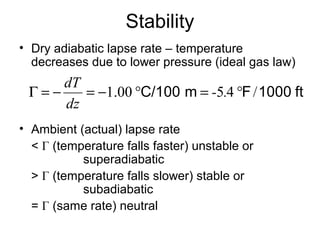
Stability 
• Dry adiabatic lapse rate – temperature 
decreases due to lower pressure (ideal gas law) 
dT 
G = - = -1.00 °C/100 m = -5.4 °F/1000 ft 
dz 
• Ambient (actual) lapse rate 
< Г (temperature falls faster) unstable or 
superadiabatic 
> Г (temperature falls slower) stable or 
subadiabatic 
= Г (same rate) neutral
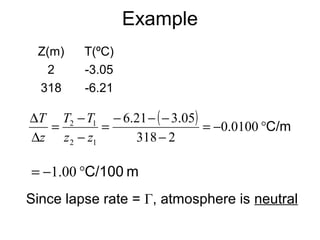
Example 
Z(m) T(ºC) 
2 -3.05 
318 -6.21 
( ) = - °C/m 
- 
T T 
T 
D = - 
= - - - 
0.0100 
2 1 
z - 
z 
D 
6.21 3.05 
318 2 
2 1 
z 
= -1.00 °C/100 m 
Since lapse rate = Г, atmosphere is neutral
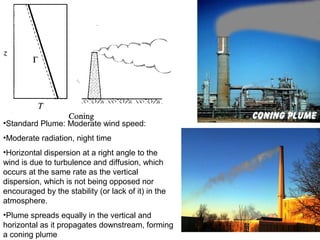
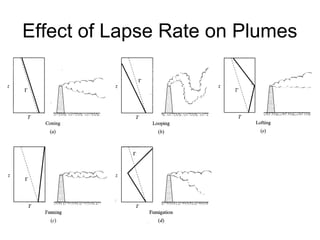
•Standard Plume: Moderate wind speed: 
•Moderate radiation, night time 
•Horizontal dispersion at a right angle to the 
wind is due to turbulence and diffusion, which 
occurs at the same rate as the vertical 
dispersion, which is not being opposed nor 
encouraged by the stability (or lack of it) in the 
atmosphere. 
•Plume spreads equally in the vertical and 
horizontal as it propagates downstream, forming 
a coning plume
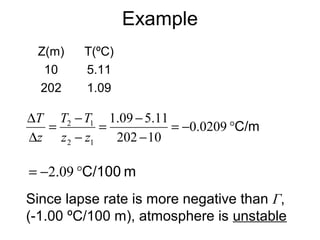
Example 
Z(m) T(ºC) 
10 5.11 
202 1.09 
T T 
T 
D 0.0209 
= - °C/m 
= - 
1.09 5.11 
- 
= - 
2 1 
z - 
z 
D 
202 10 
2 1 
z 
= -2.09 °C/100 m 
Since lapse rate is more negative than Г, 
(-1.00 ºC/100 m), atmosphere is unstable
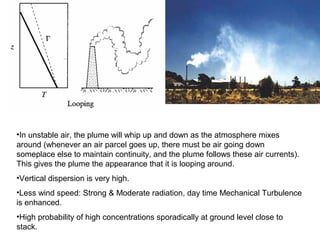
•In unstable air, the plume will whip up and down as the atmosphere mixes 
around (whenever an air parcel goes up, there must be air going down 
someplace else to maintain continuity, and the plume follows these air currents). 
This gives the plume the appearance that it is looping around. 
•Vertical dispersion is very high. 
•Less wind speed: Strong & Moderate radiation, day time Mechanical Turbulence 
is enhanced. 
•High probability of high concentrations sporadically at ground level close to 
stack.
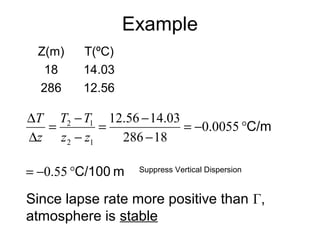
Example 
Z(m) T(ºC) 
18 14.03 
286 12.56 
T T 
T 
D 0.0055 
= - °C/m 
= - 
12.56 14.03 
- 
= - 
2 1 
z - 
z 
D 
286 18 
2 1 
z 
= -0.55 °C/100 m 
Suppress Vertical Dispersion 
Since lapse rate more positive than Г, 
atmosphere is stable
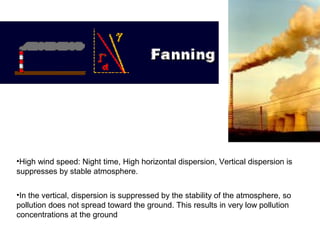
•High wind speed: Night time, High horizontal dispersion, Vertical dispersion is 
suppresses by stable atmosphere. 
•In the vertical, dispersion is suppressed by the stability of the atmosphere, so 
pollution does not spread toward the ground. This results in very low pollution 
concentrations at the ground
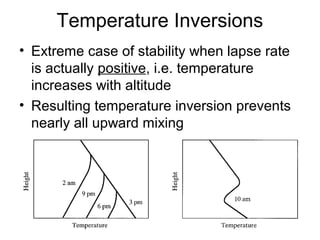
Temperature Inversions 
• Extreme case of stability when lapse rate 
is actually positive, i.e. temperature 
increases with altitude 
• Resulting temperature inversion prevents 
nearly all upward mixing
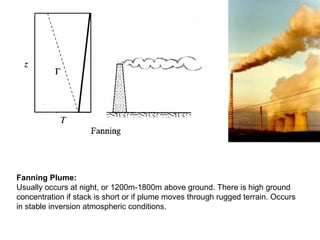
Fanning Plume: 
Usually occurs at night, or 1200m-1800m above ground. There is high ground 
concentration if stack is short or if plume moves through rugged terrain. Occurs 
in stable inversion atmospheric conditions.
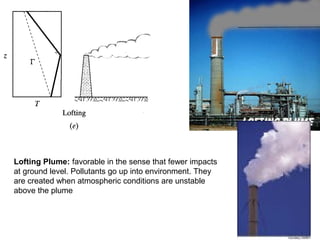
Lofting Plume: favorable in the sense that fewer impacts 
at ground level. Pollutants go up into environment. They 
are created when atmospheric conditions are unstable 
above the plume
Fumigation: 
most dangerous plume: contaminants are all coming 
down to ground level. They are created when 
atmospheric conditions are inversion stable above the 
plume and unstable below. This happens most often 
after the daylight sun has warmed the atmosphere, 
which turns a night time fanning plume into fumigation 
for about a half an hour.
Effect of Lapse Rate on Plumes
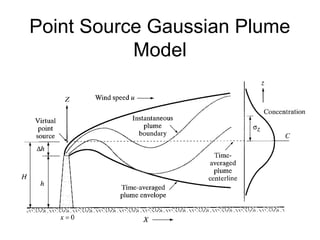
Point Source Gaussian Plume 
Model
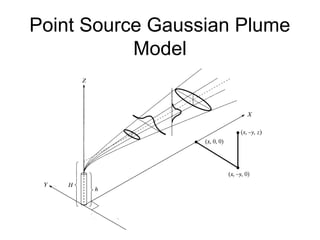
Point Source Gaussian Plume 
Model
Point Source Gaussian Plume 
Model 
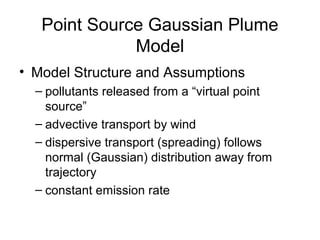
• Model Structure and Assumptions 
– pollutants released from a “virtual point 
source” 
– advective transport by wind 
– dispersive transport (spreading) follows 
normal (Gaussian) distribution away from 
trajectory 
– constant emission rate
Point Source Gaussian Plume 
Model 
• Model Structure and Assumptions (cont) 
– wind speed constant with time and elevation 
– pollutant is conservative (no reaction) 
– pollutant is “reflected by ground” 
– terrain is flat and unobstructed 
– uniform atmospheric stability
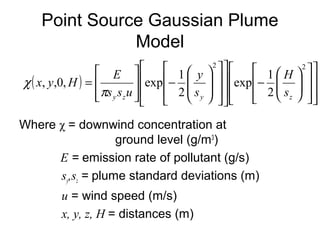
Point Source Gaussian Plume 
Model 
x y H E 
, ,0, exp 1 
( ) 
ù 
é 
ù 
é 
ö 
æ 
ù 
é 
= 
y 
y z y z s 
Where χ = downwind concentration at 
ground level (g/m3) 
é 
é 
exp 1 
E = emission rate of pollutant (g/s) 
sy,sz = plume standard deviations (m) 
u = wind speed (m/s) 
x, y, z, H = distances (m) 
ù 
ú ú 
û 
ê ê 
ë 
ù 
ú ú 
û 
ê ê 
ë 
ö 
÷ ÷ø 
æ 
ç çè 
- 
ú ú 
û 
ê ê ë 
ú ú 
û 
ê ê 
ë 
÷ ÷ 
ø 
ç ç 
è 
- 
ú úû 
ê êë 
2 2 
2 
2 
H 
s 
s s u 
p 
c
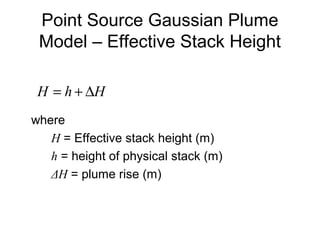
Point Source Gaussian Plume 
Model – Effective Stack Height 
H = h + DH 
where 
H = Effective stack height (m) 
h = height of physical stack (m) 
ΔH = plume rise (m)
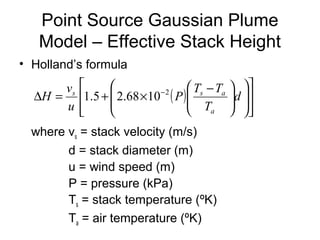
Point Source Gaussian Plume 
Model – Effective Stack Height 
• Holland’s formula 
æ D = + ´ - P T - T 
d 
( ) 
é 
æ 
H v 
s 1.5 2.68 10 2 s a 
where vs = stack velocity (m/s) 
d = stack diameter (m) 
u = wind speed (m) 
P = pressure (kPa) 
Ts = stack temperature (ºK) 
Ta = air temperature (ºK) 
ù 
ú úû 
ê êë 
ö 
÷ ÷ø 
ç çè 
ö 
÷ ÷ø 
ç çè 
T 
u 
a
Point Source Gaussian Plume 
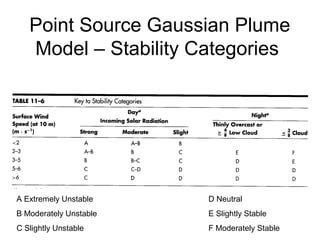
Model – Stability Categories 
A Extremely Unstable D Neutral 
B Moderately Unstable E Slightly Stable 
C Slightly Unstable F Moderately Stable
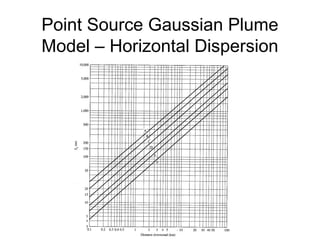
Point Source Gaussian Plume 
Model – Horizontal Dispersion
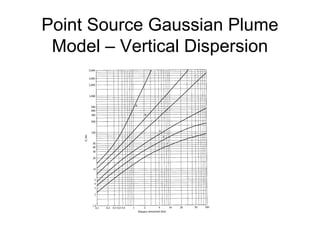
Point Source Gaussian Plume 
Model – Vertical Dispersion
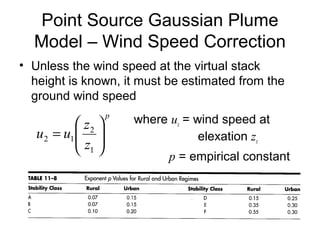
Point Source Gaussian Plume 
Model – Wind Speed Correction 
• Unless the wind speed at the virtual stack 
height is known, it must be estimated from the 
ground wind speed 
where ux = wind speed at 
elexation zx 
p = empirical constant 
p 
æ 
u u z ÷ ÷ø 
2 
z 
ö 
ç çè 
= 
1 
2 1
Example 
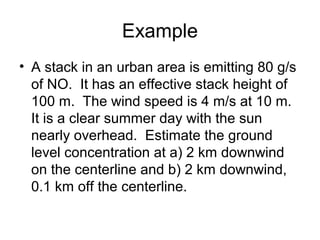
• A stack in an urban area is emitting 80 g/s 
of NO. It has an effective stack height of 
100 m. The wind speed is 4 m/s at 10 m. 
It is a clear summer day with the sun 
nearly overhead. Estimate the ground 
level concentration at a) 2 km downwind 
on the centerline and b) 2 km downwind, 
0.1 km off the centerline.
Example 
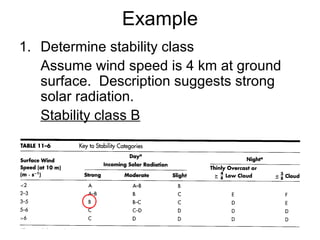
1. Determine stability class 
Assume wind speed is 4 km at ground 
surface. Description suggests strong 
solar radiation. 
Stability class B
Example 
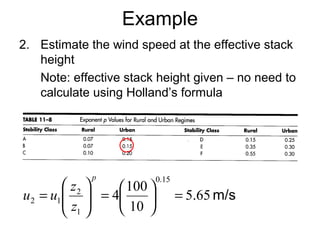
2. Estimate the wind speed at the effective stack 
height 
Note: effective stack height given – no need to 
calculate using Holland’s formula 
5.65 m/s 
4 100 
= æ ÷ ÷ø 
u u z 
÷ø 
= 2 1 10 
0.15 
2 
1 
ö çè 
ö 
ç çè æ 
= 
p 
z
Example 
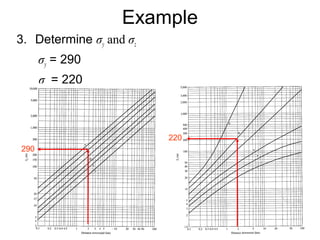
3. Determine σy and σz 
σy = 290 
σz = 220 
290 
220
Example 
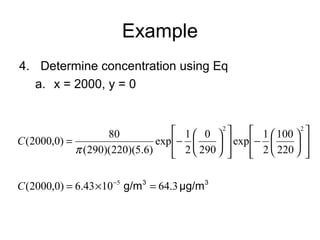
4. Determine concentration using Eq 
a. x = 2000, y = 0 
ù 
ú úû 
é 
ê êë 
100 
2 
ö çè 
÷ø 
- æ 
ù 
ú úû 
é 
exp 1 
ê êë 
0 
ö çè 
÷ø 
(2000,0) 80 
= - æ 
2 2 
220 
exp 1 
290 
2 
p 
(290)(220)(5.6) 
C 
C(2000,0) = 6.43´10-5 g/m3 = 64.3 μg/m3
Example 
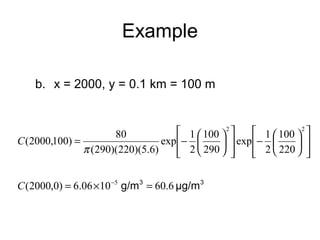
b. x = 2000, y = 0.1 km = 100 m 
ù 
ú úû 
é 
ê êë 
100 
2 
ö çè 
÷ø 
- æ 
ù 
ú úû 
é 
ê êë 
100 
2 
ö çè 
÷ø 
(2000,100) 80 
= - æ 
2 2 
220 
exp 1 
290 
exp 1 
p 
(290)(220)(5.6) 
C 
C(2000,0) = 6.06´10-5 g/m3 = 60.6 μg/m3

11 air pollution dispersion

  • 1.
    Meteorology and DispersionModeling Air Quality and Meteorology • Primary Metrological Parameter – Wind speed, Wind Direction, Atmospheric Stability • Secondary Metrological Parameter – sunlight – temperature – precipitation and humidity – Topography – Energy from the sun and earth’s rotation drives atmospheric circulation
  • 2.
    Stability • Dryadiabatic lapse rate – temperature decreases due to lower pressure (ideal gas law) dT G = - = -1.00 °C/100 m = -5.4 °F/1000 ft dz • Ambient (actual) lapse rate < Г (temperature falls faster) unstable or superadiabatic > Г (temperature falls slower) stable or subadiabatic = Г (same rate) neutral
  • 3.
    Example Z(m) T(ºC) 2 -3.05 318 -6.21 ( ) = - °C/m - T T T D = - = - - - 0.0100 2 1 z - z D 6.21 3.05 318 2 2 1 z = -1.00 °C/100 m Since lapse rate = Г, atmosphere is neutral
  • 4.
    •Standard Plume: Moderatewind speed: •Moderate radiation, night time •Horizontal dispersion at a right angle to the wind is due to turbulence and diffusion, which occurs at the same rate as the vertical dispersion, which is not being opposed nor encouraged by the stability (or lack of it) in the atmosphere. •Plume spreads equally in the vertical and horizontal as it propagates downstream, forming a coning plume
  • 5.
    Example Z(m) T(ºC) 10 5.11 202 1.09 T T T D 0.0209 = - °C/m = - 1.09 5.11 - = - 2 1 z - z D 202 10 2 1 z = -2.09 °C/100 m Since lapse rate is more negative than Г, (-1.00 ºC/100 m), atmosphere is unstable
  • 6.
    •In unstable air,the plume will whip up and down as the atmosphere mixes around (whenever an air parcel goes up, there must be air going down someplace else to maintain continuity, and the plume follows these air currents). This gives the plume the appearance that it is looping around. •Vertical dispersion is very high. •Less wind speed: Strong & Moderate radiation, day time Mechanical Turbulence is enhanced. •High probability of high concentrations sporadically at ground level close to stack.
  • 7.
    Example Z(m) T(ºC) 18 14.03 286 12.56 T T T D 0.0055 = - °C/m = - 12.56 14.03 - = - 2 1 z - z D 286 18 2 1 z = -0.55 °C/100 m Suppress Vertical Dispersion Since lapse rate more positive than Г, atmosphere is stable
  • 8.
    •High wind speed:Night time, High horizontal dispersion, Vertical dispersion is suppresses by stable atmosphere. •In the vertical, dispersion is suppressed by the stability of the atmosphere, so pollution does not spread toward the ground. This results in very low pollution concentrations at the ground
  • 9.
    Temperature Inversions •Extreme case of stability when lapse rate is actually positive, i.e. temperature increases with altitude • Resulting temperature inversion prevents nearly all upward mixing
  • 10.
    Fanning Plume: Usuallyoccurs at night, or 1200m-1800m above ground. There is high ground concentration if stack is short or if plume moves through rugged terrain. Occurs in stable inversion atmospheric conditions.
  • 11.
    Lofting Plume: favorablein the sense that fewer impacts at ground level. Pollutants go up into environment. They are created when atmospheric conditions are unstable above the plume
  • 12.
    Fumigation: most dangerousplume: contaminants are all coming down to ground level. They are created when atmospheric conditions are inversion stable above the plume and unstable below. This happens most often after the daylight sun has warmed the atmosphere, which turns a night time fanning plume into fumigation for about a half an hour.
  • 13.
    Effect of LapseRate on Plumes
  • 14.
  • 15.
  • 16.
    Point Source GaussianPlume Model • Model Structure and Assumptions – pollutants released from a “virtual point source” – advective transport by wind – dispersive transport (spreading) follows normal (Gaussian) distribution away from trajectory – constant emission rate
  • 17.
    Point Source GaussianPlume Model • Model Structure and Assumptions (cont) – wind speed constant with time and elevation – pollutant is conservative (no reaction) – pollutant is “reflected by ground” – terrain is flat and unobstructed – uniform atmospheric stability
  • 18.
    Point Source GaussianPlume Model x y H E , ,0, exp 1 ( ) ù é ù é ö æ ù é = y y z y z s Where χ = downwind concentration at ground level (g/m3) é é exp 1 E = emission rate of pollutant (g/s) sy,sz = plume standard deviations (m) u = wind speed (m/s) x, y, z, H = distances (m) ù ú ú û ê ê ë ù ú ú û ê ê ë ö ÷ ÷ø æ ç çè - ú ú û ê ê ë ú ú û ê ê ë ÷ ÷ ø ç ç è - ú úû ê êë 2 2 2 2 H s s s u p c
  • 19.
    Point Source GaussianPlume Model – Effective Stack Height H = h + DH where H = Effective stack height (m) h = height of physical stack (m) ΔH = plume rise (m)
  • 20.
    Point Source GaussianPlume Model – Effective Stack Height • Holland’s formula æ D = + ´ - P T - T d ( ) é æ H v s 1.5 2.68 10 2 s a where vs = stack velocity (m/s) d = stack diameter (m) u = wind speed (m) P = pressure (kPa) Ts = stack temperature (ºK) Ta = air temperature (ºK) ù ú úû ê êë ö ÷ ÷ø ç çè ö ÷ ÷ø ç çè T u a
  • 21.
    Point Source GaussianPlume Model – Stability Categories A Extremely Unstable D Neutral B Moderately Unstable E Slightly Stable C Slightly Unstable F Moderately Stable
  • 22.
    Point Source GaussianPlume Model – Horizontal Dispersion
  • 23.
    Point Source GaussianPlume Model – Vertical Dispersion
  • 24.
    Point Source GaussianPlume Model – Wind Speed Correction • Unless the wind speed at the virtual stack height is known, it must be estimated from the ground wind speed where ux = wind speed at elexation zx p = empirical constant p æ u u z ÷ ÷ø 2 z ö ç çè = 1 2 1
  • 25.
    Example • Astack in an urban area is emitting 80 g/s of NO. It has an effective stack height of 100 m. The wind speed is 4 m/s at 10 m. It is a clear summer day with the sun nearly overhead. Estimate the ground level concentration at a) 2 km downwind on the centerline and b) 2 km downwind, 0.1 km off the centerline.
  • 26.
    Example 1. Determinestability class Assume wind speed is 4 km at ground surface. Description suggests strong solar radiation. Stability class B
  • 27.
    Example 2. Estimatethe wind speed at the effective stack height Note: effective stack height given – no need to calculate using Holland’s formula 5.65 m/s 4 100 = æ ÷ ÷ø u u z ÷ø = 2 1 10 0.15 2 1 ö çè ö ç çè æ = p z
  • 28.
    Example 3. Determineσy and σz σy = 290 σz = 220 290 220
  • 29.
    Example 4. Determineconcentration using Eq a. x = 2000, y = 0 ù ú úû é ê êë 100 2 ö çè ÷ø - æ ù ú úû é exp 1 ê êë 0 ö çè ÷ø (2000,0) 80 = - æ 2 2 220 exp 1 290 2 p (290)(220)(5.6) C C(2000,0) = 6.43´10-5 g/m3 = 64.3 μg/m3
  • 30.
    Example b. x= 2000, y = 0.1 km = 100 m ù ú úû é ê êë 100 2 ö çè ÷ø - æ ù ú úû é ê êë 100 2 ö çè ÷ø (2000,100) 80 = - æ 2 2 220 exp 1 290 exp 1 p (290)(220)(5.6) C C(2000,0) = 6.06´10-5 g/m3 = 60.6 μg/m3