THE DNA
Miss De Marzi, Istituto Massimo
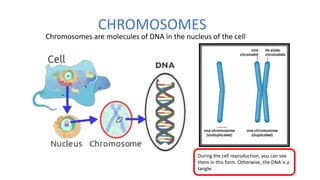
CHROMOSOMES
Chromosomes are molecules of DNA in the nucleus of the cell
During the cell reproduction, you can see
them in this form. Otherwise, the DNA is a
tangle.
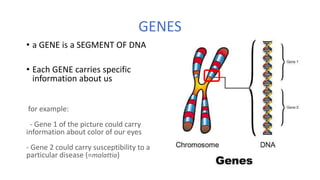
GENES
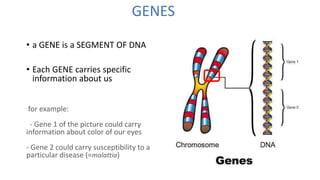
• a GENE is a SEGMENT OF DNA
• Each GENE carries specific
information about us
for example:
- Gene 1 of the picture could carry
information about color of our eyes
- Gene 2 could carry susceptibility to a
particular disease (=malattia)
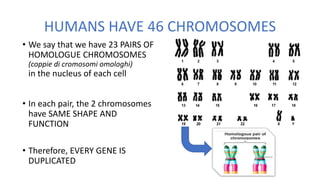
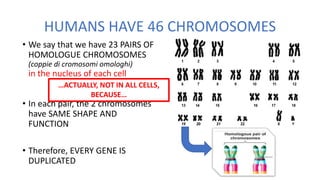
HUMANS HAVE 46 CHROMOSOMES
• We say that we have 23 PAIRS OF
HOMOLOGUE CHROMOSOMES
(coppie di cromosomi omologhi)
in the nucleus of each cell
• In each pair, the 2 chromosomes
have SAME SHAPE AND
FUNCTION
• Therefore, EVERY GENE IS
DUPLICATED
HUMANS HAVE 46 CHROMOSOMES
• We say that we have 23 PAIRS OF
HOMOLOGUE CHROMOSOMES
(coppie di cromosomi omologhi)
in the nucleus of each cell
• In each pair, the 2 chromosomes
have SAME SHAPE AND
FUNCTION
• Therefore, EVERY GENE IS
DUPLICATED
…ACTUALLY, NOT IN ALL CELLS,
BECAUSE…
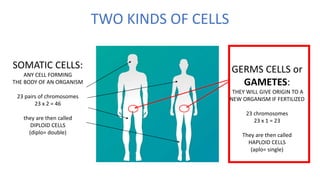
TWO KINDS OF CELLS
SOMATIC CELLS:
ANY CELL FORMING
THE BODY OF AN ORGANISM
23 pairs of chromosomes
23 x 2 = 46
they are then called
DIPLOID CELLS
(diplo= double)
GERMS CELLS or
GAMETES:
THEY WILL GIVE ORIGIN TO A
NEW ORGANISM IF FERTILIZED
23 chromosomes
23 x 1 = 23
They are then called
HAPLOID CELLS
(aplo= single)
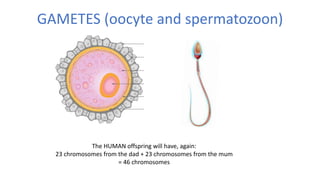
GAMETES (oocyte and spermatozoon)
The HUMAN offspring will have, again:
23 chromosomes from the dad + 23 chromosomes from the mum
= 46 chromosomes
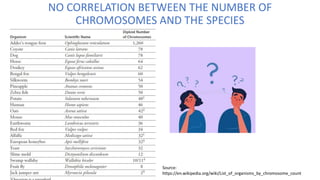
NO CORRELATION BETWEEN THE NUMBER OF
CHROMOSOMES AND THE SPECIES
Source:
https://en.wikipedia.org/wiki/List_of_organisms_by_chromosome_count
GENES
• a GENE is a SEGMENT OF DNA
• Each GENE carries specific
information about us
for example:
- Gene 1 of the picture could carry
information about color of our eyes
- Gene 2 could carry susceptibility to a
particular disease (=malattia)
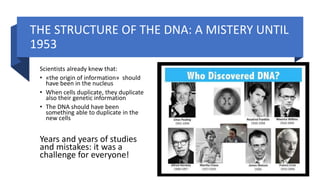
THE STRUCTURE OF THE DNA: A MISTERY UNTIL
1953
Scientists already knew that:
• «the origin of information» should
have been in the nucleus
• When cells duplicate, they duplicate
also their genetic information
• The DNA should have been
something able to duplicate in the
new cells
Years and years of studies
and mistakes: it was a
challenge for everyone!
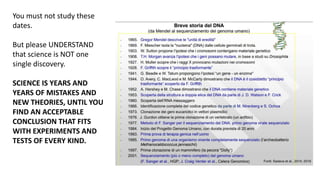
You must not study these
dates.
But please UNDERSTAND
that science is NOT one
single discovery.
SCIENCE IS YEARS AND
YEARS OF MISTAKES AND
NEW THEORIES, UNTIL YOU
FIND AN ACCEPTABLE
CONCLUSION THAT FITS
WITH EXPERIMENTS AND
TESTS OF EVERY KIND.
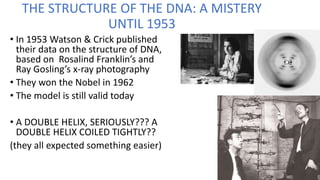
THE STRUCTURE OF THE DNA: A MISTERY
UNTIL 1953
• In 1953 Watson & Crick published
their data on the structure of DNA,
based on Rosalind Franklin’s and
Ray Gosling’s x-ray photography
• They won the Nobel in 1962
• The model is still valid today
• A DOUBLE HELIX, SERIOUSLY??? A
DOUBLE HELIX COILED TIGHTLY??
(they all expected something easier)
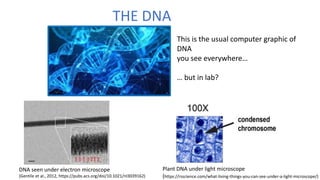
THE DNA
DNA seen under electron microscope
(Gentile et al., 2012, https://pubs.acs.org/doi/10.1021/nl3039162)
This is the usual computer graphic of
DNA
you see everywhere…
… but in lab?
Plant DNA under light microscope
(https://rsscience.com/what-living-things-you-can-see-under-a-light-microscope/)
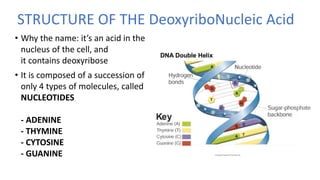
STRUCTURE OF THE DeoxyriboNucleic Acid
• Why the name: it’s an acid in the
nucleus of the cell, and
it contains deoxyribose
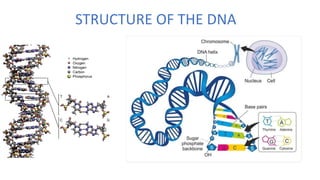
• It is composed of a succession of
only 4 types of molecules, called
NUCLEOTIDES
- ADENINE
- THYMINE
- CYTOSINE
- GUANINE
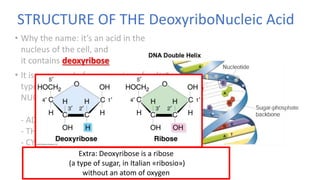
STRUCTURE OF THE DeoxyriboNucleic Acid
• Why the name: it’s an acid in the
nucleus of the cell, and
it contains deoxyribose
• It is composed of a succession of only 4
types of molecules, called
NUCLEOTIDES:
- ADENINE
- THYMINE
- CYTOSINE
- GUANINE Extra: Deoxyribose is a ribose
(a type of sugar, in Italian «ribosio»)
without an atom of oxygen
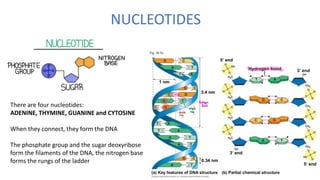
NUCLEOTIDES
There are four nucleotides:
ADENINE, THYMINE, GUANINE and CYTOSINE
When they connect, they form the DNA
The phosphate group and the sugar deoxyribose
form the filaments of the DNA, the nitrogen base
forms the rungs of the ladder
STRUCTURE OF THE DNA
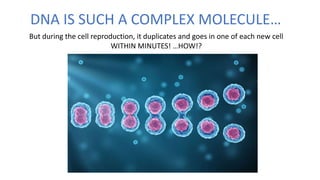
DNA IS SUCH A COMPLEX MOLECULE…
But during the cell reproduction, it duplicates and goes in one of each new cell
WITHIN MINUTES! …HOW!?
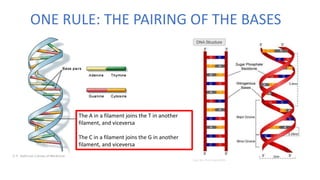
ONE RULE: THE PAIRING OF THE BASES
The A in a filament joins the T in another
filament, and viceversa
The C in a filament joins the G in another
filament, and viceversa
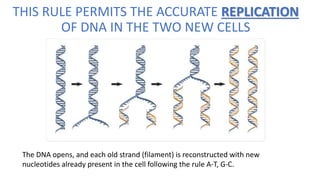
THIS RULE PERMITS THE ACCURATE REPLICATION
OF DNA IN THE TWO NEW CELLS
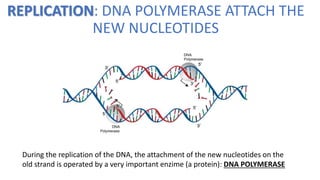
The DNA opens, and each old strand (filament) is reconstructed with new
nucleotides already present in the cell following the rule A-T, G-C.
REPLICATION: DNA POLYMERASE ATTACH THE
NEW NUCLEOTIDES
During the replication of the DNA, the attachment of the new nucleotides on the
old strand is operated by a very important enzime (a protein): DNA POLYMERASE
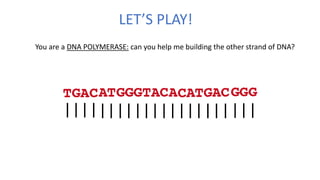
LET’S PLAY!
You are a DNA POLYMERASE: can you help me building the other strand of DNA?
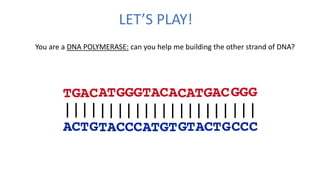
LET’S PLAY!
You are a DNA POLYMERASE: can you help me building the other strand of DNA?
…DNA CONTAINS THE INFORMATION…
… What do you mean????
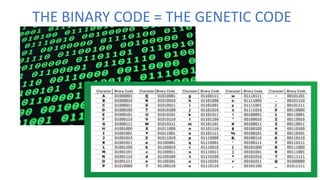
THE BINARY CODE = THE GENETIC CODE
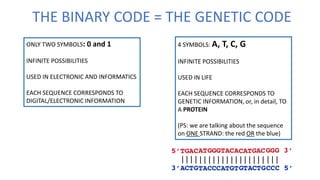
ONLY TWO SYMBOLS: 0 and 1
INFINITE POSSIBILITIES
USED IN ELECTRONIC AND INFORMATICS
EACH SEQUENCE CORRESPONDS TO
DIGITAL/ELECTRONIC INFORMATION
4 SYMBOLS: A, T, C, G
INFINITE POSSIBILITIES
USED IN LIFE
EACH SEQUENCE CORRESPONDS TO
GENETIC INFORMATION, or, in detail, TO
A PROTEIN
(PS: we are talking about the sequence
on ONE STRAND: the red OR the blue)
THE BINARY CODE = THE GENETIC CODE
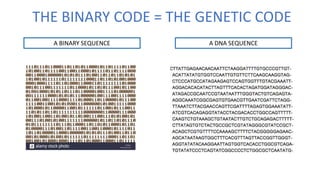
A BINARY SEQUENCE A DNA SEQUENCE
THE BINARY CODE = THE GENETIC CODE
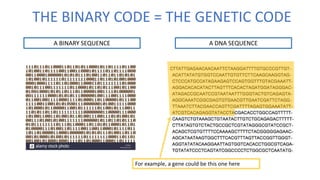
A BINARY SEQUENCE A DNA SEQUENCE
For example, a gene could be this one here
A STEP BACKWARDS
In 2 media, you’ve studied something else made in «sequences»…
A STEP BACKWARDS
In 2 media, you’ve studied something else made in «sequences»…
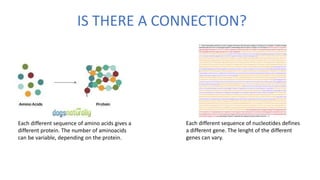
IS THERE A CONNECTION?
Each different sequence of amino acids gives a
different protein. The number of aminoacids
can be variable, depending on the protein.
Each different sequence of nucleotides defines
a different gene. The lenght of the different
genes can vary.
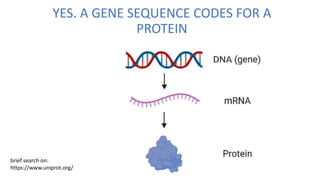
YES. A GENE SEQUENCE CODES FOR A
PROTEIN
brief search on:
https://www.uniprot.org/
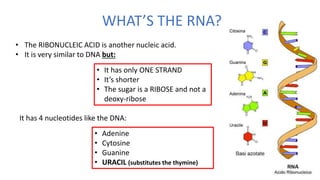
WHAT’S THE RNA?
• The RIBONUCLEIC ACID is another nucleic acid.
• It is very similar to DNA but:
• It has only ONE STRAND
• It’s shorter
• The sugar is a RIBOSE and not a
deoxy-ribose
It has 4 nucleotides like the DNA:
• Adenine
• Cytosine
• Guanine
• URACIL (substitutes the thymine)
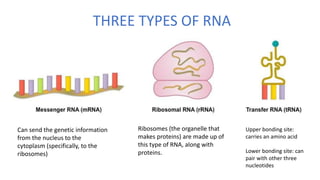
THREE TYPES OF RNA
Can send the genetic information
from the nucleus to the
cytoplasm (specifically, to the
ribosomes)
Ribosomes (the organelle that
makes proteins) are made up of
this type of RNA, along with
proteins.
Upper bonding site:
carries an amino acid
Lower bonding site: can
pair with other three
nucleotides
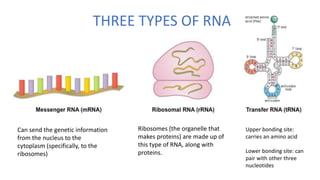
THREE TYPES OF RNA
Can send the genetic information
from the nucleus to the
cytoplasm (specifically, to the
ribosomes)
Ribosomes (the organelle that
makes proteins) are made up of
this type of RNA, along with
proteins.
Upper bonding site:
carries an amino acid
Lower bonding site: can
pair with other three
nucleotides
THREE TYPES OF RNA
Can send the genetic information
from the nucleus to the
cytoplasm (specifically, to the
ribosomes)
Ribosomes (the organelle that
makes proteins) are made up of
this type of RNA, along with
proteins.
Upper bonding site:
carries an amino acid to
the ribosome
Lower bonding site: can
pair with other three
nucleotides
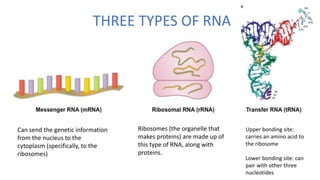
THREE TYPES OF RNA
Can send the genetic information
from the nucleus to the
cytoplasm (specifically, to the
ribosomes)
Ribosomes (the organelle that
makes proteins) are made up of
this type of RNA, along with
proteins.
Upper bonding site:
carries an amino acid
Lower bonding site: can
pair with other three
nucleotides
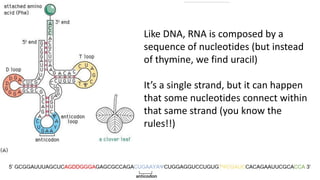
Like DNA, RNA is composed by a
sequence of nucleotides (but instead
of thymine, we find uracil)
It’s a single strand, but it can happen
that some nucleotides connect within
that same strand (you know the
rules!!)
FROM THE DNA TO THE PROTEIN
1° step: TRANSCRIPTION
TRANSCRIPTION
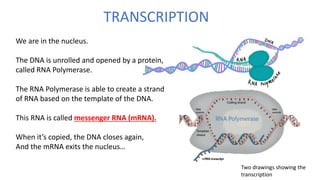
Two drawings showing the
transcription
We are in the nucleus.
The DNA is unrolled and opened by a protein,
called RNA Polymerase.
The RNA Polymerase is able to create a strand
of RNA based on the template of the DNA.
This RNA is called messenger RNA (mRNA).
When it’s copied, the DNA closes again,
And the mRNA exits the nucleus…
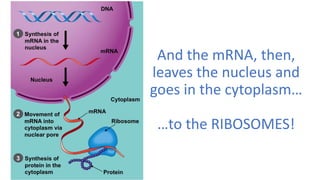
And the mRNA, then,
leaves the nucleus and
goes in the cytoplasm…
…to the RIBOSOMES!
FROM THE DNA TO THE PROTEIN
2° step: TRANSLATION
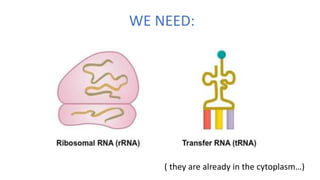
WE NEED:
( they are already in the cytoplasm…)
TRANSLATION
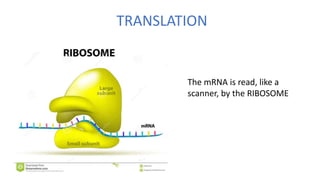
The mRNA is read, like a
scanner, by the RIBOSOME
TRANSLATION
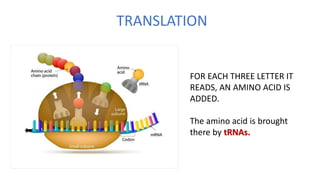
FOR EACH THREE LETTER IT
READS, AN AMINO ACID IS
ADDED.
The amino acid is brought
there by tRNAs.
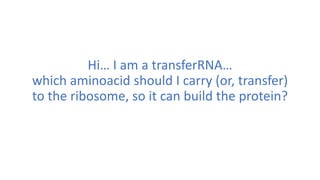
Hi… I am a transferRNA…
which aminoacid should I carry (or, transfer)
to the ribosome, so it can build the protein?
THREE TYPES OF RNA
Can send the genetic information
from the nucleus to the
cytoplasm (specifically, to the
ribosomes)
Ribosomes (the organelle that
makes proteins) are made up of
this type of RNA, along with
proteins.
Upper bonding site:
carries an amino acid
Lower bonding site: can
pair with other three
nucleotides
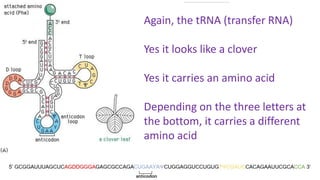
Again, the tRNA (transfer RNA)
Yes it looks like a clover
Yes it carries an amino acid
Depending on the three letters at
the bottom, it carries a different
amino acid
Probably you’ve all heard of the
GENETIC CODE
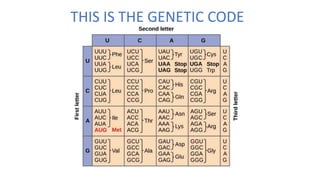
THIS IS THE GENETIC CODE
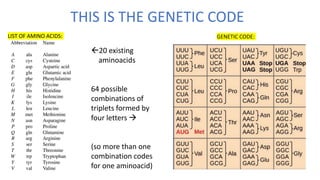
20 existing
aminoacids
64 possible
combinations of
triplets formed by
four letters 
(so more than one
combination codes
for one aminoacid)
LIST OF AMINO ACIDS: GENETIC CODE:
THIS IS THE GENETIC CODE
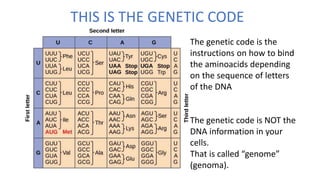
The genetic code is the
instructions on how to bind
the aminoacids depending
on the sequence of letters
of the DNA
The genetic code is NOT the
DNA information in your
cells.
That is called “genome”
(genoma).
THIS IS THE GENETIC CODE
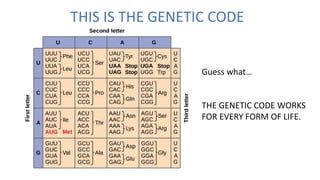
Guess what…
THE GENETIC CODE WORKS
FOR EVERY FORM OF LIFE.

The DNA

  • 1.
    THE DNA Miss DeMarzi, Istituto Massimo
  • 2.
    CHROMOSOMES Chromosomes are moleculesof DNA in the nucleus of the cell During the cell reproduction, you can see them in this form. Otherwise, the DNA is a tangle.
  • 3.
    GENES • a GENEis a SEGMENT OF DNA • Each GENE carries specific information about us for example: - Gene 1 of the picture could carry information about color of our eyes - Gene 2 could carry susceptibility to a particular disease (=malattia)
  • 4.
    HUMANS HAVE 46CHROMOSOMES • We say that we have 23 PAIRS OF HOMOLOGUE CHROMOSOMES (coppie di cromosomi omologhi) in the nucleus of each cell • In each pair, the 2 chromosomes have SAME SHAPE AND FUNCTION • Therefore, EVERY GENE IS DUPLICATED
  • 5.
    HUMANS HAVE 46CHROMOSOMES • We say that we have 23 PAIRS OF HOMOLOGUE CHROMOSOMES (coppie di cromosomi omologhi) in the nucleus of each cell • In each pair, the 2 chromosomes have SAME SHAPE AND FUNCTION • Therefore, EVERY GENE IS DUPLICATED …ACTUALLY, NOT IN ALL CELLS, BECAUSE…
  • 6.
    TWO KINDS OFCELLS SOMATIC CELLS: ANY CELL FORMING THE BODY OF AN ORGANISM 23 pairs of chromosomes 23 x 2 = 46 they are then called DIPLOID CELLS (diplo= double) GERMS CELLS or GAMETES: THEY WILL GIVE ORIGIN TO A NEW ORGANISM IF FERTILIZED 23 chromosomes 23 x 1 = 23 They are then called HAPLOID CELLS (aplo= single)
  • 7.
    GAMETES (oocyte andspermatozoon) The HUMAN offspring will have, again: 23 chromosomes from the dad + 23 chromosomes from the mum = 46 chromosomes
  • 8.
    NO CORRELATION BETWEENTHE NUMBER OF CHROMOSOMES AND THE SPECIES Source: https://en.wikipedia.org/wiki/List_of_organisms_by_chromosome_count
  • 9.
    GENES • a GENEis a SEGMENT OF DNA • Each GENE carries specific information about us for example: - Gene 1 of the picture could carry information about color of our eyes - Gene 2 could carry susceptibility to a particular disease (=malattia)
  • 10.
    THE STRUCTURE OFTHE DNA: A MISTERY UNTIL 1953 Scientists already knew that: • «the origin of information» should have been in the nucleus • When cells duplicate, they duplicate also their genetic information • The DNA should have been something able to duplicate in the new cells Years and years of studies and mistakes: it was a challenge for everyone!
  • 11.
    You must notstudy these dates. But please UNDERSTAND that science is NOT one single discovery. SCIENCE IS YEARS AND YEARS OF MISTAKES AND NEW THEORIES, UNTIL YOU FIND AN ACCEPTABLE CONCLUSION THAT FITS WITH EXPERIMENTS AND TESTS OF EVERY KIND.
  • 12.
    THE STRUCTURE OFTHE DNA: A MISTERY UNTIL 1953 • In 1953 Watson & Crick published their data on the structure of DNA, based on Rosalind Franklin’s and Ray Gosling’s x-ray photography • They won the Nobel in 1962 • The model is still valid today • A DOUBLE HELIX, SERIOUSLY??? A DOUBLE HELIX COILED TIGHTLY?? (they all expected something easier)
  • 13.
    THE DNA DNA seenunder electron microscope (Gentile et al., 2012, https://pubs.acs.org/doi/10.1021/nl3039162) This is the usual computer graphic of DNA you see everywhere… … but in lab? Plant DNA under light microscope (https://rsscience.com/what-living-things-you-can-see-under-a-light-microscope/)
  • 14.
    STRUCTURE OF THEDeoxyriboNucleic Acid • Why the name: it’s an acid in the nucleus of the cell, and it contains deoxyribose • It is composed of a succession of only 4 types of molecules, called NUCLEOTIDES - ADENINE - THYMINE - CYTOSINE - GUANINE
  • 15.
    STRUCTURE OF THEDeoxyriboNucleic Acid • Why the name: it’s an acid in the nucleus of the cell, and it contains deoxyribose • It is composed of a succession of only 4 types of molecules, called NUCLEOTIDES: - ADENINE - THYMINE - CYTOSINE - GUANINE Extra: Deoxyribose is a ribose (a type of sugar, in Italian «ribosio») without an atom of oxygen
  • 16.
    NUCLEOTIDES There are fournucleotides: ADENINE, THYMINE, GUANINE and CYTOSINE When they connect, they form the DNA The phosphate group and the sugar deoxyribose form the filaments of the DNA, the nitrogen base forms the rungs of the ladder
  • 17.
  • 18.
    DNA IS SUCHA COMPLEX MOLECULE… But during the cell reproduction, it duplicates and goes in one of each new cell WITHIN MINUTES! …HOW!?
  • 19.
    ONE RULE: THEPAIRING OF THE BASES The A in a filament joins the T in another filament, and viceversa The C in a filament joins the G in another filament, and viceversa
  • 20.
    THIS RULE PERMITSTHE ACCURATE REPLICATION OF DNA IN THE TWO NEW CELLS The DNA opens, and each old strand (filament) is reconstructed with new nucleotides already present in the cell following the rule A-T, G-C.
  • 21.
    REPLICATION: DNA POLYMERASEATTACH THE NEW NUCLEOTIDES During the replication of the DNA, the attachment of the new nucleotides on the old strand is operated by a very important enzime (a protein): DNA POLYMERASE
  • 22.
    LET’S PLAY! You area DNA POLYMERASE: can you help me building the other strand of DNA?
  • 23.
    LET’S PLAY! You area DNA POLYMERASE: can you help me building the other strand of DNA?
  • 24.
    …DNA CONTAINS THEINFORMATION… … What do you mean????
  • 25.
    THE BINARY CODE= THE GENETIC CODE
  • 26.
    THE BINARY CODE= THE GENETIC CODE ONLY TWO SYMBOLS: 0 and 1 INFINITE POSSIBILITIES USED IN ELECTRONIC AND INFORMATICS EACH SEQUENCE CORRESPONDS TO DIGITAL/ELECTRONIC INFORMATION 4 SYMBOLS: A, T, C, G INFINITE POSSIBILITIES USED IN LIFE EACH SEQUENCE CORRESPONDS TO GENETIC INFORMATION, or, in detail, TO A PROTEIN (PS: we are talking about the sequence on ONE STRAND: the red OR the blue)
  • 27.
    THE BINARY CODE= THE GENETIC CODE A BINARY SEQUENCE A DNA SEQUENCE
  • 28.
    THE BINARY CODE= THE GENETIC CODE A BINARY SEQUENCE A DNA SEQUENCE For example, a gene could be this one here
  • 29.
    A STEP BACKWARDS In2 media, you’ve studied something else made in «sequences»…
  • 30.
    A STEP BACKWARDS In2 media, you’ve studied something else made in «sequences»…
  • 31.
    IS THERE ACONNECTION? Each different sequence of amino acids gives a different protein. The number of aminoacids can be variable, depending on the protein. Each different sequence of nucleotides defines a different gene. The lenght of the different genes can vary.
  • 32.
    YES. A GENESEQUENCE CODES FOR A PROTEIN brief search on: https://www.uniprot.org/
  • 33.
    WHAT’S THE RNA? •The RIBONUCLEIC ACID is another nucleic acid. • It is very similar to DNA but: • It has only ONE STRAND • It’s shorter • The sugar is a RIBOSE and not a deoxy-ribose It has 4 nucleotides like the DNA: • Adenine • Cytosine • Guanine • URACIL (substitutes the thymine)
  • 34.
    THREE TYPES OFRNA Can send the genetic information from the nucleus to the cytoplasm (specifically, to the ribosomes) Ribosomes (the organelle that makes proteins) are made up of this type of RNA, along with proteins. Upper bonding site: carries an amino acid Lower bonding site: can pair with other three nucleotides
  • 35.
    THREE TYPES OFRNA Can send the genetic information from the nucleus to the cytoplasm (specifically, to the ribosomes) Ribosomes (the organelle that makes proteins) are made up of this type of RNA, along with proteins. Upper bonding site: carries an amino acid Lower bonding site: can pair with other three nucleotides
  • 36.
    THREE TYPES OFRNA Can send the genetic information from the nucleus to the cytoplasm (specifically, to the ribosomes) Ribosomes (the organelle that makes proteins) are made up of this type of RNA, along with proteins. Upper bonding site: carries an amino acid to the ribosome Lower bonding site: can pair with other three nucleotides
  • 37.
    THREE TYPES OFRNA Can send the genetic information from the nucleus to the cytoplasm (specifically, to the ribosomes) Ribosomes (the organelle that makes proteins) are made up of this type of RNA, along with proteins. Upper bonding site: carries an amino acid Lower bonding site: can pair with other three nucleotides Like DNA, RNA is composed by a sequence of nucleotides (but instead of thymine, we find uracil) It’s a single strand, but it can happen that some nucleotides connect within that same strand (you know the rules!!)
  • 38.
    FROM THE DNATO THE PROTEIN 1° step: TRANSCRIPTION
  • 39.
    TRANSCRIPTION Two drawings showingthe transcription We are in the nucleus. The DNA is unrolled and opened by a protein, called RNA Polymerase. The RNA Polymerase is able to create a strand of RNA based on the template of the DNA. This RNA is called messenger RNA (mRNA). When it’s copied, the DNA closes again, And the mRNA exits the nucleus…
  • 40.
    And the mRNA,then, leaves the nucleus and goes in the cytoplasm… …to the RIBOSOMES!
  • 41.
    FROM THE DNATO THE PROTEIN 2° step: TRANSLATION
  • 42.
    WE NEED: ( theyare already in the cytoplasm…)
  • 43.
    TRANSLATION The mRNA isread, like a scanner, by the RIBOSOME
  • 44.
    TRANSLATION FOR EACH THREELETTER IT READS, AN AMINO ACID IS ADDED. The amino acid is brought there by tRNAs.
  • 45.
    Hi… I ama transferRNA… which aminoacid should I carry (or, transfer) to the ribosome, so it can build the protein?
  • 46.
    THREE TYPES OFRNA Can send the genetic information from the nucleus to the cytoplasm (specifically, to the ribosomes) Ribosomes (the organelle that makes proteins) are made up of this type of RNA, along with proteins. Upper bonding site: carries an amino acid Lower bonding site: can pair with other three nucleotides Again, the tRNA (transfer RNA) Yes it looks like a clover Yes it carries an amino acid Depending on the three letters at the bottom, it carries a different amino acid
  • 47.
  • 48.
    Probably you’ve allheard of the GENETIC CODE
  • 49.
    THIS IS THEGENETIC CODE
  • 50.
    THIS IS THEGENETIC CODE 20 existing aminoacids 64 possible combinations of triplets formed by four letters  (so more than one combination codes for one aminoacid) LIST OF AMINO ACIDS: GENETIC CODE:
  • 51.
    THIS IS THEGENETIC CODE The genetic code is the instructions on how to bind the aminoacids depending on the sequence of letters of the DNA The genetic code is NOT the DNA information in your cells. That is called “genome” (genoma).
  • 52.
    THIS IS THEGENETIC CODE Guess what… THE GENETIC CODE WORKS FOR EVERY FORM OF LIFE.