UNIT 5 NOISE CALCULATIONS HPEO 408  Occupational Health Hazards
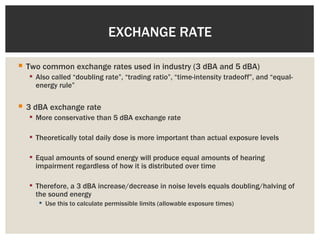
Two common exchange rates used in industry (3 dBA and 5 dBA) Also called “doubling rate”, “trading ratio”, “time-intensity tradeoff”, and “equal-energy rule” 3 dBA exchange rate  More conservative than 5 dBA exchange rate Theoretically total daily dose is more important than actual exposure levels  Equal amounts of sound energy will produce equal amounts of hearing impairment regardless of how it is distributed over time Therefore, a 3 dBA increase/decrease in noise levels equals doubling/halving of the sound energy Use this to calculate permissible limits (allowable exposure times) EXCHANGE RATE
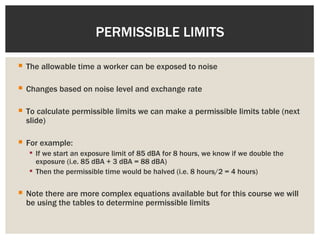
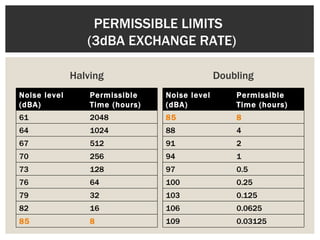
The allowable time a worker can be exposed to noise Changes based on noise level and exchange rate To calculate permissible limits we can make a permissible limits table (next slide) For example: If we start an exposure limit of 85 dBA for 8 hours, we know if we double the exposure (i.e. 85 dBA + 3 dBA = 88 dBA)  Then the permissible time would be halved (i.e. 8 hours/2 = 4 hours) Note there are more complex equations available but for this course we will be using the tables to determine permissible limits PERMISSIBLE LIMITS
Halving Doubling PERMISSIBLE LIMITS   (3dBA EXCHANGE RATE) Noise level  (dBA) Permissible Time (hours) 61 2048 64 1024 67 512 70 256 73 128 76 64 79 32 82 16 85 8 Noise level  (dBA) Permissible Time (hours) 85 8 88 4 91 2 94 1 97 0.5 100 0.25 103 0.125 106 0.0625 109 0.03125
Noise level is the ‘loudness’ of the noise exposure Dose is a percentage of allowable total daily noise exposure Combines intensity  (noise level)  and exposure time For example: 8 hr exposure at the exposure limit is the maximum therefore; 8 hr @ 85 dBA = 100% dose  “ NOISE LEVEL” VS. DOSE
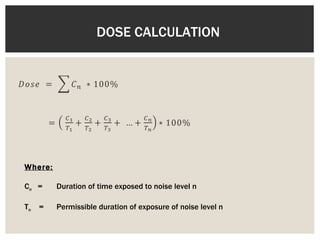
DOSE CALCULATION  Where: C n   =  Duration of time exposed to noise level n T n   =  Permissible duration of exposure of noise level n
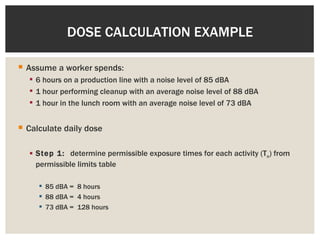
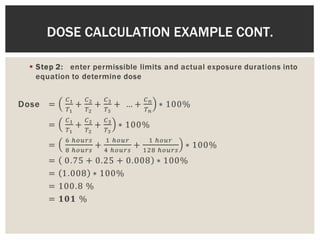
Assume a worker spends: 6 hours on a production line with a noise level of 85 dBA 1 hour performing cleanup with an average noise level of 88 dBA 1 hour in the lunch room with an average noise level of 73 dBA Calculate daily dose Step 1:  determine permissible exposure times for each activity (T n ) from permissible limits table 85 dBA =  8 hours 88 dBA =  4 hours 73 dBA =  128 hours DOSE CALCULATION EXAMPLE
DOSE CALCULATION EXAMPLE CONT.
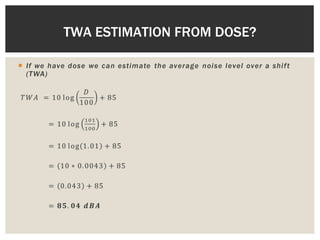
TWA ESTIMATION FROM DOSE?
WorkSafeBC – How to conduct noise survey’s http :// www.worksafebc.com/publications/health_and_safety/by_topic/assets/pdf/occupational_noise_surveys.pdf WorkSafeBC noise calculations http://www.worksafebc.com/publications/health_and_safety/by_topic/assets/pdf/basic_noise_calculations.pdf Methods for dealing with non 8-hr work shifts (i.e. L ex ) http ://www2.worksafebc.com/publications/OHSRegulation/GuidelinePart7.asp#SectionNumber:G7.2 REFERENCES FOR NOISE CALCULATIONS

Unit 5-calculation-example

  • 1.
    UNIT 5 NOISECALCULATIONS HPEO 408 Occupational Health Hazards
  • 2.
    Two common exchangerates used in industry (3 dBA and 5 dBA) Also called “doubling rate”, “trading ratio”, “time-intensity tradeoff”, and “equal-energy rule” 3 dBA exchange rate More conservative than 5 dBA exchange rate Theoretically total daily dose is more important than actual exposure levels Equal amounts of sound energy will produce equal amounts of hearing impairment regardless of how it is distributed over time Therefore, a 3 dBA increase/decrease in noise levels equals doubling/halving of the sound energy Use this to calculate permissible limits (allowable exposure times) EXCHANGE RATE
  • 3.
    The allowable timea worker can be exposed to noise Changes based on noise level and exchange rate To calculate permissible limits we can make a permissible limits table (next slide) For example: If we start an exposure limit of 85 dBA for 8 hours, we know if we double the exposure (i.e. 85 dBA + 3 dBA = 88 dBA) Then the permissible time would be halved (i.e. 8 hours/2 = 4 hours) Note there are more complex equations available but for this course we will be using the tables to determine permissible limits PERMISSIBLE LIMITS
  • 4.
    Halving Doubling PERMISSIBLELIMITS (3dBA EXCHANGE RATE) Noise level (dBA) Permissible Time (hours) 61 2048 64 1024 67 512 70 256 73 128 76 64 79 32 82 16 85 8 Noise level (dBA) Permissible Time (hours) 85 8 88 4 91 2 94 1 97 0.5 100 0.25 103 0.125 106 0.0625 109 0.03125
  • 5.
    Noise level isthe ‘loudness’ of the noise exposure Dose is a percentage of allowable total daily noise exposure Combines intensity (noise level) and exposure time For example: 8 hr exposure at the exposure limit is the maximum therefore; 8 hr @ 85 dBA = 100% dose “ NOISE LEVEL” VS. DOSE
  • 6.
    DOSE CALCULATION Where: C n = Duration of time exposed to noise level n T n = Permissible duration of exposure of noise level n
  • 7.
    Assume a workerspends: 6 hours on a production line with a noise level of 85 dBA 1 hour performing cleanup with an average noise level of 88 dBA 1 hour in the lunch room with an average noise level of 73 dBA Calculate daily dose Step 1: determine permissible exposure times for each activity (T n ) from permissible limits table 85 dBA = 8 hours 88 dBA = 4 hours 73 dBA = 128 hours DOSE CALCULATION EXAMPLE
  • 8.
  • 9.
  • 10.
    WorkSafeBC – Howto conduct noise survey’s http :// www.worksafebc.com/publications/health_and_safety/by_topic/assets/pdf/occupational_noise_surveys.pdf WorkSafeBC noise calculations http://www.worksafebc.com/publications/health_and_safety/by_topic/assets/pdf/basic_noise_calculations.pdf Methods for dealing with non 8-hr work shifts (i.e. L ex ) http ://www2.worksafebc.com/publications/OHSRegulation/GuidelinePart7.asp#SectionNumber:G7.2 REFERENCES FOR NOISE CALCULATIONS

Editor's Notes

  • #3 I am going to focus on the 3 dBA exchange rate as it is what we use in BC, and in most provinces in Canada. There is an example of the 5 dBA rate in your text book that is used by some provinces and the US if interested. Most consider 3 dBA rule the more logical since with noise exposure we are more interested in total daily dose then it seems natural to divide the exposure time in half if the exposure doubles… results in same total dose.
  • #7 Sometimes we are unable to measure dose with a dosimeter. However, it is still possible for us to estimate dose if we know: The duration of time spent doing various tasks throughout a shift The noise level during those tasks