
INTRODUCTION
SCENARIOS AT WORKPLACES
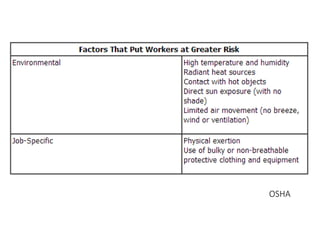
• Many people are exposed to heat on some
jobs, outdoors or in hot indoor environments.
• Operations involving high air temperatures,
radiant heat sources, high humidity, direct
physical contact with hot objects, or strenuous
physical activities have a high potential for
causing heat-related illness.
• Every year, thousands of workers become sick
from occupational heat exposure, and some
even die.
• These illnesses and deaths are preventable.
OSHA
Heat stress is the total heat burden that the body is
subjected to by both external and internal factors such as:
External
• Temperature
• Humidity
• Amount of air
movement
• Radiant temperature of
surroundings
• Clothing
Internal
• Physical activity
(metabolic heat load)
SWSA 2013
OSHA
EXAMPLE OF WORKPLACES
• iron and steel foundries
• nonferrous foundries
• brick-firing and ceramic
plants
• glass products facilities
• rubber products
factories
• electrical utilities
(particularly boiler
rooms),
• Bakeries
• confectioneries
• commercial kitchens
• Laundries
• food canneries
• chemical plants
• mining sites
• Smelters
• steam tunnels
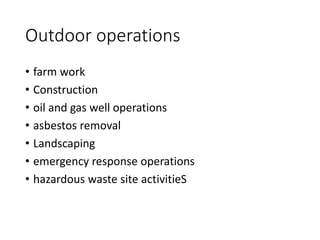
Outdoor operations
• farm work
• Construction
• oil and gas well operations
• asbestos removal
• Landscaping
• emergency response operations
• hazardous waste site activitieS
• Workers at greater risk of heat stress include those
who are 65 years of age or older, are overweight,
have heart disease or high blood pressure, or take
medications that may be affected by extreme heat.
NIOSH
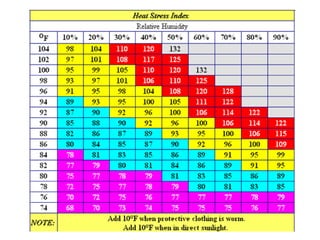
HEAT STRESS INDICES
• A single number which integrates the effects of the
basic parameters in any human thermal
environment such that its value will vary with the
thermal strain experienced by the person exposed
to a hot environment.
• All of the parameters* can be quantified, either by
measurement or estimation.
Environmental parameters
• Air temperature
• Mean radiant
temperature
• Relative humidity
• Air velocity
• Radiation
“human” factors
• Work rate (which
affects metabolic rate)
and
• Clothing level
• Whether the person is
acclimatised to hot
conditions
FUNCTION OF HEAT STRESS
INDICES
• provide tools for assessing hot environments and
predicting likely thermal strain on the body.
• Limit values based upon heat stress indices will
indicate when that strain is likely to become
unacceptable.
• The index value (measured or calculated) can be
used in design or in work practice to establish safe
limits.
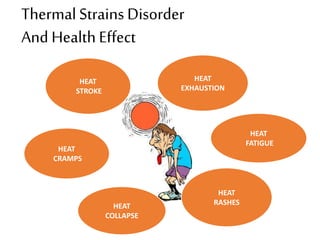
Thermal Strains Disorder
And Health Effect
HEAT
FATIGUE
HEAT
CRAMPS
HEAT
EXHAUSTION
HEAT
STROKE
HEAT
COLLAPSE
HEAT
RASHES
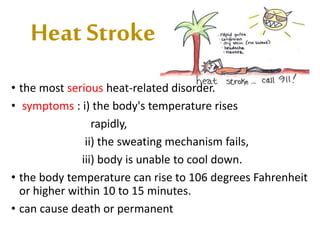
Heat Stroke
• the most serious heat-related disorder.
• symptoms : i) the body's temperature rises
rapidly,
ii) the sweating mechanism fails,
iii) body is unable to cool down.
• the body temperature can rise to 106 degrees Fahrenheit
or higher within 10 to 15 minutes.
• can cause death or permanent
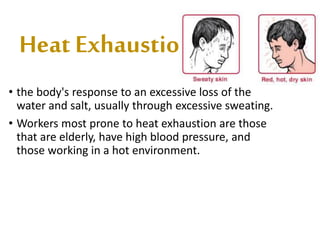
Heat Exhaustion
• the body's response to an excessive loss of the
water and salt, usually through excessive sweating.
• Workers most prone to heat exhaustion are those
that are elderly, have high blood pressure, and
those working in a hot environment.
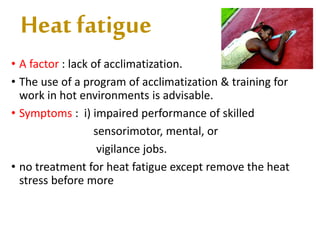
Heat fatigue
• A factor : lack of acclimatization.
• The use of a program of acclimatization & training for
work in hot environments is advisable.
• Symptoms : i) impaired performance of skilled
sensorimotor, mental, or
vigilance jobs.
• no treatment for heat fatigue except remove the heat
stress before more
Heat Cramps
• affect workers who
sweat a lot during strenuous activity.
• This sweating depletes the body's salt and moisture
levels. - causes painful cramps.
• Heat cramps may also be a symptom of heat
exhaustion.
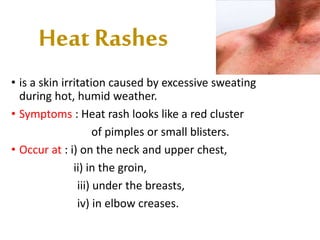
Heat Rashes
• is a skin irritation caused by excessive sweating
during hot, humid weather.
• Symptoms : Heat rash looks like a red cluster
of pimples or small blisters.
• Occur at : i) on the neck and upper chest,
ii) in the groin,
iii) under the breasts,
iv) in elbow creases.
Heat collapse (fainting)
• the brain does not receive enough oxygen because
blood pools in the extremities.
• As a result, the exposed individual may lose
consciousness. This reaction is similar to that of heat
exhaustion and does not affect the body's heat
balance.
• However, the onset of heat collapse is rapid and
unpredictable.
• To prevent, the worker should gradually become
acclimatized to the hot environment.
CONTROLLING THERMAL
EXPOSURE
• Action to take from Employers
• Schedule maintenance and repair jobs in hot areas for
cooler months.
• Acclimatize workers by exposing them for progressively
longer periods to hot work environments.
• Use relief workers or assign extra workers for physically
demanding jobs.
http://www.cdc.gov/niosh
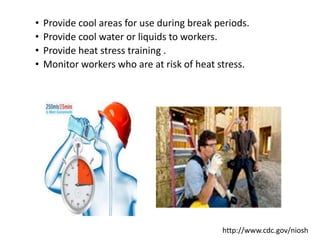
• Provide cool areas for use during break periods.
• Provide cool water or liquids to workers.
• Provide heat stress training .
• Monitor workers who are at risk of heat stress.
http://www.cdc.gov/niosh
• Action from Workers
• Wear light-colored, loose-fitting, breathable clothing such
as cotton.
• Schedule heavy work during the coolest parts of day.
• Take more breaks in extreme heat and humidity.
• Drink water frequently. Drink enough water that you never
become thirsty. Approximately 1 cup every 15-20 minutes.
http://www.cdc.gov/niosh
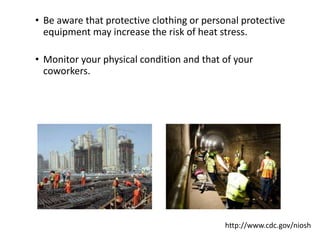
• Be aware that protective clothing or personal protective
equipment may increase the risk of heat stress.
• Monitor your physical condition and that of your
coworkers.
http://www.cdc.gov/niosh
MECHANISM OF THERMAL
EXCHANGE
• The human body at rest will dissipate the heat
generated by metabolic process.
• Methods of body heat dissipation.
• Conduction
• Convection
• Evaporation
• Radiation
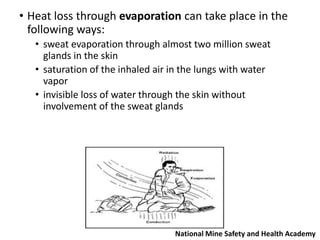
National Mine Safety and Health Academy
• Conduction is not a direct route of heat loss to the
environment for the human body most of the body is
in contact with the clothing.
• Heat rays (radiation) do not need a medium like air or
water for their transfer.
• For example, hot walls in a mine will not only warm
the mine air through convection, but also will emit
heat directly through radiation and affect persons
working in the area.
National Mine Safety and Health Academy
• Heat loss through evaporation can take place in the
following ways:
• sweat evaporation through almost two million sweat
glands in the skin
• saturation of the inhaled air in the lungs with water
vapor
• invisible loss of water through the skin without
involvement of the sweat glands
National Mine Safety and Health Academy
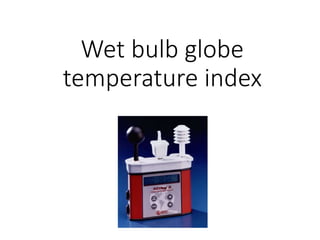
Wet bulb globe
temperature index
• The wet bulb globe temperature (WBGT) index is the
most widely used and accepted index for the
assessment of heat stress in industry
• The WBGT index is an empirical index.
• It represents the heat stress to which an individual is
exposed.
• The index was developed specifically for use in
industrial settings.
• The practicalities of an industrial application
necessitated a compromise between the requirement
for a precise index and the need to be able to easily
take controlled measurements
• The WBGT should be used to estimate whether or
not a problem exists, by identifying if the reference
values are exceeded by the measured values
• The WBGT-index combines three measurements:
• Natural wet-bulb temperature (tnw)
• Globe temperature (tg)
• Air temperature (ta)
• Inside buildings and outside buildings without
experiencing the effects of radiation from the sun
(solar load):
• WBGT = 0.7tnw + 0.3tg
• Outside buildings with solar load, or where a radiant
heat source is present indoors:
• WBGT = 0.7tnw +0.2tg +0.1ta
• The measurements are entered into the above the
equations to obtain a WBGT value.
• The WBGT value is then compared to the reference
values provided in the standard for the appropriate
metabolic rate and state of acclimation of the worker.
Metabolic rate, M WBGT Reference value
Metabolic
Rate class
Related to a
unit skin
surface area
W/m-2
Total
(for a mean
skin surface
area of
1.8m2)
W
Person
acclimatised to heat
°C
Person not acclimatised to
heat
°C
0 (resting) M≤65 M≤117 33 32
1 65<M≤130 117<M≤234 30 29
2 130<M≤200 234<M≤360 28 26
3 200<M≤260 360<M≤468
No sensible
air movement
25
Sensible Air
movement
26
No sensible
air movement
22
Sensible air
movement
23
4 M>260 M>468 23 25 18 20
Reference values of WBGT heat stress index related to a
maximum rectal temperature of 38°C
Two types of exposure limits:
• Occupational Exposure Limits
• Thermal Comfort Limits
ACGIH recommends TLVs (units of WBGT in °C).
WBGT unit takes into account environmental factors:
• Air temperature
• Humidity
• Air movement
• Solar load (heat from radiant sources)
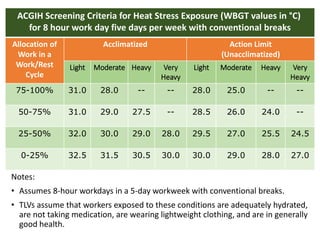
ACGIH Screening Criteria for Heat Stress Exposure (WBGT values in °C)
for 8 hour work day five days per week with conventional breaks
Allocation of
Work in a
Work/Rest
Cycle
Acclimatized Action Limit
(Unacclimatized)
Light Moderate Heavy Very
Heavy
Light Moderate Heavy Very
Heavy
75-100% 31.0 28.0 -- -- 28.0 25.0 -- --
50-75% 31.0 29.0 27.5 -- 28.5 26.0 24.0 --
25-50% 32.0 30.0 29.0 28.0 29.5 27.0 25.5 24.5
0-25% 32.5 31.5 30.5 30.0 30.0 29.0 28.0 27.0
Notes:
• Assumes 8-hour workdays in a 5-day workweek with conventional breaks.
• TLVs assume that workers exposed to these conditions are adequately hydrated,
are not taking medication, are wearing lightweight clothing, and are in generally
good health.
Humidex and Thermal Comfort
Humidex Range
(°C)
Degrees of Comfort
20 - 29 Comfortable
30 - 39 Varying degrees of
discomfort
40 - 45 Uncomfortable
46 and Over Many types of labour must
be restricted
The recommended exposure times are based on:
• Wind chill factor
• Air temperature
• Wind speed
The warm-up break periods are of 10 minute duration
in a warm location.
The schedule assumes that "normal breaks" are taken
once every two hours.
At the end of a 4-hour period, an extended break
(e.g. lunch break) in a warm location is recommended.
*2008 TLVs and BEIs - Threshold Limit Values for Chemical Substances and Physical Agents and Biological Exposure Indices. Cincinnati: American Conference
of Governmental Industrial Hygienists (ACGIH), 2008 - page 213
** Number of breaks: This
includes a normal break
after 2 hours and the
number of additional
warm-up breaks needed.
REFERENCE
• OSHA. https://www.osha.gov/SLTC/heatstress/
• Parsons, Kenneth C. in 42. Heat and Cold, Vogt,
Jean-Jacques, Editor, Encyclopedia of Occupational
Health and Safety, Jeanne Mager Stellman, Editor-
in-Chief. International Labor Organization, Geneva.
© 2011.
• SafeWork SA. 2013. Heat Stress Standard &
Documentation Developed for Use in the
Australian Environment.
http://www.aioh.org.au/product_pubs.asp

Thermal stress full

  • 1.
  • 2.
    SCENARIOS AT WORKPLACES •Many people are exposed to heat on some jobs, outdoors or in hot indoor environments. • Operations involving high air temperatures, radiant heat sources, high humidity, direct physical contact with hot objects, or strenuous physical activities have a high potential for causing heat-related illness. • Every year, thousands of workers become sick from occupational heat exposure, and some even die. • These illnesses and deaths are preventable. OSHA
  • 3.
    Heat stress isthe total heat burden that the body is subjected to by both external and internal factors such as: External • Temperature • Humidity • Amount of air movement • Radiant temperature of surroundings • Clothing Internal • Physical activity (metabolic heat load) SWSA 2013
  • 4.
  • 5.
    EXAMPLE OF WORKPLACES •iron and steel foundries • nonferrous foundries • brick-firing and ceramic plants • glass products facilities • rubber products factories • electrical utilities (particularly boiler rooms), • Bakeries • confectioneries • commercial kitchens • Laundries • food canneries • chemical plants • mining sites • Smelters • steam tunnels
  • 6.
    Outdoor operations • farmwork • Construction • oil and gas well operations • asbestos removal • Landscaping • emergency response operations • hazardous waste site activitieS
  • 7.
    • Workers atgreater risk of heat stress include those who are 65 years of age or older, are overweight, have heart disease or high blood pressure, or take medications that may be affected by extreme heat. NIOSH
  • 8.
    HEAT STRESS INDICES •A single number which integrates the effects of the basic parameters in any human thermal environment such that its value will vary with the thermal strain experienced by the person exposed to a hot environment. • All of the parameters* can be quantified, either by measurement or estimation.
  • 9.
    Environmental parameters • Airtemperature • Mean radiant temperature • Relative humidity • Air velocity • Radiation “human” factors • Work rate (which affects metabolic rate) and • Clothing level • Whether the person is acclimatised to hot conditions
  • 11.
    FUNCTION OF HEATSTRESS INDICES • provide tools for assessing hot environments and predicting likely thermal strain on the body. • Limit values based upon heat stress indices will indicate when that strain is likely to become unacceptable. • The index value (measured or calculated) can be used in design or in work practice to establish safe limits.
  • 14.
    Thermal Strains Disorder AndHealth Effect HEAT FATIGUE HEAT CRAMPS HEAT EXHAUSTION HEAT STROKE HEAT COLLAPSE HEAT RASHES
  • 15.
    Heat Stroke • themost serious heat-related disorder. • symptoms : i) the body's temperature rises rapidly, ii) the sweating mechanism fails, iii) body is unable to cool down. • the body temperature can rise to 106 degrees Fahrenheit or higher within 10 to 15 minutes. • can cause death or permanent
  • 16.
    Heat Exhaustion • thebody's response to an excessive loss of the water and salt, usually through excessive sweating. • Workers most prone to heat exhaustion are those that are elderly, have high blood pressure, and those working in a hot environment.
  • 17.
    Heat fatigue • Afactor : lack of acclimatization. • The use of a program of acclimatization & training for work in hot environments is advisable. • Symptoms : i) impaired performance of skilled sensorimotor, mental, or vigilance jobs. • no treatment for heat fatigue except remove the heat stress before more
  • 18.
    Heat Cramps • affectworkers who sweat a lot during strenuous activity. • This sweating depletes the body's salt and moisture levels. - causes painful cramps. • Heat cramps may also be a symptom of heat exhaustion.
  • 19.
    Heat Rashes • isa skin irritation caused by excessive sweating during hot, humid weather. • Symptoms : Heat rash looks like a red cluster of pimples or small blisters. • Occur at : i) on the neck and upper chest, ii) in the groin, iii) under the breasts, iv) in elbow creases.
  • 20.
    Heat collapse (fainting) •the brain does not receive enough oxygen because blood pools in the extremities. • As a result, the exposed individual may lose consciousness. This reaction is similar to that of heat exhaustion and does not affect the body's heat balance. • However, the onset of heat collapse is rapid and unpredictable. • To prevent, the worker should gradually become acclimatized to the hot environment.
  • 21.
    CONTROLLING THERMAL EXPOSURE • Actionto take from Employers • Schedule maintenance and repair jobs in hot areas for cooler months. • Acclimatize workers by exposing them for progressively longer periods to hot work environments. • Use relief workers or assign extra workers for physically demanding jobs. http://www.cdc.gov/niosh
  • 22.
    • Provide coolareas for use during break periods. • Provide cool water or liquids to workers. • Provide heat stress training . • Monitor workers who are at risk of heat stress. http://www.cdc.gov/niosh
  • 23.
    • Action fromWorkers • Wear light-colored, loose-fitting, breathable clothing such as cotton. • Schedule heavy work during the coolest parts of day. • Take more breaks in extreme heat and humidity. • Drink water frequently. Drink enough water that you never become thirsty. Approximately 1 cup every 15-20 minutes. http://www.cdc.gov/niosh
  • 24.
    • Be awarethat protective clothing or personal protective equipment may increase the risk of heat stress. • Monitor your physical condition and that of your coworkers. http://www.cdc.gov/niosh
  • 25.
    MECHANISM OF THERMAL EXCHANGE •The human body at rest will dissipate the heat generated by metabolic process. • Methods of body heat dissipation. • Conduction • Convection • Evaporation • Radiation National Mine Safety and Health Academy
  • 26.
    • Conduction isnot a direct route of heat loss to the environment for the human body most of the body is in contact with the clothing. • Heat rays (radiation) do not need a medium like air or water for their transfer. • For example, hot walls in a mine will not only warm the mine air through convection, but also will emit heat directly through radiation and affect persons working in the area. National Mine Safety and Health Academy
  • 27.
    • Heat lossthrough evaporation can take place in the following ways: • sweat evaporation through almost two million sweat glands in the skin • saturation of the inhaled air in the lungs with water vapor • invisible loss of water through the skin without involvement of the sweat glands National Mine Safety and Health Academy
  • 28.
  • 29.
    • The wetbulb globe temperature (WBGT) index is the most widely used and accepted index for the assessment of heat stress in industry • The WBGT index is an empirical index. • It represents the heat stress to which an individual is exposed. • The index was developed specifically for use in industrial settings. • The practicalities of an industrial application necessitated a compromise between the requirement for a precise index and the need to be able to easily take controlled measurements
  • 30.
    • The WBGTshould be used to estimate whether or not a problem exists, by identifying if the reference values are exceeded by the measured values • The WBGT-index combines three measurements: • Natural wet-bulb temperature (tnw) • Globe temperature (tg) • Air temperature (ta)
  • 31.
    • Inside buildingsand outside buildings without experiencing the effects of radiation from the sun (solar load): • WBGT = 0.7tnw + 0.3tg • Outside buildings with solar load, or where a radiant heat source is present indoors: • WBGT = 0.7tnw +0.2tg +0.1ta • The measurements are entered into the above the equations to obtain a WBGT value. • The WBGT value is then compared to the reference values provided in the standard for the appropriate metabolic rate and state of acclimation of the worker.
  • 32.
    Metabolic rate, MWBGT Reference value Metabolic Rate class Related to a unit skin surface area W/m-2 Total (for a mean skin surface area of 1.8m2) W Person acclimatised to heat °C Person not acclimatised to heat °C 0 (resting) M≤65 M≤117 33 32 1 65<M≤130 117<M≤234 30 29 2 130<M≤200 234<M≤360 28 26 3 200<M≤260 360<M≤468 No sensible air movement 25 Sensible Air movement 26 No sensible air movement 22 Sensible air movement 23 4 M>260 M>468 23 25 18 20 Reference values of WBGT heat stress index related to a maximum rectal temperature of 38°C
  • 34.
    Two types ofexposure limits: • Occupational Exposure Limits • Thermal Comfort Limits ACGIH recommends TLVs (units of WBGT in °C). WBGT unit takes into account environmental factors: • Air temperature • Humidity • Air movement • Solar load (heat from radiant sources)
  • 35.
    ACGIH Screening Criteriafor Heat Stress Exposure (WBGT values in °C) for 8 hour work day five days per week with conventional breaks Allocation of Work in a Work/Rest Cycle Acclimatized Action Limit (Unacclimatized) Light Moderate Heavy Very Heavy Light Moderate Heavy Very Heavy 75-100% 31.0 28.0 -- -- 28.0 25.0 -- -- 50-75% 31.0 29.0 27.5 -- 28.5 26.0 24.0 -- 25-50% 32.0 30.0 29.0 28.0 29.5 27.0 25.5 24.5 0-25% 32.5 31.5 30.5 30.0 30.0 29.0 28.0 27.0 Notes: • Assumes 8-hour workdays in a 5-day workweek with conventional breaks. • TLVs assume that workers exposed to these conditions are adequately hydrated, are not taking medication, are wearing lightweight clothing, and are in generally good health.
  • 36.
    Humidex and ThermalComfort Humidex Range (°C) Degrees of Comfort 20 - 29 Comfortable 30 - 39 Varying degrees of discomfort 40 - 45 Uncomfortable 46 and Over Many types of labour must be restricted
  • 38.
    The recommended exposuretimes are based on: • Wind chill factor • Air temperature • Wind speed The warm-up break periods are of 10 minute duration in a warm location. The schedule assumes that "normal breaks" are taken once every two hours. At the end of a 4-hour period, an extended break (e.g. lunch break) in a warm location is recommended.
  • 39.
    *2008 TLVs andBEIs - Threshold Limit Values for Chemical Substances and Physical Agents and Biological Exposure Indices. Cincinnati: American Conference of Governmental Industrial Hygienists (ACGIH), 2008 - page 213 ** Number of breaks: This includes a normal break after 2 hours and the number of additional warm-up breaks needed.
  • 40.
    REFERENCE • OSHA. https://www.osha.gov/SLTC/heatstress/ •Parsons, Kenneth C. in 42. Heat and Cold, Vogt, Jean-Jacques, Editor, Encyclopedia of Occupational Health and Safety, Jeanne Mager Stellman, Editor- in-Chief. International Labor Organization, Geneva. © 2011. • SafeWork SA. 2013. Heat Stress Standard & Documentation Developed for Use in the Australian Environment. http://www.aioh.org.au/product_pubs.asp

Editor's Notes

  • #26 convection is a mechanism of heat exchange through a medium such as air or water conduction is the transfer of heat between two bodies in contact radiation is a heat loss due to the emission of heat rays from hotter to cooler surfaces Evaporation vapor pressure at the skin lost to the environment
  • #36 Examples of work loads: Rest - sitting (quietly or with moderate arm movements) Light work - sitting or standing to control machines; performing light hand or arm work (e.g. using a table saw); occasional walking; driving Moderate work - walking about with moderate lifting and pushing or pulling; walking at moderate pace; e.g. scrubbing in a standing position Heavy work - pick and shovel work, digging, carrying, pushing/pulling heavy loads; walking at fast pace; e.g. carpenter sawing by hand Very Heavy - very intense activity at fast to maximum pace; e.g. shovelling wet sand