Energy is an economic ‘good’
• Capable of improving the living standards of
billions of people,
-in developing countries who lack access to
service or whose consumption levels are far
below those of people in industrialised
countries.
• Energy supplies will need to be expanded to
meet emerging demands if living standards are
to be improved and developing countries are to
achieve prosperity.
Total Energy Consumption
The total amount of primary energy consumed
from all sources in the year specified.
Primary energy includes losses from transportation,
friction, heat loss and other inefficiencies.
The International Energy Agency (IEA) calls this
value Total Primary Energy Supply (TPES)
Consumption = indigenous production +( imports and stock
changes)-(exports and international marine bunkers)
Energy Consumption per capita is the total
amount of energy consumed per person, in
each country in the year specified. This
variable includes energy from all energy
sources.
 Energy Consumption per GDP PPP indicates
the amount of energy consumed per unit of
income generated by the country's economy.
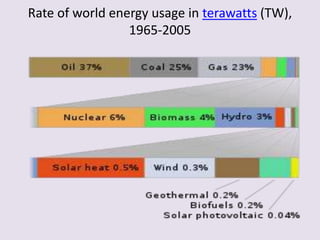
Rate of world energy usage in terawatts (TW),
1965-2005
6
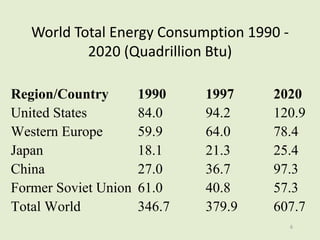
World Total Energy Consumption 1990 -
2020 (Quadrillion Btu)
Region/Country 1990 1997 2020
United States 84.0 94.2 120.9
Western Europe 59.9 64.0 78.4
Japan 18.1 21.3 25.4
China 27.0 36.7 97.3
Former Soviet Union 61.0 40.8 57.3
Total World 346.7 379.9 607.7
7
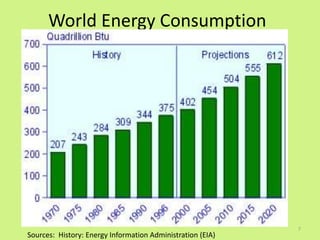
World Energy Consumption
Sources: History: Energy Information Administration (EIA)
8
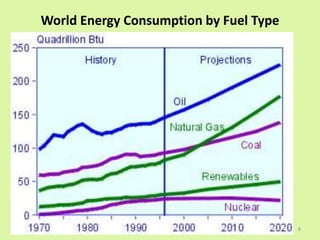
World Energy Consumption by Fuel Type
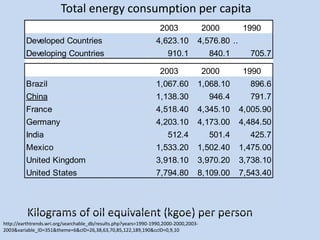
Total energy consumption per capita
Kilograms of oil equivalent (kgoe) per person
http://earthtrends.wri.org/searchable_db/results.php?years=1990-1990,2000-2000,2003-
2003&variable_ID=351&theme=6&cID=26,38,63,70,85,122,189,190&ccID=0,9,10
2003 2000 1990
Developed Countries 4,623.10 4,576.80 ..
Developing Countries 910.1 840.1 705.7
2003 2000 1990
Brazil 1,067.60 1,068.10 896.6
China 1,138.30 946.4 791.7
France 4,518.40 4,345.10 4,005.90
Germany 4,203.10 4,173.00 4,484.50
India 512.4 501.4 425.7
Mexico 1,533.20 1,502.40 1,475.00
United Kingdom 3,918.10 3,970.20 3,738.10
United States 7,794.80 8,109.00 7,543.40
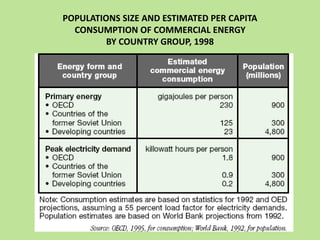
POPULATIONS SIZE AND ESTIMATED PER CAPITA
CONSUMPTION OF COMMERCIAL ENERGY
BY COUNTRY GROUP, 1998
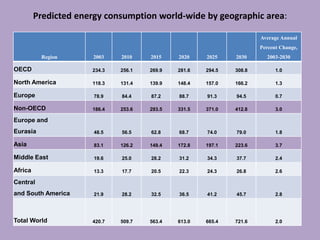
Predicted energy consumption world-wide by geographic area:
Region 2003 2010 2015 2020 2025 2030
Average Annual
Percent Change,
2003-2030
OECD 234.3 256.1 269.9 281.6 294.5 308.8 1.0
North America 118.3 131.4 139.9 148.4 157.0 166.2 1.3
Europe 78.9 84.4 87.2 88.7 91.3 94.5 0.7
Non-OECD 186.4 253.6 293.5 331.5 371.0 412.8 3.0
Europe and
Eurasia 48.5 56.5 62.8 68.7 74.0 79.0 1.8
Asia 83.1 126.2 149.4 172.8 197.1 223.6 3.7
Middle East 19.6 25.0 28.2 31.2 34.3 37.7 2.4
Africa 13.3 17.7 20.5 22.3 24.3 26.8 2.6
Central
and South America 21.9 28.2 32.5 36.5 41.2 45.7 2.8
Total World 420.7 509.7 563.4 613.0 665.4 721.6 2.0
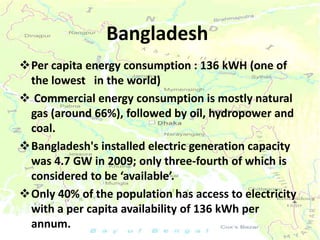
Per capita energy consumption : 136 kWH (one of
the lowest in the world)
 Commercial energy consumption is mostly natural
gas (around 66%), followed by oil, hydropower and
coal.
Bangladesh's installed electric generation capacity
was 4.7 GW in 2009; only three-fourth of which is
considered to be ‘available’.
Only 40% of the population has access to electricity
with a per capita availability of 136 kWh per
annum.
Bangladesh
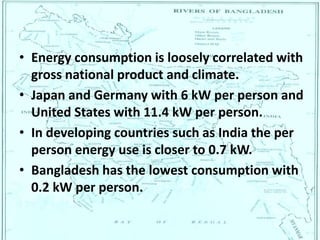
• Energy consumption is loosely correlated with
gross national product and climate.
• Japan and Germany with 6 kW per person and
United States with 11.4 kW per person.
• In developing countries such as India the per
person energy use is closer to 0.7 kW.
• Bangladesh has the lowest consumption with
0.2 kW per person.
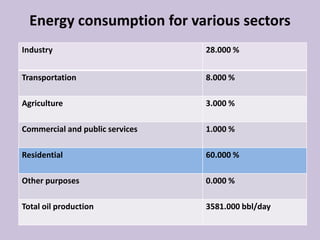
Energy consumption for various sectors
Industry 28.000 %
Transportation 8.000 %
Agriculture 3.000 %
Commercial and public services 1.000 %
Residential 60.000 %
Other purposes 0.000 %
Total oil production 3581.000 bbl/day
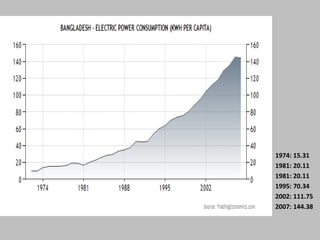
1974: 15.31
1981: 20.11
1981: 20.11
1995: 70.34
2002: 111.75
2007: 144.38
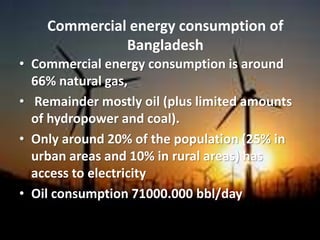
• Commercial energy consumption is around
66% natural gas,
• Remainder mostly oil (plus limited amounts
of hydropower and coal).
• Only around 20% of the population (25% in
urban areas and 10% in rural areas) has
access to electricity
• Oil consumption 71000.000 bbl/day
Commercial energy consumption of
Bangladesh
MNI-BPATC-SSC52 Energy-10 17
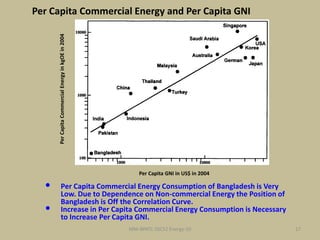
Per Capita GNI in US$ in 2004
PerCapitaCommercialEnergyinkgOEin2004
Per Capita Commercial Energy and Per Capita GNI
• Per Capita Commercial Energy Consumption of Bangladesh is Very
Low. Due to Dependence on Non-commercial Energy the Position of
Bangladesh is Off the Correlation Curve.
• Increase in Per Capita Commercial Energy Consumption is Necessary
to Increase Per Capita GNI.
• Transport energy consumption
• Domestic energy consumption
• Industrial energy consumption
• Service sector energy consumption
Overall energy consumption
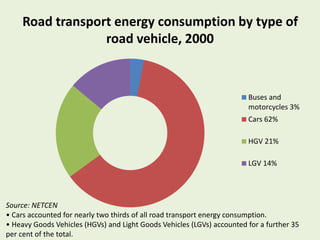
Road transport energy consumption by type of
road vehicle, 2000
Buses and
motorcycles 3%
Cars 62%
HGV 21%
LGV 14%
Source: NETCEN
• Cars accounted for nearly two thirds of all road transport energy consumption.
• Heavy Goods Vehicles (HGVs) and Light Goods Vehicles (LGVs) accounted for a further 35
per cent of the total.
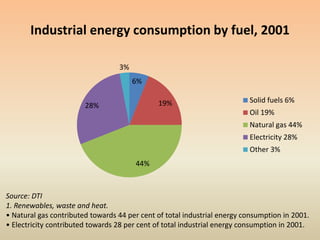
Industrial energy consumption by fuel, 2001
6%
19%
44%
28%
3%
Solid fuels 6%
Oil 19%
Natural gas 44%
Electricity 28%
Other 3%
Source: DTI
1. Renewables, waste and heat.
• Natural gas contributed towards 44 per cent of total industrial energy consumption in 2001.
• Electricity contributed towards 28 per cent of total industrial energy consumption in 2001.
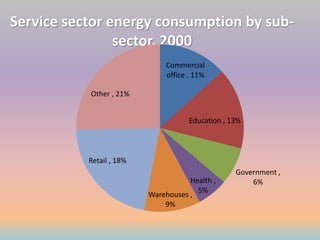
Service sector energy consumption by sub-
sector, 2000
Commercial
office , 11%
Education , 13%
Government ,
6%Health ,
5%
Warehouses ,
9%
Retail , 18%
Other , 21%
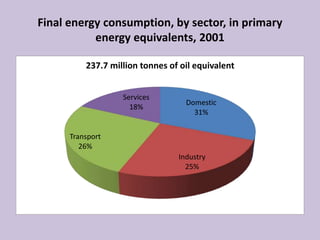
Final energy consumption, by sector, in primary
energy equivalents, 2001
Domestic
31%
Industry
25%
Transport
26%
Services
18%
237.7 million tonnes of oil equivalent
What about economic well being?
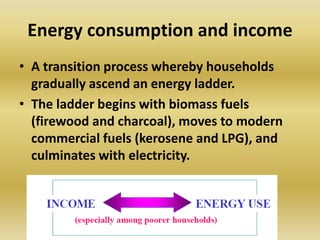
Energy consumption and income
• A transition process whereby households
gradually ascend an energy ladder.
• The ladder begins with biomass fuels
(firewood and charcoal), moves to modern
commercial fuels (kerosene and LPG), and
culminates with electricity.
• Technical progress and lower costs.
• The importance of per capita income growth.
• The benefits of service extension
– Savings in time and labor in the home
– Reductions in pollution and improvements in
health.
– Reductions in environmental damage
– Gains in energy efficiency.
The transition from traditional to
modern energy sources
• Energy demand in developing countries will rise
enormously as per capita incomes and
populations grow.
• No country has been able to raise per capita
incomes from low levels without increasing its
use of commercial energy.
Energy and economic prosperity
1. Higher incomes enable a transition to better
forms of energy use.
– “Electrification causes economic development”
– Many aspects of modern development are not
possible without electricity
– Lack of suitable forms of energy can be a constraint to
development
2. Better energy provision leads to increased
incomes and economic development.
-“Renewable energy creates jobs”
Two points…
National Saving
• Energy intensity is a measure of the energy
efficiency of a nation's economy. It is calculated
as units of energy per unit of GDP.
• High energy intensities indicate a high price or
cost of converting energy into GDP.
• Low energy intensity indicates a lower price or
cost of converting energy into GDP.
Energy intensity
Ultimately
SAVE ENERGY = SAVE MONEY
Energy consumption and economic wellbeing

Energy consumption and economic wellbeing

  • 2.
    Energy is aneconomic ‘good’ • Capable of improving the living standards of billions of people, -in developing countries who lack access to service or whose consumption levels are far below those of people in industrialised countries. • Energy supplies will need to be expanded to meet emerging demands if living standards are to be improved and developing countries are to achieve prosperity.
  • 3.
    Total Energy Consumption Thetotal amount of primary energy consumed from all sources in the year specified. Primary energy includes losses from transportation, friction, heat loss and other inefficiencies. The International Energy Agency (IEA) calls this value Total Primary Energy Supply (TPES) Consumption = indigenous production +( imports and stock changes)-(exports and international marine bunkers)
  • 4.
    Energy Consumption percapita is the total amount of energy consumed per person, in each country in the year specified. This variable includes energy from all energy sources.  Energy Consumption per GDP PPP indicates the amount of energy consumed per unit of income generated by the country's economy.
  • 5.
    Rate of worldenergy usage in terawatts (TW), 1965-2005
  • 6.
    6 World Total EnergyConsumption 1990 - 2020 (Quadrillion Btu) Region/Country 1990 1997 2020 United States 84.0 94.2 120.9 Western Europe 59.9 64.0 78.4 Japan 18.1 21.3 25.4 China 27.0 36.7 97.3 Former Soviet Union 61.0 40.8 57.3 Total World 346.7 379.9 607.7
  • 7.
    7 World Energy Consumption Sources:History: Energy Information Administration (EIA)
  • 8.
  • 9.
    Total energy consumptionper capita Kilograms of oil equivalent (kgoe) per person http://earthtrends.wri.org/searchable_db/results.php?years=1990-1990,2000-2000,2003- 2003&variable_ID=351&theme=6&cID=26,38,63,70,85,122,189,190&ccID=0,9,10 2003 2000 1990 Developed Countries 4,623.10 4,576.80 .. Developing Countries 910.1 840.1 705.7 2003 2000 1990 Brazil 1,067.60 1,068.10 896.6 China 1,138.30 946.4 791.7 France 4,518.40 4,345.10 4,005.90 Germany 4,203.10 4,173.00 4,484.50 India 512.4 501.4 425.7 Mexico 1,533.20 1,502.40 1,475.00 United Kingdom 3,918.10 3,970.20 3,738.10 United States 7,794.80 8,109.00 7,543.40
  • 10.
    POPULATIONS SIZE ANDESTIMATED PER CAPITA CONSUMPTION OF COMMERCIAL ENERGY BY COUNTRY GROUP, 1998
  • 11.
    Predicted energy consumptionworld-wide by geographic area: Region 2003 2010 2015 2020 2025 2030 Average Annual Percent Change, 2003-2030 OECD 234.3 256.1 269.9 281.6 294.5 308.8 1.0 North America 118.3 131.4 139.9 148.4 157.0 166.2 1.3 Europe 78.9 84.4 87.2 88.7 91.3 94.5 0.7 Non-OECD 186.4 253.6 293.5 331.5 371.0 412.8 3.0 Europe and Eurasia 48.5 56.5 62.8 68.7 74.0 79.0 1.8 Asia 83.1 126.2 149.4 172.8 197.1 223.6 3.7 Middle East 19.6 25.0 28.2 31.2 34.3 37.7 2.4 Africa 13.3 17.7 20.5 22.3 24.3 26.8 2.6 Central and South America 21.9 28.2 32.5 36.5 41.2 45.7 2.8 Total World 420.7 509.7 563.4 613.0 665.4 721.6 2.0
  • 12.
    Per capita energyconsumption : 136 kWH (one of the lowest in the world)  Commercial energy consumption is mostly natural gas (around 66%), followed by oil, hydropower and coal. Bangladesh's installed electric generation capacity was 4.7 GW in 2009; only three-fourth of which is considered to be ‘available’. Only 40% of the population has access to electricity with a per capita availability of 136 kWh per annum. Bangladesh
  • 13.
    • Energy consumptionis loosely correlated with gross national product and climate. • Japan and Germany with 6 kW per person and United States with 11.4 kW per person. • In developing countries such as India the per person energy use is closer to 0.7 kW. • Bangladesh has the lowest consumption with 0.2 kW per person.
  • 14.
    Energy consumption forvarious sectors Industry 28.000 % Transportation 8.000 % Agriculture 3.000 % Commercial and public services 1.000 % Residential 60.000 % Other purposes 0.000 % Total oil production 3581.000 bbl/day
  • 15.
    1974: 15.31 1981: 20.11 1981:20.11 1995: 70.34 2002: 111.75 2007: 144.38
  • 16.
    • Commercial energyconsumption is around 66% natural gas, • Remainder mostly oil (plus limited amounts of hydropower and coal). • Only around 20% of the population (25% in urban areas and 10% in rural areas) has access to electricity • Oil consumption 71000.000 bbl/day Commercial energy consumption of Bangladesh
  • 17.
    MNI-BPATC-SSC52 Energy-10 17 PerCapita GNI in US$ in 2004 PerCapitaCommercialEnergyinkgOEin2004 Per Capita Commercial Energy and Per Capita GNI • Per Capita Commercial Energy Consumption of Bangladesh is Very Low. Due to Dependence on Non-commercial Energy the Position of Bangladesh is Off the Correlation Curve. • Increase in Per Capita Commercial Energy Consumption is Necessary to Increase Per Capita GNI.
  • 18.
    • Transport energyconsumption • Domestic energy consumption • Industrial energy consumption • Service sector energy consumption Overall energy consumption
  • 19.
    Road transport energyconsumption by type of road vehicle, 2000 Buses and motorcycles 3% Cars 62% HGV 21% LGV 14% Source: NETCEN • Cars accounted for nearly two thirds of all road transport energy consumption. • Heavy Goods Vehicles (HGVs) and Light Goods Vehicles (LGVs) accounted for a further 35 per cent of the total.
  • 20.
    Industrial energy consumptionby fuel, 2001 6% 19% 44% 28% 3% Solid fuels 6% Oil 19% Natural gas 44% Electricity 28% Other 3% Source: DTI 1. Renewables, waste and heat. • Natural gas contributed towards 44 per cent of total industrial energy consumption in 2001. • Electricity contributed towards 28 per cent of total industrial energy consumption in 2001.
  • 21.
    Service sector energyconsumption by sub- sector, 2000 Commercial office , 11% Education , 13% Government , 6%Health , 5% Warehouses , 9% Retail , 18% Other , 21%
  • 22.
    Final energy consumption,by sector, in primary energy equivalents, 2001 Domestic 31% Industry 25% Transport 26% Services 18% 237.7 million tonnes of oil equivalent
  • 23.
  • 24.
    Energy consumption andincome • A transition process whereby households gradually ascend an energy ladder. • The ladder begins with biomass fuels (firewood and charcoal), moves to modern commercial fuels (kerosene and LPG), and culminates with electricity.
  • 25.
    • Technical progressand lower costs. • The importance of per capita income growth. • The benefits of service extension – Savings in time and labor in the home – Reductions in pollution and improvements in health. – Reductions in environmental damage – Gains in energy efficiency. The transition from traditional to modern energy sources
  • 26.
    • Energy demandin developing countries will rise enormously as per capita incomes and populations grow. • No country has been able to raise per capita incomes from low levels without increasing its use of commercial energy. Energy and economic prosperity
  • 27.
    1. Higher incomesenable a transition to better forms of energy use. – “Electrification causes economic development” – Many aspects of modern development are not possible without electricity – Lack of suitable forms of energy can be a constraint to development 2. Better energy provision leads to increased incomes and economic development. -“Renewable energy creates jobs” Two points…
  • 28.
  • 29.
    • Energy intensityis a measure of the energy efficiency of a nation's economy. It is calculated as units of energy per unit of GDP. • High energy intensities indicate a high price or cost of converting energy into GDP. • Low energy intensity indicates a lower price or cost of converting energy into GDP. Energy intensity
  • 30.