Pressure Relief Valve
Hector Nguema Ondo
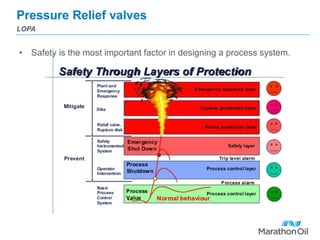
Pressure Relief valves
• Safety is the most important factor in designing a process system.
LOPA
Pressure Relief valves
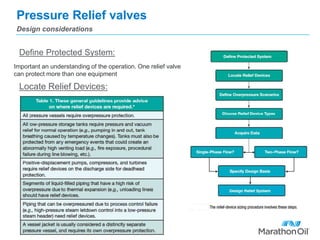
Define Protected System:
Design considerations
Important an understanding of the operation. One relief valve
can protect more than one equipment
Locate Relief Devices:
Pressure Relief valves
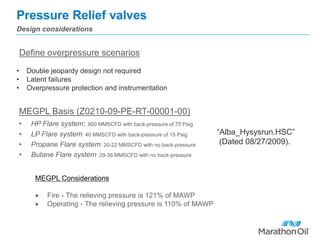
Define overpressure scenarios
Design considerations
• Double jeopardy design not required
• Latent failures
• Overpressure protection and instrumentation
MEGPL Basis (Z0210-09-PE-RT-00001-00)
• HP Flare system: 900 MMSCFD with back-pressure of 75 Psig
• LP Flare system: 40 MMSCFD with back-pressure of 15 Psig
• Propane Flare system: 20-22 MMSCFD with no back-pressure
• Butane Flare system: 29-36 MMSCFD with no back-pressure
“Alba_Hysysrun.HSC”
(Dated 08/27/2009).
MEGPL Considerations
 Fire - The relieving pressure is 121% of MAWP
 Operating - The relieving pressure is 110% of MAWP
Pressure Relief valves
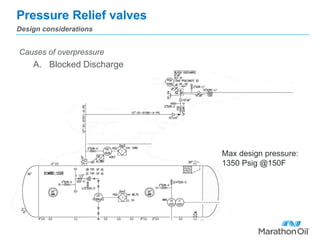
Causes of overpressure
A. Blocked Discharge
Design considerations
Max design pressure:
1350 Psig @150F
Pressure Relief valves
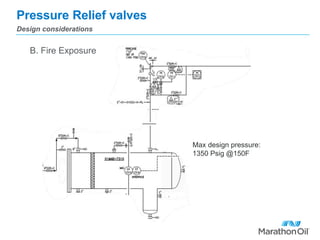
B. Fire Exposure
Design considerations
Max design pressure:
1350 Psig @150F
Pressure Relief valves
Design considerations
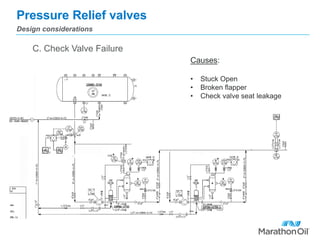
C. Check Valve Failure
Causes:
• Stuck Open
• Broken flapper
• Check valve seat leakage
Pressure Relief valves
Design considerations
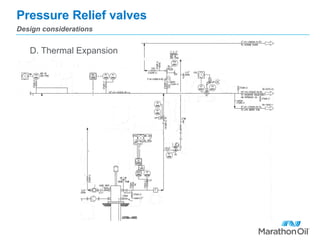
D. Thermal Expansion
Pressure Relief valves
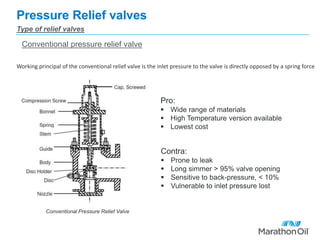
Conventional pressure relief valve
Type of relief valves
Working principal of the conventional relief valve is the inlet pressure to the valve is directly opposed by a spring force
Conventional Pressure Relief Valve
Pro:
 Wide range of materials
 High Temperature version available
 Lowest cost
Contra:
 Prone to leak
 Long simmer > 95% valve opening
 Sensitive to back-pressure, < 10%
 Vulnerable to inlet pressure lost
Pressure Relief valves
Type of relief valves
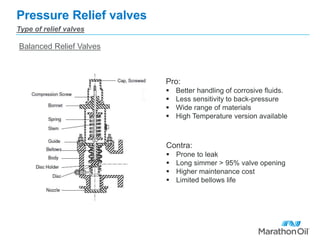
Balanced Relief Valves
Pro:
 Better handling of corrosive fluids.
 Less sensitivity to back-pressure
 Wide range of materials
 High Temperature version available
Contra:
 Prone to leak
 Long simmer > 95% valve opening
 Higher maintenance cost
 Limited bellows life
Pressure Relief valves
Type of relief valves
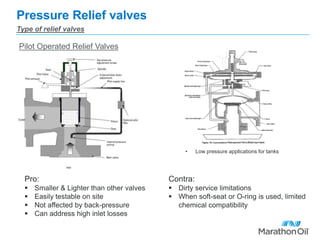
Pilot Operated Relief Valves
• Low pressure applications for tanks
Pro:
 Smaller & Lighter than other valves
 Easily testable on site
 Not affected by back-pressure
 Can address high inlet losses
Contra:
 Dirty service limitations
 When soft-seat or O-ring is used, limited
chemical compatibility
Pressure Relief valves
• Sizing for liquid service
• Sizing for gas service
Sizing relief valves
Pressure Relief valves
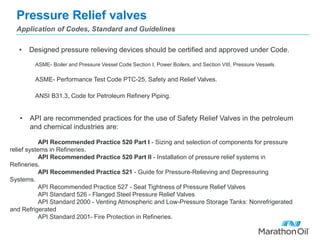
• Designed pressure relieving devices should be certified and approved under Code.
ASME- Boiler and Pressure Vessel Code Section I, Power Boilers, and Section VIII, Pressure Vessels.
ASME- Performance Test Code PTC-25, Safety and Relief Valves.
ANSI B31.3, Code for Petroleum Refinery Piping.
Application of Codes, Standard and Guidelines
• API are recommended practices for the use of Safety Relief Valves in the petroleum
and chemical industries are:
API Recommended Practice 520 Part I - Sizing and selection of components for pressure
relief systems in Refineries.
API Recommended Practice 520 Part II - Installation of pressure relief systems in
Refineries.
API Recommended Practice 521 - Guide for Pressure-Relieving and Depressuring
Systems.
API Recommended Practice 527 - Seat Tightness of Pressure Relief Valves
API Standard 526 - Flanged Steel Pressure Relief Valves
API Standard 2000 - Venting Atmospheric and Low-Pressure Storage Tanks: Nonrefrigerated
and Refrigerated
API Standard 2001- Fire Protection in Refineries.
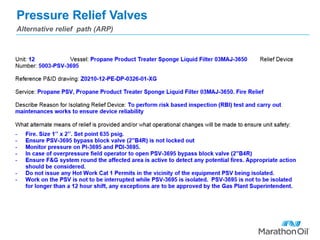
Pressure Relief Valves
Alternative relief path (ARP)
Questions?
Hector Nguema Ondo

Pressure Relief valve sizing and design

  • 1.
  • 2.
    Pressure Relief valves •Safety is the most important factor in designing a process system. LOPA
  • 3.
    Pressure Relief valves DefineProtected System: Design considerations Important an understanding of the operation. One relief valve can protect more than one equipment Locate Relief Devices:
  • 4.
    Pressure Relief valves Defineoverpressure scenarios Design considerations • Double jeopardy design not required • Latent failures • Overpressure protection and instrumentation MEGPL Basis (Z0210-09-PE-RT-00001-00) • HP Flare system: 900 MMSCFD with back-pressure of 75 Psig • LP Flare system: 40 MMSCFD with back-pressure of 15 Psig • Propane Flare system: 20-22 MMSCFD with no back-pressure • Butane Flare system: 29-36 MMSCFD with no back-pressure “Alba_Hysysrun.HSC” (Dated 08/27/2009). MEGPL Considerations  Fire - The relieving pressure is 121% of MAWP  Operating - The relieving pressure is 110% of MAWP
  • 5.
    Pressure Relief valves Causesof overpressure A. Blocked Discharge Design considerations Max design pressure: 1350 Psig @150F
  • 6.
    Pressure Relief valves B.Fire Exposure Design considerations Max design pressure: 1350 Psig @150F
  • 7.
    Pressure Relief valves Designconsiderations C. Check Valve Failure Causes: • Stuck Open • Broken flapper • Check valve seat leakage
  • 8.
    Pressure Relief valves Designconsiderations D. Thermal Expansion
  • 9.
    Pressure Relief valves Conventionalpressure relief valve Type of relief valves Working principal of the conventional relief valve is the inlet pressure to the valve is directly opposed by a spring force Conventional Pressure Relief Valve Pro:  Wide range of materials  High Temperature version available  Lowest cost Contra:  Prone to leak  Long simmer > 95% valve opening  Sensitive to back-pressure, < 10%  Vulnerable to inlet pressure lost
  • 10.
    Pressure Relief valves Typeof relief valves Balanced Relief Valves Pro:  Better handling of corrosive fluids.  Less sensitivity to back-pressure  Wide range of materials  High Temperature version available Contra:  Prone to leak  Long simmer > 95% valve opening  Higher maintenance cost  Limited bellows life
  • 11.
    Pressure Relief valves Typeof relief valves Pilot Operated Relief Valves • Low pressure applications for tanks Pro:  Smaller & Lighter than other valves  Easily testable on site  Not affected by back-pressure  Can address high inlet losses Contra:  Dirty service limitations  When soft-seat or O-ring is used, limited chemical compatibility
  • 12.
    Pressure Relief valves •Sizing for liquid service • Sizing for gas service Sizing relief valves
  • 13.
    Pressure Relief valves •Designed pressure relieving devices should be certified and approved under Code. ASME- Boiler and Pressure Vessel Code Section I, Power Boilers, and Section VIII, Pressure Vessels. ASME- Performance Test Code PTC-25, Safety and Relief Valves. ANSI B31.3, Code for Petroleum Refinery Piping. Application of Codes, Standard and Guidelines • API are recommended practices for the use of Safety Relief Valves in the petroleum and chemical industries are: API Recommended Practice 520 Part I - Sizing and selection of components for pressure relief systems in Refineries. API Recommended Practice 520 Part II - Installation of pressure relief systems in Refineries. API Recommended Practice 521 - Guide for Pressure-Relieving and Depressuring Systems. API Recommended Practice 527 - Seat Tightness of Pressure Relief Valves API Standard 526 - Flanged Steel Pressure Relief Valves API Standard 2000 - Venting Atmospheric and Low-Pressure Storage Tanks: Nonrefrigerated and Refrigerated API Standard 2001- Fire Protection in Refineries.
  • 14.
  • 15.

Editor's Notes

  • #10 PSV-401 DIESEL STRIPPER – Blocked discharge scenario
  • #12 The most common types of relief valves associated with the Alba gas plant are pilot operated valves because these valves generally tend to have a high capacity compared to the others, can operate at near 50% back pressure without capacity loss, and allow the process vessel to be operated much closer to the set pressure.