Health, Safety and the Environment
CGE653
Ir. Dr. MOHD SHIRAZ ARIS
INTRODUCTION
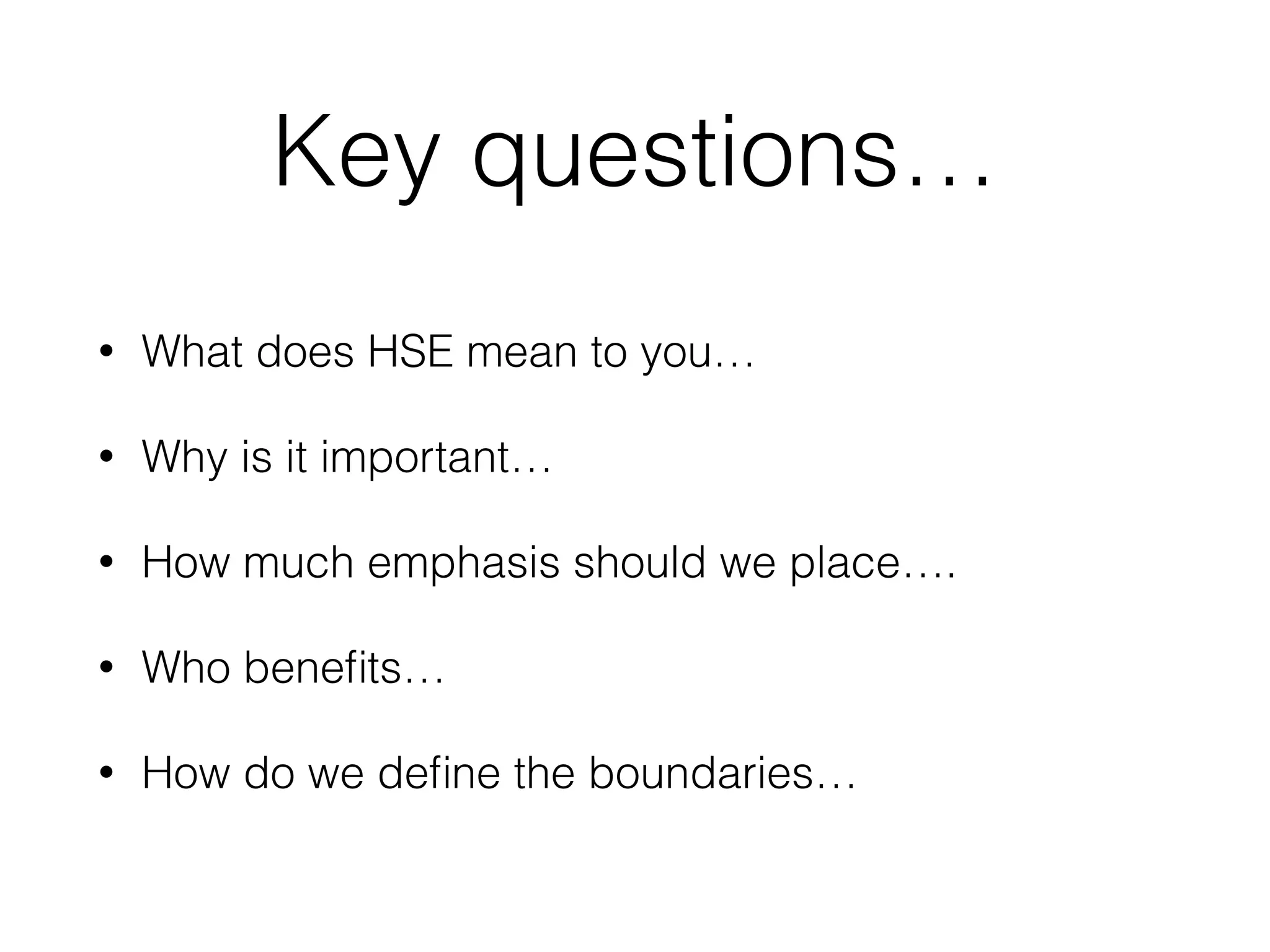
Key questions…
• What does HSE mean to you…
• Why is it important…
• How much emphasis should we place….
• Who benefits…
• How do we define the boundaries…
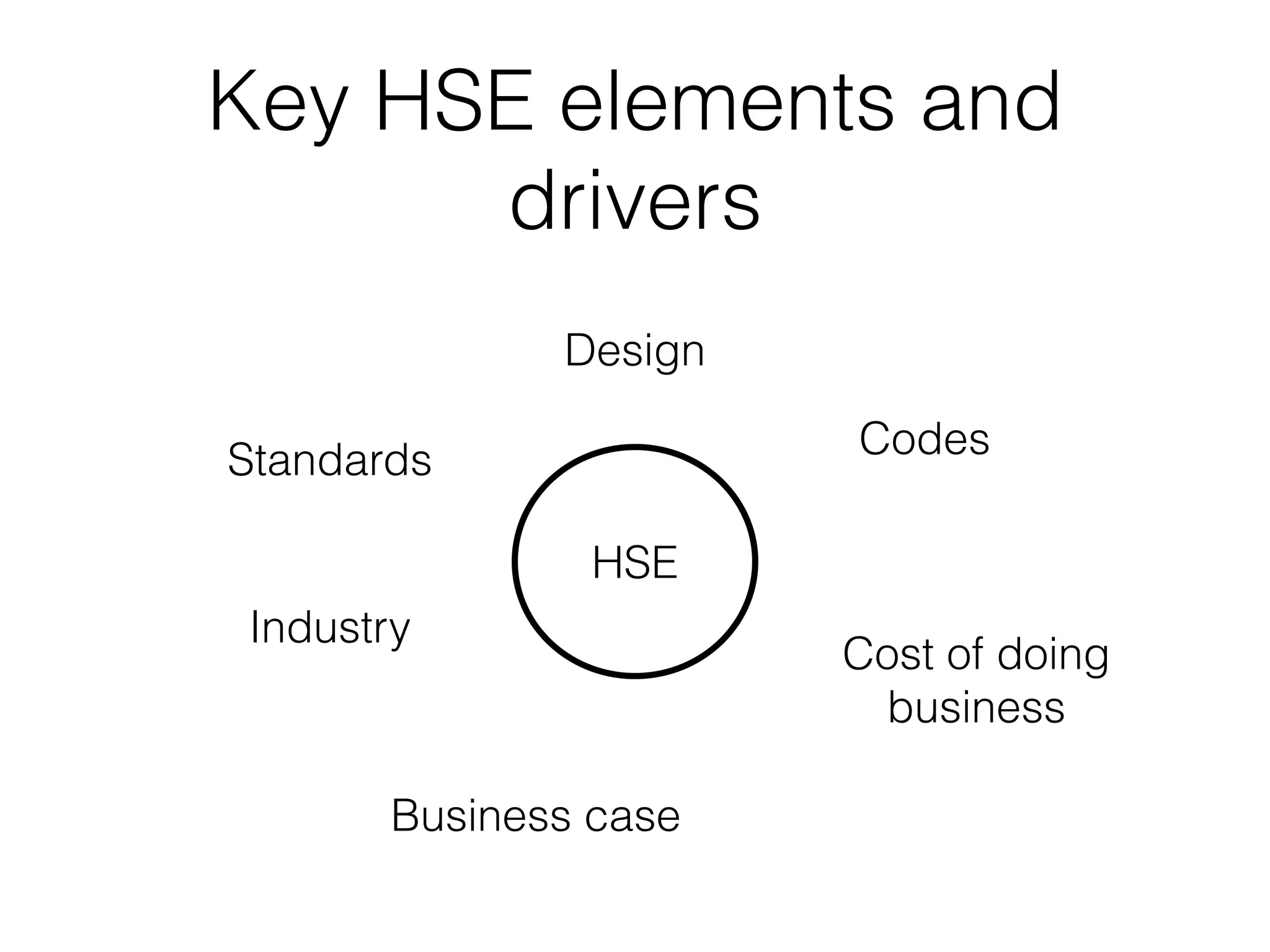
Key HSE elements and
drivers
HSE
Standards Codes
Industry
Business case
Cost of doing
business
Design
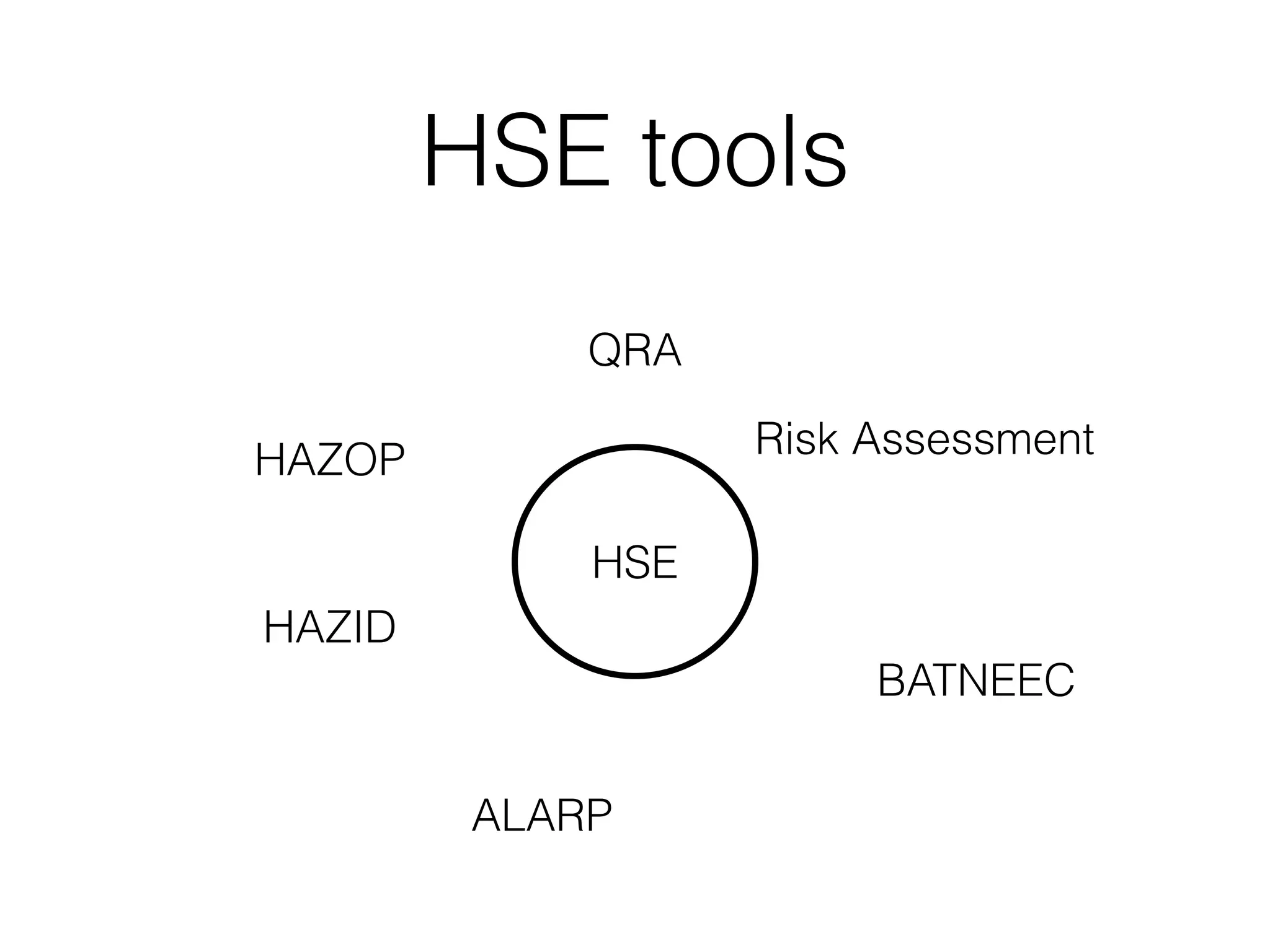
HSE tools
HSE
HAZOP Risk Assessment
HAZID
ALARP
BATNEEC
QRA
Health,Safety&Environmtn–
CGE653


Introduction to Health, Safety and Environment
Acknowledgement to:
Dr Syed Shatir A. Syed-Hassan
Faculty of Chemical
Engineering
Universiti Teknologi MARA
Health,Safety&Environmtn–
CGE653
Introduction
Health,Safety&Environmtn–
CGE653
Some Terminologies
• Safety
• Health
• Chronic
• Acute
• Hazard
• Risk
• Accident
• Incident
• Near Miss
Health,Safety&Environmtn–
CGE653
Safety and Health
• Safety = the absence of: (i) injury and harm on
human and (ii) damage on property and the
environment
• Opposite of safety = accident
• Health = a state of physical and mental well-being
– including the absence of disease or infirmity.
• Safety deals with acute effects of hazards
• Health issue deals with chronic effects of hazards
• Chronic: persistent, prolonged and repeated
• Acute: immediate, short term
Health,Safety&Environmtn–
CGE653
Hazard versus Risk
▪ Hazard = a condition that has the potential to
cause human injury or fatality, damage to
property, damage to the environment or some
combination of these.
▪ Risk = a measure of human injury,
environmental damage, or economic loss in
terms of both the incident likelihood and the
magnitude of the loss or injury.
▪ In other words, risk = a chance of injury or
loss or bad consequences to happen.
Health,Safety&Environmtn–
CGE653
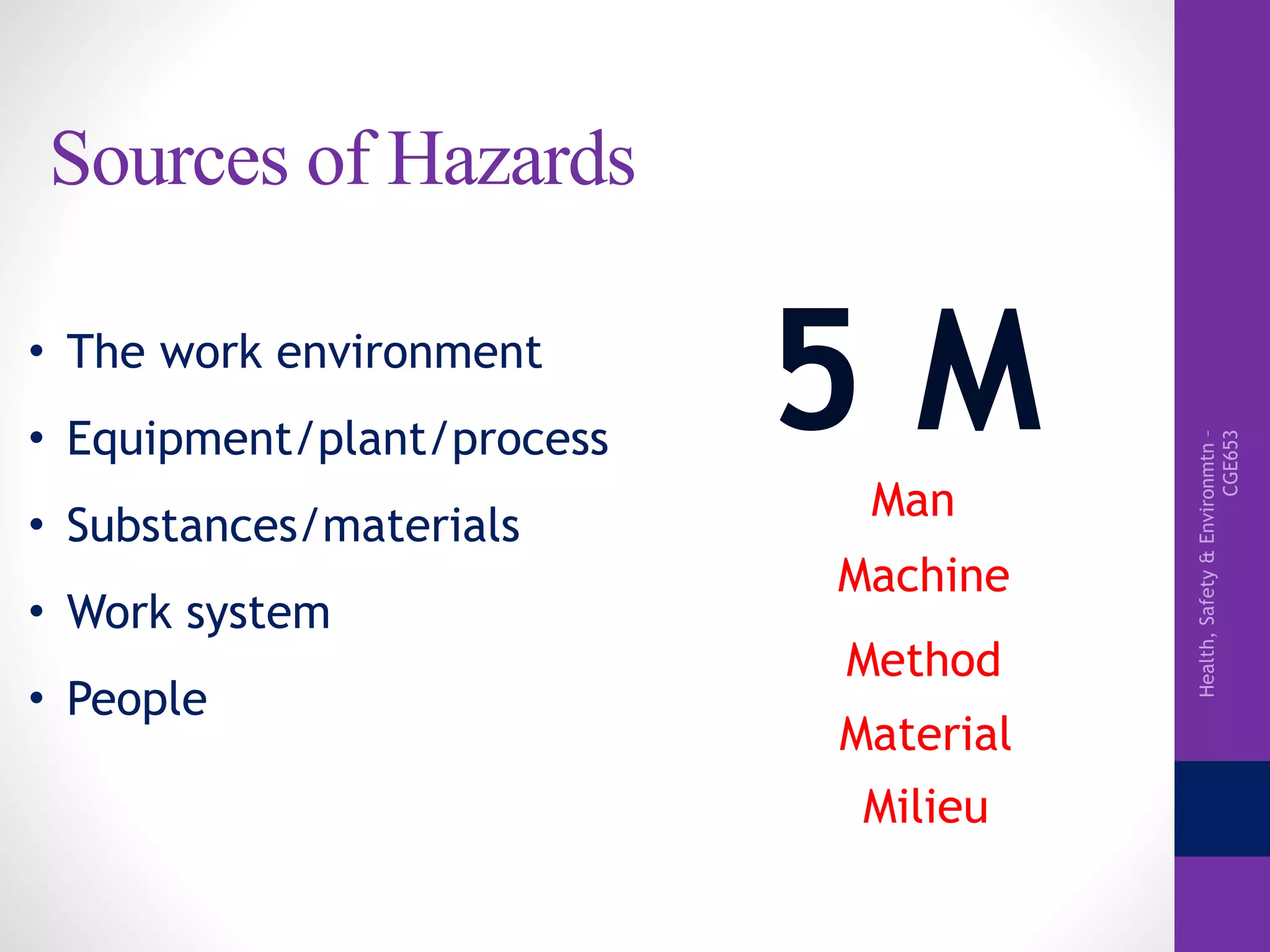
Sources of Hazards
• The work environment
• Equipment/plant/process
• Substances/materials
• Work system
• People
5 M
Man
Machine
Method
Material
Milieu
Health,Safety&Environmtn–
CGE653
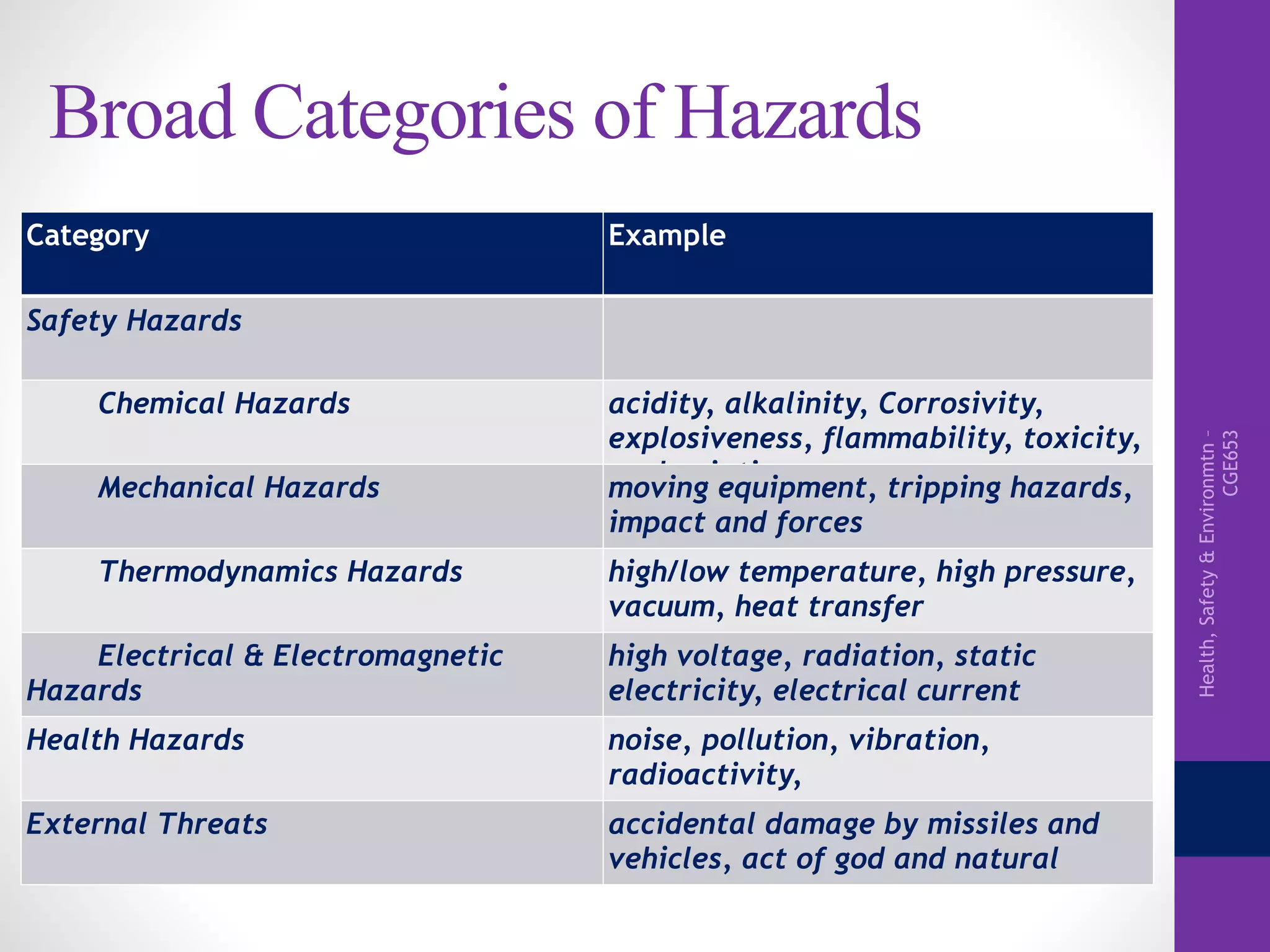
Broad Categories of Hazards
Category Example
Safety Hazards
Chemical Hazards acidity, alkalinity, Corrosivity,
explosiveness, flammability, toxicity,
asphyxiation.Mechanical Hazards moving equipment, tripping hazards,
impact and forces
Thermodynamics Hazards high/low temperature, high pressure,
vacuum, heat transfer
Electrical & Electromagnetic
Hazards
high voltage, radiation, static
electricity, electrical current
Health Hazards noise, pollution, vibration,
radioactivity,
External Threats accidental damage by missiles and
vehicles, act of god and natural
causes
Health,Safety&Environmtn–
CGE653
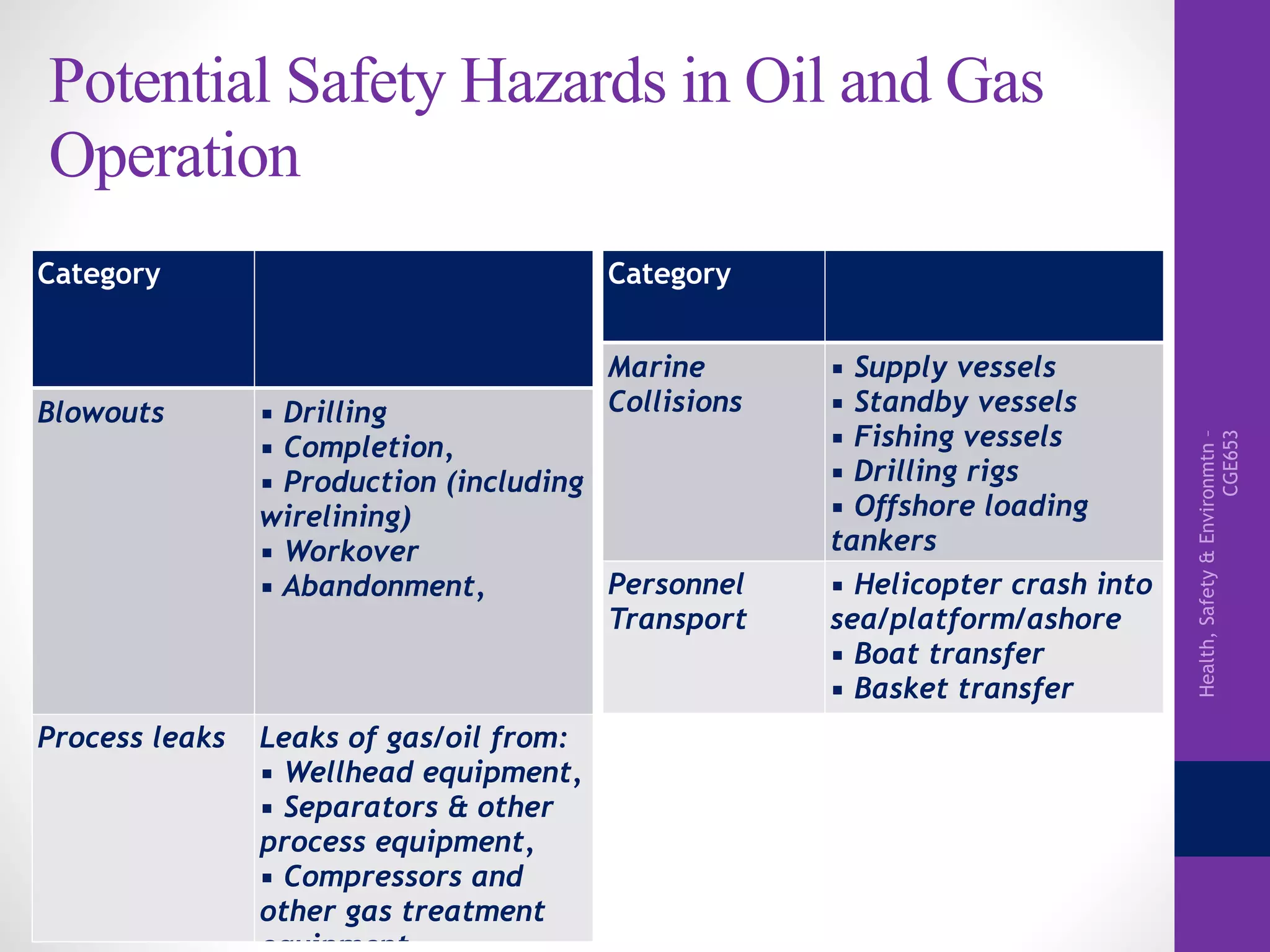
Potential Safety Hazards in Oil and Gas
Operation
Category
Blowouts ▪ Drilling
▪ Completion,
▪ Production (including
wirelining)
▪ Workover
▪ Abandonment,
Process leaks Leaks of gas/oil from:
▪ Wellhead equipment,
▪ Separators & other
process equipment,
▪ Compressors and
other gas treatment
Category
Marine
Collisions
▪ Supply vessels
▪ Standby vessels
▪ Fishing vessels
▪ Drilling rigs
▪ Offshore loading
tankers
Personnel
Transport
▪ Helicopter crash into
sea/platform/ashore
▪ Boat transfer
▪ Basket transfer
Health,Safety&Environmtn–
CGE653
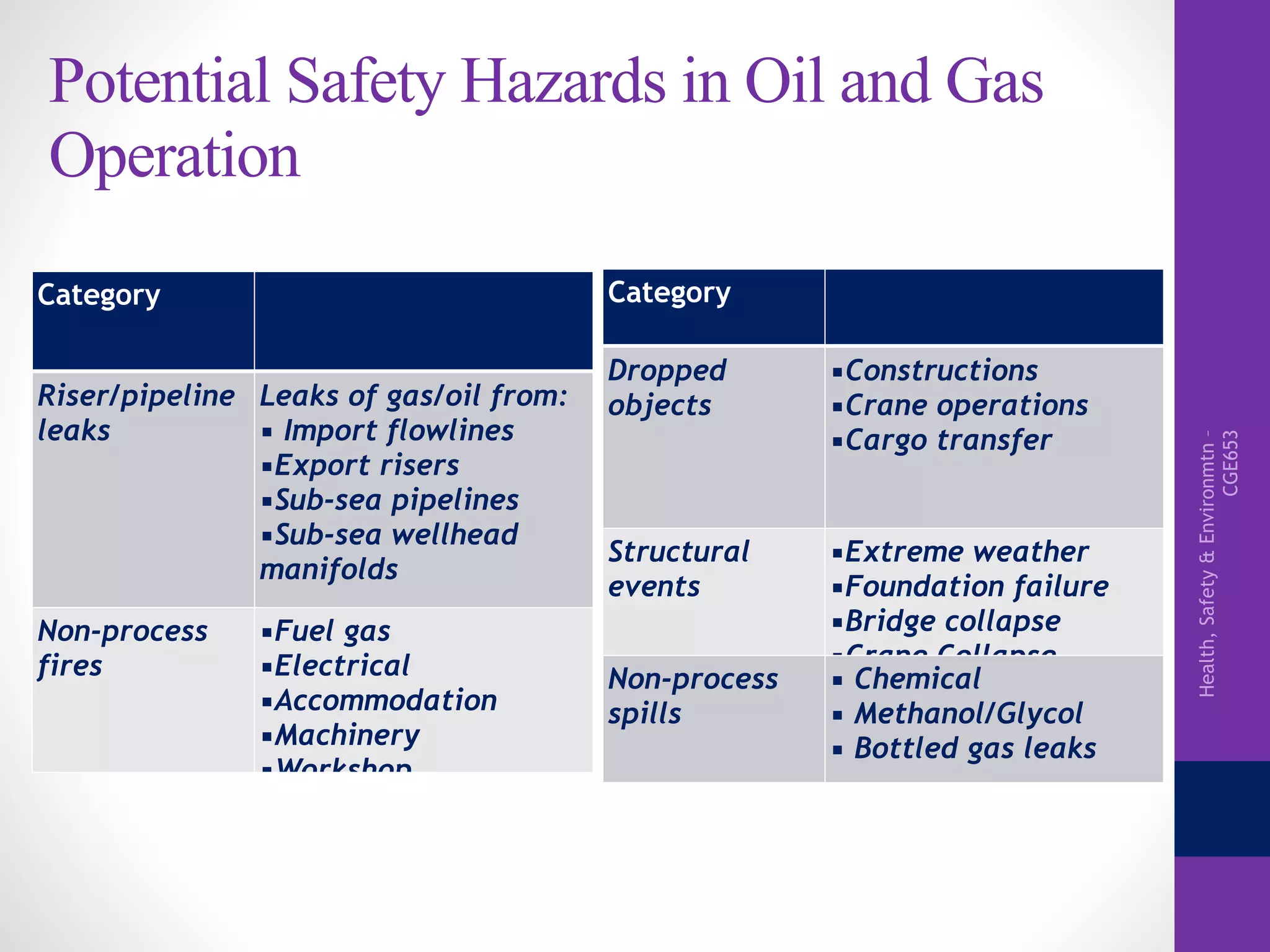
Potential Safety Hazards in Oil and Gas
Operation
Category
Riser/pipeline
leaks
Leaks of gas/oil from:
▪ Import flowlines
▪Export risers
▪Sub-sea pipelines
▪Sub-sea wellhead
manifolds
Non-process
fires
▪Fuel gas
▪Electrical
▪Accommodation
▪Machinery
▪Workshop
Category
Dropped
objects
▪Constructions
▪Crane operations
▪Cargo transfer
Structural
events
▪Extreme weather
▪Foundation failure
▪Bridge collapse
▪Crane Collapse
Non-process
spills
▪ Chemical
▪ Methanol/Glycol
▪ Bottled gas leaks
Health,Safety&Environmtn–
CGE653
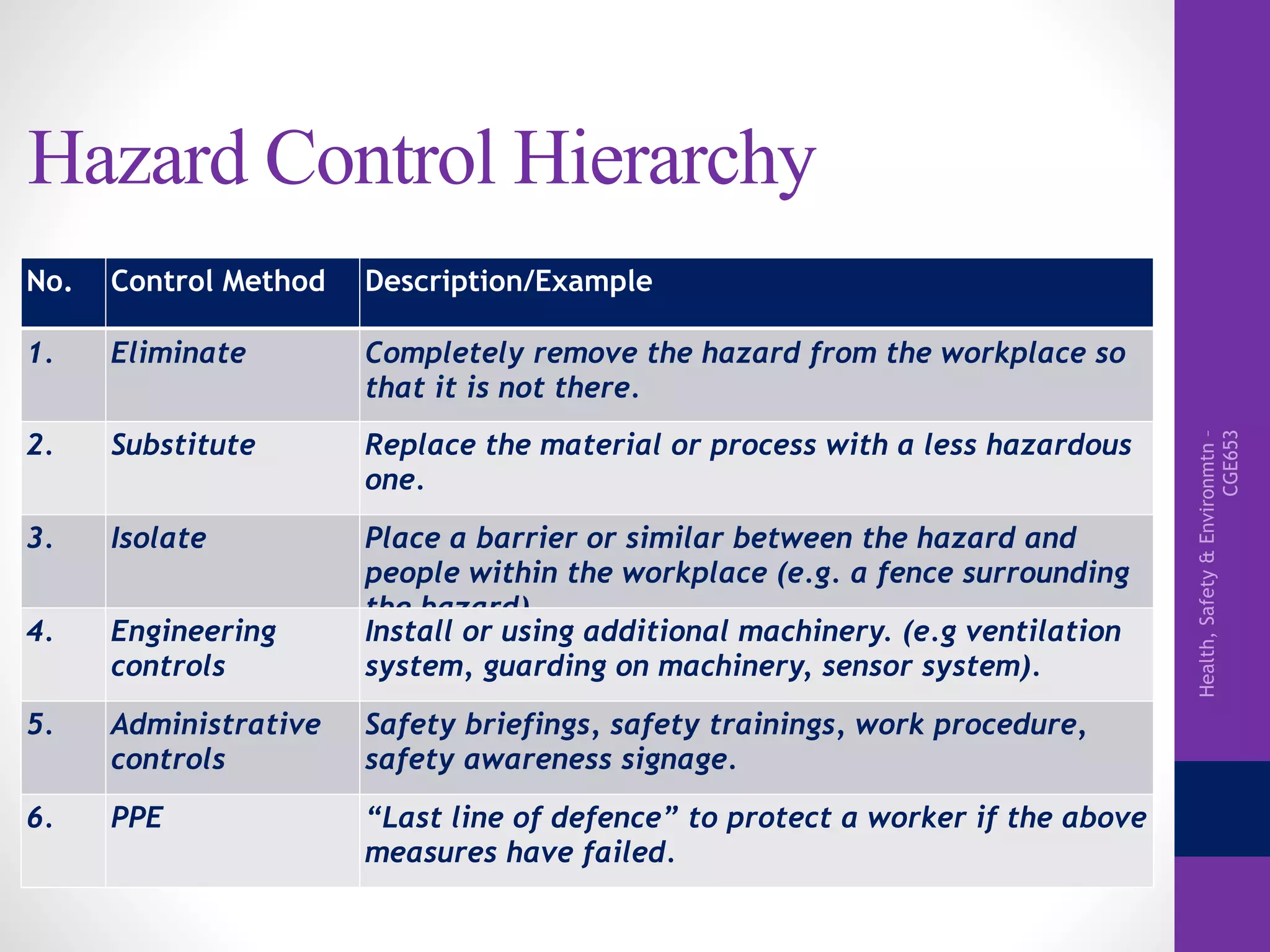
Hazard Control Hierarchy
No. Control Method Description/Example
1. Eliminate Completely remove the hazard from the workplace so
that it is not there.
2. Substitute Replace the material or process with a less hazardous
one.
3. Isolate Place a barrier or similar between the hazard and
people within the workplace (e.g. a fence surrounding
the hazard).
4. Engineering
controls
Install or using additional machinery. (e.g ventilation
system, guarding on machinery, sensor system).
5. Administrative
controls
Safety briefings, safety trainings, work procedure,
safety awareness signage.
6. PPE “Last line of defence” to protect a worker if the above
measures have failed.
Health,Safety&Environmtn–
CGE653
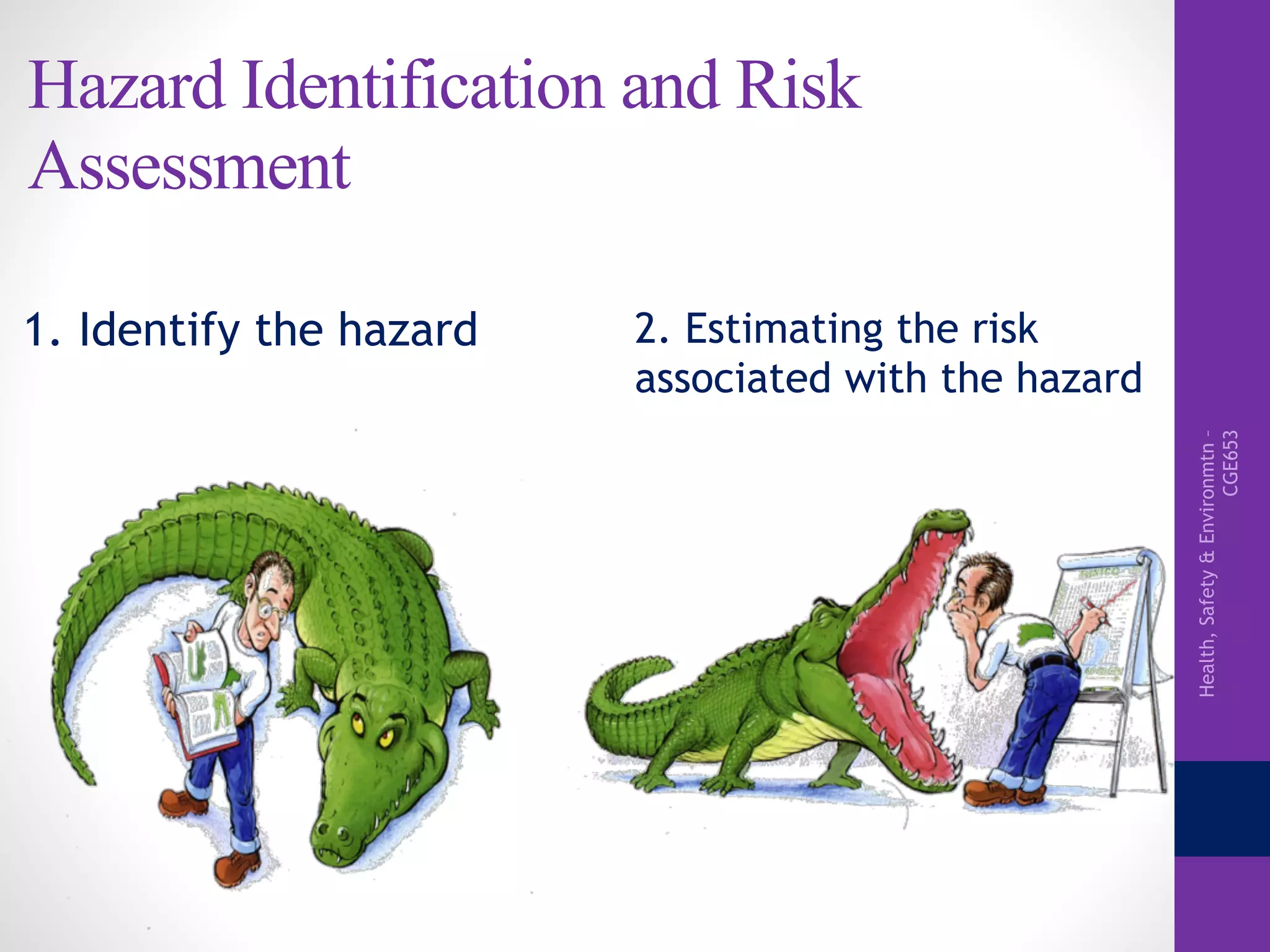
Hazard Identification and Risk
Assessment
1. Identify the hazard 2. Estimating the risk
associated with the hazard
Health,Safety&Environmtn–
CGE653
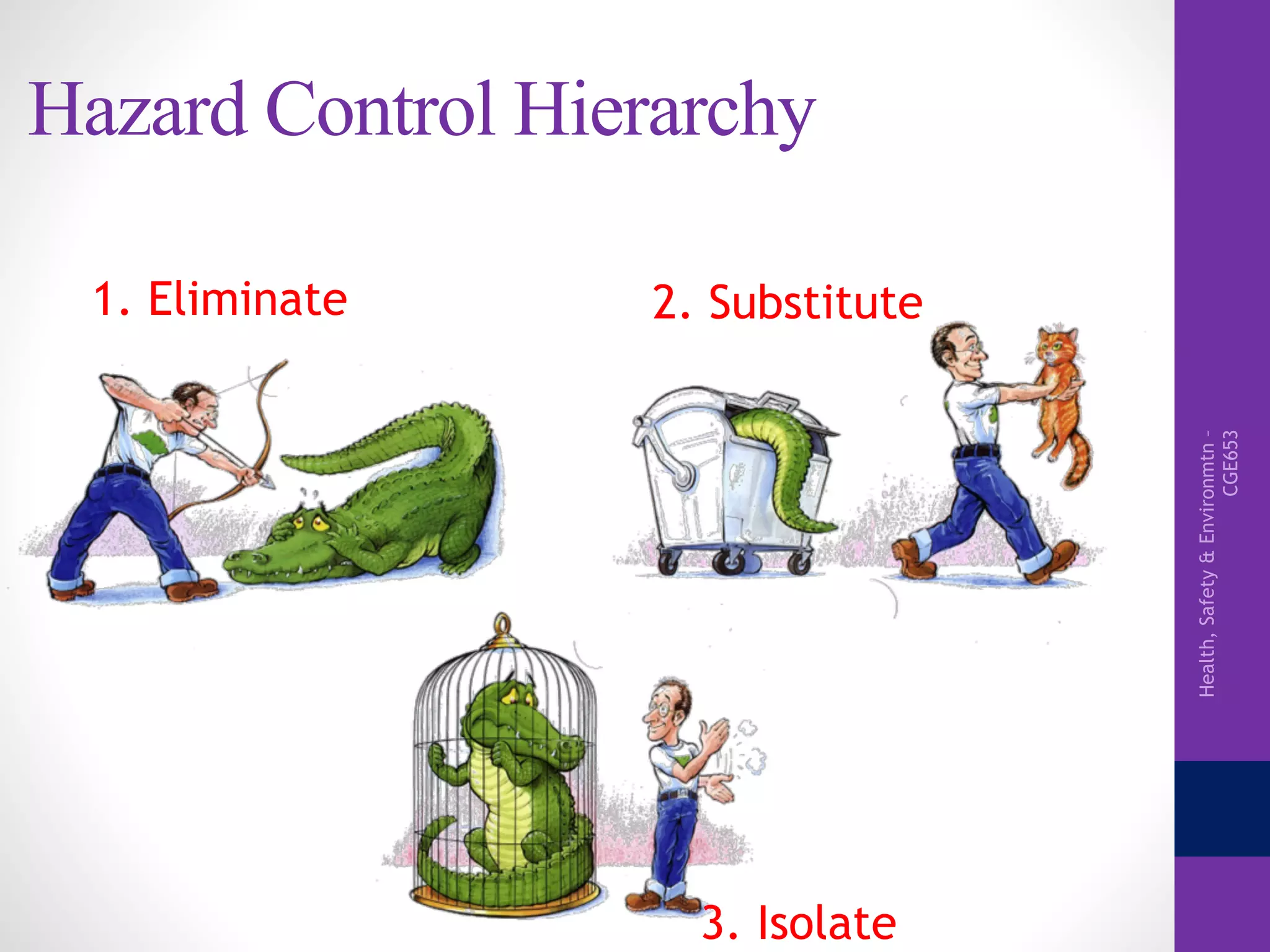
Hazard Control Hierarchy
1. Eliminate 2. Substitute
3. Isolate
Health,Safety&Environmtn–
CGE653
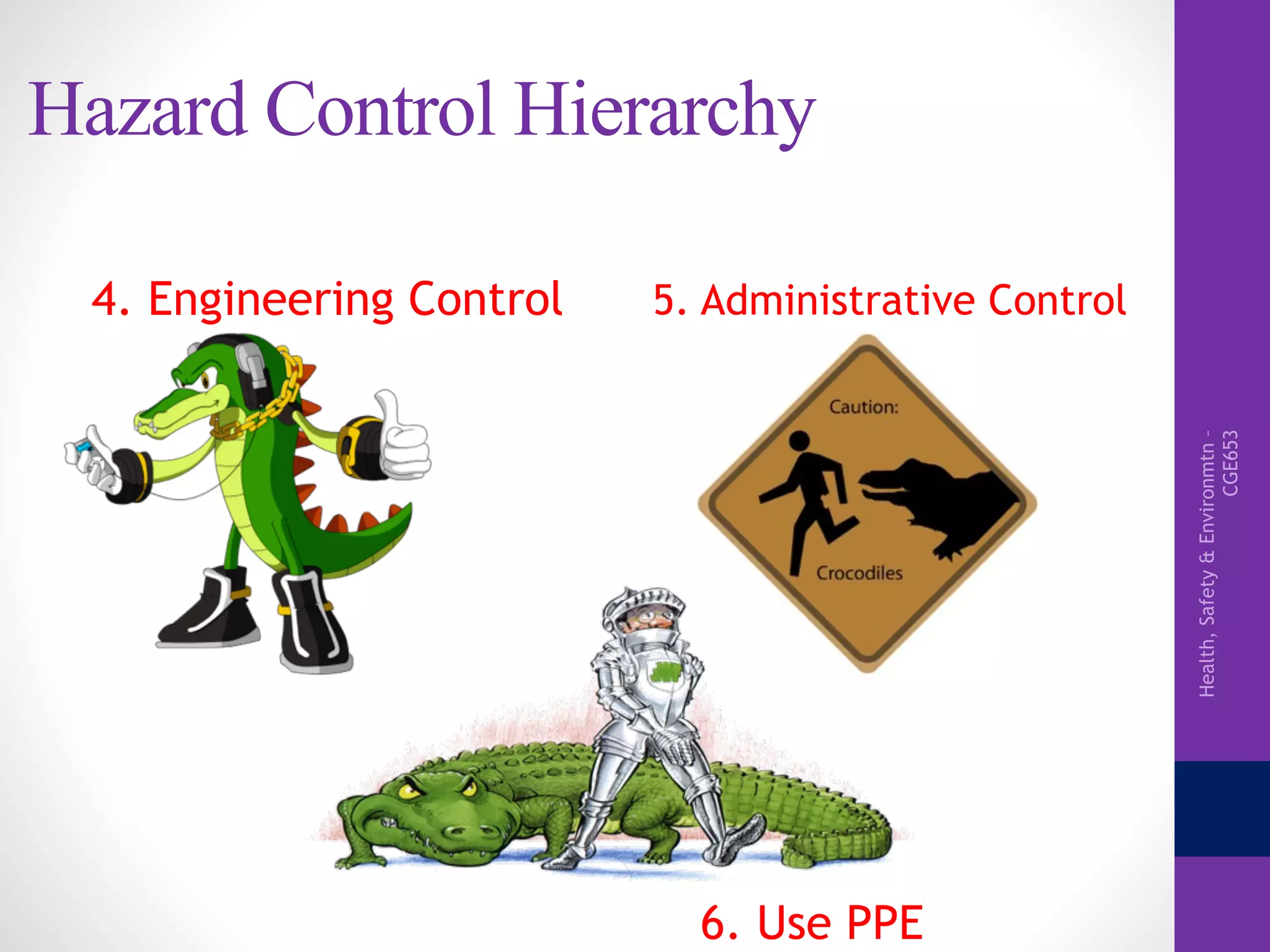
Hazard Control Hierarchy
4. Engineering Control 5. Administrative Control
6. Use PPE
ProcessSafety-CPE615
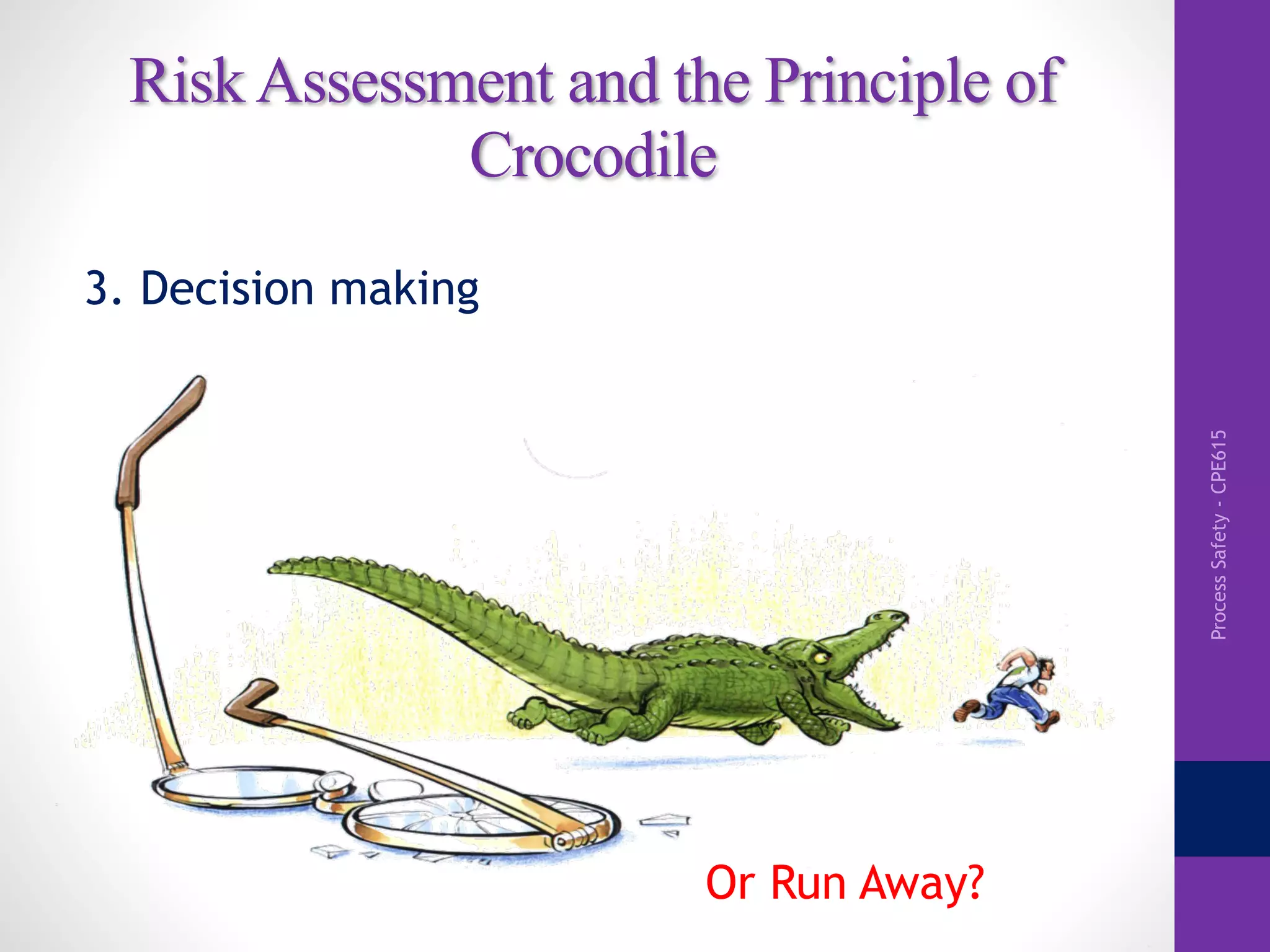
Risk Assessment and the Principle of
Crocodile
3. Decision making
Or Run Away?
Health,Safety&Environmtn–
CGE653
Personal Protective Equipment
Considered as a last resort in hazard control
because:
• Only protects one person.
• Only protects if it is worn properly.
• Difficulties with fit, practicalities of use,
ergonomics, etc.
• Difficulties with enforcement of use.
• Other on-going management issues such as
training, replacement, repair.
Health,Safety&Environmtn–
CGE653
Incident versus Accident
• Incident: all undesired circumstances that have
the potential to cause accidents.
• Accident: a sequence of events that produce
unintended injury, damage to property or the
environment, production losses, or increased
liabilities.
• Accident refers to the event, not the results of
the event.
Health,Safety&Environmtn–
CGE653
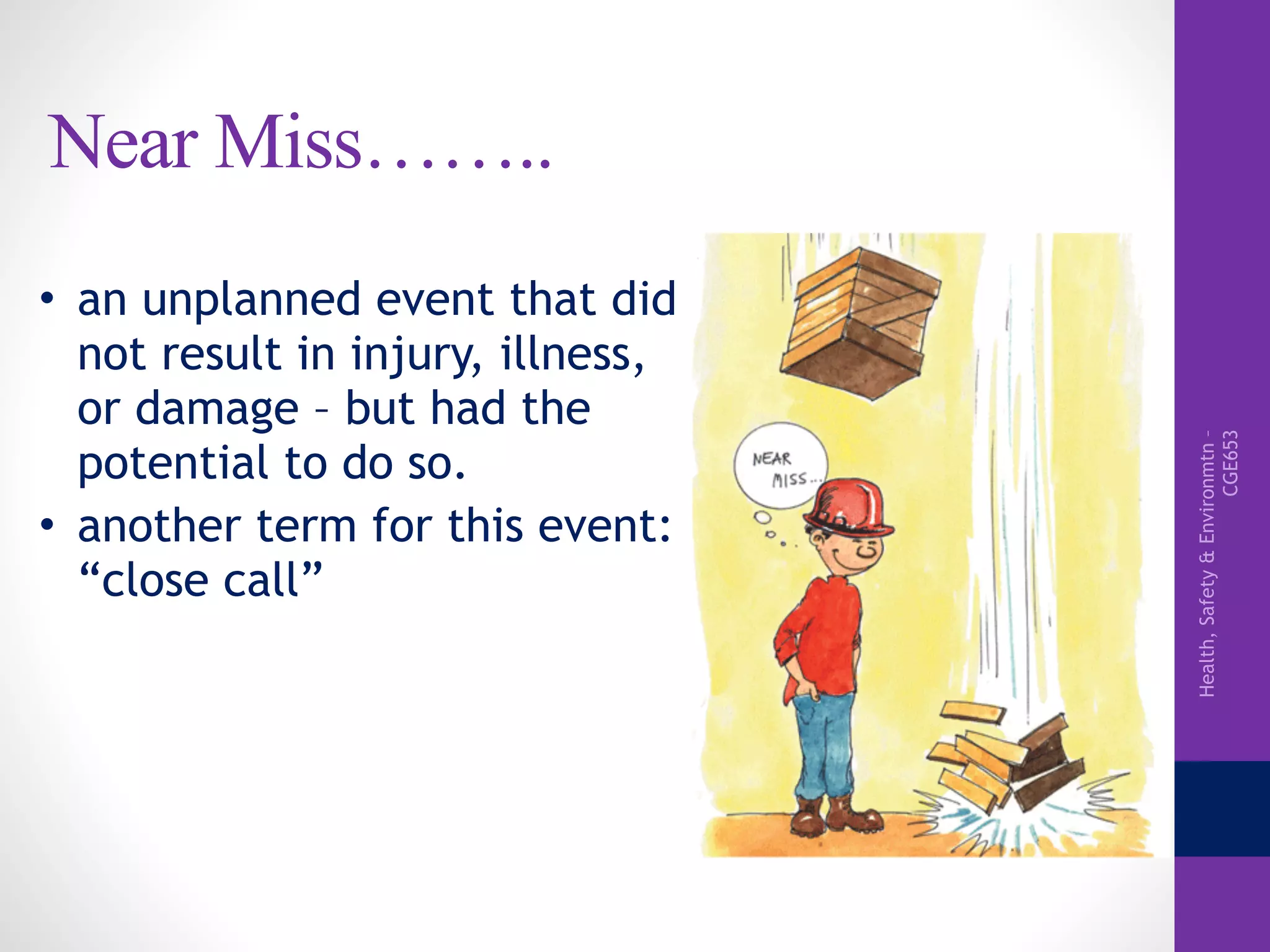
Near Miss……..
• an unplanned event that did
not result in injury, illness,
or damage – but had the
potential to do so.
• another term for this event:
“close call”
Health,Safety&Environmtn–
CGE653
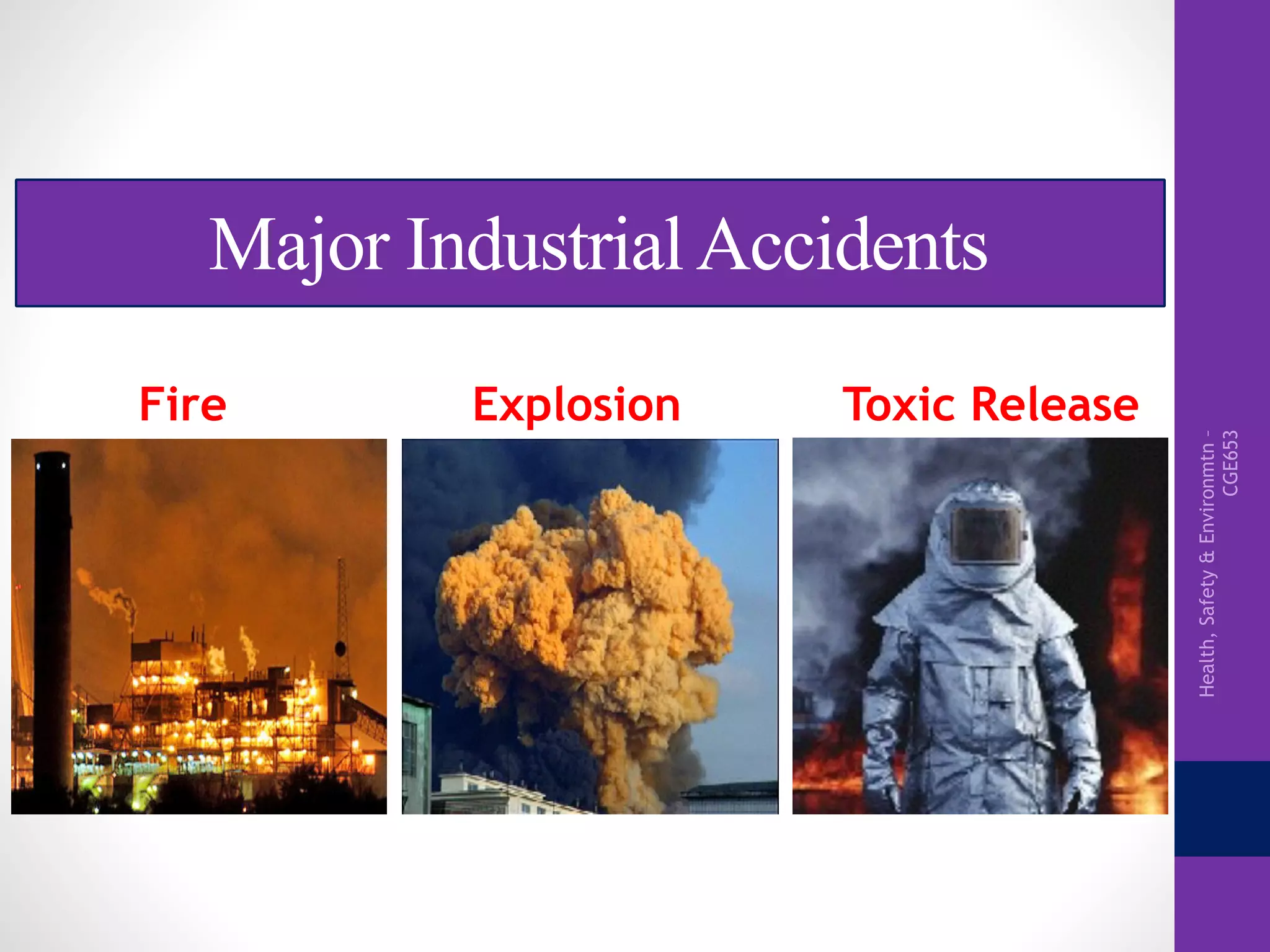
Fire Toxic ReleaseExplosion
Major IndustrialAccidents
Health,Safety&Environmtn–
CGE653
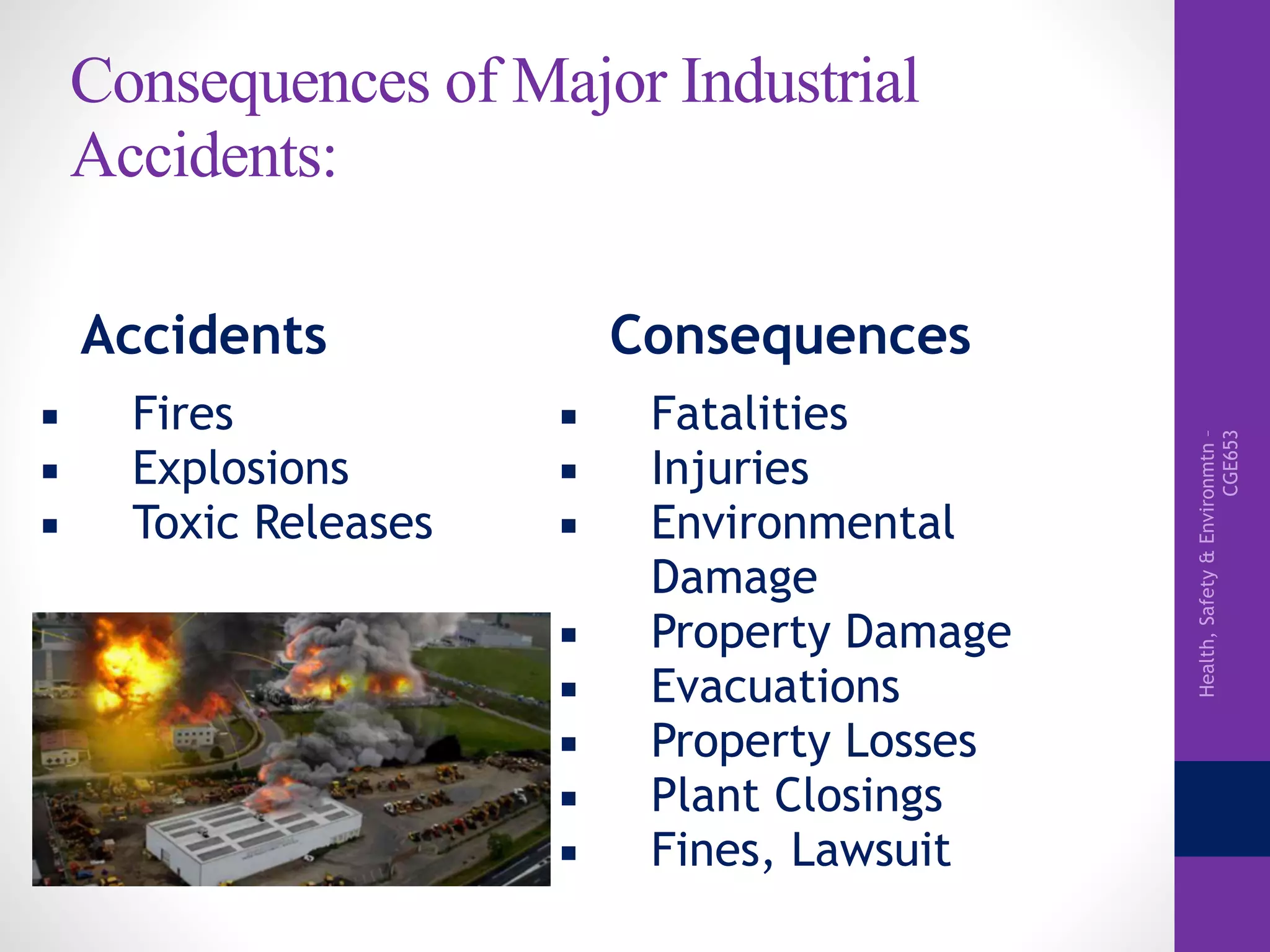
Consequences of Major Industrial
Accidents:
▪ Fires
▪ Explosions
▪ Toxic Releases
▪ Fatalities
▪ Injuries
▪ Environmental
Damage
▪ Property Damage
▪ Evacuations
▪ Property Losses
▪ Plant Closings
▪ Fines, Lawsuit
Accidents Consequences
Health,Safety&Environmtn–
CGE653
Some Major Industrial Accidents in the
Past
Health,Safety&Environmtn–
CGE653
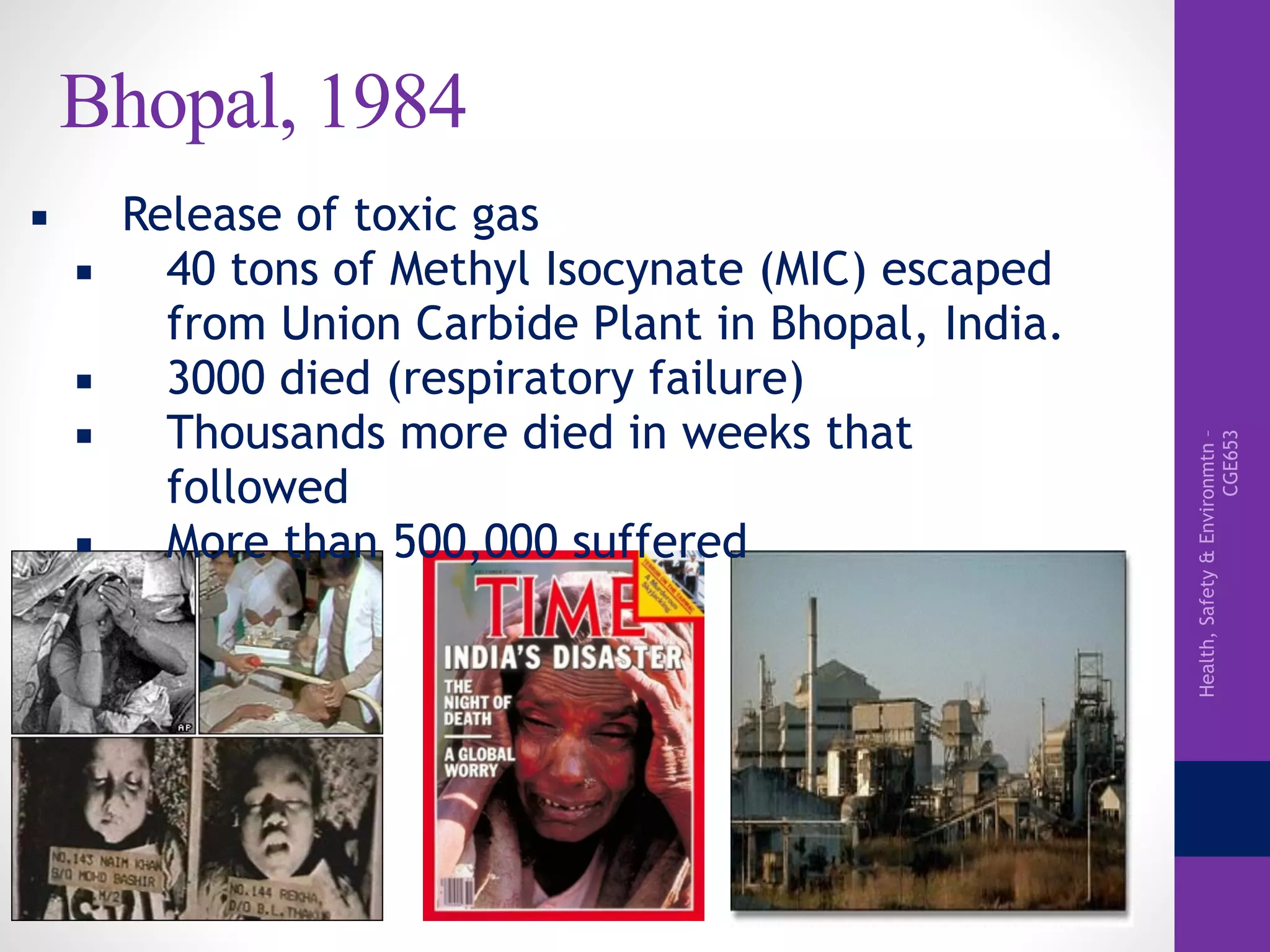
Bhopal, 1984
▪ Release of toxic gas
▪ 40 tons of Methyl Isocynate (MIC) escaped
from Union Carbide Plant in Bhopal, India.
▪ 3000 died (respiratory failure)
▪ Thousands more died in weeks that
followed
▪ More than 500,000 suffered
Health,Safety&Environmtn–
CGE653
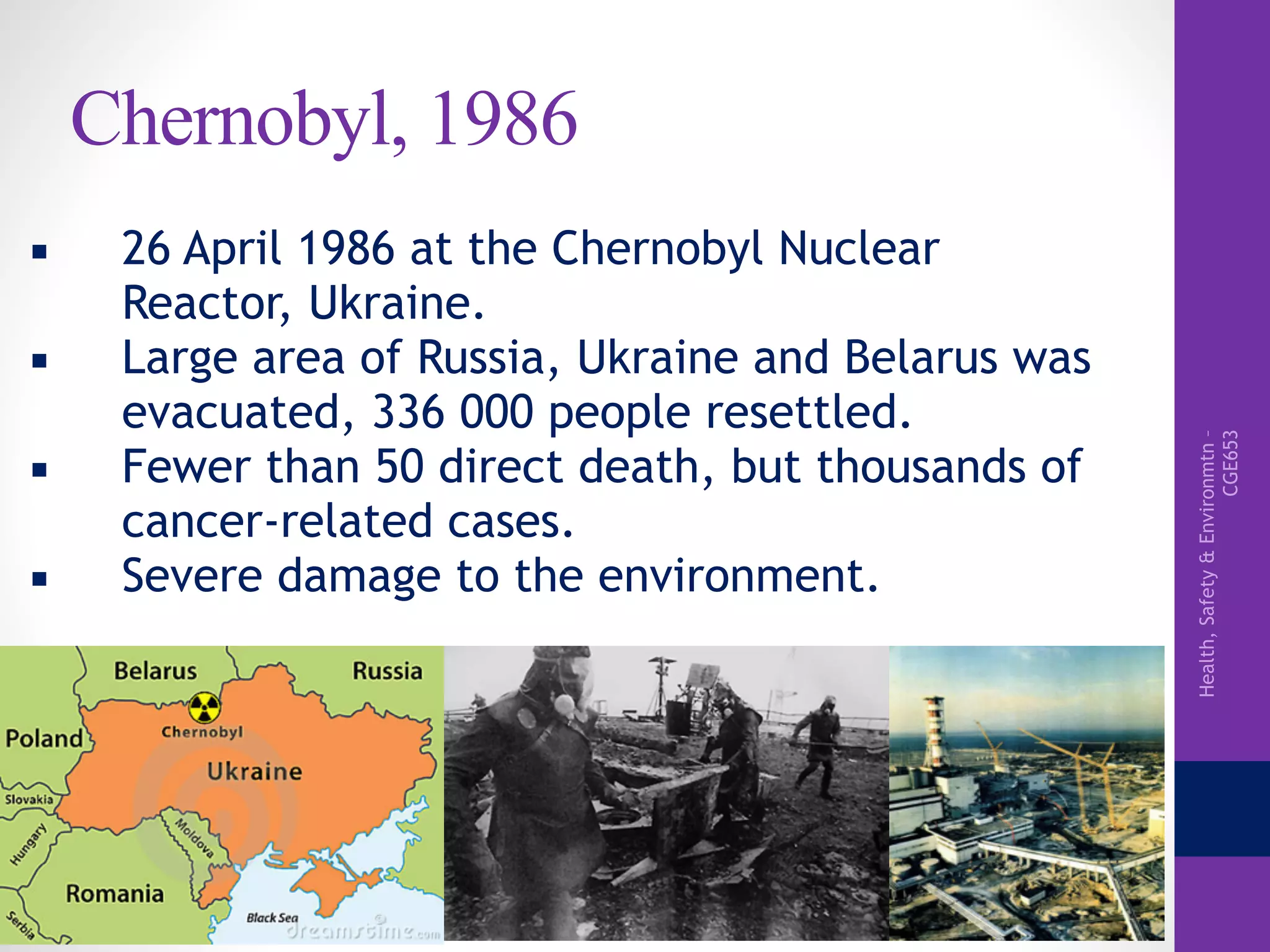
Chernobyl, 1986
▪ 26 April 1986 at the Chernobyl Nuclear
Reactor, Ukraine.
▪ Large area of Russia, Ukraine and Belarus was
evacuated, 336 000 people resettled.
▪ Fewer than 50 direct death, but thousands of
cancer-related cases.
▪ Severe damage to the environment.
Health,Safety&Environmtn–
CGE653
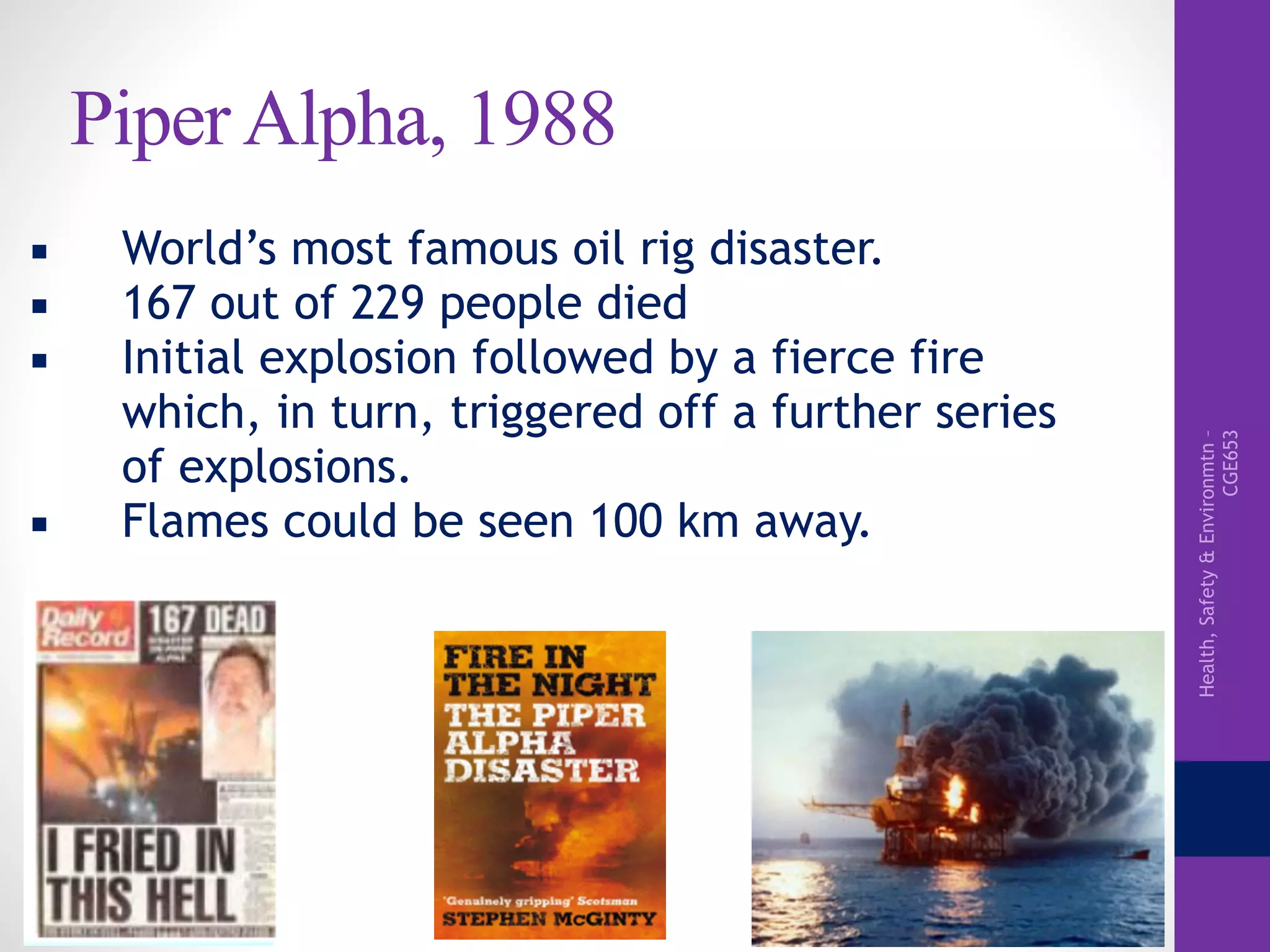
Piper Alpha, 1988
▪ World’s most famous oil rig disaster.
▪ 167 out of 229 people died
▪ Initial explosion followed by a fierce fire
which, in turn, triggered off a further series
of explosions.
▪ Flames could be seen 100 km away.
Health,Safety&Environmtn–
CGE653
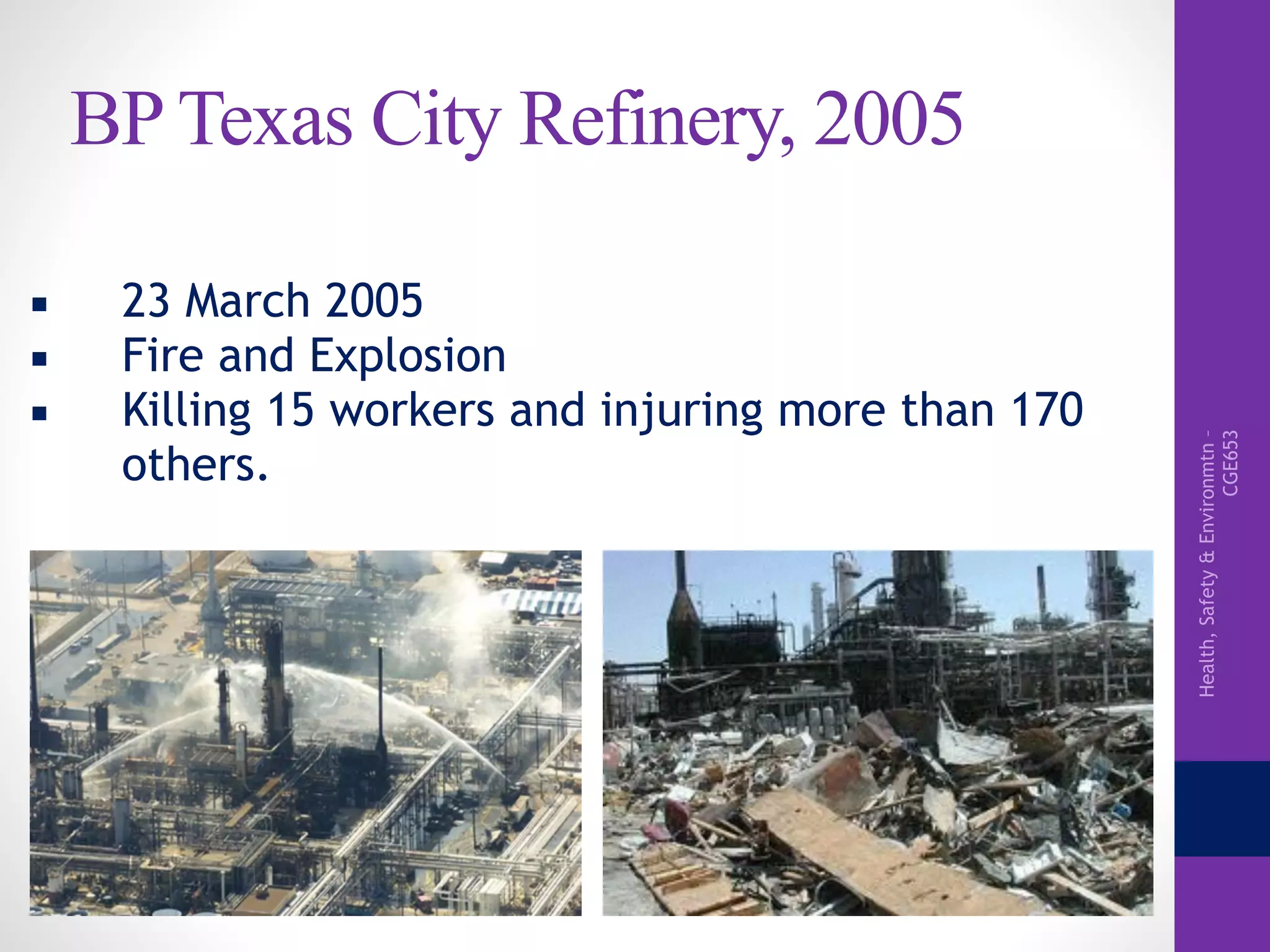
BP Texas City Refinery, 2005
▪ 23 March 2005
▪ Fire and Explosion
▪ Killing 15 workers and injuring more than 170
others.
Health,Safety&Environmtn–
CGE653
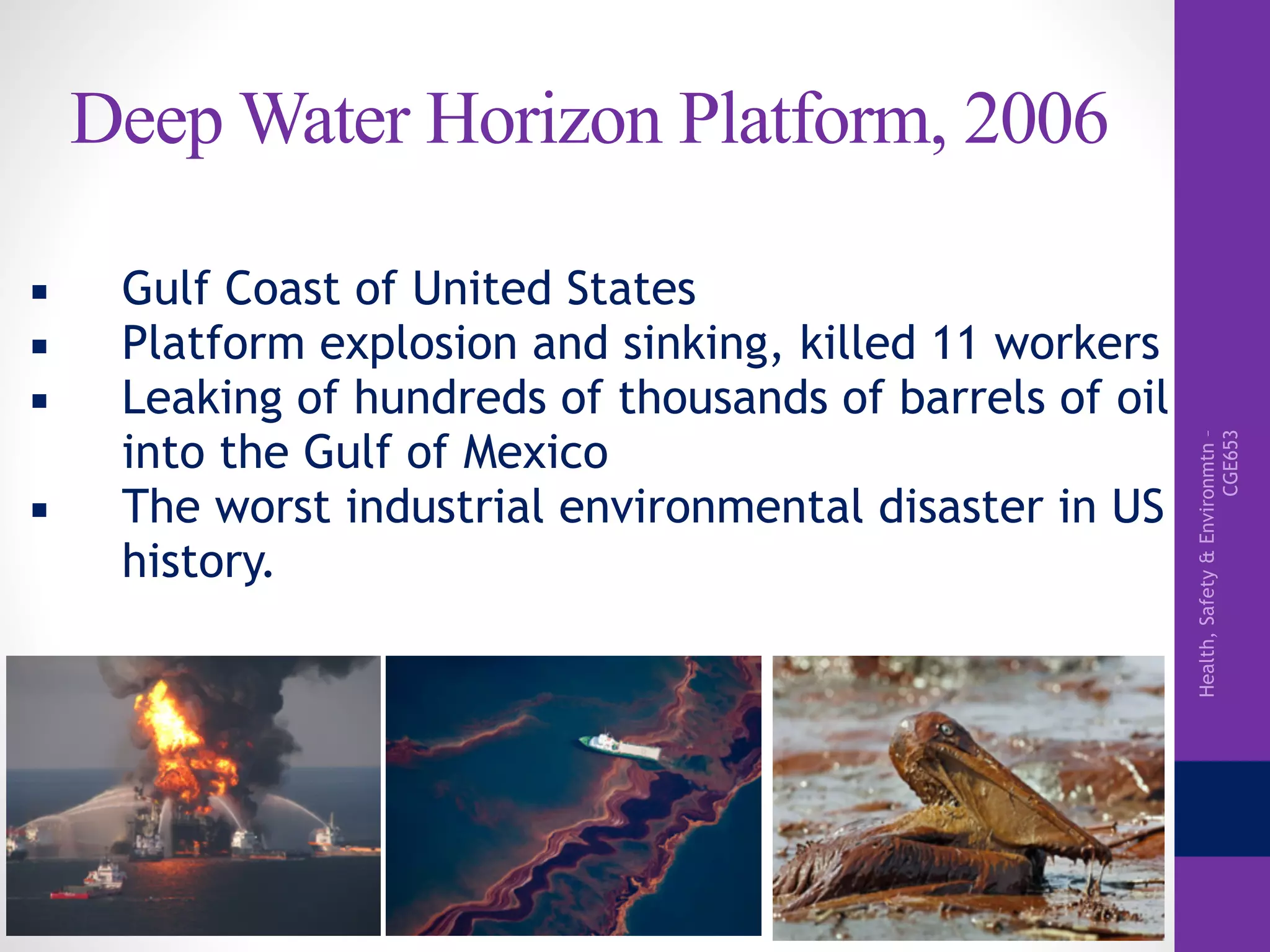
Deep Water Horizon Platform, 2006
▪ Gulf Coast of United States
▪ Platform explosion and sinking, killed 11 workers
▪ Leaking of hundreds of thousands of barrels of oil
into the Gulf of Mexico
▪ The worst industrial environmental disaster in US
history.
Health,Safety&Environmtn–
CGE653
Importance of Safety
• Prevention of ...
• Death or injury to workers
• Death and injury to general publics
• Physical and financial damage to the properties/
facilities
• Damage to third party properties
• Damage to the environment
Accident is costly!!!
Health,Safety&Environmtn–
CGE653
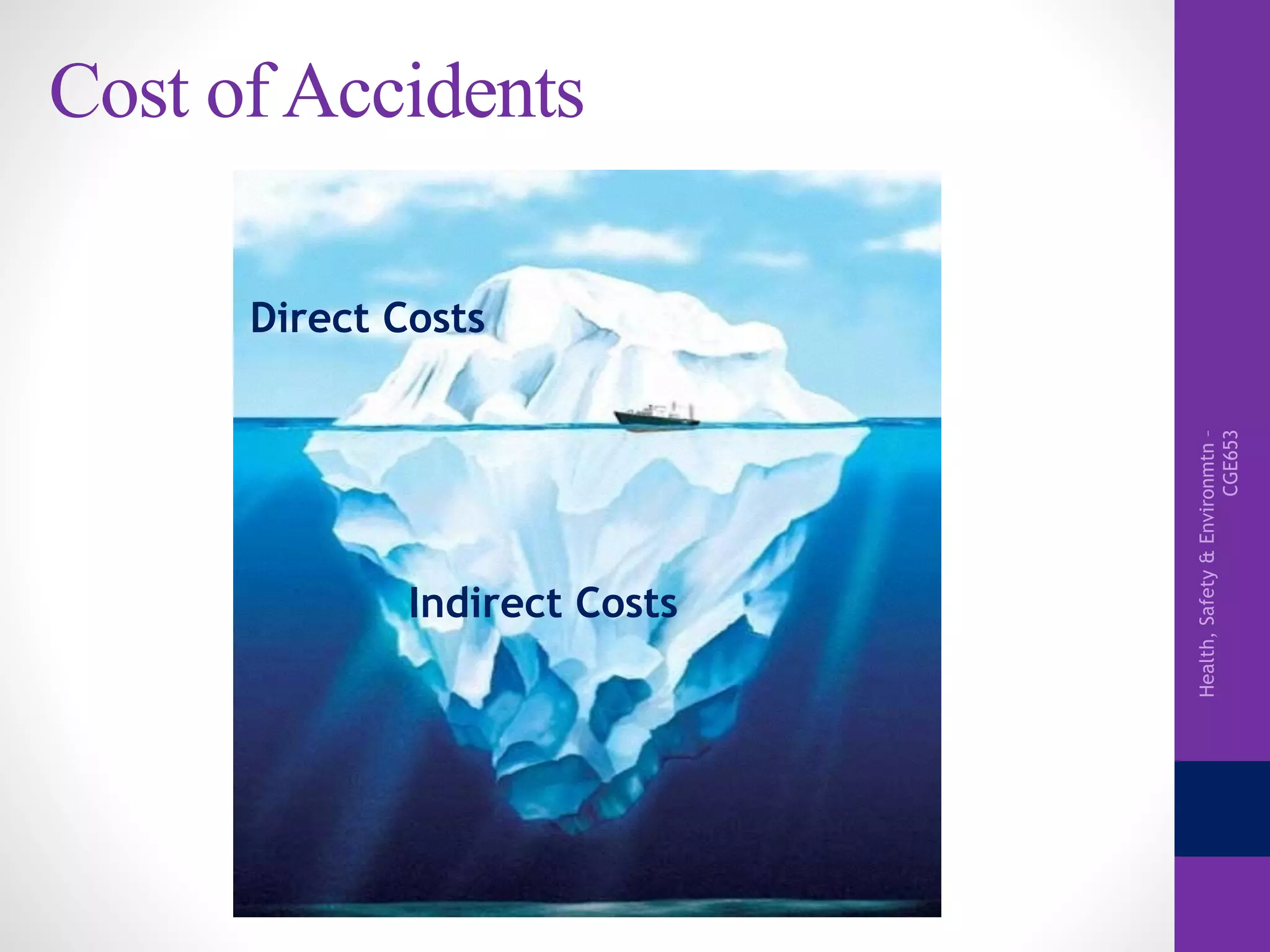
Cost of Accidents
Direct Costs
Indirect Costs
Health,Safety&Environmtn–
CGE653
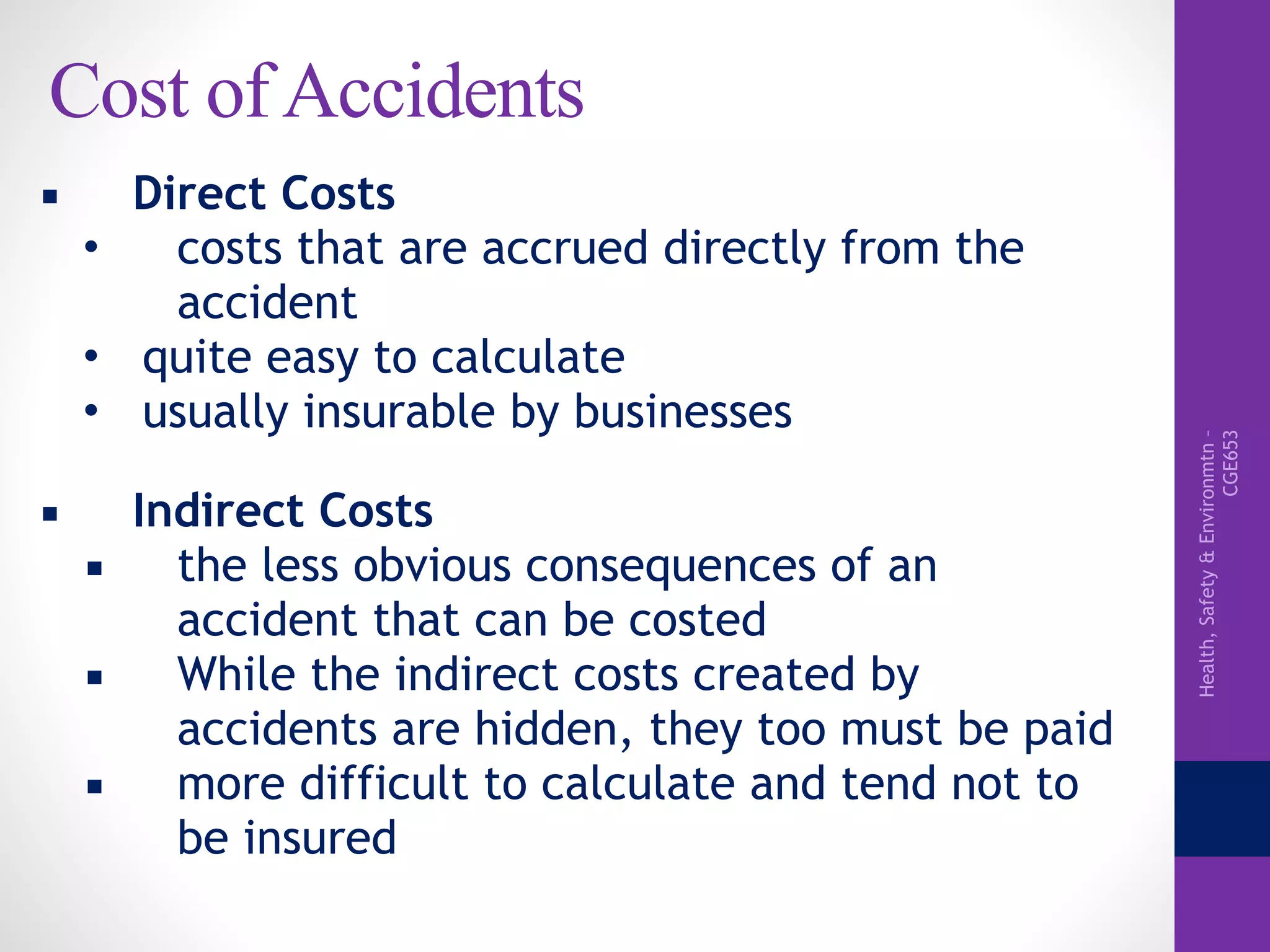
Cost of Accidents
▪ Direct Costs
• costs that are accrued directly from the
accident
• quite easy to calculate
• usually insurable by businesses
▪ Indirect Costs
▪ the less obvious consequences of an
accident that can be costed
▪ While the indirect costs created by
accidents are hidden, they too must be paid
▪ more difficult to calculate and tend not to
be insured
Health,Safety&Environmtn–
CGE653
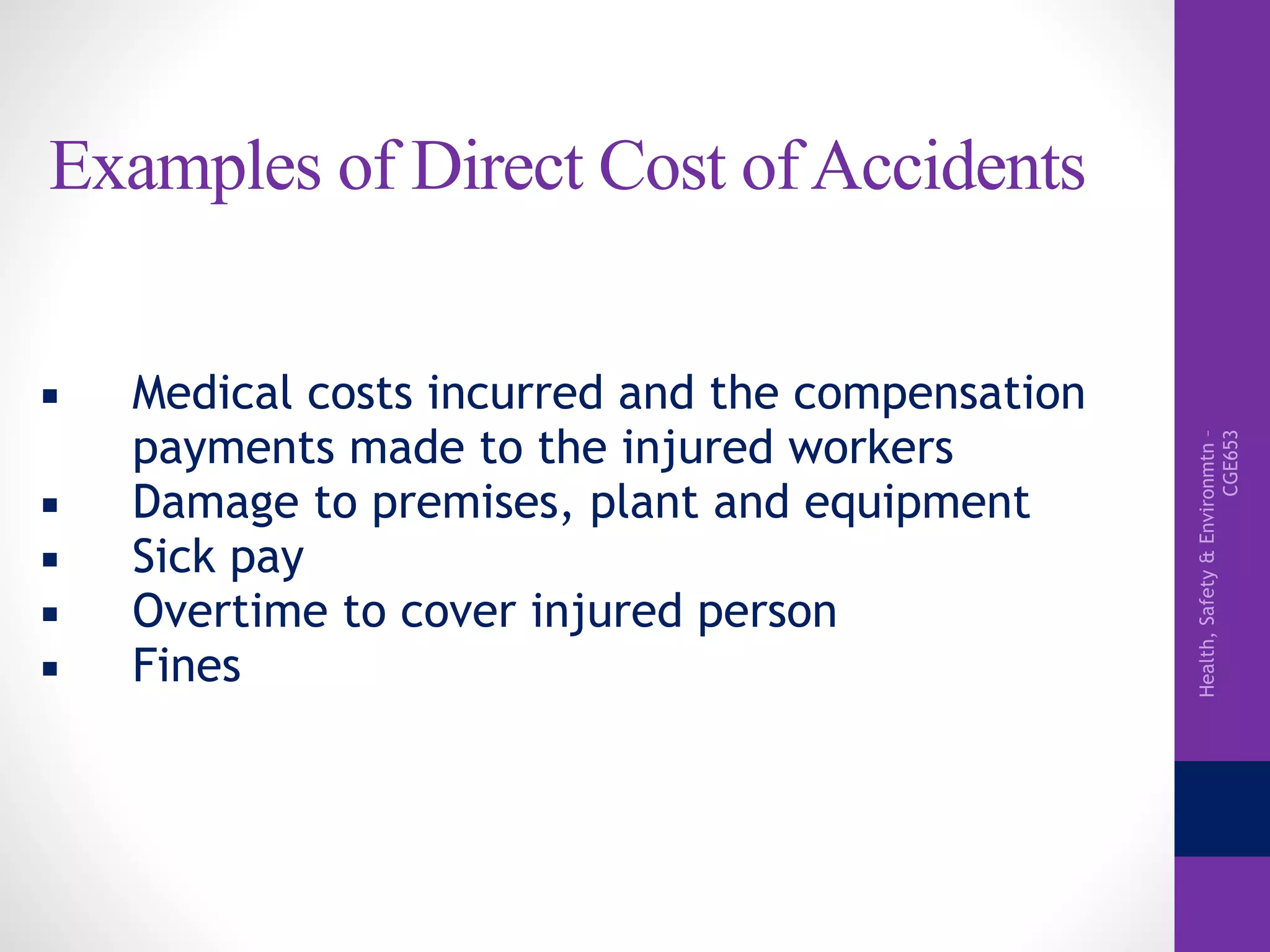
Examples of Direct Cost of Accidents
▪ Medical costs incurred and the compensation
payments made to the injured workers
▪ Damage to premises, plant and equipment
▪ Sick pay
▪ Overtime to cover injured person
▪ Fines
Health,Safety&Environmtn–
CGE653
Examples of Indirect Cost of Accidents
▪ Loss of an employee's skills and work output
▪ Downtime during investigations and pay of
people investigating
▪ Training costs for replacement operators
▪ Increased Insurance Premiums
▪ Defending criminal and civil prosecutions
▪ Bad publicity
▪ Workplace effects: poor productivity due to
low morale
Health,Safety&Environmtn–
CGE653
Safety is a Good Business
• Decrease workers compensation
• Decrease retraining costs
• Decrease absenteeism
• Reduce production interruption
• Increase productivity
• Increase morale of workers
• Attracting people to work
• Enhancing company’s corporate reputation
Health,Safety&Environmtn–
CGE653
Engineers and Safety
▪ A requirement for engineering degree
programmes
▪ Important aspect in the application for
professional engineer
▪ Non-compliance with safety standards can
severely affect a company’s bottom line.
▪ Engineers who design the workplace and its
equipment or who manage and supervise
workers need to have an understanding of the
safety and health regulation.
Health,Safety&Environmtn–
CGE653
Code of Ethics
Engineering is an important and learned profession.
As members of this profession, engineers are
expected to exhibit the highest standards of honesty
and integrity. Engineering has a direct and vital
impact on the quality of life for all people.
Accordingly, the services provided by engineers
require honesty, impartiality, fairness and equity,
and must be dedicated to the protection of the
public health, safety, and welfare. Engineers must
perform under a standard of professional behavior
that requires adherence to the highest principles of
ethical conduct.
Health,Safety&Environmtn–
CGE653
Engineering Ethics: Engineers shall hold
paramount the safety, health, and
welfare of the public in the
performance of their professional
duties.
Health,Safety&Environmtn–
CGE653
Theories of Accident Causation
Health,Safety&Environmtn–
CGE653
Why do accidents occur?
• We choose to handle dangerous processes,
materials, energies
▪ To make a living
▪ To provide society with desirable products
• As long as we choose to handle them, a
potential for loss events exist.
Things can be done to reduce their
likelihood and severity to negligible or
tolerable levels.
Health,Safety&Environmtn–
CGE653
How do accidents occur?
• There are several theories that
attempt to explain the occurrence
of accidents.
▪ Domino theory
▪ Human factors theory
▪ Swiss cheese model
▪ Accident/incident theory
▪ Sociotechnical system framework
▪ Epidemiological Theory
▪ Systems Theory
Health,Safety&Environmtn–
CGE653
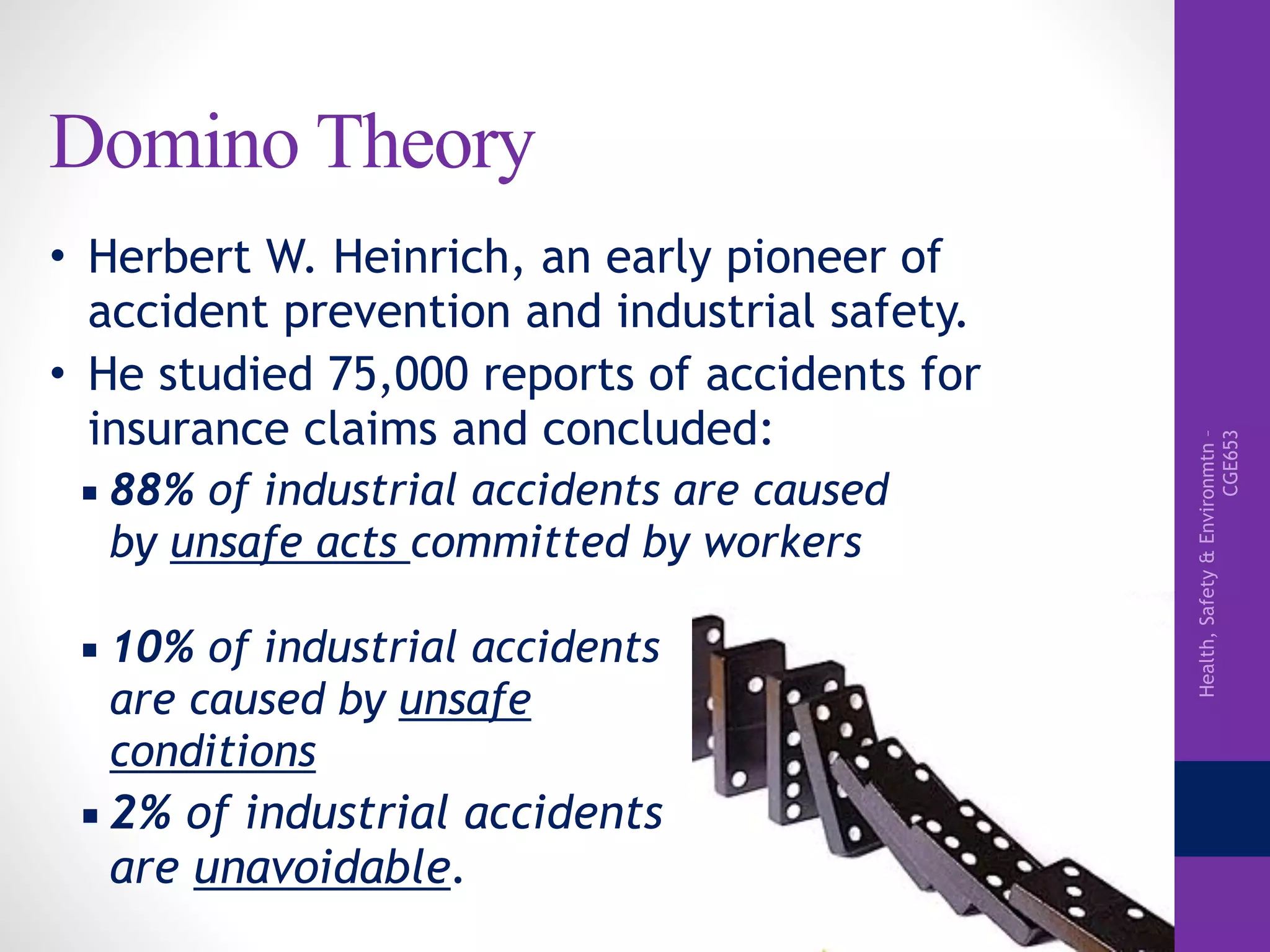
Domino Theory
• Herbert W. Heinrich, an early pioneer of
accident prevention and industrial safety.
• He studied 75,000 reports of accidents for
insurance claims and concluded:
▪ 88% of industrial accidents are caused
by unsafe acts committed by workers
▪ 10% of industrial accidents
are caused by unsafe
conditions
▪ 2% of industrial accidents
are unavoidable.
Health,Safety&Environmtn–
CGE653
Heinrich’s Axiom of Industrial Safety
1. Injuries result from a complete series of
factors, one of which is the accident itself
2. An accident can occur as a result of unsafe act
and/or unsafe conditions
3. Most accidents are the result of unsafe
behaviour by people
4. An unsafe act or an unsafe conditions does not
immediately result in an accident/injury;
Health,Safety&Environmtn–
CGE653
Heinrich’s Axiom of Industrial Safety
5. The reasons why people commit unsafe acts
can serve as helpful guides in selecting
corrective actions.
6. The severity of an accident is largely
fortuitous and the factors that cause it are
largely preventable.
7. The prevention techniques are analogous with
the best quality and productivity techniques.
Health,Safety&Environmtn–
CGE653
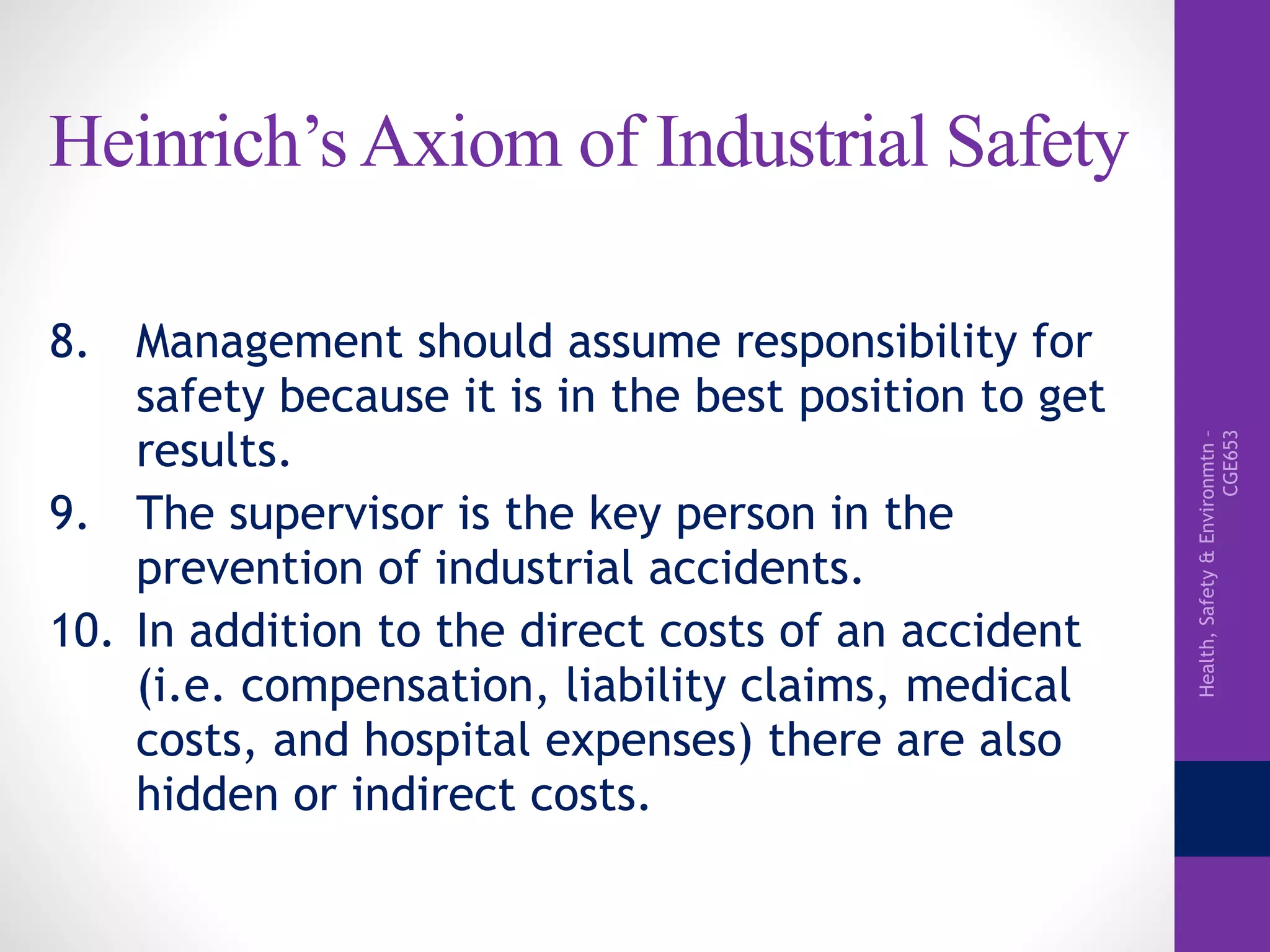
Heinrich’s Axiom of Industrial Safety
8. Management should assume responsibility for
safety because it is in the best position to get
results.
9. The supervisor is the key person in the
prevention of industrial accidents.
10. In addition to the direct costs of an accident
(i.e. compensation, liability claims, medical
costs, and hospital expenses) there are also
hidden or indirect costs.
Health,Safety&Environmtn–
CGE653
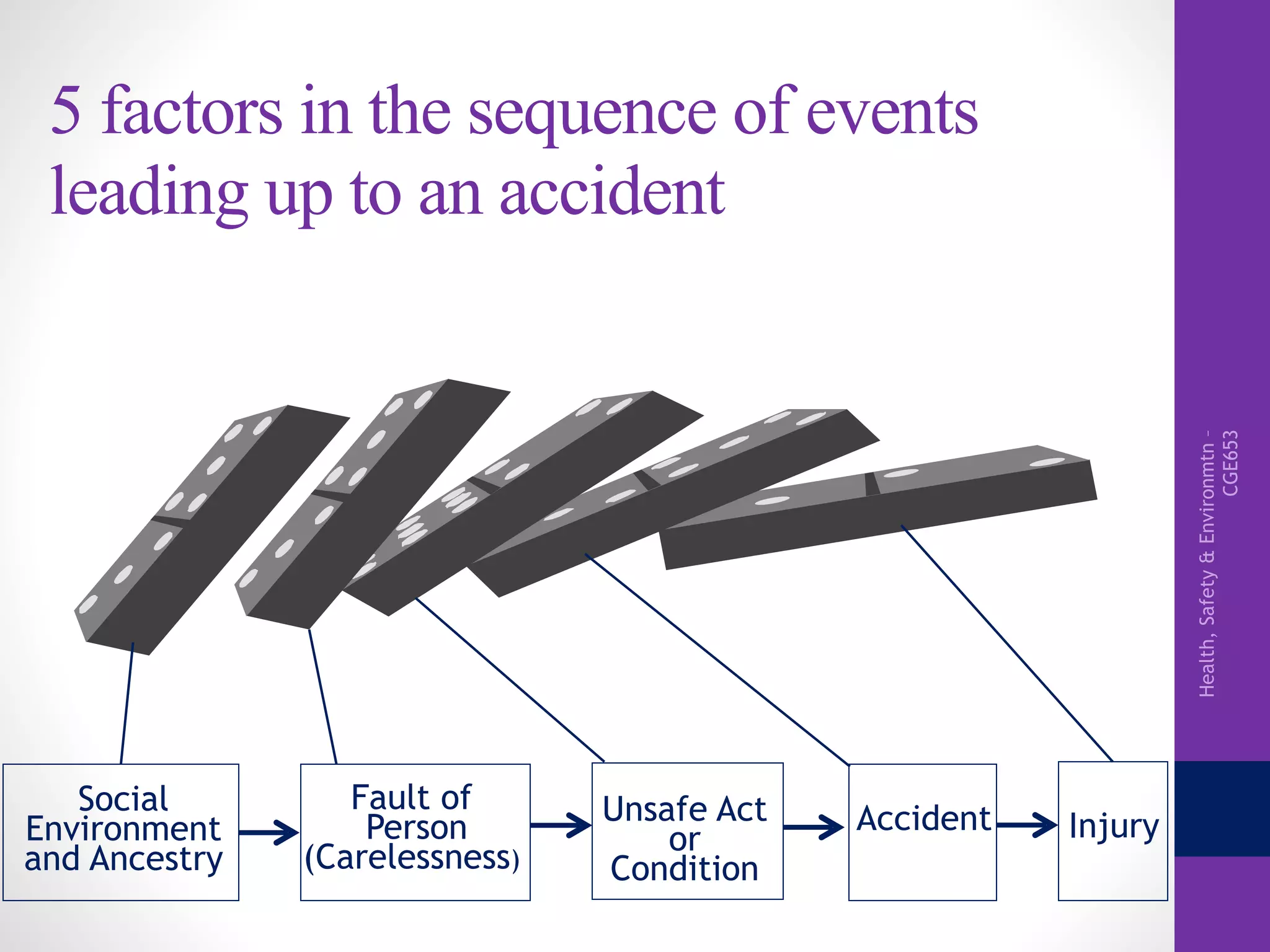
5 factors in the sequence of events
leading up to an accident
Social
Environment
and Ancestry
Fault of
Person
(Carelessness)
Unsafe Act
or
Condition
Accident Injury
Health,Safety&Environmtn–
CGE653
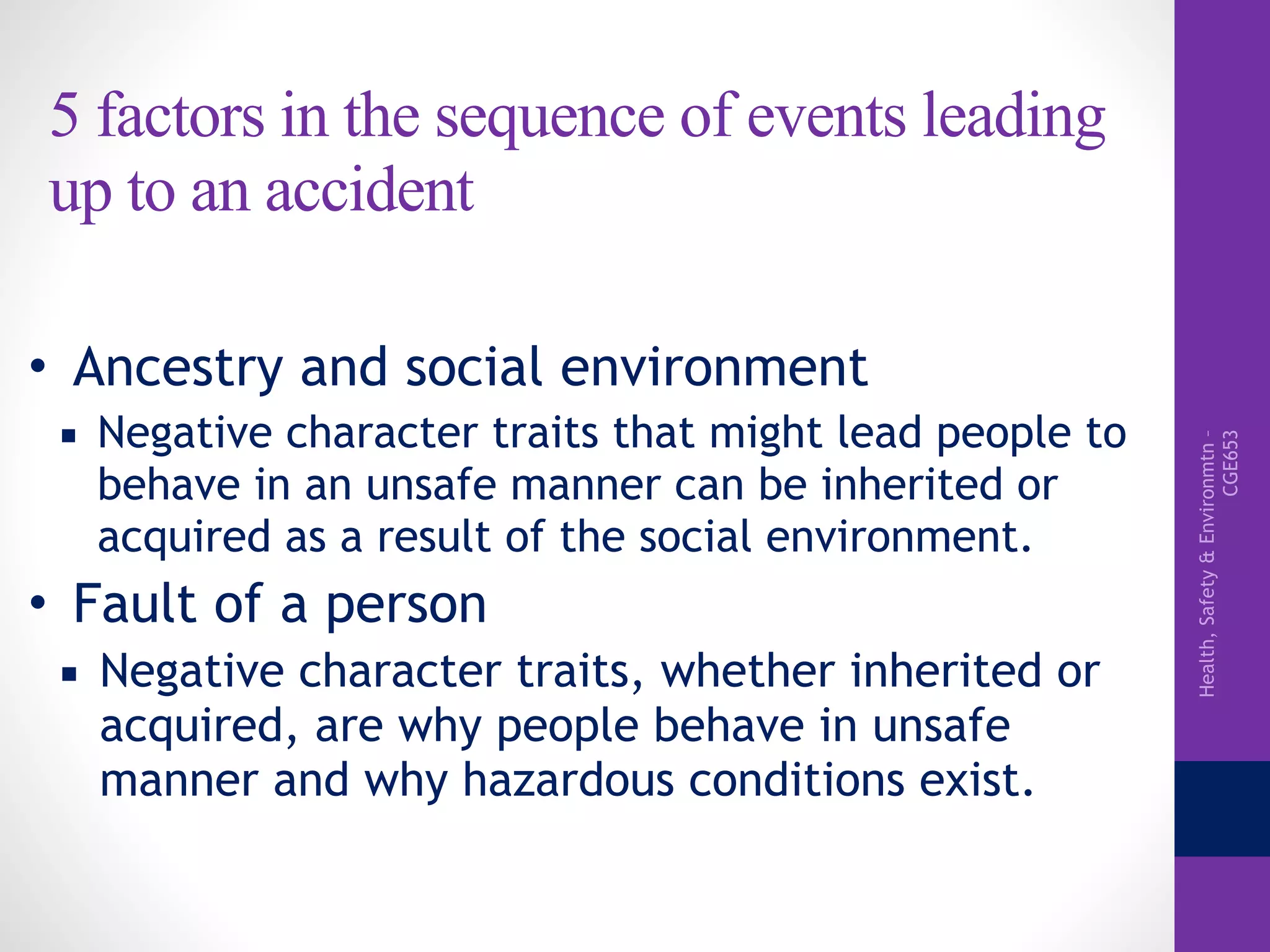
5 factors in the sequence of events leading
up to an accident
• Ancestry and social environment
▪ Negative character traits that might lead people to
behave in an unsafe manner can be inherited or
acquired as a result of the social environment.
• Fault of a person
▪ Negative character traits, whether inherited or
acquired, are why people behave in unsafe
manner and why hazardous conditions exist.
Health,Safety&Environmtn–
CGE653
5 factors in the sequence of events leading
up to an accident
• Unsafe act/Unsafe conditions
▪ Unsafe acts committed by people
▪ Unsafe conditions due to the presence of
mechanical/physical hazards
• Accidents
• Injury
Health,Safety&Environmtn–
CGE653
Domino Theory
• A personal injury (the final domino) occurs only as a
result of an accident.
• An accident occurs only as a result of a personal or
mechanical hazard.
• Personal and mechanical hazards exist only through
the fault of careless persons or poorly designed or
improperly maintained equipment.
• Faults of persons are inherited or acquired as a result
of their social environment or acquired by ancestry.
• The environment is where and how a person was
raised and educated.
Health,Safety&Environmtn–
CGE653
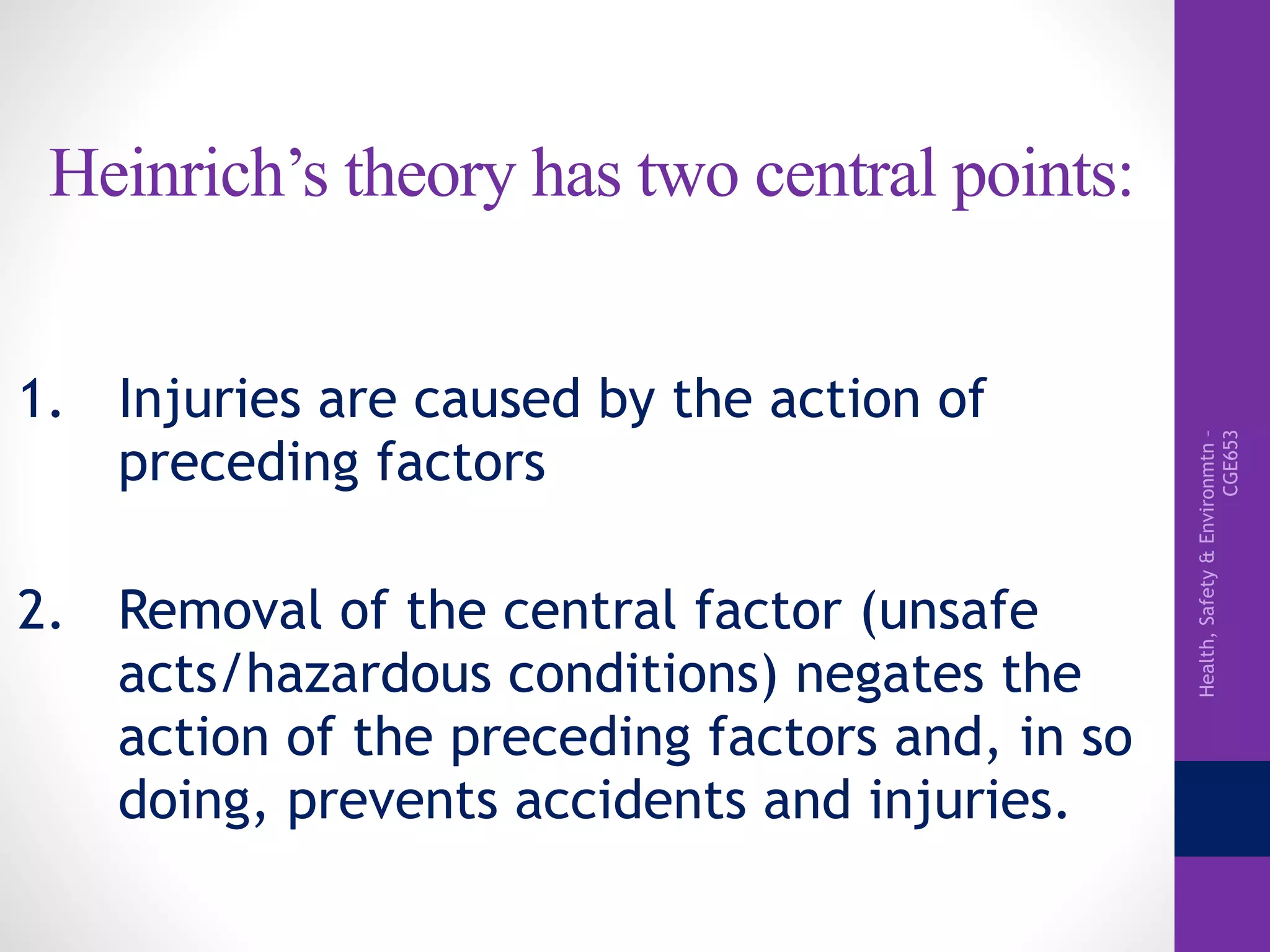
Heinrich’s theory has two central points:
1. Injuries are caused by the action of
preceding factors
2. Removal of the central factor (unsafe
acts/hazardous conditions) negates the
action of the preceding factors and, in so
doing, prevents accidents and injuries.
Health,Safety&Environmtn–
CGE653
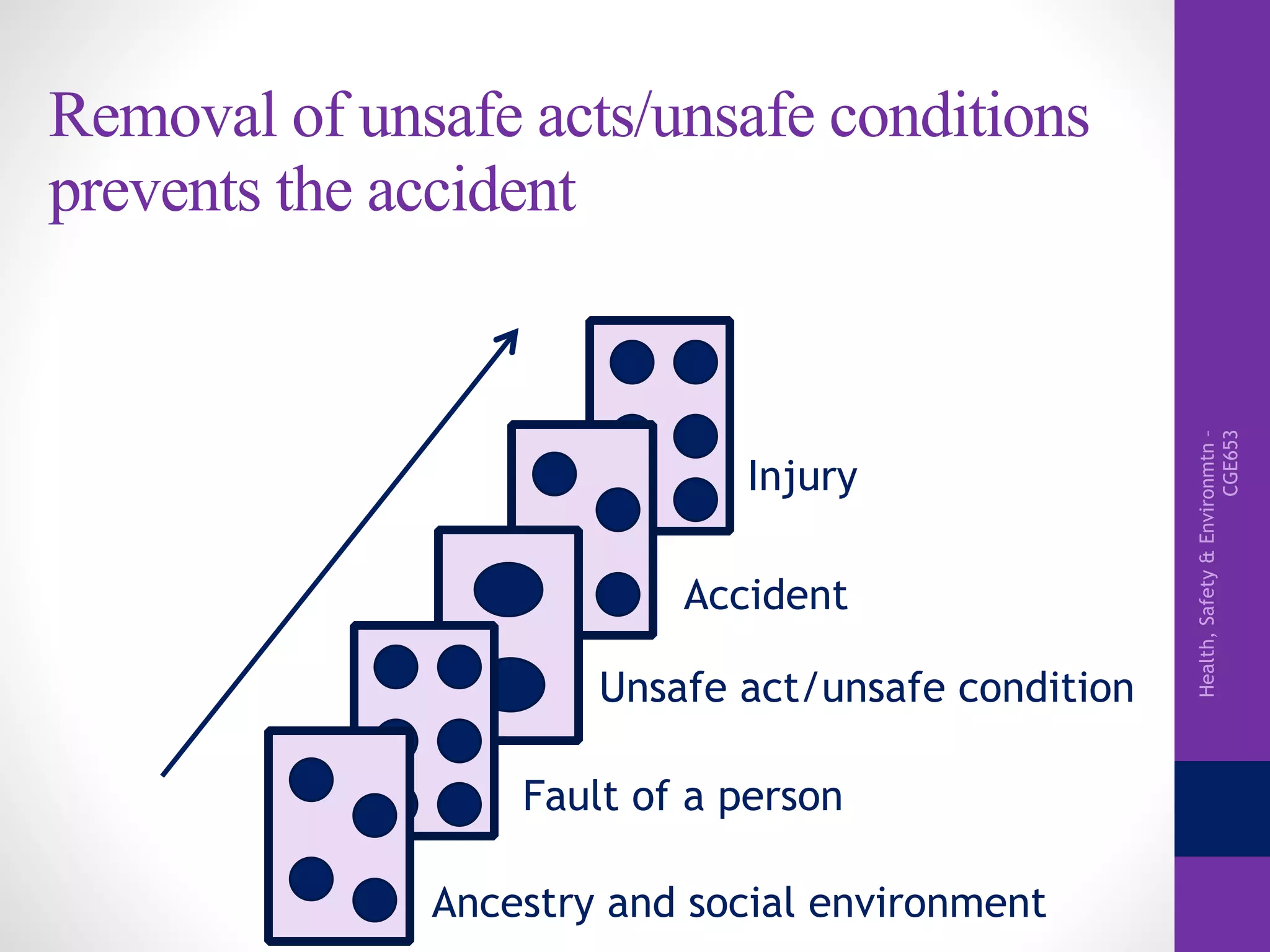
Removal of unsafe acts/unsafe conditions
prevents the accident
Ancestry and social environment
Fault of a person
Unsafe act/unsafe condition
Accident
Injury
Health,Safety&Environmtn–
CGE653
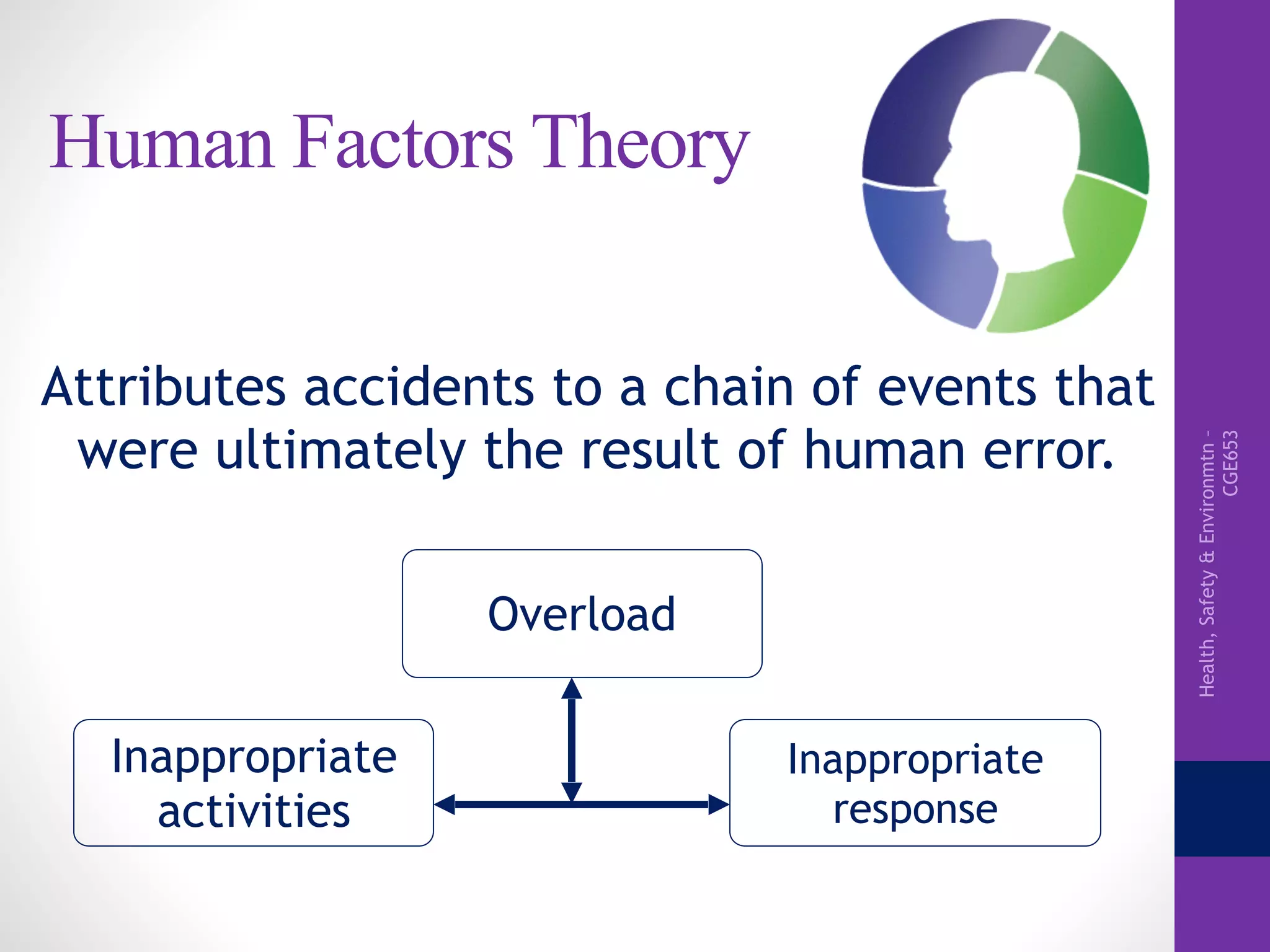
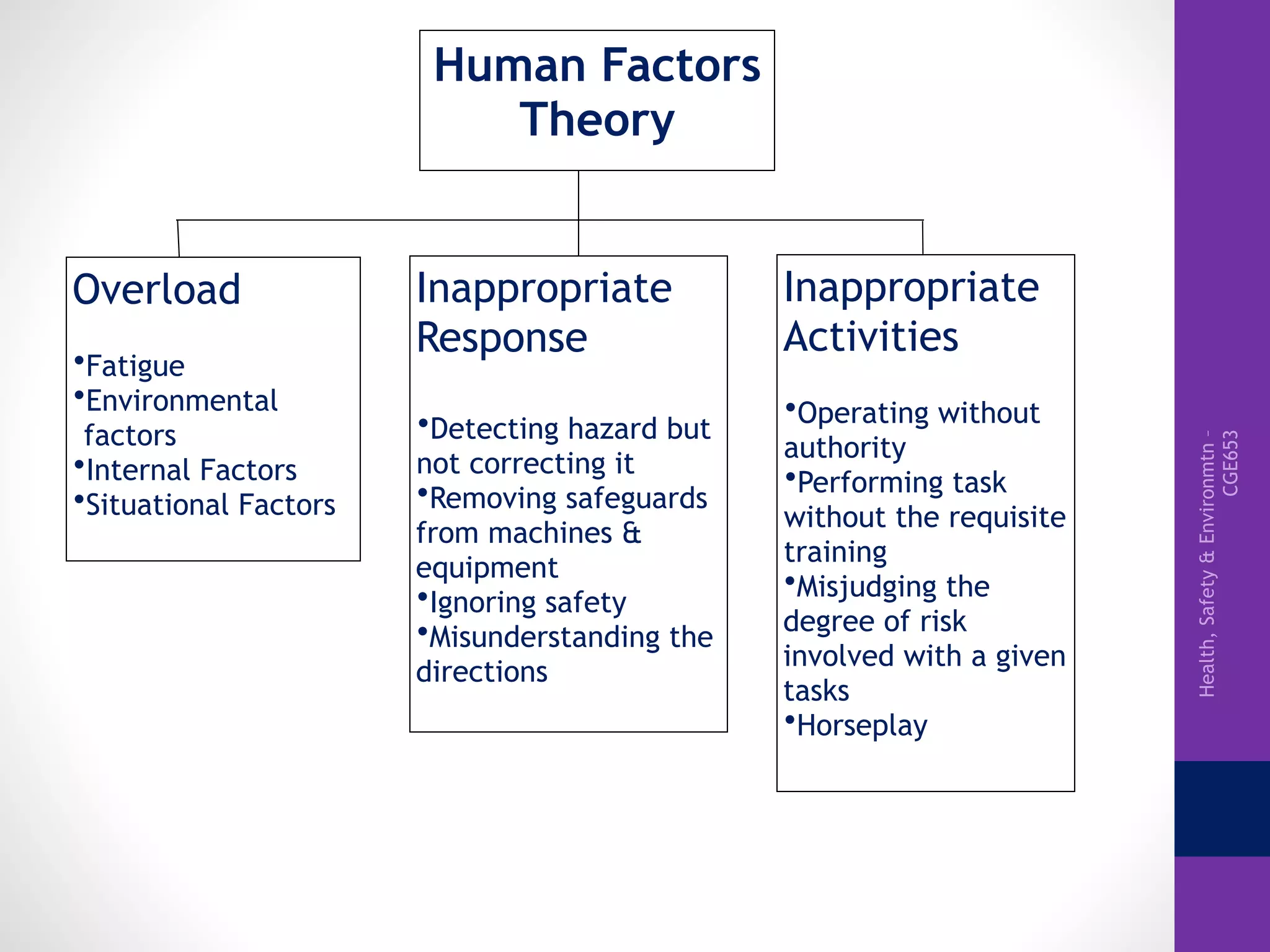
Human Factors Theory
Overload
Inappropriate
response
Inappropriate
activities
Attributes accidents to a chain of events that
were ultimately the result of human error.
Health,Safety&Environmtn–
CGE653
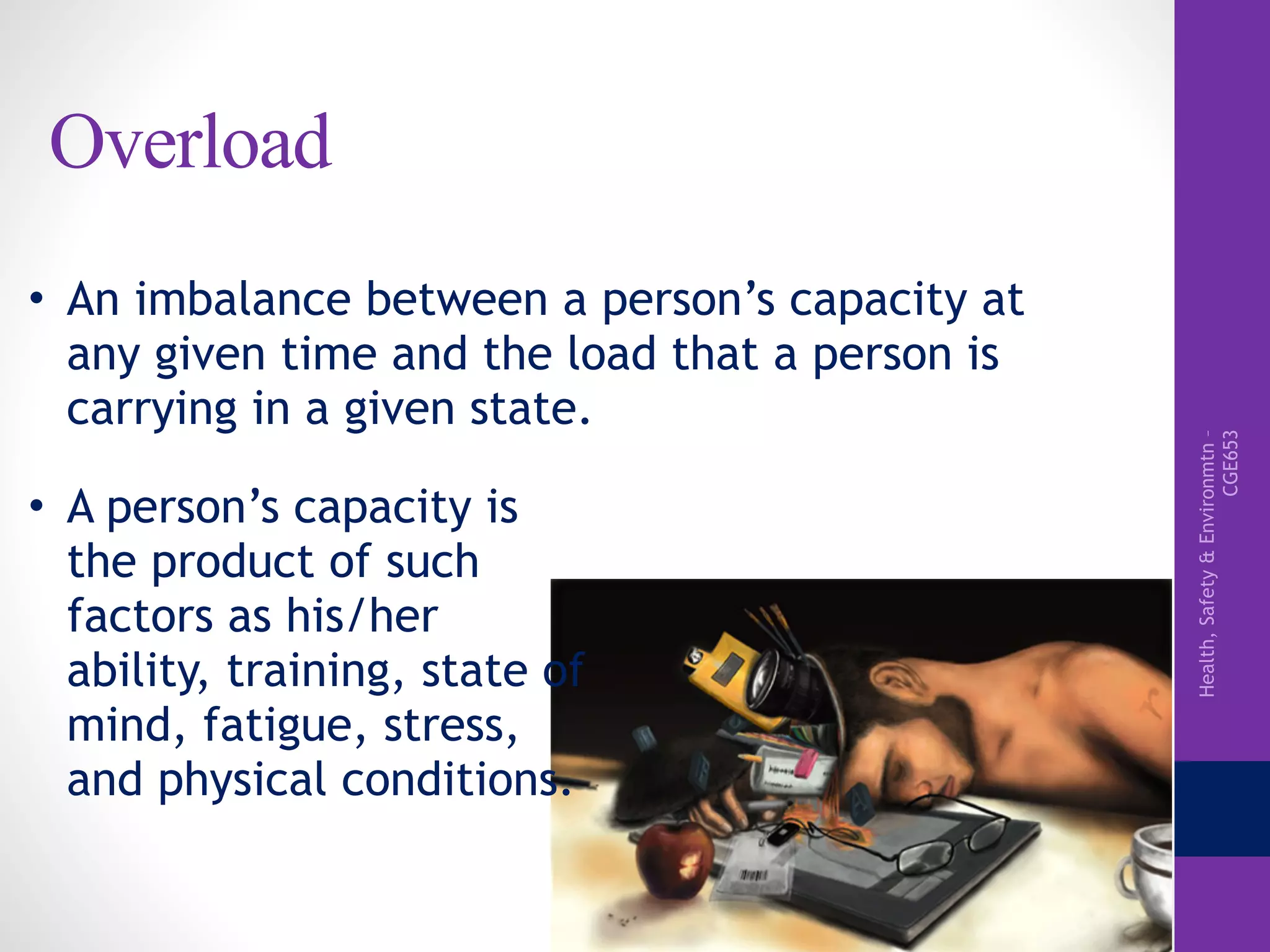
Overload
• An imbalance between a person’s capacity at
any given time and the load that a person is
carrying in a given state.
• A person’s capacity is
the product of such
factors as his/her
ability, training, state of
mind, fatigue, stress,
and physical conditions.
Health,Safety&Environmtn–
CGE653
Overload
• Added burden resulting
from
▪ Environmental factors
(noise, distractions, etc.);
▪ Situational factors (level of
risks, unclear instructions,
etc.); and
▪ Internal factors (personal
problems, emotional stress,
worry, etc.)
Health,Safety&Environmtn–
CGE653
Inappropriate Response
• How a person responds in a given situation can
cause or prevent an accident.
• Inappropriate response include:
▪ A person detects a hazardous condition but does
nothing to correct it;
▪ A person removes a safeguard from a machine in an
effort to increase output; or
▪ A person disregards an established safety procedure
• Such responses can lead to accidents.
Health,Safety&Environmtn–
CGE653
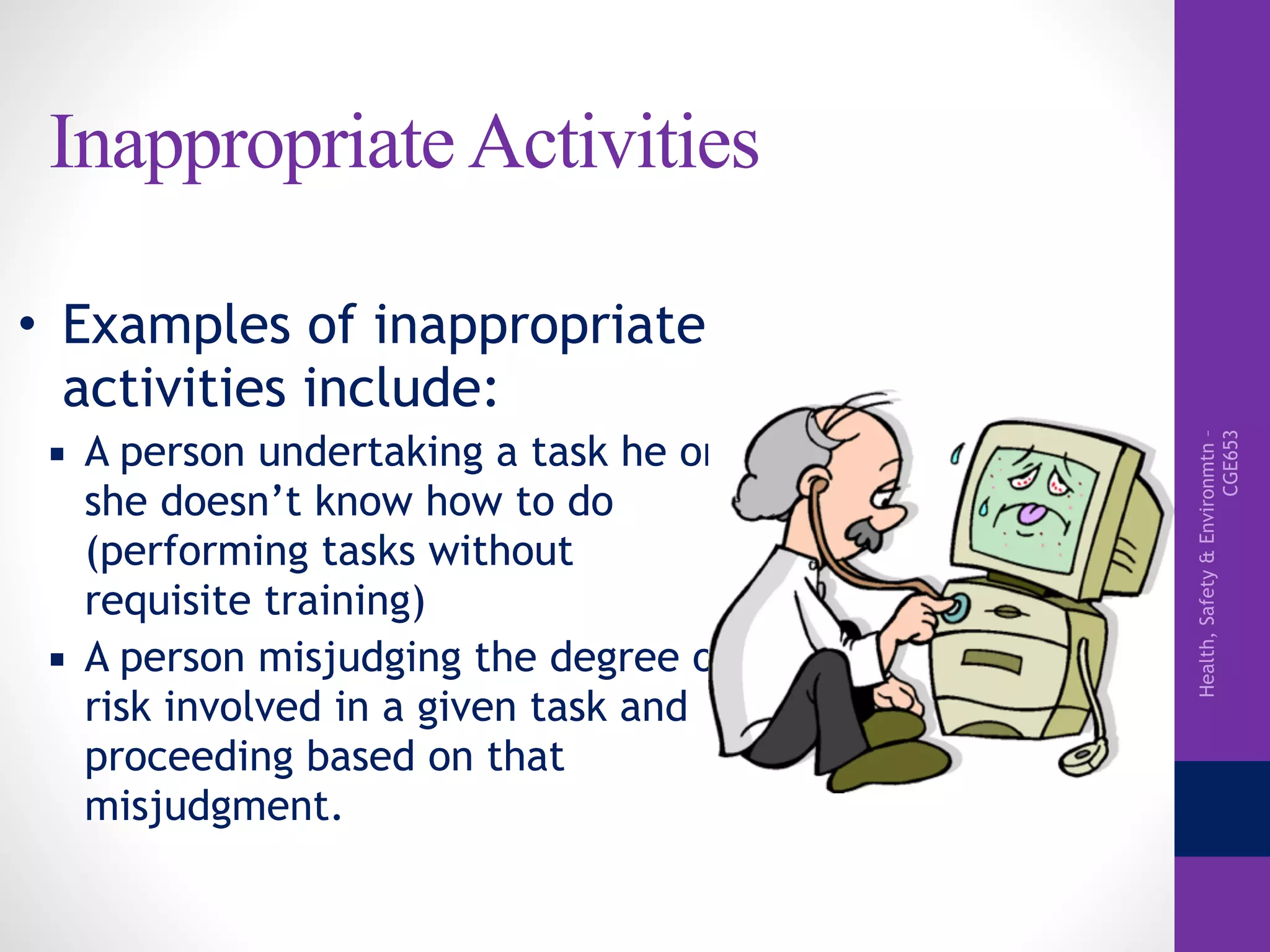
Inappropriate Activities
• Examples of inappropriate
activities include:
▪ A person undertaking a task he or
she doesn’t know how to do
(performing tasks without
requisite training)
▪ A person misjudging the degree of
risk involved in a given task and
proceeding based on that
misjudgment.
Health,Safety&Environmtn–
CGE653
Human Factors
Theory
Overload
•Fatigue
•Environmental
factors
•Internal Factors
•Situational Factors
Inappropriate
Response
•Detecting hazard but
not correcting it
•Removing safeguards
from machines &
equipment
•Ignoring safety
•Misunderstanding the
directions
Inappropriate
Activities
•Operating without
authority
•Performing task
without the requisite
training
•Misjudging the
degree of risk
involved with a given
tasks
•Horseplay
Health,Safety&Environmtn–
CGE653
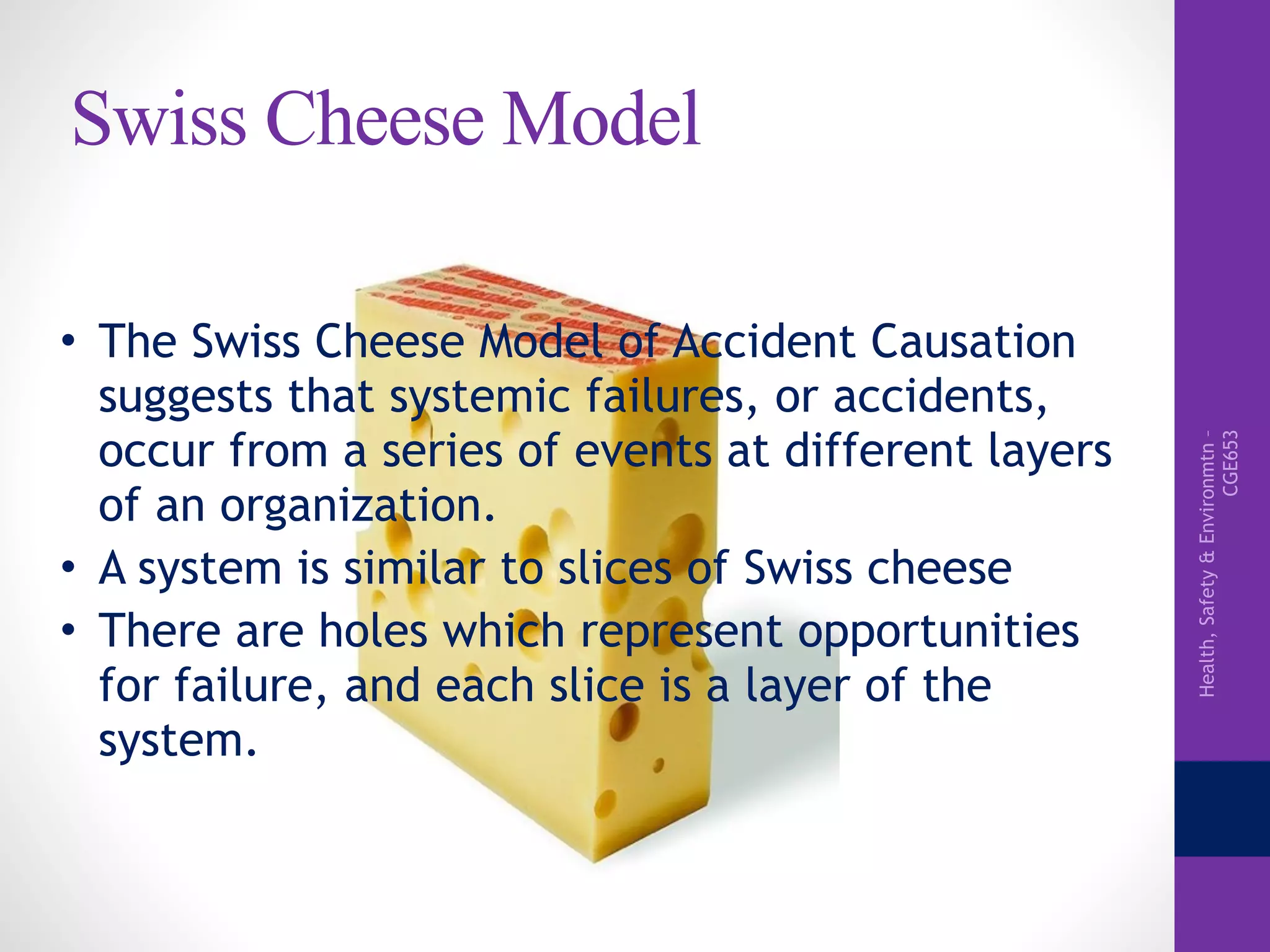
Swiss Cheese Model
• The Swiss Cheese Model of Accident Causation
suggests that systemic failures, or accidents,
occur from a series of events at different layers
of an organization.
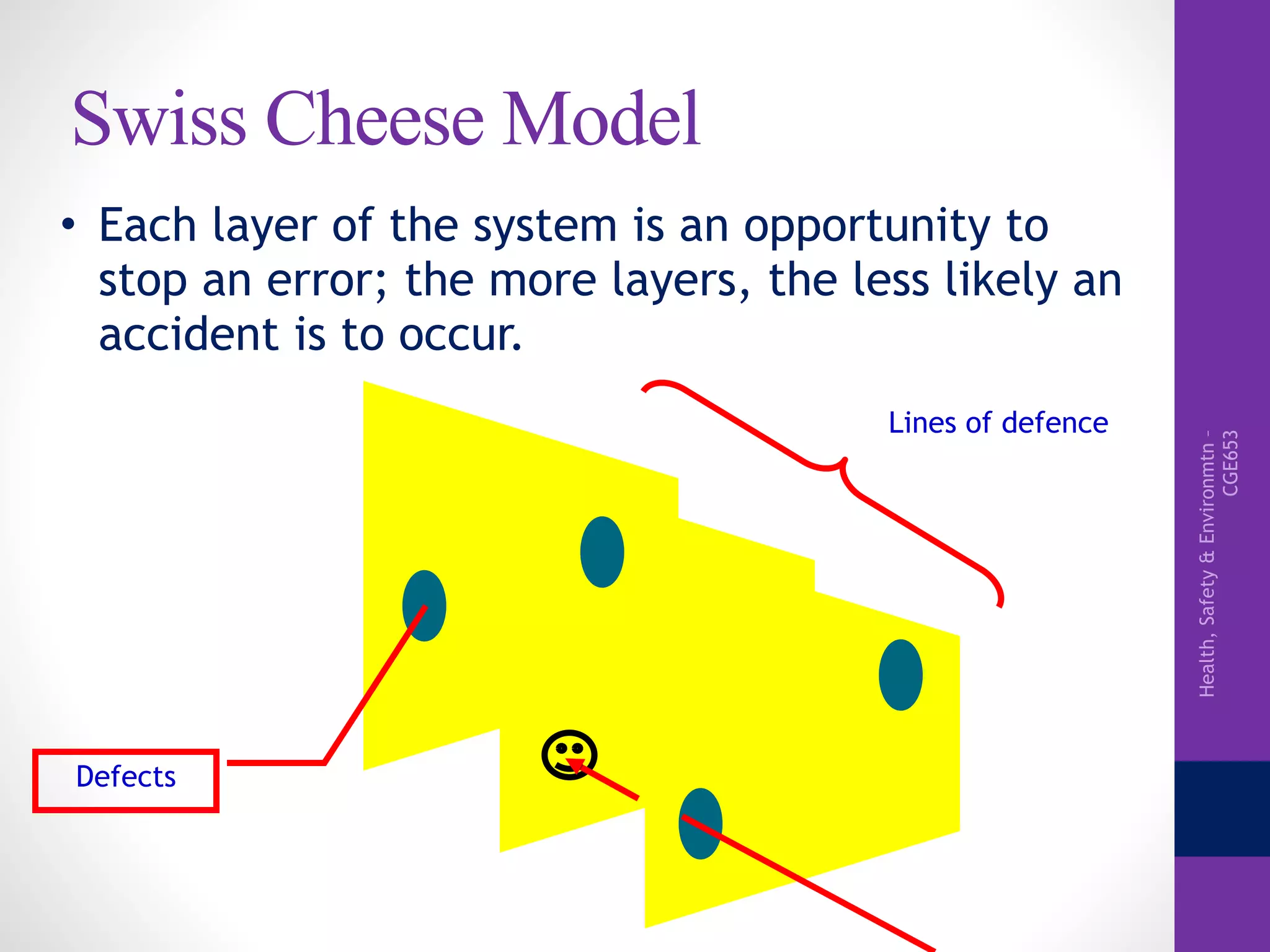
• A system is similar to slices of Swiss cheese
• There are holes which represent opportunities
for failure, and each slice is a layer of the
system.
Health,Safety&Environmtn–
CGE653
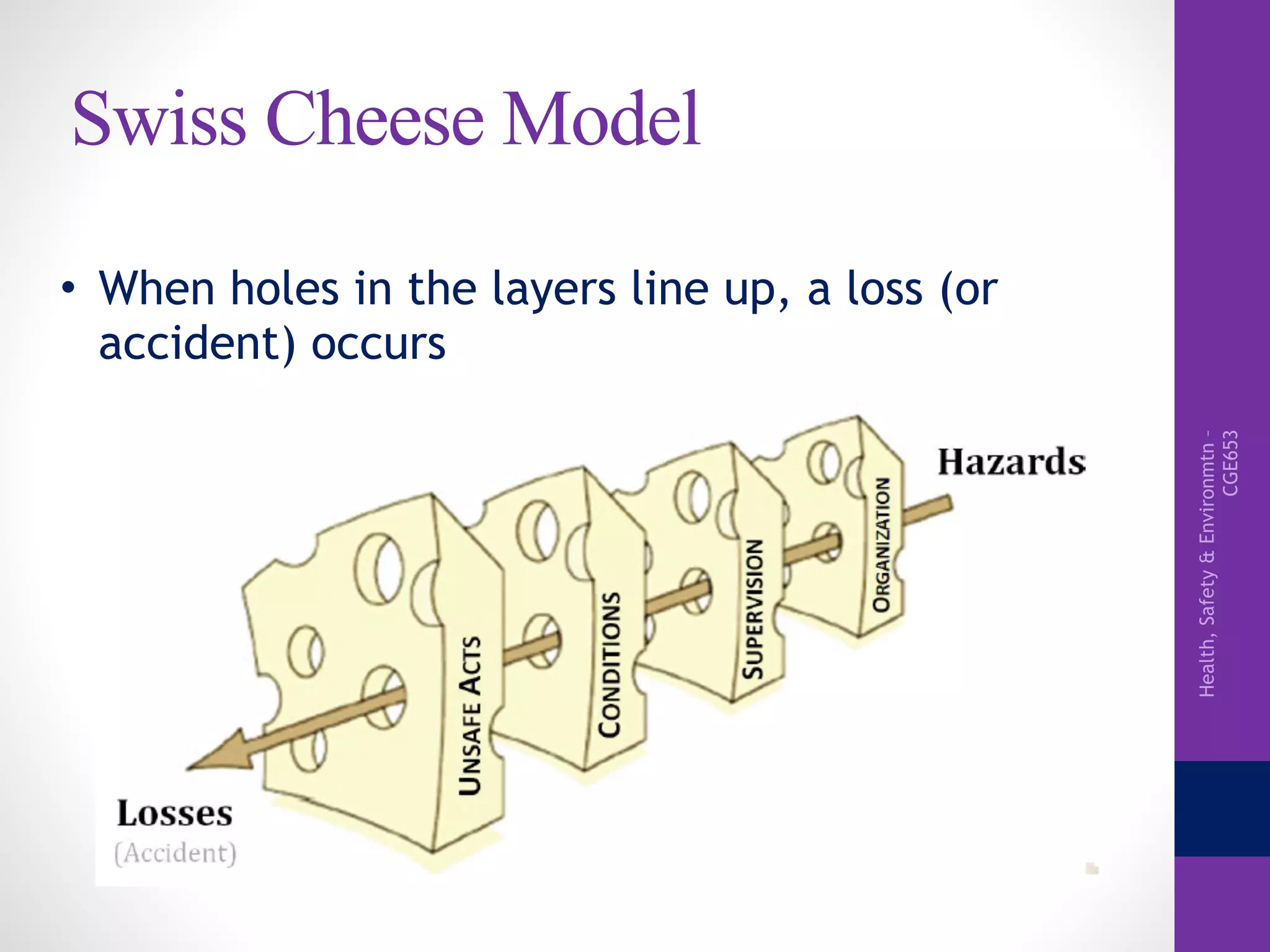
Swiss Cheese Model
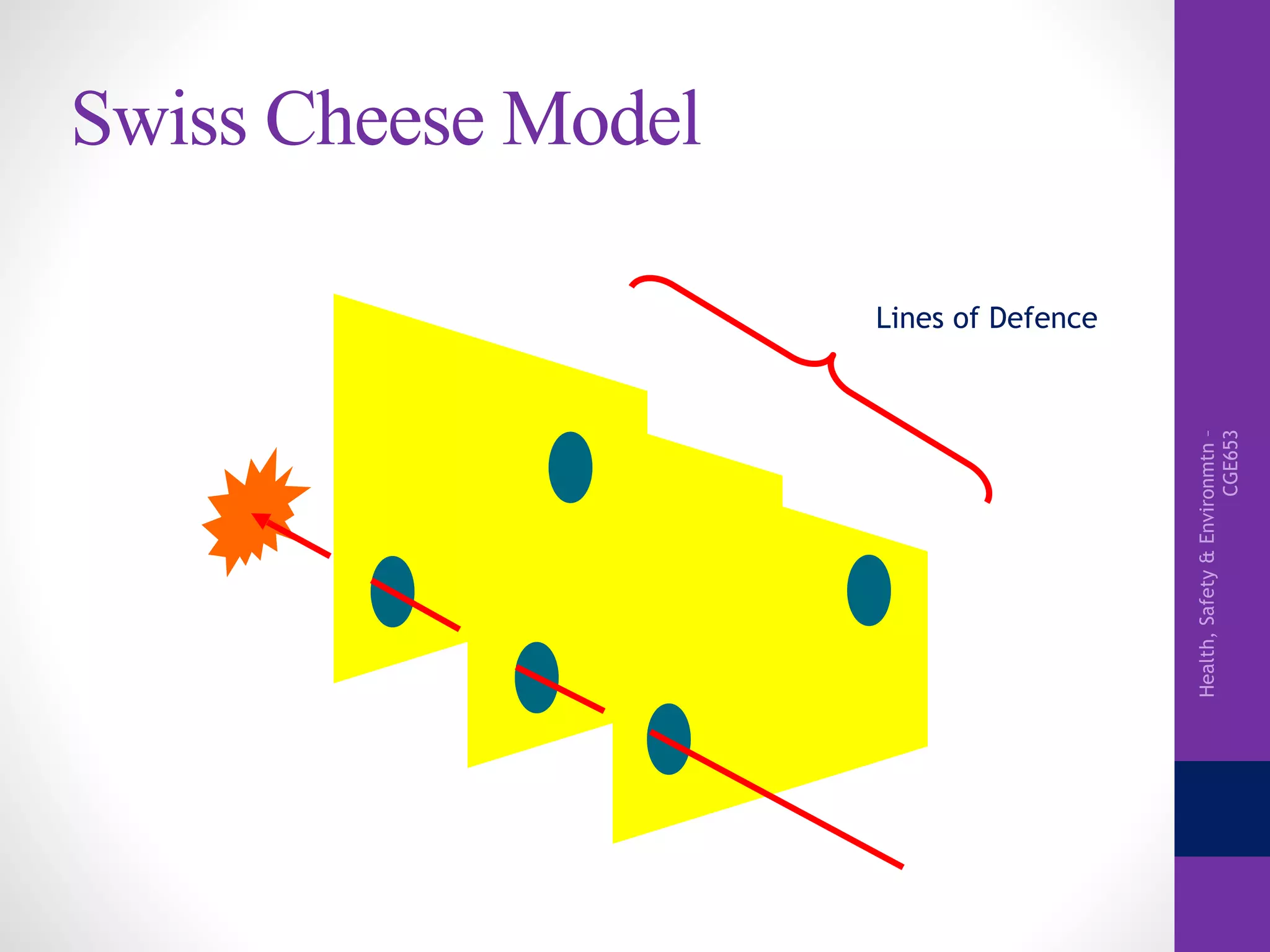
• When holes in the layers line up, a loss (or
accident) occurs
Health,Safety&Environmtn–
CGE653
Swiss Cheese Model
• Each layer of the system is an opportunity to
stop an error; the more layers, the less likely an
accident is to occur.
Lines of defence
Defects
Health,Safety&Environmtn–
CGE653
Swiss Cheese Model
Lines of Defence
Health,Safety&Environmtn–
CGE653
Lessons from the Past Disasters
Health,Safety&Environmtn–
CGE653
Learning from Past Experiences
• Kletz* recommended four ways for organisations to
learn from past experience:
▪ Recent and old accidents should be described in safety
bulletins and discussed at safety meetings
▪ standards and codes of practice should contain notes on
accidents which led to the recommendations
▪ a 'black book' containing reports of accidents with
technical interest that have occurred should be
compulsory reading for all newcomers and for refreshing
memories
▪ accident information retrieval and storage systems should
be used as they contain a wealth of useful information
* Kletz, T. A. On the need to publish more case histories. Plant/Operations
Progress, 1988, 7(3), 145-147.
Health,Safety&Environmtn–
CGE653
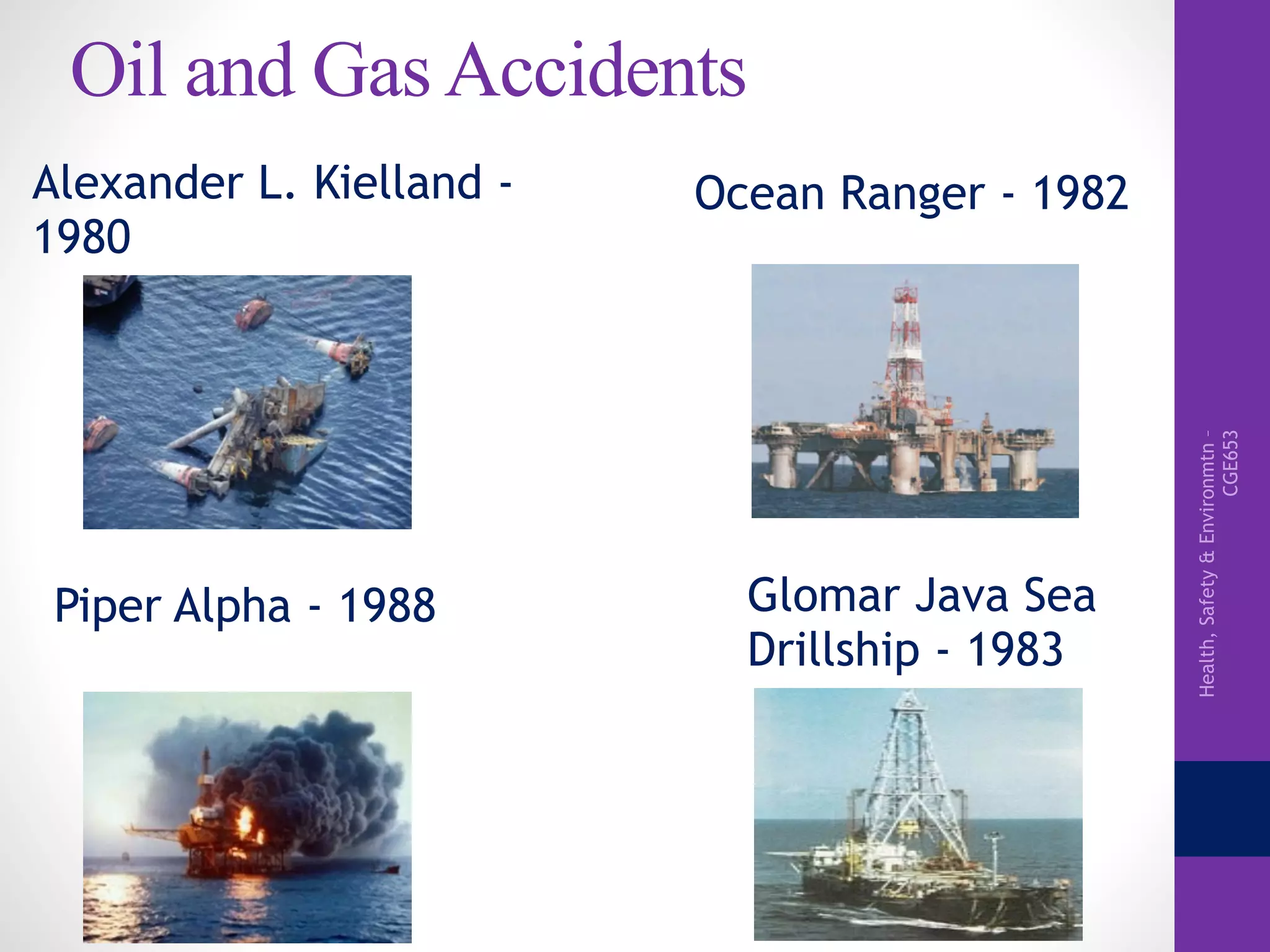
Oil and Gas Accidents
Piper Alpha - 1988
Alexander L. Kielland -
1980
Ocean Ranger - 1982
Glomar Java Sea
Drillship - 1983
Health,Safety&Environmtn–
CGE653
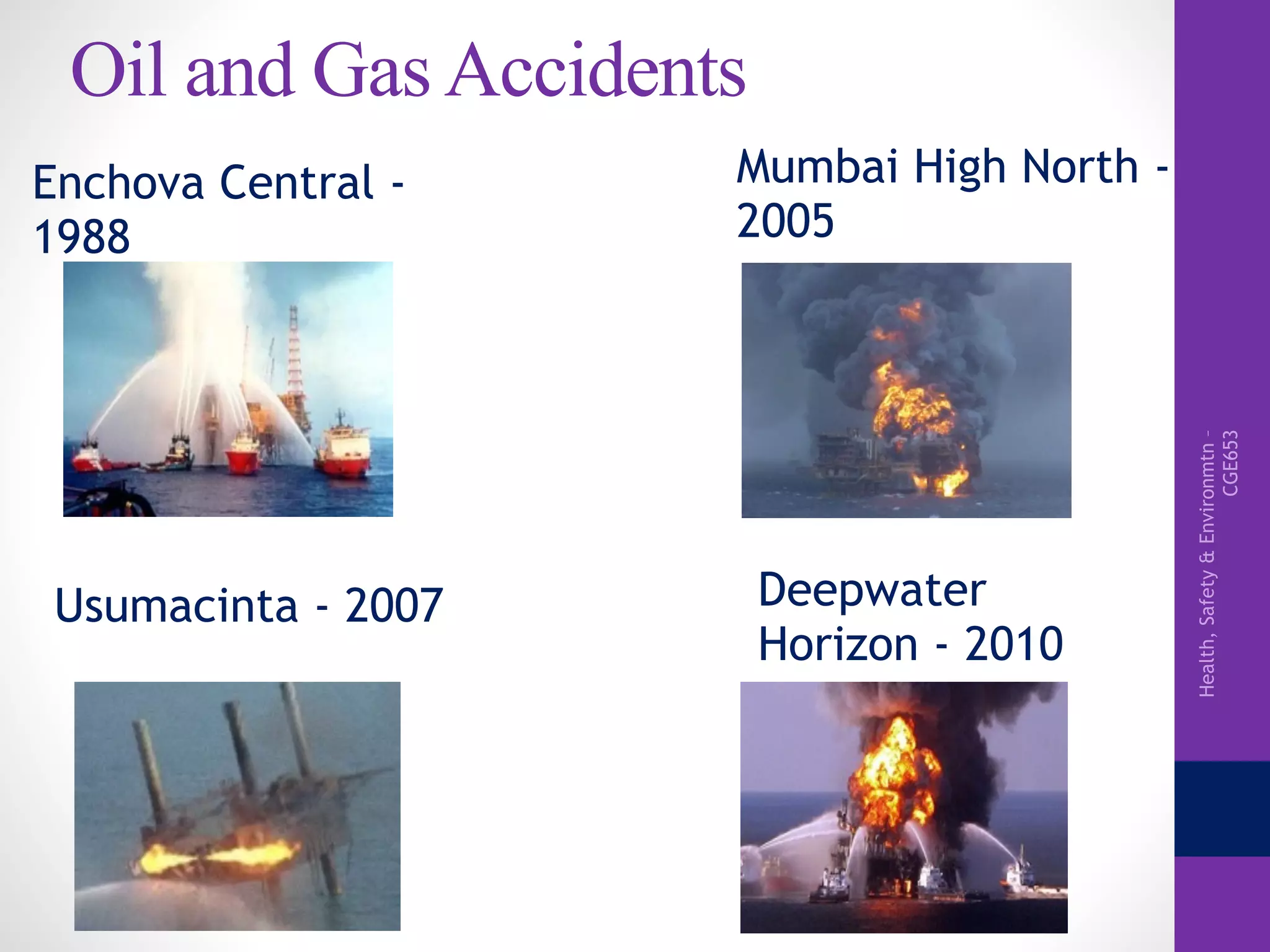
Oil and Gas Accidents
Usumacinta - 2007
Enchova Central -
1988
Mumbai High North -
2005
Deepwater
Horizon - 2010
Health,Safety&Environmtn–
CGE653
Safety Culture
Health,Safety&Environmtn–
CGE653
Safety Culture
• Culture can be seen as a concept that describes
the shared corporate values within an organisation
which influences the attitudes and behaviours of
all of its members.
• Safety culture is a part of the overall culture of
the organisation and is seen as affecting the
attitudes and beliefs of members in terms of
health and safety performance.
• In other words, safety culture is the attitudes,
values, norms, and beliefs that a particular group
of people share with respect to risk and safety
Health,Safety&Environmtn–
CGE653
Safety Culture
• Safety culture refers to the extent to which
individuals and groups in the organisation will
commit to:
▪ personal responsibility for safety
▪ act to preserve safety
▪ enhance and communicate safety concerns
▪ strive to actively learn
▪ adapt and modify behavior based on lessons learned
from mistakes
Health,Safety&Environmtn–
CGE653
Safety Culture
• A “good” safety culture can be promoted by four
factors:
▪ “senior management commitment to safety”
▪ realistic and flexible customs and practices for
handling both well-defined and ill-defined hazards
▪ continuous organisational learning through
practices such as feedback systems, monitoring
and analysing
▪ a care and concern for hazards which is shared
across the workforce.
Health,Safety&Environmtn–
CGE653
Safety Legislation and
Regulations
Health,Safety&Environmtn–
CGE653
Legislation, Act and Regulation
• Legislation is a law passed by a legislative body
such as a Parliament or State Legislature.
• A law is considered to be an act when it has
already been duly passed by a legislative body.
• A regulation, on the other hand, is one that is
approved by a group of individuals based on an
act that has already been passed. These
regulations are based on the act that has been
approved and served as a means to make the act
a lot easier to follow and adhere to. For this
reason, one act can have numerous regulations.
Health,Safety&Environmtn–
CGE653
Evolution of OSH Legislation
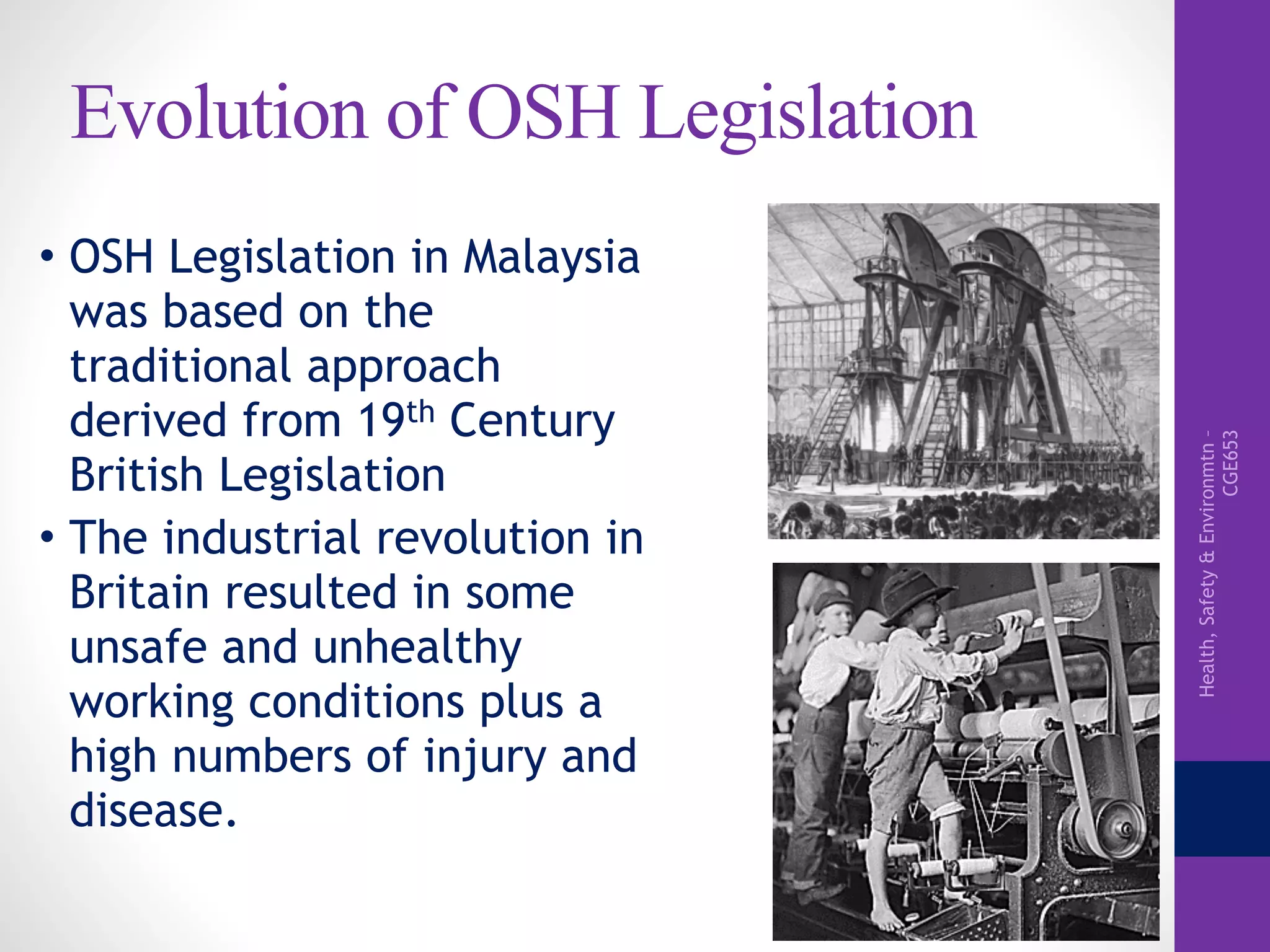
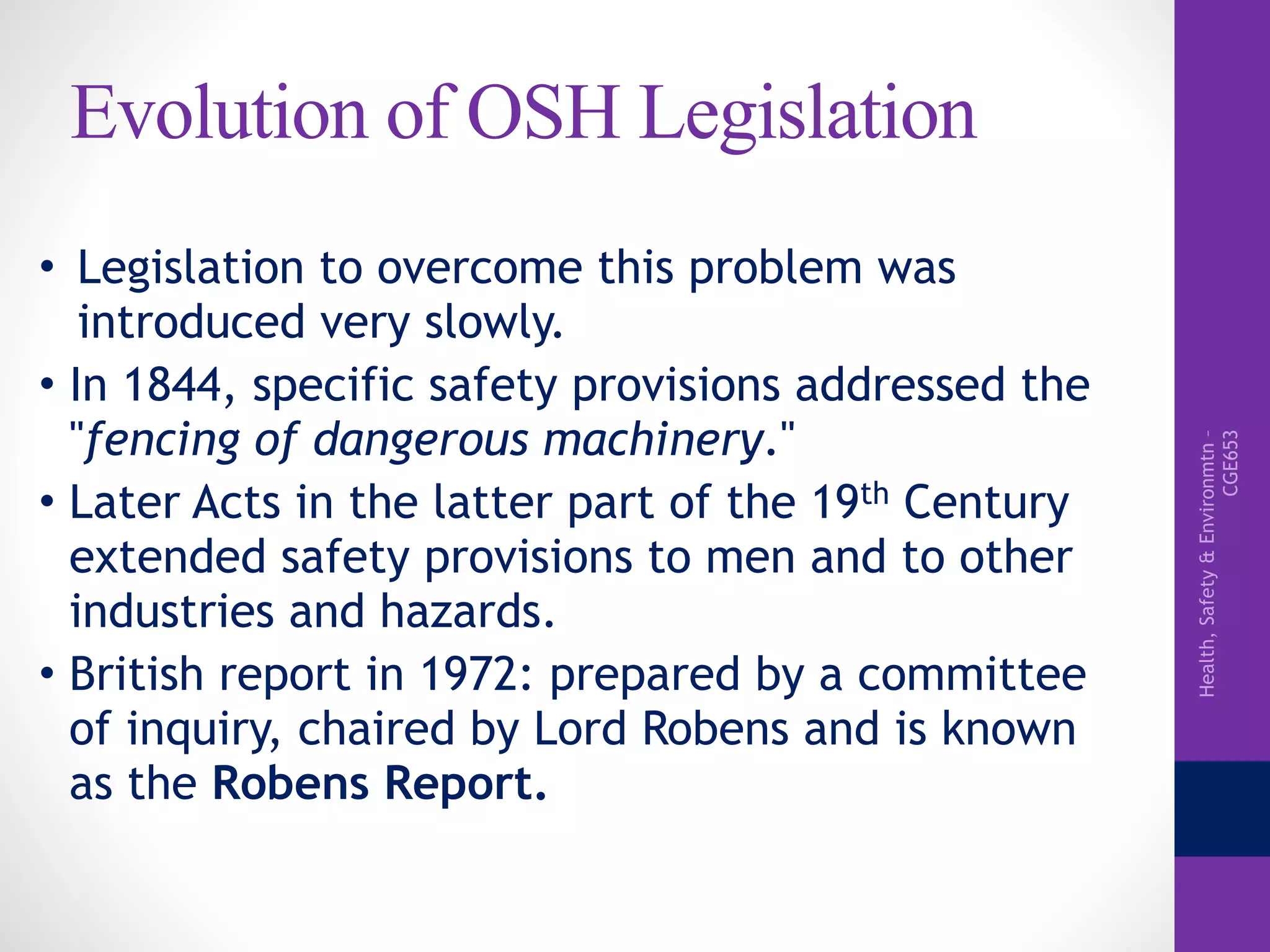
• OSH Legislation in Malaysia
was based on the
traditional approach
derived from 19th Century
British Legislation
• The industrial revolution in
Britain resulted in some
unsafe and unhealthy
working conditions plus a
high numbers of injury and
disease.
Health,Safety&Environmtn–
CGE653
Evolution of OSH Legislation
• Legislation to overcome this problem was
introduced very slowly.
• In 1844, specific safety provisions addressed the
"fencing of dangerous machinery."
• Later Acts in the latter part of the 19th Century
extended safety provisions to men and to other
industries and hazards.
• British report in 1972: prepared by a committee
of inquiry, chaired by Lord Robens and is known
as the Robens Report.
Health,Safety&Environmtn–
CGE653
Evolution of OSH Legislation
• The major recommendations made by Robens
include:
▪ There should be more self regulation by employers
and employees; (for example Safety & Health Officers
and Safety & Health Committees);
▪ There should be a single, comprehensive Act dealing
with occupational safety and health that should
contain a clear statement of the basic principles of
the safety responsibility of employers, employees
and manufacturers, based on common law.
▪ The Act shall be supported by regulations and
voluntary codes with the emphasis on the latter.
Health,Safety&Environmtn–
CGE653
Evolution of OSH Legislation
• The Occupational Safety and Health Act in
Malaysia as well as new style safety and health
legislation in the UK and Australia, reflects many
principles that were stated in a British report in
1972.
• In the year 1967, the Factory and Machinery Act
was approved by the Parliament of Malaysia.
• In 1970, the Factory and Machinery Act and eight
regulations under the act were enforced.
• This act was legislated to overcome the
weaknesses in the Machinery Ordinance 1953,
• Workers were not protected if they work in a workplace that
doesn’t use machinery.
Health,Safety&Environmtn–
CGE653
Introduction to OSHA 1994
• Occupational Safety and Health Act – 1994
• This legislation was made considering the fact that
the Factory and Machinery Act 1967 only covers
occupational safety and health in the
manufacturing, mining, quarrying and construction
industries, whereas the other industries are not
covered.
• The purpose of Occupational Safety and Health
Act 1994 is to promote and encourage
occupational safety and health awareness among
employers and workers.
Health,Safety&Environmtn–
CGE653
Introduction to OSHA 1994
• Main principles that had been taken as the
foundation in the drafting of this Act.
1. Self-regulation
To handle issues relating to occupational safety and
health, employers must develop a good and orderly
management system. Starting with formation of a safety
and health policy and consequently employers have to
make the proper arrangements to be carried out.
Health,Safety&Environmtn–
CGE653
Introduction to OSHA 1994
2. Tripartite consultation
where employers, employees and the government
must negotiate to settle issues and problems
relating to occupational safety and health at the
workplace.
3. Co-operation
where employers and employees must co-operate to
take care, nurture and to increase the quality of
occupational safety and health at the workplace.
Without co-operation between employers and
employees, none of the occupational safety and
health programmes carried out would succeed.
Health,Safety&Environmtn–
CGE653
Application of OSHA 1994
• Apply throughout Malaysia to the industries as
follows (First Schedule )
• Manufacturing;
• Mining and Quarrying;
• Construction;
• Agriculture, Forestry and Fishing;
• Utilities such as Electricity, Gas, Water and sanitary
Services;
• Transport, Storage and Communication;
• Wholesale and Retail Trades;
• Hotels and Restaurants;
• Finance, Insurance, Real Estate and Business Services
• Public Services and Statutory Authorities
Health,Safety&Environmtn–
CGE653
Application of OSHA 1994
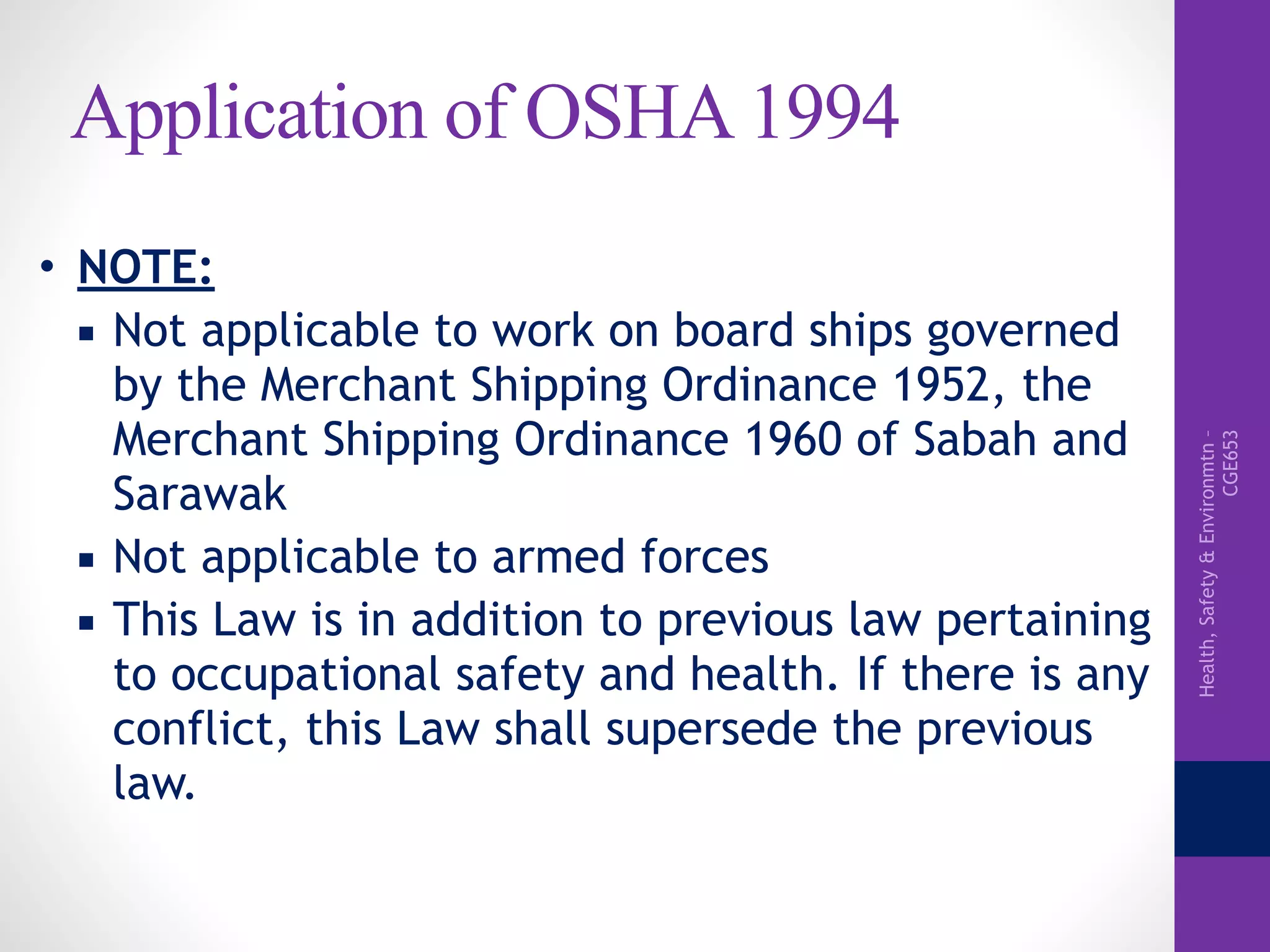
• NOTE:
▪ Not applicable to work on board ships governed
by the Merchant Shipping Ordinance 1952, the
Merchant Shipping Ordinance 1960 of Sabah and
Sarawak
▪ Not applicable to armed forces
▪ This Law is in addition to previous law pertaining
to occupational safety and health. If there is any
conflict, this Law shall supersede the previous
law.
Health,Safety&Environmtn–
CGE653
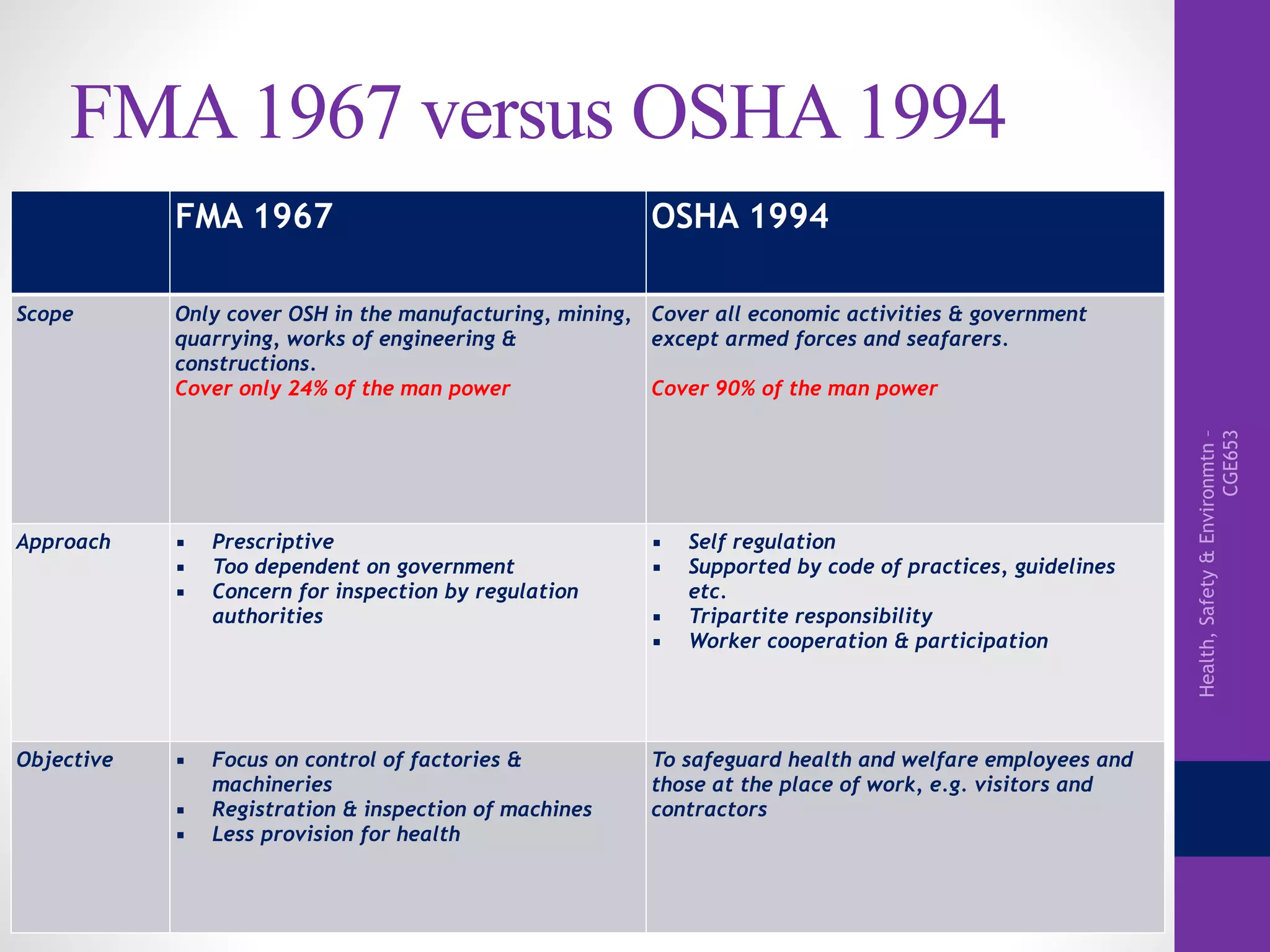
FMA 1967 versus OSHA 1994
FMA 1967 OSHA 1994
Scope Only cover OSH in the manufacturing, mining,
quarrying, works of engineering &
constructions.
Cover only 24% of the man power
Cover all economic activities & government
except armed forces and seafarers.
Cover 90% of the man power
Approach ▪ Prescriptive
▪ Too dependent on government
▪ Concern for inspection by regulation
authorities
▪ Self regulation
▪ Supported by code of practices, guidelines
etc.
▪ Tripartite responsibility
▪ Worker cooperation & participation
Objective ▪ Focus on control of factories &
machineries
▪ Registration & inspection of machines
▪ Less provision for health
To safeguard health and welfare employees and
those at the place of work, e.g. visitors and
contractors
Health,Safety&Environmtn–
CGE653
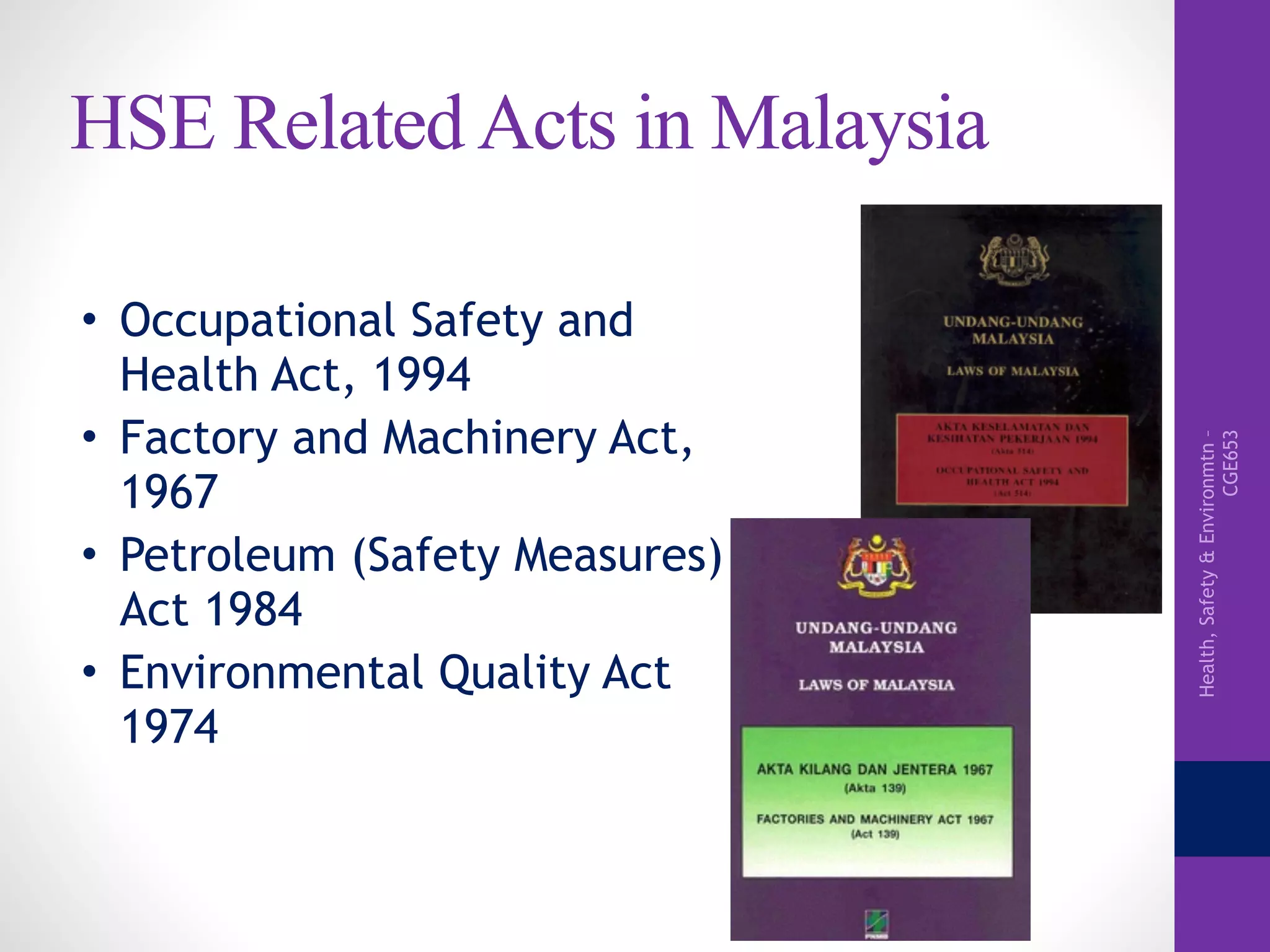
HSE Related Acts in Malaysia
• Occupational Safety and
Health Act, 1994
• Factory and Machinery Act,
1967
• Petroleum (Safety Measures)
Act 1984
• Environmental Quality Act
1974
Health,Safety&Environmtn–
CGE653
Occupational Safety and Health
Act, 1994
Laws of Malaysia
Act 514
Health,Safety&Environmtn–
CGE653
OSHA 1994
• Date of coming into operation – 25 Feb 1994
• Contain 15 Parts, 67 Sections and 3 Schedules
• Applicable throughout Malaysia to the industries
specified in the First Schedule
• Not applicable to work on board ships governed
by the Merchant Shipping Ordinance 1952, 1960
(Sabah) or 1960 (Sarawak) or the armed forces
Health,Safety&Environmtn–
CGE653
Section 4: Object of the Act
• To secure the safety, health and welfare of persons
at work against risks
• To protect persons at a place of work other than
persons at work against risks
• To promote an occupational environment for
persons at work which is adapted to their
physiological and psychological needs.
• To provide the means whereby the associated
occupational safety and health legislation may be
progressively replaced by a system of regulations
and approved industry codes of practice to
maintain or improved the S&H standards
Health,Safety&Environmtn–
CGE653
“Responsibilities to ensure the safety and
health at the workplace lies with those who
create the risk and with those work with the
risk”
Health,Safety&Environmtn–
CGE653
Concept of OSHA 1994
• Accident prevention is an essential part of good
management and workmanship
• Management and workers must cooperate
• Top management must take the lead
• A defined and known safety and health policy
• Organization and resources to achieve policy
Health,Safety&Environmtn–
CGE653
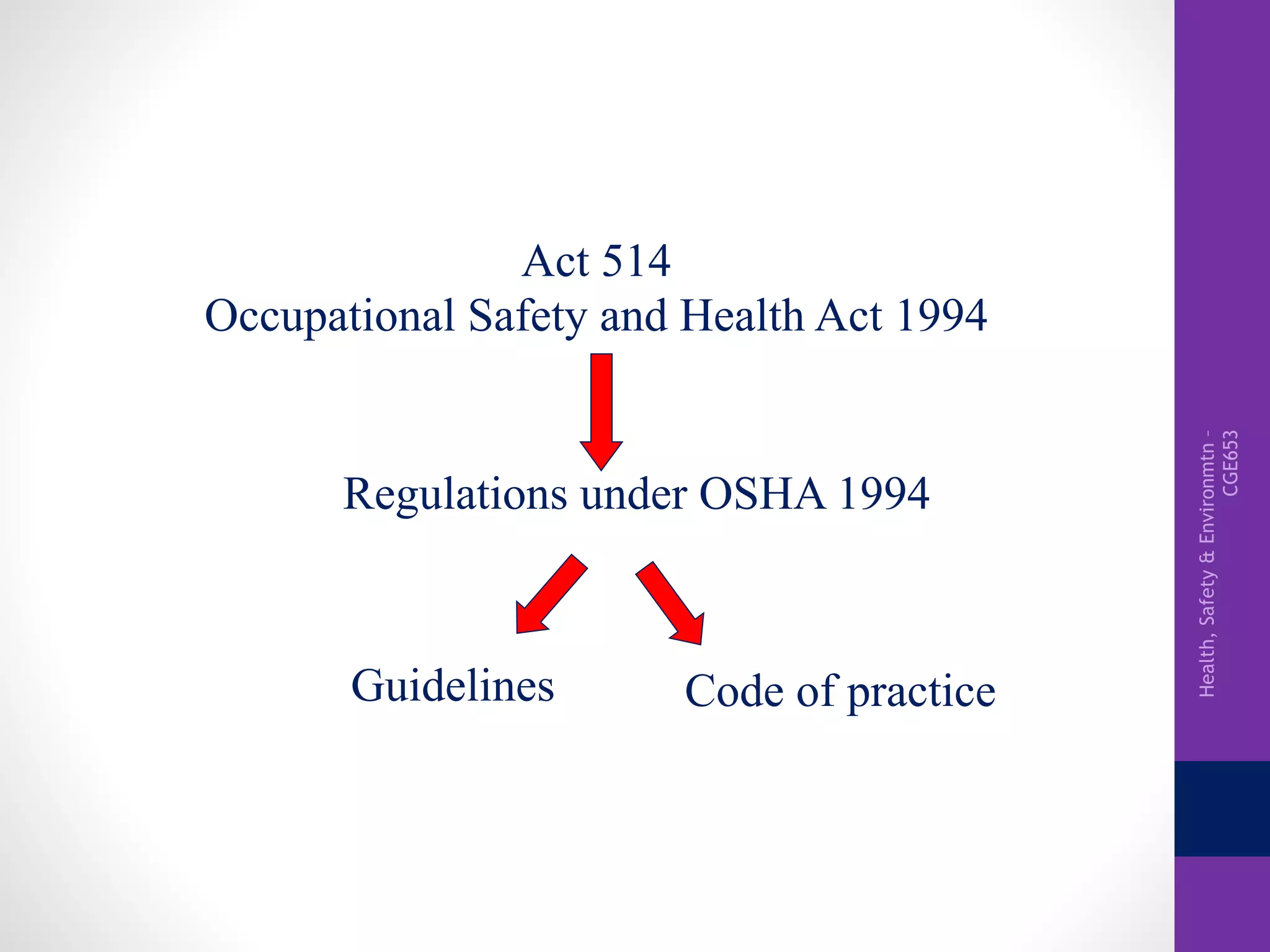
Act 514
Occupational Safety and Health Act 1994
Regulations under OSHA 1994
Guidelines Code of practice
Health,Safety&Environmtn–
CGE653
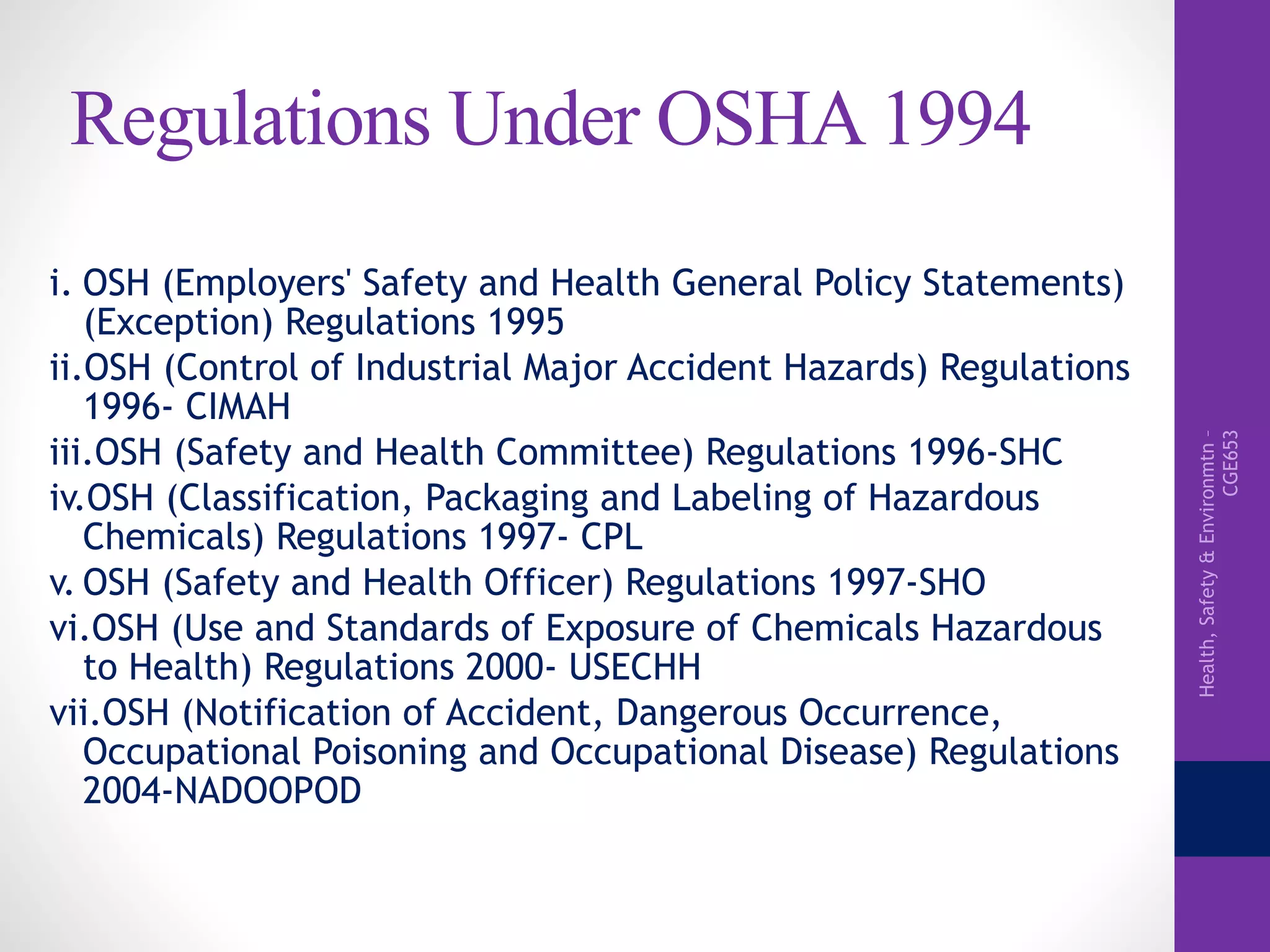
Regulations Under OSHA 1994
i. OSH (Employers' Safety and Health General Policy Statements)
(Exception) Regulations 1995
ii.OSH (Control of Industrial Major Accident Hazards) Regulations
1996- CIMAH
iii.OSH (Safety and Health Committee) Regulations 1996-SHC
iv.OSH (Classification, Packaging and Labeling of Hazardous
Chemicals) Regulations 1997- CPL
v. OSH (Safety and Health Officer) Regulations 1997-SHO
vi.OSH (Use and Standards of Exposure of Chemicals Hazardous
to Health) Regulations 2000- USECHH
vii.OSH (Notification of Accident, Dangerous Occurrence,
Occupational Poisoning and Occupational Disease) Regulations
2004-NADOOPOD
Health,Safety&Environmtn–
CGE653
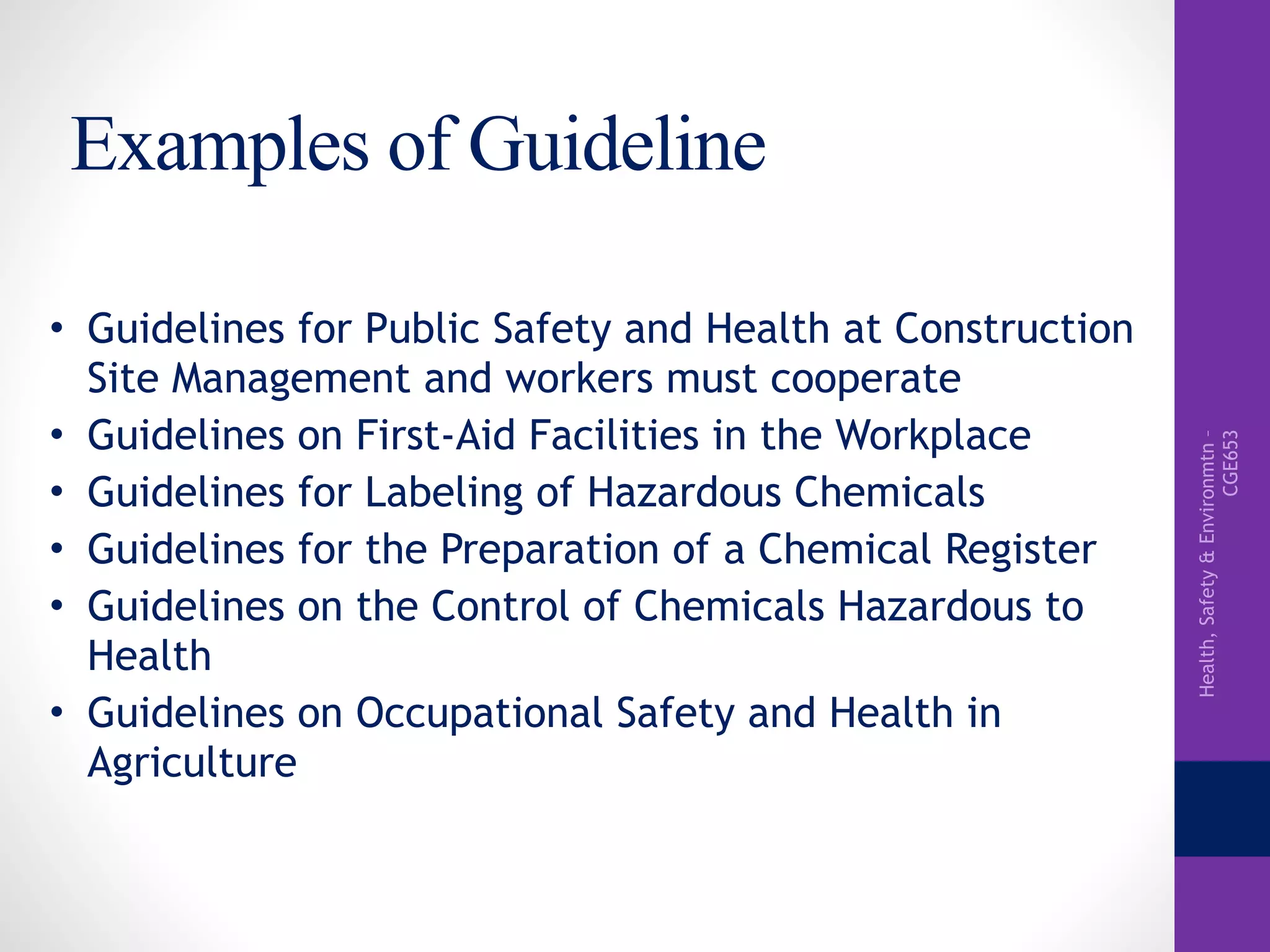
Examples of Guideline
• Guidelines for Public Safety and Health at Construction
Site Management and workers must cooperate
• Guidelines on First-Aid Facilities in the Workplace
• Guidelines for Labeling of Hazardous Chemicals
• Guidelines for the Preparation of a Chemical Register
• Guidelines on the Control of Chemicals Hazardous to
Health
• Guidelines on Occupational Safety and Health in
Agriculture
Health,Safety&Environmtn–
CGE653
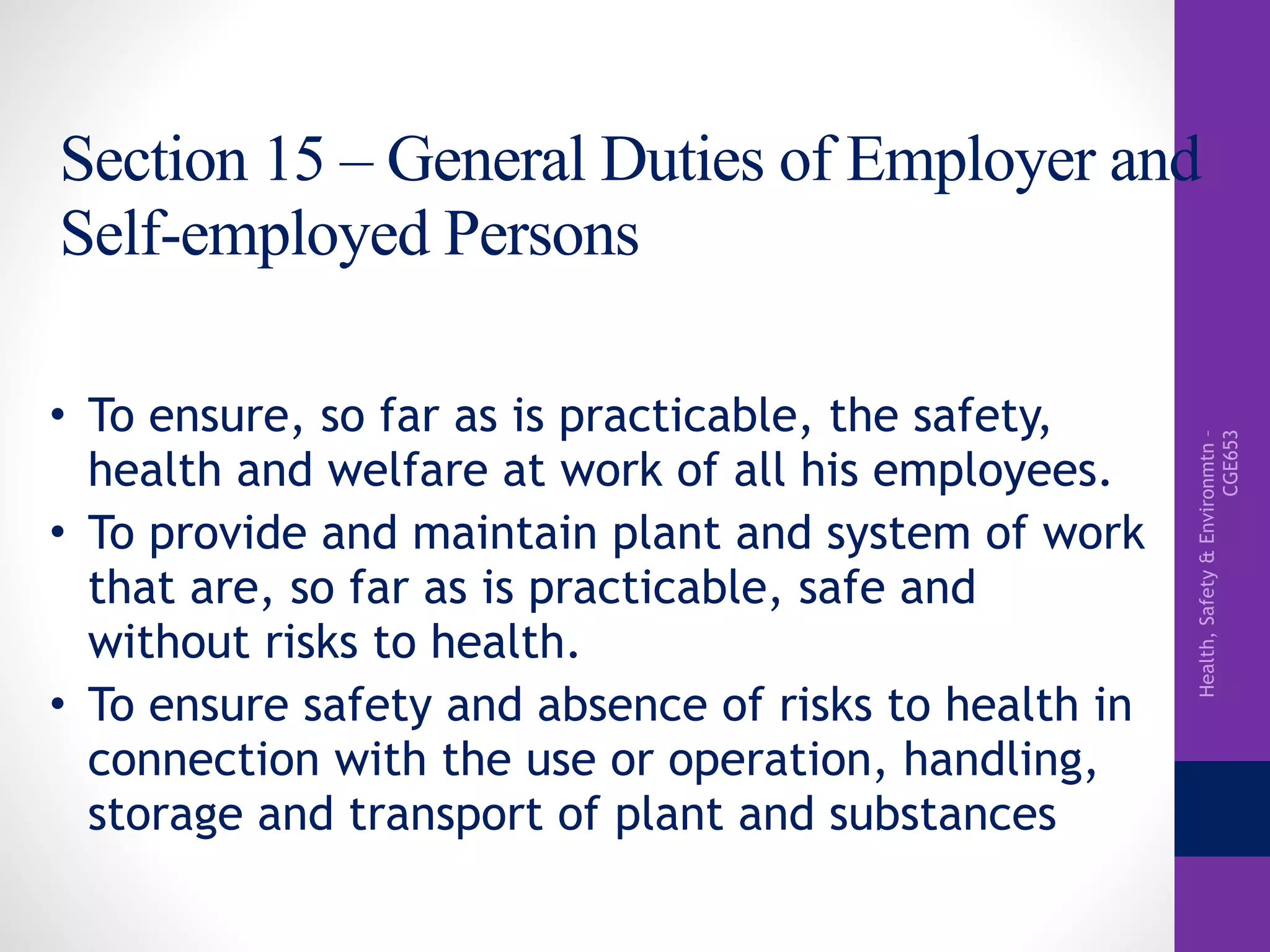
Section 15 – General Duties of Employer and
Self-employed Persons
• To ensure, so far as is practicable, the safety,
health and welfare at work of all his employees.
• To provide and maintain plant and system of work
that are, so far as is practicable, safe and
without risks to health.
• To ensure safety and absence of risks to health in
connection with the use or operation, handling,
storage and transport of plant and substances
Health,Safety&Environmtn–
CGE653
Section 15 – General Duties of Employer and
Self-employed Persons
• To provide information, instruction, training and
supervision.
• To maintain any place of work under the control
of the employer or self-employed person and to
provide access to and egress from it that are safe
and without such risks.
• To provide and maintain a working environment
that is safe, without risks to health, & adequate
as regards facilities for their welfare at work.
Health,Safety&Environmtn–
CGE653
Section 16 – Duty to formulate S&H Policy
It shall be the duty of every employer and every
self-employed person to:
▪ prepare and revise a written statement on S&H
policy
▪ arrange for the time being in force in carrying
out the policy
▪ bring the statement and any revision of it to the
notice of all of his employees
Health,Safety&Environmtn–
CGE653
Section 24 – General Duties of an Employee
• To take reasonable care for the safety and health
of himself and of other persons who may be
affected by his acts or omissions at work.
• To cooperate with his employers or any other
person.
• To wear or use at all times any PPE.
• To comply with any instruction or measure on
OSH.
Health,Safety&Environmtn–
CGE653
Factory and Machinery Act 1967
(Revised -1974)
Laws of Malaysia
Act 139
Health,Safety&Environmtn–
CGE653
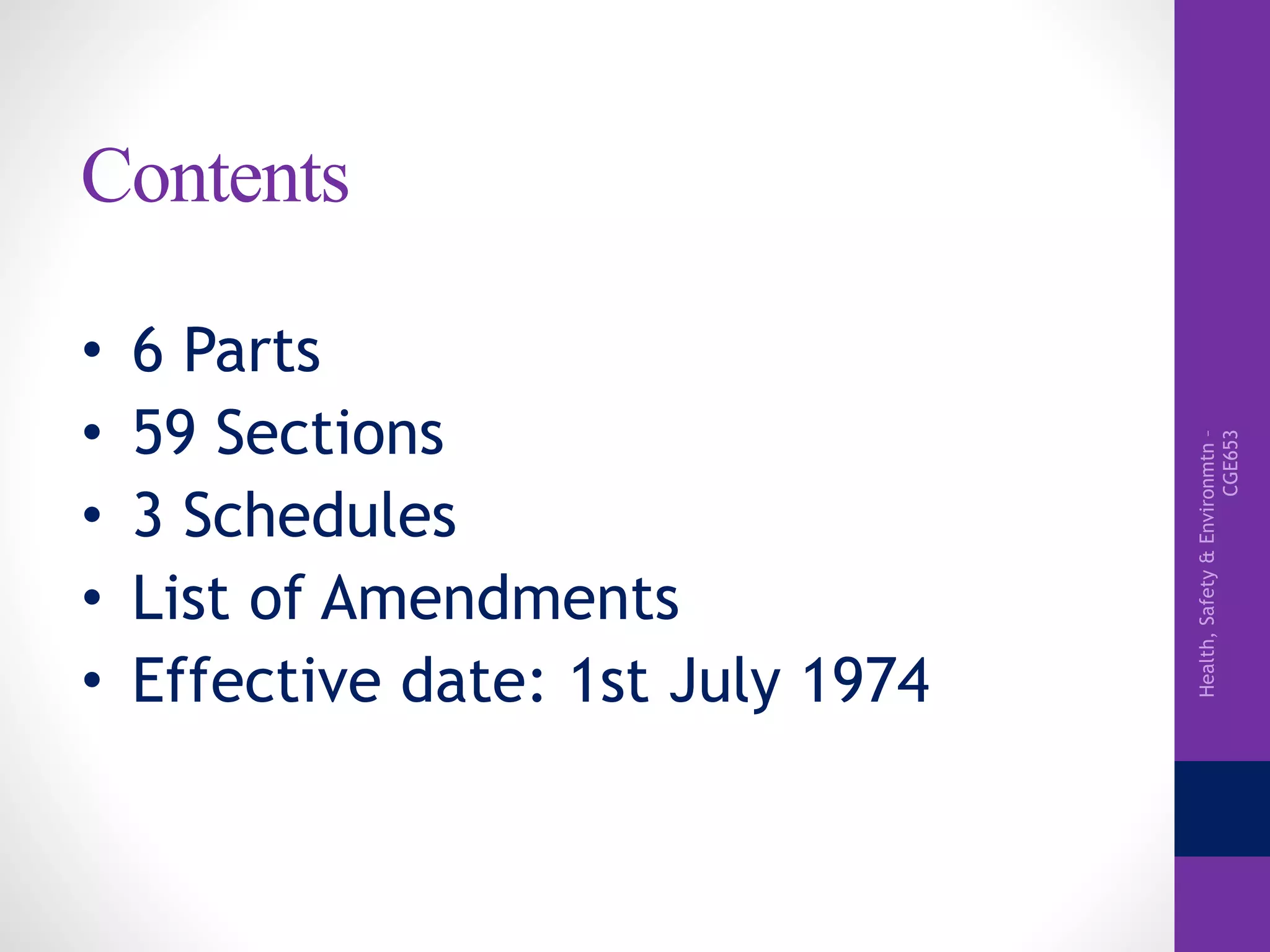
Contents
• 6 Parts
• 59 Sections
• 3 Schedules
• List of Amendments
• Effective date: 1st July 1974
Health,Safety&Environmtn–
CGE653
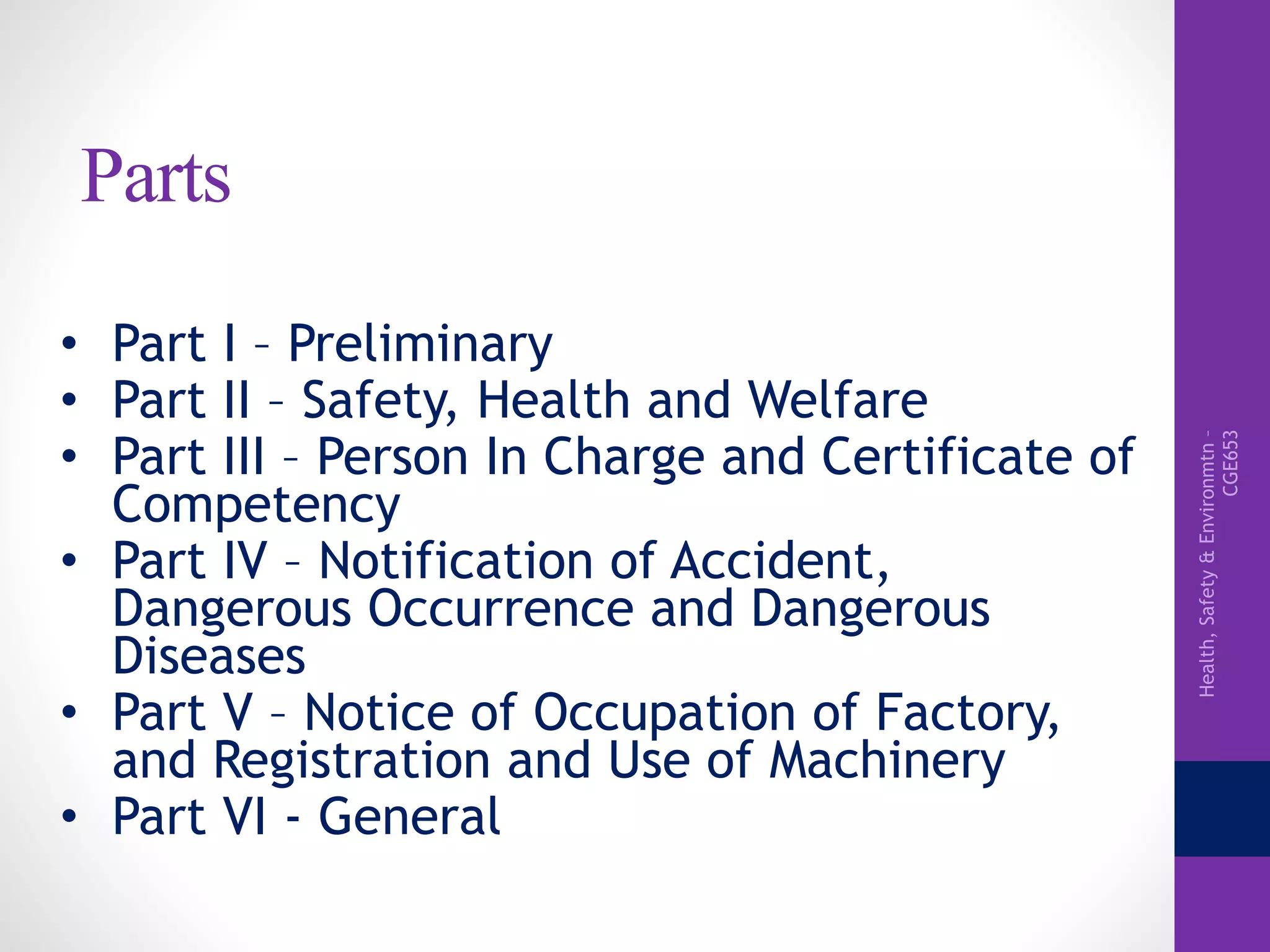
Parts
• Part I – Preliminary
• Part II – Safety, Health and Welfare
• Part III – Person In Charge and Certificate of
Competency
• Part IV – Notification of Accident,
Dangerous Occurrence and Dangerous
Diseases
• Part V – Notice of Occupation of Factory,
and Registration and Use of Machinery
• Part VI - General
Health,Safety&Environmtn–
CGE653
Petroleum (Safety Measures)
Act 1984
Laws of Malaysia
Act 302
Health,Safety&Environmtn–
CGE653
Contents
• 11 Parts
• 48 Sections
• 1 Schedule
• List of Amendments
•Effective date: 1st March 1985
Health,Safety&Environmtn–
CGE653
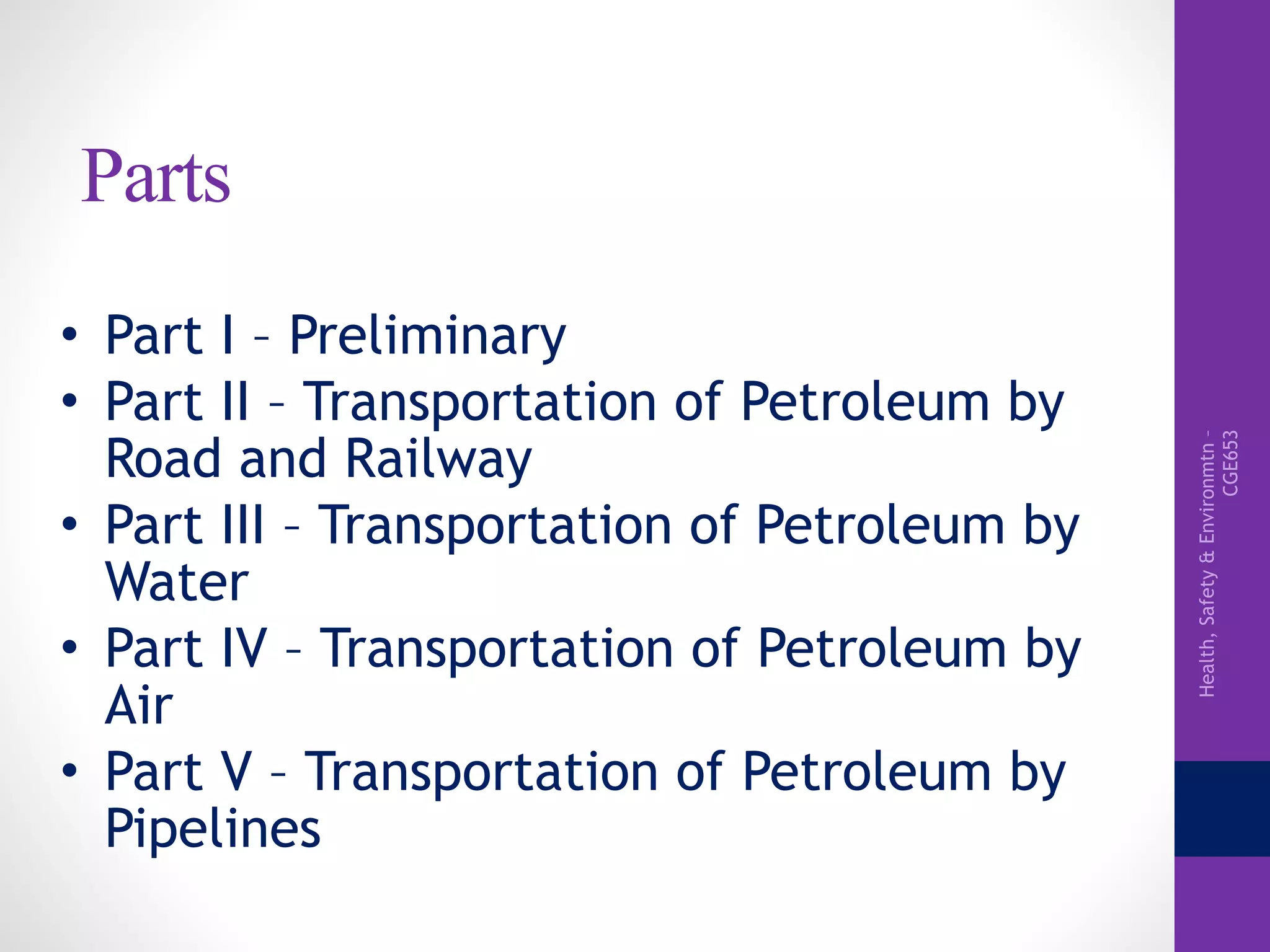
Parts
• Part I – Preliminary
• Part II – Transportation of Petroleum by
Road and Railway
• Part III – Transportation of Petroleum by
Water
• Part IV – Transportation of Petroleum by
Air
• Part V – Transportation of Petroleum by
Pipelines
Health,Safety&Environmtn–
CGE653
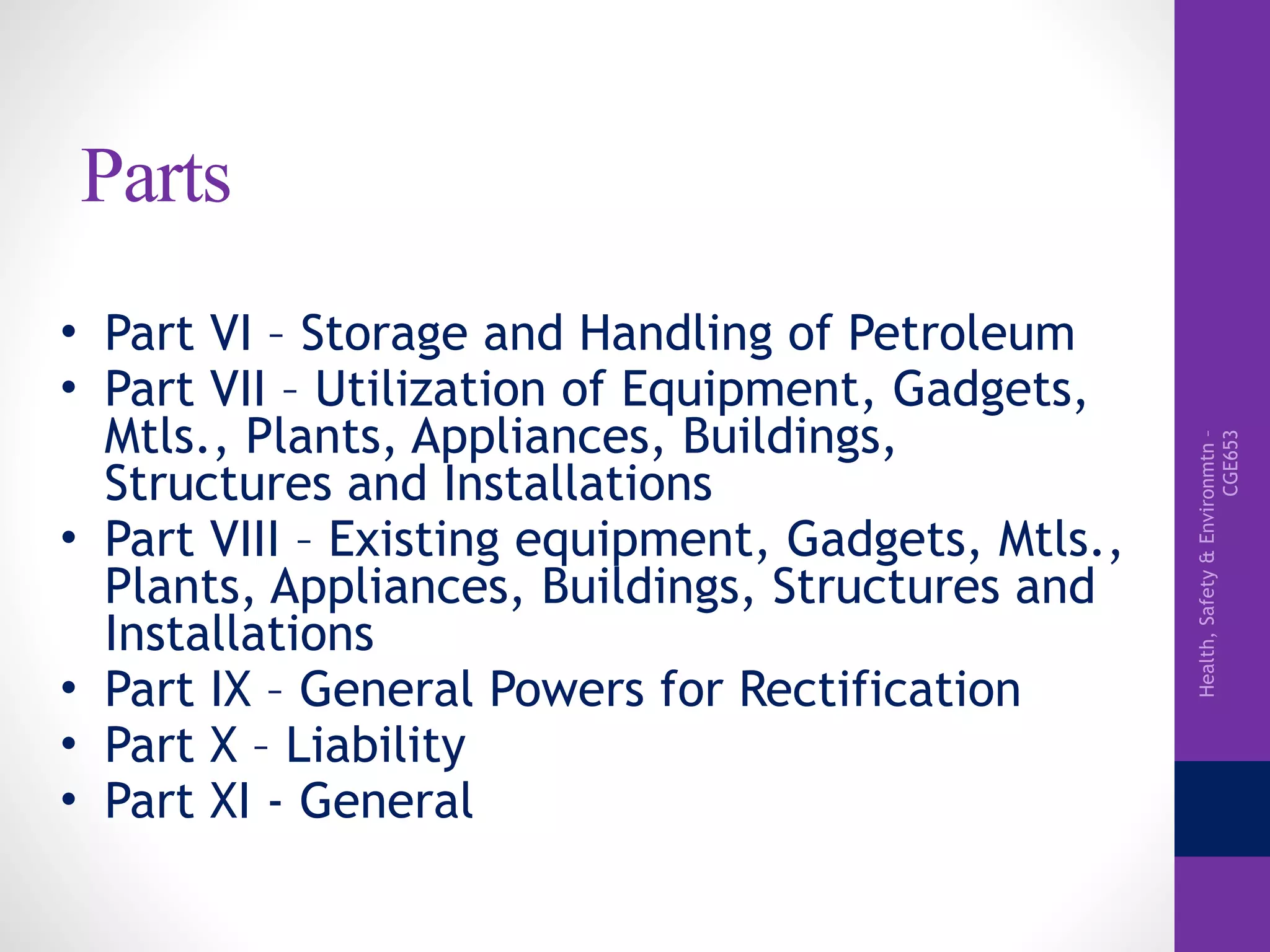
Parts
• Part VI – Storage and Handling of Petroleum
• Part VII – Utilization of Equipment, Gadgets,
Mtls., Plants, Appliances, Buildings,
Structures and Installations
• Part VIII – Existing equipment, Gadgets, Mtls.,
Plants, Appliances, Buildings, Structures and
Installations
• Part IX – General Powers for Rectification
• Part X – Liability
• Part XI - General
Health,Safety&Environmtn–
CGE653
For More Information
Ministry of Human Resources
Department of Occupational Safety and Health
(DOSH)
www.dosh.gov.my
Health,Safety&Environmtn–
CGE653
Petronas Procedures and Guidelines for
Upstream Activities (PPGUA)
• Exploration Activities
• Project Development
• Inspection and Maintenance of Production
Facilities
• Production Operations
• Management of Health, Safety & Environment
• Platform Abandonment
Case study 1
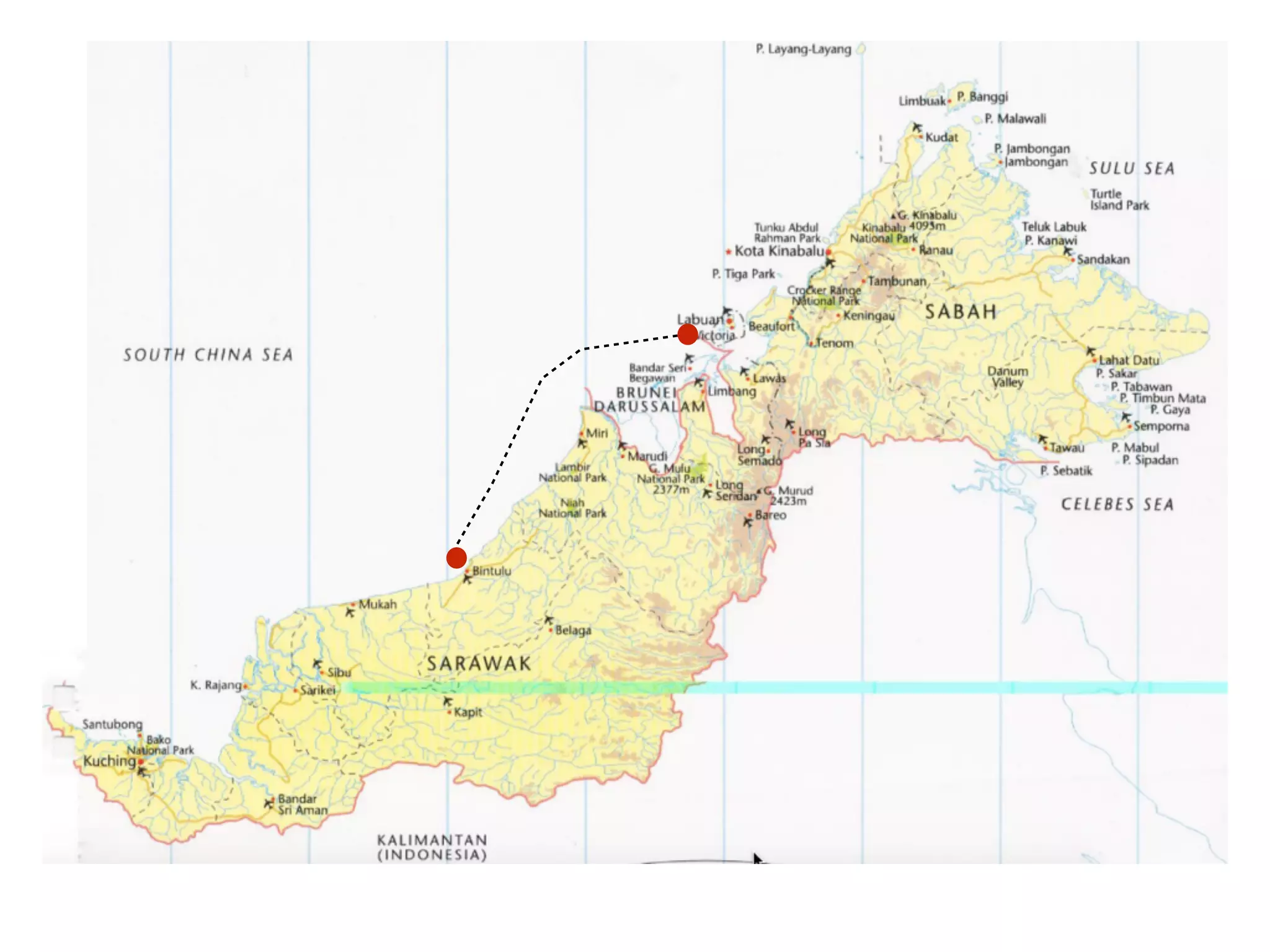
A supply of liquid ammonia is required to meet the demand
of an ammonia injection program at an EOR facility in
Sabah. The facility is located 70km off the coast of Labuan
and the closet ammonia source is the Asean Bintulu
Fertilizer in Bintulu, Sarawak. Ammonia is a corrosive and a
known to have carcinogenic properties in its liquid phase. If
the injection facility requires 10kbd ammonia and ABF has a
storage capacity of 5000 MT at bintulu port. work out a high
level HSE strategy for the delivery of ammonia for a 3 week
injection campaign.
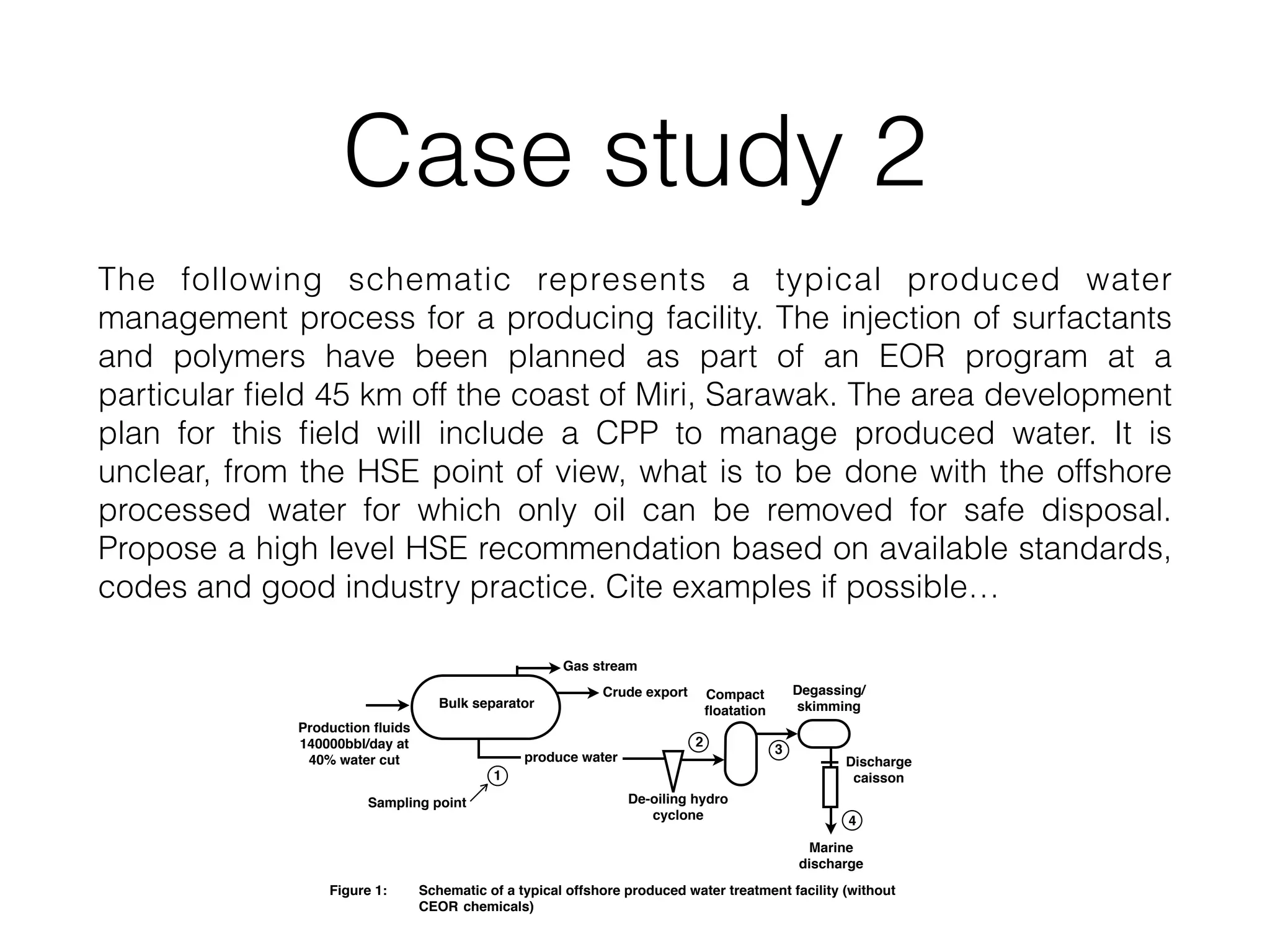
Case study 2
The following schematic represents a typical produced water
management process for a producing facility. The injection of surfactants
and polymers have been planned as part of an EOR program at a
particular field 45 km off the coast of Miri, Sarawak. The area development
plan for this field will include a CPP to manage produced water. It is
unclear, from the HSE point of view, what is to be done with the offshore
processed water for which only oil can be removed for safe disposal.
Propose a high level HSE recommendation based on available standards,
codes and good industry practice. Cite examples if possible…
Bulk separator
Gas stream
Crude export
produce water
De-oiling hydro
cyclone
Compact
floatation
Degassing/
skimming
Marine
discharge
Discharge
caisson1
2
4
3
Figure 1: Schematic of a typical offshore produced water treatment facility (without
CEOR chemicals)
Sampling point
Production fluids
140000bbl/day at
40% water cut

Hse uitm introduction

  • 1.
    Health, Safety andthe Environment CGE653 Ir. Dr. MOHD SHIRAZ ARIS INTRODUCTION
  • 2.
    Key questions… • Whatdoes HSE mean to you… • Why is it important… • How much emphasis should we place…. • Who benefits… • How do we define the boundaries…
  • 3.
    Key HSE elementsand drivers HSE Standards Codes Industry Business case Cost of doing business Design
  • 4.
    HSE tools HSE HAZOP RiskAssessment HAZID ALARP BATNEEC QRA
  • 5.
    Health,Safety&Environmtn– CGE653 
 Introduction to Health,Safety and Environment Acknowledgement to: Dr Syed Shatir A. Syed-Hassan Faculty of Chemical Engineering Universiti Teknologi MARA
  • 6.
  • 7.
    Health,Safety&Environmtn– CGE653 Some Terminologies • Safety •Health • Chronic • Acute • Hazard • Risk • Accident • Incident • Near Miss
  • 8.
    Health,Safety&Environmtn– CGE653 Safety and Health •Safety = the absence of: (i) injury and harm on human and (ii) damage on property and the environment • Opposite of safety = accident • Health = a state of physical and mental well-being – including the absence of disease or infirmity. • Safety deals with acute effects of hazards • Health issue deals with chronic effects of hazards • Chronic: persistent, prolonged and repeated • Acute: immediate, short term
  • 9.
    Health,Safety&Environmtn– CGE653 Hazard versus Risk ▪Hazard = a condition that has the potential to cause human injury or fatality, damage to property, damage to the environment or some combination of these. ▪ Risk = a measure of human injury, environmental damage, or economic loss in terms of both the incident likelihood and the magnitude of the loss or injury. ▪ In other words, risk = a chance of injury or loss or bad consequences to happen.
  • 10.
    Health,Safety&Environmtn– CGE653 Sources of Hazards •The work environment • Equipment/plant/process • Substances/materials • Work system • People 5 M Man Machine Method Material Milieu
  • 11.
    Health,Safety&Environmtn– CGE653 Broad Categories ofHazards Category Example Safety Hazards Chemical Hazards acidity, alkalinity, Corrosivity, explosiveness, flammability, toxicity, asphyxiation.Mechanical Hazards moving equipment, tripping hazards, impact and forces Thermodynamics Hazards high/low temperature, high pressure, vacuum, heat transfer Electrical & Electromagnetic Hazards high voltage, radiation, static electricity, electrical current Health Hazards noise, pollution, vibration, radioactivity, External Threats accidental damage by missiles and vehicles, act of god and natural causes
  • 12.
    Health,Safety&Environmtn– CGE653 Potential Safety Hazardsin Oil and Gas Operation Category Blowouts ▪ Drilling ▪ Completion, ▪ Production (including wirelining) ▪ Workover ▪ Abandonment, Process leaks Leaks of gas/oil from: ▪ Wellhead equipment, ▪ Separators & other process equipment, ▪ Compressors and other gas treatment Category Marine Collisions ▪ Supply vessels ▪ Standby vessels ▪ Fishing vessels ▪ Drilling rigs ▪ Offshore loading tankers Personnel Transport ▪ Helicopter crash into sea/platform/ashore ▪ Boat transfer ▪ Basket transfer
  • 13.
    Health,Safety&Environmtn– CGE653 Potential Safety Hazardsin Oil and Gas Operation Category Riser/pipeline leaks Leaks of gas/oil from: ▪ Import flowlines ▪Export risers ▪Sub-sea pipelines ▪Sub-sea wellhead manifolds Non-process fires ▪Fuel gas ▪Electrical ▪Accommodation ▪Machinery ▪Workshop Category Dropped objects ▪Constructions ▪Crane operations ▪Cargo transfer Structural events ▪Extreme weather ▪Foundation failure ▪Bridge collapse ▪Crane Collapse Non-process spills ▪ Chemical ▪ Methanol/Glycol ▪ Bottled gas leaks
  • 14.
    Health,Safety&Environmtn– CGE653 Hazard Control Hierarchy No.Control Method Description/Example 1. Eliminate Completely remove the hazard from the workplace so that it is not there. 2. Substitute Replace the material or process with a less hazardous one. 3. Isolate Place a barrier or similar between the hazard and people within the workplace (e.g. a fence surrounding the hazard). 4. Engineering controls Install or using additional machinery. (e.g ventilation system, guarding on machinery, sensor system). 5. Administrative controls Safety briefings, safety trainings, work procedure, safety awareness signage. 6. PPE “Last line of defence” to protect a worker if the above measures have failed.
  • 15.
    Health,Safety&Environmtn– CGE653 Hazard Identification andRisk Assessment 1. Identify the hazard 2. Estimating the risk associated with the hazard
  • 16.
  • 17.
    Health,Safety&Environmtn– CGE653 Hazard Control Hierarchy 4.Engineering Control 5. Administrative Control 6. Use PPE
  • 18.
    ProcessSafety-CPE615 Risk Assessment andthe Principle of Crocodile 3. Decision making Or Run Away?
  • 19.
    Health,Safety&Environmtn– CGE653 Personal Protective Equipment Consideredas a last resort in hazard control because: • Only protects one person. • Only protects if it is worn properly. • Difficulties with fit, practicalities of use, ergonomics, etc. • Difficulties with enforcement of use. • Other on-going management issues such as training, replacement, repair.
  • 20.
    Health,Safety&Environmtn– CGE653 Incident versus Accident •Incident: all undesired circumstances that have the potential to cause accidents. • Accident: a sequence of events that produce unintended injury, damage to property or the environment, production losses, or increased liabilities. • Accident refers to the event, not the results of the event.
  • 21.
    Health,Safety&Environmtn– CGE653 Near Miss…….. • anunplanned event that did not result in injury, illness, or damage – but had the potential to do so. • another term for this event: “close call”
  • 22.
  • 23.
    Health,Safety&Environmtn– CGE653 Consequences of MajorIndustrial Accidents: ▪ Fires ▪ Explosions ▪ Toxic Releases ▪ Fatalities ▪ Injuries ▪ Environmental Damage ▪ Property Damage ▪ Evacuations ▪ Property Losses ▪ Plant Closings ▪ Fines, Lawsuit Accidents Consequences
  • 24.
  • 25.
    Health,Safety&Environmtn– CGE653 Bhopal, 1984 ▪ Releaseof toxic gas ▪ 40 tons of Methyl Isocynate (MIC) escaped from Union Carbide Plant in Bhopal, India. ▪ 3000 died (respiratory failure) ▪ Thousands more died in weeks that followed ▪ More than 500,000 suffered
  • 26.
    Health,Safety&Environmtn– CGE653 Chernobyl, 1986 ▪ 26April 1986 at the Chernobyl Nuclear Reactor, Ukraine. ▪ Large area of Russia, Ukraine and Belarus was evacuated, 336 000 people resettled. ▪ Fewer than 50 direct death, but thousands of cancer-related cases. ▪ Severe damage to the environment.
  • 27.
    Health,Safety&Environmtn– CGE653 Piper Alpha, 1988 ▪World’s most famous oil rig disaster. ▪ 167 out of 229 people died ▪ Initial explosion followed by a fierce fire which, in turn, triggered off a further series of explosions. ▪ Flames could be seen 100 km away.
  • 28.
    Health,Safety&Environmtn– CGE653 BP Texas CityRefinery, 2005 ▪ 23 March 2005 ▪ Fire and Explosion ▪ Killing 15 workers and injuring more than 170 others.
  • 29.
    Health,Safety&Environmtn– CGE653 Deep Water HorizonPlatform, 2006 ▪ Gulf Coast of United States ▪ Platform explosion and sinking, killed 11 workers ▪ Leaking of hundreds of thousands of barrels of oil into the Gulf of Mexico ▪ The worst industrial environmental disaster in US history.
  • 30.
    Health,Safety&Environmtn– CGE653 Importance of Safety •Prevention of ... • Death or injury to workers • Death and injury to general publics • Physical and financial damage to the properties/ facilities • Damage to third party properties • Damage to the environment Accident is costly!!!
  • 31.
  • 32.
    Health,Safety&Environmtn– CGE653 Cost of Accidents ▪Direct Costs • costs that are accrued directly from the accident • quite easy to calculate • usually insurable by businesses ▪ Indirect Costs ▪ the less obvious consequences of an accident that can be costed ▪ While the indirect costs created by accidents are hidden, they too must be paid ▪ more difficult to calculate and tend not to be insured
  • 33.
    Health,Safety&Environmtn– CGE653 Examples of DirectCost of Accidents ▪ Medical costs incurred and the compensation payments made to the injured workers ▪ Damage to premises, plant and equipment ▪ Sick pay ▪ Overtime to cover injured person ▪ Fines
  • 34.
    Health,Safety&Environmtn– CGE653 Examples of IndirectCost of Accidents ▪ Loss of an employee's skills and work output ▪ Downtime during investigations and pay of people investigating ▪ Training costs for replacement operators ▪ Increased Insurance Premiums ▪ Defending criminal and civil prosecutions ▪ Bad publicity ▪ Workplace effects: poor productivity due to low morale
  • 35.
    Health,Safety&Environmtn– CGE653 Safety is aGood Business • Decrease workers compensation • Decrease retraining costs • Decrease absenteeism • Reduce production interruption • Increase productivity • Increase morale of workers • Attracting people to work • Enhancing company’s corporate reputation
  • 36.
    Health,Safety&Environmtn– CGE653 Engineers and Safety ▪A requirement for engineering degree programmes ▪ Important aspect in the application for professional engineer ▪ Non-compliance with safety standards can severely affect a company’s bottom line. ▪ Engineers who design the workplace and its equipment or who manage and supervise workers need to have an understanding of the safety and health regulation.
  • 37.
    Health,Safety&Environmtn– CGE653 Code of Ethics Engineeringis an important and learned profession. As members of this profession, engineers are expected to exhibit the highest standards of honesty and integrity. Engineering has a direct and vital impact on the quality of life for all people. Accordingly, the services provided by engineers require honesty, impartiality, fairness and equity, and must be dedicated to the protection of the public health, safety, and welfare. Engineers must perform under a standard of professional behavior that requires adherence to the highest principles of ethical conduct.
  • 38.
    Health,Safety&Environmtn– CGE653 Engineering Ethics: Engineersshall hold paramount the safety, health, and welfare of the public in the performance of their professional duties.
  • 39.
  • 40.
    Health,Safety&Environmtn– CGE653 Why do accidentsoccur? • We choose to handle dangerous processes, materials, energies ▪ To make a living ▪ To provide society with desirable products • As long as we choose to handle them, a potential for loss events exist. Things can be done to reduce their likelihood and severity to negligible or tolerable levels.
  • 41.
    Health,Safety&Environmtn– CGE653 How do accidentsoccur? • There are several theories that attempt to explain the occurrence of accidents. ▪ Domino theory ▪ Human factors theory ▪ Swiss cheese model ▪ Accident/incident theory ▪ Sociotechnical system framework ▪ Epidemiological Theory ▪ Systems Theory
  • 42.
    Health,Safety&Environmtn– CGE653 Domino Theory • HerbertW. Heinrich, an early pioneer of accident prevention and industrial safety. • He studied 75,000 reports of accidents for insurance claims and concluded: ▪ 88% of industrial accidents are caused by unsafe acts committed by workers ▪ 10% of industrial accidents are caused by unsafe conditions ▪ 2% of industrial accidents are unavoidable.
  • 43.
    Health,Safety&Environmtn– CGE653 Heinrich’s Axiom ofIndustrial Safety 1. Injuries result from a complete series of factors, one of which is the accident itself 2. An accident can occur as a result of unsafe act and/or unsafe conditions 3. Most accidents are the result of unsafe behaviour by people 4. An unsafe act or an unsafe conditions does not immediately result in an accident/injury;
  • 44.
    Health,Safety&Environmtn– CGE653 Heinrich’s Axiom ofIndustrial Safety 5. The reasons why people commit unsafe acts can serve as helpful guides in selecting corrective actions. 6. The severity of an accident is largely fortuitous and the factors that cause it are largely preventable. 7. The prevention techniques are analogous with the best quality and productivity techniques.
  • 45.
    Health,Safety&Environmtn– CGE653 Heinrich’s Axiom ofIndustrial Safety 8. Management should assume responsibility for safety because it is in the best position to get results. 9. The supervisor is the key person in the prevention of industrial accidents. 10. In addition to the direct costs of an accident (i.e. compensation, liability claims, medical costs, and hospital expenses) there are also hidden or indirect costs.
  • 46.
    Health,Safety&Environmtn– CGE653 5 factors inthe sequence of events leading up to an accident Social Environment and Ancestry Fault of Person (Carelessness) Unsafe Act or Condition Accident Injury
  • 47.
    Health,Safety&Environmtn– CGE653 5 factors inthe sequence of events leading up to an accident • Ancestry and social environment ▪ Negative character traits that might lead people to behave in an unsafe manner can be inherited or acquired as a result of the social environment. • Fault of a person ▪ Negative character traits, whether inherited or acquired, are why people behave in unsafe manner and why hazardous conditions exist.
  • 48.
    Health,Safety&Environmtn– CGE653 5 factors inthe sequence of events leading up to an accident • Unsafe act/Unsafe conditions ▪ Unsafe acts committed by people ▪ Unsafe conditions due to the presence of mechanical/physical hazards • Accidents • Injury
  • 49.
    Health,Safety&Environmtn– CGE653 Domino Theory • Apersonal injury (the final domino) occurs only as a result of an accident. • An accident occurs only as a result of a personal or mechanical hazard. • Personal and mechanical hazards exist only through the fault of careless persons or poorly designed or improperly maintained equipment. • Faults of persons are inherited or acquired as a result of their social environment or acquired by ancestry. • The environment is where and how a person was raised and educated.
  • 50.
    Health,Safety&Environmtn– CGE653 Heinrich’s theory hastwo central points: 1. Injuries are caused by the action of preceding factors 2. Removal of the central factor (unsafe acts/hazardous conditions) negates the action of the preceding factors and, in so doing, prevents accidents and injuries.
  • 51.
    Health,Safety&Environmtn– CGE653 Removal of unsafeacts/unsafe conditions prevents the accident Ancestry and social environment Fault of a person Unsafe act/unsafe condition Accident Injury
  • 52.
  • 53.
    Health,Safety&Environmtn– CGE653 Overload • An imbalancebetween a person’s capacity at any given time and the load that a person is carrying in a given state. • A person’s capacity is the product of such factors as his/her ability, training, state of mind, fatigue, stress, and physical conditions.
  • 54.
    Health,Safety&Environmtn– CGE653 Overload • Added burdenresulting from ▪ Environmental factors (noise, distractions, etc.); ▪ Situational factors (level of risks, unclear instructions, etc.); and ▪ Internal factors (personal problems, emotional stress, worry, etc.)
  • 55.
    Health,Safety&Environmtn– CGE653 Inappropriate Response • Howa person responds in a given situation can cause or prevent an accident. • Inappropriate response include: ▪ A person detects a hazardous condition but does nothing to correct it; ▪ A person removes a safeguard from a machine in an effort to increase output; or ▪ A person disregards an established safety procedure • Such responses can lead to accidents.
  • 56.
    Health,Safety&Environmtn– CGE653 Inappropriate Activities • Examplesof inappropriate activities include: ▪ A person undertaking a task he or she doesn’t know how to do (performing tasks without requisite training) ▪ A person misjudging the degree of risk involved in a given task and proceeding based on that misjudgment.
  • 57.
    Health,Safety&Environmtn– CGE653 Human Factors Theory Overload •Fatigue •Environmental factors •Internal Factors •SituationalFactors Inappropriate Response •Detecting hazard but not correcting it •Removing safeguards from machines & equipment •Ignoring safety •Misunderstanding the directions Inappropriate Activities •Operating without authority •Performing task without the requisite training •Misjudging the degree of risk involved with a given tasks •Horseplay
  • 58.
    Health,Safety&Environmtn– CGE653 Swiss Cheese Model •The Swiss Cheese Model of Accident Causation suggests that systemic failures, or accidents, occur from a series of events at different layers of an organization. • A system is similar to slices of Swiss cheese • There are holes which represent opportunities for failure, and each slice is a layer of the system.
  • 59.
    Health,Safety&Environmtn– CGE653 Swiss Cheese Model •When holes in the layers line up, a loss (or accident) occurs
  • 60.
    Health,Safety&Environmtn– CGE653 Swiss Cheese Model •Each layer of the system is an opportunity to stop an error; the more layers, the less likely an accident is to occur. Lines of defence Defects
  • 61.
  • 62.
  • 63.
    Health,Safety&Environmtn– CGE653 Learning from PastExperiences • Kletz* recommended four ways for organisations to learn from past experience: ▪ Recent and old accidents should be described in safety bulletins and discussed at safety meetings ▪ standards and codes of practice should contain notes on accidents which led to the recommendations ▪ a 'black book' containing reports of accidents with technical interest that have occurred should be compulsory reading for all newcomers and for refreshing memories ▪ accident information retrieval and storage systems should be used as they contain a wealth of useful information * Kletz, T. A. On the need to publish more case histories. Plant/Operations Progress, 1988, 7(3), 145-147.
  • 64.
    Health,Safety&Environmtn– CGE653 Oil and GasAccidents Piper Alpha - 1988 Alexander L. Kielland - 1980 Ocean Ranger - 1982 Glomar Java Sea Drillship - 1983
  • 65.
    Health,Safety&Environmtn– CGE653 Oil and GasAccidents Usumacinta - 2007 Enchova Central - 1988 Mumbai High North - 2005 Deepwater Horizon - 2010
  • 66.
  • 67.
    Health,Safety&Environmtn– CGE653 Safety Culture • Culturecan be seen as a concept that describes the shared corporate values within an organisation which influences the attitudes and behaviours of all of its members. • Safety culture is a part of the overall culture of the organisation and is seen as affecting the attitudes and beliefs of members in terms of health and safety performance. • In other words, safety culture is the attitudes, values, norms, and beliefs that a particular group of people share with respect to risk and safety
  • 68.
    Health,Safety&Environmtn– CGE653 Safety Culture • Safetyculture refers to the extent to which individuals and groups in the organisation will commit to: ▪ personal responsibility for safety ▪ act to preserve safety ▪ enhance and communicate safety concerns ▪ strive to actively learn ▪ adapt and modify behavior based on lessons learned from mistakes
  • 69.
    Health,Safety&Environmtn– CGE653 Safety Culture • A“good” safety culture can be promoted by four factors: ▪ “senior management commitment to safety” ▪ realistic and flexible customs and practices for handling both well-defined and ill-defined hazards ▪ continuous organisational learning through practices such as feedback systems, monitoring and analysing ▪ a care and concern for hazards which is shared across the workforce.
  • 70.
  • 71.
    Health,Safety&Environmtn– CGE653 Legislation, Act andRegulation • Legislation is a law passed by a legislative body such as a Parliament or State Legislature. • A law is considered to be an act when it has already been duly passed by a legislative body. • A regulation, on the other hand, is one that is approved by a group of individuals based on an act that has already been passed. These regulations are based on the act that has been approved and served as a means to make the act a lot easier to follow and adhere to. For this reason, one act can have numerous regulations.
  • 72.
    Health,Safety&Environmtn– CGE653 Evolution of OSHLegislation • OSH Legislation in Malaysia was based on the traditional approach derived from 19th Century British Legislation • The industrial revolution in Britain resulted in some unsafe and unhealthy working conditions plus a high numbers of injury and disease.
  • 73.
    Health,Safety&Environmtn– CGE653 Evolution of OSHLegislation • Legislation to overcome this problem was introduced very slowly. • In 1844, specific safety provisions addressed the "fencing of dangerous machinery." • Later Acts in the latter part of the 19th Century extended safety provisions to men and to other industries and hazards. • British report in 1972: prepared by a committee of inquiry, chaired by Lord Robens and is known as the Robens Report.
  • 74.
    Health,Safety&Environmtn– CGE653 Evolution of OSHLegislation • The major recommendations made by Robens include: ▪ There should be more self regulation by employers and employees; (for example Safety & Health Officers and Safety & Health Committees); ▪ There should be a single, comprehensive Act dealing with occupational safety and health that should contain a clear statement of the basic principles of the safety responsibility of employers, employees and manufacturers, based on common law. ▪ The Act shall be supported by regulations and voluntary codes with the emphasis on the latter.
  • 75.
    Health,Safety&Environmtn– CGE653 Evolution of OSHLegislation • The Occupational Safety and Health Act in Malaysia as well as new style safety and health legislation in the UK and Australia, reflects many principles that were stated in a British report in 1972. • In the year 1967, the Factory and Machinery Act was approved by the Parliament of Malaysia. • In 1970, the Factory and Machinery Act and eight regulations under the act were enforced. • This act was legislated to overcome the weaknesses in the Machinery Ordinance 1953, • Workers were not protected if they work in a workplace that doesn’t use machinery.
  • 76.
    Health,Safety&Environmtn– CGE653 Introduction to OSHA1994 • Occupational Safety and Health Act – 1994 • This legislation was made considering the fact that the Factory and Machinery Act 1967 only covers occupational safety and health in the manufacturing, mining, quarrying and construction industries, whereas the other industries are not covered. • The purpose of Occupational Safety and Health Act 1994 is to promote and encourage occupational safety and health awareness among employers and workers.
  • 77.
    Health,Safety&Environmtn– CGE653 Introduction to OSHA1994 • Main principles that had been taken as the foundation in the drafting of this Act. 1. Self-regulation To handle issues relating to occupational safety and health, employers must develop a good and orderly management system. Starting with formation of a safety and health policy and consequently employers have to make the proper arrangements to be carried out.
  • 78.
    Health,Safety&Environmtn– CGE653 Introduction to OSHA1994 2. Tripartite consultation where employers, employees and the government must negotiate to settle issues and problems relating to occupational safety and health at the workplace. 3. Co-operation where employers and employees must co-operate to take care, nurture and to increase the quality of occupational safety and health at the workplace. Without co-operation between employers and employees, none of the occupational safety and health programmes carried out would succeed.
  • 79.
    Health,Safety&Environmtn– CGE653 Application of OSHA1994 • Apply throughout Malaysia to the industries as follows (First Schedule ) • Manufacturing; • Mining and Quarrying; • Construction; • Agriculture, Forestry and Fishing; • Utilities such as Electricity, Gas, Water and sanitary Services; • Transport, Storage and Communication; • Wholesale and Retail Trades; • Hotels and Restaurants; • Finance, Insurance, Real Estate and Business Services • Public Services and Statutory Authorities
  • 80.
    Health,Safety&Environmtn– CGE653 Application of OSHA1994 • NOTE: ▪ Not applicable to work on board ships governed by the Merchant Shipping Ordinance 1952, the Merchant Shipping Ordinance 1960 of Sabah and Sarawak ▪ Not applicable to armed forces ▪ This Law is in addition to previous law pertaining to occupational safety and health. If there is any conflict, this Law shall supersede the previous law.
  • 81.
    Health,Safety&Environmtn– CGE653 FMA 1967 versusOSHA 1994 FMA 1967 OSHA 1994 Scope Only cover OSH in the manufacturing, mining, quarrying, works of engineering & constructions. Cover only 24% of the man power Cover all economic activities & government except armed forces and seafarers. Cover 90% of the man power Approach ▪ Prescriptive ▪ Too dependent on government ▪ Concern for inspection by regulation authorities ▪ Self regulation ▪ Supported by code of practices, guidelines etc. ▪ Tripartite responsibility ▪ Worker cooperation & participation Objective ▪ Focus on control of factories & machineries ▪ Registration & inspection of machines ▪ Less provision for health To safeguard health and welfare employees and those at the place of work, e.g. visitors and contractors
  • 82.
    Health,Safety&Environmtn– CGE653 HSE Related Actsin Malaysia • Occupational Safety and Health Act, 1994 • Factory and Machinery Act, 1967 • Petroleum (Safety Measures) Act 1984 • Environmental Quality Act 1974
  • 83.
    Health,Safety&Environmtn– CGE653 Occupational Safety andHealth Act, 1994 Laws of Malaysia Act 514
  • 84.
    Health,Safety&Environmtn– CGE653 OSHA 1994 • Dateof coming into operation – 25 Feb 1994 • Contain 15 Parts, 67 Sections and 3 Schedules • Applicable throughout Malaysia to the industries specified in the First Schedule • Not applicable to work on board ships governed by the Merchant Shipping Ordinance 1952, 1960 (Sabah) or 1960 (Sarawak) or the armed forces
  • 85.
    Health,Safety&Environmtn– CGE653 Section 4: Objectof the Act • To secure the safety, health and welfare of persons at work against risks • To protect persons at a place of work other than persons at work against risks • To promote an occupational environment for persons at work which is adapted to their physiological and psychological needs. • To provide the means whereby the associated occupational safety and health legislation may be progressively replaced by a system of regulations and approved industry codes of practice to maintain or improved the S&H standards
  • 86.
    Health,Safety&Environmtn– CGE653 “Responsibilities to ensurethe safety and health at the workplace lies with those who create the risk and with those work with the risk”
  • 87.
    Health,Safety&Environmtn– CGE653 Concept of OSHA1994 • Accident prevention is an essential part of good management and workmanship • Management and workers must cooperate • Top management must take the lead • A defined and known safety and health policy • Organization and resources to achieve policy
  • 88.
    Health,Safety&Environmtn– CGE653 Act 514 Occupational Safetyand Health Act 1994 Regulations under OSHA 1994 Guidelines Code of practice
  • 89.
    Health,Safety&Environmtn– CGE653 Regulations Under OSHA1994 i. OSH (Employers' Safety and Health General Policy Statements) (Exception) Regulations 1995 ii.OSH (Control of Industrial Major Accident Hazards) Regulations 1996- CIMAH iii.OSH (Safety and Health Committee) Regulations 1996-SHC iv.OSH (Classification, Packaging and Labeling of Hazardous Chemicals) Regulations 1997- CPL v. OSH (Safety and Health Officer) Regulations 1997-SHO vi.OSH (Use and Standards of Exposure of Chemicals Hazardous to Health) Regulations 2000- USECHH vii.OSH (Notification of Accident, Dangerous Occurrence, Occupational Poisoning and Occupational Disease) Regulations 2004-NADOOPOD
  • 90.
    Health,Safety&Environmtn– CGE653 Examples of Guideline •Guidelines for Public Safety and Health at Construction Site Management and workers must cooperate • Guidelines on First-Aid Facilities in the Workplace • Guidelines for Labeling of Hazardous Chemicals • Guidelines for the Preparation of a Chemical Register • Guidelines on the Control of Chemicals Hazardous to Health • Guidelines on Occupational Safety and Health in Agriculture
  • 91.
    Health,Safety&Environmtn– CGE653 Section 15 –General Duties of Employer and Self-employed Persons • To ensure, so far as is practicable, the safety, health and welfare at work of all his employees. • To provide and maintain plant and system of work that are, so far as is practicable, safe and without risks to health. • To ensure safety and absence of risks to health in connection with the use or operation, handling, storage and transport of plant and substances
  • 92.
    Health,Safety&Environmtn– CGE653 Section 15 –General Duties of Employer and Self-employed Persons • To provide information, instruction, training and supervision. • To maintain any place of work under the control of the employer or self-employed person and to provide access to and egress from it that are safe and without such risks. • To provide and maintain a working environment that is safe, without risks to health, & adequate as regards facilities for their welfare at work.
  • 93.
    Health,Safety&Environmtn– CGE653 Section 16 –Duty to formulate S&H Policy It shall be the duty of every employer and every self-employed person to: ▪ prepare and revise a written statement on S&H policy ▪ arrange for the time being in force in carrying out the policy ▪ bring the statement and any revision of it to the notice of all of his employees
  • 94.
    Health,Safety&Environmtn– CGE653 Section 24 –General Duties of an Employee • To take reasonable care for the safety and health of himself and of other persons who may be affected by his acts or omissions at work. • To cooperate with his employers or any other person. • To wear or use at all times any PPE. • To comply with any instruction or measure on OSH.
  • 95.
    Health,Safety&Environmtn– CGE653 Factory and MachineryAct 1967 (Revised -1974) Laws of Malaysia Act 139
  • 96.
    Health,Safety&Environmtn– CGE653 Contents • 6 Parts •59 Sections • 3 Schedules • List of Amendments • Effective date: 1st July 1974
  • 97.
    Health,Safety&Environmtn– CGE653 Parts • Part I– Preliminary • Part II – Safety, Health and Welfare • Part III – Person In Charge and Certificate of Competency • Part IV – Notification of Accident, Dangerous Occurrence and Dangerous Diseases • Part V – Notice of Occupation of Factory, and Registration and Use of Machinery • Part VI - General
  • 98.
  • 99.
    Health,Safety&Environmtn– CGE653 Contents • 11 Parts •48 Sections • 1 Schedule • List of Amendments •Effective date: 1st March 1985
  • 100.
    Health,Safety&Environmtn– CGE653 Parts • Part I– Preliminary • Part II – Transportation of Petroleum by Road and Railway • Part III – Transportation of Petroleum by Water • Part IV – Transportation of Petroleum by Air • Part V – Transportation of Petroleum by Pipelines
  • 101.
    Health,Safety&Environmtn– CGE653 Parts • Part VI– Storage and Handling of Petroleum • Part VII – Utilization of Equipment, Gadgets, Mtls., Plants, Appliances, Buildings, Structures and Installations • Part VIII – Existing equipment, Gadgets, Mtls., Plants, Appliances, Buildings, Structures and Installations • Part IX – General Powers for Rectification • Part X – Liability • Part XI - General
  • 102.
    Health,Safety&Environmtn– CGE653 For More Information Ministryof Human Resources Department of Occupational Safety and Health (DOSH) www.dosh.gov.my
  • 103.
    Health,Safety&Environmtn– CGE653 Petronas Procedures andGuidelines for Upstream Activities (PPGUA) • Exploration Activities • Project Development • Inspection and Maintenance of Production Facilities • Production Operations • Management of Health, Safety & Environment • Platform Abandonment
  • 104.
    Case study 1 Asupply of liquid ammonia is required to meet the demand of an ammonia injection program at an EOR facility in Sabah. The facility is located 70km off the coast of Labuan and the closet ammonia source is the Asean Bintulu Fertilizer in Bintulu, Sarawak. Ammonia is a corrosive and a known to have carcinogenic properties in its liquid phase. If the injection facility requires 10kbd ammonia and ABF has a storage capacity of 5000 MT at bintulu port. work out a high level HSE strategy for the delivery of ammonia for a 3 week injection campaign.
  • 106.
    Case study 2 Thefollowing schematic represents a typical produced water management process for a producing facility. The injection of surfactants and polymers have been planned as part of an EOR program at a particular field 45 km off the coast of Miri, Sarawak. The area development plan for this field will include a CPP to manage produced water. It is unclear, from the HSE point of view, what is to be done with the offshore processed water for which only oil can be removed for safe disposal. Propose a high level HSE recommendation based on available standards, codes and good industry practice. Cite examples if possible… Bulk separator Gas stream Crude export produce water De-oiling hydro cyclone Compact floatation Degassing/ skimming Marine discharge Discharge caisson1 2 4 3 Figure 1: Schematic of a typical offshore produced water treatment facility (without CEOR chemicals) Sampling point Production fluids 140000bbl/day at 40% water cut