O C C U P AT I O N A L N O I S E H A Z A R D
B Y : C A N D I C E G R A H A M B S N , R N
O C C U P A T I O N A L H E A L T H S P E C I A L I S T
OBJECTIVES
You will …….
• Be able to recall basic facts and statistics about occupational noise
• Be able to state the difference between noise and sound
• Identify noise hazards
• State noise mitigation methods
How to prevent hearing loss !
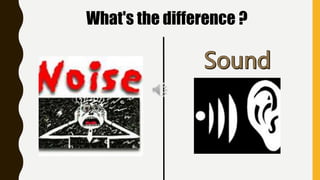
What's the difference ?
INTRODUCTION
Occupational Noise Exposure
Noise in the work environment that has
potential to be hazardous.
Why is it a hazard?
Noise-related hearing loss has been one of
the most prevalent occupational health
concerns in the United States for more
FA S T FA C T S
• 1 9 8 1 - H E A R I N G C O N S E R V A T I O N P R O G R A M
• T E N M I L L I O N P E O P L E I N T H E U . S . H A V E N O I S E -
R E L A T E D H E A R I N G L O S S
• T W E N T Y - T W O M I L L I O N W O R K E R S A R E E X P O S E D T O
P O T E N T I A L L Y D A M A G I N G N O I S E E A C H Y E A R .
• I N 2 0 0 7 , A P P R O X I M A T E L Y 8 2 % O F T H E C A S E S
I N V O L V I N G O C C U P A T I O N A L H E A R I N G L O S S W E R E
R E P O R T E D A M O N G W O R K E R S I N T H E
M A N U F A C T U R I N G S E C T O R .
HOW WE HEAR
• Outer
• Middle
• Inner
WHAT IS SOUND
• A sound wave is a
pressure wave;
regions of high
(compressions)
and low pressure
(rarefactions) are
established as the
result of the
vibrations of the
sound source.
CHARACTERISTICS OF SOUND
•Amplitude (objective)
•Loudness (subjective)
•Frequency (pitch)
•Intensity (energy transported)
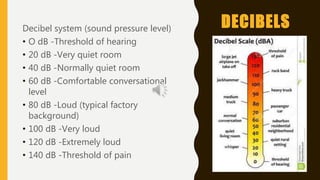
DECIBELSDecibel system (sound pressure level)
• O dB -Threshold of hearing
• 20 dB -Very quiet room
• 40 dB -Normally quiet room
• 60 dB -Comfortable conversational
level
• 80 dB -Loud (typical factory
background)
• 100 dB -Very loud
• 120 dB -Extremely loud
• 140 dB -Threshold of pain
WHAT IS ACCEPTABLE
•OSHA's permissible exposure limit (PEL) is 90
dBA (8hr)
-Standard uses a 5 dBA exchange rate
•The National Institute for Occupational Safety
and Health (NIOSH) worker exposures below a
level equivalent to 85 dBA (8hr)
-NIOSH recommends a 3 dBA exchange rate
CLICK TO BEGIN VIDEO
Hearing loss myths & facts . [Video file]. (2015, Feb 24, 2015). Retrieved from
https://www.youtube.com/watch?v=iTFPh-COLFk
OCCUPATIONAL NOISE SOURCE
•Compressors
•Woodworking Machines
•Pneumatic Tools
•Electric Motors
•Ventilator and Exhaust Fans
E F F E C T S O F N O I S E
• TINNITUS
• HYPERTENSION
• CARDIOVASCULAR EFFECTS
• SLEEP DISTURBANCE
• ANNOYANCE
• HEARING LOSS
HOW TO REDUCE NOISE EXPOSURE
Engineering controls involve modifying or replacing
equipment, or making related physical changes at the
noise source or along the transmission path to reduce the
noise level at the worker's ear.
Administrative controls are changes in the workplace
or schedule that reduce or eliminate the worker
exposure to noise.
Hearing protection devices (HPDs)
Effective hearing conservation program strives to prevent,
promote and protect
YOUR RESPONSIBILITIES
•Wear HPDs when exposed to
hazardous noise
•Attend hearing tests and
training as directed
•Abide by the hearing
conservation program
requirements and make others
aware of the need to wear HPDs
in noise hazardous areas
ANY QUESTIONS?
Candice Graham BSN,RN
Occupational Health
Specialist
cgrahamadderton@uams.ed
REFERENCES
Coulter, B. (Producer). (2010, Oct 28, 2010). Sound Waves. Retrieved from
http://www.slideshare.net/brucecoulter/sound-waves-5597634
Hearing loss myths & facts . [Video file]. (2015, Feb 24, 2015). Retrieved from
https://www.youtube.com/watch?v=iTFPh-COLFk
Hearing. (2016, March 17). In Wikipedia, The Free Encyclopedia. Retrieved 01:18, March
29, 2016, from
https://en.wikipedia.org/w/index.php?title=Hearing&oldid=710529865
Noise. (2016, March 21). In Wikipedia, The Free Encyclopedia. Retrieved 00:34, March 29,
2016, from https://en.wikipedia.org/w/index.php?title=Noise&oldid=711250399
United States Department of Labor. (n.d). Occupational Noise Exposure. Retrieved from
https://www.osha.gov/SLTC/noisehearingconservation/index.html
Sehrnd, G., & Gerges, S. (n.d). Noise source . Retrieved from
http://www.who.int/occupational_health/publications/noise5.pdf
Sound. (2016, March 21). In Wikipedia, The Free Encyclopedia. Retrieved 00:35, March
29, 2016, from

Occupational noise hazard

  • 1.
    O C CU P AT I O N A L N O I S E H A Z A R D B Y : C A N D I C E G R A H A M B S N , R N O C C U P A T I O N A L H E A L T H S P E C I A L I S T
  • 2.
    OBJECTIVES You will ……. •Be able to recall basic facts and statistics about occupational noise • Be able to state the difference between noise and sound • Identify noise hazards • State noise mitigation methods How to prevent hearing loss !
  • 3.
  • 4.
    INTRODUCTION Occupational Noise Exposure Noisein the work environment that has potential to be hazardous. Why is it a hazard? Noise-related hearing loss has been one of the most prevalent occupational health concerns in the United States for more
  • 5.
    FA S TFA C T S • 1 9 8 1 - H E A R I N G C O N S E R V A T I O N P R O G R A M • T E N M I L L I O N P E O P L E I N T H E U . S . H A V E N O I S E - R E L A T E D H E A R I N G L O S S • T W E N T Y - T W O M I L L I O N W O R K E R S A R E E X P O S E D T O P O T E N T I A L L Y D A M A G I N G N O I S E E A C H Y E A R . • I N 2 0 0 7 , A P P R O X I M A T E L Y 8 2 % O F T H E C A S E S I N V O L V I N G O C C U P A T I O N A L H E A R I N G L O S S W E R E R E P O R T E D A M O N G W O R K E R S I N T H E M A N U F A C T U R I N G S E C T O R .
  • 6.
    HOW WE HEAR •Outer • Middle • Inner
  • 7.
    WHAT IS SOUND •A sound wave is a pressure wave; regions of high (compressions) and low pressure (rarefactions) are established as the result of the vibrations of the sound source.
  • 8.
    CHARACTERISTICS OF SOUND •Amplitude(objective) •Loudness (subjective) •Frequency (pitch) •Intensity (energy transported)
  • 9.
    DECIBELSDecibel system (soundpressure level) • O dB -Threshold of hearing • 20 dB -Very quiet room • 40 dB -Normally quiet room • 60 dB -Comfortable conversational level • 80 dB -Loud (typical factory background) • 100 dB -Very loud • 120 dB -Extremely loud • 140 dB -Threshold of pain
  • 10.
    WHAT IS ACCEPTABLE •OSHA'spermissible exposure limit (PEL) is 90 dBA (8hr) -Standard uses a 5 dBA exchange rate •The National Institute for Occupational Safety and Health (NIOSH) worker exposures below a level equivalent to 85 dBA (8hr) -NIOSH recommends a 3 dBA exchange rate
  • 11.
    CLICK TO BEGINVIDEO Hearing loss myths & facts . [Video file]. (2015, Feb 24, 2015). Retrieved from https://www.youtube.com/watch?v=iTFPh-COLFk
  • 12.
    OCCUPATIONAL NOISE SOURCE •Compressors •WoodworkingMachines •Pneumatic Tools •Electric Motors •Ventilator and Exhaust Fans
  • 13.
    E F FE C T S O F N O I S E • TINNITUS • HYPERTENSION • CARDIOVASCULAR EFFECTS • SLEEP DISTURBANCE • ANNOYANCE • HEARING LOSS
  • 14.
    HOW TO REDUCENOISE EXPOSURE Engineering controls involve modifying or replacing equipment, or making related physical changes at the noise source or along the transmission path to reduce the noise level at the worker's ear. Administrative controls are changes in the workplace or schedule that reduce or eliminate the worker exposure to noise. Hearing protection devices (HPDs) Effective hearing conservation program strives to prevent, promote and protect
  • 16.
    YOUR RESPONSIBILITIES •Wear HPDswhen exposed to hazardous noise •Attend hearing tests and training as directed •Abide by the hearing conservation program requirements and make others aware of the need to wear HPDs in noise hazardous areas
  • 17.
    ANY QUESTIONS? Candice GrahamBSN,RN Occupational Health Specialist cgrahamadderton@uams.ed
  • 18.
    REFERENCES Coulter, B. (Producer).(2010, Oct 28, 2010). Sound Waves. Retrieved from http://www.slideshare.net/brucecoulter/sound-waves-5597634 Hearing loss myths & facts . [Video file]. (2015, Feb 24, 2015). Retrieved from https://www.youtube.com/watch?v=iTFPh-COLFk Hearing. (2016, March 17). In Wikipedia, The Free Encyclopedia. Retrieved 01:18, March 29, 2016, from https://en.wikipedia.org/w/index.php?title=Hearing&oldid=710529865 Noise. (2016, March 21). In Wikipedia, The Free Encyclopedia. Retrieved 00:34, March 29, 2016, from https://en.wikipedia.org/w/index.php?title=Noise&oldid=711250399 United States Department of Labor. (n.d). Occupational Noise Exposure. Retrieved from https://www.osha.gov/SLTC/noisehearingconservation/index.html Sehrnd, G., & Gerges, S. (n.d). Noise source . Retrieved from http://www.who.int/occupational_health/publications/noise5.pdf Sound. (2016, March 21). In Wikipedia, The Free Encyclopedia. Retrieved 00:35, March 29, 2016, from

Editor's Notes

  • #4 Noise Any sound that is undesired or that interfere with activity. Noise. (2016, March 21). In Wikipedia, The Free Encyclopedia. Retrieved 00:34, March 29, 2016, from https://en.wikipedia.org/w/index.php?title=Noise&oldid=711250399
  • #6  Center for Disease Control and Prevention. (September 17, 2015). Noise loss and prevention . Retrieved March 20,2016, from http://www.cdc.gov/niosh/topics/noise/stats.html
  • #7  Hearing. (2016, March 17). In Wikipedia, The Free Encyclopedia. Retrieved 01:18, March 29, 2016, from https://en.wikipedia.org/w/index.php?title=Hearing&oldid=710529865
  • #8 Sound. (2016, March 21). In Wikipedia, The Free Encyclopedia. Retrieved 00:35, March 29, 2016, from https://en.wikipedia.org/w/index.php?title=Sound&oldid=711256846
  • #9  Coulter, B. (Producer). (2010, Oct 28, 2010). Sound Waves. Retrieved from http://www.slideshare.net/brucecoulter/sound-waves-5597634
  • #10  United States Department of Labor. (n.d). Occupational Noise Exposure. Retrieved from https://www.osha.gov/SLTC/noisehearingconservation/index.html
  • #11  United States Department of Labor. (n.d). Occupational Noise Exposure. Retrieved from https://www.osha.gov/SLTC/noisehearingconservation/index.html
  • #12 Hearing loss myths & facts . [Video file]. (2015, Feb 24, 2015). Retrieved from https://www.youtube.com/watch?v=iTFPh-COLFk
  • #13 The pressure pulses from compressors are quite severe, and equivalent sound pressure levels can exceed 105dB The noise level of hand held tools can reach as high as 110 dB(A) at the operator’s ear. For large motors in the range of 1000 kW, 3600 RPM, a sound pressure level of as high as 106 dB(A) occurs. Fan and blower noise is the easiest and most straightforward noise problem to solve, using an absorptive type silencer Sehrnd, G., & Gerges, S. (n.d). Noise source . Retrieved from http://www.who.int/occupational_health/publications/noise5.pdf
  • #14  Exposure to high noise levels can also cause permanent ringing in the ear or “tinnitus” Tinnitus sufferers complain of constant whistling, squealing, roaring or buzzing in one or both ears Severe tinnitus may disrupt sleep, reduce concentration and cause irritability and depression Our ears can recover from short exposure to loud noise but over time nerve damage will occur The longer and louder the noise the greater chance permanent damage will occur There is no such thing as “tough ears” or “getting used to it”
  • #15 Examples of inexpensive, effective engineering controls include some of the following: Choose low-noise tools and machinery; Maintain and lubricate machinery and equipment (e.g., oil bearings); Place a barrier between the noise source and employee (e.g., sound walls or curtains); and Enclose or isolate the noise source. Examples include: Operating noisy machines during shifts when fewer people are exposed; Limiting the amount of time a person spends at a noise source; Providing quiet areas where workers can gain relief from hazardous noise sources; and Controlling noise exposure through distance is often an effective, yet simple and inexpensive administrative control. Specifically, for every doubling of the distance between the source of noise and the worker, the noise is decreased by 6 dBA. An effective hearing conservation program must be implemented by employers in general industry whenever worker noise exposure is equal to or greater than 85 dBA for an 8 hour exposure or in the construction industry when exposures exceed 90 dBA for an 8 hour exposure. This program strives to prevent initial occupational hearing loss, preserve and protect remaining hearing, and equip workers with the knowledge and hearing protection devices necessary to protect them. Key elements of an effective hearing conservation program include: Workplace noise sampling including personal noise monitoring which identifies which employees are at risk from hazardous levels of noise. Informing workers at risk from hazardous levels of noise exposure of the results of their noise monitoring. Providing affected workers or their authorized representatives with an opportunity to observe any noise measurements conducted. Maintaining a worker audiometric testing program (hearing tests) which is a professional evaluation of the health effects of noise upon individual worker's hearing. Implementing comprehensive hearing protection follow-up procedures for workers who show a loss of hearing (standard threshold shift) after completing baseline (first) and yearly audiometric testing. Proper selection of hearing protection based upon individual fit and manufacturer's quality testing indicating the likely protection that they will provide to a properly trained wearer. Evaluate the hearing protectors attenuation and effectiveness for the specific workplace noise. Training and information that ensures the workers are aware of the hazard from excessive noise exposures and how to properly use the protective equipment that has been provided. Data management of and worker access to records regarding monitoring and noise sampling. HPDs such as earmuffs and plugs, are considered an acceptable but less desirable option to control exposures to noise and are generally used during the time necessary to implement engineering or administrative controls, when such controls are not feasible, or when worker's hearing tests indicate significant hearing damage Controls for noise exposure . (August 8, 2014). Retrieved March 8, 2015, from http://www.cdc.gov/niosh/topics/noisecontrol/
  • #16 Protection examples