Boiler Efficiency Calculations
Manohar Tatwawadi
Director
Boiler Efficiency
• Calculated as per ASME PTC 4.1, DIN 1942
• Different Standards have different methods
specified.
• All parameters responsible for calculations well
defined in the standards.
• Approximations, if any, shall also be defined.
• Efficiency testing procedures are also defined.
• Sampling methods for fuel, ash, gas etc are also
defined in the standard.
Manohar Tatwawadi08-Aug-19 2
Methods of Calculation of Boiler
Efficiency
• Direct Method:-
– Input Output Method.
– Very few parameters are required
– Ease of Calculation
– Used for reporting to Regulatory Authorities,
Public Bodies, stakeholders etc.
– Does not give details as to accounting of losses
– Operators may not judge the improvement areas.
Manohar Tatwawadi08-Aug-19 3
Methods of Calculation of Boiler
Efficiency
• Indirect Method:-
– Well known as losses method
– Generally adopted by the staff
– Accuracy can be higher than Direct Method
– Losses can be accounted for
– Gives a clue for improvement area
Both these methods are suitably stated in the
Efficiency Standards.
Manohar Tatwawadi08-Aug-19 4
Direct Method of Boiler Efficiency
Measurement
• Efficiency = Input / Output
• Input = Fuel Heat Value X Fuel Flow Rate
• Output = Steam Flow Rate X Heat Absorbed by
Steam
• Parameters required for computing Efficiency
– Fuel Heat Value ----- GCV in Kcal/kg
– Fuel Flow Rate ------ Kg/hr
– Steam Flow Rate ---- Kg/hr
– Heat Absorbed by steam ----- kcal/kg
Manohar Tatwawadi08-Aug-19 5
Parameters for Boiler Efficiency
• Fuel Heat Value ----- GCV in Kcal/kg
– The Sample of the fuel burnt in the boiler is
collected and tested for the GCV as stipulated
procedure in the standards.
– The calculation of GCV may involve certain
formulae or by “Bomb Calorimeter”
– The “Proximate Analysis” of the sampled Fuel /
Coal s generally done on “AIR Dry Basis”, which
shall be converted into “As Received Basis” for
calculations.
Manohar Tatwawadi08-Aug-19 6
Parameters for Boiler Efficiency
• Fuel Flow Rate:- ------ kg/hr
– This parameter may be available from Belt
Weighers, Gravimetric Feeders
– Can be approximated with RPM of Feeders as per
the design curves of feeders
– Can be approximated for the day by fuel stock
registers and calculated per hour.
– Sometimes by actual weighment
Manohar Tatwawadi08-Aug-19 7
Parameters for Boiler Efficiency
• Steam flow Rate:- -------- kg/hr
– Can be accurately measured by instrumentation
(Orifice in the steam line, measuring the DP and
converting it to Flow)
– There may be totalisers for the steam produced
– The steam flow rate must include all the steam
produced by the boiler
– The steam flow with attemperation and the feed
flow must be balanced and there should not be
any blow-down open / passing.
Manohar Tatwawadi08-Aug-19 8
Parameters for Boiler Efficiency
• Heat Absorbed by Steam:- ------- kcal/kg
– For calculation of Heat absorbed by Steam following
parameters will be required.
• Steam Temperature
• Steam Pressure
• Feed Water Temperature at Economiser Inlet and
• Feed water Pressure at Economiser Inlet
– From the above parameters and from the steam
tables Enthalpy of Steam and Feed water can be
calculated.
– Heat absorbed by steam = Enthalpy of Steam –
Enthalpy of Feed Water.
Manohar Tatwawadi08-Aug-19 9
Direct Method …Boiler Efficiency
• Boiler Efficiency = Heat Output /Heat Input
Manohar Tatwawadi08-Aug-19 10
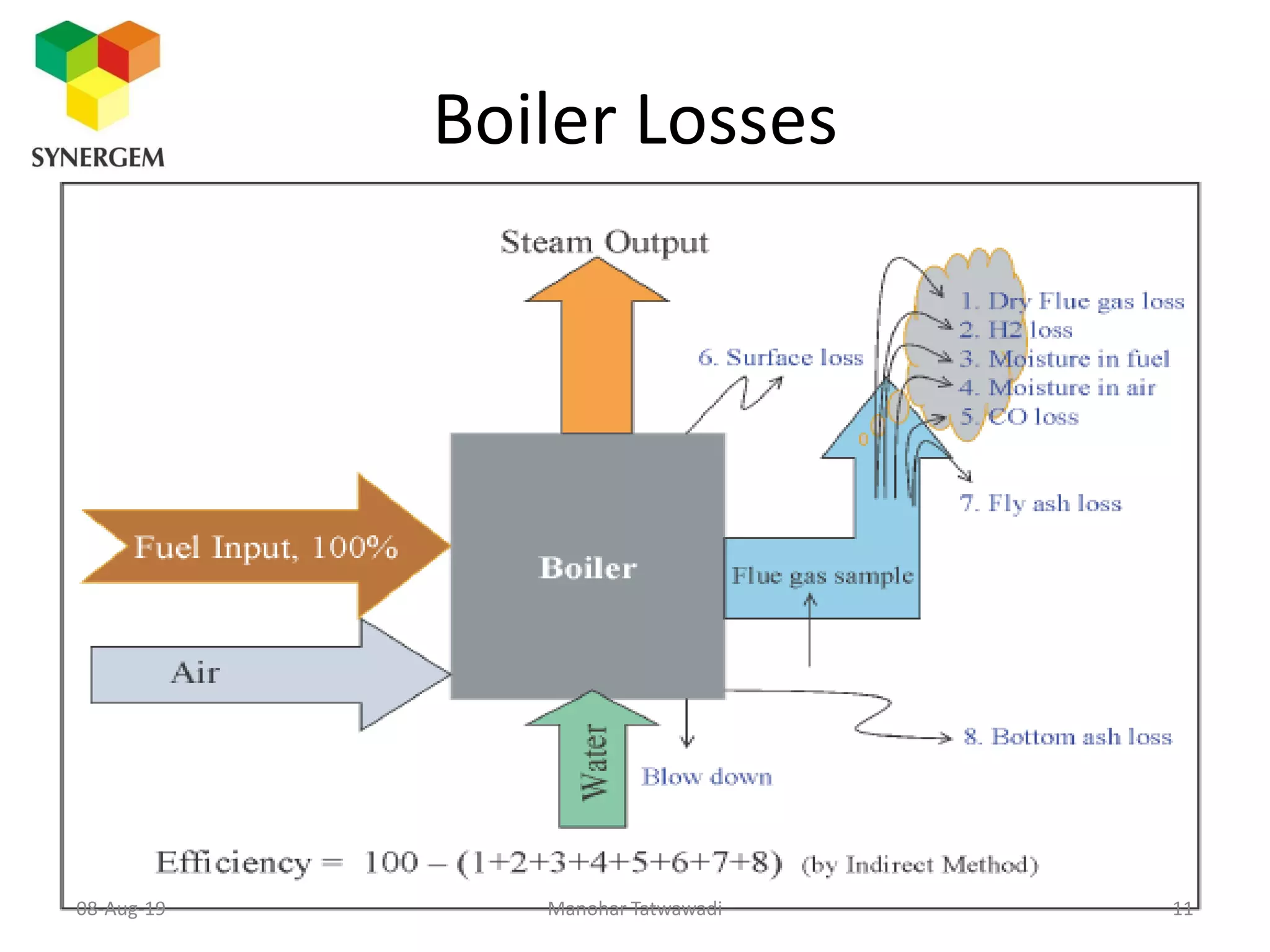
Boiler Losses
Manohar Tatwawadi08-Aug-19 11
Indirect --- Loss Method Efficiency
• In this method the losses are calculated per kg of
fuel / coal burnt.
• The main Heat losses in the boiler are
– L1. Loss due to dry flue gas (sensible heat)
– L2. Unburnt losses in fly ash (Carbon)
– L3. Unburnt losses in bottom ash (Carbon)
– L4. Loss due to hydrogen in fuel (H2)
– L5. Loss due to moisture in fuel (H2O)
– L6. Loss due to moisture in air (H2O)
– L7. Loss due to carbon monoxide (CO)
– L8. Loss due to surface radiation (Approximated or
given by the designer)
Manohar Tatwawadi08-Aug-19 12
Losses Controllable…….
• The losses can be divided into controllable and
non controllable losses
• Controllable Losses
– Loss due to Dry Flue gas
– Loss due to Unburnt carbon and
– Loss due to moisture in Fuel (Upto certain limits)
Manohar Tatwawadi08-Aug-19 13
Prerequisites for Boiler Efficiency Tests
• Boiler must be running at more than 90% of full Load.
• Boiler Load must be steady for at least 2 Hours before
the test with all parameters stabilsed and throughout
the test. (Test Period 30 min. to 1 hr.)
• No Blowdowns shall be allowed during the test.
• No soot blowing allowed during the test.
• No change in fuel quality and quantity is allowed
during the Test period.
• Bed material charging is not allowed during the test.
• Change of slumping Compartment is also not allowed
during the Test.
• All Ash Hoppers are clear of Ash.
Manohar Tatwawadi08-Aug-19 14
Parameters Recorded for
Computations
1. Main steam Temp, Pressure, Flow
2. Total air supplied to the boiler
3. Atmospheric Temperature
4. All bed Temperatures
5. Furnace Temperature
6. Flue gas temp at Economiser inlet, APH inlet
and APH outlet.
7. Oxygen in flue gas at APH inlet / Outlet
Manohar Tatwawadi08-Aug-19 15
Parameters obtained from Laboratory
1. Coal Proximate Analysis
2. Coal Heating Value (GCV)
3. Dry Bulb/Wet Bulb atmospheric Temp
4. Ash Analysis for unburnts (Ash Samples to be
taken from Boiler Bank, Economiser, APH &
ESP Hoppers as available)
5. Unburnts in Ash analysed as per weighted
averages of Ash (Weightages given by the
manufacturer)
Manohar Tatwawadi08-Aug-19 16
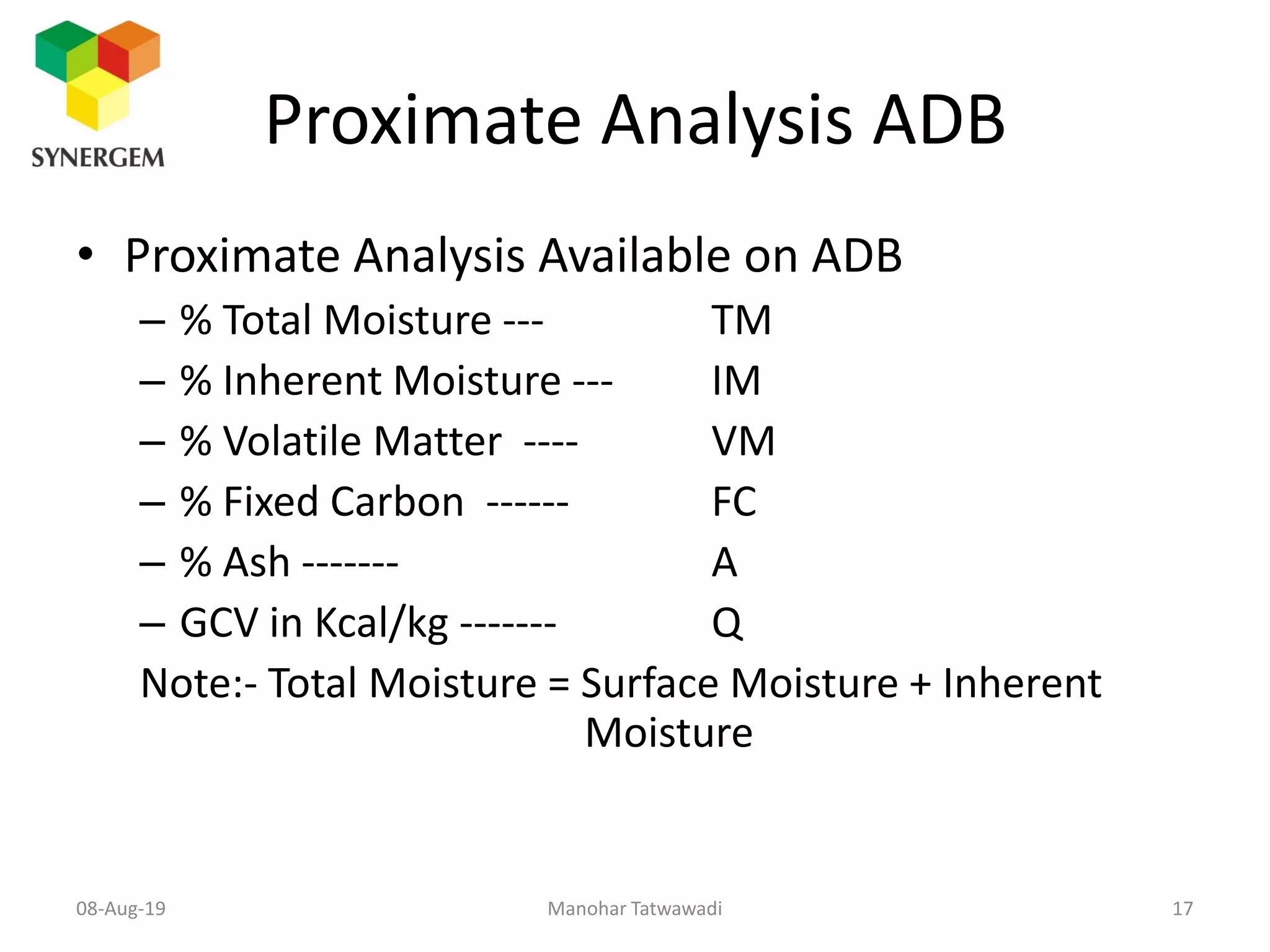
Proximate Analysis ADB
• Proximate Analysis Available on ADB
– % Total Moisture --- TM
– % Inherent Moisture --- IM
– % Volatile Matter ---- VM
– % Fixed Carbon ------ FC
– % Ash ------- A
– GCV in Kcal/kg ------- Q
Note:- Total Moisture = Surface Moisture + Inherent
Moisture
Manohar Tatwawadi08-Aug-19 17
K Factor
• K Factor for Conversion From ADB to ARB
• K Factor = (100 – TM)/(100 – IM)
• By multiplying this constant K with the
Proximate Analysis ADB, Proximate Analysis
on ARB can be calculated & these parameters
are used for the calculation of Ultimate
Analysis.
Manohar Tatwawadi08-Aug-19 18
Ultimate Analysis
• Carbon Content in Coal:- By Parr’s Method ----- C
• Carbon Content = (1- 0.01*Z)*Cp + (0.05*A) – (0.5*S)
• where, Z = ASH content of the fuel burnt
= (TM + 1.1*A +0.1*S)
• where, Cp = Carbon content on “ASH free basis”
= (0.0015782*Qp) – (0.2226*Vp) + 37.69
• where, Qp= Calorific value
= (100*Q*4.186)/(100-Z)
• where, Vp = Volatile matter content
= (100*(V - 0.1*A - 0.1*S))/(100 – Z)
Manohar Tatwawadi08-Aug-19 19
Ultimate Analysis
• Hydrogen Content:- By Parr’s Method -------- H
• H2 Content = (1- 0.01*Z )*Hp +(0.01*A) – (0.015 * S)
where, Hp= Hydrogen content on “ASH free basis”
= (0.0001707*Qp) + (0.0653*Vp) – 2.92
• Nitrogen Content :- By Gebhardt Formula ---- N
• N2 Content = [2.1 -(0.012*VM)]
• Sulphur Content :- By lab testing ---- S
• Oxygen Content = (100 – (C+H+N+S+A+TM)) ----- O
Manohar Tatwawadi08-Aug-19 20
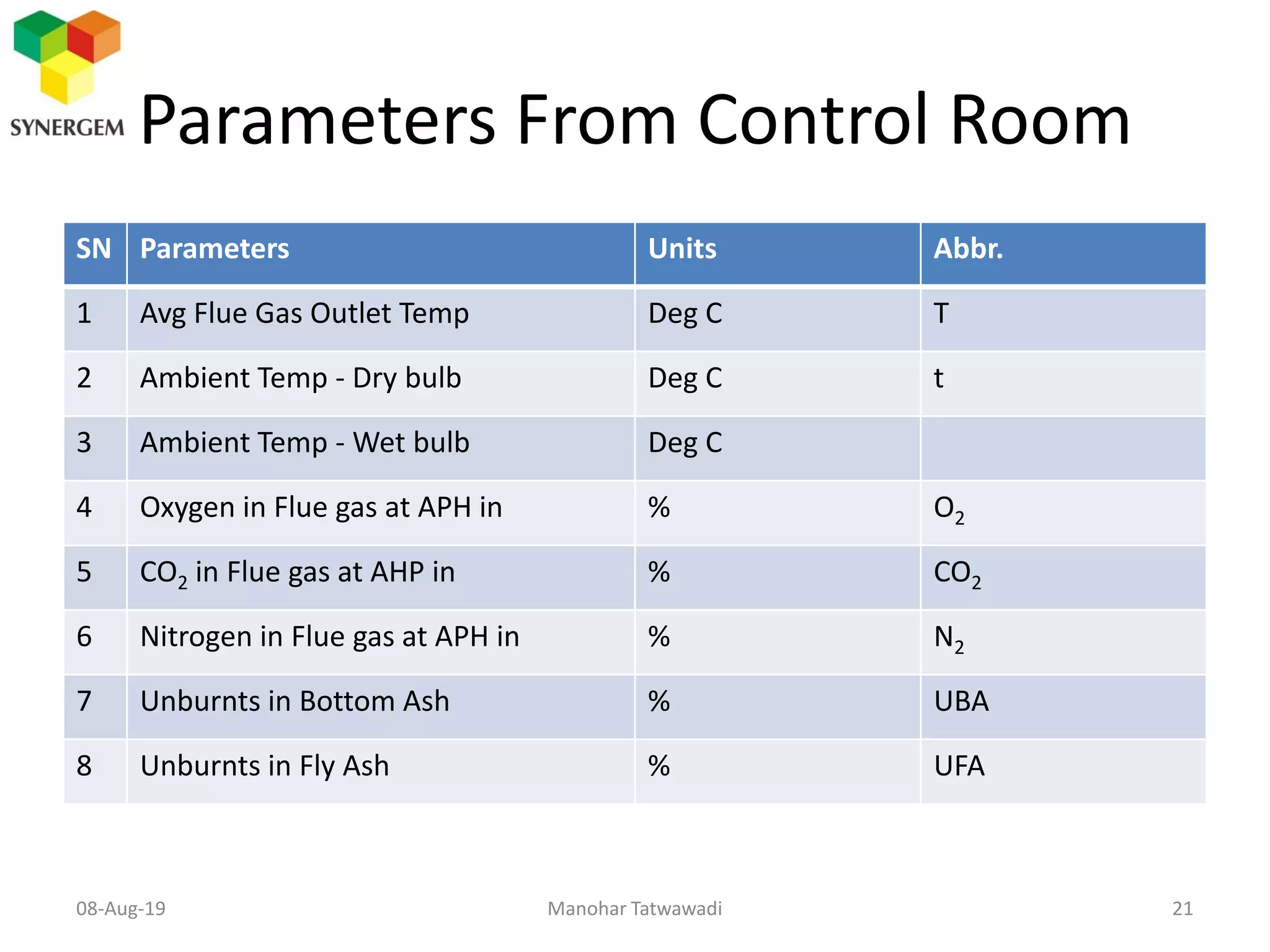
Parameters From Control Room
SN Parameters Units Abbr.
1 Avg Flue Gas Outlet Temp Deg C T
2 Ambient Temp - Dry bulb Deg C t
3 Ambient Temp - Wet bulb Deg C
4 Oxygen in Flue gas at APH in % O2
5 CO2 in Flue gas at AHP in % CO2
6 Nitrogen in Flue gas at APH in % N2
7 Unburnts in Bottom Ash % UBA
8 Unburnts in Fly Ash % UFA
Manohar Tatwawadi08-Aug-19 21
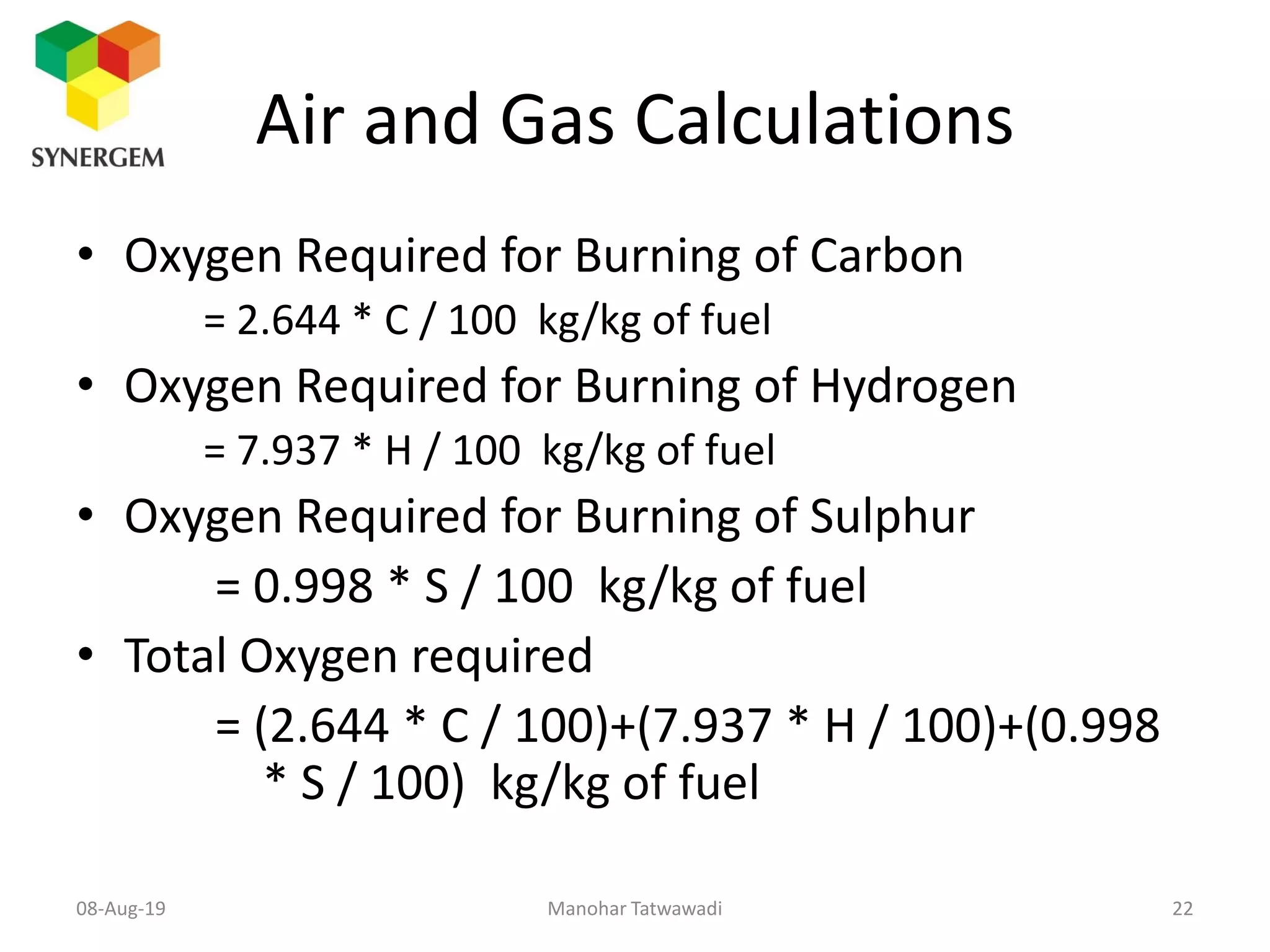
Air and Gas Calculations
• Oxygen Required for Burning of Carbon
= 2.644 * C / 100 kg/kg of fuel
• Oxygen Required for Burning of Hydrogen
= 7.937 * H / 100 kg/kg of fuel
• Oxygen Required for Burning of Sulphur
= 0.998 * S / 100 kg/kg of fuel
• Total Oxygen required
= (2.644 * C / 100)+(7.937 * H / 100)+(0.998
* S / 100) kg/kg of fuel
Manohar Tatwawadi08-Aug-19 22
AIR REQUIRED
• Oxygen already in the Fuel ----- O
• Therefore Total Oxygen required ----- Or
= (2.644 * C / 100)+(7.937 * H / 100) +
(0.998 * S / 100) - O kg/kg of fuel
Weight Fraction of Oxygen in Air = 23%
Therefore Air Required For Combustion
• = Or * 100 / 23 -------- Ar
Manohar Tatwawadi08-Aug-19 23
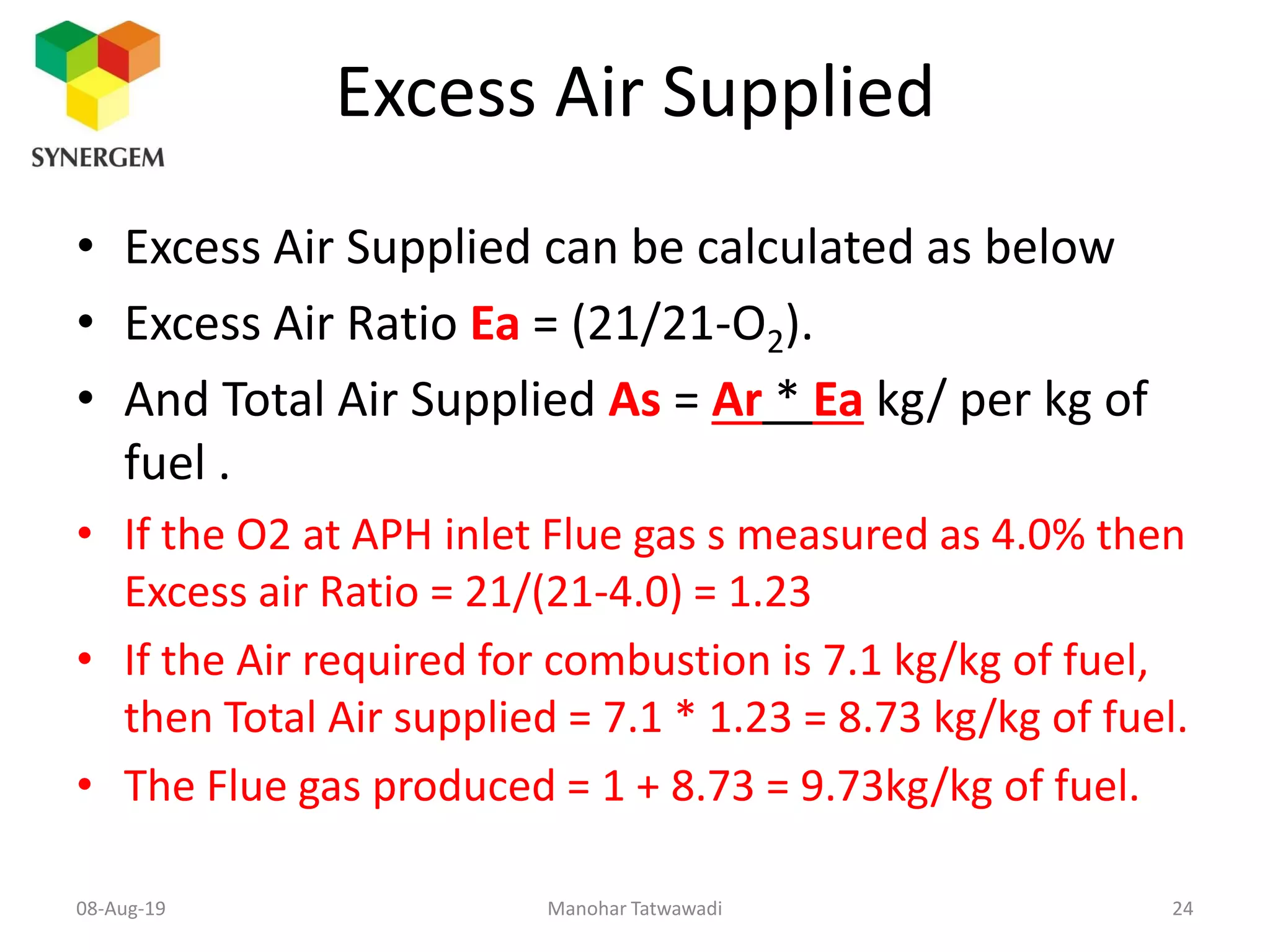
Excess Air Supplied
• Excess Air Supplied can be calculated as below
• Excess Air Ratio Ea = (21/21-O2).
• And Total Air Supplied As = Ar * Ea kg/ per kg of
fuel .
• If the O2 at APH inlet Flue gas s measured as 4.0% then
Excess air Ratio = 21/(21-4.0) = 1.23
• If the Air required for combustion is 7.1 kg/kg of fuel,
then Total Air supplied = 7.1 * 1.23 = 8.73 kg/kg of fuel.
• The Flue gas produced = 1 + 8.73 = 9.73kg/kg of fuel.
Manohar Tatwawadi08-Aug-19 24
Flue gases produced
• CO2 produced = 3.644 * C /100 kg/kg fuel
• H2O Produced = 8.937 * H /100 kg/kg fuel
• H2O in Air = Moisture in Air * As kg/kg fuel
• H2O in Fuel = TM /100 kg/kg fuel
• SO2 Produced = 1.998 * S / 100 kg/kg fuel
• N2 in Flue gas = 0.77 * As + N2 in fuel kg/kg fuel
• Oxygen in Flue gas = O2/100
• Total Flue gas produced =
(CO2+H2O+SO2+N2+O2) kg/kg fuel ---------- Mfg
Manohar Tatwawadi08-Aug-19 25
Losses Calculations
• Loss Due to Unburnt Carbon ----- LUC
= (33820*Unburnt Carbon in ash kg/kg)* 100 /
(4.186*Q)
• Where, Unburnt Carbon in ash per kg of coal
= (0.00008*A%*% UFA) + (0.00002*A%*% UBA)
Manohar Tatwawadi08-Aug-19 26
Losses Calculations
• Loss due to Dry Flue Gas -------- LDG
• = (100/(12*(CO2+CO)))*(( C/100 + S/267-
carbon in ash))*(30.6*(T - t))*100/(4.186*Q)
• The Equation in red is the mass of flue gas
• The figure in Green is the specific heat of Flue
gas.
Manohar Tatwawadi08-Aug-19 27
Calculation of Losses
• Loss due to Moisture in Fuel -------- LMF
= ((TM + 9*H )/100) * (1.88*(T -25) + 2442 + 4.2*(25 - t ))
* 100 /(4.186*Q)
The equation in red is the heat in water vapour
• Loss due to Moisture in Air --------- LMA
= (Ma*h*1.88*(T - t)*100)/(4.186*Q )
Where, Ma = Dry air for combustion in kg / kg fuel
= (3.034*% of N2 in flue gas/(% of CO2 + CO ))*
(C/100 + S / 267 - C in ash)
And h = Mass of moisture per kg of dry air
(From Psychometric chart)
Manohar Tatwawadi08-Aug-19 28
Calculation of Losses
• Loss Due to Carbon Mono-oxide ---- LCO
• When carbon burns to Carbon di-oxide, the
heat released is 8080 Kcal/kg of carbon.
• But when carbon burns to produce Carbon
mono-oxide the heat release is only 2556
kcal/kg of carbon.
• In the process we loose 5524kcal/kg of carbon
Manohar Tatwawadi08-Aug-19 29
Loss Due To Carbon Mono-oxide
• Loss Due to Carbon Mono-oxide ---- LCO
=CO*7*Cvco*(C-100*U)/3/(CO2+CO) /Q
Where CO = % = ppm/10000
Cvco = Calorifc Value of CO = 2415kcal/kg
C= Carbon in fuel
U = Unburnt Carbon in Ash
CO2 = CO2 in Flue gas
Q = GCV of Fuel
Manohar Tatwawadi08-Aug-19 30
Radiation & Other Losses
• Radiation and other losses are approximated
dependent on Manufacturer’s Design Data
• Radiation and other loss ------- LRO
• Total Losses = LUC + LDG + LMF + LMA + LCO+
LRO
• Boiler Efficiency = 100 – (Total Losses)
Manohar Tatwawadi08-Aug-19 31
Manohar Tatwawadi08-Aug-19 32

Boiler Efficiency Calculations

  • 1.
  • 2.
    Boiler Efficiency • Calculatedas per ASME PTC 4.1, DIN 1942 • Different Standards have different methods specified. • All parameters responsible for calculations well defined in the standards. • Approximations, if any, shall also be defined. • Efficiency testing procedures are also defined. • Sampling methods for fuel, ash, gas etc are also defined in the standard. Manohar Tatwawadi08-Aug-19 2
  • 3.
    Methods of Calculationof Boiler Efficiency • Direct Method:- – Input Output Method. – Very few parameters are required – Ease of Calculation – Used for reporting to Regulatory Authorities, Public Bodies, stakeholders etc. – Does not give details as to accounting of losses – Operators may not judge the improvement areas. Manohar Tatwawadi08-Aug-19 3
  • 4.
    Methods of Calculationof Boiler Efficiency • Indirect Method:- – Well known as losses method – Generally adopted by the staff – Accuracy can be higher than Direct Method – Losses can be accounted for – Gives a clue for improvement area Both these methods are suitably stated in the Efficiency Standards. Manohar Tatwawadi08-Aug-19 4
  • 5.
    Direct Method ofBoiler Efficiency Measurement • Efficiency = Input / Output • Input = Fuel Heat Value X Fuel Flow Rate • Output = Steam Flow Rate X Heat Absorbed by Steam • Parameters required for computing Efficiency – Fuel Heat Value ----- GCV in Kcal/kg – Fuel Flow Rate ------ Kg/hr – Steam Flow Rate ---- Kg/hr – Heat Absorbed by steam ----- kcal/kg Manohar Tatwawadi08-Aug-19 5
  • 6.
    Parameters for BoilerEfficiency • Fuel Heat Value ----- GCV in Kcal/kg – The Sample of the fuel burnt in the boiler is collected and tested for the GCV as stipulated procedure in the standards. – The calculation of GCV may involve certain formulae or by “Bomb Calorimeter” – The “Proximate Analysis” of the sampled Fuel / Coal s generally done on “AIR Dry Basis”, which shall be converted into “As Received Basis” for calculations. Manohar Tatwawadi08-Aug-19 6
  • 7.
    Parameters for BoilerEfficiency • Fuel Flow Rate:- ------ kg/hr – This parameter may be available from Belt Weighers, Gravimetric Feeders – Can be approximated with RPM of Feeders as per the design curves of feeders – Can be approximated for the day by fuel stock registers and calculated per hour. – Sometimes by actual weighment Manohar Tatwawadi08-Aug-19 7
  • 8.
    Parameters for BoilerEfficiency • Steam flow Rate:- -------- kg/hr – Can be accurately measured by instrumentation (Orifice in the steam line, measuring the DP and converting it to Flow) – There may be totalisers for the steam produced – The steam flow rate must include all the steam produced by the boiler – The steam flow with attemperation and the feed flow must be balanced and there should not be any blow-down open / passing. Manohar Tatwawadi08-Aug-19 8
  • 9.
    Parameters for BoilerEfficiency • Heat Absorbed by Steam:- ------- kcal/kg – For calculation of Heat absorbed by Steam following parameters will be required. • Steam Temperature • Steam Pressure • Feed Water Temperature at Economiser Inlet and • Feed water Pressure at Economiser Inlet – From the above parameters and from the steam tables Enthalpy of Steam and Feed water can be calculated. – Heat absorbed by steam = Enthalpy of Steam – Enthalpy of Feed Water. Manohar Tatwawadi08-Aug-19 9
  • 10.
    Direct Method …BoilerEfficiency • Boiler Efficiency = Heat Output /Heat Input Manohar Tatwawadi08-Aug-19 10
  • 11.
  • 12.
    Indirect --- LossMethod Efficiency • In this method the losses are calculated per kg of fuel / coal burnt. • The main Heat losses in the boiler are – L1. Loss due to dry flue gas (sensible heat) – L2. Unburnt losses in fly ash (Carbon) – L3. Unburnt losses in bottom ash (Carbon) – L4. Loss due to hydrogen in fuel (H2) – L5. Loss due to moisture in fuel (H2O) – L6. Loss due to moisture in air (H2O) – L7. Loss due to carbon monoxide (CO) – L8. Loss due to surface radiation (Approximated or given by the designer) Manohar Tatwawadi08-Aug-19 12
  • 13.
    Losses Controllable……. • Thelosses can be divided into controllable and non controllable losses • Controllable Losses – Loss due to Dry Flue gas – Loss due to Unburnt carbon and – Loss due to moisture in Fuel (Upto certain limits) Manohar Tatwawadi08-Aug-19 13
  • 14.
    Prerequisites for BoilerEfficiency Tests • Boiler must be running at more than 90% of full Load. • Boiler Load must be steady for at least 2 Hours before the test with all parameters stabilsed and throughout the test. (Test Period 30 min. to 1 hr.) • No Blowdowns shall be allowed during the test. • No soot blowing allowed during the test. • No change in fuel quality and quantity is allowed during the Test period. • Bed material charging is not allowed during the test. • Change of slumping Compartment is also not allowed during the Test. • All Ash Hoppers are clear of Ash. Manohar Tatwawadi08-Aug-19 14
  • 15.
    Parameters Recorded for Computations 1.Main steam Temp, Pressure, Flow 2. Total air supplied to the boiler 3. Atmospheric Temperature 4. All bed Temperatures 5. Furnace Temperature 6. Flue gas temp at Economiser inlet, APH inlet and APH outlet. 7. Oxygen in flue gas at APH inlet / Outlet Manohar Tatwawadi08-Aug-19 15
  • 16.
    Parameters obtained fromLaboratory 1. Coal Proximate Analysis 2. Coal Heating Value (GCV) 3. Dry Bulb/Wet Bulb atmospheric Temp 4. Ash Analysis for unburnts (Ash Samples to be taken from Boiler Bank, Economiser, APH & ESP Hoppers as available) 5. Unburnts in Ash analysed as per weighted averages of Ash (Weightages given by the manufacturer) Manohar Tatwawadi08-Aug-19 16
  • 17.
    Proximate Analysis ADB •Proximate Analysis Available on ADB – % Total Moisture --- TM – % Inherent Moisture --- IM – % Volatile Matter ---- VM – % Fixed Carbon ------ FC – % Ash ------- A – GCV in Kcal/kg ------- Q Note:- Total Moisture = Surface Moisture + Inherent Moisture Manohar Tatwawadi08-Aug-19 17
  • 18.
    K Factor • KFactor for Conversion From ADB to ARB • K Factor = (100 – TM)/(100 – IM) • By multiplying this constant K with the Proximate Analysis ADB, Proximate Analysis on ARB can be calculated & these parameters are used for the calculation of Ultimate Analysis. Manohar Tatwawadi08-Aug-19 18
  • 19.
    Ultimate Analysis • CarbonContent in Coal:- By Parr’s Method ----- C • Carbon Content = (1- 0.01*Z)*Cp + (0.05*A) – (0.5*S) • where, Z = ASH content of the fuel burnt = (TM + 1.1*A +0.1*S) • where, Cp = Carbon content on “ASH free basis” = (0.0015782*Qp) – (0.2226*Vp) + 37.69 • where, Qp= Calorific value = (100*Q*4.186)/(100-Z) • where, Vp = Volatile matter content = (100*(V - 0.1*A - 0.1*S))/(100 – Z) Manohar Tatwawadi08-Aug-19 19
  • 20.
    Ultimate Analysis • HydrogenContent:- By Parr’s Method -------- H • H2 Content = (1- 0.01*Z )*Hp +(0.01*A) – (0.015 * S) where, Hp= Hydrogen content on “ASH free basis” = (0.0001707*Qp) + (0.0653*Vp) – 2.92 • Nitrogen Content :- By Gebhardt Formula ---- N • N2 Content = [2.1 -(0.012*VM)] • Sulphur Content :- By lab testing ---- S • Oxygen Content = (100 – (C+H+N+S+A+TM)) ----- O Manohar Tatwawadi08-Aug-19 20
  • 21.
    Parameters From ControlRoom SN Parameters Units Abbr. 1 Avg Flue Gas Outlet Temp Deg C T 2 Ambient Temp - Dry bulb Deg C t 3 Ambient Temp - Wet bulb Deg C 4 Oxygen in Flue gas at APH in % O2 5 CO2 in Flue gas at AHP in % CO2 6 Nitrogen in Flue gas at APH in % N2 7 Unburnts in Bottom Ash % UBA 8 Unburnts in Fly Ash % UFA Manohar Tatwawadi08-Aug-19 21
  • 22.
    Air and GasCalculations • Oxygen Required for Burning of Carbon = 2.644 * C / 100 kg/kg of fuel • Oxygen Required for Burning of Hydrogen = 7.937 * H / 100 kg/kg of fuel • Oxygen Required for Burning of Sulphur = 0.998 * S / 100 kg/kg of fuel • Total Oxygen required = (2.644 * C / 100)+(7.937 * H / 100)+(0.998 * S / 100) kg/kg of fuel Manohar Tatwawadi08-Aug-19 22
  • 23.
    AIR REQUIRED • Oxygenalready in the Fuel ----- O • Therefore Total Oxygen required ----- Or = (2.644 * C / 100)+(7.937 * H / 100) + (0.998 * S / 100) - O kg/kg of fuel Weight Fraction of Oxygen in Air = 23% Therefore Air Required For Combustion • = Or * 100 / 23 -------- Ar Manohar Tatwawadi08-Aug-19 23
  • 24.
    Excess Air Supplied •Excess Air Supplied can be calculated as below • Excess Air Ratio Ea = (21/21-O2). • And Total Air Supplied As = Ar * Ea kg/ per kg of fuel . • If the O2 at APH inlet Flue gas s measured as 4.0% then Excess air Ratio = 21/(21-4.0) = 1.23 • If the Air required for combustion is 7.1 kg/kg of fuel, then Total Air supplied = 7.1 * 1.23 = 8.73 kg/kg of fuel. • The Flue gas produced = 1 + 8.73 = 9.73kg/kg of fuel. Manohar Tatwawadi08-Aug-19 24
  • 25.
    Flue gases produced •CO2 produced = 3.644 * C /100 kg/kg fuel • H2O Produced = 8.937 * H /100 kg/kg fuel • H2O in Air = Moisture in Air * As kg/kg fuel • H2O in Fuel = TM /100 kg/kg fuel • SO2 Produced = 1.998 * S / 100 kg/kg fuel • N2 in Flue gas = 0.77 * As + N2 in fuel kg/kg fuel • Oxygen in Flue gas = O2/100 • Total Flue gas produced = (CO2+H2O+SO2+N2+O2) kg/kg fuel ---------- Mfg Manohar Tatwawadi08-Aug-19 25
  • 26.
    Losses Calculations • LossDue to Unburnt Carbon ----- LUC = (33820*Unburnt Carbon in ash kg/kg)* 100 / (4.186*Q) • Where, Unburnt Carbon in ash per kg of coal = (0.00008*A%*% UFA) + (0.00002*A%*% UBA) Manohar Tatwawadi08-Aug-19 26
  • 27.
    Losses Calculations • Lossdue to Dry Flue Gas -------- LDG • = (100/(12*(CO2+CO)))*(( C/100 + S/267- carbon in ash))*(30.6*(T - t))*100/(4.186*Q) • The Equation in red is the mass of flue gas • The figure in Green is the specific heat of Flue gas. Manohar Tatwawadi08-Aug-19 27
  • 28.
    Calculation of Losses •Loss due to Moisture in Fuel -------- LMF = ((TM + 9*H )/100) * (1.88*(T -25) + 2442 + 4.2*(25 - t )) * 100 /(4.186*Q) The equation in red is the heat in water vapour • Loss due to Moisture in Air --------- LMA = (Ma*h*1.88*(T - t)*100)/(4.186*Q ) Where, Ma = Dry air for combustion in kg / kg fuel = (3.034*% of N2 in flue gas/(% of CO2 + CO ))* (C/100 + S / 267 - C in ash) And h = Mass of moisture per kg of dry air (From Psychometric chart) Manohar Tatwawadi08-Aug-19 28
  • 29.
    Calculation of Losses •Loss Due to Carbon Mono-oxide ---- LCO • When carbon burns to Carbon di-oxide, the heat released is 8080 Kcal/kg of carbon. • But when carbon burns to produce Carbon mono-oxide the heat release is only 2556 kcal/kg of carbon. • In the process we loose 5524kcal/kg of carbon Manohar Tatwawadi08-Aug-19 29
  • 30.
    Loss Due ToCarbon Mono-oxide • Loss Due to Carbon Mono-oxide ---- LCO =CO*7*Cvco*(C-100*U)/3/(CO2+CO) /Q Where CO = % = ppm/10000 Cvco = Calorifc Value of CO = 2415kcal/kg C= Carbon in fuel U = Unburnt Carbon in Ash CO2 = CO2 in Flue gas Q = GCV of Fuel Manohar Tatwawadi08-Aug-19 30
  • 31.
    Radiation & OtherLosses • Radiation and other losses are approximated dependent on Manufacturer’s Design Data • Radiation and other loss ------- LRO • Total Losses = LUC + LDG + LMF + LMA + LCO+ LRO • Boiler Efficiency = 100 – (Total Losses) Manohar Tatwawadi08-Aug-19 31
  • 32.