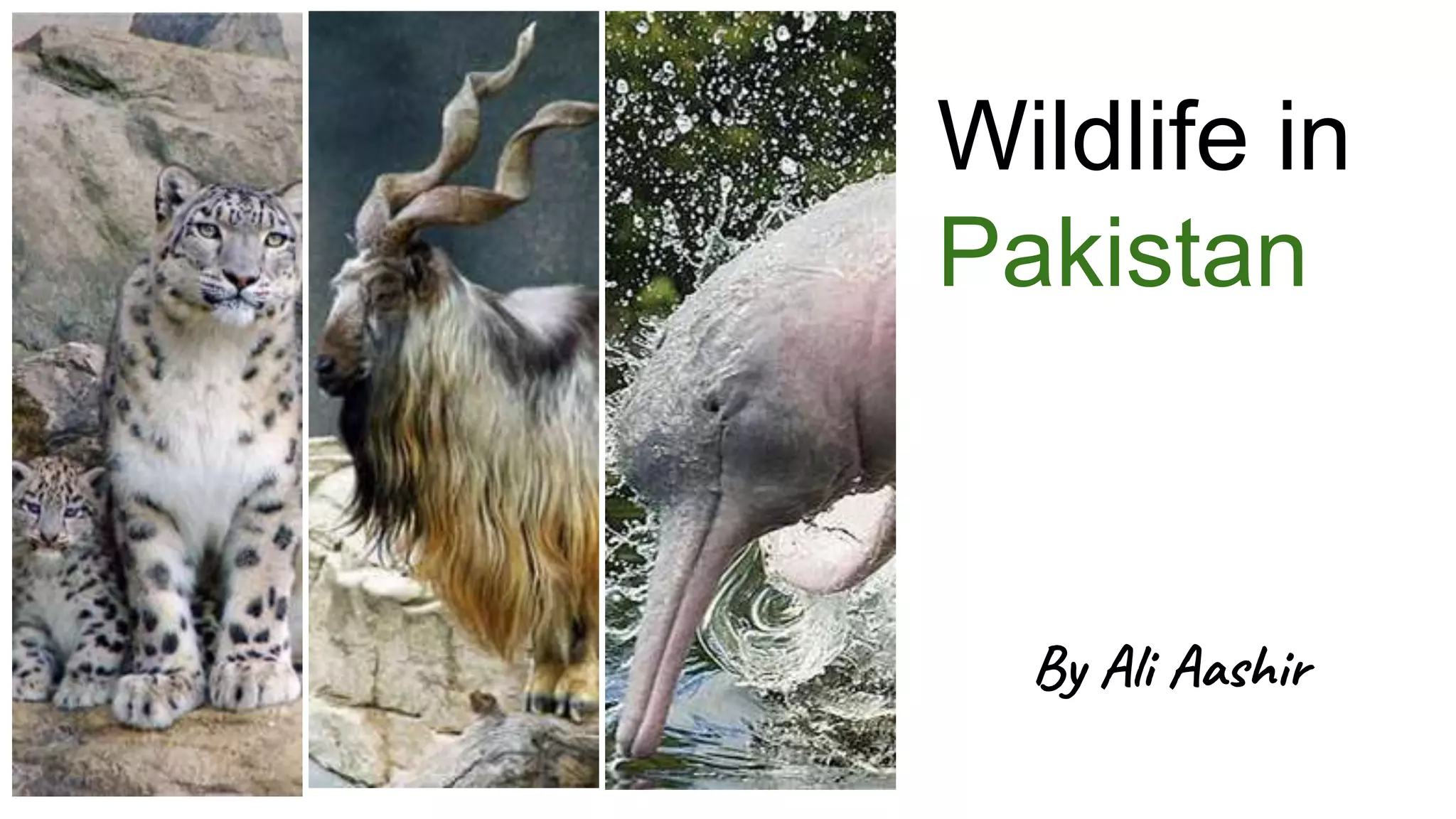
Wildlife in
Pakistan
By Ali Aashir
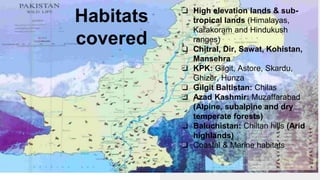
❏ High elevation lands & sub-
tropical lands (Himalayas,
Karakoram and Hindukush
ranges)
❏ Chitral, Dir, Sawat, Kohistan,
Mansehra
❏ KPK: Gilgit, Astore, Skardu,
Ghizer, Hunza
❏ Gilgit Baltistan: Chilas
❏ Azad Kashmir: Muzaffarabad
(Alpine, subalpine and dry
temperate forests)
❏ Baluchistan: Chiltan hills (Arid
highlands)
❏ Coastal & Marine habitats
Habitats
covered
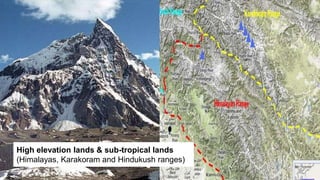
High elevation lands & sub-tropical lands
(Himalayas, Karakoram and Hindukush ranges)
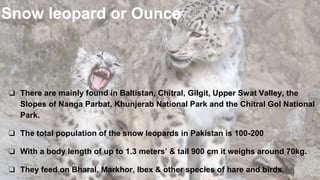
Snow leopard or Ounce
❏ There are mainly found in Baltistan, Chitral, Gilgit, Upper Swat Valley, the
Slopes of Nanga Parbat, Khunjerab National Park and the Chitral Gol National
Park.
❏ The total population of the snow leopards in Pakistan is 100-200
❏ With a body length of up to 1.3 meters’ & tail 900 cm it weighs around 70kg.
❏ They feed on Bharal, Markhor, Ibex & other species of hare and birds.
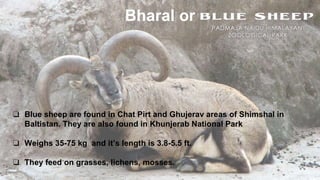
❏ Blue sheep are found in Chat Pirt and Ghujerav areas of Shimshal in
Baltistan. They are also found in Khunjerab National Park
❏ Weighs 35-75 kg and it’s length is 3.8-5.5 ft.
❏ They feed on grasses, lichens, mosses.
Bharal or
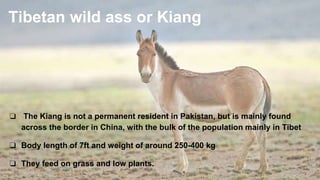
Tibetan wild ass or Kiang
❏ The Kiang is not a permanent resident in Pakistan, but is mainly found
across the border in China, with the bulk of the population mainly in Tibet
❏ Body length of 7ft and weight of around 250-400 kg
❏ They feed on grass and low plants.
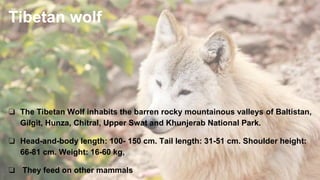
Tibetan wolf
❏ The Tibetan Wolf inhabits the barren rocky mountainous valleys of Baltistan,
Gilgit, Hunza, Chitral, Upper Swat and Khunjerab National Park.
❏ Head-and-body length: 100- 150 cm. Tail length: 31-51 cm. Shoulder height:
66-81 cm. Weight: 16-60 kg,
❏ They feed on other mammals
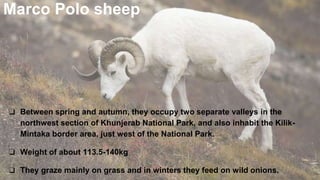
Marco Polo sheep
❏ Between spring and autumn, they occupy two separate valleys in the
northwest section of Khunjerab National Park, and also inhabit the Kilik-
Mintaka border area, just west of the National Park.
❏ Weight of about 113.5-140kg
❏ They graze mainly on grass and in winters they feed on wild onions.
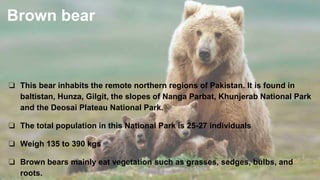
Brown bear
❏ This bear inhabits the remote northern regions of Pakistan. It is found in
baltistan, Hunza, Gilgit, the slopes of Nanga Parbat, Khunjerab National Park
and the Deosai Plateau National Park.
❏ The total population in this National Park is 25-27 individuals
❏ Weigh 135 to 390 kgs
❏ Brown bears mainly eat vegetation such as grasses, sedges, bulbs, and
roots.
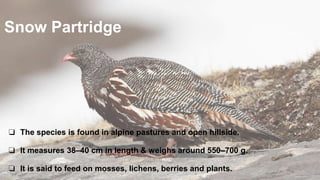
Snow Partridge
❏ The species is found in alpine pastures and open hillside.
❏ It measures 38–40 cm in length & weighs around 550–700 g.
❏ It is said to feed on mosses, lichens, berries and plants.
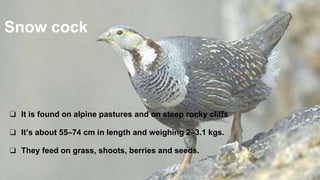
Snow cock
❏ It is found on alpine pastures and on steep rocky cliffs
❏ It’s about 55–74 cm in length and weighing 2–3.1 kgs.
❏ They feed on grass, shoots, berries and seeds.
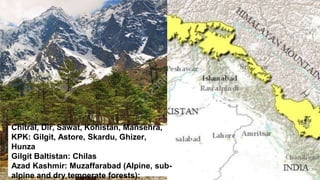
Chitral, Dir, Sawat, Kohistan, Mansehra,
KPK: Gilgit, Astore, Skardu, Ghizer,
Hunza
Gilgit Baltistan: Chilas
Azad Kashmir: Muzaffarabad (Alpine, sub-
alpine and dry temperate forests):
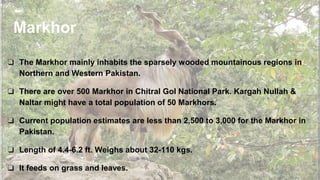
Markhor
❏ The Markhor mainly inhabits the sparsely wooded mountainous regions in
Northern and Western Pakistan.
❏ There are over 500 Markhor in Chitral Gol National Park. Kargah Nullah &
Naltar might have a total population of 50 Markhors.
❏ Current population estimates are less than 2,500 to 3,000 for the Markhor in
Pakistan.
❏ Length of 4.4-6.2 ft. Weighs about 32-110 kgs.
❏ It feeds on grass and leaves.
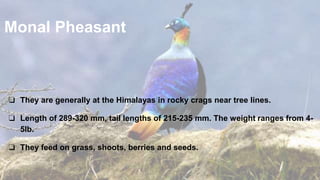
Monal Pheasant
❏ They are generally at the Himalayas in rocky crags near tree lines.
❏ Length of 289-320 mm, tail lengths of 215-235 mm. The weight ranges from 4-
5lb.
❏ They feed on grass, shoots, berries and seeds.
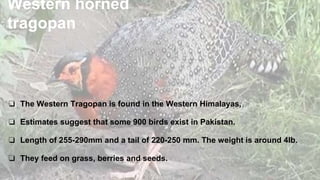
Western horned
tragopan
❏ The Western Tragopan is found in the Western Himalayas,
❏ Estimates suggest that some 900 birds exist in Pakistan.
❏ Length of 255-290mm and a tail of 220-250 mm. The weight is around 4lb.
❏ They feed on grass, berries and seeds.
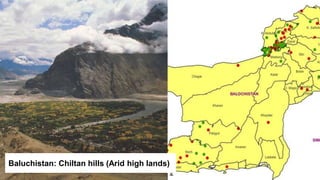
Baluchistan: Chiltan hills (Arid high lands)
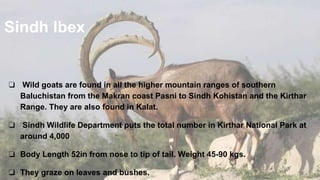
Sindh Ibex
❏ Wild goats are found in all the higher mountain ranges of southern
Baluchistan from the Makran coast Pasni to Sindh Kohistan and the Kirthar
Range. They are also found in Kalat.
❏ Sindh Wildlife Department puts the total number in Kirthar National Park at
around 4,000
❏ Body Length 52in from nose to tip of tail. Weight 45-90 kgs.
❏ They graze on leaves and bushes.
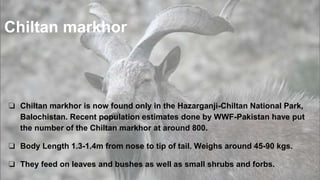
Chiltan markhor
❏ Chiltan markhor is now found only in the Hazarganji-Chiltan National Park,
Balochistan. Recent population estimates done by WWF-Pakistan have put
the number of the Chiltan markhor at around 800.
❏ Body Length 1.3-1.4m from nose to tip of tail. Weighs around 45-90 kgs.
❏ They feed on leaves and bushes as well as small shrubs and forbs.
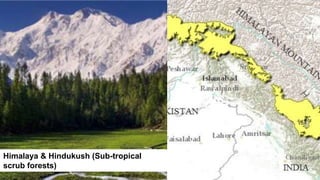
Himalaya & Hindukush (Sub-tropical
scrub forests)
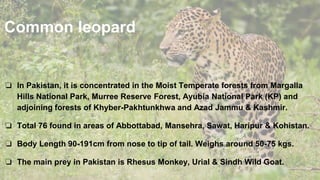
Common leopard
❏ In Pakistan, it is concentrated in the Moist Temperate forests from Margalla
Hills National Park, Murree Reserve Forest, Ayubia National Park (KP) and
adjoining forests of Khyber-Pakhtunkhwa and Azad Jammu & Kashmir.
❏ Total 76 found in areas of Abbottabad, Mansehra, Sawat, Haripur & Kohistan.
❏ Body Length 90-191cm from nose to tip of tail. Weighs around 50-75 kgs.
❏ The main prey in Pakistan is Rhesus Monkey, Urial & Sindh Wild Goat.
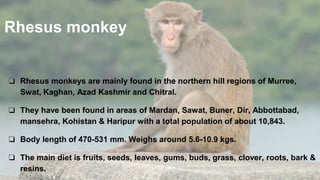
Rhesus monkey
❏ Rhesus monkeys are mainly found in the northern hill regions of Murree,
Swat, Kaghan, Azad Kashmir and Chitral.
❏ They have been found in areas of Mardan, Sawat, Buner, Dir, Abbottabad,
mansehra, Kohistan & Haripur with a total population of about 10,843.
❏ Body length of 470-531 mm. Weighs around 5.6-10.9 kgs.
❏ The main diet is fruits, seeds, leaves, gums, buds, grass, clover, roots, bark &
resins.
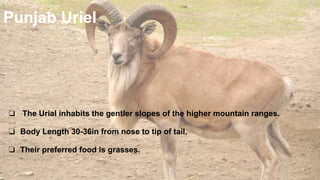
Punjab Uriel
❏ The Urial inhabits the gentler slopes of the higher mountain ranges.
❏ Body Length 30-36in from nose to tip of tail.
❏ Their preferred food is grasses.
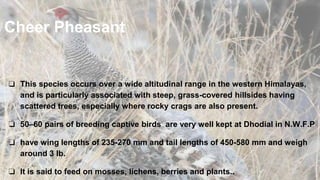
Cheer Pheasant
❏ This species occurs over a wide altitudinal range in the western Himalayas,
and is particularly associated with steep, grass-covered hillsides having
scattered trees, especially where rocky crags are also present.
❏ 50–60 pairs of breeding captive birds are very well kept at Dhodial in N.W.F.P
❏ have wing lengths of 235-270 mm and tail lengths of 450-580 mm and weigh
around 3 lb.
❏ It is said to feed on mosses, lichens, berries and plants..
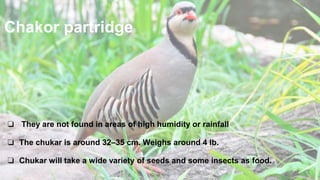
Chakor partridge
❏ They are not found in areas of high humidity or rainfall
❏ The chukar is around 32–35 cm. Weighs around 4 lb.
❏ Chukar will take a wide variety of seeds and some insects as food.
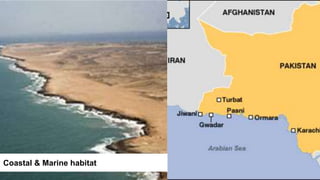
Coastal & Marine habitat
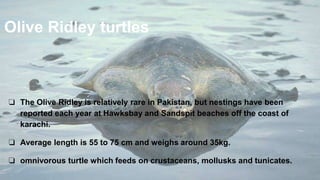
Olive Ridley turtles
❏ The Olive Ridley is relatively rare in Pakistan, but nestings have been
reported each year at Hawksbay and Sandspit beaches off the coast of
karachi.
❏ Average length is 55 to 75 cm and weighs around 35kg.
❏ omnivorous turtle which feeds on crustaceans, mollusks and tunicates.
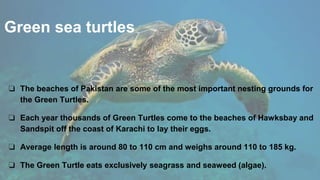
Green sea turtles
❏ The beaches of Pakistan are some of the most important nesting grounds for
the Green Turtles.
❏ Each year thousands of Green Turtles come to the beaches of Hawksbay and
Sandspit off the coast of Karachi to lay their eggs.
❏ Average length is around 80 to 110 cm and weighs around 110 to 185 kg.
❏ The Green Turtle eats exclusively seagrass and seaweed (algae).
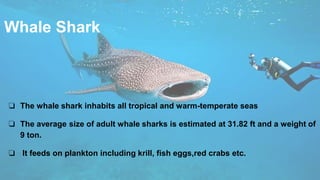
Whale Shark
❏ The whale shark inhabits all tropical and warm-temperate seas
❏ The average size of adult whale sharks is estimated at 31.82 ft and a weight of
9 ton.
❏ It feeds on plankton including krill, fish eggs,red crabs etc.
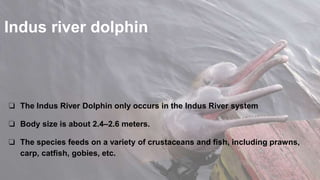
Indus river dolphin
❏ The Indus River Dolphin only occurs in the Indus River system
❏ Body size is about 2.4–2.6 meters.
❏ The species feeds on a variety of crustaceans and fish, including prawns,
carp, catfish, gobies, etc.
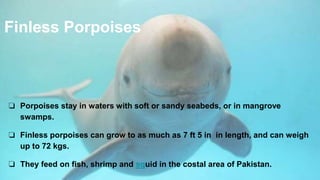
Finless Porpoises
❏ Porpoises stay in waters with soft or sandy seabeds, or in mangrove
swamps.
❏ Finless porpoises can grow to as much as 7 ft 5 in in length, and can weigh
up to 72 kgs.
❏ They feed on fish, shrimp and squid in the costal area of Pakistan.
Thank you for your
patience

Wildlife in Pakistan

  • 1.
  • 2.
    ❏ High elevationlands & sub- tropical lands (Himalayas, Karakoram and Hindukush ranges) ❏ Chitral, Dir, Sawat, Kohistan, Mansehra ❏ KPK: Gilgit, Astore, Skardu, Ghizer, Hunza ❏ Gilgit Baltistan: Chilas ❏ Azad Kashmir: Muzaffarabad (Alpine, subalpine and dry temperate forests) ❏ Baluchistan: Chiltan hills (Arid highlands) ❏ Coastal & Marine habitats Habitats covered
  • 4.
    High elevation lands& sub-tropical lands (Himalayas, Karakoram and Hindukush ranges)
  • 5.
    Snow leopard orOunce ❏ There are mainly found in Baltistan, Chitral, Gilgit, Upper Swat Valley, the Slopes of Nanga Parbat, Khunjerab National Park and the Chitral Gol National Park. ❏ The total population of the snow leopards in Pakistan is 100-200 ❏ With a body length of up to 1.3 meters’ & tail 900 cm it weighs around 70kg. ❏ They feed on Bharal, Markhor, Ibex & other species of hare and birds.
  • 6.
    ❏ Blue sheepare found in Chat Pirt and Ghujerav areas of Shimshal in Baltistan. They are also found in Khunjerab National Park ❏ Weighs 35-75 kg and it’s length is 3.8-5.5 ft. ❏ They feed on grasses, lichens, mosses. Bharal or
  • 7.
    Tibetan wild assor Kiang ❏ The Kiang is not a permanent resident in Pakistan, but is mainly found across the border in China, with the bulk of the population mainly in Tibet ❏ Body length of 7ft and weight of around 250-400 kg ❏ They feed on grass and low plants.
  • 8.
    Tibetan wolf ❏ TheTibetan Wolf inhabits the barren rocky mountainous valleys of Baltistan, Gilgit, Hunza, Chitral, Upper Swat and Khunjerab National Park. ❏ Head-and-body length: 100- 150 cm. Tail length: 31-51 cm. Shoulder height: 66-81 cm. Weight: 16-60 kg, ❏ They feed on other mammals
  • 9.
    Marco Polo sheep ❏Between spring and autumn, they occupy two separate valleys in the northwest section of Khunjerab National Park, and also inhabit the Kilik- Mintaka border area, just west of the National Park. ❏ Weight of about 113.5-140kg ❏ They graze mainly on grass and in winters they feed on wild onions.
  • 10.
    Brown bear ❏ Thisbear inhabits the remote northern regions of Pakistan. It is found in baltistan, Hunza, Gilgit, the slopes of Nanga Parbat, Khunjerab National Park and the Deosai Plateau National Park. ❏ The total population in this National Park is 25-27 individuals ❏ Weigh 135 to 390 kgs ❏ Brown bears mainly eat vegetation such as grasses, sedges, bulbs, and roots.
  • 11.
    Snow Partridge ❏ Thespecies is found in alpine pastures and open hillside. ❏ It measures 38–40 cm in length & weighs around 550–700 g. ❏ It is said to feed on mosses, lichens, berries and plants.
  • 12.
    Snow cock ❏ Itis found on alpine pastures and on steep rocky cliffs ❏ It’s about 55–74 cm in length and weighing 2–3.1 kgs. ❏ They feed on grass, shoots, berries and seeds.
  • 13.
    Chitral, Dir, Sawat,Kohistan, Mansehra, KPK: Gilgit, Astore, Skardu, Ghizer, Hunza Gilgit Baltistan: Chilas Azad Kashmir: Muzaffarabad (Alpine, sub- alpine and dry temperate forests):
  • 14.
    Markhor ❏ The Markhormainly inhabits the sparsely wooded mountainous regions in Northern and Western Pakistan. ❏ There are over 500 Markhor in Chitral Gol National Park. Kargah Nullah & Naltar might have a total population of 50 Markhors. ❏ Current population estimates are less than 2,500 to 3,000 for the Markhor in Pakistan. ❏ Length of 4.4-6.2 ft. Weighs about 32-110 kgs. ❏ It feeds on grass and leaves.
  • 15.
    Monal Pheasant ❏ Theyare generally at the Himalayas in rocky crags near tree lines. ❏ Length of 289-320 mm, tail lengths of 215-235 mm. The weight ranges from 4- 5lb. ❏ They feed on grass, shoots, berries and seeds.
  • 16.
    Western horned tragopan ❏ TheWestern Tragopan is found in the Western Himalayas, ❏ Estimates suggest that some 900 birds exist in Pakistan. ❏ Length of 255-290mm and a tail of 220-250 mm. The weight is around 4lb. ❏ They feed on grass, berries and seeds.
  • 17.
    Baluchistan: Chiltan hills(Arid high lands)
  • 18.
    Sindh Ibex ❏ Wildgoats are found in all the higher mountain ranges of southern Baluchistan from the Makran coast Pasni to Sindh Kohistan and the Kirthar Range. They are also found in Kalat. ❏ Sindh Wildlife Department puts the total number in Kirthar National Park at around 4,000 ❏ Body Length 52in from nose to tip of tail. Weight 45-90 kgs. ❏ They graze on leaves and bushes.
  • 19.
    Chiltan markhor ❏ Chiltanmarkhor is now found only in the Hazarganji-Chiltan National Park, Balochistan. Recent population estimates done by WWF-Pakistan have put the number of the Chiltan markhor at around 800. ❏ Body Length 1.3-1.4m from nose to tip of tail. Weighs around 45-90 kgs. ❏ They feed on leaves and bushes as well as small shrubs and forbs.
  • 20.
    Himalaya & Hindukush(Sub-tropical scrub forests)
  • 21.
    Common leopard ❏ InPakistan, it is concentrated in the Moist Temperate forests from Margalla Hills National Park, Murree Reserve Forest, Ayubia National Park (KP) and adjoining forests of Khyber-Pakhtunkhwa and Azad Jammu & Kashmir. ❏ Total 76 found in areas of Abbottabad, Mansehra, Sawat, Haripur & Kohistan. ❏ Body Length 90-191cm from nose to tip of tail. Weighs around 50-75 kgs. ❏ The main prey in Pakistan is Rhesus Monkey, Urial & Sindh Wild Goat.
  • 22.
    Rhesus monkey ❏ Rhesusmonkeys are mainly found in the northern hill regions of Murree, Swat, Kaghan, Azad Kashmir and Chitral. ❏ They have been found in areas of Mardan, Sawat, Buner, Dir, Abbottabad, mansehra, Kohistan & Haripur with a total population of about 10,843. ❏ Body length of 470-531 mm. Weighs around 5.6-10.9 kgs. ❏ The main diet is fruits, seeds, leaves, gums, buds, grass, clover, roots, bark & resins.
  • 23.
    Punjab Uriel ❏ TheUrial inhabits the gentler slopes of the higher mountain ranges. ❏ Body Length 30-36in from nose to tip of tail. ❏ Their preferred food is grasses.
  • 24.
    Cheer Pheasant ❏ Thisspecies occurs over a wide altitudinal range in the western Himalayas, and is particularly associated with steep, grass-covered hillsides having scattered trees, especially where rocky crags are also present. ❏ 50–60 pairs of breeding captive birds are very well kept at Dhodial in N.W.F.P ❏ have wing lengths of 235-270 mm and tail lengths of 450-580 mm and weigh around 3 lb. ❏ It is said to feed on mosses, lichens, berries and plants..
  • 25.
    Chakor partridge ❏ Theyare not found in areas of high humidity or rainfall ❏ The chukar is around 32–35 cm. Weighs around 4 lb. ❏ Chukar will take a wide variety of seeds and some insects as food.
  • 26.
  • 27.
    Olive Ridley turtles ❏The Olive Ridley is relatively rare in Pakistan, but nestings have been reported each year at Hawksbay and Sandspit beaches off the coast of karachi. ❏ Average length is 55 to 75 cm and weighs around 35kg. ❏ omnivorous turtle which feeds on crustaceans, mollusks and tunicates.
  • 28.
    Green sea turtles ❏The beaches of Pakistan are some of the most important nesting grounds for the Green Turtles. ❏ Each year thousands of Green Turtles come to the beaches of Hawksbay and Sandspit off the coast of Karachi to lay their eggs. ❏ Average length is around 80 to 110 cm and weighs around 110 to 185 kg. ❏ The Green Turtle eats exclusively seagrass and seaweed (algae).
  • 29.
    Whale Shark ❏ Thewhale shark inhabits all tropical and warm-temperate seas ❏ The average size of adult whale sharks is estimated at 31.82 ft and a weight of 9 ton. ❏ It feeds on plankton including krill, fish eggs,red crabs etc.
  • 30.
    Indus river dolphin ❏The Indus River Dolphin only occurs in the Indus River system ❏ Body size is about 2.4–2.6 meters. ❏ The species feeds on a variety of crustaceans and fish, including prawns, carp, catfish, gobies, etc.
  • 31.
    Finless Porpoises ❏ Porpoisesstay in waters with soft or sandy seabeds, or in mangrove swamps. ❏ Finless porpoises can grow to as much as 7 ft 5 in in length, and can weigh up to 72 kgs. ❏ They feed on fish, shrimp and squid in the costal area of Pakistan.
  • 32.
    Thank you foryour patience