Science
Unit:
Classification and
species
Species and classification (differences between
species)
Explanation
An organism is a
living thing.
There are millions of
different types of
living organisms on
Earth.
Differences between organisms
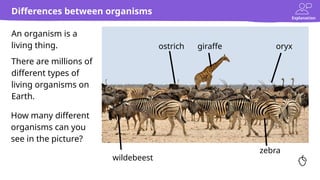
wildebeest
zebra
ostrich oryx
giraffe
How many different
organisms can you
see in the picture?
Explanation
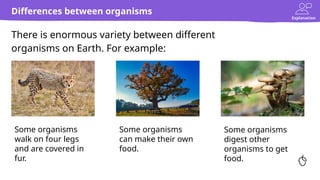
There is enormous variety between different
organisms on Earth. For example:
Differences between organisms
Some organisms
walk on four legs
and are covered in
fur.
Some organisms
can make their own
food.
Some organisms
digest other
organisms to get
food.
True False
Justify your answer
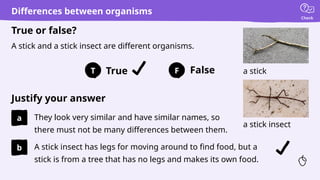
True or false?
T F
Check
a
b
They look very similar and have similar names, so
there must not be many differences between them.
A stick and a stick insect are different organisms.
A stick insect has legs for moving around to find food, but a
stick is from a tree that has no legs and makes its own food.
Differences between organisms
a stick
a stick insect
Task A
Practice
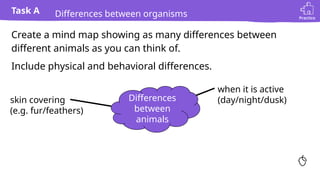
Create a mind map showing as many differences between
different animals as you can think of.
Include physical and behavioral differences.
Differences between organisms
Differences
between
animals
when it is active
(day/night/dusk)
skin covering
(e.g. fur/feathers)
Task A
Feedback
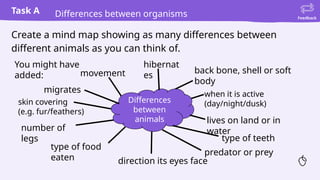
back bone, shell or soft
body
Create a mind map showing as many differences between
different animals as you can think of.
Differences between organisms
Differences
between
animals
when it is active
(day/night/dusk)
lives on land or in
water
type of teeth
direction its eyes face
type of food
eaten
movement
You might have
added:
number of
legs
predator or prey
migrates
hibernat
es
skin covering
(e.g. fur/feathers)
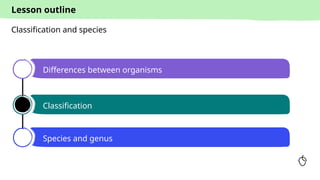
Lesson outline
Differences between organisms
Classification
Species and genus
Classification and species
Explanation
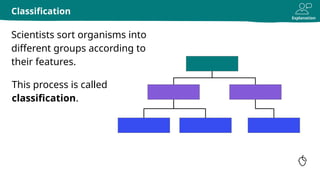
Classification
Scientists sort organisms into
different groups according to
their features.
This process is called
classification.
Explanation
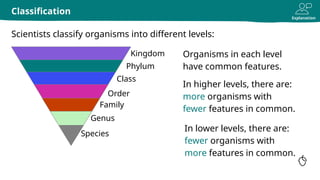
Organisms in each level
have common features.
Scientists classify organisms into different levels:
Classification
Kingdom
Phylum
Class
Order
Family
Genus
Species
In higher levels, there are:
more organisms with
fewer features in common.
In lower levels, there are:
fewer organisms with
more features in common.
Explanation
Classification
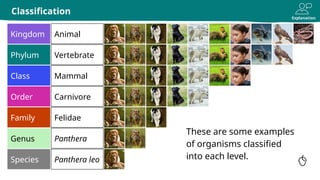
Kingdom Animal
Phylum Vertebrate
Species Panthera leo
Genus Panthera
Class Mammal
Order Carnivore
Family Felidae
These are some examples
of organisms classified
into each level.
Explanation
Classification
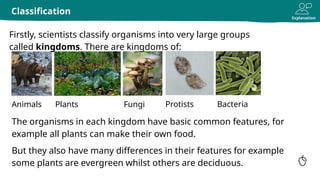
Animals
The organisms in each kingdom have basic common features, for
example all plants can make their own food.
But they also have many differences in their features for example
some plants are evergreen whilst others are deciduous.
Plants Fungi Bacteria
Firstly, scientists classify organisms into very large groups
called kingdoms. There are kingdoms of:
Protists
Check
Less organisms with few similarities in their features.
Which of the statements best describes the organisms in larger
groups such as kingdoms?
Classification
a
b
c
More organisms with many similarities in their features.
More organisms with few similarities in their features.
Less organisms with many similarities in their features.
d
Explanation
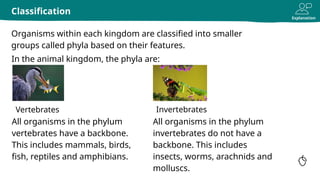
Organisms within each kingdom are classified into smaller
groups called phyla based on their features.
Classification
Vertebrates Invertebrates
All organisms in the phylum
vertebrates have a backbone.
This includes mammals, birds,
fish, reptiles and amphibians.
In the animal kingdom, the phyla are:
All organisms in the phylum
invertebrates do not have a
backbone. This includes
insects, worms, arachnids and
molluscs.
Check
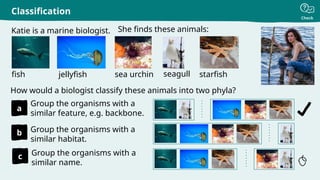
Katie is a marine biologist.
Classification
How would a biologist classify these animals into two phyla?
seagull
sea urchin
jellyfish starfish
fish
She finds these animals:
a
Group the organisms with a
similar feature, e.g. backbone.
b Group the organisms with a
similar habitat.
c Group the organisms with a
similar name.
Explanation
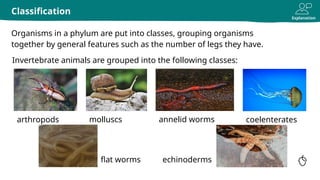
Organisms in a phylum are put into classes, grouping organisms
together by general features such as the number of legs they have.
Classification
coelenterates
flat worms
annelid worms
molluscs
arthropods
echinoderms
Invertebrate animals are grouped into the following classes:
Explanation
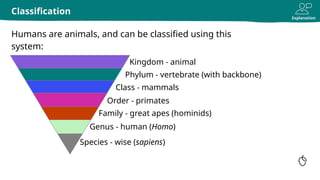
Humans are animals, and can be classified using this
system:
Classification
Kingdom - animal
Phylum - vertebrate (with backbone)
Class - mammals
Order - primates
Family - great apes (hominids)
Genus - human (Homo)
Species - wise (sapiens)
Check
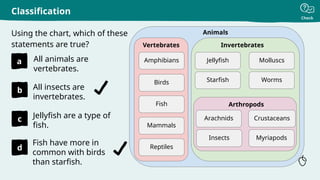
Fish have more in
common with birds
than starfish.
Using the chart, which of these
statements are true?
Classification
a
b
c
All animals are
vertebrates.
All insects are
invertebrates.
Jellyfish are a type of
fish.
d
Amphibians
Birds
Fish
Mammals
Reptiles
Jellyfish Molluscs
Starfish Worms
Arachnids Crustaceans
Insects Myriapods
Animals
Invertebrates
Vertebrates
Arthropods
Practice
Task B Classification
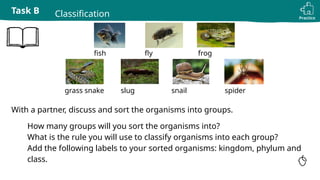
With a partner, discuss and sort the organisms into groups.
1. How many groups will you sort the organisms into?
2. What is the rule you will use to classify organisms into each group?
3. Add the following labels to your sorted organisms: kingdom, phylum and
class.
fly frog
grass snake slug snail spider
fish
Task B
Feedback
Classification
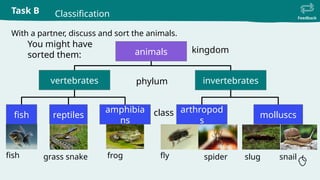
With a partner, discuss and sort the animals.
You might have
sorted them: animals
vertebrates invertebrates
fish reptiles
amphibia
ns
arthropod
s
molluscs
fish grass snake frog fly spider slug snail
kingdom
phylum
class
Lesson outline
Differences between organisms
Classification
Genus and species
Classification and species
Explanation
Genus and species
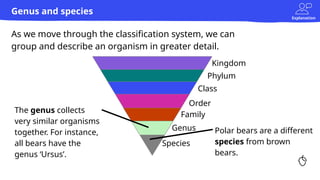
As we move through the classification system, we can
group and describe an organism in greater detail.
Kingdom
Phylum
Class
Order
Family
Genus
Species
The genus collects
very similar organisms
together. For instance,
all bears have the
genus ‘Ursus’.
Polar bears are a different
species from brown
bears.
Explanation
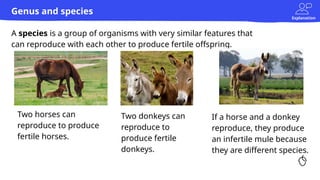
A species is a group of organisms with very similar features that
can reproduce with each other to produce fertile offspring.
Genus and species
Two horses can
reproduce to produce
fertile horses.
Two donkeys can
reproduce to
produce fertile
donkeys.
If a horse and a donkey
reproduce, they produce
an infertile mule because
they are different species.
True False
Justify your answer
True or false?
Check
a
b
T F
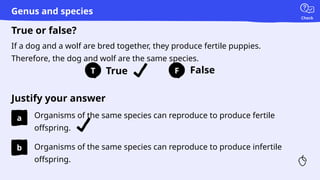
If a dog and a wolf are bred together, they produce fertile puppies.
Therefore, the dog and wolf are the same species.
Genus and species
Organisms of the same species can reproduce to produce infertile
offspring.
Organisms of the same species can reproduce to produce fertile
offspring.
Explanation
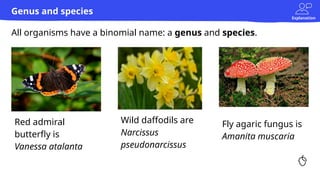
All organisms have a binomial name: a genus and species.
Genus and species
Red admiral
butterfly is
Vanessa atalanta
Wild daffodils are
Narcissus
pseudonarcissus
Fly agaric fungus is
Amanita muscaria
Explanation
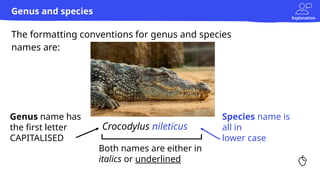
The formatting conventions for genus and species
names are:
Genus and species
Crocodylus nileticus
Genus name has
the first letter
CAPITALISED
Species name is
all in
lower case
Both names are either in
italics or underlined
Explanation
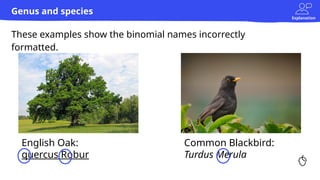
Common Blackbird:
Turdus Merula
English Oak:
quercus Robur
These examples show the binomial names incorrectly
formatted.
Genus and species
Check
a
b
c
d
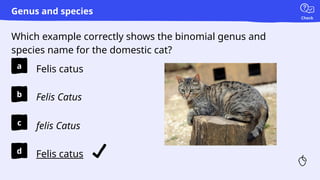
Which example correctly shows the binomial genus and
species name for the domestic cat?
Genus and species
Felis Catus
Felis catus
Felis catus
felis Catus
Practice
Task C
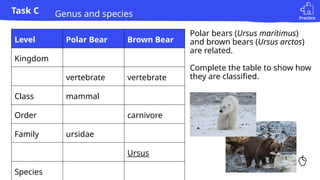
Polar bears (Ursus maritimus)
and brown bears (Ursus arctos)
are related.
Complete the table to show how
they are classified.
Level Polar Bear Brown Bear
Kingdom
vertebrate vertebrate
Class mammal
Order carnivore
Family ursidae
Ursus
Species
Genus and species
Task C
Feedback
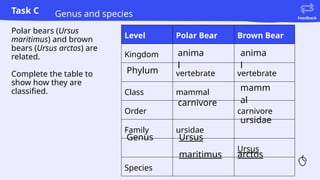
Polar bears (Ursus
maritimus) and brown
bears (Ursus arctos) are
related.
Complete the table to
show how they are
classified.
Genus and species
Level Polar Bear Brown Bear
Kingdom
vertebrate vertebrate
Class mammal
Order carnivore
Family ursidae
Ursus
Species
anima
l
anima
l
Phylum
mamm
al
carnivore
ursidae
Genus Ursus
maritimus arctos
Summary
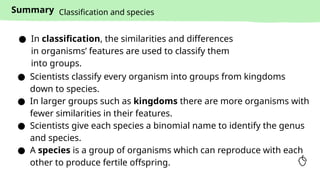
● Scientists classify every organism into groups from kingdoms
down to species.
● In larger groups such as kingdoms there are more organisms with
fewer similarities in their features.
● Scientists give each species a binomial name to identify the genus
and species.
● A species is a group of organisms which can reproduce with each
other to produce fertile offspring.
Classification and species
● In classification, the similarities and differences
in organisms’ features are used to classify them
into groups.
slide-deck.pptxclassificationpptpptpptppt

  • 1.
    Science Unit: Classification and species Species andclassification (differences between species)
  • 2.
    Explanation An organism isa living thing. There are millions of different types of living organisms on Earth. Differences between organisms wildebeest zebra ostrich oryx giraffe How many different organisms can you see in the picture?
  • 3.
    Explanation There is enormousvariety between different organisms on Earth. For example: Differences between organisms Some organisms walk on four legs and are covered in fur. Some organisms can make their own food. Some organisms digest other organisms to get food.
  • 4.
    True False Justify youranswer True or false? T F Check a b They look very similar and have similar names, so there must not be many differences between them. A stick and a stick insect are different organisms. A stick insect has legs for moving around to find food, but a stick is from a tree that has no legs and makes its own food. Differences between organisms a stick a stick insect
  • 5.
    Task A Practice Create amind map showing as many differences between different animals as you can think of. Include physical and behavioral differences. Differences between organisms Differences between animals when it is active (day/night/dusk) skin covering (e.g. fur/feathers)
  • 6.
    Task A Feedback back bone,shell or soft body Create a mind map showing as many differences between different animals as you can think of. Differences between organisms Differences between animals when it is active (day/night/dusk) lives on land or in water type of teeth direction its eyes face type of food eaten movement You might have added: number of legs predator or prey migrates hibernat es skin covering (e.g. fur/feathers)
  • 7.
    Lesson outline Differences betweenorganisms Classification Species and genus Classification and species
  • 8.
    Explanation Classification Scientists sort organismsinto different groups according to their features. This process is called classification.
  • 9.
    Explanation Organisms in eachlevel have common features. Scientists classify organisms into different levels: Classification Kingdom Phylum Class Order Family Genus Species In higher levels, there are: more organisms with fewer features in common. In lower levels, there are: fewer organisms with more features in common.
  • 10.
    Explanation Classification Kingdom Animal Phylum Vertebrate SpeciesPanthera leo Genus Panthera Class Mammal Order Carnivore Family Felidae These are some examples of organisms classified into each level.
  • 11.
    Explanation Classification Animals The organisms ineach kingdom have basic common features, for example all plants can make their own food. But they also have many differences in their features for example some plants are evergreen whilst others are deciduous. Plants Fungi Bacteria Firstly, scientists classify organisms into very large groups called kingdoms. There are kingdoms of: Protists
  • 12.
    Check Less organisms withfew similarities in their features. Which of the statements best describes the organisms in larger groups such as kingdoms? Classification a b c More organisms with many similarities in their features. More organisms with few similarities in their features. Less organisms with many similarities in their features. d
  • 13.
    Explanation Organisms within eachkingdom are classified into smaller groups called phyla based on their features. Classification Vertebrates Invertebrates All organisms in the phylum vertebrates have a backbone. This includes mammals, birds, fish, reptiles and amphibians. In the animal kingdom, the phyla are: All organisms in the phylum invertebrates do not have a backbone. This includes insects, worms, arachnids and molluscs.
  • 14.
    Check Katie is amarine biologist. Classification How would a biologist classify these animals into two phyla? seagull sea urchin jellyfish starfish fish She finds these animals: a Group the organisms with a similar feature, e.g. backbone. b Group the organisms with a similar habitat. c Group the organisms with a similar name.
  • 15.
    Explanation Organisms in aphylum are put into classes, grouping organisms together by general features such as the number of legs they have. Classification coelenterates flat worms annelid worms molluscs arthropods echinoderms Invertebrate animals are grouped into the following classes:
  • 16.
    Explanation Humans are animals,and can be classified using this system: Classification Kingdom - animal Phylum - vertebrate (with backbone) Class - mammals Order - primates Family - great apes (hominids) Genus - human (Homo) Species - wise (sapiens)
  • 17.
    Check Fish have morein common with birds than starfish. Using the chart, which of these statements are true? Classification a b c All animals are vertebrates. All insects are invertebrates. Jellyfish are a type of fish. d Amphibians Birds Fish Mammals Reptiles Jellyfish Molluscs Starfish Worms Arachnids Crustaceans Insects Myriapods Animals Invertebrates Vertebrates Arthropods
  • 18.
    Practice Task B Classification Witha partner, discuss and sort the organisms into groups. 1. How many groups will you sort the organisms into? 2. What is the rule you will use to classify organisms into each group? 3. Add the following labels to your sorted organisms: kingdom, phylum and class. fly frog grass snake slug snail spider fish
  • 19.
    Task B Feedback Classification With apartner, discuss and sort the animals. You might have sorted them: animals vertebrates invertebrates fish reptiles amphibia ns arthropod s molluscs fish grass snake frog fly spider slug snail kingdom phylum class
  • 20.
    Lesson outline Differences betweenorganisms Classification Genus and species Classification and species
  • 21.
    Explanation Genus and species Aswe move through the classification system, we can group and describe an organism in greater detail. Kingdom Phylum Class Order Family Genus Species The genus collects very similar organisms together. For instance, all bears have the genus ‘Ursus’. Polar bears are a different species from brown bears.
  • 22.
    Explanation A species isa group of organisms with very similar features that can reproduce with each other to produce fertile offspring. Genus and species Two horses can reproduce to produce fertile horses. Two donkeys can reproduce to produce fertile donkeys. If a horse and a donkey reproduce, they produce an infertile mule because they are different species.
  • 23.
    True False Justify youranswer True or false? Check a b T F If a dog and a wolf are bred together, they produce fertile puppies. Therefore, the dog and wolf are the same species. Genus and species Organisms of the same species can reproduce to produce infertile offspring. Organisms of the same species can reproduce to produce fertile offspring.
  • 24.
    Explanation All organisms havea binomial name: a genus and species. Genus and species Red admiral butterfly is Vanessa atalanta Wild daffodils are Narcissus pseudonarcissus Fly agaric fungus is Amanita muscaria
  • 25.
    Explanation The formatting conventionsfor genus and species names are: Genus and species Crocodylus nileticus Genus name has the first letter CAPITALISED Species name is all in lower case Both names are either in italics or underlined
  • 26.
    Explanation Common Blackbird: Turdus Merula EnglishOak: quercus Robur These examples show the binomial names incorrectly formatted. Genus and species
  • 27.
    Check a b c d Which example correctlyshows the binomial genus and species name for the domestic cat? Genus and species Felis Catus Felis catus Felis catus felis Catus
  • 28.
    Practice Task C Polar bears(Ursus maritimus) and brown bears (Ursus arctos) are related. Complete the table to show how they are classified. Level Polar Bear Brown Bear Kingdom vertebrate vertebrate Class mammal Order carnivore Family ursidae Ursus Species Genus and species
  • 29.
    Task C Feedback Polar bears(Ursus maritimus) and brown bears (Ursus arctos) are related. Complete the table to show how they are classified. Genus and species Level Polar Bear Brown Bear Kingdom vertebrate vertebrate Class mammal Order carnivore Family ursidae Ursus Species anima l anima l Phylum mamm al carnivore ursidae Genus Ursus maritimus arctos
  • 30.
    Summary ● Scientists classifyevery organism into groups from kingdoms down to species. ● In larger groups such as kingdoms there are more organisms with fewer similarities in their features. ● Scientists give each species a binomial name to identify the genus and species. ● A species is a group of organisms which can reproduce with each other to produce fertile offspring. Classification and species ● In classification, the similarities and differences in organisms’ features are used to classify them into groups.