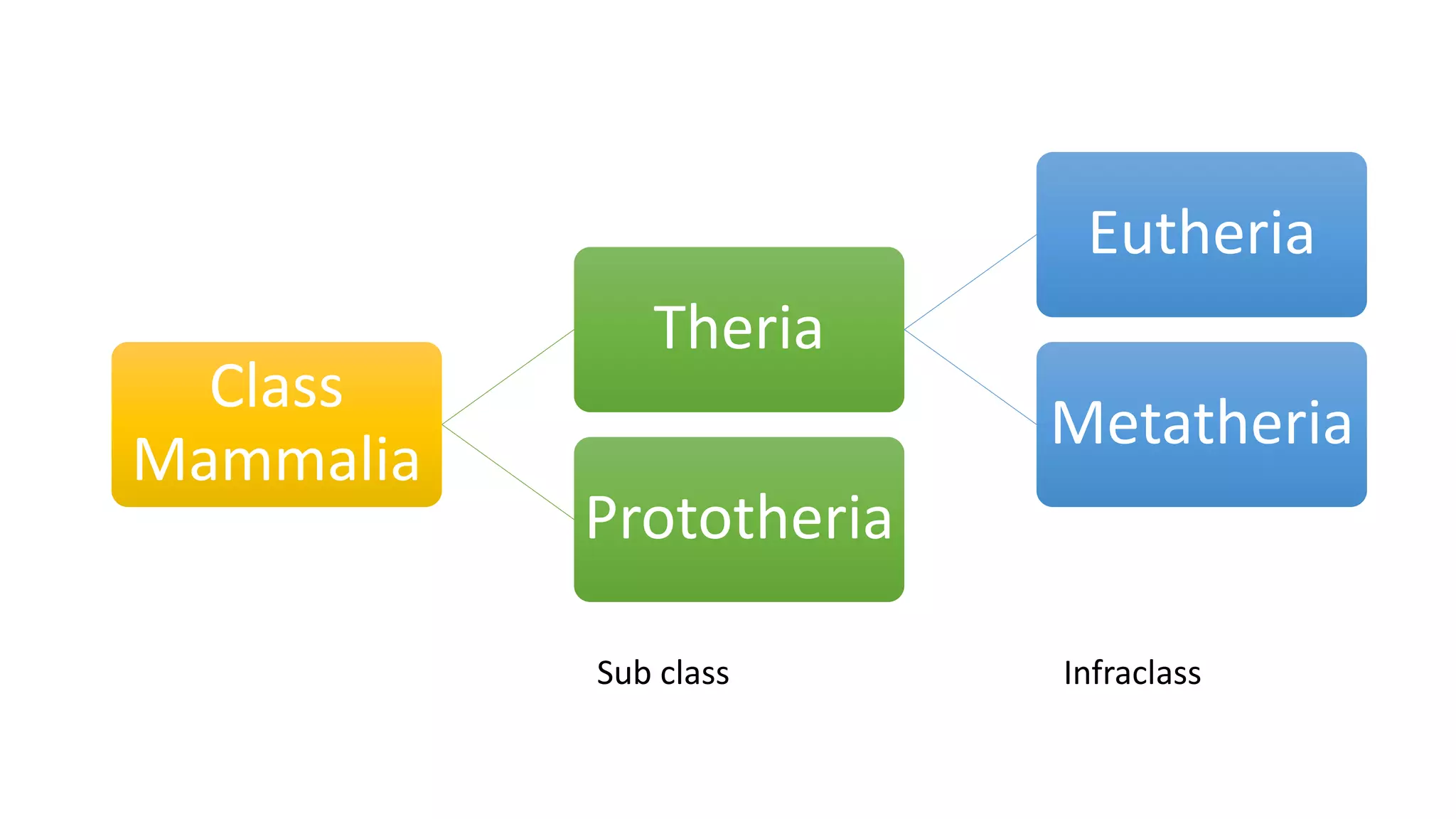
Class
Mammalia
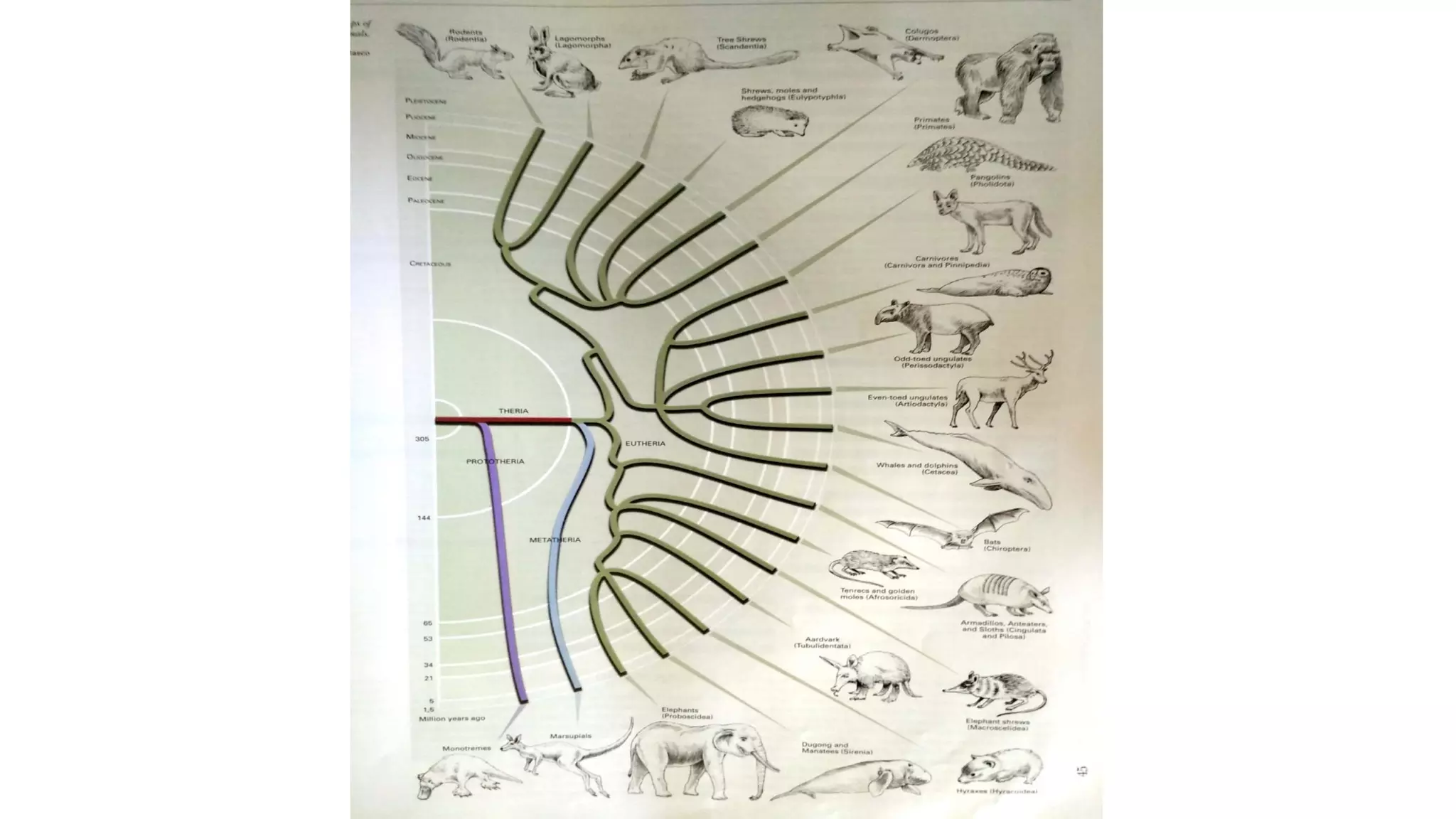
Theria
Eutheria
Metatheria
Prototheria
Sub class Infraclass
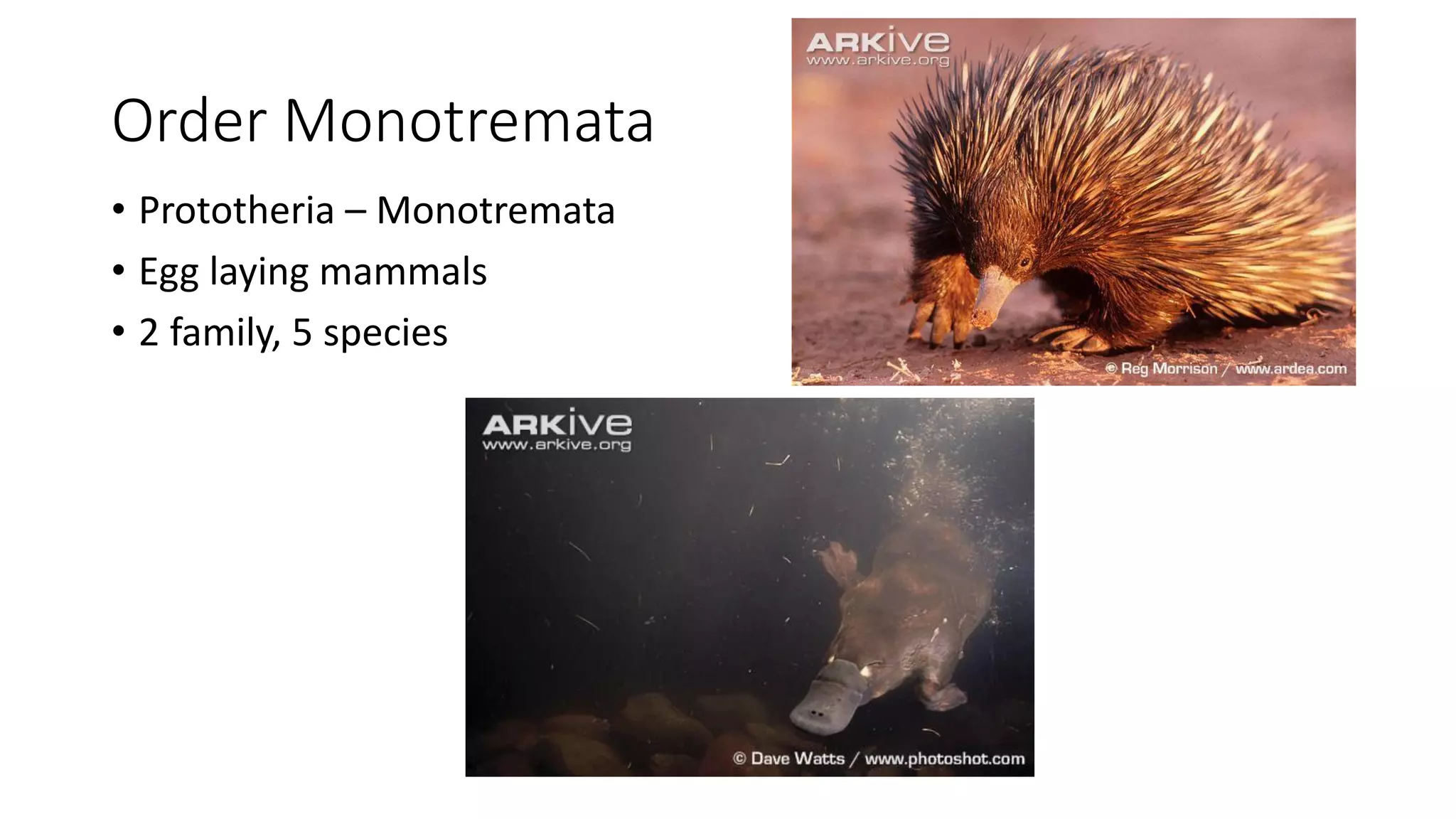
Order Monotremata
• Prototheria – Monotremata
• Egg laying mammals
• 2 family, 5 species
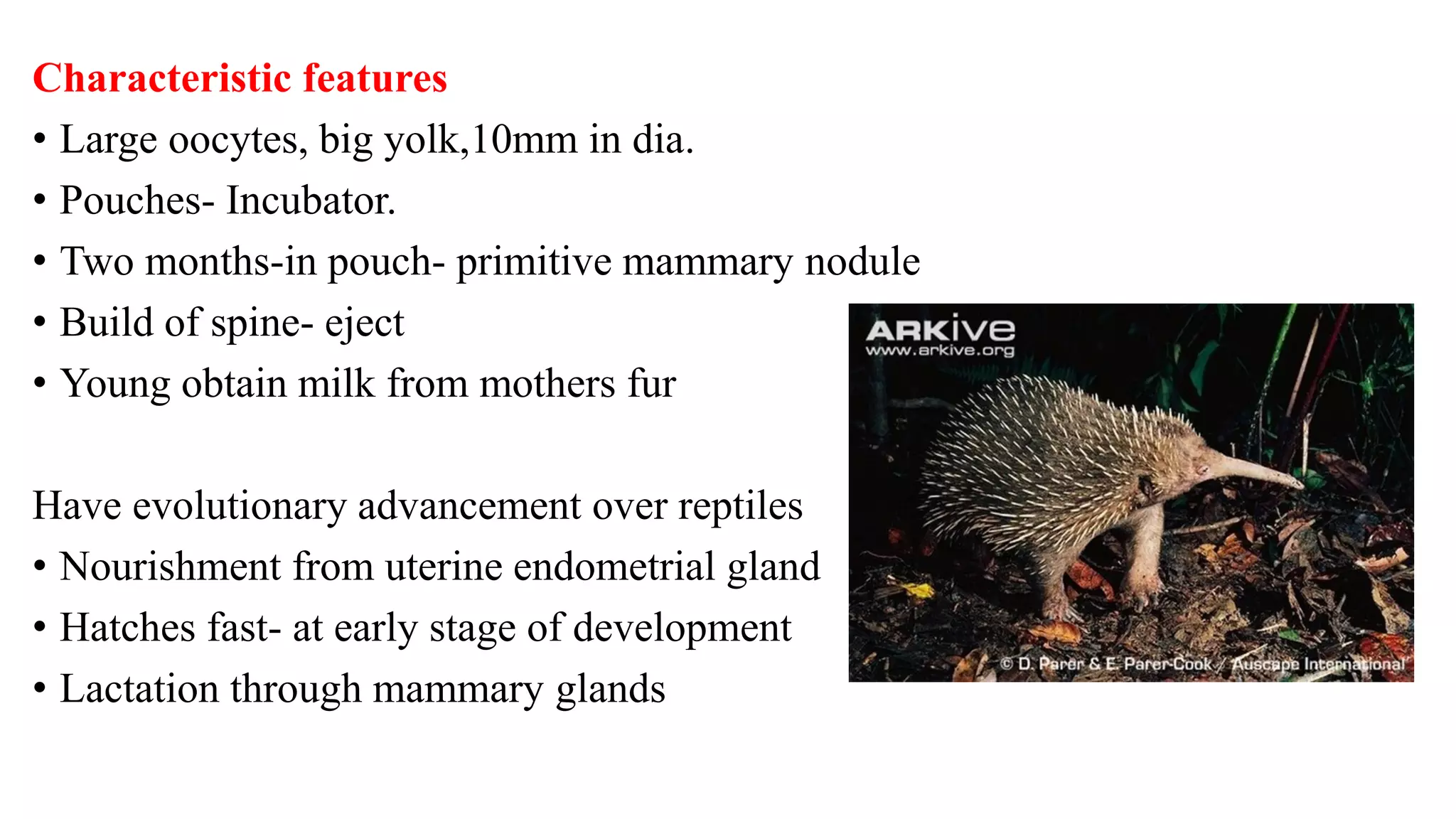
Characteristic features
• Large oocytes, big yolk,10mm in dia.
• Pouches- Incubator.
• Two months-in pouch- primitive mammary nodule
• Build of spine- eject
• Young obtain milk from mothers fur
Have evolutionary advancement over reptiles
• Nourishment from uterine endometrial gland
• Hatches fast- at early stage of development
• Lactation through mammary glands
Marsupials
• Metatheria – Marsupials
• Pouched mammals
• 7 orders
Features of marsupials
• Embryo develops rapidly- subsequent development in pouch
• Eggshell membrane are retained- semi permeable barrier between the
embryo and maternal tissue
• Lack trophoblast
• Modified reproductive cycle- Kangaroos – embryonic diapause
• Focussing all the resources on one at a time
Order Didelphimorphia
• American Opossums
• 1 family, 87 species
• North & South America
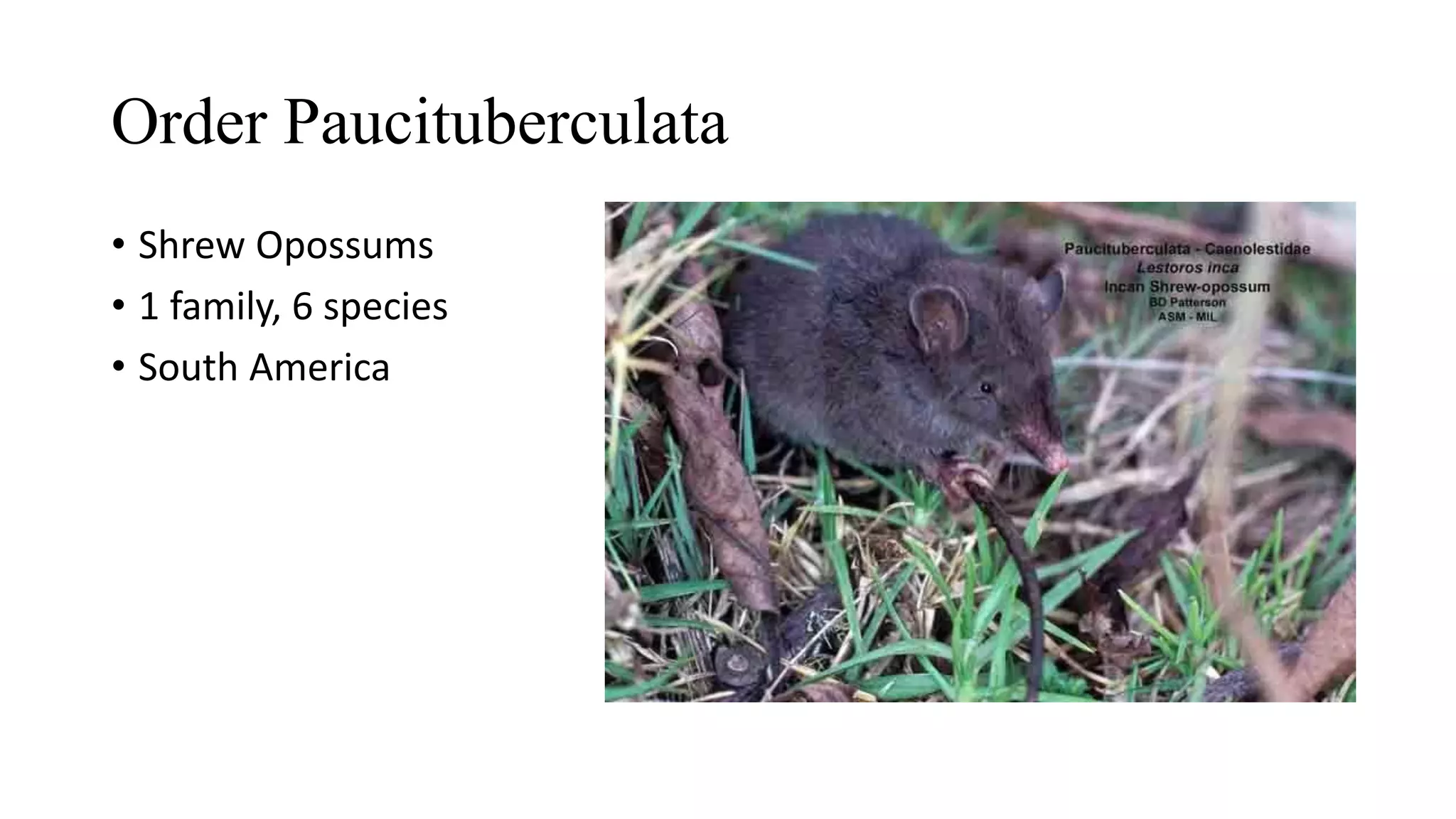
Order Paucituberculata
• Shrew Opossums
• 1 family, 6 species
• South America
Order Microbiotheria
• Monito del monte
• South America
Order Dasyuromorphia
• Carnivorous marsupials
• Includes quolls, dunnarts, the numbat and the Tasmanian devil
• 2 extant families, 70 species
• The extinct Tasmanian Wolf or Thylacine belonged to this order
• Australia
Order Paramelemorphia
• Bandicoots and bilbies
• Omnivorous marsupials
• 3 families, 21 species
• Australia and New Guinea
Eastern barred bandicoot
Greater Bilby
Order Notoryctemorphia
• Marsupial moles
• 1 family, 2 species
• Australia
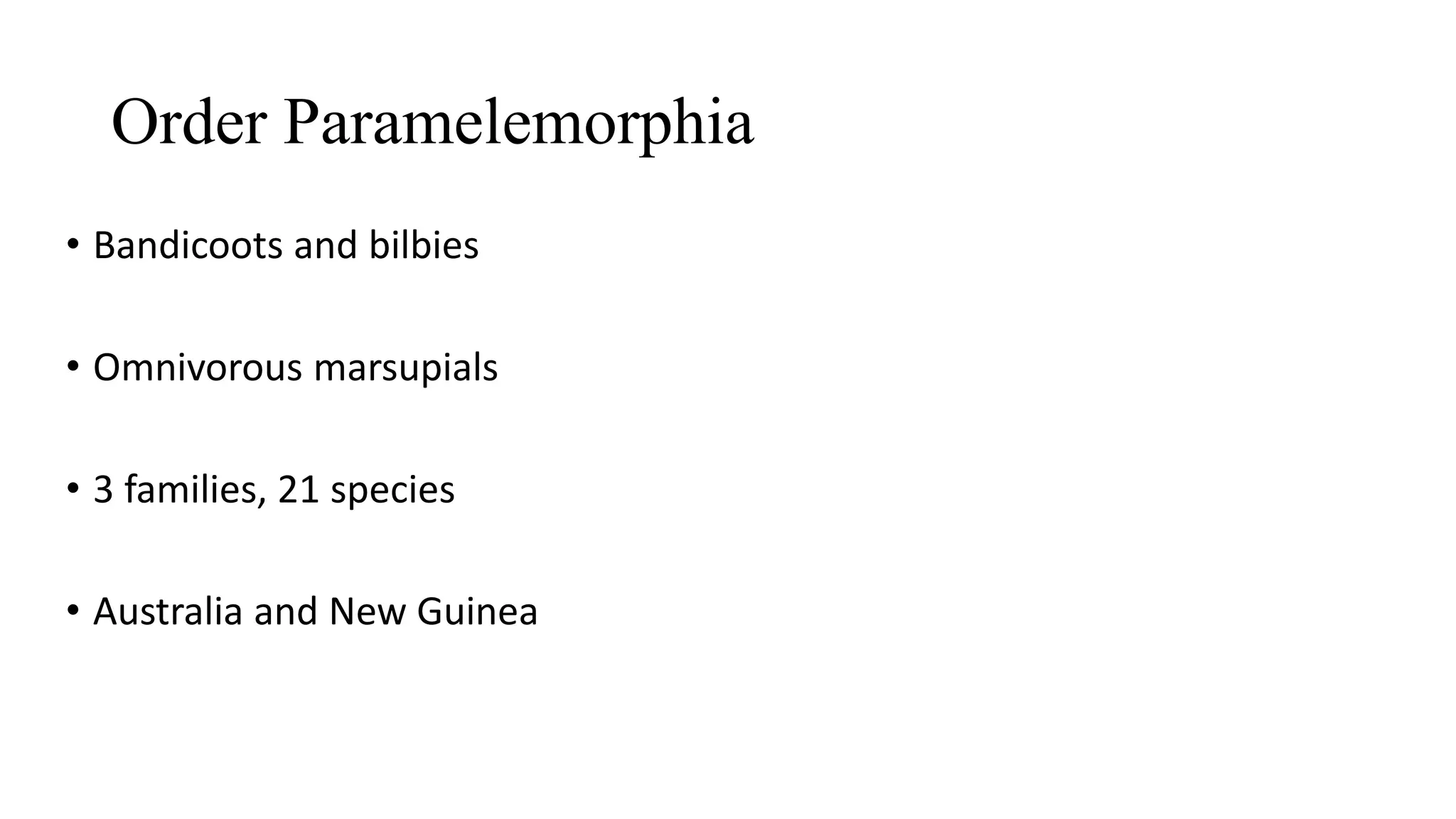
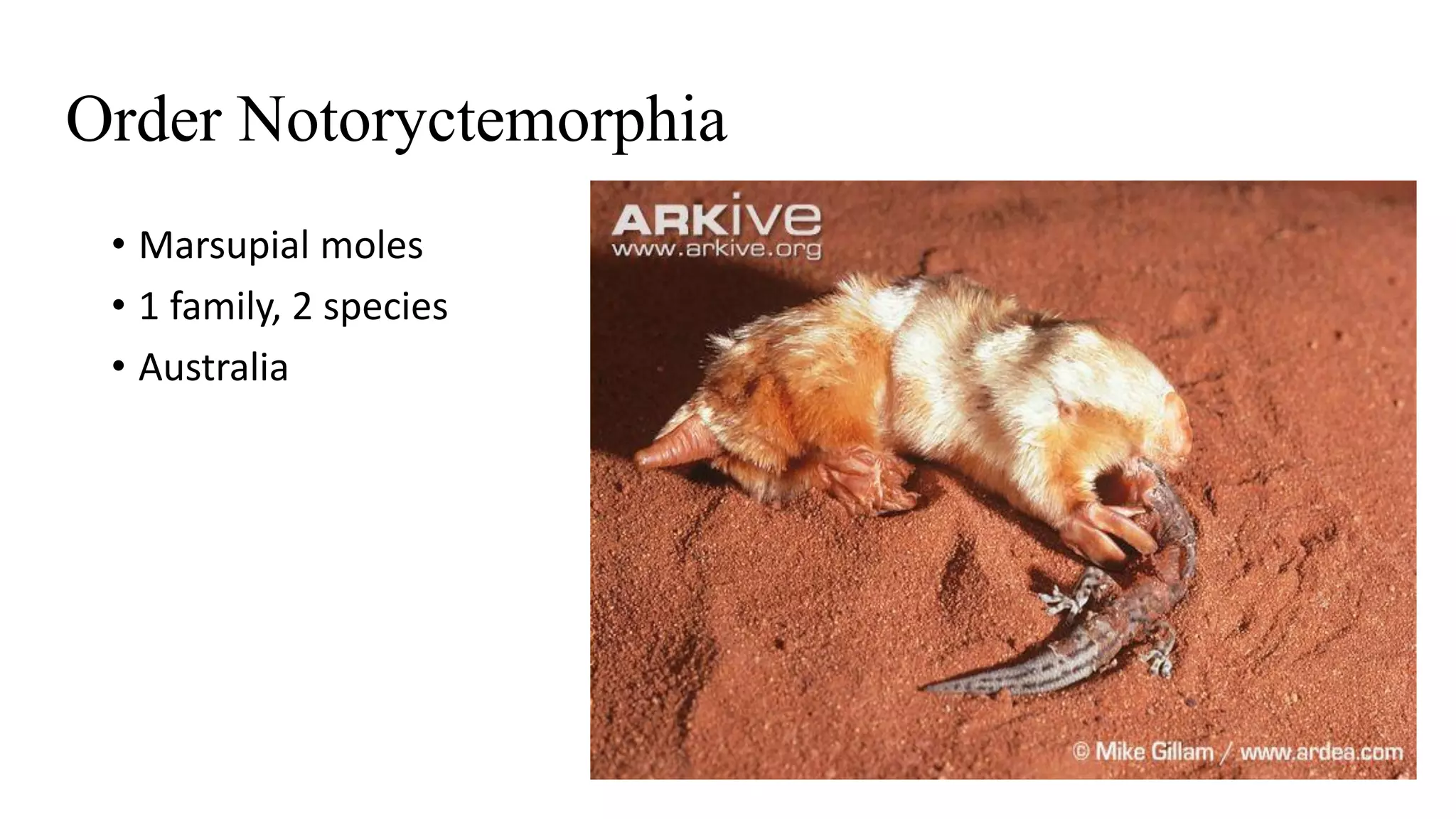
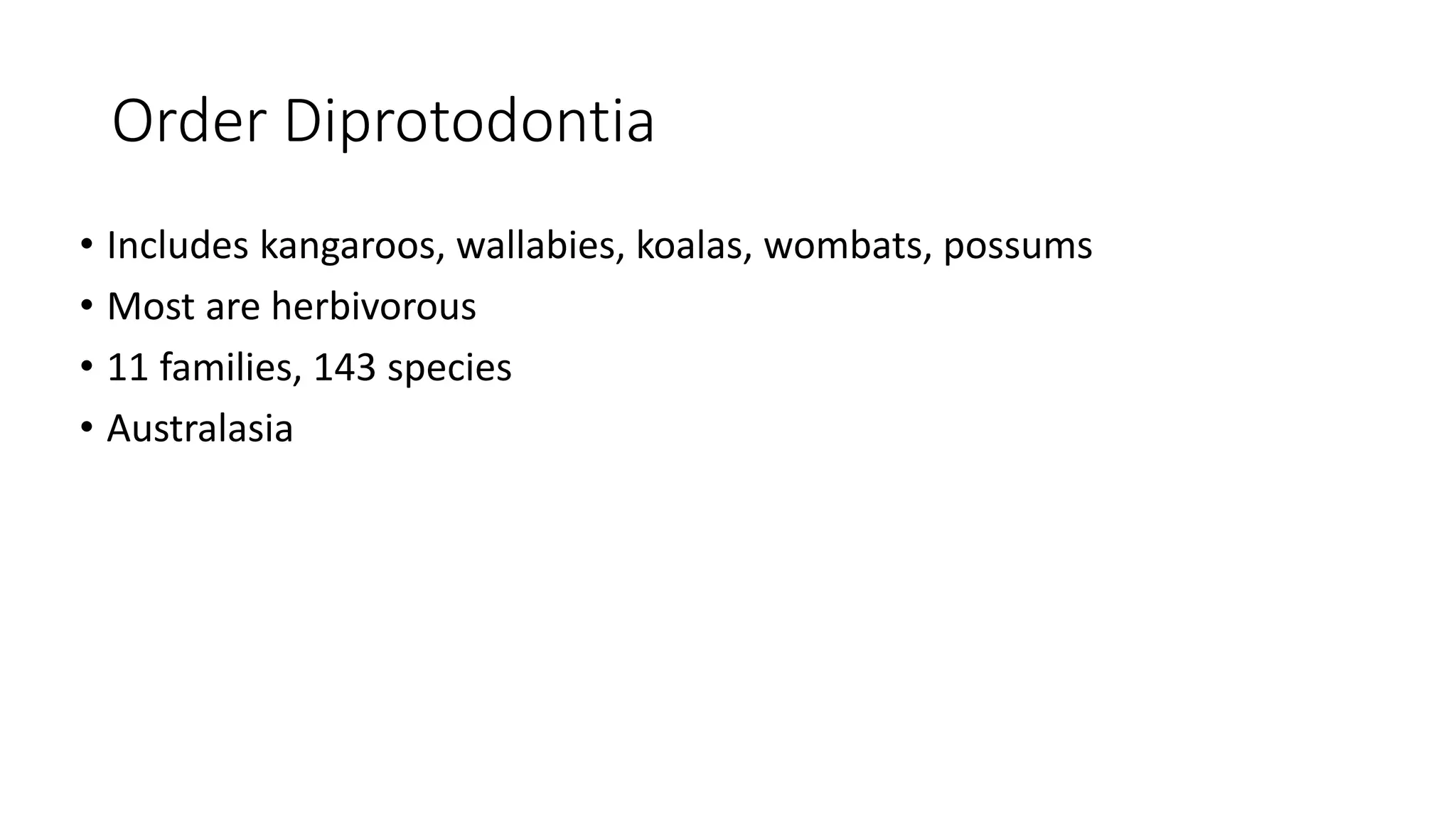
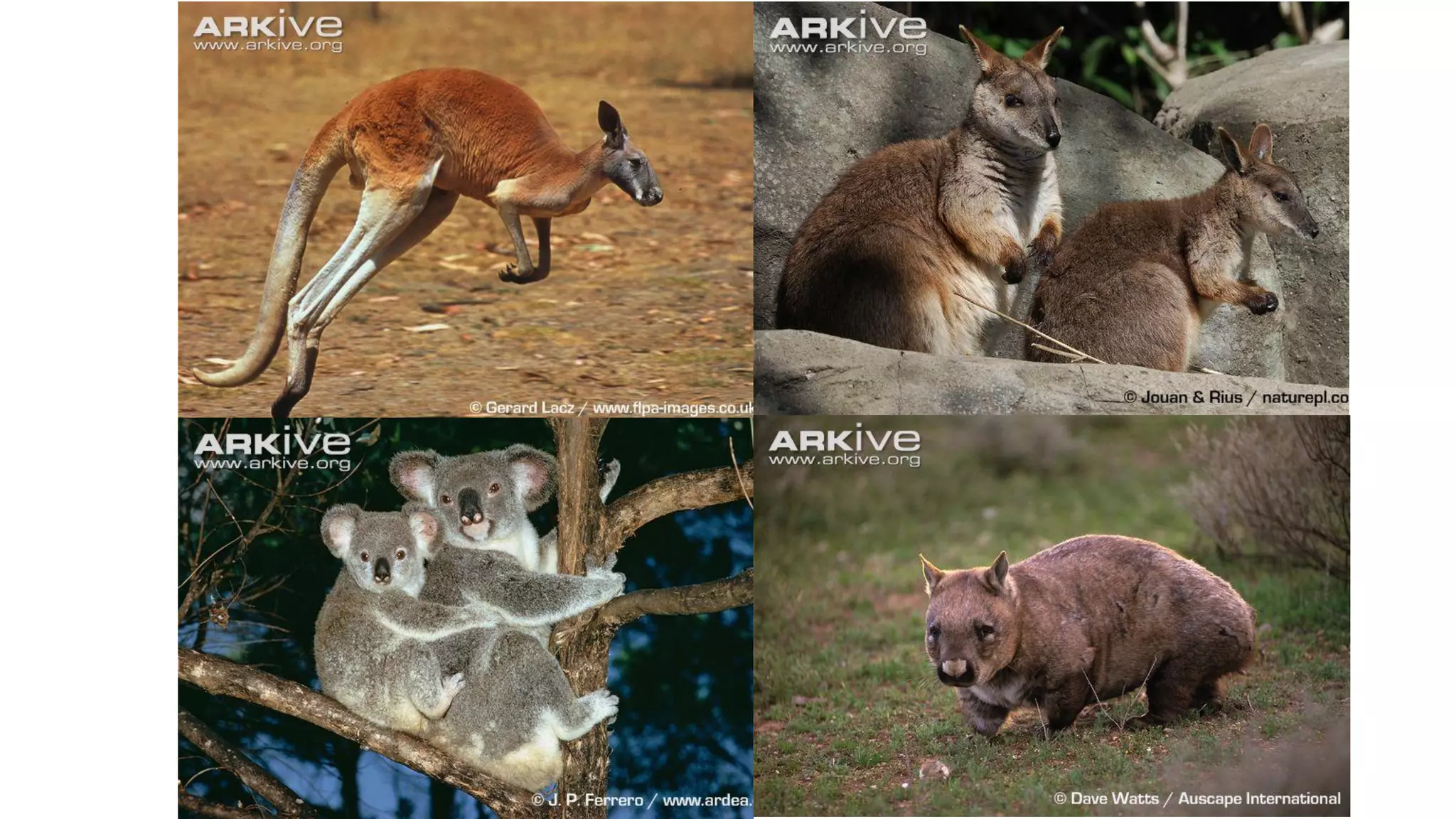
Order Diprotodontia
• Includes kangaroos, wallabies, koalas, wombats, possums
• Most are herbivorous
• 11 families, 143 species
• Australasia
Eutheria – Placental Mammals
Order Afrosoricida
• Tenrecs (Southern Africa) and Golden Moles (Africa and Madagascar)
• 2 families, 51 species
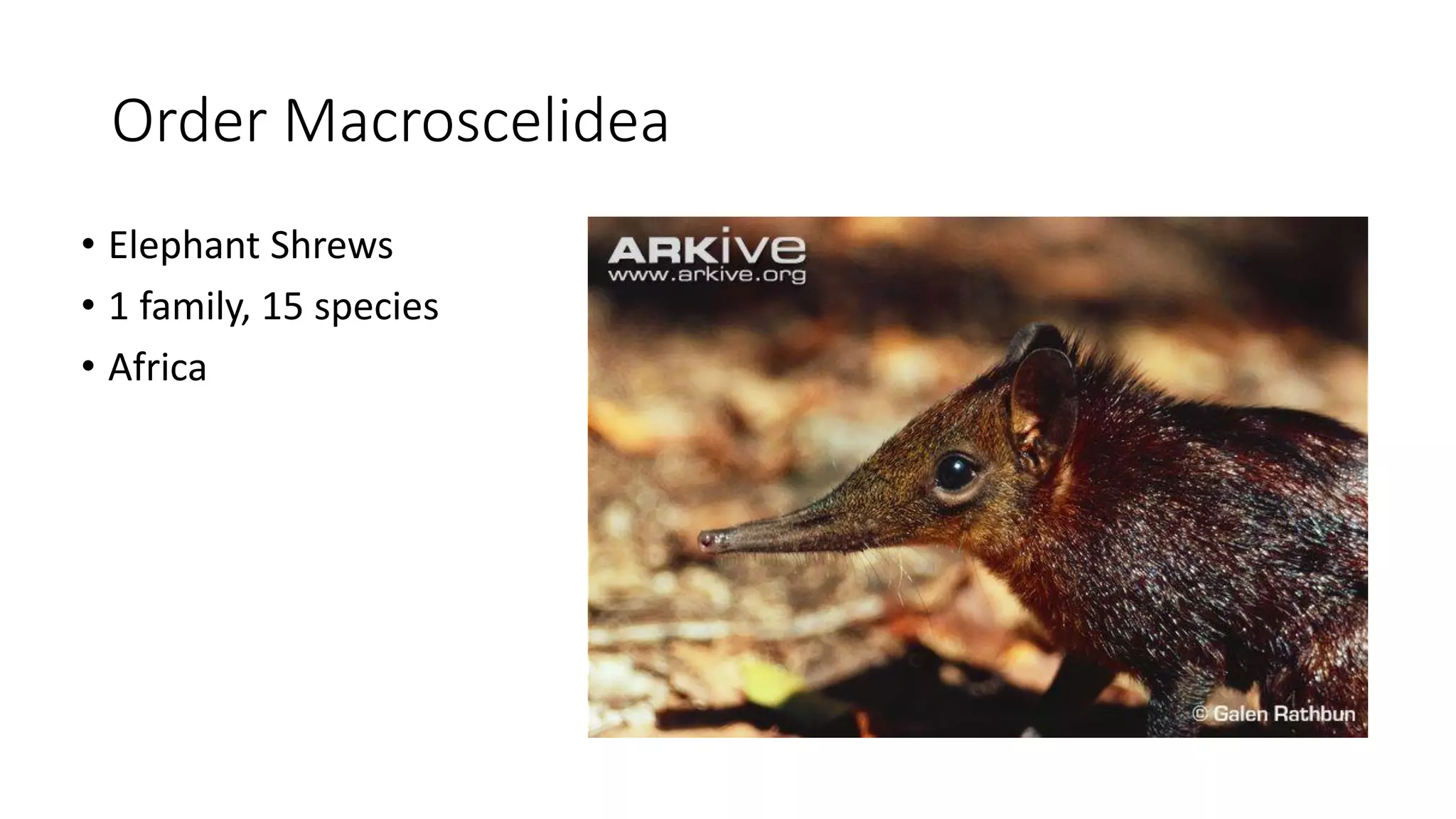
Order Macroscelidea
• Elephant Shrews
• 1 family, 15 species
• Africa
Order Tubulidentata
• Aardwark
• Africa
Order Hyracoidea
• Hyraxes
• 1 family, 4 species
• Africa and the
Middle East
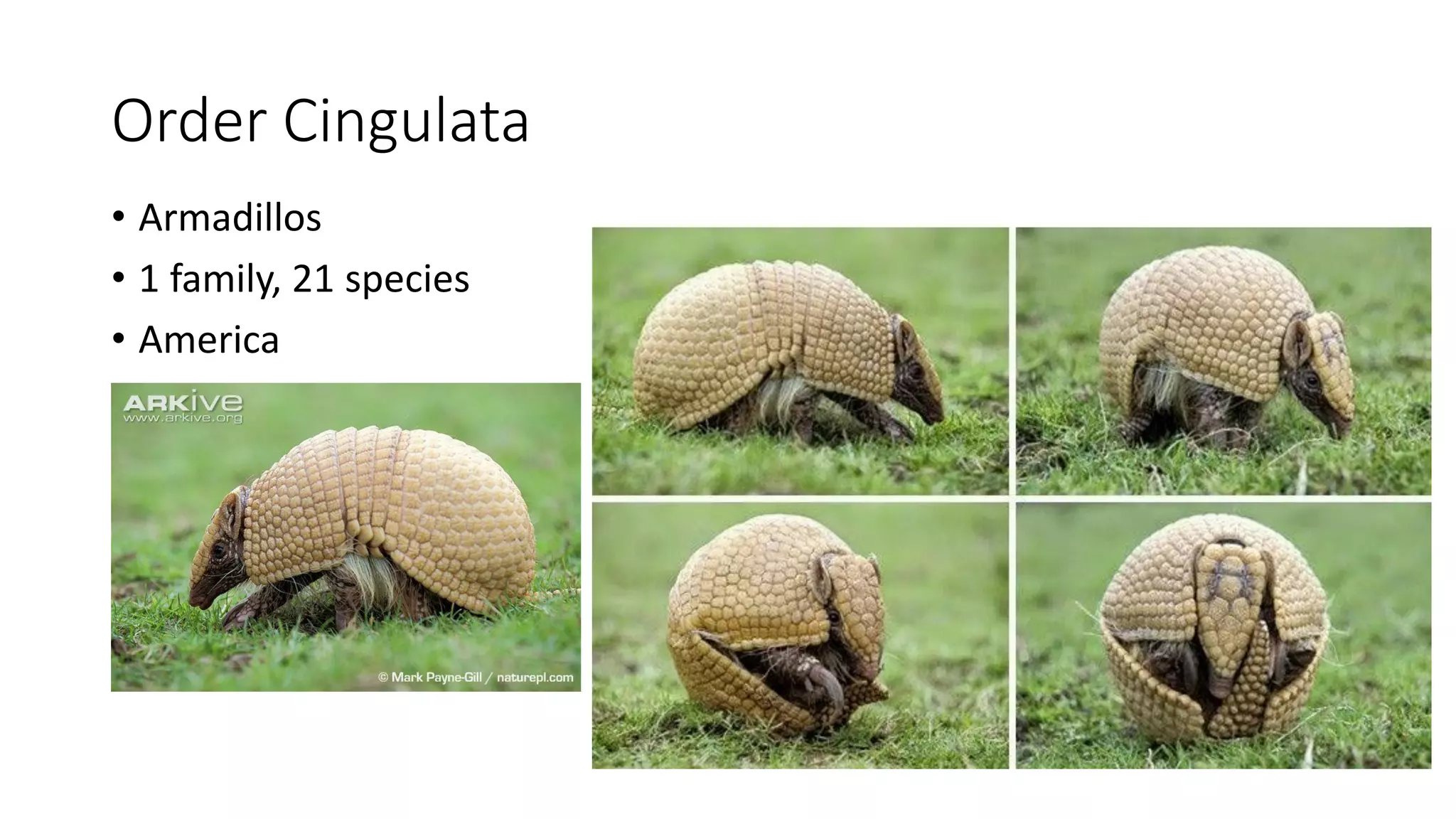
Order Cingulata
• Armadillos
• 1 family, 21 species
• America
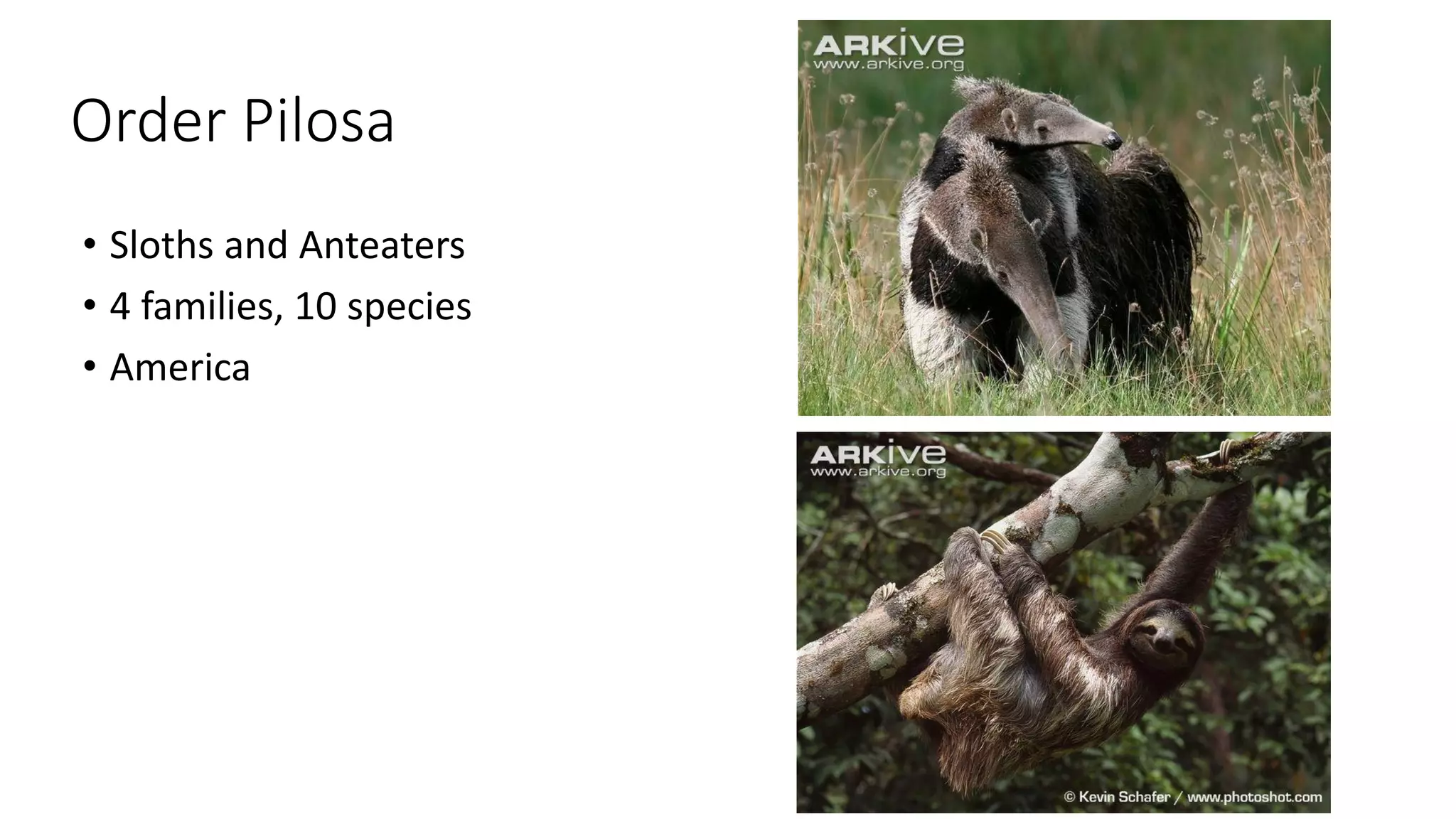
Order Pilosa
• Sloths and Anteaters
• 4 families, 10 species
• America
Order Dermoptera
• Flying Lemurs or Colugos
• Arboreal gliding mammals
• 1 family, 2 species
PRIMATES
Cercopithecidae
• Old World Monkeys
• Medium-sized to large monkeys with long trunks, ischial callosities narrow
nasal opening and palate, dagger-like canines, molars with two ridges, and
tail lacking or short in some, long in most; males usually larges than females
• 90-180 cm
• Palearctic, Afrotropical and Indo-Malayan region
• 23 genera, 159 species
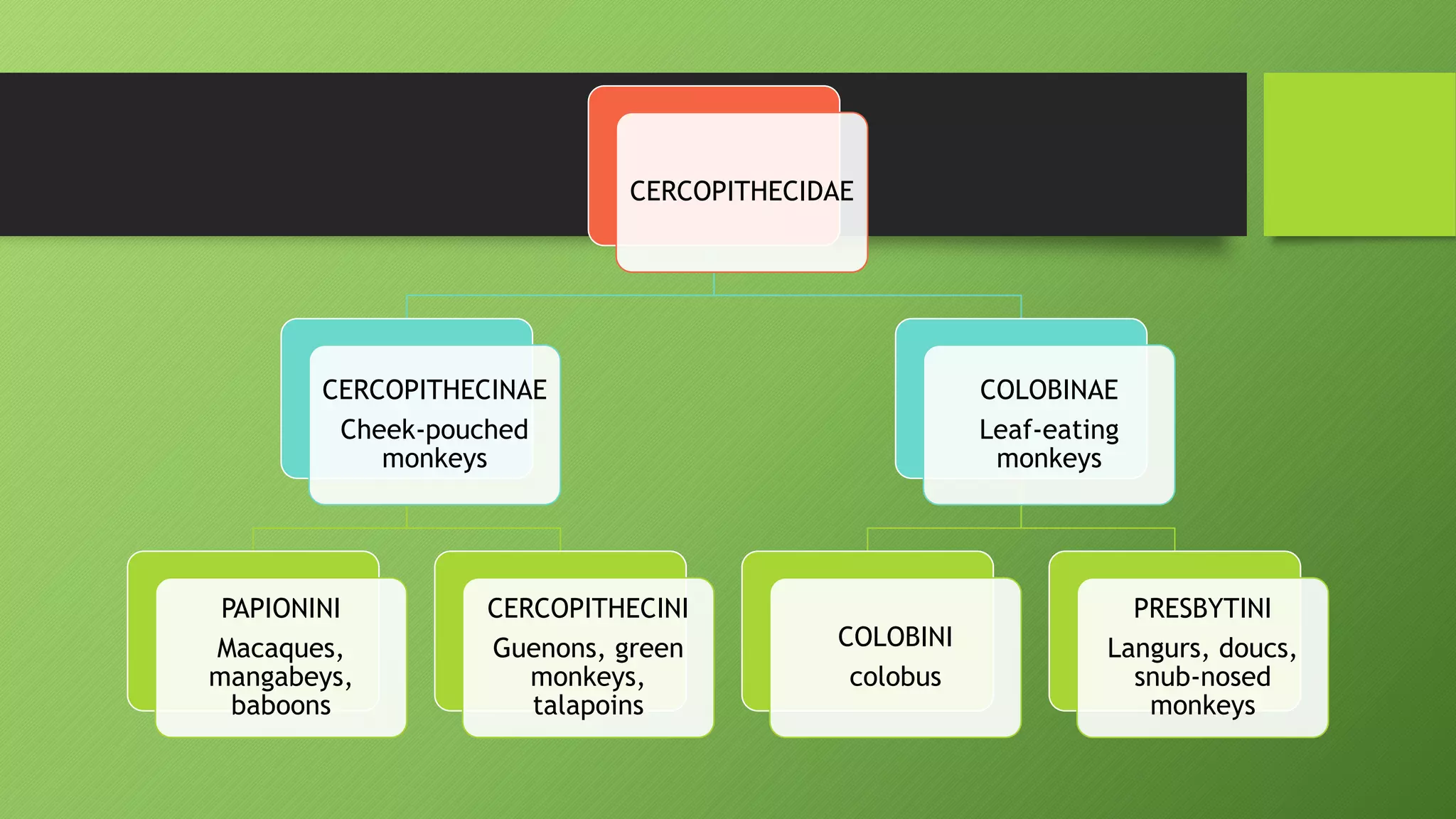
CERCOPITHECIDAE
CERCOPITHECINAE
Cheek-pouched
monkeys
PAPIONINI
Macaques,
mangabeys,
baboons
CERCOPITHECINI
Guenons, green
monkeys,
talapoins
COLOBINAE
Leaf-eating
monkeys
COLOBINI
colobus
PRESBYTINI
Langurs, doucs,
snub-nosed
monkeys
Mandrill
Gelada
Gelada
Angolan Colobus
Golden Snub-nosed Monkey
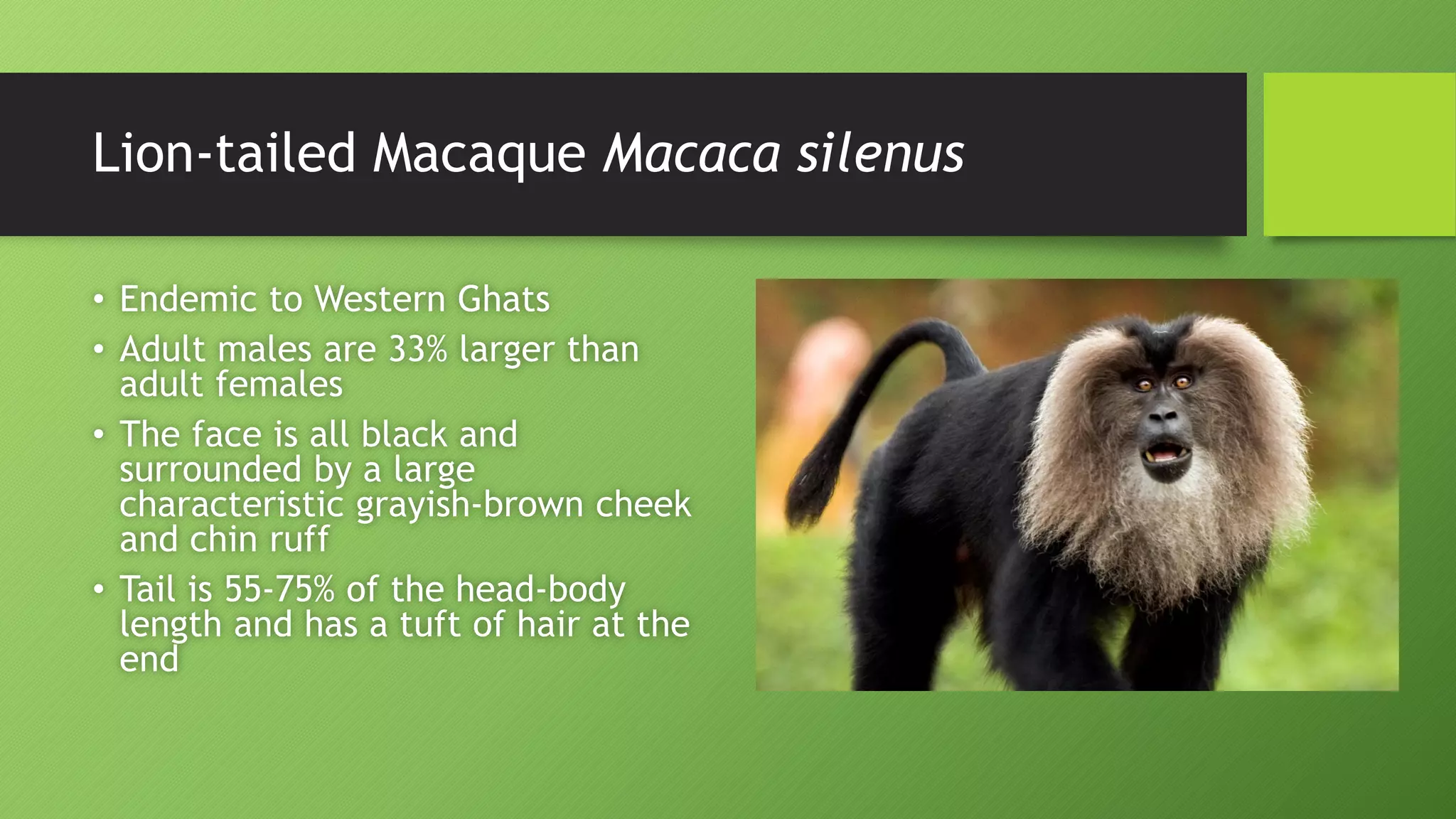
Lion-tailed Macaque Macaca silenus
• Endemic to Western Ghats
• Adult males are 33% larger than
adult females
• The face is all black and
surrounded by a large
characteristic grayish-brown cheek
and chin ruff
• Tail is 55-75% of the head-body
length and has a tuft of hair at the
end
• Fruits of Artocarpus and flowers and fruits of Cullenia exarillata
are important foods that are available through out the year
• Diurnal and arboreal
• Live in groups of 4-30 individuals
• EN
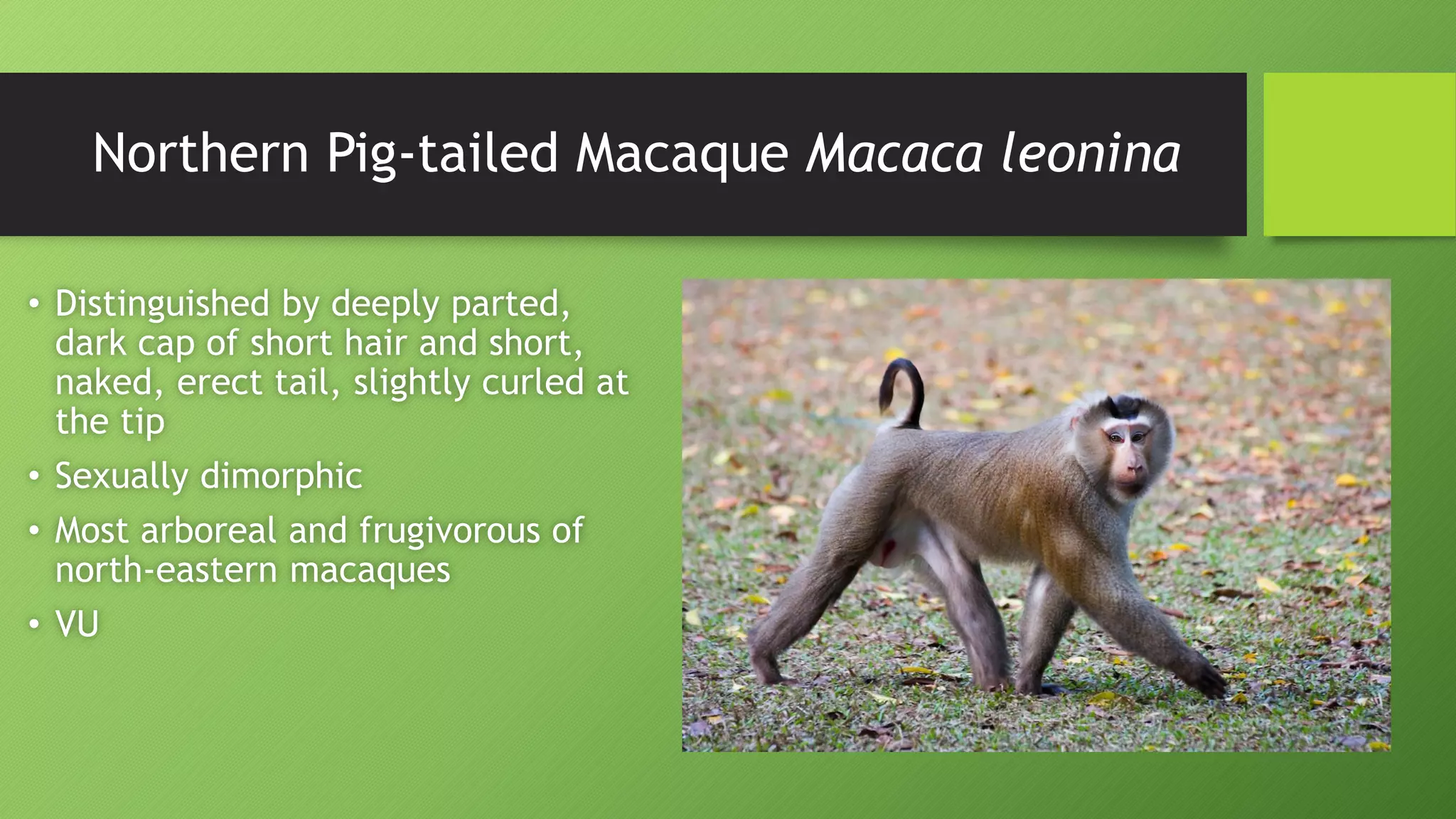
Northern Pig-tailed Macaque Macaca leonina
• Distinguished by deeply parted,
dark cap of short hair and short,
naked, erect tail, slightly curled at
the tip
• Sexually dimorphic
• Most arboreal and frugivorous of
north-eastern macaques
• VU
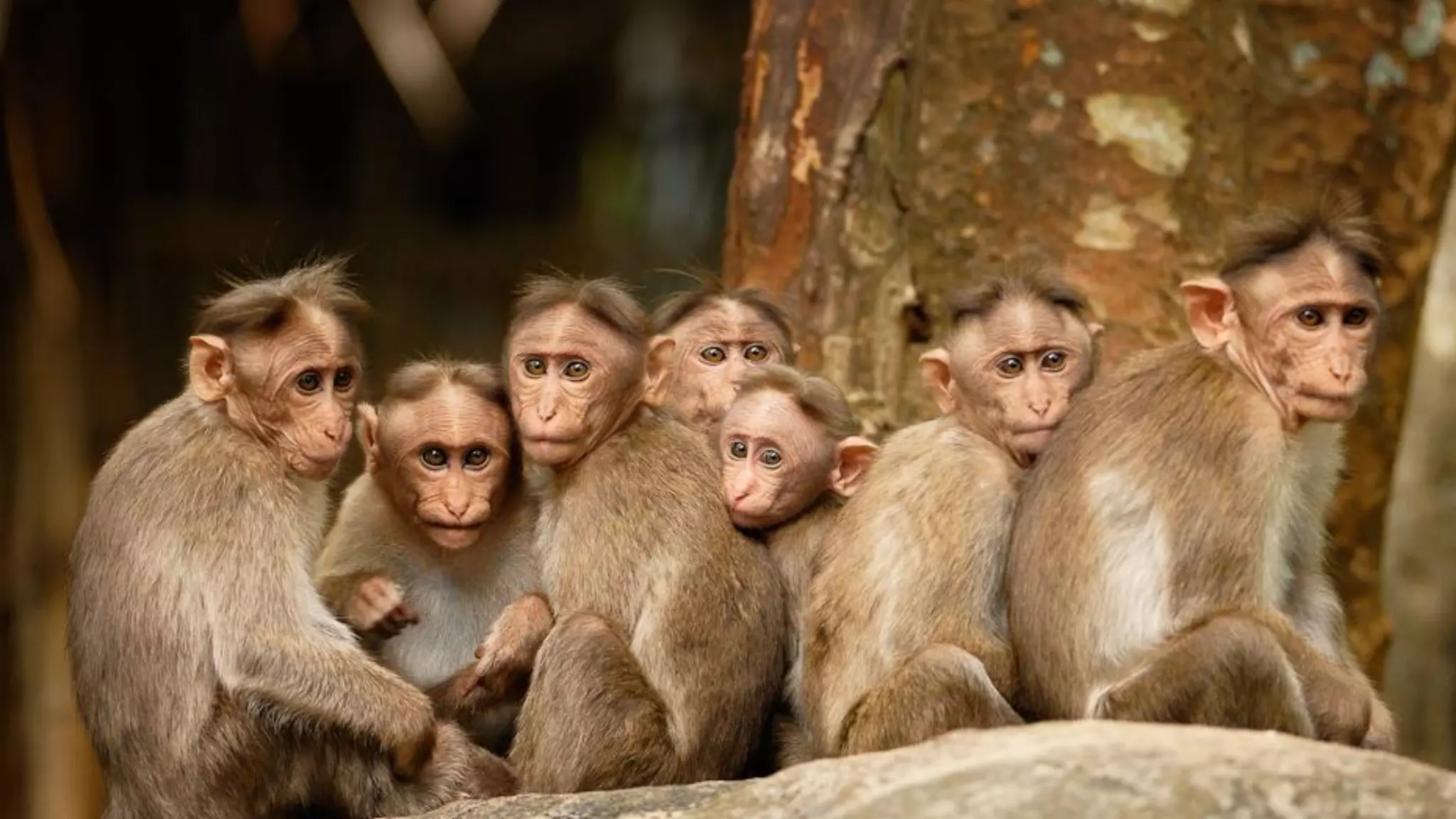
Bonnet Macaque Macaca radiata
• Distinguished by a cap or bonnet of long hair,
arranged in a whorl and parted clearly, and a very
long tail that is longer than body
• Face and ears are bare, with skin of adults being
brown to pinkish or bright scarlet in some females
• Males are larger and more heavily set than females
• M. r. radiata is common in places that have human habitation while M. r.
diluta is more a forest inhabitant
• Diet includes ripe fruits, seeds, flowers, shoots, animals etc.
• In urban areas they raid garbage dumps and home gardens
• M. r. radiata – Dark-bellied Bonnet Macaque
• M. r. diluta – Light-bellied Bonnet Macaque
• The former has grayish brown crown while the latter has pale yellowish-brown
crown.
• M. r. diluta has whitish ventral skin which largely lacks pigment (as opposed
to dark bluish gray ventral of radiate), hence the name light-bellied macaque
Assamese Macaque Macaca assamensis
• Is a heavy, thickset forest
macaque with a brownish
grey coat and pale venter
• It superficially resembles the
Rhesus but lacks the orange-
tinted posterior and has a
different tail carriage
• M. a. assamensis – Eastern Assamese Macaque
• M. a. pelops – Western Assamese Macaque
• M. a. pelops has a longer tail that is half the length of its head
and body, and twice the length of its hind foot while the other has
a shorter tail that is less than half or even a third of the length of
its head and body and only a little longer than its hind foot
• NT
Arunachal Macaque Macaca munzula
• A dark patch or whorl of hair on the
central crown, sometimes
surrounded by pale hairs, is
distinctive
• Dark brown face has a heavy jaw and
is not bearded like the Assamese
Macaque
• EN
Stump-Tailed Macaque Macaca arctoides
• Also known as the Bear Macaque
• Largest macaque species in India
• Unique crown of hair that radiates from a central whorl
and falls sleekly to the back of the head and reddish
pink face
• Prominent cheek pouches
• It has the shortest tail among macaques and is extremely
territorial by nature
• Males can be distinguished from females by their large size, large
genitalia and large canines
• Grows bald with age
• VU
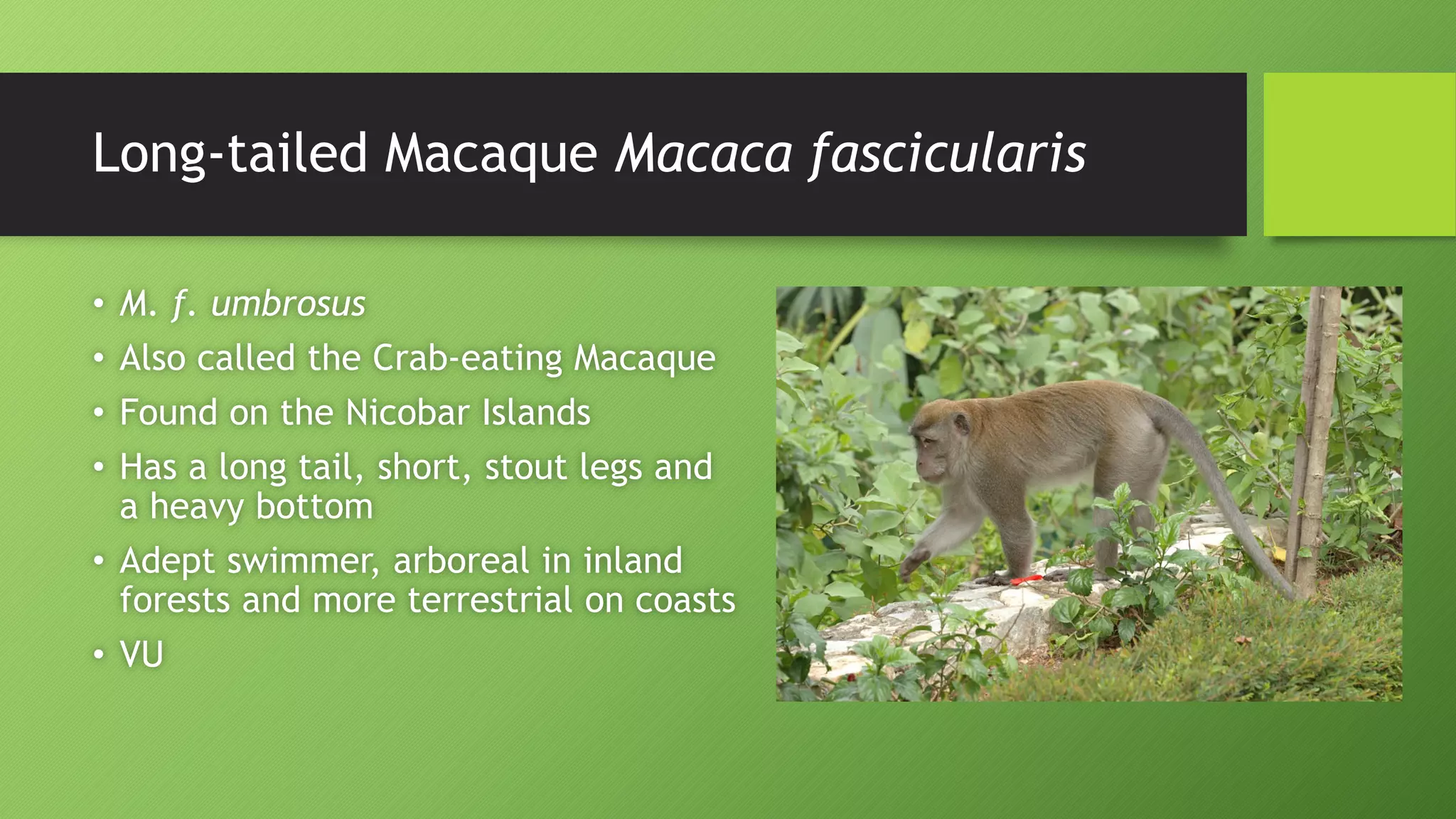
Long-tailed Macaque Macaca fascicularis
• M. f. umbrosus
• Also called the Crab-eating Macaque
• Found on the Nicobar Islands
• Has a long tail, short, stout legs and
a heavy bottom
• Adept swimmer, arboreal in inland
forests and more terrestrial on coasts
• VU
Rhesus Macaque Macaca mulatta
• Most widespread
• Brown in colour with fur varying from
very thick and dark to sparse sandy
brown
• Orangish tint to the fur in its
hindquarters and loins
• Carries its medium-sized tail erect with
a bend at the tip
• Dominance behavior by alpha males and sub-adults include threat
displays such as shaking tree branches (electric lines in cities)
• Most diverse habitat user – temple surrounds, urban, rural, village-
cum-pond, pond sides, road sides, canal sides and forests
• Hybridization with Assamese Macaque
Bengal Sacred Langur Semnopithecus entellus
• Northern Plains Langur
• Most widely spread langur in India
• It is a crestless, average-sized langur,
overall yellowish brown or pale
orange, ventrally suffused with buff
on the chest
• It is black-pawed up to the wrist and
has a forward-looped tail
• Male langurs possess harem and do not tolerate subadults or even
very young males in the troop. This makes it more peaceful
• Found in all habitats except desert, and also found near human
settlements
Chamba Sacred Langur Semnopithecus ajax
• A large hill langur, blunt headed,
maned, mauve-brown backed with
whitish venter and dark hands and
forearms.
• Dark silvery dorsal fur
• EN
Terai Sacred Langur Semnopithecus hector
• Medium-sized crestless
race, greyish brown on the
back and buff-white/pale
grey venter
• Distinctive grey moustache
on a black face and
uniformly pale grey hands
Nepal Sacred Langur Semnopithecus
schistaceus
• It is a maned, pale-pawed race similar in most
respects to the Terai Langur. It has a darker,
mauvish brown back than S. hector
• The ventral colour is whiter and the ruff
around the head can be heavy in higher
altitudes
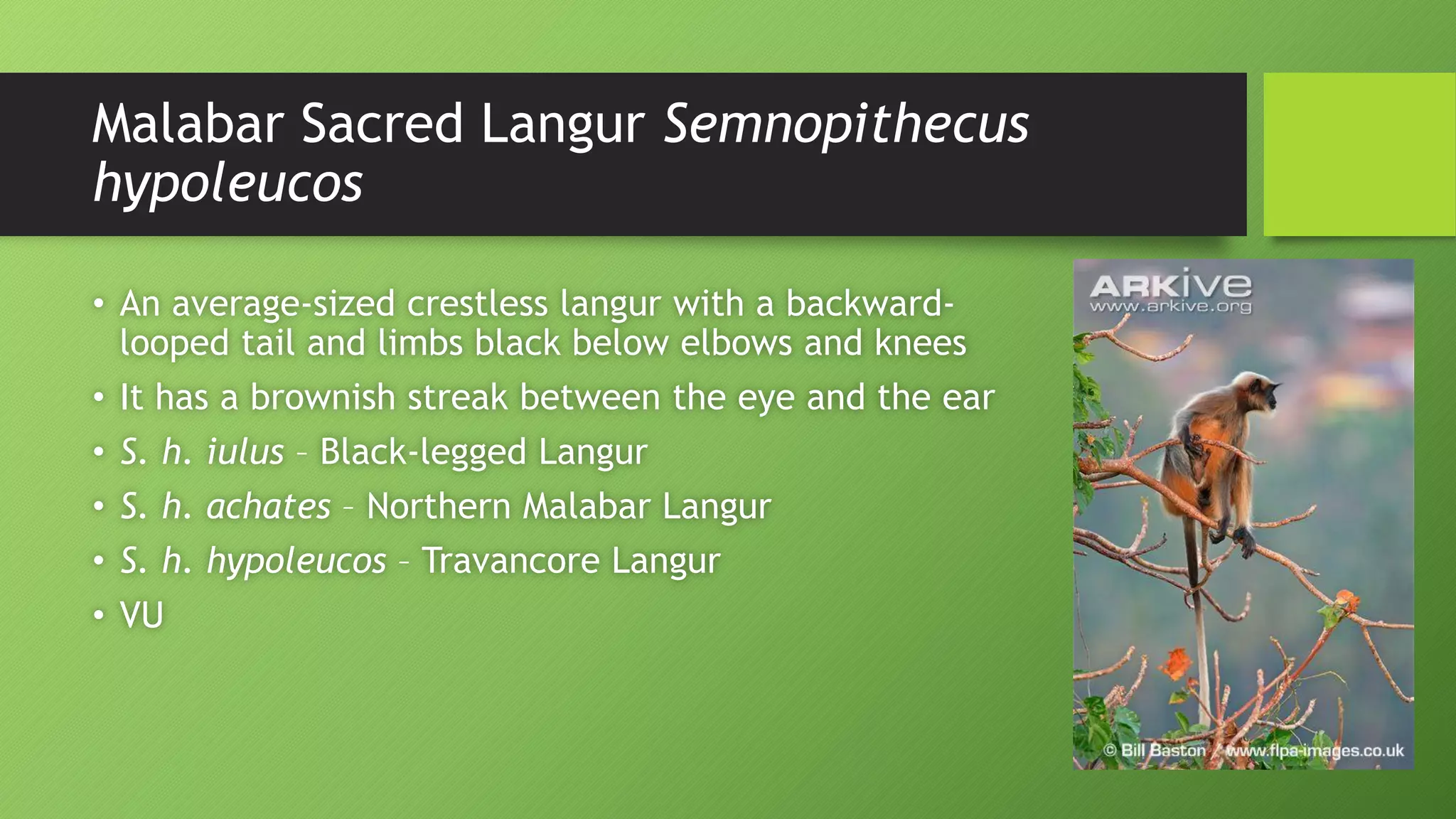
Malabar Sacred Langur Semnopithecus
hypoleucos
• An average-sized crestless langur with a backward-
looped tail and limbs black below elbows and knees
• It has a brownish streak between the eye and the ear
• S. h. iulus – Black-legged Langur
• S. h. achates – Northern Malabar Langur
• S. h. hypoleucos – Travancore Langur
• VU
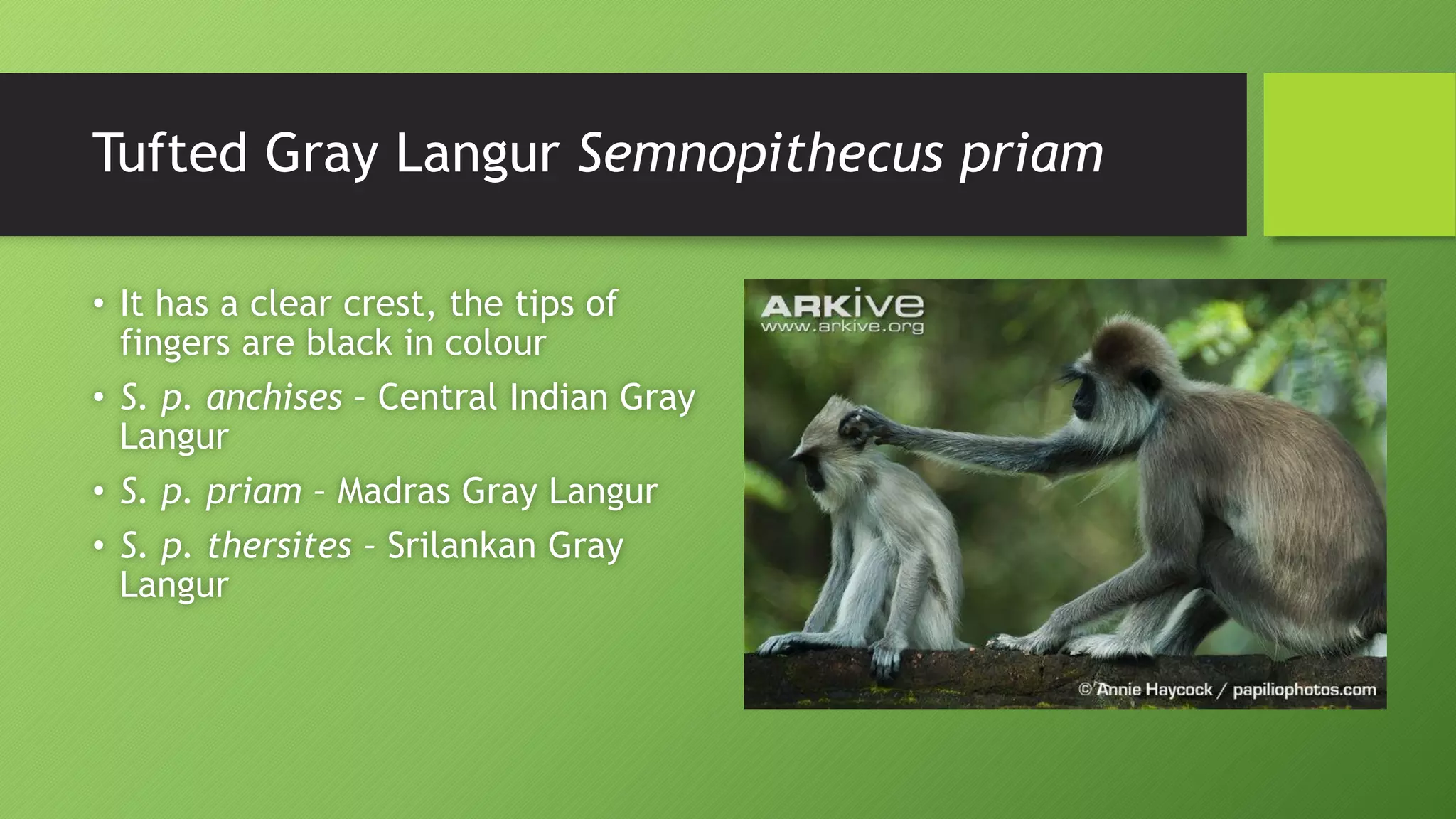
Tufted Gray Langur Semnopithecus priam
• It has a clear crest, the tips of
fingers are black in colour
• S. p. anchises – Central Indian Gray
Langur
• S. p. priam – Madras Gray Langur
• S. p. thersites – Srilankan Gray
Langur
132. S. entellus
133. S. ajax
134. S.hector
135. S. schistaceus
136. S. hypoleucos
137. S. priam
Nilgiri Langur Semnopithecus johnii
• The most vocal of southern forest monkeys, its
characteristic ‘hoo-hoo’ call can be heard mostly at
dawn and sometimes at dusk
• Endemic to Western Ghats
• VU
Golden Langur Trachypithecus geei
• It has deep cream to off-
white fur in the non-breeding
season and golden orange or
deep golden fur in the
breeding season
• Infants are orange-brown with
pink faces, palms and soles
• EN
Capped Langur Trachypithecus pileatus
• Found in North East India
• Varying belly colouration used to
separate subspecies
• They live exclusively on trees and
seldom come down to ground
• VU
Phayre’s Langur Trachypithecus phayrei
• Also called Phayre’s
Leaf Monkey
• The male has circular
white rings compared
with the females
whose eye rings are
roughly triangular
• Infant is golden
coloured
• EN
Hylobatidae
• Gibbons
• Small to medium-sized apes with slender body, short trunk, broad
chest, very long arms, short legs, ischial callosities, short muzzle,
shallow face, long canine teeth, simple molar teeth, long, curved,
slender digits, robust thumb and big toe, coat nearly black to
almost cream and no external tail; no sexual dimorphism
• 40-90 cm
• Indo-Malayan region
• 4 genera, 19 species
Western Hoolock Gibbon Hoolock hoolock
• Second largest gibbon in the world
after the Siamang
• Gibbons are monogamous and are
thought to pair for life
• Male are uniform black and females
are uniform blonde in colour
• EN
Eastern Hoolock Gibbon Hoolock leuconedys
• Female is paler than Western
Hoolock and not uniformly
coloured
• Males have white genital tufts,
white eyebrows have distinct
gap
• VU
Class - Mammalia, mammals classification

Class - Mammalia, mammals classification

  • 1.
  • 4.
    Order Monotremata • Prototheria– Monotremata • Egg laying mammals • 2 family, 5 species
  • 5.
    Characteristic features • Largeoocytes, big yolk,10mm in dia. • Pouches- Incubator. • Two months-in pouch- primitive mammary nodule • Build of spine- eject • Young obtain milk from mothers fur Have evolutionary advancement over reptiles • Nourishment from uterine endometrial gland • Hatches fast- at early stage of development • Lactation through mammary glands
  • 6.
    Marsupials • Metatheria –Marsupials • Pouched mammals • 7 orders
  • 7.
    Features of marsupials •Embryo develops rapidly- subsequent development in pouch • Eggshell membrane are retained- semi permeable barrier between the embryo and maternal tissue • Lack trophoblast • Modified reproductive cycle- Kangaroos – embryonic diapause • Focussing all the resources on one at a time
  • 8.
    Order Didelphimorphia • AmericanOpossums • 1 family, 87 species • North & South America
  • 9.
    Order Paucituberculata • ShrewOpossums • 1 family, 6 species • South America
  • 10.
    Order Microbiotheria • Monitodel monte • South America
  • 11.
    Order Dasyuromorphia • Carnivorousmarsupials • Includes quolls, dunnarts, the numbat and the Tasmanian devil • 2 extant families, 70 species • The extinct Tasmanian Wolf or Thylacine belonged to this order • Australia
  • 13.
    Order Paramelemorphia • Bandicootsand bilbies • Omnivorous marsupials • 3 families, 21 species • Australia and New Guinea
  • 14.
  • 15.
    Order Notoryctemorphia • Marsupialmoles • 1 family, 2 species • Australia
  • 16.
    Order Diprotodontia • Includeskangaroos, wallabies, koalas, wombats, possums • Most are herbivorous • 11 families, 143 species • Australasia
  • 18.
  • 19.
    Order Afrosoricida • Tenrecs(Southern Africa) and Golden Moles (Africa and Madagascar) • 2 families, 51 species
  • 20.
    Order Macroscelidea • ElephantShrews • 1 family, 15 species • Africa
  • 21.
  • 22.
    Order Hyracoidea • Hyraxes •1 family, 4 species • Africa and the Middle East
  • 23.
    Order Cingulata • Armadillos •1 family, 21 species • America
  • 24.
    Order Pilosa • Slothsand Anteaters • 4 families, 10 species • America
  • 25.
    Order Dermoptera • FlyingLemurs or Colugos • Arboreal gliding mammals • 1 family, 2 species
  • 26.
  • 27.
    Cercopithecidae • Old WorldMonkeys • Medium-sized to large monkeys with long trunks, ischial callosities narrow nasal opening and palate, dagger-like canines, molars with two ridges, and tail lacking or short in some, long in most; males usually larges than females • 90-180 cm • Palearctic, Afrotropical and Indo-Malayan region • 23 genera, 159 species
  • 28.
  • 29.
  • 30.
  • 31.
  • 32.
  • 33.
  • 34.
    Lion-tailed Macaque Macacasilenus • Endemic to Western Ghats • Adult males are 33% larger than adult females • The face is all black and surrounded by a large characteristic grayish-brown cheek and chin ruff • Tail is 55-75% of the head-body length and has a tuft of hair at the end
  • 35.
    • Fruits ofArtocarpus and flowers and fruits of Cullenia exarillata are important foods that are available through out the year • Diurnal and arboreal • Live in groups of 4-30 individuals • EN
  • 37.
    Northern Pig-tailed MacaqueMacaca leonina • Distinguished by deeply parted, dark cap of short hair and short, naked, erect tail, slightly curled at the tip • Sexually dimorphic • Most arboreal and frugivorous of north-eastern macaques • VU
  • 39.
    Bonnet Macaque Macacaradiata • Distinguished by a cap or bonnet of long hair, arranged in a whorl and parted clearly, and a very long tail that is longer than body • Face and ears are bare, with skin of adults being brown to pinkish or bright scarlet in some females • Males are larger and more heavily set than females
  • 41.
    • M. r.radiata is common in places that have human habitation while M. r. diluta is more a forest inhabitant • Diet includes ripe fruits, seeds, flowers, shoots, animals etc. • In urban areas they raid garbage dumps and home gardens
  • 42.
    • M. r.radiata – Dark-bellied Bonnet Macaque • M. r. diluta – Light-bellied Bonnet Macaque • The former has grayish brown crown while the latter has pale yellowish-brown crown. • M. r. diluta has whitish ventral skin which largely lacks pigment (as opposed to dark bluish gray ventral of radiate), hence the name light-bellied macaque
  • 44.
    Assamese Macaque Macacaassamensis • Is a heavy, thickset forest macaque with a brownish grey coat and pale venter • It superficially resembles the Rhesus but lacks the orange- tinted posterior and has a different tail carriage
  • 45.
    • M. a.assamensis – Eastern Assamese Macaque • M. a. pelops – Western Assamese Macaque • M. a. pelops has a longer tail that is half the length of its head and body, and twice the length of its hind foot while the other has a shorter tail that is less than half or even a third of the length of its head and body and only a little longer than its hind foot • NT
  • 47.
    Arunachal Macaque Macacamunzula • A dark patch or whorl of hair on the central crown, sometimes surrounded by pale hairs, is distinctive • Dark brown face has a heavy jaw and is not bearded like the Assamese Macaque • EN
  • 49.
    Stump-Tailed Macaque Macacaarctoides • Also known as the Bear Macaque • Largest macaque species in India • Unique crown of hair that radiates from a central whorl and falls sleekly to the back of the head and reddish pink face • Prominent cheek pouches
  • 50.
    • It hasthe shortest tail among macaques and is extremely territorial by nature • Males can be distinguished from females by their large size, large genitalia and large canines • Grows bald with age • VU
  • 52.
    Long-tailed Macaque Macacafascicularis • M. f. umbrosus • Also called the Crab-eating Macaque • Found on the Nicobar Islands • Has a long tail, short, stout legs and a heavy bottom • Adept swimmer, arboreal in inland forests and more terrestrial on coasts • VU
  • 54.
    Rhesus Macaque Macacamulatta • Most widespread • Brown in colour with fur varying from very thick and dark to sparse sandy brown • Orangish tint to the fur in its hindquarters and loins • Carries its medium-sized tail erect with a bend at the tip
  • 56.
    • Dominance behaviorby alpha males and sub-adults include threat displays such as shaking tree branches (electric lines in cities) • Most diverse habitat user – temple surrounds, urban, rural, village- cum-pond, pond sides, road sides, canal sides and forests • Hybridization with Assamese Macaque
  • 58.
    Bengal Sacred LangurSemnopithecus entellus • Northern Plains Langur • Most widely spread langur in India • It is a crestless, average-sized langur, overall yellowish brown or pale orange, ventrally suffused with buff on the chest • It is black-pawed up to the wrist and has a forward-looped tail
  • 59.
    • Male langurspossess harem and do not tolerate subadults or even very young males in the troop. This makes it more peaceful • Found in all habitats except desert, and also found near human settlements
  • 61.
    Chamba Sacred LangurSemnopithecus ajax • A large hill langur, blunt headed, maned, mauve-brown backed with whitish venter and dark hands and forearms. • Dark silvery dorsal fur • EN
  • 63.
    Terai Sacred LangurSemnopithecus hector • Medium-sized crestless race, greyish brown on the back and buff-white/pale grey venter • Distinctive grey moustache on a black face and uniformly pale grey hands
  • 65.
    Nepal Sacred LangurSemnopithecus schistaceus • It is a maned, pale-pawed race similar in most respects to the Terai Langur. It has a darker, mauvish brown back than S. hector • The ventral colour is whiter and the ruff around the head can be heavy in higher altitudes
  • 67.
    Malabar Sacred LangurSemnopithecus hypoleucos • An average-sized crestless langur with a backward- looped tail and limbs black below elbows and knees • It has a brownish streak between the eye and the ear • S. h. iulus – Black-legged Langur • S. h. achates – Northern Malabar Langur • S. h. hypoleucos – Travancore Langur • VU
  • 69.
    Tufted Gray LangurSemnopithecus priam • It has a clear crest, the tips of fingers are black in colour • S. p. anchises – Central Indian Gray Langur • S. p. priam – Madras Gray Langur • S. p. thersites – Srilankan Gray Langur
  • 71.
    132. S. entellus 133.S. ajax 134. S.hector 135. S. schistaceus 136. S. hypoleucos 137. S. priam
  • 72.
    Nilgiri Langur Semnopithecusjohnii • The most vocal of southern forest monkeys, its characteristic ‘hoo-hoo’ call can be heard mostly at dawn and sometimes at dusk • Endemic to Western Ghats • VU
  • 74.
    Golden Langur Trachypithecusgeei • It has deep cream to off- white fur in the non-breeding season and golden orange or deep golden fur in the breeding season • Infants are orange-brown with pink faces, palms and soles • EN
  • 76.
    Capped Langur Trachypithecuspileatus • Found in North East India • Varying belly colouration used to separate subspecies • They live exclusively on trees and seldom come down to ground • VU
  • 78.
    Phayre’s Langur Trachypithecusphayrei • Also called Phayre’s Leaf Monkey • The male has circular white rings compared with the females whose eye rings are roughly triangular • Infant is golden coloured • EN
  • 80.
    Hylobatidae • Gibbons • Smallto medium-sized apes with slender body, short trunk, broad chest, very long arms, short legs, ischial callosities, short muzzle, shallow face, long canine teeth, simple molar teeth, long, curved, slender digits, robust thumb and big toe, coat nearly black to almost cream and no external tail; no sexual dimorphism • 40-90 cm • Indo-Malayan region • 4 genera, 19 species
  • 81.
    Western Hoolock GibbonHoolock hoolock • Second largest gibbon in the world after the Siamang • Gibbons are monogamous and are thought to pair for life • Male are uniform black and females are uniform blonde in colour • EN
  • 83.
    Eastern Hoolock GibbonHoolock leuconedys • Female is paler than Western Hoolock and not uniformly coloured • Males have white genital tufts, white eyebrows have distinct gap • VU