
Sheep Farming
S.Y.B.Sc Zoology Sem IV
Biren Daftary
AdAdvantages
Sheep Products
• Wool and lambs
• Regular income twice a year
• Lambs can be grown for 5-6 months and sold odd for
quick returns
Sheep manure
• Source of fertilizer
• Individual sheep: 0.5 to 0.7 tonnes every year
• Twice as much N and K compared to cattle manure
Low maintenance cost
• Ability to thrive on natural vegetation
• Cost of feeding is very less
• High feed efficiency is remarkable
• No need of expensive building and equipment
Natural control of weeds
Converter of waste feed into profitable products
• Pasture-cheapest source of carbs, proteins and fats.
• Good pasture provides sufficient grazing for five
sheep per hectare
• Sheep can pick up lost grains due to peculiar
structure of their lips
No damage to trees
Play an important role in livelihood in India
Breeds of Sheep
• 40 breeds
• Named after place of origin or on prominent
characteristics
• Breeds: Indigenous, cross breeds, exotic
Indigenous Breeds
 3 or 4 types on basis of agroclimatic
conditions
• North western, central arid & semi arid region
• Northern temperature region
• Southern region
• Eastern region
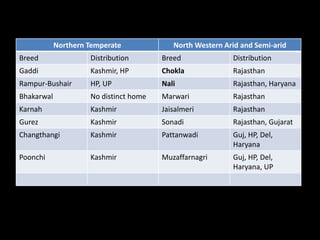
Northern Temperate
Northern Temperate North Western Arid and Semi-arid
Breed Distribution Breed Distribution
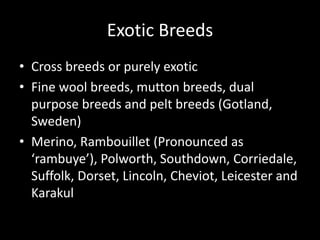
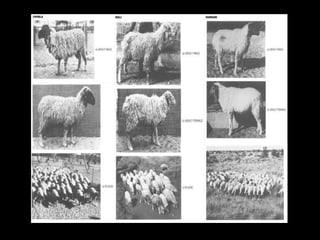
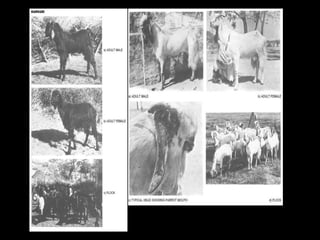
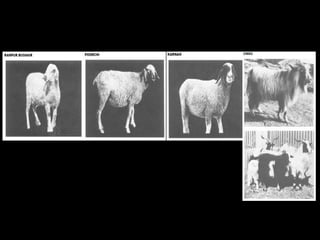
Gaddi Kashmir, HP Chokla Rajasthan
Rampur-Bushair HP, UP Nali Rajasthan, Haryana
Bhakarwal No distinct home Marwari Rajasthan
Karnah Kashmir Jaisalmeri Rajasthan
Gurez Kashmir Sonadi Rajasthan, Gujarat
Changthangi Kashmir Pattanwadi Guj, HP, Del,
Haryana
Poonchi Kashmir Muzaffarnagri Guj, HP, Del,
Haryana, UP
Exotic Breeds
• Cross breeds or purely exotic
• Fine wool breeds, mutton breeds, dual
purpose breeds and pelt breeds (Gotland,
Sweden)
• Merino, Rambouillet (Pronounced as
‘rambuye’), Polworth, Southdown, Corriedale,
Suffolk, Dorset, Lincoln, Cheviot, Leicester and
Karakul
Jamunapari
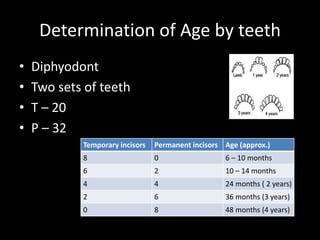
Determination of Age by teeth
• Diphyodont
• Two sets of teeth
• T – 20
• P – 32
Temporary incisors Permanent incisors Age (approx.)
8 0 6 – 10 months
6 2 10 – 14 months
4 4 24 months ( 2 years)
2 6 36 months (3 years)
0 8 48 months (4 years)
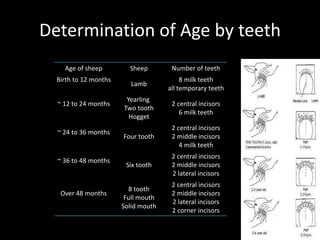
Determination of Age by teeth
Age of sheep Sheep Number of teeth
Birth to 12 months
Lamb
8 milk teeth
all temporary teeth
~ 12 to 24 months
Yearling
Two tooth
Hogget
2 central incisors
6 milk teeth
~ 24 to 36 months
Four tooth
2 central incisors
2 middle incisors
4 milk teeth
~ 36 to 48 months
Six tooth
2 central incisors
2 middle incisors
2 lateral incisors
Over 48 months
8 tooth
Full mouth
Solid mouth
2 central incisors
2 middle incisors
2 lateral incisors
2 corner incisors
Feeding of ewes (resting period)
• Food requirements are low
• Grazing on green grasslands
• Common leguminous plants
• 1 – 2 kg / day
• Feed supply increased before breeding
• Flushing
• Grain ration (maize, oats, jowar, hay)
Feeding (during gestation)
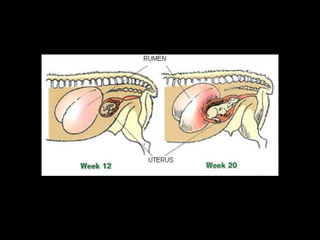
• Gestation period 143 – 151 days (avg. 148 days)
• Feeding during first 10 weeks
– Not critical
– Legume hay, grass, maize
– Mineral supplements
– Salt – important constituent
• Feeding during last half of gestation period
– 110 gm grains added from 11th to 15th week
– 225 gm from 16th week
– Additional protein may be added
• Feeding during suckling period
– Lambs to be fed properly
– Proper amount of milk production
• Feeding during first 10 days after lambing
– Reduction of concentrates in ration
– Amount of grain should be gradually increased as
lambs grow
• Feeding after lambing until weaning
– Allowed to feed on green pastures
– Amount of mineral and salt (w.r.t pasture quality)
– High quality silage, grain, hay
Breeding
• March to April, June to July, Sept to Oct – Breeding season
• Preparing the ewe for breeding:
– Flushing – extra ration, fresh pasture. Helps in increasing
ovum
– Tagging – Docking, removing wool
– Eyeing – clipping excess wool around the eyes to remove
blindness
• Preparing of ram for breeding:
– Shearing – remove wool. Make active and improve fertility
– Ringing – clipping the wool from neck and belly region.
Proper contact
System of mating
• Flock mating system (30 – 45 ewes and 1 ram)
• Semi flock system (breeding only at night, rest
during the day)
• Hand mating system (selected ewe and ram
breeding)
• Artificial insemination
• Controlling heat (oestrous synchronization)
• Telescopic breeding
• Administration of hormones or their analogues
Signs of pregnancy
• Ewes which are not pregnant will not gain weight
• Ewes carrying single lamb will be leaner in
appearance
• Ewes carrying twins will be heavier
• Separation of flock
• Scratching the ground with fore-legs
• Becoming restless, changing position either by
standing / sitting
• Trying to find sheltered place away from the flock
(Physiological signs)
• Enlargement of vulva
• Distention of udder
• Wax formation on teats
• Sign of filling of teats with milk
• Sinking away on either side of the rump
Lambing
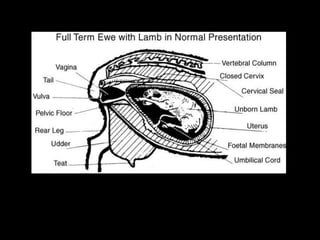
• Act of bringing forth the lamb
• Signs: leave the flock, restlessness, distended
udder, genetilia in flushed and flaccid condition
• Labour pain → strain → water bag
• Birth of the lamb
• Colostrum
• Multiple deliveries
• Management of complications in lambing
Raising lambs
• First 48 hours most critical
Caring of lambs
• Care of navel cord
• Removal of mucous
• Feeding
a) Immediately after birth
b) Orphaned/disowned lamb
c) 10 days old lamb
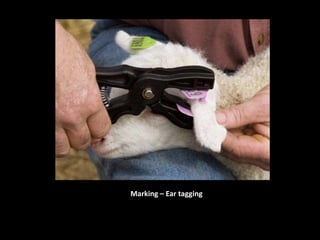
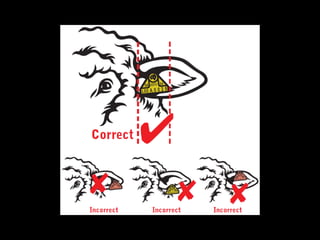
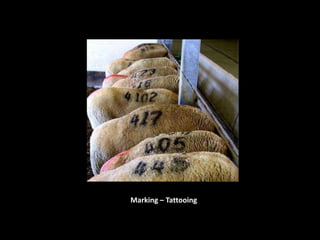
• Marking (ear tagging & tattooing)
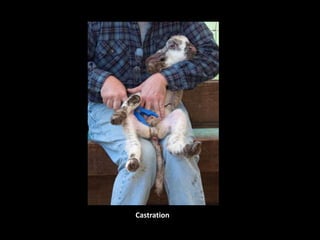
• Castration (7-14 days old)
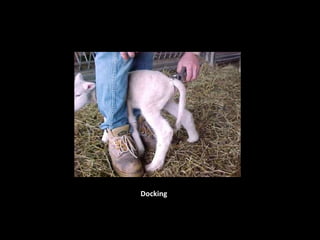
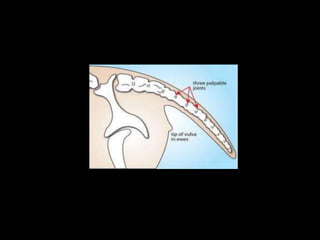
• Docking
• Weaning (3 months old)
a. If rebreeding desired → 2 months
b. If low milk production → 2 months
c. Supplementary feed : 20 parts oil cake in place
of grains
d. Gastro-intestinal parasitic treatment(within 30
days)
e. CuSo4
Castration
Docking
Marking – Ear tagging
Marking – Tattooing
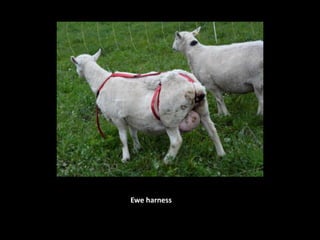
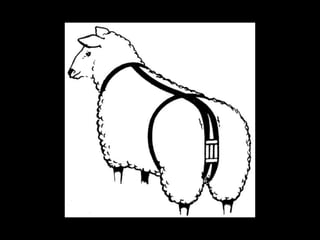
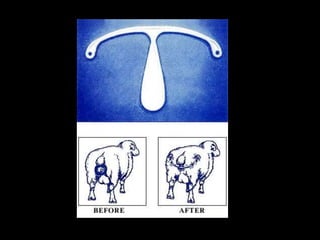
Ewe harness
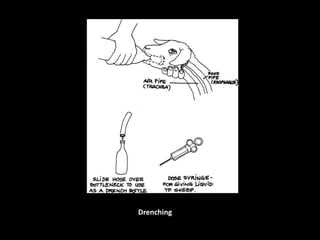
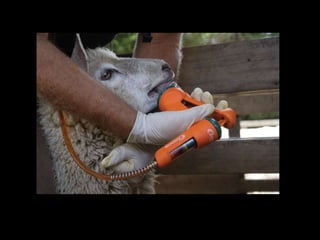
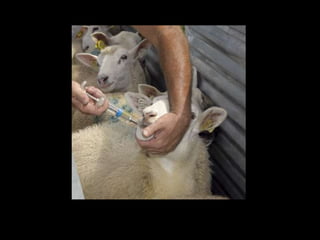
Drenching
Sheep farming
Sheep farming
Sheep farming

Sheep farming

  • 1.
    Sheep Farming S.Y.B.Sc ZoologySem IV Biren Daftary
  • 2.
    AdAdvantages Sheep Products • Wooland lambs • Regular income twice a year • Lambs can be grown for 5-6 months and sold odd for quick returns Sheep manure • Source of fertilizer • Individual sheep: 0.5 to 0.7 tonnes every year • Twice as much N and K compared to cattle manure
  • 3.
    Low maintenance cost •Ability to thrive on natural vegetation • Cost of feeding is very less • High feed efficiency is remarkable • No need of expensive building and equipment Natural control of weeds
  • 4.
    Converter of wastefeed into profitable products • Pasture-cheapest source of carbs, proteins and fats. • Good pasture provides sufficient grazing for five sheep per hectare • Sheep can pick up lost grains due to peculiar structure of their lips No damage to trees Play an important role in livelihood in India
  • 5.
    Breeds of Sheep •40 breeds • Named after place of origin or on prominent characteristics • Breeds: Indigenous, cross breeds, exotic
  • 6.
    Indigenous Breeds  3or 4 types on basis of agroclimatic conditions • North western, central arid & semi arid region • Northern temperature region • Southern region • Eastern region
  • 7.
    Northern Temperate Northern TemperateNorth Western Arid and Semi-arid Breed Distribution Breed Distribution Gaddi Kashmir, HP Chokla Rajasthan Rampur-Bushair HP, UP Nali Rajasthan, Haryana Bhakarwal No distinct home Marwari Rajasthan Karnah Kashmir Jaisalmeri Rajasthan Gurez Kashmir Sonadi Rajasthan, Gujarat Changthangi Kashmir Pattanwadi Guj, HP, Del, Haryana Poonchi Kashmir Muzaffarnagri Guj, HP, Del, Haryana, UP
  • 8.
    Exotic Breeds • Crossbreeds or purely exotic • Fine wool breeds, mutton breeds, dual purpose breeds and pelt breeds (Gotland, Sweden) • Merino, Rambouillet (Pronounced as ‘rambuye’), Polworth, Southdown, Corriedale, Suffolk, Dorset, Lincoln, Cheviot, Leicester and Karakul
  • 10.
  • 12.
    Determination of Ageby teeth • Diphyodont • Two sets of teeth • T – 20 • P – 32 Temporary incisors Permanent incisors Age (approx.) 8 0 6 – 10 months 6 2 10 – 14 months 4 4 24 months ( 2 years) 2 6 36 months (3 years) 0 8 48 months (4 years)
  • 13.
    Determination of Ageby teeth Age of sheep Sheep Number of teeth Birth to 12 months Lamb 8 milk teeth all temporary teeth ~ 12 to 24 months Yearling Two tooth Hogget 2 central incisors 6 milk teeth ~ 24 to 36 months Four tooth 2 central incisors 2 middle incisors 4 milk teeth ~ 36 to 48 months Six tooth 2 central incisors 2 middle incisors 2 lateral incisors Over 48 months 8 tooth Full mouth Solid mouth 2 central incisors 2 middle incisors 2 lateral incisors 2 corner incisors
  • 14.
    Feeding of ewes(resting period) • Food requirements are low • Grazing on green grasslands • Common leguminous plants • 1 – 2 kg / day • Feed supply increased before breeding • Flushing • Grain ration (maize, oats, jowar, hay)
  • 15.
    Feeding (during gestation) •Gestation period 143 – 151 days (avg. 148 days) • Feeding during first 10 weeks – Not critical – Legume hay, grass, maize – Mineral supplements – Salt – important constituent • Feeding during last half of gestation period – 110 gm grains added from 11th to 15th week – 225 gm from 16th week – Additional protein may be added
  • 16.
    • Feeding duringsuckling period – Lambs to be fed properly – Proper amount of milk production • Feeding during first 10 days after lambing – Reduction of concentrates in ration – Amount of grain should be gradually increased as lambs grow • Feeding after lambing until weaning – Allowed to feed on green pastures – Amount of mineral and salt (w.r.t pasture quality) – High quality silage, grain, hay
  • 17.
    Breeding • March toApril, June to July, Sept to Oct – Breeding season • Preparing the ewe for breeding: – Flushing – extra ration, fresh pasture. Helps in increasing ovum – Tagging – Docking, removing wool – Eyeing – clipping excess wool around the eyes to remove blindness • Preparing of ram for breeding: – Shearing – remove wool. Make active and improve fertility – Ringing – clipping the wool from neck and belly region. Proper contact
  • 18.
    System of mating •Flock mating system (30 – 45 ewes and 1 ram) • Semi flock system (breeding only at night, rest during the day) • Hand mating system (selected ewe and ram breeding) • Artificial insemination • Controlling heat (oestrous synchronization) • Telescopic breeding • Administration of hormones or their analogues
  • 19.
    Signs of pregnancy •Ewes which are not pregnant will not gain weight • Ewes carrying single lamb will be leaner in appearance • Ewes carrying twins will be heavier • Separation of flock • Scratching the ground with fore-legs • Becoming restless, changing position either by standing / sitting • Trying to find sheltered place away from the flock
  • 20.
    (Physiological signs) • Enlargementof vulva • Distention of udder • Wax formation on teats • Sign of filling of teats with milk • Sinking away on either side of the rump
  • 21.
    Lambing • Act ofbringing forth the lamb • Signs: leave the flock, restlessness, distended udder, genetilia in flushed and flaccid condition • Labour pain → strain → water bag • Birth of the lamb • Colostrum • Multiple deliveries • Management of complications in lambing
  • 22.
    Raising lambs • First48 hours most critical Caring of lambs • Care of navel cord • Removal of mucous • Feeding a) Immediately after birth b) Orphaned/disowned lamb c) 10 days old lamb
  • 23.
    • Marking (eartagging & tattooing) • Castration (7-14 days old) • Docking • Weaning (3 months old) a. If rebreeding desired → 2 months b. If low milk production → 2 months c. Supplementary feed : 20 parts oil cake in place of grains d. Gastro-intestinal parasitic treatment(within 30 days) e. CuSo4
  • 24.
  • 25.
  • 27.
  • 29.
  • 32.
  • 35.