Summary: 
1) Scientific classification 
2) Characteristics 
3) Life-cycle 
4) Behavior 
5) Habitat 
6) Location 
7) Bite 
8) Effects of its bite 
9) Sources 
BBrroowwnn rreecclluussee ssppiiddeerr -- AAgguussttíínn MMAARRTTIINNEEZZ ZZUUMMEELL –– MMRRGGII –– EENNMMSSEE -- 11//1133
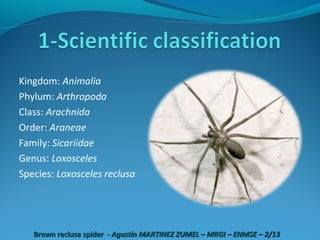
Kingdom: Animalia 
Phylum: Arthropoda 
Class: Arachnida 
Order: Araneae 
Family: Sicariidae 
Genus: Loxosceles 
Species: Loxosceles reclusa 
BBrroowwnn rreecclluussee ssppiiddeerr -- AAgguussttíínn MMAARRTTIINNEEZZ ZZUUMMEELL –– MMRRGGII –– EENNMMSSEE –– 22//1133
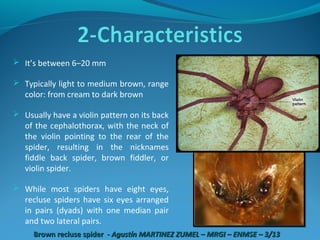
 It’s between 6–20 mm 
 Typically light to medium brown, range 
color: from cream to dark brown 
 Usually have a violin pattern on its back 
of the cephalothorax, with the neck of 
the violin pointing to the rear of the 
spider, resulting in the nicknames 
fiddle back spider, brown fiddler, or 
violin spider. 
 While most spiders have eight eyes, 
recluse spiders have six eyes arranged 
in pairs (dyads) with one median pair 
and two lateral pairs. 
BBrroowwnn rreecclluussee ssppiiddeerr -- AAgguussttíínn MMAARRTTIINNEEZZ ZZUUMMEELL –– MMRRGGII –– EENNMMSSEE –– 33//1133
 Adult brown recluse spiders often lives about one to two years. 
 Each female produces several egg sacs over a period of two to 
three months, from May to July, with approximately fifty eggs in 
each sack. 
 The spiderlings take about one year to grow to adulthood. The 
brown recluse spider is resilient and can tolerate up to six 
months of extreme drought and scarcity or absence of food. 
BBrroowwnn rreecclluussee ssppiiddeerr -- AAgguussttíínn MMAARRTTIINNEEZZ ZZUUMMEELL –– MMRRGGII –– EENNMMSSEE –– 55//1133
 When is threatened it usually flees, seemingly to avoid a conflict. 
The spider doesn’t usually jump unless be touched brusquely, and 
even then its avoidance movement is more of a horizontal lunge. 
 A brown recluse's stance on a flat surface is usually with all legs 
radially extended. When alarmed it may lower its body, withdraw 
the two front legs backwards in a defensive position, withdraw the 
rearmost pair of legs into a position for lunging forward. 
BBrroowwnn rreecclluussee ssppiiddeerr -- AAgguussttíínn MMAARRTTIINNEEZZ ZZUUMMEELL –– MMRRGGII –– EENNMMSSEE –– 44//1133
BBrroowwnn rreecclluussee ssppiiddeerr -- AAgguussttíínn MMAARRTTIINNEEZZ ZZUUMMEELL –– MMRRGGII –– EENNMMSSEE -- 66//1133
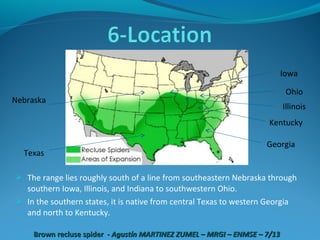
Iowa 
Ohio 
Kentucky 
Georgia 
Nebraska 
Texas 
 The range lies roughly south of a line from southeastern Nebraska through 
southern Iowa, Illinois, and Indiana to southwestern Ohio. 
 In the southern states, it is native from central Texas to western Georgia 
and north to Kentucky. 
BBrroowwnn rreecclluussee ssppiiddeerr -- AAgguussttíínn MMAARRTTIINNEEZZ ZZUUMMEELL –– MMRRGGII –– EENNMMSSEE –– 77//1133 
Illinois
 The brown recluse venom is extremely poisonous. Its powerful 
necrotizing venom (destroys living tissue) contains the dermonecrotic 
agent sphingomyelinase D. 
 It’s even more potent than a rattlesnake. The recluse venom causes less 
disease than a rattlesnake bite because of the small quantities injected 
into its victims. It’s toxic to cells and tissues. 
 The brown recluse spider is rarely aggressive, and bites from the species 
are uncommon. The spider usually bites only when pressed against the 
skin, such as when tangled within clothes, towels, bedding and inside 
work gloves. 
 This species of spider normally attacks its prey by injecting venom along 
with its bite. The venom is powerful and it is used to kill other insects. 
BBrroowwnn rreecclluussee ssppiiddeerr -- AAgguussttíínn MMAARRTTIINNEEZZ ZZUUMMEELL –– MMRRGGII –– EENNMMSSEE –– 88//1133
 The bite frequently is not felt initially and may not be immediately 
painful, but it can be serious. 
 The bites produced a range of symptoms common to many members 
of the Loxosceles genus known as loxoscelism, which may be severe 
dermonecrotic lesions (i.e. necrosis); an even smaller number produce 
severe cutaneous (skin) or viscerocutaneous (systemic) symptoms. 
 The systemic symptoms most commonly experienced include nausea, 
vomiting, fever, rashes, and muscle and joint pain. Rarely, such bites 
can result in hemolysis (the bursting of red blood cells.), 
thrombocytopenia, disseminated intravascular coagulation, organ 
damage, and even death. 
BBrroowwnn rreecclluussee ssppiiddeerr -- AAgguussttíínn MMAARRTTIINNEEZZ ZZUUMMEELL –– MMRRGGII –– EENNMMSSEE –– 99//1133
 Most fatalities are in children under the age of seven or those with a 
weak immune system. 
 The bite forms a necrotizing ulcer that destroys soft tissue and may 
take months to heal, leaving deep scars. These bites usually become 
painful and itchy within 2 to 8 hours. Pain and other local effects 
worsen 12 to 36 hours after the bite, and the necrosis develops over 
the next few days. 
 Over time, the wound may grow to as large as 25 cm. The damaged 
tissue becomes gangrenous. 
BBrroowwnn rreecclluussee ssppiiddeerr -- AAgguussttíínn MMAARRTTIINNEEZZ ZZUUMMEELL –– MMRRGGII –– EENNMMSSEE –– 1100//1133
Progressed brown recluse spider bite: 
Initially the bite site is mildly red 
After three days: necrosis (death) of skin and 
subcutaneous fat. 
Ninth day: severe destructive necrotic lesions with 
deep wide borders result. 
BBrroowwnn rreecclluussee ssppiiddeerr -- AAgguussttíínn MMAARRTTIINNEEZZ ZZUUMMEELL –– MMRRGGII –– EENNMMSSEE –– 1111//1133
Day 38°: After the bite, a wide area of dead tissue 
was excised, necessitating skin grafting. 
View of healed brown recluse wound approximately 
10 months after the bite. 
BBrroowwnn rreecclluussee ssppiiddeerr -- AAgguussttíínn MMAARRTTIINNEEZZ ZZUUMMEELL –– MMRRGGII –– EENNMMSSEE –– 1122//1133
 http://en.wikipedia.org/wiki/Brown_recluse_spider 
 http://healthool.com/brown-recluse-spider-bite/ 
 http://www.homeshieldxp.com/recluse-brown/ 
 http://es.orkin.com/otras-plagas/araas/efectos-toxicos-de-la-araa-reclusa- 
parda-sobre-las-celulas-rojas/ 
 http://www.medicinenet.com/black_widow_brown_recluse_pictures_ 
slideshow/article.htm 
 http://www.brownreclusespider.org/brown-recluse-spider-information. 
htm 
BBrroowwnn rreecclluussee ssppiiddeerr -- AAgguussttíínn MMAARRTTIINNEEZZ ZZUUMMEELL –– MMRRGGII –– EENNMMSSEE –– 1133//1133

Brown recluse spider

  • 1.
    Summary: 1) Scientificclassification 2) Characteristics 3) Life-cycle 4) Behavior 5) Habitat 6) Location 7) Bite 8) Effects of its bite 9) Sources BBrroowwnn rreecclluussee ssppiiddeerr -- AAgguussttíínn MMAARRTTIINNEEZZ ZZUUMMEELL –– MMRRGGII –– EENNMMSSEE -- 11//1133
  • 2.
    Kingdom: Animalia Phylum:Arthropoda Class: Arachnida Order: Araneae Family: Sicariidae Genus: Loxosceles Species: Loxosceles reclusa BBrroowwnn rreecclluussee ssppiiddeerr -- AAgguussttíínn MMAARRTTIINNEEZZ ZZUUMMEELL –– MMRRGGII –– EENNMMSSEE –– 22//1133
  • 3.
     It’s between6–20 mm  Typically light to medium brown, range color: from cream to dark brown  Usually have a violin pattern on its back of the cephalothorax, with the neck of the violin pointing to the rear of the spider, resulting in the nicknames fiddle back spider, brown fiddler, or violin spider.  While most spiders have eight eyes, recluse spiders have six eyes arranged in pairs (dyads) with one median pair and two lateral pairs. BBrroowwnn rreecclluussee ssppiiddeerr -- AAgguussttíínn MMAARRTTIINNEEZZ ZZUUMMEELL –– MMRRGGII –– EENNMMSSEE –– 33//1133
  • 4.
     Adult brownrecluse spiders often lives about one to two years.  Each female produces several egg sacs over a period of two to three months, from May to July, with approximately fifty eggs in each sack.  The spiderlings take about one year to grow to adulthood. The brown recluse spider is resilient and can tolerate up to six months of extreme drought and scarcity or absence of food. BBrroowwnn rreecclluussee ssppiiddeerr -- AAgguussttíínn MMAARRTTIINNEEZZ ZZUUMMEELL –– MMRRGGII –– EENNMMSSEE –– 55//1133
  • 5.
     When isthreatened it usually flees, seemingly to avoid a conflict. The spider doesn’t usually jump unless be touched brusquely, and even then its avoidance movement is more of a horizontal lunge.  A brown recluse's stance on a flat surface is usually with all legs radially extended. When alarmed it may lower its body, withdraw the two front legs backwards in a defensive position, withdraw the rearmost pair of legs into a position for lunging forward. BBrroowwnn rreecclluussee ssppiiddeerr -- AAgguussttíínn MMAARRTTIINNEEZZ ZZUUMMEELL –– MMRRGGII –– EENNMMSSEE –– 44//1133
  • 6.
    BBrroowwnn rreecclluussee ssppiiddeerr-- AAgguussttíínn MMAARRTTIINNEEZZ ZZUUMMEELL –– MMRRGGII –– EENNMMSSEE -- 66//1133
  • 7.
    Iowa Ohio Kentucky Georgia Nebraska Texas  The range lies roughly south of a line from southeastern Nebraska through southern Iowa, Illinois, and Indiana to southwestern Ohio.  In the southern states, it is native from central Texas to western Georgia and north to Kentucky. BBrroowwnn rreecclluussee ssppiiddeerr -- AAgguussttíínn MMAARRTTIINNEEZZ ZZUUMMEELL –– MMRRGGII –– EENNMMSSEE –– 77//1133 Illinois
  • 8.
     The brownrecluse venom is extremely poisonous. Its powerful necrotizing venom (destroys living tissue) contains the dermonecrotic agent sphingomyelinase D.  It’s even more potent than a rattlesnake. The recluse venom causes less disease than a rattlesnake bite because of the small quantities injected into its victims. It’s toxic to cells and tissues.  The brown recluse spider is rarely aggressive, and bites from the species are uncommon. The spider usually bites only when pressed against the skin, such as when tangled within clothes, towels, bedding and inside work gloves.  This species of spider normally attacks its prey by injecting venom along with its bite. The venom is powerful and it is used to kill other insects. BBrroowwnn rreecclluussee ssppiiddeerr -- AAgguussttíínn MMAARRTTIINNEEZZ ZZUUMMEELL –– MMRRGGII –– EENNMMSSEE –– 88//1133
  • 9.
     The bitefrequently is not felt initially and may not be immediately painful, but it can be serious.  The bites produced a range of symptoms common to many members of the Loxosceles genus known as loxoscelism, which may be severe dermonecrotic lesions (i.e. necrosis); an even smaller number produce severe cutaneous (skin) or viscerocutaneous (systemic) symptoms.  The systemic symptoms most commonly experienced include nausea, vomiting, fever, rashes, and muscle and joint pain. Rarely, such bites can result in hemolysis (the bursting of red blood cells.), thrombocytopenia, disseminated intravascular coagulation, organ damage, and even death. BBrroowwnn rreecclluussee ssppiiddeerr -- AAgguussttíínn MMAARRTTIINNEEZZ ZZUUMMEELL –– MMRRGGII –– EENNMMSSEE –– 99//1133
  • 10.
     Most fatalitiesare in children under the age of seven or those with a weak immune system.  The bite forms a necrotizing ulcer that destroys soft tissue and may take months to heal, leaving deep scars. These bites usually become painful and itchy within 2 to 8 hours. Pain and other local effects worsen 12 to 36 hours after the bite, and the necrosis develops over the next few days.  Over time, the wound may grow to as large as 25 cm. The damaged tissue becomes gangrenous. BBrroowwnn rreecclluussee ssppiiddeerr -- AAgguussttíínn MMAARRTTIINNEEZZ ZZUUMMEELL –– MMRRGGII –– EENNMMSSEE –– 1100//1133
  • 11.
    Progressed brown reclusespider bite: Initially the bite site is mildly red After three days: necrosis (death) of skin and subcutaneous fat. Ninth day: severe destructive necrotic lesions with deep wide borders result. BBrroowwnn rreecclluussee ssppiiddeerr -- AAgguussttíínn MMAARRTTIINNEEZZ ZZUUMMEELL –– MMRRGGII –– EENNMMSSEE –– 1111//1133
  • 12.
    Day 38°: Afterthe bite, a wide area of dead tissue was excised, necessitating skin grafting. View of healed brown recluse wound approximately 10 months after the bite. BBrroowwnn rreecclluussee ssppiiddeerr -- AAgguussttíínn MMAARRTTIINNEEZZ ZZUUMMEELL –– MMRRGGII –– EENNMMSSEE –– 1122//1133
  • 13.
     http://en.wikipedia.org/wiki/Brown_recluse_spider http://healthool.com/brown-recluse-spider-bite/  http://www.homeshieldxp.com/recluse-brown/  http://es.orkin.com/otras-plagas/araas/efectos-toxicos-de-la-araa-reclusa- parda-sobre-las-celulas-rojas/  http://www.medicinenet.com/black_widow_brown_recluse_pictures_ slideshow/article.htm  http://www.brownreclusespider.org/brown-recluse-spider-information. htm BBrroowwnn rreecclluussee ssppiiddeerr -- AAgguussttíínn MMAARRTTIINNEEZZ ZZUUMMEELL –– MMRRGGII –– EENNMMSSEE –– 1133//1133