Ch 23-5 QuizFive “Great” PowersPrinciples guiding the conventionMetternich wants to goBalance of powerA new map of EuropeCongress SystemKings restored to power	Accomplishments of the congress (creation of Germanic Confederation, etc.)19th Century Political Spectrum (Conservative or Liberal)How the Congress of Vienna tried to create peace and stability in EuropeStuff to Review: 23-5 TCN, section 23-5 in book, Europe After the Congress of Vienna map and questions, Congress of Vienna visual organizer, and 19th Century Political Spectrum worksheet
23-4: NationalismCase Study: Italy
Review?Nationalists: people who believe that people of a single “nationality” should unite under a single governmentGoal of Nationalists? Create a NATION-STATEBonds that create a nation-state? Nationality, Language, Culture, Religion, History, and Territory
MAIN IDEAThe force of nationalism contributed to the formation of two new nations (Germany and Italy) and a new political order in Europe.
Case Study: ITALYItalian Unification / Risorgimento
Italy up to 1815Italian Peninsula had not been unified since the fall of the Roman Empire. In 1815:Austria rules Italian provinces of Venetia and Lombardy in NorthSpain rules Kingdom of Two SiciliesMost spoke the same language, but the peninsula divided into competing states (each with its own government)Napoleon had invaded ItalyUnited many states under one governmentUnification did not lastCongress of Vienna split these states back up
Desire for UnificationGroups in several Italian states began to push the idea of a unified Italian stateItalian unification seen as being against Austrian Empire Most powerful force against unificationMetternich stated that the word Italy was “purely a geographic expression”Pope opposd to Italian unificationDifferences on what Italy would be: confederation under pope? Republic? Kingdom?
The Movement for Unity Begins
Italian Nationalist LeadersCount Cavour (The “Head”)Giuseppi Garibaldi (The “Sword”)Giuseppi Mazzini (The “Heart”)King Victor Emmanuel II
Giuseppi Mazzini(1805 – 1872)The “Heart”1832: forms Young ItalyNationalist groupFight for unification of Italian states through popular uprisingAttracts people to the cause of Italian unificationWorks for a democratic republic
Giuseppi Garibaldi(1807-1882)The “Sword”Met Mazzini in 1833Joined Young ItalyFailed insurrection, flees to Brazil in 1834Participates in Brazilian movement for independenceBack to Italy in 1849, flees to US and then UK
Count Camillodi Cavour(1810-1861)The “Mind”Wealthy aristocratJournalist for Il RisorgimentoFavors an expanded PiedmontBecame Prime Minister of Piedmont on 4 November 1852
Victor Emmanuel II(1820-1878)Became king of Sardinia-Piedmont in 1849Gave Camillodi Cavour the title of Prime MinisterBecame symbol of the Italian Risorgimento
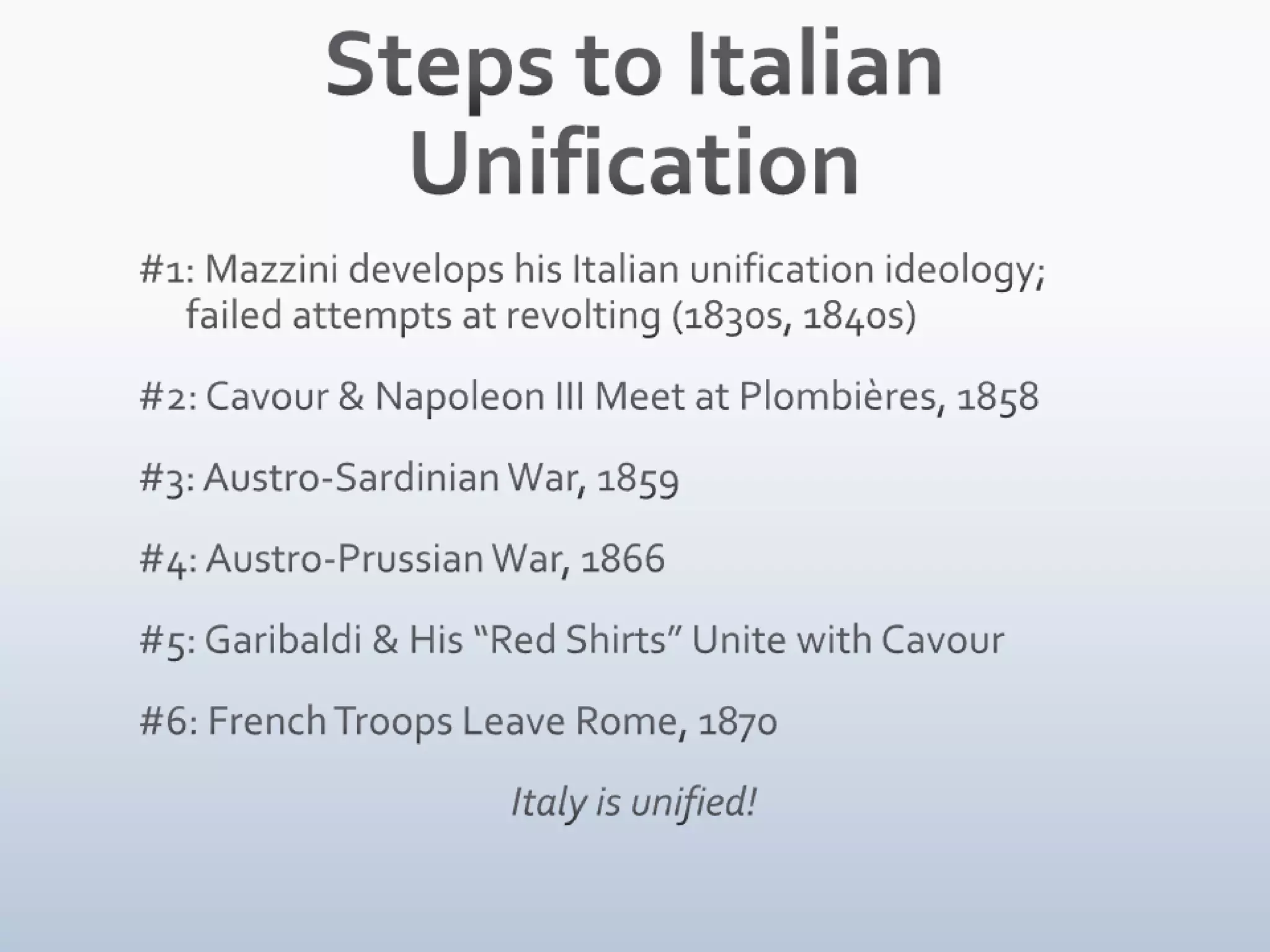
Steps to Italian Unification#1: Mazzini develops his Italian unification ideology; failed attempts at revolting (1830s, 1840s)#2: Cavour & Napoleon III Meet at Plombières, 1858#3: Austro-Sardinian War, 1859#4: Austro-Prussian War, 1866#5: Garibaldi & His “Red Shirts” Unite with Cavour#6: French Troops Leave Rome, 1870Italy is unified!
Pact of PlombièresSummer of 1858Cavour and Napoleon III sign secret agreementWhat is in the agreement?Joint war against AustriaPiedmont gain Austrian territories in Italy (Lombardy and Venetia), as well as Duchies of Parma and ModenaFrance gets Savoy and Nice
Austro-Sardinian War of 1859War started by Austrians after Piedmontese begin mobilizing an armyUltimatum to Piedmont: Demobilize army of Austria will fightPiedmont won’t demobilize, Austria declares WARFrance intervenes on Piedmont’s sideShort war, significant battlesBattle of MagentaBattle of Solferino
Results of War of 1859Austrians pushed out of Lombardy; forces march into VenetiaItalian patriots in Tuscany, Modena, and Parma overthrew Austrian rulers and asked to be annexed to kingdom of Sardinia  Napoleon III signs armistice with AustriaArmistice agreement:Sardinia receives LombardyAustria keeps Venetia, returns to power in Tuscany, Modena, and ParmaNapoleon III gets Nice and Savoy (even though he had only partially delivered on deal)
Plebiscites held in Parma, Modena, and Tuscany vote the Austrian empire to join the Sardinian kingdom
By 1860, four states remain:1) Sardinia-Piedmont, (2) Venetia, (3) Papal States, and (4) Kingdom of the Two Sicilies
Austro-Prussian War, 1866Italy supports PrussiaAustria is defeated, Italy gets Venetia
Garibaldi and the “Red Shirts” Unite with CavourGaribaldi invades Sicily and takes control of islandGaribaldi moves to mainlandTakes Naples (capital of Two Sicilies)Calls for help from Sardinia-PiedmontCombined army defeats army of Two Sicilies
French Troops Leave Rome, 1870French troops stationed in Rome to support the popeGaribaldi demands that Italian state attack Rome; Italy refusesGaribaldi + 2,000 volunteers move on Rome; stopped by Italian troopsAgreement – French troops will leave by 1866…but they returnOutbreak of Franco-Prusian WarFrench troops leaveItaly takes Rome after French defeatPope withdrawsRome becomes capital of Italy
A Unified Peninsula!
Italianunificationppt

Italianunificationppt

  • 1.
    Ch 23-5 QuizFive“Great” PowersPrinciples guiding the conventionMetternich wants to goBalance of powerA new map of EuropeCongress SystemKings restored to power Accomplishments of the congress (creation of Germanic Confederation, etc.)19th Century Political Spectrum (Conservative or Liberal)How the Congress of Vienna tried to create peace and stability in EuropeStuff to Review: 23-5 TCN, section 23-5 in book, Europe After the Congress of Vienna map and questions, Congress of Vienna visual organizer, and 19th Century Political Spectrum worksheet
  • 2.
  • 3.
    Review?Nationalists: people whobelieve that people of a single “nationality” should unite under a single governmentGoal of Nationalists? Create a NATION-STATEBonds that create a nation-state? Nationality, Language, Culture, Religion, History, and Territory
  • 4.
    MAIN IDEAThe forceof nationalism contributed to the formation of two new nations (Germany and Italy) and a new political order in Europe.
  • 5.
    Case Study: ITALYItalianUnification / Risorgimento
  • 7.
    Italy up to1815Italian Peninsula had not been unified since the fall of the Roman Empire. In 1815:Austria rules Italian provinces of Venetia and Lombardy in NorthSpain rules Kingdom of Two SiciliesMost spoke the same language, but the peninsula divided into competing states (each with its own government)Napoleon had invaded ItalyUnited many states under one governmentUnification did not lastCongress of Vienna split these states back up
  • 8.
    Desire for UnificationGroupsin several Italian states began to push the idea of a unified Italian stateItalian unification seen as being against Austrian Empire Most powerful force against unificationMetternich stated that the word Italy was “purely a geographic expression”Pope opposd to Italian unificationDifferences on what Italy would be: confederation under pope? Republic? Kingdom?
  • 9.
    The Movement forUnity Begins
  • 10.
    Italian Nationalist LeadersCountCavour (The “Head”)Giuseppi Garibaldi (The “Sword”)Giuseppi Mazzini (The “Heart”)King Victor Emmanuel II
  • 11.
    Giuseppi Mazzini(1805 –1872)The “Heart”1832: forms Young ItalyNationalist groupFight for unification of Italian states through popular uprisingAttracts people to the cause of Italian unificationWorks for a democratic republic
  • 12.
    Giuseppi Garibaldi(1807-1882)The “Sword”MetMazzini in 1833Joined Young ItalyFailed insurrection, flees to Brazil in 1834Participates in Brazilian movement for independenceBack to Italy in 1849, flees to US and then UK
  • 13.
    Count Camillodi Cavour(1810-1861)The“Mind”Wealthy aristocratJournalist for Il RisorgimentoFavors an expanded PiedmontBecame Prime Minister of Piedmont on 4 November 1852
  • 14.
    Victor Emmanuel II(1820-1878)Becameking of Sardinia-Piedmont in 1849Gave Camillodi Cavour the title of Prime MinisterBecame symbol of the Italian Risorgimento
  • 15.
    Steps to ItalianUnification#1: Mazzini develops his Italian unification ideology; failed attempts at revolting (1830s, 1840s)#2: Cavour & Napoleon III Meet at Plombières, 1858#3: Austro-Sardinian War, 1859#4: Austro-Prussian War, 1866#5: Garibaldi & His “Red Shirts” Unite with Cavour#6: French Troops Leave Rome, 1870Italy is unified!
  • 16.
    Pact of PlombièresSummerof 1858Cavour and Napoleon III sign secret agreementWhat is in the agreement?Joint war against AustriaPiedmont gain Austrian territories in Italy (Lombardy and Venetia), as well as Duchies of Parma and ModenaFrance gets Savoy and Nice
  • 17.
    Austro-Sardinian War of1859War started by Austrians after Piedmontese begin mobilizing an armyUltimatum to Piedmont: Demobilize army of Austria will fightPiedmont won’t demobilize, Austria declares WARFrance intervenes on Piedmont’s sideShort war, significant battlesBattle of MagentaBattle of Solferino
  • 18.
    Results of Warof 1859Austrians pushed out of Lombardy; forces march into VenetiaItalian patriots in Tuscany, Modena, and Parma overthrew Austrian rulers and asked to be annexed to kingdom of Sardinia  Napoleon III signs armistice with AustriaArmistice agreement:Sardinia receives LombardyAustria keeps Venetia, returns to power in Tuscany, Modena, and ParmaNapoleon III gets Nice and Savoy (even though he had only partially delivered on deal)
  • 19.
    Plebiscites held inParma, Modena, and Tuscany vote the Austrian empire to join the Sardinian kingdom
  • 20.
    By 1860, fourstates remain:1) Sardinia-Piedmont, (2) Venetia, (3) Papal States, and (4) Kingdom of the Two Sicilies
  • 21.
    Austro-Prussian War, 1866Italysupports PrussiaAustria is defeated, Italy gets Venetia
  • 22.
    Garibaldi and the“Red Shirts” Unite with CavourGaribaldi invades Sicily and takes control of islandGaribaldi moves to mainlandTakes Naples (capital of Two Sicilies)Calls for help from Sardinia-PiedmontCombined army defeats army of Two Sicilies
  • 23.
    French Troops LeaveRome, 1870French troops stationed in Rome to support the popeGaribaldi demands that Italian state attack Rome; Italy refusesGaribaldi + 2,000 volunteers move on Rome; stopped by Italian troopsAgreement – French troops will leave by 1866…but they returnOutbreak of Franco-Prusian WarFrench troops leaveItaly takes Rome after French defeatPope withdrawsRome becomes capital of Italy
  • 24.

Editor's Notes

  • #7 Austria ruled Italian provinces of Venetia and Lombardy in the north, and several small states.South – Spanish Bourbon family rules Kingdom of Two Sicilies