Imperialism
Ch. 14 & 15
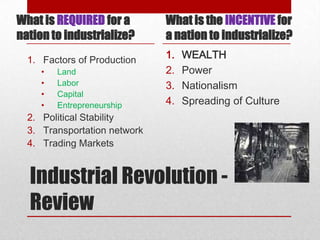
What is REQUIRED for a        What is the INCENTIVE for
nation to industrialize?      a nation to industrialize?
  1. Factors of Production    1.   WEALTH
     •   Land                 2.   Power
     •   Labor                3.   Nationalism
     •   Capital
     •   Entrepreneurship     4.   Spreading of Culture
  2. Political Stability
  3. Transportation network
  4. Trading Markets


  Industrial Revolution -
  Review
• Imperialism - Policy of extending control over other
  countries or territories
  • Economically
  • Politically
  • Socially
• Countries looked to take resources and spread their
  culture
• Imperial nations convinced themselves that what they
  were doing was positive for everyone involved
• Technological superiority allowed European nations to
  dominate non-developed areas and establish global
  empire


Imperialism
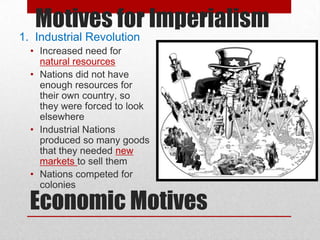
Motives for Imperialism
1. Industrial Revolution
  • Increased need for
    natural resources
  • Nations did not have
    enough resources for
    their own country, so
    they were forced to look
    elsewhere
  • Industrial Nations
    produced so many goods
    that they needed new
    markets to sell them
  • Nations competed for
    colonies

  Economic Motives
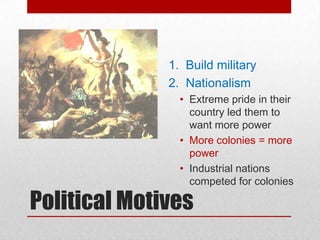
1. Build military
              2. Nationalism
                • Extreme pride in their
                  country led them to
                  want more power
                • More colonies = more
                  power
                • Industrial nations
                  competed for colonies

Political Motives
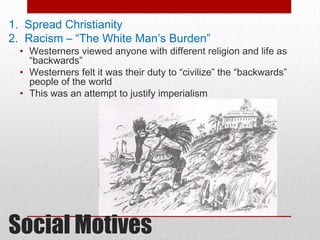
1. Spread Christianity
2. Racism – “The White Man’s Burden”
 • Westerners viewed anyone with different religion and life as
   “backwards”
 • Westerners felt it was their duty to “civilize” the “backwards”
   people of the world
 • This was an attempt to justify imperialism


Social Motives
• Direct rule - Local rulers were replaced with officials
  from the ruling country
• Indirect rule - local rulers kept their position in
  government, but under control of another nation
• Protectorates - one country depends on another for
  its protection
• Spheres of Influence – an area of a nation in which
  a more powerful nation has control


Types of Control
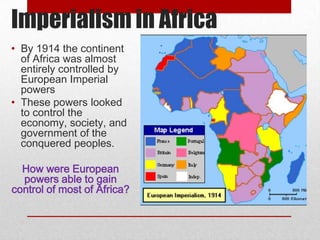
Imperialism in Africa
• By 1914 the continent
  of Africa was almost
  entirely controlled by
  European Imperial
  powers
• These powers looked
  to control the
  economy, society, and
  government of the
  conquered peoples.

  How were European
  powers able to gain
control of most of Africa?
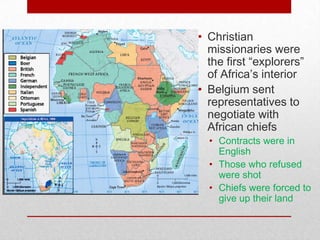
• Christian
  missionaries were
  the first “explorers”
  of Africa’s interior
• Belgium sent
  representatives to
  negotiate with
  African chiefs
  • Contracts were in
    English
  • Those who refused
    were shot
  • Chiefs were forced to
    give up their land
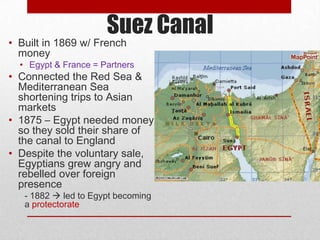
Suez Canal
• Built in 1869 w/ French
  money
  • Egypt & France = Partners
• Connected the Red Sea &
  Mediterranean Sea
  shortening trips to Asian
  markets
• 1875 – Egypt needed money
  so they sold their share of
  the canal to England
• Despite the voluntary sale,
  Egyptians grew angry and
  rebelled over foreign
  presence
   - 1882  led to Egypt becoming
   a protectorate
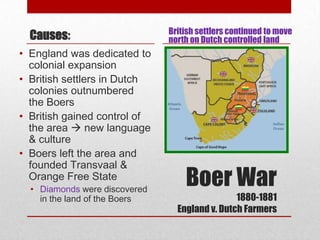
British settlers continued to move
  Causes:                      north on Dutch controlled land
• England was dedicated to
  colonial expansion
• British settlers in Dutch
  colonies outnumbered
  the Boers
• British gained control of
  the area  new language
  & culture
• Boers left the area and
  founded Transvaal &
  Orange Free State
  • Diamonds were discovered
                                   Boer War
    in the land of the Boers                    1880-1881
                                 England v. Dutch Farmers
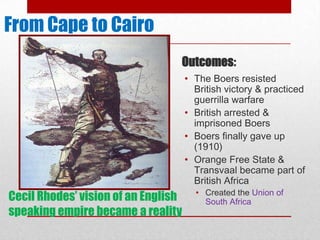
From Cape to Cairo
                                 Outcomes:
                                     • The Boers resisted
                                       British victory & practiced
                                       guerrilla warfare
                                     • British arrested &
                                       imprisoned Boers
                                     • Boers finally gave up
                                       (1910)
                                     • Orange Free State &
                                       Transvaal became part of
                                       British Africa
                                       • Created the Union of
Cecil Rhodes’ vision of an English       South Africa
speaking empire became a reality
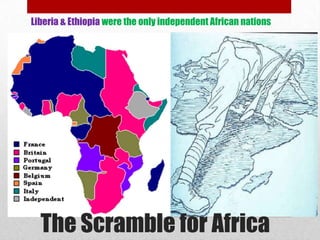
Liberia & Ethiopia were the only independent African nations


  The Scramble for Africa
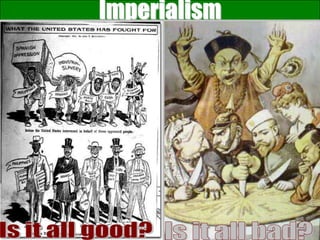
Imperialism
The policy of setting up colonies &
        building up empires.
Countries look to extract resources & spread their
                       culture.


Imperial nations convinced themselves that what
    they were doing was positive for everyone
                    involved.
Positive                         Negative
  • Modernized countries           • Created problems between
                                     African tribes
      • Roads, railroads, canals
                                   • Forced ethnic groups into
  •   Built up trade markets         the same nation
  •   New farming methods          • Destroyed African culture
                                     • Assimilation (adopt another
  •   Modernized medicines             culture)
                                   • In many parts, segregation
  •   Public education               & class system based on
  •   Built up military              color were introduced
                                   • Africa has yet to recover
                                     • Corruption, instability,
                                       violence, & authoritative
                                       regimes are common


Effects of Imperialism on Africa
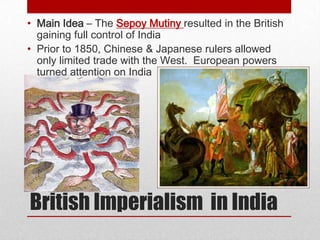
• Main Idea – The Sepoy Mutiny resulted in the British
  gaining full control of India
• Prior to 1850, Chinese & Japanese rulers allowed
  only limited trade with the West. European powers
  turned attention on India


British Imperialism in India
Background
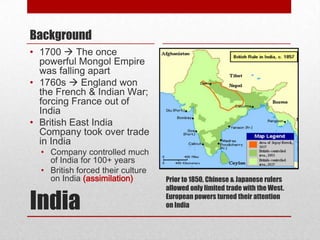
• 1700  The once
  powerful Mongol Empire
  was falling apart
• 1760s  England won
  the French & Indian War;
  forcing France out of
  India
• British East India
  Company took over trade
  in India
  • Company controlled much
    of India for 100+ years
  • British forced their culture
    on India (assimilation)        Prior to 1850, Chinese & Japanese rulers
                                   allowed only limited trade with the West.

India                              European powers turned their attention
                                   on India
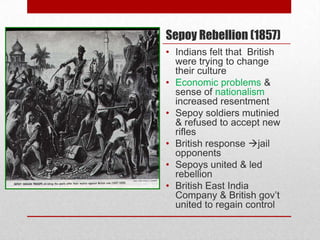
Sepoy Rebellion (1857)
• Indians felt that British
  were trying to change
  their culture
• Economic problems &
  sense of nationalism
  increased resentment
• Sepoy soldiers mutinied
  & refused to accept new
  rifles
• British response jail
  opponents
• Sepoys united & led
  rebellion
• British East India
  Company & British gov’t
  united to regain control
• Religious differences & weak leadership doomed
  India
• British fully controlled India
• Indian nationalist movements begin
  • Gahndi
• British East India Company removed from power


Outcome of Sepoy Rebellion
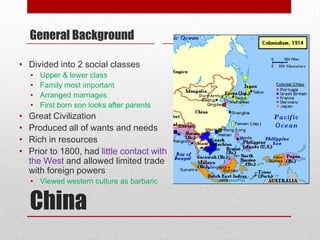
General Background

• Divided into 2 social classes
    •   Upper & lower class
    •   Family most important
    •   Arranged marriages
    •   First born son looks after parents
•   Great Civilization
•   Produced all of wants and needs
•   Rich in resources
•   Prior to 1800, had little contact with
    the West and allowed limited trade
    with foreign powers
    • Viewed western culture as barbaric


    China
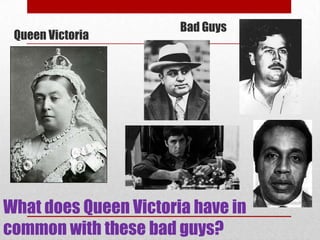
Bad Guys
 Queen Victoria


What does Queen Victoria have in
common with these bad guys?
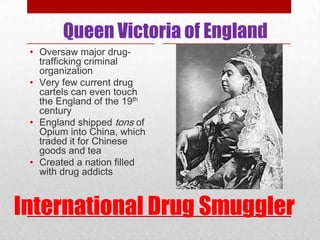
Queen Victoria of England
 • Oversaw major drug-
   trafficking criminal
   organization
 • Very few current drug
   cartels can even touch
   the England of the 19th
   century
 • England shipped tons of
   Opium into China, which
   traded it for Chinese
   goods and tea
 • Created a nation filled
   with drug addicts


International Drug Smuggler
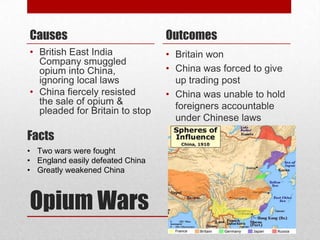
Causes                            Outcomes
• British East India              • Britain won
  Company smuggled
  opium into China,               • China was forced to give
  ignoring local laws               up trading post
• China fiercely resisted         • China was unable to hold
  the sale of opium &               foreigners accountable
  pleaded for Britain to stop
                                    under Chinese laws
Facts
• Two wars were fought
• England easily defeated China
• Greatly weakened China


Opium Wars
Response to Pressure from the West
 By what right do they [British merchants] . . . use
   the poisonous drug [opium] to injure the
   Chinese people? . . . I have heard that the
   smoking of opium is very strictly forbidden by
   your country; that is because the harm caused
   by opium is clearly understood. Since it is not
   permitted to do harm to your own country, then
   even less should you let it be passed on to the
   harm of other countries.
 LIN ZEXU, quoted in China’s Response to the West


Why did Lin Zexu oppose the Opium trade with Britain?
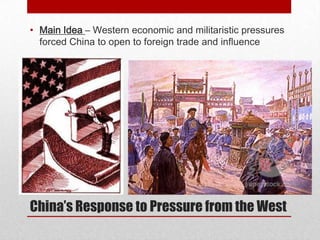
• Main Idea – Western economic and militaristic pressures
  forced China to open to foreign trade and influence


China’s Response to Pressure from the West
1800s
• After years of imbalanced trading with China,
  England looked to find a product that Chinese were
  willing to purchase
• British traders discovered that Opium Trade = Large
  Profits
• British traded Opium for tea & silk
• Chinese officials learned about the dangers of
  opium and declared it illegal


British look to increase trade
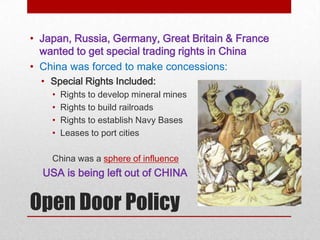
• Japan, Russia, Germany, Great Britain & France
  wanted to get special trading rights in China
• China was forced to make concessions:
  • Special Rights Included:
    •   Rights to develop mineral mines
    •   Rights to build railroads
    •   Rights to establish Navy Bases
    •   Leases to port cities

    China was a sphere of influence
  USA is being left out of CHINA


Open Door Policy
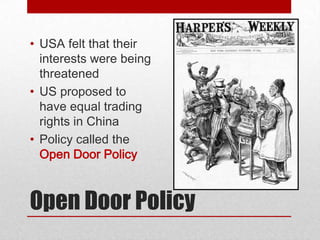
• USA felt that their
  interests were being
  threatened
• US proposed to
  have equal trading
  rights in China
• Policy called the
  Open Door Policy


Open Door Policy
Facts:                    Effects:
• Major imperial powers   • Increased foreigners in
  agreed to respect         China
  trading rights          • China remained “free”
• Treaties were unequal     from colonial rule
  & unfair to China       • Japan eventually
                            ignored the policy
                            (1920)


US Proposes Open Door Policy (1900)
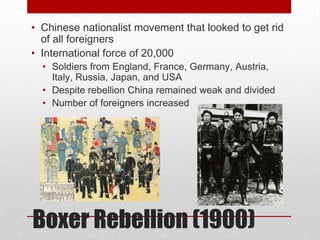
• Chinese nationalist movement that looked to get rid
  of all foreigners
• International force of 20,000
  • Soldiers from England, France, Germany, Austria,
    Italy, Russia, Japan, and USA
  • Despite rebellion China remained weak and divided
  • Number of foreigners increased


Boxer Rebellion (1900)
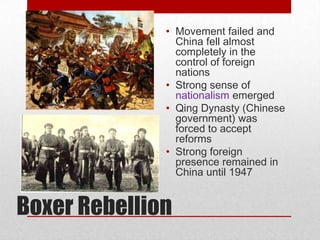
• Movement failed and
                China fell almost
                completely in the
                control of foreign
                nations
              • Strong sense of
                nationalism emerged
              • Qing Dynasty (Chinese
                government) was
                forced to accept
                reforms
              • Strong foreign
                presence remained in
                China until 1947


Boxer Rebellion
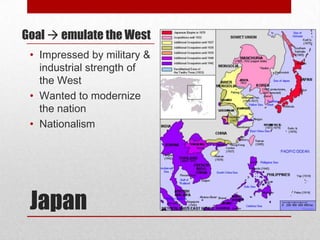
Goal  emulate the West
 • Impressed by military &
   industrial strength of
   the West
 • Wanted to modernize
   the nation
 • Nationalism


 Japan
• Abolished feudalism  focused on industry
  • Restored the power of the Emperor
    • Established Meiji Restoration
  • “Modernized” Japanese culture
    • New calendar
    • Adopted western clothing
  • Modernized Navy & Army
    • Removed the samurai

  In less than 30 years, established themselves as a world
  power
  - Unequal treaty
  - Racism


How did Japan create an Empire?

Imperialism notes

  • 1.
  • 2.
    What is REQUIREDfor a What is the INCENTIVE for nation to industrialize? a nation to industrialize? 1. Factors of Production 1. WEALTH • Land 2. Power • Labor 3. Nationalism • Capital • Entrepreneurship 4. Spreading of Culture 2. Political Stability 3. Transportation network 4. Trading Markets Industrial Revolution - Review
  • 3.
    • Imperialism -Policy of extending control over other countries or territories • Economically • Politically • Socially • Countries looked to take resources and spread their culture • Imperial nations convinced themselves that what they were doing was positive for everyone involved • Technological superiority allowed European nations to dominate non-developed areas and establish global empire Imperialism
  • 4.
    Motives for Imperialism 1.Industrial Revolution • Increased need for natural resources • Nations did not have enough resources for their own country, so they were forced to look elsewhere • Industrial Nations produced so many goods that they needed new markets to sell them • Nations competed for colonies Economic Motives
  • 5.
    1. Build military 2. Nationalism • Extreme pride in their country led them to want more power • More colonies = more power • Industrial nations competed for colonies Political Motives
  • 6.
    1. Spread Christianity 2.Racism – “The White Man’s Burden” • Westerners viewed anyone with different religion and life as “backwards” • Westerners felt it was their duty to “civilize” the “backwards” people of the world • This was an attempt to justify imperialism Social Motives
  • 7.
    • Direct rule- Local rulers were replaced with officials from the ruling country • Indirect rule - local rulers kept their position in government, but under control of another nation • Protectorates - one country depends on another for its protection • Spheres of Influence – an area of a nation in which a more powerful nation has control Types of Control
  • 8.
    Imperialism in Africa •By 1914 the continent of Africa was almost entirely controlled by European Imperial powers • These powers looked to control the economy, society, and government of the conquered peoples. How were European powers able to gain control of most of Africa?
  • 9.
    • Christian missionaries were the first “explorers” of Africa’s interior • Belgium sent representatives to negotiate with African chiefs • Contracts were in English • Those who refused were shot • Chiefs were forced to give up their land
  • 10.
    Suez Canal • Builtin 1869 w/ French money • Egypt & France = Partners • Connected the Red Sea & Mediterranean Sea shortening trips to Asian markets • 1875 – Egypt needed money so they sold their share of the canal to England • Despite the voluntary sale, Egyptians grew angry and rebelled over foreign presence - 1882  led to Egypt becoming a protectorate
  • 11.
    British settlers continuedto move Causes: north on Dutch controlled land • England was dedicated to colonial expansion • British settlers in Dutch colonies outnumbered the Boers • British gained control of the area  new language & culture • Boers left the area and founded Transvaal & Orange Free State • Diamonds were discovered Boer War in the land of the Boers 1880-1881 England v. Dutch Farmers
  • 12.
    From Cape toCairo Outcomes: • The Boers resisted British victory & practiced guerrilla warfare • British arrested & imprisoned Boers • Boers finally gave up (1910) • Orange Free State & Transvaal became part of British Africa • Created the Union of Cecil Rhodes’ vision of an English South Africa speaking empire became a reality
  • 13.
    Liberia & Ethiopiawere the only independent African nations The Scramble for Africa
  • 14.
    Imperialism The policy ofsetting up colonies & building up empires. Countries look to extract resources & spread their culture. Imperial nations convinced themselves that what they were doing was positive for everyone involved.
  • 15.
    Positive Negative • Modernized countries • Created problems between African tribes • Roads, railroads, canals • Forced ethnic groups into • Built up trade markets the same nation • New farming methods • Destroyed African culture • Assimilation (adopt another • Modernized medicines culture) • In many parts, segregation • Public education & class system based on • Built up military color were introduced • Africa has yet to recover • Corruption, instability, violence, & authoritative regimes are common Effects of Imperialism on Africa
  • 16.
    • Main Idea– The Sepoy Mutiny resulted in the British gaining full control of India • Prior to 1850, Chinese & Japanese rulers allowed only limited trade with the West. European powers turned attention on India British Imperialism in India
  • 17.
    Background • 1700 The once powerful Mongol Empire was falling apart • 1760s  England won the French & Indian War; forcing France out of India • British East India Company took over trade in India • Company controlled much of India for 100+ years • British forced their culture on India (assimilation) Prior to 1850, Chinese & Japanese rulers allowed only limited trade with the West. India European powers turned their attention on India
  • 18.
    Sepoy Rebellion (1857) •Indians felt that British were trying to change their culture • Economic problems & sense of nationalism increased resentment • Sepoy soldiers mutinied & refused to accept new rifles • British response jail opponents • Sepoys united & led rebellion • British East India Company & British gov’t united to regain control
  • 19.
    • Religious differences& weak leadership doomed India • British fully controlled India • Indian nationalist movements begin • Gahndi • British East India Company removed from power Outcome of Sepoy Rebellion
  • 20.
    General Background • Dividedinto 2 social classes • Upper & lower class • Family most important • Arranged marriages • First born son looks after parents • Great Civilization • Produced all of wants and needs • Rich in resources • Prior to 1800, had little contact with the West and allowed limited trade with foreign powers • Viewed western culture as barbaric China
  • 21.
    Bad Guys QueenVictoria What does Queen Victoria have in common with these bad guys?
  • 22.
    Queen Victoria ofEngland • Oversaw major drug- trafficking criminal organization • Very few current drug cartels can even touch the England of the 19th century • England shipped tons of Opium into China, which traded it for Chinese goods and tea • Created a nation filled with drug addicts International Drug Smuggler
  • 23.
    Causes Outcomes • British East India • Britain won Company smuggled opium into China, • China was forced to give ignoring local laws up trading post • China fiercely resisted • China was unable to hold the sale of opium & foreigners accountable pleaded for Britain to stop under Chinese laws Facts • Two wars were fought • England easily defeated China • Greatly weakened China Opium Wars
  • 24.
    Response to Pressurefrom the West By what right do they [British merchants] . . . use the poisonous drug [opium] to injure the Chinese people? . . . I have heard that the smoking of opium is very strictly forbidden by your country; that is because the harm caused by opium is clearly understood. Since it is not permitted to do harm to your own country, then even less should you let it be passed on to the harm of other countries. LIN ZEXU, quoted in China’s Response to the West Why did Lin Zexu oppose the Opium trade with Britain?
  • 25.
    • Main Idea– Western economic and militaristic pressures forced China to open to foreign trade and influence China’s Response to Pressure from the West
  • 26.
    1800s • After yearsof imbalanced trading with China, England looked to find a product that Chinese were willing to purchase • British traders discovered that Opium Trade = Large Profits • British traded Opium for tea & silk • Chinese officials learned about the dangers of opium and declared it illegal British look to increase trade
  • 27.
    • Japan, Russia,Germany, Great Britain & France wanted to get special trading rights in China • China was forced to make concessions: • Special Rights Included: • Rights to develop mineral mines • Rights to build railroads • Rights to establish Navy Bases • Leases to port cities China was a sphere of influence USA is being left out of CHINA Open Door Policy
  • 28.
    • USA feltthat their interests were being threatened • US proposed to have equal trading rights in China • Policy called the Open Door Policy Open Door Policy
  • 29.
    Facts: Effects: • Major imperial powers • Increased foreigners in agreed to respect China trading rights • China remained “free” • Treaties were unequal from colonial rule & unfair to China • Japan eventually ignored the policy (1920) US Proposes Open Door Policy (1900)
  • 30.
    • Chinese nationalistmovement that looked to get rid of all foreigners • International force of 20,000 • Soldiers from England, France, Germany, Austria, Italy, Russia, Japan, and USA • Despite rebellion China remained weak and divided • Number of foreigners increased Boxer Rebellion (1900)
  • 31.
    • Movement failedand China fell almost completely in the control of foreign nations • Strong sense of nationalism emerged • Qing Dynasty (Chinese government) was forced to accept reforms • Strong foreign presence remained in China until 1947 Boxer Rebellion
  • 32.
    Goal  emulatethe West • Impressed by military & industrial strength of the West • Wanted to modernize the nation • Nationalism Japan
  • 33.
    • Abolished feudalism focused on industry • Restored the power of the Emperor • Established Meiji Restoration • “Modernized” Japanese culture • New calendar • Adopted western clothing • Modernized Navy & Army • Removed the samurai In less than 30 years, established themselves as a world power - Unequal treaty - Racism How did Japan create an Empire?