Do Now
Explain in detail how you arrange your
clothes at home.

How are products arranged and stacked on shelves
in a grocery store?
How is the periodic
table used to
classify and provide
information about all
known elements?
Using the Periodic Table

 • How are elements arranged on the
   periodic table?
 • What can you learn about elements
   from the periodic table?
How does sorting help scientists understand
What they are studying?
Sorting helps scientists understand how things
are similar and how they are different


Explain in your own words what you think the
periodic table is?
What is the periodic table?
• The periodic table is a chart of the
  elements arranged into rows and
  columns according to their physical
  and chemical properties.
• It can be used to determine the
  relationships among the elements.
100   table   The periodic table
              is a chart of the
              elements arranged
              into rows and
              columns according
              to their physical and
              chemical properties.
Developing a Periodic Table
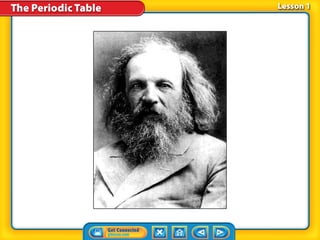
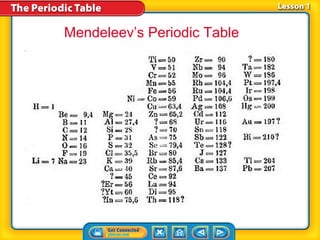
• In 1869 Dimitri Mendeleev
  was working on a way to
  classify elements.
• At the time, more than 60
  elements had been
  discovered.
Developing a Periodic Table


 Russian chemist and    Periodic table of the
 Teacher who lived in   elements; a system for
 the 1800s              organizing the elements
Developing a Periodic Table
• Mendeleev studied the physical properties
  such as density, color, melting point and
  atomic mass of each element.
• He also noted chemical properties such as
  how each element reacted with other
  elements.
• Mendeleev arranged the elements in a list
  using their atomic mass.
Mendeleev’s Periodic Table
density                  Color

Melting and boiling point   atomic mass
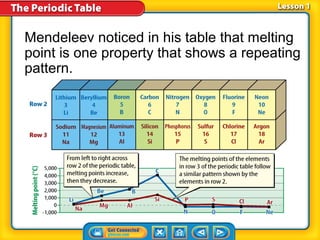
Mendeleev noticed in his table that melting
point is one property that shows a repeating
pattern.
Problems with Mendeleev’s Table
• Mendeleev’s periodic table enabled
  scientists to relate the properties of the
  known elements to their position on the
  table
• However, the table had a problem!!
  Some elements seemed out of place.
Henry Moseley
• In the early 1900’s, the scientist Henry
  Moseley solved the problem with the
  periodic table.
• Moseley listed the elements according to
  increasing ATOMIC NUMBER
When Moseley listed the elements
according to atomic number, columns
contained elements with similar properties,
such as copper, silver, and gold.
properties

Atomic mass                Atomic Number
              patterns
Developing a Periodic Table (cont.)


        What determines where an
        element is located on the
        periodic table you use today?
Today’s Periodic Table
You can identify many of the properties of an
element from its placement on the periodic
table.


    period
    Science Use the completion of a
    cycle; a row on the periodic table
    Common Use a point used to mark
    the end of a sentence; a time frame
The table is organized into columns, rows, and
blocks, which are based on certain patterns of
properties.
Today’s Periodic Table (cont.)
• The element key shows an element’s
  chemical symbol, atomic number, and
  atomic mass.
• The key also contains a symbol that
  shows the state of matter at
  room temperature.
Today’s Periodic Table (cont.)
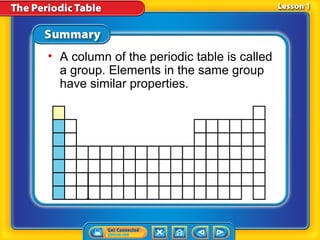
• A group is a column on the periodic table.
• Elements in the same group have similar
  chemical properties and react with other
  elements in
  similar ways.
Today’s Periodic Table (cont.)


        What can you infer about the
        properties of two elements in
        the same group?
Today’s Periodic Table (cont.)
• The rows on the periodic table are
  called periods.


• The atomic number of each element
  increases by one as you read from left
  to right across each period.
Today’s Periodic Table (cont.)
• Metals are on the left side and in the
  middle of the periodic table.
• With the exception of hydrogen,
  nonmetals are located on the right side
  of the periodic table.
• Between the metals and the nonmetals
  on the periodic table are the
  metalloids.
How Scientists Use the Periodic
Table
Even today, new elements are created in
laboratories, named, and added to the
present-day periodic table.
How Scientists Use the Periodic
Table (cont.)
• Scientists can use the periodic table to
  predict the properties of new elements
  they create.
• The periodic table contains more than
  100 elements, each with its unique
  properties that differ from the
  properties of other elements.
• On the periodic table, elements are
  arranged according to increasing
  atomic numbers and similar properties.
• A column of the periodic table is called
  a group. Elements in the same group
  have similar properties.
• A row of the periodic table is called a
  period. Properties of elements repeat
  in the same pattern from left to right
  across each period.
How did Mendeleev arrange
elements when he first used a
table to classify elements?
A. columns of increasing atomic mass
B. rows of increasing atomic mass
C. rows of increasing atomic number
D. rows of decreasing atomic number
What does the element key of a
periodic table indicate?

A. chemical symbol
B. atomic number
C. atomic mass
D. all of these
Where are all nonmetals (with the
exception of hydrogen) located
on the periodic table?
A. top half
B. right side
C. left side
D. bottom half
Do you agree or disagree?

1. The elements on the periodic table are
   arranged in rows in the order they were
   discovered.
2. The properties of an element are
   related to the element’s location on the
   periodic table.
Metals

• What elements are metals?
• What are the properties of metals?
Metals

• metal          • alkali metal
• luster         • alkaline earth
                   metal
• ductility
                 • transition element
• malleability
What is a metal?
• More than three-quarters of the
  elements on the periodic table are
  metals.
• With the exception of hydrogen, all of
  the elements in groups 1-12 on the
  periodic table are metals.
• Some of the elements in groups 13-15
  are metals.
What is a metal? (cont.)
To be a metal, an element must have
certain properties.


         How does the position of an
         element on the periodic table
         allow you to determine if the
         element is a metal?
What is a metal? (cont.)
• A metal is an element that is generally
  shiny. It is easily pulled into wires or
  hammered into thin sheets. A metal is
  a good conductor of electricity and
  thermal energy.
• Luster describes the ability of a metal
  to reflect light.
What is a metal? (cont.)
Ductility is the ability to be pulled into
thin wires.


     ductility
     from Latin ductilis, means “may
     be led or drawn”
What is a metal? (cont.)
• Malleability is the ability of a
  substance to be hammered or rolled
  into sheets.
• Gold is so malleable that it can be
  hammered into thin sheets.
• In general the density, strength, boiling
  point, and melting point of a metal are
  greater than those of other elements.
What is a metal? (cont.)


        What are some physical
        properties of metals?
Group 1: Alkali Metals
• The elements in group 1 are called
  alkali metals.
• The alkali metals include lithium,
  sodium, potassium, rubidium, cesium,
  and francium.
• Alkali metals react quickly with other
  elements, such as oxygen and in
  nature, occur only in compounds.
Group 1: Alkali Metals (cont.)
Alkali metals react violently with water.
They are also soft enough to be cut with
a knife.
Group 2: Alkaline Earth Metals
• The elements in group 2 on the
  periodic table are called alkaline earth
  metals.
• The alkaline earth metals are
  beryllium, magnesium, calcium,
  strontium, barium, and radium.
Group 2: Alkaline Earth Metals (cont.)
Pure alkaline earth metals do not occur
naturally but instead combine with other
elements and form compounds.
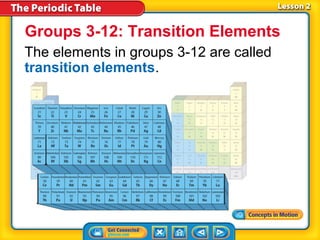
Groups 3-12: Transition Elements
The elements in groups 3-12 are called
transition elements.
Groups 3-12: Transition Elements
                                      (cont.)

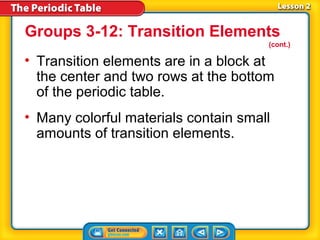
• Transition elements are in a block at
  the center and two rows at the bottom
  of the periodic table.
• Many colorful materials contain small
  amounts of transition elements.
Groups 3-12: Transition Elements
                                        (cont.)

• All transition elements are metals with
  higher melting points, greater strength,
  and higher densities than the alkali
  metals and the alkaline earth metals.
• Because of their high densities,
  strength, and resistance to corrosion,
  transition elements make good building
  materials.
Groups 3-12: Transition Elements
                                            (cont.)
Two rows of transition elements—the
lanthanide and actinide series—were removed
from the main part of the table so that periods
6 and 7 were not longer than the other periods.
Patterns in Properties of Metals
Metallic properties include luster,
malleability, and electrical conductivity.
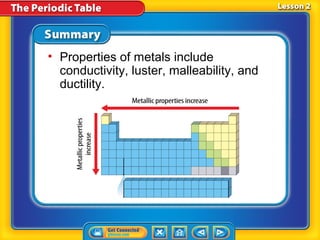
• Properties of metals include
  conductivity, luster, malleability, and
  ductility.
• Alkali metals and alkaline earth metals
  react easily with other elements. These
  metals make up groups 1 and 2 on the
  periodic table.
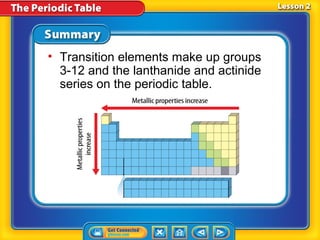
• Transition elements make up groups
  3-12 and the lanthanide and actinide
  series on the periodic table.
Which term describes the ability
of a metal to reflect light?

A. malleability
B. ductility
C. luster
D. alkaline
Which of the following is true of
alkaline earth metals?
A. They all belong to the same
   period.
B. They react quickly with other
   elements.
C. They include gold.
D. All of the above are true.
Which of the following distinguishes
transition elements from alkali metals?
A. Transition elements have higher
   melting points.
B. Transition elements have greater
   strength.
C. Transition elements have higher
   densities.
D. All of the above are true.
Do you agree or disagree?

3. Fewer than half of the elements are
   metals.
4. Metals are usually good conductors of
   electricity.
Nonmetals and Metalloids

 • Where are nonmetals and metalloids
   on the periodic table?
 • What are the properties of nonmetals
   and metalloids?
Nonmetals and Metalloids

 • nonmetal
 • halogen
 • noble gas
 • metalloid
 • semiconductor
The Elements of Life
More than 96 percent
of the mass of the
human body comes
from four nonmetals–
oxygen, carbon,
hydrogen, and
nitrogen.
The Elements of Life (cont.)
• Nonmetals are elements that have no
  metallic properties.
• The four elements that make up most
  of the human body, along with
  phosphorus and sulfur, are the six
  elements in proteins, fats, nucleic
  acids, and other large molecules in
  your body and in all other living things.
How are nonmetals different from
metals?
• Nonmetals have properties that are
  different from those of metals.
• Many nonmetals are gases at room
  temperature and those that are solid at
  room temperature have a dull surface,
  which means they have no luster.
• Because nonmetals are poor conductors
  of electricity and thermal energy, they
  are good insulators.
Phosphorus and carbon are dull, brittle
solids that do not conduct thermal energy
or electricity.
How are nonmetals different from
metals? (cont.)


       What properties do nonmetals
       have?
How are nonmetals different from
metals? (cont.)
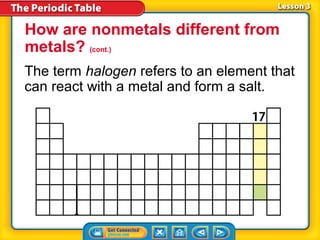
An element in group 17 of the periodic
table is galled a halogen.


    halogen
    from Greek hals, means “salt”;
    and –gen, means “to produce”
How are nonmetals different from
metals? (cont.)
The term halogen refers to an element that
can react with a metal and form a salt.
How are nonmetals different from
metals? (cont.)
• Halogens react readily with other
  elements and form compounds.
• Halogens can only occur naturally in
  compounds.
• In general, halogens are less reactive
  as you move down the group.
How are nonmetals different from
metals? (cont.)
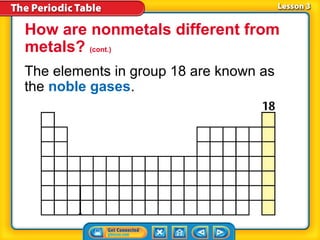
The elements in group 18 are known as
the noble gases.
How are nonmetals different from
metals? (cont.)
• Unlike the halogens, the only way
  elements in this group react with other
  elements is under special conditions in
  a laboratory.
• Of all the elements, hydrogen has the
  smallest atomic mass and is the most
  common element in the universe.
How are nonmetals different from
metals? (cont.)
• Hydrogen is most often classified as a
  nonmetal because it has many
  properties like those of nonmetals.
• However, hydrogen also has some
  properties similar to those of the group 1
  alkali metals.
• Under conditions on Earth, hydrogen
  usually behaves as a nonmetal.
Between the metals and the nonmetals
on the periodic table are elements known
as metalloids.
Metalloids (cont.)
• A metalloid is an element that has
  physical and chemical properties of both
  metals and nonmetals.
• The elements boron, silicon, germanium,
  arsenic, antimony, tellurium, polonium,
  and astatine are metalloids.
• Silicon is the most abundant metalloid in
  the universe.
Metalloids (cont.)


         Where are metalloids on the
         periodic table?
Metalloids (cont.)
• A property of metalloids is the ability to
  act as a semiconductor.
• A semiconductor conducts electricity
  at high temperatures, but not at low
  temperatures.
Metalloids (cont.)
Silicon is used in making semiconductor
devices for computers and other electronic
products.


     semiconductor
     from Latin semi-, means “half”;
     and conducere, means “to bring
     together”
Metals, Nonmetals, and
Metalloids
• An element’s position on the periodic
  table tells you a lot about the element.
• Understanding the properties of
  elements can help you decide which
  element to use in a given situation.
• A nonmetal is an element that has no
  metallic properties. Solid nonmetals are
  dull and brittle and do not conduct
  thermal energy or electricity.
• Halogens and noble gases are
  nonmetals. These elements are
  found in group 17 and group 18 of
  the periodic table.
• Metalloids have some metallic
  properties and some nonmetallic
  properties. The most important use
  of metalloids is as semiconductors.
What term refers to elements in
group 18 that only react with other
elements under special laboratory
conditions?
A. halogen
B. nonmetals
C. noble gases
D. metalloid
Which term refers to an element that
conducts electricity at high
temperatures, but not at low
temperatures?
A. metal
B. conductor
C. halogen
D. semiconductor
Which term refers to an element
that can react with a metal and
form a salt?
A. halogen
B. noble gas
C. semiconductor
D. none of the above
Do you agree or disagree?

5. Most of the elements in living things
   are nonmetals.
6. Even though they look very different,
   oxygen and sulfur share some similar
   properties.
Key Concept Summary
Interactive Concept Map
Chapter Review
Standardized Test Practice
Elements are
grouped and
organized on the
periodic table
according to
increasing atomic
number and similar
properties.
Lesson 1: Using the Periodic Table
• Elements are organized on the periodic table by
  increasing atomic number and similar properties.
• Elements in the same group, or column, of the
  periodic table have similar properties.
• Elements’ properties change across a period, which
  is a row of the
  periodic table.
• Each element key
  on the periodic table
  provides the name,
  symbol, atomic
  number, and atomic
  mass for an element.
Lesson 2: Metals
• Metals are located on the left and middle parts of
  the periodic table.
• Metals are elements that have ductility, malleability,
  luster, and conductivity.
• The alkali metals are in group 1 of the periodic table,
  and the alkaline earth metals are in group 2.
• Transition elements are metals in groups 3-12 of the
  periodic table, as
  well as the lanthanide
  and actinide series.
Lesson 3: Nonmetals and Metalloids
• Nonmetals are on the right side of the periodic table, and
  metalloids are located between metals and nonmetals.
• Nonmetals are elements
  that have no metallic
  properties. Solid
  nonmetals are dull in
  appearance, brittle, and
  do not conduct electricity.
  Metalloids are elements
  that have properties of
  both metals and nonmetals.
• Some metalloids are semiconductors.
• Elements in group 17 are called halogens, and elements
  in group 18 are noble gases.
Can new elements created in
laboratories be added to the
periodic table?
A. no
B. yes
C. Maybe, but it has never been done.
D. none of these
What is another name for a
column on the periodic table?

A. group
B. row
C. period
D. block
Which term refers to a metal’s
ability to be pulled into thin
wires?
A. luster
B. ductility
C. malleability
D. alkali
What term refers to elements that
have no metallic properties?

A. metalloids
B. metals
C. nonmetals
D. semiconductors
More than 96 percent of the mass of
the human body comes from four
nonmetals—oxygen, carbon,
hydrogen, and what else?
A. boron
B. silicon
C. nitrogen
D. none of these
Where are metals found on the
periodic table?

A. top
B. left side and in the middle
C. right side
D. bottom
Which group of metals includes
sodium, potassium, and cesium?

A. alkali metals
B. alkaline earth metals
C. transitional elements
D. nonmetals
Which term refers to the ability of
a substance to be hammered or
rolled into sheets?
A. luster
B. ductility
C. malleability
D. conductivity
Of all the elements, which one
has the smallest atomic mass?

A. carbon
B. sulfur
C. hydrogen
D. nitrogen
Metallic properties of the
elements tend to do what as you
move down a group?
A. increase
B. decrease
C. remain the same
D. none of these

Unit 1 lesson 13 ppt

  • 2.
    Do Now Explain indetail how you arrange your clothes at home. How are products arranged and stacked on shelves in a grocery store?
  • 3.
    How is theperiodic table used to classify and provide information about all known elements?
  • 4.
    Using the PeriodicTable • How are elements arranged on the periodic table? • What can you learn about elements from the periodic table?
  • 5.
    How does sortinghelp scientists understand What they are studying? Sorting helps scientists understand how things are similar and how they are different Explain in your own words what you think the periodic table is?
  • 6.
    What is theperiodic table? • The periodic table is a chart of the elements arranged into rows and columns according to their physical and chemical properties. • It can be used to determine the relationships among the elements.
  • 7.
    100 table The periodic table is a chart of the elements arranged into rows and columns according to their physical and chemical properties.
  • 10.
    Developing a PeriodicTable • In 1869 Dimitri Mendeleev was working on a way to classify elements. • At the time, more than 60 elements had been discovered.
  • 11.
    Developing a PeriodicTable Russian chemist and Periodic table of the Teacher who lived in elements; a system for the 1800s organizing the elements
  • 13.
    Developing a PeriodicTable • Mendeleev studied the physical properties such as density, color, melting point and atomic mass of each element. • He also noted chemical properties such as how each element reacted with other elements. • Mendeleev arranged the elements in a list using their atomic mass.
  • 14.
  • 15.
    density Color Melting and boiling point atomic mass
  • 16.
    Mendeleev noticed inhis table that melting point is one property that shows a repeating pattern.
  • 17.
    Problems with Mendeleev’sTable • Mendeleev’s periodic table enabled scientists to relate the properties of the known elements to their position on the table • However, the table had a problem!! Some elements seemed out of place.
  • 18.
    Henry Moseley • Inthe early 1900’s, the scientist Henry Moseley solved the problem with the periodic table. • Moseley listed the elements according to increasing ATOMIC NUMBER
  • 20.
    When Moseley listedthe elements according to atomic number, columns contained elements with similar properties, such as copper, silver, and gold.
  • 21.
    properties Atomic mass Atomic Number patterns
  • 22.
    Developing a PeriodicTable (cont.) What determines where an element is located on the periodic table you use today?
  • 23.
    Today’s Periodic Table Youcan identify many of the properties of an element from its placement on the periodic table. period Science Use the completion of a cycle; a row on the periodic table Common Use a point used to mark the end of a sentence; a time frame
  • 24.
    The table isorganized into columns, rows, and blocks, which are based on certain patterns of properties.
  • 25.
    Today’s Periodic Table(cont.) • The element key shows an element’s chemical symbol, atomic number, and atomic mass. • The key also contains a symbol that shows the state of matter at room temperature.
  • 26.
    Today’s Periodic Table(cont.) • A group is a column on the periodic table. • Elements in the same group have similar chemical properties and react with other elements in similar ways.
  • 27.
    Today’s Periodic Table(cont.) What can you infer about the properties of two elements in the same group?
  • 28.
    Today’s Periodic Table(cont.) • The rows on the periodic table are called periods. • The atomic number of each element increases by one as you read from left to right across each period.
  • 29.
    Today’s Periodic Table(cont.) • Metals are on the left side and in the middle of the periodic table. • With the exception of hydrogen, nonmetals are located on the right side of the periodic table. • Between the metals and the nonmetals on the periodic table are the metalloids.
  • 30.
    How Scientists Usethe Periodic Table Even today, new elements are created in laboratories, named, and added to the present-day periodic table.
  • 31.
    How Scientists Usethe Periodic Table (cont.) • Scientists can use the periodic table to predict the properties of new elements they create. • The periodic table contains more than 100 elements, each with its unique properties that differ from the properties of other elements.
  • 32.
    • On theperiodic table, elements are arranged according to increasing atomic numbers and similar properties.
  • 33.
    • A columnof the periodic table is called a group. Elements in the same group have similar properties.
  • 34.
    • A rowof the periodic table is called a period. Properties of elements repeat in the same pattern from left to right across each period.
  • 35.
    How did Mendeleevarrange elements when he first used a table to classify elements? A. columns of increasing atomic mass B. rows of increasing atomic mass C. rows of increasing atomic number D. rows of decreasing atomic number
  • 36.
    What does theelement key of a periodic table indicate? A. chemical symbol B. atomic number C. atomic mass D. all of these
  • 37.
    Where are allnonmetals (with the exception of hydrogen) located on the periodic table? A. top half B. right side C. left side D. bottom half
  • 38.
    Do you agreeor disagree? 1. The elements on the periodic table are arranged in rows in the order they were discovered. 2. The properties of an element are related to the element’s location on the periodic table.
  • 39.
    Metals • What elementsare metals? • What are the properties of metals?
  • 40.
    Metals • metal • alkali metal • luster • alkaline earth metal • ductility • transition element • malleability
  • 41.
    What is ametal? • More than three-quarters of the elements on the periodic table are metals. • With the exception of hydrogen, all of the elements in groups 1-12 on the periodic table are metals. • Some of the elements in groups 13-15 are metals.
  • 42.
    What is ametal? (cont.) To be a metal, an element must have certain properties. How does the position of an element on the periodic table allow you to determine if the element is a metal?
  • 43.
    What is ametal? (cont.) • A metal is an element that is generally shiny. It is easily pulled into wires or hammered into thin sheets. A metal is a good conductor of electricity and thermal energy. • Luster describes the ability of a metal to reflect light.
  • 44.
    What is ametal? (cont.) Ductility is the ability to be pulled into thin wires. ductility from Latin ductilis, means “may be led or drawn”
  • 45.
    What is ametal? (cont.) • Malleability is the ability of a substance to be hammered or rolled into sheets. • Gold is so malleable that it can be hammered into thin sheets. • In general the density, strength, boiling point, and melting point of a metal are greater than those of other elements.
  • 46.
    What is ametal? (cont.) What are some physical properties of metals?
  • 47.
    Group 1: AlkaliMetals • The elements in group 1 are called alkali metals. • The alkali metals include lithium, sodium, potassium, rubidium, cesium, and francium. • Alkali metals react quickly with other elements, such as oxygen and in nature, occur only in compounds.
  • 48.
    Group 1: AlkaliMetals (cont.) Alkali metals react violently with water. They are also soft enough to be cut with a knife.
  • 49.
    Group 2: AlkalineEarth Metals • The elements in group 2 on the periodic table are called alkaline earth metals. • The alkaline earth metals are beryllium, magnesium, calcium, strontium, barium, and radium.
  • 50.
    Group 2: AlkalineEarth Metals (cont.) Pure alkaline earth metals do not occur naturally but instead combine with other elements and form compounds.
  • 51.
    Groups 3-12: TransitionElements The elements in groups 3-12 are called transition elements.
  • 52.
    Groups 3-12: TransitionElements (cont.) • Transition elements are in a block at the center and two rows at the bottom of the periodic table. • Many colorful materials contain small amounts of transition elements.
  • 53.
    Groups 3-12: TransitionElements (cont.) • All transition elements are metals with higher melting points, greater strength, and higher densities than the alkali metals and the alkaline earth metals. • Because of their high densities, strength, and resistance to corrosion, transition elements make good building materials.
  • 54.
    Groups 3-12: TransitionElements (cont.) Two rows of transition elements—the lanthanide and actinide series—were removed from the main part of the table so that periods 6 and 7 were not longer than the other periods.
  • 55.
    Patterns in Propertiesof Metals Metallic properties include luster, malleability, and electrical conductivity.
  • 56.
    • Properties ofmetals include conductivity, luster, malleability, and ductility.
  • 57.
    • Alkali metalsand alkaline earth metals react easily with other elements. These metals make up groups 1 and 2 on the periodic table.
  • 58.
    • Transition elementsmake up groups 3-12 and the lanthanide and actinide series on the periodic table.
  • 59.
    Which term describesthe ability of a metal to reflect light? A. malleability B. ductility C. luster D. alkaline
  • 60.
    Which of thefollowing is true of alkaline earth metals? A. They all belong to the same period. B. They react quickly with other elements. C. They include gold. D. All of the above are true.
  • 61.
    Which of thefollowing distinguishes transition elements from alkali metals? A. Transition elements have higher melting points. B. Transition elements have greater strength. C. Transition elements have higher densities. D. All of the above are true.
  • 62.
    Do you agreeor disagree? 3. Fewer than half of the elements are metals. 4. Metals are usually good conductors of electricity.
  • 63.
    Nonmetals and Metalloids • Where are nonmetals and metalloids on the periodic table? • What are the properties of nonmetals and metalloids?
  • 64.
    Nonmetals and Metalloids • nonmetal • halogen • noble gas • metalloid • semiconductor
  • 65.
    The Elements ofLife More than 96 percent of the mass of the human body comes from four nonmetals– oxygen, carbon, hydrogen, and nitrogen.
  • 66.
    The Elements ofLife (cont.) • Nonmetals are elements that have no metallic properties. • The four elements that make up most of the human body, along with phosphorus and sulfur, are the six elements in proteins, fats, nucleic acids, and other large molecules in your body and in all other living things.
  • 67.
    How are nonmetalsdifferent from metals? • Nonmetals have properties that are different from those of metals. • Many nonmetals are gases at room temperature and those that are solid at room temperature have a dull surface, which means they have no luster. • Because nonmetals are poor conductors of electricity and thermal energy, they are good insulators.
  • 68.
    Phosphorus and carbonare dull, brittle solids that do not conduct thermal energy or electricity.
  • 69.
    How are nonmetalsdifferent from metals? (cont.) What properties do nonmetals have?
  • 70.
    How are nonmetalsdifferent from metals? (cont.) An element in group 17 of the periodic table is galled a halogen. halogen from Greek hals, means “salt”; and –gen, means “to produce”
  • 71.
    How are nonmetalsdifferent from metals? (cont.) The term halogen refers to an element that can react with a metal and form a salt.
  • 72.
    How are nonmetalsdifferent from metals? (cont.) • Halogens react readily with other elements and form compounds. • Halogens can only occur naturally in compounds. • In general, halogens are less reactive as you move down the group.
  • 73.
    How are nonmetalsdifferent from metals? (cont.) The elements in group 18 are known as the noble gases.
  • 74.
    How are nonmetalsdifferent from metals? (cont.) • Unlike the halogens, the only way elements in this group react with other elements is under special conditions in a laboratory. • Of all the elements, hydrogen has the smallest atomic mass and is the most common element in the universe.
  • 75.
    How are nonmetalsdifferent from metals? (cont.) • Hydrogen is most often classified as a nonmetal because it has many properties like those of nonmetals. • However, hydrogen also has some properties similar to those of the group 1 alkali metals. • Under conditions on Earth, hydrogen usually behaves as a nonmetal.
  • 76.
    Between the metalsand the nonmetals on the periodic table are elements known as metalloids.
  • 77.
    Metalloids (cont.) • Ametalloid is an element that has physical and chemical properties of both metals and nonmetals. • The elements boron, silicon, germanium, arsenic, antimony, tellurium, polonium, and astatine are metalloids. • Silicon is the most abundant metalloid in the universe.
  • 78.
    Metalloids (cont.) Where are metalloids on the periodic table?
  • 79.
    Metalloids (cont.) • Aproperty of metalloids is the ability to act as a semiconductor. • A semiconductor conducts electricity at high temperatures, but not at low temperatures.
  • 80.
    Metalloids (cont.) Silicon isused in making semiconductor devices for computers and other electronic products. semiconductor from Latin semi-, means “half”; and conducere, means “to bring together”
  • 81.
    Metals, Nonmetals, and Metalloids •An element’s position on the periodic table tells you a lot about the element. • Understanding the properties of elements can help you decide which element to use in a given situation.
  • 82.
    • A nonmetalis an element that has no metallic properties. Solid nonmetals are dull and brittle and do not conduct thermal energy or electricity.
  • 83.
    • Halogens andnoble gases are nonmetals. These elements are found in group 17 and group 18 of the periodic table.
  • 84.
    • Metalloids havesome metallic properties and some nonmetallic properties. The most important use of metalloids is as semiconductors.
  • 85.
    What term refersto elements in group 18 that only react with other elements under special laboratory conditions? A. halogen B. nonmetals C. noble gases D. metalloid
  • 86.
    Which term refersto an element that conducts electricity at high temperatures, but not at low temperatures? A. metal B. conductor C. halogen D. semiconductor
  • 87.
    Which term refersto an element that can react with a metal and form a salt? A. halogen B. noble gas C. semiconductor D. none of the above
  • 88.
    Do you agreeor disagree? 5. Most of the elements in living things are nonmetals. 6. Even though they look very different, oxygen and sulfur share some similar properties.
  • 89.
    Key Concept Summary InteractiveConcept Map Chapter Review Standardized Test Practice
  • 90.
    Elements are grouped and organizedon the periodic table according to increasing atomic number and similar properties.
  • 91.
    Lesson 1: Usingthe Periodic Table • Elements are organized on the periodic table by increasing atomic number and similar properties. • Elements in the same group, or column, of the periodic table have similar properties. • Elements’ properties change across a period, which is a row of the periodic table. • Each element key on the periodic table provides the name, symbol, atomic number, and atomic mass for an element.
  • 92.
    Lesson 2: Metals •Metals are located on the left and middle parts of the periodic table. • Metals are elements that have ductility, malleability, luster, and conductivity. • The alkali metals are in group 1 of the periodic table, and the alkaline earth metals are in group 2. • Transition elements are metals in groups 3-12 of the periodic table, as well as the lanthanide and actinide series.
  • 93.
    Lesson 3: Nonmetalsand Metalloids • Nonmetals are on the right side of the periodic table, and metalloids are located between metals and nonmetals. • Nonmetals are elements that have no metallic properties. Solid nonmetals are dull in appearance, brittle, and do not conduct electricity. Metalloids are elements that have properties of both metals and nonmetals. • Some metalloids are semiconductors. • Elements in group 17 are called halogens, and elements in group 18 are noble gases.
  • 94.
    Can new elementscreated in laboratories be added to the periodic table? A. no B. yes C. Maybe, but it has never been done. D. none of these
  • 95.
    What is anothername for a column on the periodic table? A. group B. row C. period D. block
  • 96.
    Which term refersto a metal’s ability to be pulled into thin wires? A. luster B. ductility C. malleability D. alkali
  • 97.
    What term refersto elements that have no metallic properties? A. metalloids B. metals C. nonmetals D. semiconductors
  • 98.
    More than 96percent of the mass of the human body comes from four nonmetals—oxygen, carbon, hydrogen, and what else? A. boron B. silicon C. nitrogen D. none of these
  • 99.
    Where are metalsfound on the periodic table? A. top B. left side and in the middle C. right side D. bottom
  • 100.
    Which group ofmetals includes sodium, potassium, and cesium? A. alkali metals B. alkaline earth metals C. transitional elements D. nonmetals
  • 101.
    Which term refersto the ability of a substance to be hammered or rolled into sheets? A. luster B. ductility C. malleability D. conductivity
  • 102.
    Of all theelements, which one has the smallest atomic mass? A. carbon B. sulfur C. hydrogen D. nitrogen
  • 103.
    Metallic properties ofthe elements tend to do what as you move down a group? A. increase B. decrease C. remain the same D. none of these