By Sharan Bindroo
Asiya Khan
Jahnavi Verma
Class:VIII C
Index
 Defining Constellation
 Facts about constellations
History of constellations
Naming constellations
Few constellations: Case Study
Summary
What is a CONSTELLATION?
•A constellation is a group of stars that
form an image in the sky.
•Constellations are pictures that tell
stories that were made hundreds of
years ago.
•A constellations is a group of starts
that you can see in a particular area of
the night sky.
•The stories behind the constellations
were stories that poets, farmers and
astronomers have made up over the
past 6,000 years.
Facts…
o There are 88 total constellations in
the world
o Some constellations move over the
year
o One of the constellations has the
planet Mars in between them
o Every constellation has a story of how
they came to be and what they mean
or represent
oThey are named on big greek and
Babylonian rulers of the 15 CE
Facts continued
• If you are on the equator you can view
all of the constellations in a year.
• If you are on the North Pole, you can
only see part of the sky.
• Most stories that the constellations had
were about
hunters, warriors, queens, kings, birds, b
ears, horses and other figures
• The reason we can’t see some
constellations all the time is because
there are up in our sky enduring the day.
History of Constellations
• There are 88 officially recognized constellations in the sky, and
these astronomical patterns have a fascinating and long
history.
• Forty-eight of the constellations are known as ancient or
original, meaning they were talked about by the Greeks and
probably by the Babylonians and still earlier peoples. After
the 15th century, with the age of the great discoveries and
worldwide navigation, the southernmost parts of the sky
became known to man and had to be charted.
• Other 48 constellations were found by modern astronomers.
• Furthermore, across the entire sky were large gaps filled
chiefly with dim stars between them. In more recent times
people have invented the modern constellations to fill up
some of these spaces.
Draco – the
dragon

Draco the dragon
is one of the few
constellations that
really looks like
itself.
 His story is that
he used to guard
the golden apple
tree in Hesperides
garden.
Grus

Grus was
often referred
to as flamingo.
 The ancient
Egyptians used
the Crane as a
symbol of the
astronomer
because of high
flight.
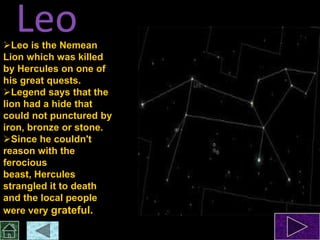
Leo

Leo is the Nemean
Lion which was killed
by Hercules on one of
his great quests.
Legend says that the
lion had a hide that
could not punctured by
iron, bronze or stone.
Since he couldn't
reason with the
ferocious
beast, Hercules
strangled it to death
and the local people
were very grateful.
Ursa Major( Big Dipper)

This group of stars
contains those who
make up the big dipper
and small. It is also
known as the great
bear and it is in the
northern hemisphere.
 Ursa Major has seven
Messier
objects, including a
double start, a
planetary nebula, an
irregular galaxy, and
four spiral galaxies.
Indus

 Indus is a constellation in the
southern hemisphere.
 It was one of the 12 constellations
that were observed by the Dutch
navigators Pieter Dirkszoon Keyser
and Frederick de Houtman, mapped
by the Dutch astronomer Petrus
Plancius.
 Indus was first depicted in Johann
Bayer's atlasUranometria in 1603.
 The name of the constellation means
"the Indian" and it is illustrated as a
man holding arrows, without a
bow, as though hunting.
 It is unclear whether Indus refers to a
native of the East Indies or the
Americas.
It is also known as
the Sea Serpent.
This constellation is
seen in the southern
hemisphere and you
can see it between
January and May.
It represents a giant
water snake.
 Hydra is the largest
constellation in the
sky.
It was a giant beast
with the body of a dog
and 100 snake like
heads.

Hydra
Summary
 A constellation is a group of stars that form an
image in the sky.
There are 88 total constellations in the world.
A constellations is a group of starts that you
can see in a particular area of the night sky.
The stories behind the constellations were
stories that poets, farmers and astronomers
have made up over the past 6,000 years.
Resources
http://www.space.com/15486-night-skyconstellations-names.html
http://www.comfychair.org/~cmbell/myth/my
th.html
www.cosmoquest.com
www.space.com
www.starregistry.co.uk
stars.astro.illinois.edu
We hope you
enjoyed our
educational
slideshow!
Constellations
Constellations

Constellations

  • 1.
    By Sharan Bindroo AsiyaKhan Jahnavi Verma Class:VIII C
  • 2.
    Index  Defining Constellation Facts about constellations History of constellations Naming constellations Few constellations: Case Study Summary
  • 3.
    What is aCONSTELLATION? •A constellation is a group of stars that form an image in the sky. •Constellations are pictures that tell stories that were made hundreds of years ago. •A constellations is a group of starts that you can see in a particular area of the night sky. •The stories behind the constellations were stories that poets, farmers and astronomers have made up over the past 6,000 years.
  • 4.
    Facts… o There are88 total constellations in the world o Some constellations move over the year o One of the constellations has the planet Mars in between them o Every constellation has a story of how they came to be and what they mean or represent oThey are named on big greek and Babylonian rulers of the 15 CE
  • 5.
    Facts continued • Ifyou are on the equator you can view all of the constellations in a year. • If you are on the North Pole, you can only see part of the sky. • Most stories that the constellations had were about hunters, warriors, queens, kings, birds, b ears, horses and other figures • The reason we can’t see some constellations all the time is because there are up in our sky enduring the day.
  • 6.
    History of Constellations •There are 88 officially recognized constellations in the sky, and these astronomical patterns have a fascinating and long history. • Forty-eight of the constellations are known as ancient or original, meaning they were talked about by the Greeks and probably by the Babylonians and still earlier peoples. After the 15th century, with the age of the great discoveries and worldwide navigation, the southernmost parts of the sky became known to man and had to be charted. • Other 48 constellations were found by modern astronomers. • Furthermore, across the entire sky were large gaps filled chiefly with dim stars between them. In more recent times people have invented the modern constellations to fill up some of these spaces.
  • 8.
    Draco – the dragon Dracothe dragon is one of the few constellations that really looks like itself.  His story is that he used to guard the golden apple tree in Hesperides garden.
  • 9.
    Grus Grus was often referred toas flamingo.  The ancient Egyptians used the Crane as a symbol of the astronomer because of high flight.
  • 10.
    Leo Leo is theNemean Lion which was killed by Hercules on one of his great quests. Legend says that the lion had a hide that could not punctured by iron, bronze or stone. Since he couldn't reason with the ferocious beast, Hercules strangled it to death and the local people were very grateful.
  • 11.
    Ursa Major( BigDipper) This group of stars contains those who make up the big dipper and small. It is also known as the great bear and it is in the northern hemisphere.  Ursa Major has seven Messier objects, including a double start, a planetary nebula, an irregular galaxy, and four spiral galaxies.
  • 12.
    Indus  Indus isa constellation in the southern hemisphere.  It was one of the 12 constellations that were observed by the Dutch navigators Pieter Dirkszoon Keyser and Frederick de Houtman, mapped by the Dutch astronomer Petrus Plancius.  Indus was first depicted in Johann Bayer's atlasUranometria in 1603.  The name of the constellation means "the Indian" and it is illustrated as a man holding arrows, without a bow, as though hunting.  It is unclear whether Indus refers to a native of the East Indies or the Americas.
  • 13.
    It is alsoknown as the Sea Serpent. This constellation is seen in the southern hemisphere and you can see it between January and May. It represents a giant water snake.  Hydra is the largest constellation in the sky. It was a giant beast with the body of a dog and 100 snake like heads. Hydra
  • 14.
    Summary  A constellationis a group of stars that form an image in the sky. There are 88 total constellations in the world. A constellations is a group of starts that you can see in a particular area of the night sky. The stories behind the constellations were stories that poets, farmers and astronomers have made up over the past 6,000 years.
  • 15.
  • 16.
    We hope you enjoyedour educational slideshow!