Understanding Stem Cell 
Abdurahman Laqif 
Yuyun Rindiastuti 
Department of Obstetrics and Gynecology Medical Faculty 
of Sebelas Maret University 
Dr. Moewardi General Hospital of Surakarta 
Indonesia
Contents 
• What is Stem cell (SC) 
– Definition 
– Microanatomy 
– Characteristics 
– Development phase of SC 
• When 
– Stem cell time line 
• Why 
– Plasticity/ differntiation 
• Where 
– Resource 
– Work 
• How 
– Make SC 
– Work in the tissue/ body
Definition 
• Stem cells are unspecialized cells in the 
human body that are capable of becoming 
specialized cells, each with new 
specialized cell functions.
Definition 
• Progenitor cell ( Precursor cell): is 
unspecialized or has partial characteristic 
of specialized cell that is capable of 
undergoing cell division and yielding two 
specialized cells 2-Example is the myeloid 
progenitor/precursor undergoing cell 
division to yield two specialized cells, 
a-A 
neutrophil 
b-A red blood 
cell
Progenitor SC 
Intermediate/ progenitor stem cell 
• 1-Stem cells, in general, generate an 
intermediate cell type or types before they 
achieve their final differentiation. 
• 2-The intermediate cell is called a precursor or 
progenitor cell. 
3-Progenitor or precursor cells in fetal or adult 
tissues are partly differentiated cells that divide 
and give rise to differentiated cells. 
4-Such cells are usually regarded as 
"committed" to differentiate along a particular 
cellular developmental pathway
Stem cells and Progenitor cell
Microanatomy Image: Stem cell 
Stem cell 
stem cell colony
Characteristics 
Stem cells have two important characteristics 
that distinguish them from other types of cells. 
• First, they are unspecialized cells that renew 
themselves for long periods through cell division. 
• The second is that under certain physiologic or 
experimental conditions, they can be induced to 
become cells with special functions such as the 
beating cells of the heart muscle or the insulin 
producing cells of the pancreas
What is a Stem Cell? 
Somatic Cell Stem Cell 
Two identical daughters Self-renewal Differentiate
Properties of stem cell: 
• they are: 
1. capable of dividing and renewing 
themselves for long periods 
2. they are unspecialized 
3. and they can give rise to specialized cell 
types
Sources of stem cells: 
• Embryonic Stem Cells 
• Adult Stem Cells 
• Adult Stem Cells 
• Adult Stem Cells
Sources of Embryonic Stem Cells 
1. In Vitro Fertilization ( IVF)  Blastocyst 
A human blastocyst, 
which is produced 
about 5 days after 
fertilization, is smaller 
than the period at 
the end of this sentence. 
NIH/Mr. J.Conaghan. 
2. Nuclear Transfer (SCNT)
Somatic Cell Nuclear Transfer 
DOLLY 
1997 
“Decisions” 
not irreversible 
Melissa Henriksen, PhD
Producing Embryonic Stem Cells Using 
Nuclear Transfer Is Not the Same as 
Reproductive Cloning 
The use of nuclear transfer to develop disease-specific 
stem cells can be called research 
cloning, and the use of this technique for 
personalized tissue transplants is sometimes 
called therapeutic cloning. These terms must be 
carefully distinguished from reproductive 
cloning, in which the intent is to implant a 
cloned embryo in a female’s womb and allow it 
to develop fully into an individual.
Adult Stem Cells sources 
- Bone Marrow Stem Cells 
- Peripheral Blood Stem Cells 
- Neuronal Stem Cells (from olfactory bulb, spinal cord) 
- Muscle Stem Cells 
- Liver Stem Cells 
- Pancreatic Stem Cells 
- Corneal Limbal Stem Cells 
- Umbilical Cord Blood
Human Stem Cell Classification based on the 
sources
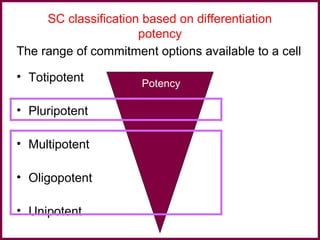
SC classification based on differentiation 
potency 
The range of commitment options available to a cell 
• Totipotent 
Potency 
• Pluripotent 
• Multipotent 
• Oligopotent 
• Unipotent
SC classification based on differentiation 
potency 
• Totipotent Stem Cells: The master cells of the body that 
contain all the genetic information needed to create all the cells 
of the body and the placenta. Totipotent cells exist only in the 
first three to four divisions of the fertilized egg and give rise to 
the next stage of development — the pluripotent stem cells 
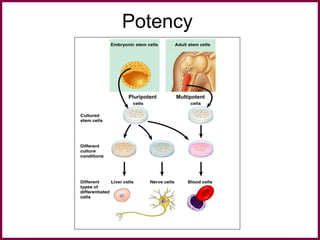
• Pluripotent Stem Cells: Stem cells that can develop into all the 
different cell types in the body except the placenta. They give rise to 
mulitpotent and unipotent stem cells as the embryo develops. 
• Multipotent Stem Cells: Stem cells that can give rise to a limited 
number of other cell types. They are committed to becoming a 
variety of cell types associated with specific functions or 
organs/tissues (e.g., blood, heart, muscle) in the body. For example, 
blood stem cells give rise to red blood cells, white blood cells, and 
platelets 
• Unipotent Stem Cells: Stem cells that can renew and give rise to 
only a single mature cell type.
Potency 
Pluripotent Multipotent
Stem cell plasticity 
Different Cell Types 
pancreatic bone neurons ES 
Same DNA 
Different Gene Expression
Plasticity of HESC 
• Human embryonic stem cell (HESC) telah 
terbukti sangat primitif, dapat berproliferasi 
tanpa batas, dan memiliki kemampuan 
untuk menurunkan galur semua jenis sel 
dewasa.
Plasticity of ASC 
• adult stem cell (ASC), dari jaringan dewasa yang 
sudah terarah menjadi jaringan tertentu, masih 
mampu berdiferensiasi menjadi sel bagian dari 
suatu jaringan lain. Pada saat ini belum ada 
istilah baku untuk menyebut fenomena ini dalam 
literatur ilmiah. Maka sering disebut sebagai 
plastisitas, diferensiasi unorthodox, maupun 
transdiferensiasi. 
• Tampaknya, dengan sinyal microenvironment, 
yang sesuai, adult stem cell dari sumsum tulang 
mampu bertransdiferensiasi menjadi berbagai 
macam sel dari organ yang berbeda-beda. 
Kirschstein R, Skirboll LR.
Plasticity of ASC 
• 1. It is the ability of an adult stem cell from one 
tissue to generate the cell type (s) of another 
tissue. 
2. Example under experimental conditions, adult 
stem cells from bone marrow generated cells that 
resemble neurons and other cell types are found in 
the brain. 
3. Evidence suggests that, adult stem cells 
are capable of being "genetically reprogrammed” 
to generate cells that have characteristics of 
different tissues. 
Dr. Fakhri Al-Bagdadi BVSc, Ph.D.
Development phase of SC 
• Tidak diketahui asal muasal yang pasti dari adult 
stemcell ; beberapa peneliti mengajukan 
hipotesis bahwa stem cell yang dicegah untuk 
berdiferensiasi ini disebar dan diletakkan 
dengan mekanisme tertentu yang belum 
diketahui selama periode perkembangan fetal.
of stem cell division: From SC to terminal diffferentiated
Why SC have plasticity capability? 
• Kerusakan jaringan tampaknya menciptakan 
lingkungan yang sesuai bagi perubahan 
orientasi diferensiasi ini. Tampaknya lingkungan 
jaringan extrahematopoietic yang terbentuk 
setelah apoptosis atau nekrosis (seperti 
keseimbangan sitokin maupun keadaan matriks 
ekstraseluler) memungkinkan engraftment yang 
sesuai bagi stem cell yang sedang beredar di 
aliran darah. Yang tidak diketahui adalah 
apakah stem cell melewati fase jaringan spesifik 
sebelum maturasi, baik melalui transdiferensiasi 
maupun fusi sel.
Plastisitas: Transdiferensiasi langsung dan 
tak langsung 
• Sel yang sudah terarah telah memulai rangkaian 
diferensiasi terminal yang diduga disebabkan oleh 
perubahan konformasi DNA. Transdiferensiasi 
menunjukkan kemampuan dari sebuah sel yang sudah 
terarah untuk mengubah pola ekspresi gennya menjadi 
sel yang betul betul berbeda dengan karakter asalnya, 
dan ini dapat terjadi langsung maupun tak langsung. 
Transdiferensiasi tak langsung berarti stem cell berde-diferensiasi 
diikuti proses maturasi ke jalur alternatif. 
Transdiferensiasi langsung berarti terdapat transisi 
langsung pada pola ekspresi gen sel tersebut.
Plastisitas : Fusi sel 
• Mekanisme alternatif untuk plastisitas adalah 
terjadinya fusi sel antara hematopoietic stem cell 
dengan non-hematopoietic stem cell membentuk 
heterokarion, dengan demikian mengubah pola 
ekspresi gen dari pola asli sel sumsum tulang 
menjadi pola ekspresi pasangan fusinya. 
Contohnya, fusi in vitro fibroblast dengan 
myoblast diketahui menghasilkan ekspresi 
mRNA yang spesifik untuk myocyte dengan 
nuklei yang spesifik untuk fibroblast.
When ?
How : Stem cell work?  Stem cell 
Niche 
• Both ES cells and somatic stem cells are thought to be maintained (and 
perhaps defined) by the environment produced by the surrounding 
differentiated cells. 
• • Exactly how this stem cell niche is maintained is not known yet. 
• • The differentiated cells may: 
• – secret specific factors into the surrounding matrix 
• – communicate with the stem cells via gap junctions or receptor mediated 
inducers 
• – Such communication may activate specific signaling pathways, such as the 
Wnt/frizzled (which activates Lef-1/TCF), Notch/delta, or 
• Sonic hedgehog/patched pathways. 
• • Loss of the stem cell niche can induce a stem cell to divide, die, or 
differentiate. 
• • Change in the niche may induce a stem cell to alter its phenotype and its 
function.
Stem cell Niche
Use
Understanding stem cell

Understanding stem cell

  • 1.
    Understanding Stem Cell Abdurahman Laqif Yuyun Rindiastuti Department of Obstetrics and Gynecology Medical Faculty of Sebelas Maret University Dr. Moewardi General Hospital of Surakarta Indonesia
  • 2.
    Contents • Whatis Stem cell (SC) – Definition – Microanatomy – Characteristics – Development phase of SC • When – Stem cell time line • Why – Plasticity/ differntiation • Where – Resource – Work • How – Make SC – Work in the tissue/ body
  • 3.
    Definition • Stemcells are unspecialized cells in the human body that are capable of becoming specialized cells, each with new specialized cell functions.
  • 4.
    Definition • Progenitorcell ( Precursor cell): is unspecialized or has partial characteristic of specialized cell that is capable of undergoing cell division and yielding two specialized cells 2-Example is the myeloid progenitor/precursor undergoing cell division to yield two specialized cells, a-A neutrophil b-A red blood cell
  • 5.
    Progenitor SC Intermediate/progenitor stem cell • 1-Stem cells, in general, generate an intermediate cell type or types before they achieve their final differentiation. • 2-The intermediate cell is called a precursor or progenitor cell. 3-Progenitor or precursor cells in fetal or adult tissues are partly differentiated cells that divide and give rise to differentiated cells. 4-Such cells are usually regarded as "committed" to differentiate along a particular cellular developmental pathway
  • 6.
    Stem cells andProgenitor cell
  • 7.
    Microanatomy Image: Stemcell Stem cell stem cell colony
  • 8.
    Characteristics Stem cellshave two important characteristics that distinguish them from other types of cells. • First, they are unspecialized cells that renew themselves for long periods through cell division. • The second is that under certain physiologic or experimental conditions, they can be induced to become cells with special functions such as the beating cells of the heart muscle or the insulin producing cells of the pancreas
  • 9.
    What is aStem Cell? Somatic Cell Stem Cell Two identical daughters Self-renewal Differentiate
  • 10.
    Properties of stemcell: • they are: 1. capable of dividing and renewing themselves for long periods 2. they are unspecialized 3. and they can give rise to specialized cell types
  • 11.
    Sources of stemcells: • Embryonic Stem Cells • Adult Stem Cells • Adult Stem Cells • Adult Stem Cells
  • 12.
    Sources of EmbryonicStem Cells 1. In Vitro Fertilization ( IVF)  Blastocyst A human blastocyst, which is produced about 5 days after fertilization, is smaller than the period at the end of this sentence. NIH/Mr. J.Conaghan. 2. Nuclear Transfer (SCNT)
  • 13.
    Somatic Cell NuclearTransfer DOLLY 1997 “Decisions” not irreversible Melissa Henriksen, PhD
  • 14.
    Producing Embryonic StemCells Using Nuclear Transfer Is Not the Same as Reproductive Cloning The use of nuclear transfer to develop disease-specific stem cells can be called research cloning, and the use of this technique for personalized tissue transplants is sometimes called therapeutic cloning. These terms must be carefully distinguished from reproductive cloning, in which the intent is to implant a cloned embryo in a female’s womb and allow it to develop fully into an individual.
  • 15.
    Adult Stem Cellssources - Bone Marrow Stem Cells - Peripheral Blood Stem Cells - Neuronal Stem Cells (from olfactory bulb, spinal cord) - Muscle Stem Cells - Liver Stem Cells - Pancreatic Stem Cells - Corneal Limbal Stem Cells - Umbilical Cord Blood
  • 17.
    Human Stem CellClassification based on the sources
  • 18.
    SC classification basedon differentiation potency The range of commitment options available to a cell • Totipotent Potency • Pluripotent • Multipotent • Oligopotent • Unipotent
  • 20.
    SC classification basedon differentiation potency • Totipotent Stem Cells: The master cells of the body that contain all the genetic information needed to create all the cells of the body and the placenta. Totipotent cells exist only in the first three to four divisions of the fertilized egg and give rise to the next stage of development — the pluripotent stem cells • Pluripotent Stem Cells: Stem cells that can develop into all the different cell types in the body except the placenta. They give rise to mulitpotent and unipotent stem cells as the embryo develops. • Multipotent Stem Cells: Stem cells that can give rise to a limited number of other cell types. They are committed to becoming a variety of cell types associated with specific functions or organs/tissues (e.g., blood, heart, muscle) in the body. For example, blood stem cells give rise to red blood cells, white blood cells, and platelets • Unipotent Stem Cells: Stem cells that can renew and give rise to only a single mature cell type.
  • 21.
  • 22.
    Stem cell plasticity Different Cell Types pancreatic bone neurons ES Same DNA Different Gene Expression
  • 23.
    Plasticity of HESC • Human embryonic stem cell (HESC) telah terbukti sangat primitif, dapat berproliferasi tanpa batas, dan memiliki kemampuan untuk menurunkan galur semua jenis sel dewasa.
  • 24.
    Plasticity of ASC • adult stem cell (ASC), dari jaringan dewasa yang sudah terarah menjadi jaringan tertentu, masih mampu berdiferensiasi menjadi sel bagian dari suatu jaringan lain. Pada saat ini belum ada istilah baku untuk menyebut fenomena ini dalam literatur ilmiah. Maka sering disebut sebagai plastisitas, diferensiasi unorthodox, maupun transdiferensiasi. • Tampaknya, dengan sinyal microenvironment, yang sesuai, adult stem cell dari sumsum tulang mampu bertransdiferensiasi menjadi berbagai macam sel dari organ yang berbeda-beda. Kirschstein R, Skirboll LR.
  • 25.
    Plasticity of ASC • 1. It is the ability of an adult stem cell from one tissue to generate the cell type (s) of another tissue. 2. Example under experimental conditions, adult stem cells from bone marrow generated cells that resemble neurons and other cell types are found in the brain. 3. Evidence suggests that, adult stem cells are capable of being "genetically reprogrammed” to generate cells that have characteristics of different tissues. Dr. Fakhri Al-Bagdadi BVSc, Ph.D.
  • 26.
    Development phase ofSC • Tidak diketahui asal muasal yang pasti dari adult stemcell ; beberapa peneliti mengajukan hipotesis bahwa stem cell yang dicegah untuk berdiferensiasi ini disebar dan diletakkan dengan mekanisme tertentu yang belum diketahui selama periode perkembangan fetal.
  • 27.
    of stem celldivision: From SC to terminal diffferentiated
  • 28.
    Why SC haveplasticity capability? • Kerusakan jaringan tampaknya menciptakan lingkungan yang sesuai bagi perubahan orientasi diferensiasi ini. Tampaknya lingkungan jaringan extrahematopoietic yang terbentuk setelah apoptosis atau nekrosis (seperti keseimbangan sitokin maupun keadaan matriks ekstraseluler) memungkinkan engraftment yang sesuai bagi stem cell yang sedang beredar di aliran darah. Yang tidak diketahui adalah apakah stem cell melewati fase jaringan spesifik sebelum maturasi, baik melalui transdiferensiasi maupun fusi sel.
  • 29.
    Plastisitas: Transdiferensiasi langsungdan tak langsung • Sel yang sudah terarah telah memulai rangkaian diferensiasi terminal yang diduga disebabkan oleh perubahan konformasi DNA. Transdiferensiasi menunjukkan kemampuan dari sebuah sel yang sudah terarah untuk mengubah pola ekspresi gennya menjadi sel yang betul betul berbeda dengan karakter asalnya, dan ini dapat terjadi langsung maupun tak langsung. Transdiferensiasi tak langsung berarti stem cell berde-diferensiasi diikuti proses maturasi ke jalur alternatif. Transdiferensiasi langsung berarti terdapat transisi langsung pada pola ekspresi gen sel tersebut.
  • 30.
    Plastisitas : Fusisel • Mekanisme alternatif untuk plastisitas adalah terjadinya fusi sel antara hematopoietic stem cell dengan non-hematopoietic stem cell membentuk heterokarion, dengan demikian mengubah pola ekspresi gen dari pola asli sel sumsum tulang menjadi pola ekspresi pasangan fusinya. Contohnya, fusi in vitro fibroblast dengan myoblast diketahui menghasilkan ekspresi mRNA yang spesifik untuk myocyte dengan nuklei yang spesifik untuk fibroblast.
  • 31.
  • 32.
    How : Stemcell work?  Stem cell Niche • Both ES cells and somatic stem cells are thought to be maintained (and perhaps defined) by the environment produced by the surrounding differentiated cells. • • Exactly how this stem cell niche is maintained is not known yet. • • The differentiated cells may: • – secret specific factors into the surrounding matrix • – communicate with the stem cells via gap junctions or receptor mediated inducers • – Such communication may activate specific signaling pathways, such as the Wnt/frizzled (which activates Lef-1/TCF), Notch/delta, or • Sonic hedgehog/patched pathways. • • Loss of the stem cell niche can induce a stem cell to divide, die, or differentiate. • • Change in the niche may induce a stem cell to alter its phenotype and its function.
  • 33.
  • 34.