Animal cell science and Technology
13. Stem cell culture
Shailendra Singh Shera, Ph.D
LT.13. Stem cells , Stem cell culture and Embryonic stem cell applications
Content outline
1. Stem cells definition
2. Characteristic of stem cells
3. Types of stem cells
4. Culture of Embryonic Stem cells
5. Overview of ES culture
6. Application s of ES cells
7. Test your understanding
8. References
What are stem cells?
A cell that has the ability to continuously divide and differentiate (develop) into various other kind(s) of
cells/tissues
Characteristic of stem cells
• They are unspecialized cells capable of renewing themselves through cell division, sometimes after
long periods of inactivity. ( Self Renew)
• Under certain physiologic or experimental conditions, they can be induced to become tissue- or
organ-specific cells with special functions. ( pluripotent and repair)
Types of stem cells
Stem cells
Adult stem
cells
Tissue
specific stem
cells
Induced
pluripotent
stem cells
Embryonic
stem cells
Embryonic Stem cells
blastocyst
outer layer of cells
= ‘trophectoderm’
cells inside
= ‘inner cell mass’
embryonic stem cells taken from
the inner cell mass
culture in the lab
to grow more cells
fluid with nutrients
•Embryonic stem cells are obtained from the inner cell mass of the blastocyst, a mainly hollow ball of cells
that, in the human, forms three to five days after an egg cell is fertilized by a sperm. A human blastocyst is
about the size of the dot above this “i.”
•Embryonic stem cells are pluripotent, meaning they can give rise to every cell type in the fully formed
body, but not the placenta and umbilical cord.
embryonic stem cells
PLURIPOTENT
all possible types of specialized cells
differentiation
What ES cell can do?
Somatic / Adult stem cells
•Somatic or adult stem cells are undifferentiated cells residing in various tissues of the body that
retain the capability of repopulating/repairing a tissue when needed.
•corneal epithelial stem cells located in basal cell layers of limbal region of the cornea. These limbal
stem cells are thought to be the source of new corneal epithelial cells, which migrate to the surface
of the cornea as they replace older cells or repair epithelial injuries.
•Specific areas of a tissue that contain adult stem cells are called stem cell niches. For example, a
stem cell derived from the liver will only generate more liver cells
Tissue specific stem cells
•Tissue-specific stem cells (also referred to as somatic or adult stem cells) are more specialized
than embryonic stem cells. Typically, these stem cells can generate different cell types for the
specific tissue or organ in which they live.
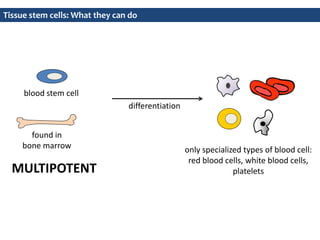
•For example, blood-forming (or hematopoietic) stem cells in the bone marrow can give rise to red
blood cells, white blood cells and platelets.
•However, blood-forming stem cells don’t generate liver or lung or brain cells, and stem cells in
other tissues and organs don’t generate red or white blood cells or platelets.
Tissue stem cells: Where we find them
muscles
skin
surface of the eye brain
breast
intestines (gut)
bone marrow
testicles
MULTIPOTENT
blood stem cell
found in
bone marrow
differentiation
only specialized types of blood cell:
red blood cells, white blood cells,
platelets
Tissue stem cells: What they can do
Stem cell niches
Direct contact Soluble factors Intermediate cell
stem cell
niche
Niche
Microenvironment around stem cells that provides
support and signals regulating self-renewal and
differentiation
•Induced pluripotent stem cells (iPSCs) are adult cells that have been genetically reprogrammed to
an embryonic stem cell–like state by being forced to express genes and factors important for
maintaining the defining properties of embryonic stem cells.
•Reprogramming process that uses specific transcription factors, such as Oct4, Sox2, Klf4, and c-
Myc, to induce pluripotency.
•Induced pluripotent stem (iPS) cells are cells that have been engineered in the lab by converting
tissue-specific cells, such as skin cells, into cells that behave like embryonic stem cells.
Induced pluripotent cells ( iPSC cells)
Stem cells can be categorized according to their lineage potential as:
Totipotent: cells of the very early embryo (first few cell divisions) that are capable of forming the
entire organism
Pluripotent: cells that can differentiate into all the different cells of an organism, except for placenta
and amniotic sac (not sufficient to form the full organism)
Multipotent: cells that can differentiate into more than one type of non-stem cell, but within a related
group of cell types
Unipotent: cells that can differentiate into only one type of non-stem cell
Induced pluripotent stem cells (iPS cells)
cell from the body
‘genetic reprogramming’
= add certain genes to the cell
induced pluripotent stem (iPS) cell
behaves like an embryonic stem cell
Advantage: no need for embryos!
all possible types of
specialized cells
culture iPS cells in the lab
differentiation
Culture of ES cell : Derivation
The zygote undergoes successive
mitotic divisions until a sphere of
cells—the blastocyst—is formed. In
the blastocyst, the trophoblast at its
periphery generates the embryonic
membranes and placenta, whereas
the inner cell mass develops into the
fetus. Embryonic stem cells are
immortal in culture, having been
established from one pluripotent cell
collected from the inner cell mass.
These are capable of differentiating
into any of the mature cell types
present in the adult organism.
•The essential part of these culturing procedures is a separation of inner cell mass to culture future
hESCs. When the colony reaches the appropriate size, cells must be separated. The occurrence of
pluripotent cells lasts for 1–2 days.
•Cell passaging is used to form smaller clusters of cells on a new culture surface. There are four
important passaging procedures.
Enzymatic dissociation is a cutting action of enzymes on proteins and adhesion domains that bind
the colony. It is a gentler method than the manual passage. It is crucial to not leave hESCs alone
after passaging. Solitary cells are more sensitive and can easily undergo cell death; collagenase
type IV is an example.
Manual passage, on the other hand, focuses on using cell scratchers. The selection of certain cells
is not necessary. This should be done in the early stages of cell line derivation .
Trypsin utilization allows a healthy, automated hESC passage. Good Manufacturing Practice
(GMP)-grade recombinant trypsin is widely available in this procedure. However, there is a risk of
decreasing the pluripotency and viability of stem cells. Trypsin utilization can be halted with an
inhibitor of the protein rho-associated protein kinase (ROCK).
Culture of ES cell : Steps & Important point
Ethylenediaminetetraacetic acid (EDTA) indirectly suppresses cell-to-cell connections by chelating
divalent cations. Their suppression promotes cell dissociation.
Stem cells require a mixture of growth factors and nutrients to differentiate and devel
•Traditional culture methods used for hESCs are mouse embryonic fibroblasts (MEFs) as a feeder
layer and bovine serum as a medium.
•hESCs cultured in the presence of animal products express the non-human sialic acid, N-
glycolylneuraminic acid (NeuGc). Feeder layers prevent uncontrolled proliferation with factors such
as leukaemia inhibitory factor (LIF) .
•First feeder layer-free culture can be supplemented with serum replacement, combined with
laminin This causes stable karyotypes of stem cells and pluripotency lasting for over a year.
•Initial culturing media can be serum (e.g. foetal calf serum FCS), artificial replacement such as
synthetic serum substitute (SSS), knockout serum replacement (KOSR), or StemPro .
• The simplest culture medium contains only eight essential elements: DMEM/F12 medium,
selenium, NaHCO3, l-ascorbic acid, transferrin, insulin, TGFβ1, and FGF2 .
Overview of ES cell culture
Applications of Embryonic stem cells
Image source : stemcell.nih.gov
Treatment of cardiac disease
•Mouse embryonic stem cells have been used to derive mouse cardiomyocytes. When injected into
the hearts of recipient adult mice, the cardiomyocytes repopulated the heart tissue and stably
integrated into the muscle tissue of the adult mouse heart.
Treatment of Lung disease
•Transplantation of pulmonary progenitor cells derived from human embryonic stem cells (hESCs)
may provide a novel approach to regenerate endogenous lung cells destroyed by injury and
disease.
Test your understanding*
*Questions adapted from: Practice and Learn Animal cell Science and Technology: Multiple choice question for learning.
Author: Shailendra Singh Shera . Publisher: Amazon Kindle.
1.What is the peculiar properties of stem cells?
a. It can divide quickly
b. It can divide indefinitely
c. It can differentiate into other types of cells
d. None of the above
2.Tissue specific stem cells and Induced pluripotent stem cells are…………
a. Type of embryonic stem cells
b. Types of hybrid cells
c. Types of adult stem cells
d. None of the above
3.Totipotent stem cells are
a. cells of the very early embryo (first few cell divisions) that are capable of forming the entire organism
b. cells that can differentiate into all the different cells of an organism, except for placenta and amniotic sac
(not sufficient to form the full organism)
c. cells that can differentiate into more than one type of non-stem cell, but within a related group of cell
types
d. cells that can differentiate into only one type of non-stem cell
4.Reprogramming of adult stem cells to induced pluripotent stem cell can be best done on
a. skin cells
b. Blood cells
c. Both (a) and (b)
d. None of the above
5. What do you understand by stem cell niche?
a. It is an area of a tissue that provides a specific microenvironment, in which stem cells are present in an
undifferentiated and self-renewable state.
b. It is a type of differentiated stem cells
c. It refers to area in cell culture dishes where stem cells are concentrated
d. None of the above
1. WWW. Eurostemcell.org ( For graphical slide)
2. https://stemcells.nih.gov/info/Regenerative_Medicine/2006Chapter1.htm
3. https://stemcells.nih.gov/info/basics/III.htm
4. “potential-clinical-applications-of-embryonic-stem-cells.” .
References and further reading
Further reading
1. Watson, J.D., Gilman, M., Witowski J.and Zoller, M. Recombinant DNA, 2nd ed., Scientific American
Books, 1983
2. Glick, B.R. and Pasternack, J.J. Molecular Biotechnology, 3rd ed., ASM Press, 2003
3. Davis J.M. Basic Cell Culture: A Practical Approach, IRL Press, 1998
4. Freshney R.I. Animal Cell Culture a practical approach, 1987
MCQ Practice questions
1. Practice and Learn Animal cell Science and Technology: Multiple choice question for learning.
Author: Shailendra Singh Shera . Publisher: Amazon Kindle.
Available on: amazon.com

13.Stem cell culture

  • 1.
    Animal cell scienceand Technology 13. Stem cell culture Shailendra Singh Shera, Ph.D
  • 2.
    LT.13. Stem cells, Stem cell culture and Embryonic stem cell applications Content outline 1. Stem cells definition 2. Characteristic of stem cells 3. Types of stem cells 4. Culture of Embryonic Stem cells 5. Overview of ES culture 6. Application s of ES cells 7. Test your understanding 8. References
  • 3.
    What are stemcells? A cell that has the ability to continuously divide and differentiate (develop) into various other kind(s) of cells/tissues Characteristic of stem cells • They are unspecialized cells capable of renewing themselves through cell division, sometimes after long periods of inactivity. ( Self Renew) • Under certain physiologic or experimental conditions, they can be induced to become tissue- or organ-specific cells with special functions. ( pluripotent and repair) Types of stem cells Stem cells Adult stem cells Tissue specific stem cells Induced pluripotent stem cells Embryonic stem cells
  • 4.
    Embryonic Stem cells blastocyst outerlayer of cells = ‘trophectoderm’ cells inside = ‘inner cell mass’ embryonic stem cells taken from the inner cell mass culture in the lab to grow more cells fluid with nutrients •Embryonic stem cells are obtained from the inner cell mass of the blastocyst, a mainly hollow ball of cells that, in the human, forms three to five days after an egg cell is fertilized by a sperm. A human blastocyst is about the size of the dot above this “i.” •Embryonic stem cells are pluripotent, meaning they can give rise to every cell type in the fully formed body, but not the placenta and umbilical cord.
  • 5.
    embryonic stem cells PLURIPOTENT allpossible types of specialized cells differentiation What ES cell can do?
  • 6.
    Somatic / Adultstem cells •Somatic or adult stem cells are undifferentiated cells residing in various tissues of the body that retain the capability of repopulating/repairing a tissue when needed. •corneal epithelial stem cells located in basal cell layers of limbal region of the cornea. These limbal stem cells are thought to be the source of new corneal epithelial cells, which migrate to the surface of the cornea as they replace older cells or repair epithelial injuries. •Specific areas of a tissue that contain adult stem cells are called stem cell niches. For example, a stem cell derived from the liver will only generate more liver cells Tissue specific stem cells •Tissue-specific stem cells (also referred to as somatic or adult stem cells) are more specialized than embryonic stem cells. Typically, these stem cells can generate different cell types for the specific tissue or organ in which they live. •For example, blood-forming (or hematopoietic) stem cells in the bone marrow can give rise to red blood cells, white blood cells and platelets. •However, blood-forming stem cells don’t generate liver or lung or brain cells, and stem cells in other tissues and organs don’t generate red or white blood cells or platelets.
  • 7.
    Tissue stem cells:Where we find them muscles skin surface of the eye brain breast intestines (gut) bone marrow testicles
  • 8.
    MULTIPOTENT blood stem cell foundin bone marrow differentiation only specialized types of blood cell: red blood cells, white blood cells, platelets Tissue stem cells: What they can do
  • 9.
    Stem cell niches Directcontact Soluble factors Intermediate cell stem cell niche Niche Microenvironment around stem cells that provides support and signals regulating self-renewal and differentiation
  • 10.
    •Induced pluripotent stemcells (iPSCs) are adult cells that have been genetically reprogrammed to an embryonic stem cell–like state by being forced to express genes and factors important for maintaining the defining properties of embryonic stem cells. •Reprogramming process that uses specific transcription factors, such as Oct4, Sox2, Klf4, and c- Myc, to induce pluripotency. •Induced pluripotent stem (iPS) cells are cells that have been engineered in the lab by converting tissue-specific cells, such as skin cells, into cells that behave like embryonic stem cells. Induced pluripotent cells ( iPSC cells) Stem cells can be categorized according to their lineage potential as: Totipotent: cells of the very early embryo (first few cell divisions) that are capable of forming the entire organism Pluripotent: cells that can differentiate into all the different cells of an organism, except for placenta and amniotic sac (not sufficient to form the full organism) Multipotent: cells that can differentiate into more than one type of non-stem cell, but within a related group of cell types Unipotent: cells that can differentiate into only one type of non-stem cell
  • 11.
    Induced pluripotent stemcells (iPS cells) cell from the body ‘genetic reprogramming’ = add certain genes to the cell induced pluripotent stem (iPS) cell behaves like an embryonic stem cell Advantage: no need for embryos! all possible types of specialized cells culture iPS cells in the lab differentiation
  • 12.
    Culture of EScell : Derivation The zygote undergoes successive mitotic divisions until a sphere of cells—the blastocyst—is formed. In the blastocyst, the trophoblast at its periphery generates the embryonic membranes and placenta, whereas the inner cell mass develops into the fetus. Embryonic stem cells are immortal in culture, having been established from one pluripotent cell collected from the inner cell mass. These are capable of differentiating into any of the mature cell types present in the adult organism.
  • 13.
    •The essential partof these culturing procedures is a separation of inner cell mass to culture future hESCs. When the colony reaches the appropriate size, cells must be separated. The occurrence of pluripotent cells lasts for 1–2 days. •Cell passaging is used to form smaller clusters of cells on a new culture surface. There are four important passaging procedures. Enzymatic dissociation is a cutting action of enzymes on proteins and adhesion domains that bind the colony. It is a gentler method than the manual passage. It is crucial to not leave hESCs alone after passaging. Solitary cells are more sensitive and can easily undergo cell death; collagenase type IV is an example. Manual passage, on the other hand, focuses on using cell scratchers. The selection of certain cells is not necessary. This should be done in the early stages of cell line derivation . Trypsin utilization allows a healthy, automated hESC passage. Good Manufacturing Practice (GMP)-grade recombinant trypsin is widely available in this procedure. However, there is a risk of decreasing the pluripotency and viability of stem cells. Trypsin utilization can be halted with an inhibitor of the protein rho-associated protein kinase (ROCK). Culture of ES cell : Steps & Important point
  • 14.
    Ethylenediaminetetraacetic acid (EDTA)indirectly suppresses cell-to-cell connections by chelating divalent cations. Their suppression promotes cell dissociation. Stem cells require a mixture of growth factors and nutrients to differentiate and devel •Traditional culture methods used for hESCs are mouse embryonic fibroblasts (MEFs) as a feeder layer and bovine serum as a medium. •hESCs cultured in the presence of animal products express the non-human sialic acid, N- glycolylneuraminic acid (NeuGc). Feeder layers prevent uncontrolled proliferation with factors such as leukaemia inhibitory factor (LIF) . •First feeder layer-free culture can be supplemented with serum replacement, combined with laminin This causes stable karyotypes of stem cells and pluripotency lasting for over a year. •Initial culturing media can be serum (e.g. foetal calf serum FCS), artificial replacement such as synthetic serum substitute (SSS), knockout serum replacement (KOSR), or StemPro . • The simplest culture medium contains only eight essential elements: DMEM/F12 medium, selenium, NaHCO3, l-ascorbic acid, transferrin, insulin, TGFβ1, and FGF2 .
  • 15.
    Overview of EScell culture
  • 16.
    Applications of Embryonicstem cells Image source : stemcell.nih.gov
  • 17.
    Treatment of cardiacdisease •Mouse embryonic stem cells have been used to derive mouse cardiomyocytes. When injected into the hearts of recipient adult mice, the cardiomyocytes repopulated the heart tissue and stably integrated into the muscle tissue of the adult mouse heart. Treatment of Lung disease •Transplantation of pulmonary progenitor cells derived from human embryonic stem cells (hESCs) may provide a novel approach to regenerate endogenous lung cells destroyed by injury and disease.
  • 18.
    Test your understanding* *Questionsadapted from: Practice and Learn Animal cell Science and Technology: Multiple choice question for learning. Author: Shailendra Singh Shera . Publisher: Amazon Kindle. 1.What is the peculiar properties of stem cells? a. It can divide quickly b. It can divide indefinitely c. It can differentiate into other types of cells d. None of the above 2.Tissue specific stem cells and Induced pluripotent stem cells are………… a. Type of embryonic stem cells b. Types of hybrid cells c. Types of adult stem cells d. None of the above 3.Totipotent stem cells are a. cells of the very early embryo (first few cell divisions) that are capable of forming the entire organism b. cells that can differentiate into all the different cells of an organism, except for placenta and amniotic sac (not sufficient to form the full organism) c. cells that can differentiate into more than one type of non-stem cell, but within a related group of cell types d. cells that can differentiate into only one type of non-stem cell 4.Reprogramming of adult stem cells to induced pluripotent stem cell can be best done on a. skin cells b. Blood cells c. Both (a) and (b) d. None of the above 5. What do you understand by stem cell niche? a. It is an area of a tissue that provides a specific microenvironment, in which stem cells are present in an undifferentiated and self-renewable state. b. It is a type of differentiated stem cells c. It refers to area in cell culture dishes where stem cells are concentrated d. None of the above
  • 19.
    1. WWW. Eurostemcell.org( For graphical slide) 2. https://stemcells.nih.gov/info/Regenerative_Medicine/2006Chapter1.htm 3. https://stemcells.nih.gov/info/basics/III.htm 4. “potential-clinical-applications-of-embryonic-stem-cells.” . References and further reading Further reading 1. Watson, J.D., Gilman, M., Witowski J.and Zoller, M. Recombinant DNA, 2nd ed., Scientific American Books, 1983 2. Glick, B.R. and Pasternack, J.J. Molecular Biotechnology, 3rd ed., ASM Press, 2003 3. Davis J.M. Basic Cell Culture: A Practical Approach, IRL Press, 1998 4. Freshney R.I. Animal Cell Culture a practical approach, 1987 MCQ Practice questions 1. Practice and Learn Animal cell Science and Technology: Multiple choice question for learning. Author: Shailendra Singh Shera . Publisher: Amazon Kindle. Available on: amazon.com