Stem Cell & It’s
Types
404 UNIT III, IV
PRESENTED BY:
MAULIK R PATEL
MSc Biochemistry
Stem cell & its types
404 UNIT III, IV
Presentation Overview
1. Introduction
2. History
3. What are stem cells?
4. What makes a cell a stem cell?
5. Types of stem cells
6. Stem cell timeline
7. Major uses of stem cells
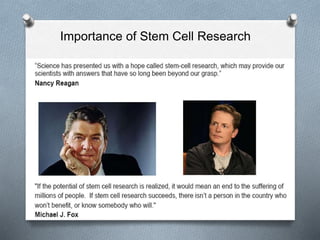
Importance of Stem Cell Research
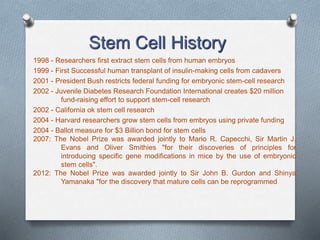
1998 - Researchers first extract stem cells from human embryos
1999 - First Successful human transplant of insulin-making cells from cadavers
2001 - President Bush restricts federal funding for embryonic stem-cell research
2002 - Juvenile Diabetes Research Foundation International creates $20 million
fund-raising effort to support stem-cell research
2002 - California ok stem cell research
2004 - Harvard researchers grow stem cells from embryos using private funding
2004 - Ballot measure for $3 Billion bond for stem cells
2007: The Nobel Prize was awarded jointly to Mario R. Capecchi, Sir Martin J.
Evans and Oliver Smithies "for their discoveries of principles for
introducing specific gene modifications in mice by the use of embryonic
stem cells".
2012: The Nobel Prize was awarded jointly to Sir John B. Gurdon and Shinya
Yamanaka "for the discovery that mature cells can be reprogrammed
Stem Cell History
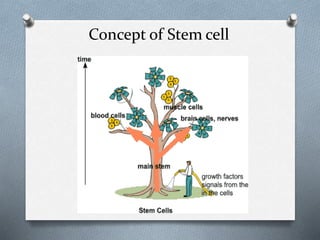
Concept of Stem cell
What are stem cells?
• the body is made up of about 200 different kinds
of specialised cells such as muscle cells, nerve
cells, fat cells and skin cells
• all cells in the body come from stem cells
• a stem cell is a cell that is not yet specialised
• the process of specialisation is called
differentiation
• once the differentiation pathway of a stem cell
has been decided, it can no longer become
another type of cell on its own
Stem Cell – Definition
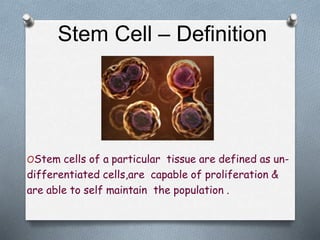
OStem cells of a particular tissue are defined as un-
differentiated cells,are capable of proliferation &
are able to self maintain the population .
What makes a cell a stem cell?
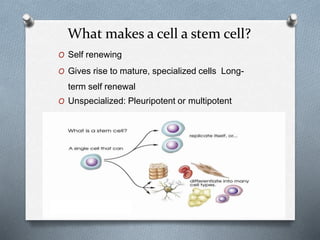
O Self renewing
O Gives rise to mature, specialized cells Long-
term self renewal
O Unspecialized: Pleuripotent or multipotent
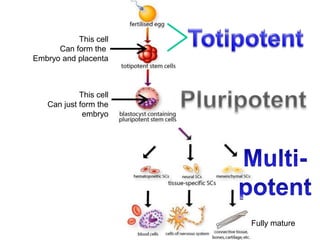
O Totipotent – Can differentiate into embryonic and extra
embryonic cell types. Can construct a complete viable
organism. Ex: Cell produced by fusion of an egg and
sperm
O Pluripotent – Can differentiate into nearly all cells, cells
derived from any of the three germ layers.
O Multipotent - Can differentiate into a number of cells, but
only those of a closely related family of cells.
O Oligopotent - Can differentiate into only a few cells, such
as lymphoid or myeloid stem cells.
O Unipotent - Can produce only one cell type of their own,
property of self renewal.
PROPRTIES OF STEM CELL
This cell
Can form the
Embryo and placenta
This cell
Can just form the
embryo
Fully mature
TYPES OF STEM CELLS
O There are three main types of stem cell:
O Embryonic stem cells
O Adult stem cells
O Induced pluripotent stem cells
EMBRYONIC STEM CELL
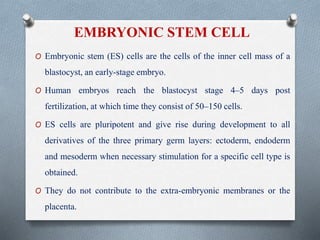
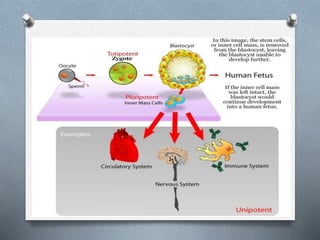
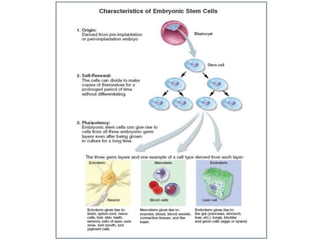
O Embryonic stem (ES) cells are the cells of the inner cell mass of a
blastocyst, an early-stage embryo.
O Human embryos reach the blastocyst stage 4–5 days post
fertilization, at which time they consist of 50–150 cells.
O ES cells are pluripotent and give rise during development to all
derivatives of the three primary germ layers: ectoderm, endoderm
and mesoderm when necessary stimulation for a specific cell type is
obtained.
O They do not contribute to the extra-embryonic membranes or the
placenta.
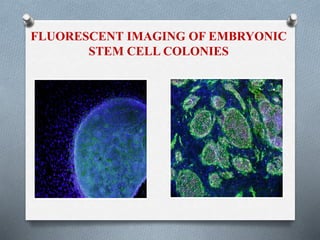
FLUORESCENT IMAGING OF EMBRYONIC
STEM CELL COLONIES
ADULT STEM CELLS
 These are also known as tissue specific stem cells.
 Adult stem cells supply new cells as an organism grows and
to replace cells that get damaged.
 These stem cells can generate different cell types for the
specific tissue or organ in which they live.
 Adult stem cells are said to be multipotent, which means
they can only change into some cells in the body but not all.
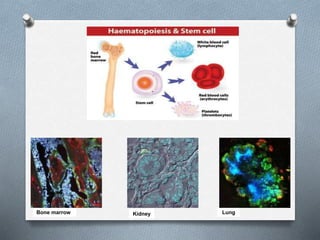
 For Example: Blood-forming (or hematopoietic) stem
cells in the bone marrow can give rise to red blood cells,
white blood cells and platelets. However, blood-forming stem
cells don’t generate liver or lung or brain cells.
Bone marrow Kidney Lung
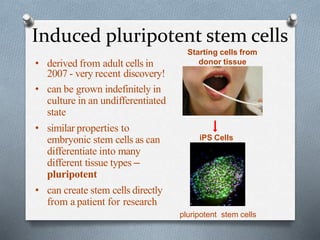
Induced pluripotent stem cells
• derived from adult cells in
2007 - very recent discovery!
• can be grown indefinitely in
culture in an undifferentiated
state
• similar properties to
embryonic stem cells as can
differentiate into many
different tissue types –
pluripotent
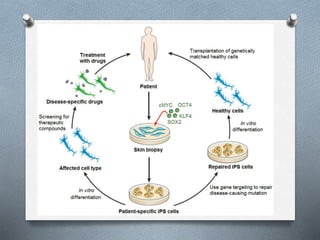
• can create stem cells directly
from a patient for research
Starting cells from
donor tissue
iPS Cells
pluripotent stem cells
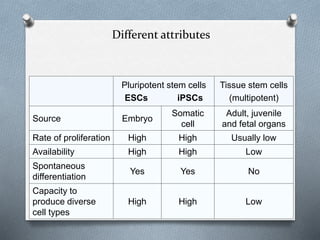
Different attributes
Pluripotent stem cells
ESCs iPSCs
Tissue stem cells
(multipotent)
Source Embryo
Somatic
cell
Adult, juvenile
and fetal organs
Rate of proliferation High High Usually low
Availability High High Low
Spontaneous
differentiation
Yes Yes No
Capacity to
produce diverse
cell types
High High Low
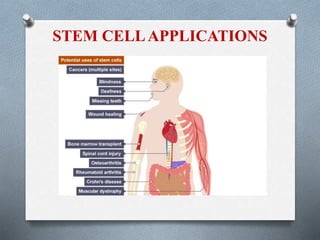
STEM CELLAPPLICATIONS
www.stemcellcentre.edu.au
www.stemcellchannel.com.au
www.gummy-stuff.org/stem-cells.htm.
http://en.wikipedia.org/wiki/Stem_cell_therapy
Stem cell & it's types

Stem cell & it's types

  • 1.
    Stem Cell &It’s Types 404 UNIT III, IV PRESENTED BY: MAULIK R PATEL MSc Biochemistry
  • 2.
    Stem cell &its types 404 UNIT III, IV
  • 3.
    Presentation Overview 1. Introduction 2.History 3. What are stem cells? 4. What makes a cell a stem cell? 5. Types of stem cells 6. Stem cell timeline 7. Major uses of stem cells
  • 4.
    Importance of StemCell Research
  • 6.
    1998 - Researchersfirst extract stem cells from human embryos 1999 - First Successful human transplant of insulin-making cells from cadavers 2001 - President Bush restricts federal funding for embryonic stem-cell research 2002 - Juvenile Diabetes Research Foundation International creates $20 million fund-raising effort to support stem-cell research 2002 - California ok stem cell research 2004 - Harvard researchers grow stem cells from embryos using private funding 2004 - Ballot measure for $3 Billion bond for stem cells 2007: The Nobel Prize was awarded jointly to Mario R. Capecchi, Sir Martin J. Evans and Oliver Smithies "for their discoveries of principles for introducing specific gene modifications in mice by the use of embryonic stem cells". 2012: The Nobel Prize was awarded jointly to Sir John B. Gurdon and Shinya Yamanaka "for the discovery that mature cells can be reprogrammed Stem Cell History
  • 7.
  • 8.
    What are stemcells? • the body is made up of about 200 different kinds of specialised cells such as muscle cells, nerve cells, fat cells and skin cells • all cells in the body come from stem cells • a stem cell is a cell that is not yet specialised • the process of specialisation is called differentiation • once the differentiation pathway of a stem cell has been decided, it can no longer become another type of cell on its own
  • 9.
    Stem Cell –Definition OStem cells of a particular tissue are defined as un- differentiated cells,are capable of proliferation & are able to self maintain the population .
  • 10.
    What makes acell a stem cell? O Self renewing O Gives rise to mature, specialized cells Long- term self renewal O Unspecialized: Pleuripotent or multipotent
  • 11.
    O Totipotent –Can differentiate into embryonic and extra embryonic cell types. Can construct a complete viable organism. Ex: Cell produced by fusion of an egg and sperm O Pluripotent – Can differentiate into nearly all cells, cells derived from any of the three germ layers. O Multipotent - Can differentiate into a number of cells, but only those of a closely related family of cells. O Oligopotent - Can differentiate into only a few cells, such as lymphoid or myeloid stem cells. O Unipotent - Can produce only one cell type of their own, property of self renewal. PROPRTIES OF STEM CELL
  • 12.
    This cell Can formthe Embryo and placenta This cell Can just form the embryo Fully mature
  • 13.
    TYPES OF STEMCELLS O There are three main types of stem cell: O Embryonic stem cells O Adult stem cells O Induced pluripotent stem cells
  • 14.
    EMBRYONIC STEM CELL OEmbryonic stem (ES) cells are the cells of the inner cell mass of a blastocyst, an early-stage embryo. O Human embryos reach the blastocyst stage 4–5 days post fertilization, at which time they consist of 50–150 cells. O ES cells are pluripotent and give rise during development to all derivatives of the three primary germ layers: ectoderm, endoderm and mesoderm when necessary stimulation for a specific cell type is obtained. O They do not contribute to the extra-embryonic membranes or the placenta.
  • 17.
    FLUORESCENT IMAGING OFEMBRYONIC STEM CELL COLONIES
  • 18.
    ADULT STEM CELLS These are also known as tissue specific stem cells.  Adult stem cells supply new cells as an organism grows and to replace cells that get damaged.  These stem cells can generate different cell types for the specific tissue or organ in which they live.  Adult stem cells are said to be multipotent, which means they can only change into some cells in the body but not all.  For Example: Blood-forming (or hematopoietic) stem cells in the bone marrow can give rise to red blood cells, white blood cells and platelets. However, blood-forming stem cells don’t generate liver or lung or brain cells.
  • 19.
  • 20.
    Induced pluripotent stemcells • derived from adult cells in 2007 - very recent discovery! • can be grown indefinitely in culture in an undifferentiated state • similar properties to embryonic stem cells as can differentiate into many different tissue types – pluripotent • can create stem cells directly from a patient for research Starting cells from donor tissue iPS Cells pluripotent stem cells
  • 22.
    Different attributes Pluripotent stemcells ESCs iPSCs Tissue stem cells (multipotent) Source Embryo Somatic cell Adult, juvenile and fetal organs Rate of proliferation High High Usually low Availability High High Low Spontaneous differentiation Yes Yes No Capacity to produce diverse cell types High High Low
  • 23.
  • 24.

Editor's Notes