Scott, C.  (2006).  Stem Cell Now.  PI Press:  New York, NY.
Medical Breakthrough James Thomson, a professor at the Wisconsin Regional Primate Research Center at the University of Wisconsin, reported he had developed the first line of human embryonic stem cells.  --November 6, 1998 Science   Scott, C.  (2006).  Stem Cell Now.  PI Press:  New York, NY.
What are “Stem Cells”? Cell that has the capacity to both self-renew (make more stem cells by cell division) and differentiate into mature, specialized cells. Scott, C.  (2006).  Stem Cell Now.  PI Press:  New York, NY.
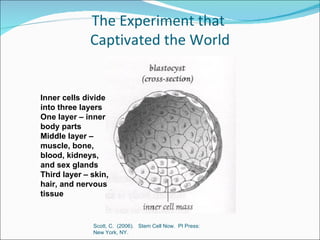
The Experiment that  Captivated the World Scott, C.  (2006).  Stem Cell Now.  PI Press:  New York, NY.  Inner cells divide into three layers One layer – inner body parts Middle layer – muscle, bone, blood, kidneys, and sex glands Third layer – skin, hair, and nervous tissue
Cell World White blood cells Red blood cells Bone cells Nerve cells Muscle cells Scott, C.  (2006).  Stem Cell Now.  PI Press:  New York, NY.
Review:  Cell Division Mitosis: Resting cell Chromosomes double and condense Duplicated chromosomes line up Chromosomes separate New nuclei form; cell divides Daughter cells Scott, C.  (2006).  Stem Cell Now.  PI Press:  New York, NY.
Scott, C.  (2006).  Stem Cell Now.  PI Press:  New York, NY.
A Brief History of  Embryonic Stem Cells Scott, C.  (2006).  Stem Cell Now.  PI Press:  New York, NY.
Hello “Dolly” Scott, C.  (2006).  Stem Cell Now.  PI Press:  New York, NY.
Human Embryonic Stem Cells (hESCs) Scott, C.  (2006).  Stem Cell Now.  PI Press:  New York, NY.  Protein secreted by the layer nourish the stem cells above, providing essential nutrients and signals that dampen the urge to differentiate.
Nuclear Transfer for Therapies Scott, C.  (2006).  Stem Cell Now.  PI Press:  New York, NY.
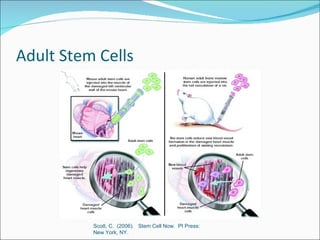
Adult Stem Cells Scott, C.  (2006).  Stem Cell Now.  PI Press:  New York, NY.
Pros and Cons Pros Cons Stem cell research can potentially help treating a range of medical problems. It could lead us closer to cure: Parkinson’s Disease Alzheimer’s Disease Heart Diseases, Stroke and Diabetes (Type 1) Birth Defects Spinal Cord Injuries Replace or Repair Damaged Organs Reduced Risk of Transplantation (You could possibly get a copy of your own heart in a heart-transplantation in the future) "We should not mess with human life.“ Some argue that stem cell research in the far future can lead to knowledge on how to clone humans. It is hard to say whether this is true, but we have seen devastating consequences of other research, even with good intentions, such as nuclear research. Scott, C.  (2006).  Stem Cell Now.  PI Press:  New York, NY.
Pros and Cons (continues) Pros Cons "The benefits of stem cell research has such a great outcome, that it outweighs the ethical issues." (Cost-benefit-analysis) "If someone is going to have an abortion, isn’t it better that we use it for something useful?" Adult stem cells would not be that interesting because they do not have the same properties as stem cells from a fetus. Another often mentioned advantage is that this research would give great insights about basics of the body. Critics against stem cell research, argue that there are ethical issues do not justify the benefits. "A life is a life and that should never be compromised. A fertilized egg should be valued as a human life even if it is in its very first weeks. Destroying human life in the hopes of saving human life is not ethical." We should (and will) develop more ethical methods (such as using adult stem cells) which will enable us to research ethically. We should wait to those methods are available. The scientific value has been overstated or has flaws. E.g. we do not know for sure that we can use stem cells to clone organs to be transplanted to oneself. Scott, C.  (2006).  Stem Cell Now.  PI Press:  New York, NY.
Questions for Stem-Cell Scientists Can nuclear transfer make cloned human cells? Can embryonic stem cells cure Parkinson’s disease? Can cancer be reversed? Can stem cells repair nerve damage? Can stem cells cure diabetes? Scott, C.  (2006).  Stem Cell Now.  PI Press:  New York, NY.
What Do You Think About  Stem-Cell Research? “Our decisions today will determine whether history regards America at the beginning of the twenty-first century as embarking on a new path of enlightenment or retreating to a dark and pessimistic time.”  --Christopher Thomas Scott, author  of  Stem Cell Now Scott, C.  (2006).  Stem Cell Now.  PI Press:  New York, NY.
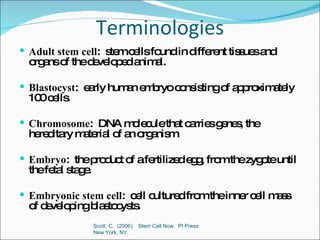
Terminologies Adult stem cell :  stem cells found in different tissues and organs of the developed animal. Blastocyst :  early human embryo consisting of approximately 100 cells. Chromosome :  DNA molecule that carries genes, the hereditary material of an organism. Embryo :  the product of a fertilized egg, from the zygote until the fetal stage. Embryonic stem cell :  cell cultured from the inner cell mass of developing blastocysts. Scott, C.  (2006).  Stem Cell Now.  PI Press:  New York, NY.
Terminologies Somatic cell nuclear transfer :  laboratory technique in which the nucleus of a somatic cell is injected, or transferred, into an egg that has had its nucleus removed. Somatic cells :  any cell within the developing or developed organism with the exception of egg and sperm cells.  Scott, C.  (2006).  Stem Cell Now.  PI Press:  New York, NY.
For Your Interest Video :  http:// stemcells.nih.gov/info/cellmovie.htm Video:  http://www.videojug.com/interview/life-extension-therapies-2#what-are-stem-cells http://stemcells.nih.gov/info/basics/basics1.asp Scott, C.  (2006).  Stem Cell Now.  PI Press:  New York, NY.

Stem Cell Research (HED 100)

  • 1.
    Scott, C. (2006). Stem Cell Now. PI Press: New York, NY.
  • 2.
    Medical Breakthrough JamesThomson, a professor at the Wisconsin Regional Primate Research Center at the University of Wisconsin, reported he had developed the first line of human embryonic stem cells. --November 6, 1998 Science Scott, C. (2006). Stem Cell Now. PI Press: New York, NY.
  • 3.
    What are “StemCells”? Cell that has the capacity to both self-renew (make more stem cells by cell division) and differentiate into mature, specialized cells. Scott, C. (2006). Stem Cell Now. PI Press: New York, NY.
  • 4.
    The Experiment that Captivated the World Scott, C. (2006). Stem Cell Now. PI Press: New York, NY. Inner cells divide into three layers One layer – inner body parts Middle layer – muscle, bone, blood, kidneys, and sex glands Third layer – skin, hair, and nervous tissue
  • 5.
    Cell World Whiteblood cells Red blood cells Bone cells Nerve cells Muscle cells Scott, C. (2006). Stem Cell Now. PI Press: New York, NY.
  • 6.
    Review: CellDivision Mitosis: Resting cell Chromosomes double and condense Duplicated chromosomes line up Chromosomes separate New nuclei form; cell divides Daughter cells Scott, C. (2006). Stem Cell Now. PI Press: New York, NY.
  • 7.
    Scott, C. (2006). Stem Cell Now. PI Press: New York, NY.
  • 8.
    A Brief Historyof Embryonic Stem Cells Scott, C. (2006). Stem Cell Now. PI Press: New York, NY.
  • 9.
    Hello “Dolly” Scott,C. (2006). Stem Cell Now. PI Press: New York, NY.
  • 10.
    Human Embryonic StemCells (hESCs) Scott, C. (2006). Stem Cell Now. PI Press: New York, NY. Protein secreted by the layer nourish the stem cells above, providing essential nutrients and signals that dampen the urge to differentiate.
  • 11.
    Nuclear Transfer forTherapies Scott, C. (2006). Stem Cell Now. PI Press: New York, NY.
  • 12.
    Adult Stem CellsScott, C. (2006). Stem Cell Now. PI Press: New York, NY.
  • 13.
    Adult Stem CellsScott, C. (2006). Stem Cell Now. PI Press: New York, NY.
  • 14.
    Pros and ConsPros Cons Stem cell research can potentially help treating a range of medical problems. It could lead us closer to cure: Parkinson’s Disease Alzheimer’s Disease Heart Diseases, Stroke and Diabetes (Type 1) Birth Defects Spinal Cord Injuries Replace or Repair Damaged Organs Reduced Risk of Transplantation (You could possibly get a copy of your own heart in a heart-transplantation in the future) "We should not mess with human life.“ Some argue that stem cell research in the far future can lead to knowledge on how to clone humans. It is hard to say whether this is true, but we have seen devastating consequences of other research, even with good intentions, such as nuclear research. Scott, C. (2006). Stem Cell Now. PI Press: New York, NY.
  • 15.
    Pros and Cons(continues) Pros Cons "The benefits of stem cell research has such a great outcome, that it outweighs the ethical issues." (Cost-benefit-analysis) "If someone is going to have an abortion, isn’t it better that we use it for something useful?" Adult stem cells would not be that interesting because they do not have the same properties as stem cells from a fetus. Another often mentioned advantage is that this research would give great insights about basics of the body. Critics against stem cell research, argue that there are ethical issues do not justify the benefits. "A life is a life and that should never be compromised. A fertilized egg should be valued as a human life even if it is in its very first weeks. Destroying human life in the hopes of saving human life is not ethical." We should (and will) develop more ethical methods (such as using adult stem cells) which will enable us to research ethically. We should wait to those methods are available. The scientific value has been overstated or has flaws. E.g. we do not know for sure that we can use stem cells to clone organs to be transplanted to oneself. Scott, C. (2006). Stem Cell Now. PI Press: New York, NY.
  • 16.
    Questions for Stem-CellScientists Can nuclear transfer make cloned human cells? Can embryonic stem cells cure Parkinson’s disease? Can cancer be reversed? Can stem cells repair nerve damage? Can stem cells cure diabetes? Scott, C. (2006). Stem Cell Now. PI Press: New York, NY.
  • 17.
    What Do YouThink About Stem-Cell Research? “Our decisions today will determine whether history regards America at the beginning of the twenty-first century as embarking on a new path of enlightenment or retreating to a dark and pessimistic time.” --Christopher Thomas Scott, author of Stem Cell Now Scott, C. (2006). Stem Cell Now. PI Press: New York, NY.
  • 18.
    Terminologies Adult stemcell : stem cells found in different tissues and organs of the developed animal. Blastocyst : early human embryo consisting of approximately 100 cells. Chromosome : DNA molecule that carries genes, the hereditary material of an organism. Embryo : the product of a fertilized egg, from the zygote until the fetal stage. Embryonic stem cell : cell cultured from the inner cell mass of developing blastocysts. Scott, C. (2006). Stem Cell Now. PI Press: New York, NY.
  • 19.
    Terminologies Somatic cellnuclear transfer : laboratory technique in which the nucleus of a somatic cell is injected, or transferred, into an egg that has had its nucleus removed. Somatic cells : any cell within the developing or developed organism with the exception of egg and sperm cells. Scott, C. (2006). Stem Cell Now. PI Press: New York, NY.
  • 20.
    For Your InterestVideo : http:// stemcells.nih.gov/info/cellmovie.htm Video: http://www.videojug.com/interview/life-extension-therapies-2#what-are-stem-cells http://stemcells.nih.gov/info/basics/basics1.asp Scott, C. (2006). Stem Cell Now. PI Press: New York, NY.