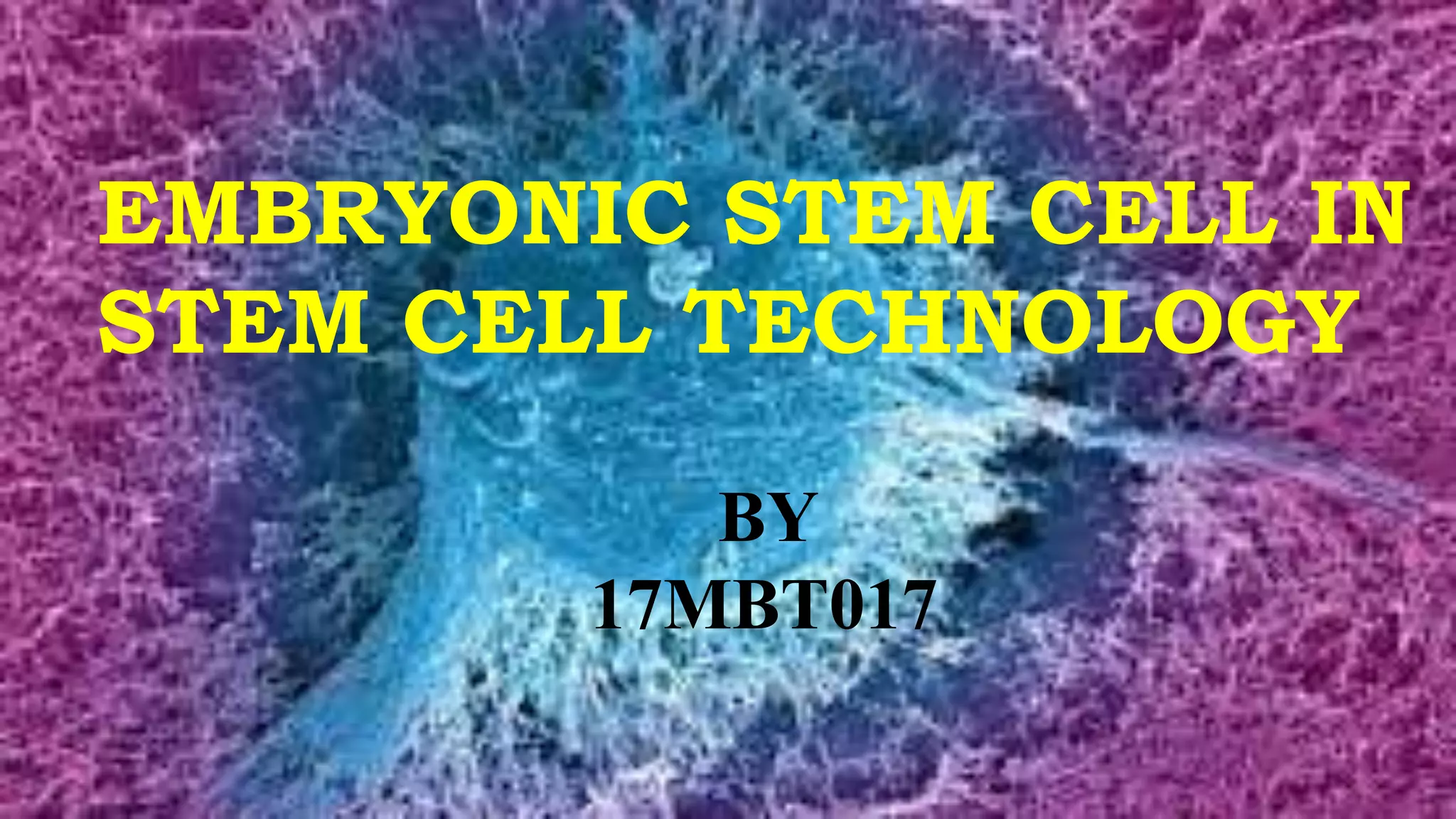

EMBRYONIC STEM CELL IN
STEM CELL TECHNOLOGY
BY
17MBT017
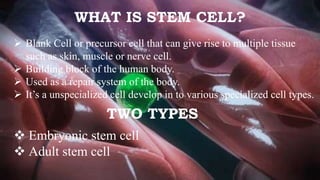
WHAT IS STEM CELL?
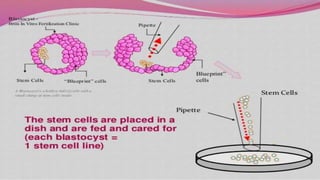
 Blank Cell or precursor cell that can give rise to multiple tissue
such as skin, muscle or nerve cell.
 Building block of the human body.
 Used as a repair system of the body.
 It’s a unspecialized cell develop in to various specialized cell types.
TWO TYPES
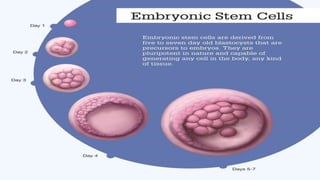
 Embryonic stem cell
 Adult stem cell
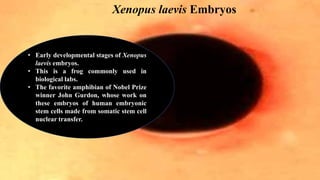
• Early developmental stages of Xenopus
laevis embryos.
• This is a frog commonly used in
biological labs.
• The favorite amphibian of Nobel Prize
winner John Gurdon, whose work on
these embryos of human embryonic
stem cells made from somatic stem cell
nuclear transfer.
Xenopus laevis Embryos
 Vincent Fleury, a researcher at the Paris
Diderot University, studied the early stage of
embryo development.
 When embryonic cells first form a flat sheet
of cells before folding into a U-shape,
resembling a folded pancake.
 He demonstrated that the formation of a
chicken's head is a consequence of the
collision between both sides of the embryo
flowing at constant speed towards each
other.
 He discovered that the mathematical
formula describing magnetic fields
representing the hydrodynamic flow
of embryonic cells.
 When the two sides collided, the
embryonic cells were subject to forces that
those of two magnets oriented head on,
which resulted in the formation of the head.
 The head formation does not merely result
from a series of discrete events activated
by genetic switches.
 The chemical gradients are not the
prevailing force responsible for movement
of cells in early embryo formation.
 These studies shed new light on vertebrate
development, and could ultimately provide
some clues for scientists involved in
regenerative medicines.
EMBRYO DEVELOPMENT OBEYS THE LAWS OF HYDRODYNAMICS
• Dr Ramkumar Sambasivan at
the Bangalore-based Institute
of Stem Cell Biology
And Regenerative
Medicine (In Stem Cell
Culture).
• Has shown how a genetic
switch controls development
of organs and body plan of
animals.
SCIENTISTS FIND GENETIC SWITCH THAT DECIDES FATE OF
EMBRYONIC STEM CELLS
• It led to
development of
five spinal cords
instead of one
seen in normal
embryos.
• The extra spinal cords
were formed at the
expense of a tissue,
which in normal
course would have
given rise to muscles
and skeleton.
• The team used
mouse model
for this study.
• They found that
when a gene
called Tbx6 was
mutated in mouse
embryos.
• This novel observation in
mutants highlighted the
important role of Tbx6 is
to connection between
spinal cord and muscle-
skeleton development.
Advantages of ES cells
•In general, the cultures from embryonic tissues
survive, and proliferate better than those from the
adult.
•This is due to the fact that ES cells are less specialized
with higher proliferative potential.
Limitations of ES cells
•In some cases, the ES cells will be different from the adult cells, and
thus there is no guarantee that they will mature to adult-type cells.
•Therefore, it is necessary to characterize the cells by appropriate
methods.
REFERENCES
 V. Fleury (2011). A change in boundary
conditions induces a discontinuity of
tissue flow in chicken embryos and the
formation of the cephalic fold. European
Physical Journal
E. DOI:10.1140/epje/i2011-11073-0
 http://www.freshphotons.com/post/54825
273995/jtotheizzoe-early-developmental-
stages
 https://indusdictum.com/2018/01/05/scien
tists-find-genetic-switch-that-decides-fate-
embryonic-stem-cells/
Embryonic stem cell

Embryonic stem cell

  • 1.
    EMBRYONIC STEM CELLIN STEM CELL TECHNOLOGY BY 17MBT017
  • 2.
    WHAT IS STEMCELL?  Blank Cell or precursor cell that can give rise to multiple tissue such as skin, muscle or nerve cell.  Building block of the human body.  Used as a repair system of the body.  It’s a unspecialized cell develop in to various specialized cell types. TWO TYPES  Embryonic stem cell  Adult stem cell
  • 5.
    • Early developmentalstages of Xenopus laevis embryos. • This is a frog commonly used in biological labs. • The favorite amphibian of Nobel Prize winner John Gurdon, whose work on these embryos of human embryonic stem cells made from somatic stem cell nuclear transfer. Xenopus laevis Embryos
  • 6.
     Vincent Fleury,a researcher at the Paris Diderot University, studied the early stage of embryo development.  When embryonic cells first form a flat sheet of cells before folding into a U-shape, resembling a folded pancake.  He demonstrated that the formation of a chicken's head is a consequence of the collision between both sides of the embryo flowing at constant speed towards each other.  He discovered that the mathematical formula describing magnetic fields representing the hydrodynamic flow of embryonic cells.  When the two sides collided, the embryonic cells were subject to forces that those of two magnets oriented head on, which resulted in the formation of the head.  The head formation does not merely result from a series of discrete events activated by genetic switches.  The chemical gradients are not the prevailing force responsible for movement of cells in early embryo formation.  These studies shed new light on vertebrate development, and could ultimately provide some clues for scientists involved in regenerative medicines. EMBRYO DEVELOPMENT OBEYS THE LAWS OF HYDRODYNAMICS
  • 7.
    • Dr RamkumarSambasivan at the Bangalore-based Institute of Stem Cell Biology And Regenerative Medicine (In Stem Cell Culture). • Has shown how a genetic switch controls development of organs and body plan of animals. SCIENTISTS FIND GENETIC SWITCH THAT DECIDES FATE OF EMBRYONIC STEM CELLS • It led to development of five spinal cords instead of one seen in normal embryos. • The extra spinal cords were formed at the expense of a tissue, which in normal course would have given rise to muscles and skeleton. • The team used mouse model for this study. • They found that when a gene called Tbx6 was mutated in mouse embryos. • This novel observation in mutants highlighted the important role of Tbx6 is to connection between spinal cord and muscle- skeleton development.
  • 8.
    Advantages of EScells •In general, the cultures from embryonic tissues survive, and proliferate better than those from the adult. •This is due to the fact that ES cells are less specialized with higher proliferative potential. Limitations of ES cells •In some cases, the ES cells will be different from the adult cells, and thus there is no guarantee that they will mature to adult-type cells. •Therefore, it is necessary to characterize the cells by appropriate methods.
  • 9.
    REFERENCES  V. Fleury(2011). A change in boundary conditions induces a discontinuity of tissue flow in chicken embryos and the formation of the cephalic fold. European Physical Journal E. DOI:10.1140/epje/i2011-11073-0  http://www.freshphotons.com/post/54825 273995/jtotheizzoe-early-developmental- stages  https://indusdictum.com/2018/01/05/scien tists-find-genetic-switch-that-decides-fate- embryonic-stem-cells/