MAGNETIC ABRASIVE
FINISHING PROCESS
Marathwada mitra mandal’s COLLEGE OF
ENGINEERING
GUIDED BY :
Mr. P.V. SAWAI
PRESENTED BY :
Rahul Sangappa Lokhande
ROLL NO. C331
T120450908
INTRODUCTION
 Traditionally finishing processes are crucial, expensive uncontrolled
and a labour intensive phase in the overall production.
 It also include total production cost and time.
 The ever increasing demand from the industry for better quality & cost
competitive product with complex design material need to good
surface finishing.
 In case of some application like internal finishing of capillary tube,
machining of titanium alloy, aircraft application , medical application
where high surface finish parts are required.
 Magnetic abrasive finishing (MAF) is the process which capable of
precision finishing of such work pieces.
 Since MAF does not require direct contact with the tool, the particles
can be introduced into area which are hard to reach by conventional
techniques.
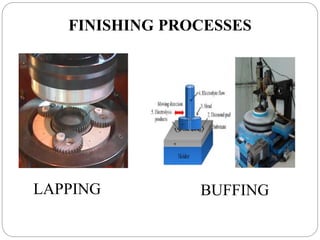
FINISHING PROCESSES
LAPPING BUFFING
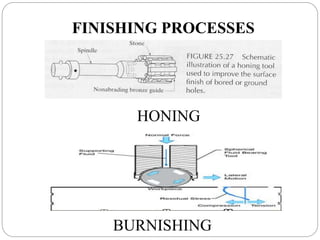
FINISHING PROCESSES
HONING
BURNISHING
LITERATURE REVIEW
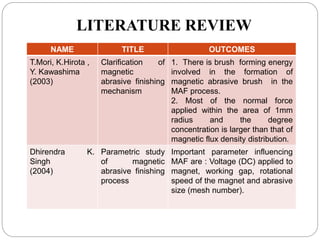
NAME TITLE OUTCOMES
T.Mori, K.Hirota ,
Y. Kawashima
(2003)
Clarification of
magnetic
abrasive finishing
mechanism
1. There is brush forming energy
involved in the formation of
magnetic abrasive brush in the
MAF process.
2. Most of the normal force
applied within the area of 1mm
radius and the degree
concentration is larger than that of
magnetic flux density distribution.
Dhirendra K.
Singh
(2004)
Parametric study
of magnetic
abrasive finishing
process
Important parameter influencing
MAF are : Voltage (DC) applied to
magnet, working gap, rotational
speed of the magnet and abrasive
size (mesh number).
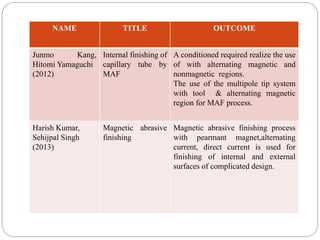
NAME TITLE OUTCOME
Junmo Kang,
Hitomi Yamaguchi
(2012)
Internal finishing of
capillary tube by
MAF
A conditioned required realize the use
of with alternating magnetic and
nonmagnetic regions.
The use of the multipole tip system
with tool & alternating magnetic
region for MAF process.
Harish Kumar,
Sehijpal Singh
(2013)
Magnetic abrasive
finishing
Magnetic abrasive finishing process
with pearmant magnet,alternating
current, direct current is used for
finishing of internal and external
surfaces of complicated design.
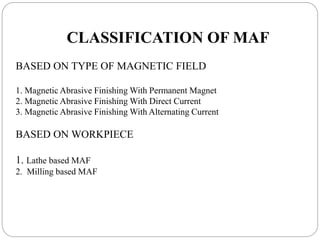
CLASSIFICATION OF MAF
BASED ON TYPE OF MAGNETIC FIELD
1. Magnetic Abrasive Finishing With Permanent Magnet
2. Magnetic Abrasive Finishing With Direct Current
3. Magnetic Abrasive Finishing With Alternating Current
BASED ON WORKPIECE
1. Lathe based MAF
2. Milling based MAF
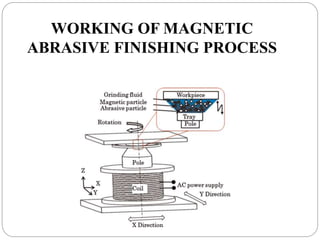
WORKING OF MAGNETIC
ABRASIVE FINISHING PROCESS
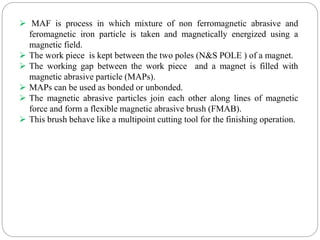
 MAF is process in which mixture of non ferromagnetic abrasive and
feromagnetic iron particle is taken and magnetically energized using a
magnetic field.
 The work piece is kept between the two poles (N&S POLE ) of a magnet.
 The working gap between the work piece and a magnet is filled with
magnetic abrasive particle (MAPs).
 MAPs can be used as bonded or unbonded.
 The magnetic abrasive particles join each other along lines of magnetic
force and form a flexible magnetic abrasive brush (FMAB).
 This brush behave like a multipoint cutting tool for the finishing operation.
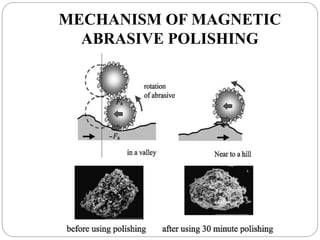
MECHANISM OF MAGNETIC
ABRASIVE POLISHING
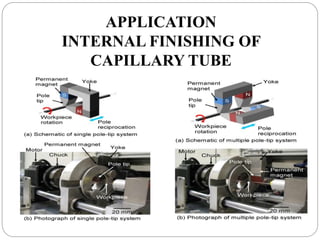
APPLICATION
INTERNAL FINISHING OF
CAPILLARY TUBE
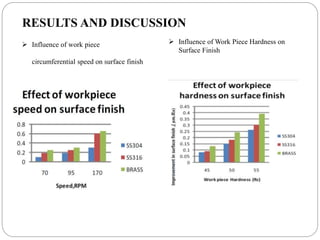
 Influence of work piece
circumferential speed on surface finish
 Influence of Work Piece Hardness on
Surface Finish
RESULTS AND DISCUSSION
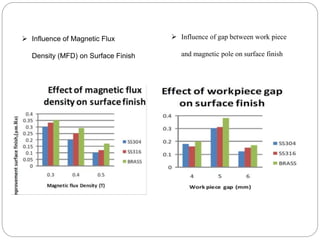
 Influence of Magnetic Flux
Density (MFD) on Surface Finish
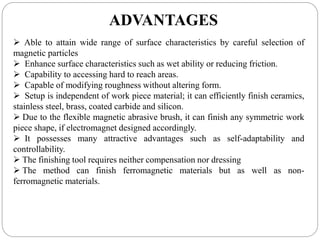
 Influence of gap between work piece
and magnetic pole on surface finish
ADVANTAGES
 Able to attain wide range of surface characteristics by careful selection of
magnetic particles
 Enhance surface characteristics such as wet ability or reducing friction.
 Capability to accessing hard to reach areas.
 Capable of modifying roughness without altering form.
 Setup is independent of work piece material; it can efficiently finish ceramics,
stainless steel, brass, coated carbide and silicon.
 Due to the flexible magnetic abrasive brush, it can finish any symmetric work
piece shape, if electromagnet designed accordingly.
 It possesses many attractive advantages such as self-adaptability and
controllability.
 The finishing tool requires neither compensation nor dressing
 The method can finish ferromagnetic materials but as well as non-
ferromagnetic materials.
DISADVANTAGES
 It is difficult to implement Magnetic abrasive finishing in mass production
operation.
 Not applicable for some ordinary finishing task where conventional
finishing technique can be easily implemented.
 Time consuming process.
 The cost of process is high.
APPLICATION
 Cutting tools
 Turbine blades
 Air foils
 Optics
 Sanitary pipes
 Food industry
 Capillary tubes, needles, biopsy needles in ,medical field
 Curved pipes
FUTURE SCOPE
 Study on the different combination of abrasive particles and magnetic
cluster to widen the approach of process.
 Use of MAF in other than manufacturing industries.
 Use of Abrasive Nano techniques for finishing.
CONCLUSION
• Magnetic abrasive finishing process can be used for surface finishing as well as
surface modification of hard to finish surfaces such as brass, stainless steel, etc.
• Magnetic abrasive finishing can be successfully used for finishing of internal as
well as external surfaces of complicated design.
• In magnetic abrasive finishing process, magnetic force is affected by the
material, shape and size of work, work-pole gap distance, and composition of
magnetic abrasives.
• The MAF-processed improves tribological properties, reduces the friction on the
chip-tool interface, and results in extended tool life. Smoothing with minimal
material removal and negligible changes in cutting edge geometry.
THANK YOU

Magnestic abrasive finishing process

  • 1.
    MAGNETIC ABRASIVE FINISHING PROCESS Marathwadamitra mandal’s COLLEGE OF ENGINEERING GUIDED BY : Mr. P.V. SAWAI PRESENTED BY : Rahul Sangappa Lokhande ROLL NO. C331 T120450908
  • 2.
    INTRODUCTION  Traditionally finishingprocesses are crucial, expensive uncontrolled and a labour intensive phase in the overall production.  It also include total production cost and time.  The ever increasing demand from the industry for better quality & cost competitive product with complex design material need to good surface finishing.  In case of some application like internal finishing of capillary tube, machining of titanium alloy, aircraft application , medical application where high surface finish parts are required.  Magnetic abrasive finishing (MAF) is the process which capable of precision finishing of such work pieces.  Since MAF does not require direct contact with the tool, the particles can be introduced into area which are hard to reach by conventional techniques.
  • 3.
  • 4.
  • 5.
    LITERATURE REVIEW NAME TITLEOUTCOMES T.Mori, K.Hirota , Y. Kawashima (2003) Clarification of magnetic abrasive finishing mechanism 1. There is brush forming energy involved in the formation of magnetic abrasive brush in the MAF process. 2. Most of the normal force applied within the area of 1mm radius and the degree concentration is larger than that of magnetic flux density distribution. Dhirendra K. Singh (2004) Parametric study of magnetic abrasive finishing process Important parameter influencing MAF are : Voltage (DC) applied to magnet, working gap, rotational speed of the magnet and abrasive size (mesh number).
  • 6.
    NAME TITLE OUTCOME JunmoKang, Hitomi Yamaguchi (2012) Internal finishing of capillary tube by MAF A conditioned required realize the use of with alternating magnetic and nonmagnetic regions. The use of the multipole tip system with tool & alternating magnetic region for MAF process. Harish Kumar, Sehijpal Singh (2013) Magnetic abrasive finishing Magnetic abrasive finishing process with pearmant magnet,alternating current, direct current is used for finishing of internal and external surfaces of complicated design.
  • 7.
    CLASSIFICATION OF MAF BASEDON TYPE OF MAGNETIC FIELD 1. Magnetic Abrasive Finishing With Permanent Magnet 2. Magnetic Abrasive Finishing With Direct Current 3. Magnetic Abrasive Finishing With Alternating Current BASED ON WORKPIECE 1. Lathe based MAF 2. Milling based MAF
  • 8.
  • 9.
     MAF isprocess in which mixture of non ferromagnetic abrasive and feromagnetic iron particle is taken and magnetically energized using a magnetic field.  The work piece is kept between the two poles (N&S POLE ) of a magnet.  The working gap between the work piece and a magnet is filled with magnetic abrasive particle (MAPs).  MAPs can be used as bonded or unbonded.  The magnetic abrasive particles join each other along lines of magnetic force and form a flexible magnetic abrasive brush (FMAB).  This brush behave like a multipoint cutting tool for the finishing operation.
  • 10.
  • 11.
  • 12.
     Influence ofwork piece circumferential speed on surface finish  Influence of Work Piece Hardness on Surface Finish RESULTS AND DISCUSSION
  • 13.
     Influence ofMagnetic Flux Density (MFD) on Surface Finish  Influence of gap between work piece and magnetic pole on surface finish
  • 14.
    ADVANTAGES  Able toattain wide range of surface characteristics by careful selection of magnetic particles  Enhance surface characteristics such as wet ability or reducing friction.  Capability to accessing hard to reach areas.  Capable of modifying roughness without altering form.  Setup is independent of work piece material; it can efficiently finish ceramics, stainless steel, brass, coated carbide and silicon.  Due to the flexible magnetic abrasive brush, it can finish any symmetric work piece shape, if electromagnet designed accordingly.  It possesses many attractive advantages such as self-adaptability and controllability.  The finishing tool requires neither compensation nor dressing  The method can finish ferromagnetic materials but as well as non- ferromagnetic materials.
  • 15.
    DISADVANTAGES  It isdifficult to implement Magnetic abrasive finishing in mass production operation.  Not applicable for some ordinary finishing task where conventional finishing technique can be easily implemented.  Time consuming process.  The cost of process is high. APPLICATION  Cutting tools  Turbine blades  Air foils  Optics  Sanitary pipes  Food industry  Capillary tubes, needles, biopsy needles in ,medical field  Curved pipes
  • 16.
    FUTURE SCOPE  Studyon the different combination of abrasive particles and magnetic cluster to widen the approach of process.  Use of MAF in other than manufacturing industries.  Use of Abrasive Nano techniques for finishing.
  • 17.
    CONCLUSION • Magnetic abrasivefinishing process can be used for surface finishing as well as surface modification of hard to finish surfaces such as brass, stainless steel, etc. • Magnetic abrasive finishing can be successfully used for finishing of internal as well as external surfaces of complicated design. • In magnetic abrasive finishing process, magnetic force is affected by the material, shape and size of work, work-pole gap distance, and composition of magnetic abrasives. • The MAF-processed improves tribological properties, reduces the friction on the chip-tool interface, and results in extended tool life. Smoothing with minimal material removal and negligible changes in cutting edge geometry.
  • 18.