1
CHAPTER 1
INTRODUCTION
1.1 GENERAL
All modern manufacturing industries focus on a higher economy,
increased productivity and enhanced quality in their manufacturing processes.
To enhance the material performance, a high energy rate forming technique is
of great importance to industry, which relies on a long and trouble free forming
process.
High energy rate forming (HERF) is the shaping of materials by
rapidly conveying energy to them for short time durations. There are a number
of methods of HERF, based mainly on the source of energy used for obtaining
high velocities (Wilson Frank 1964). Common methods of HERF are explosive
forming, electro hydraulic forming (EHF) and electromagnetic forming (EMF).
Among these techniques, electromagnetic forming is a high-speed process,
using a pulsed magnetic field to form the work piece, made of metals such as
copper and aluminum alloys with high electrical conductivity, which results in
increased deformation, higher hardness, reduced corrosion rate and good
formability. Reduction of weight is one of the major concerns in the
automotive industry. Aluminium and its alloys have a wide range of
applications, especially in the fabrication industries, aerospace, automobile and
other structural applications, due to their low density and high strength to
weight ratio, higher ductility and good corrosive resistance (Kleiner et al
1993).
2
Wrought aluminum alloys are of two types: non-heat treatable (i.e.,
the 1xxx, 3xxx, 4xxx, and 5xxx series) and heat treatable (the 2xxx, 6xxx, and
7xxx series). Aluminum alloys are either thermally treated or mechanically
treated to obtain the desired balanced mechanical properties required for
consistent component service performance (Polmear 1995). The heat treatable
alloys achieve their strength by precipitation hardening after thermal treatment.
The aluminum alloys corresponding to the 6xxx series are heat treatable. The
mechanical strength of these alloys is increased by the addition of magnesium
to accelerate the precipitation hardening as well as to achieve benefits from
natural aging effects (ASM Handbook 1993). Aluminium alloys AA6101 are
typically used in the automotive, aerospace, electrical and construction
industries.
1.2 HIGH ENERGY RATE FORMING
High energy rate forming methods are gaining popularity due to the
various advantages associated with them. They overcome the limitations of
conventional forming and make it possible to form metals with low formability
into complex shapes. This, in turn, has high economic and environmental
advantages linked due to potential weight savings in vehicles (Wilson Frank
1964). In conventional forming conditions, inertia is neglected, as the velocity
of forming is typically less than 5 m/s, while typical high velocity forming
operations are carried out at work-piece velocities of about 100 m/s (Daehn
Glenn 2003).
1.2.1 Explosive Forming
Explosive forming is distinguished from conventional forming in
that the punch or diaphragm is replaced by an explosive charge. The explosives
used are generally high – explosive chemicals, gaseous mixtures, or
3
propellants. There are two type of techniques of high – explosive forming:
(i) the stand – off technique (ii) the contact technique (Davis and Austin 1970).
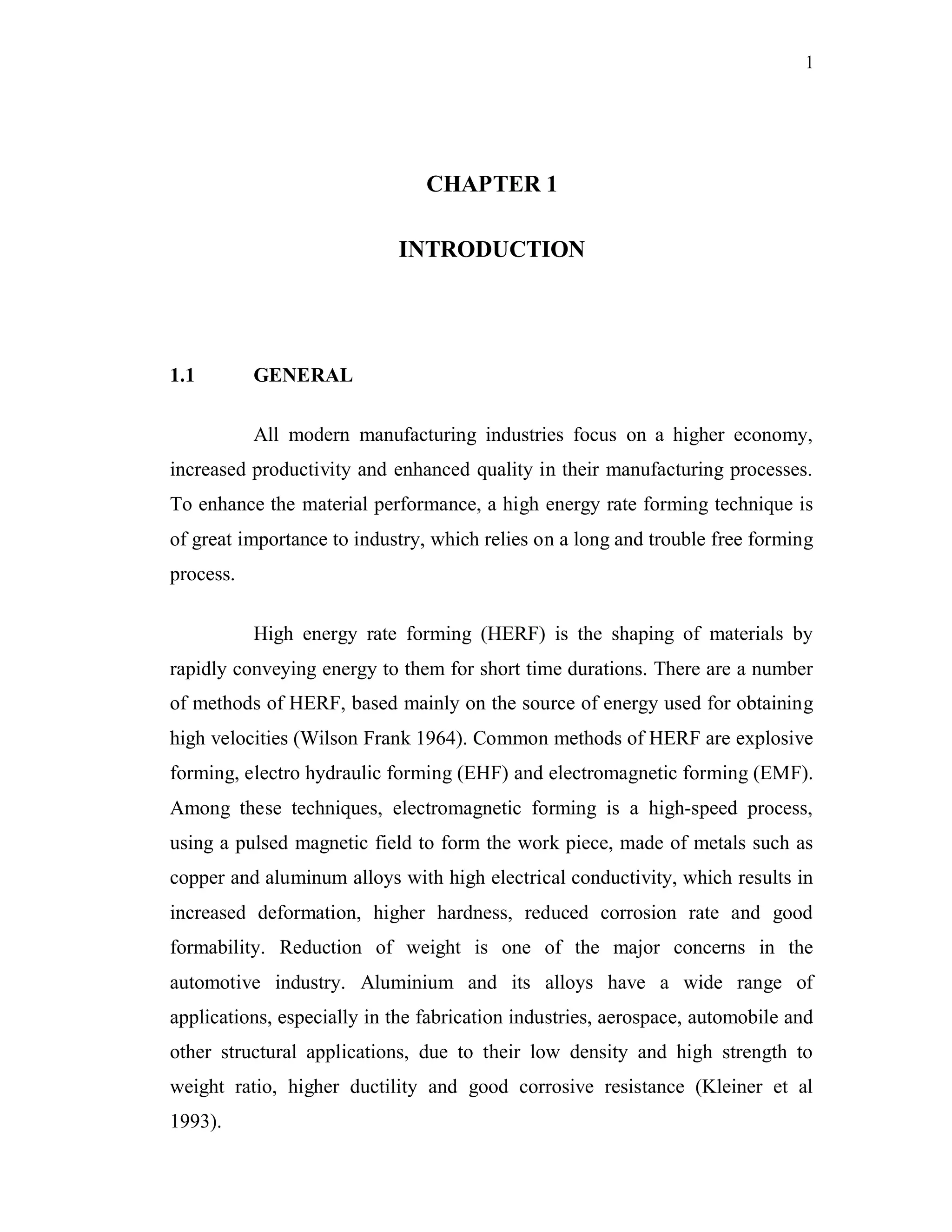
Standoff Technique: The sheet metal blank is clamped over a die
and the assembly is lowered into a tank filled with water. The air in the die is
pumped out. The explosive charge is placed at some predetermined distance
from the work piece (Figure 1.1). On detonation of the explosive, a pressure
pulse of very high intensity is produced. A gas bubble is also produced, which
expands spherically and then collapses. When the pressure pulse impinges
against the work piece, the metal is deformed into the die with a velocity as
high as 120 m/s (ASTME 1964). The use of water as the energy transfer
medium ensures a uniform transmission of energy and muffles the sound of the
explosive blast. The process is versatile – a large variety of shape can be
formed, there is virtually no limit to the size of the work piece, and it is suitable
for low – quantity production as well (Ezra 1973). The process has been
successfully used to form steel plates 0f 25 mm thick and 400 mm length and
to bulge steel tubes with thickers as high as 25 mm.
Figure 1.1 Sequence of underwater explosive forming operations.
(i) explosive charge is set in position (ii) formation of pressure
pulse during detonation of charge
(iii) work piece deformation and (iv) gas bubbles vent at the
surface of the water (nptel).
4
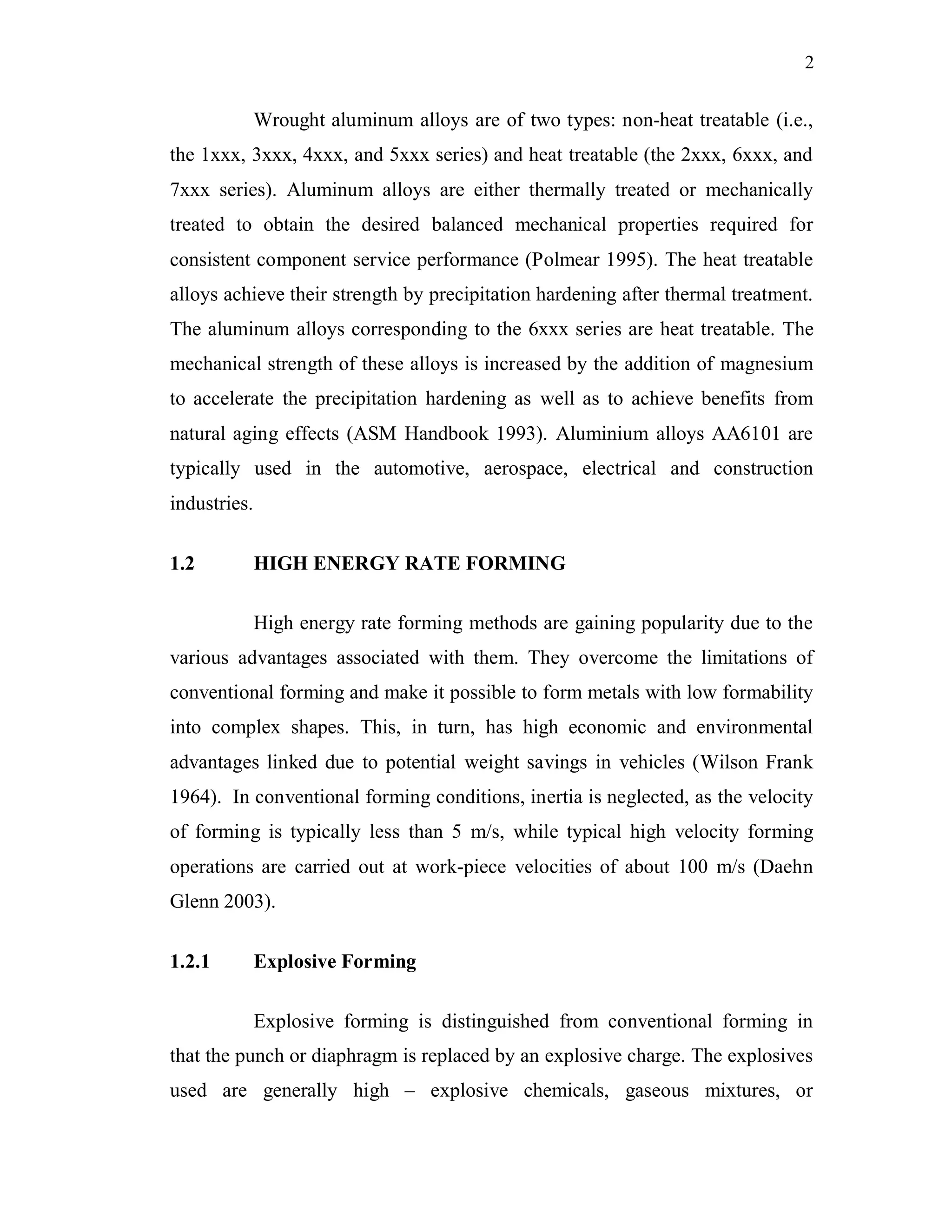
Contact Technique: The explosive charge in the form of a cartridge
is held in direct contact with the work piece while the detonation is initiated.
The detonation builds up extremely high pressures (upto 30,000MPa) on the
surface of the work piece, resulting in metal deformation, and possible fracture.
The process is used for bulging tubes locally. (Figure 1.2).
Figure 1.2 Schematic Illustration of contact technique of explosive
forming (nptel)
1.2.2 Electro Hydraulic Forming
Electro hydraulic forming (EHF), also known as electro spark
forming, is a process in which electrical energy is converted into mechanical
energy for the forming of metallic parts. A bank of capacitors is first charged
with high voltage, and then discharged across a gap between two electrodes,
causing explosions inside the hollow work piece, which is filled with some
suitable medium, generally water, as shown in Figure 1.3. These explosions
produce shock waves that travel radially in all directions at high velocity until
they meet some obstruction. If the discharge energy is sufficiently high, the
hollow work piece is deformed (Wilson Frank 1964 and Noland Micheal
1967). The rate of deformation can be controlled by applying external restraints
in the form of die or by varying the amount of energy released.
5
(a) (b)
Figure 1.3 Electro-hydraulic forming process (nptel) - (a) Unrestrained
expansion (b) Restrained expansion
1.2.3 Gun Forming
There is considerable evidence in the literature about the use of free
flying projectiles to penetrate, perforate and even weld metal plates. However,
there have been very few attempts to use this process as a practical metal
forming process. G.G Corbett et al 1996 effectively summarized the recent
research in the wide range of projectile-target configurations in the field of
impact dynamics. The work of a large number of people in the area of dynamic
loading of plates and shells has been reported. Typically they involve tests in
which plates are struck by hard steel spheres at velocities ranging from
150-2700 m/s ; spot welding of different materials by high-speed water jets;
use of polymeric projectiles for impact spot welding of thick and very high
strength plates with an industrial stud driver gun at impact velocity around 750
m/s . The effect of projectile nose geometry on the weld interface has also been
studied by the use of different nose geometries. High velocity projectiles
6
launched with a rifle gun have also been used for spot impact welding of
aluminum – steel sheets wherein it has been demonstrated that the strength of
the joint is even higher than parent material. Seth mala (2002), used the similar
rifle for forming high strength steel sheets against a die with a hemispherical
cavity.
1.2.4 Electro Magnetic Forming
1.2.4.1 Fundamental of electromagnetic forming
The process is also called magnetic pulse forming, and is mainly
used for swaging type operations, such as fastening fittings on the ends of tubes
and crimping the terminal ends of cables. Other applications of the process are
blanking, forming, embossing, and drawing. The work coils needed for
different applications may vary although the same power source is be used.
The principle of electromagnetic forming of a tubular work piece is
shown in Figureb1.4. The work piece is placed into or enveloping a coil. A
high charging voltage is supplied for a short time to a bank of capacitors
connected in parallel. The amount of electrical energy stored in the bank can be
increased either by adding capacitors to the bank or by increasing the voltage.
When the charging is complete, which takes very little time, a high voltage
switch triggers the stored electrical energy through the coil. A high – intensity
magnetic field is established which induces eddy currents into the conductive
work piece, resulting in the establishment of another magnetic field. The forces
produced by the two magnetic fields oppose each other with the consequence,
that there is a repelling force between the coil and the tubular work piece that
causes permanent deformation of the work piece (nptel).
Either permanent or expandable coils may be used. Since the
repelling force acts on the coil as well the work, the coil itself and the
insulation on it must be capable of withstanding the force, or else they will be
7
destroyed. The expandable coils are less costly, and are also preferred when a
high energy level is needed (Daehn Glenn 1999). Electro Magnetic forming
can be accomplished in any of the following three types of coils used,
depending upon the operation and requirements.
Figure 1.4 Various applications of electromagnetic forming process
(nptel). (i) Compression (ii) Expansion and (iii) Sheet metal
forming.
A coil used for ring compression is shown in Figure 1.4. (i)
This coil is similar in geometry to an expansion coil. However,
during the forming operation, the coil is placed surrounding the
tube to be compressed.
8
A coil used for tube expansion is shown in Figure 1.4. (ii); for
an expansion operation, the coil is placed inside the tube to be
expanded.
A flat coil which consists of a metal strip wound spirally in a
plane is shown in Figure 1.4. (iii); Coils of this type are used
for forming of sheet metal.
Two types of deformations can be obtained generally in
electromagnetic forming system: (i) compression (shrinking) and (ii) expansion
(bulging) of hollow circular cylindrical work pieces. When the work piece is
placed inside the forming coil, it is subjected to compression (shrinking) and its
diameter decreases during the deformation process. When the work piece is
placed outside the forming coil, it is subjected to expansion (bulging) and its
diameter increases during the deformation process. Either compression, or
expansion, and even a combination of both to attain final shapes can be
obtained, with a typical electromagnetic forming system for shaping hollow
cylindrical objects. In order to get more insight into the electromagnetic
forming process that can lead to such shapes, an investigation is required of the
electromagnetic forming of hollow circular cylindrical objects in detail.
The electromagnetic forming technology has unique advantages in
the forming, joining and assembly of light weight metals such as aluminum
because of the improved formability and mechanical properties, strain
distribution, reduction in wrinkling, active control of spring back, minimization
of distortions at local features, local coining and simple die (Daehn et al 2003,
Kamal 2005 and Seth et al 2005). The applications of electromagnetic tube
compression include, shape joints between a metallic tube and an internal
metallic mandrel for axial or torsional loading, friction joints between a
metallic tube and a wire rope or a non-metallic internal mandrel, solid state
welding between a tube and an internal mandrel of dissimilar metallic
9
materials, tow poles, aircraft torque tubes, chassis components and dynamic
compaction of many kinds of powders (Chelluri 1994 and Mamlis et al 2004).
1.2.4.2 Some important features of electromagnetic forming
Some important characteristic process features that make the
electromagnetic forming different from other forming processes are:
(1) Sheet metal in electromagnetic forming must be conductive
enough to allow the sufficient induced eddy currents. The
efficiency of electromagnetic forming is directly related to the
conductivity of the metal sheet. Metals with poor conductivity
can only be formed effectively if an auxiliary driver sheet with
high conductivity is used to push the metal sheet (George
Dieter 1986 and Richard Gedney 2002). Aluminum alloys are
good electrical conductors with higher conductivity compared
to plain carbon steel (Lee and Huh 1997). Aluminum alloys are
generally suitable for electromagnetic forming.
(2) The discharge time of electromagnetic forming is very short,
generally very short in the order of 10 microseconds (Vincent
Vohnout 1998). The conventional sheet stamping usually takes
a few seconds. The current in coil and sheet metal are damped
sinusoidally, and the most deformation work is done within the
first half cycle. Therefore, electromagnetic forming is a
transient event compared with conventional sheet stamping.
(3) As mentioned before, the distribution of electromagnetic
pressure can be directly controlled by the spatial configuration
of the coil. The magnitude of electromagnetic pressure can be
controlled by the stored charge in the capacitor bank.
10
Electromagnetic forming is easy to apply and control, making it
very suitable to be combined with conventional sheet stamping.
The practical coil can be designed to deal with the different
requirements of each forming operation.
1.2.4.3 Benefits of electromagnetic forming
Electromagnetic forming usually is used to accelerate the sheet metal
at velocities up to a few hundred meters per second, which are 100 to 1000
times greater than the deformation rates of conventional quasi-static forming
such as the sheet metal stamping (~0.1m/s to ~100m/s). It is well known that
high deformation velocity (over about 50m/s) can significantly increase the
formability of metals by several times, compared with those obtained in
conventional quasi-static forming (Glenn et al 1999 and Amit et al 1996). The
extended formability is available over a broad range of deformation velocities,
which is kind of material dependent but generally lies over 50m/s (Glenn et al
1999).
A complete understanding of how formability is affected by high
deformation velocity is still lacking. However, some issues about the
improvement of formability are clear now and will be briefly discussed. The
effect of inertia on a neck is the most straightforward way to explain the
improved formability in high velocity forming. Several researchers have shown
that failure in a tensile sample is delayed when inertial forces are relatively
large (X.Hu and Glenn 1996). Hu and Daehn believed that the velocity gradient
in the necking area leads to non-uniform inertia forces. Further the inertia
forces produce the additional tensile stress and strain at the areas outside of
necking.
The second reason for improved formability is due to inertial
ironing. The sheet metal with high velocity impacts the stationary hard die, and
11
produces a very large through-thickness compressive stress. This is termed as
inertial ironing (Glenn et al 1999). This compressive stress can be much larger
than the flow stress of the metal, and produced significal effect on the
deformation modes. There are some other issues on the formability in high
velocity forming, such as boundary conditions, constitutive equation changes at
high velocity.
The EMF process has several advantages over conventional forming processes.
Some of these advantages are common to all the high rate processes while
some are unique to electromagnetic forming. The advantages include:
Improved formability.
Wrinkling can be greatly eliminated.
Forming process can be combined with joining and assembling
even with the dissimilar components including glass, plastic,
composites and other metals.
Close dimensional tolerances are possible as spring back can be
significantly reduced.
Use of single sided dies reduces the tooling costs.
Applications of lubricants are greatly reduced or even
unnecessary; so, forming can be used in clean room conditions.
The process provides better reproducibility, as the current
passing through the forming coils is the only variable need to
be controlled for a given forming set-up. This is controlled by
the amount of energy discharged.
12
Since there is no physical contact between the work piece and
die as compared to the use of a punch in conventional forming
process, the surface finish can be improved.
High production rates are possible. The attribute that
essentially control the production rate would be the time taken
for the capacitor bank to get charged.
It is an environmentally clean process as no lubricants are
necessary.
1.2.4.4 Applications of electromagnetic forming
Electromagnetic forming is a process that has been applied since the
1960’s, but it is still to the developing stage. Its common applications include,
the assembly operations to form axisymmetric parts, using compression or
expansion solenoid type forming coils. Most of the applications are for the
swaging of tubular components onto coaxial mating parts for assembly. The
method is also used, though not commonly in forming of shallow shells from
flat sheets using flat spiral coils (John A. Waller 1978, Paul 1966 and Bruno
1968).
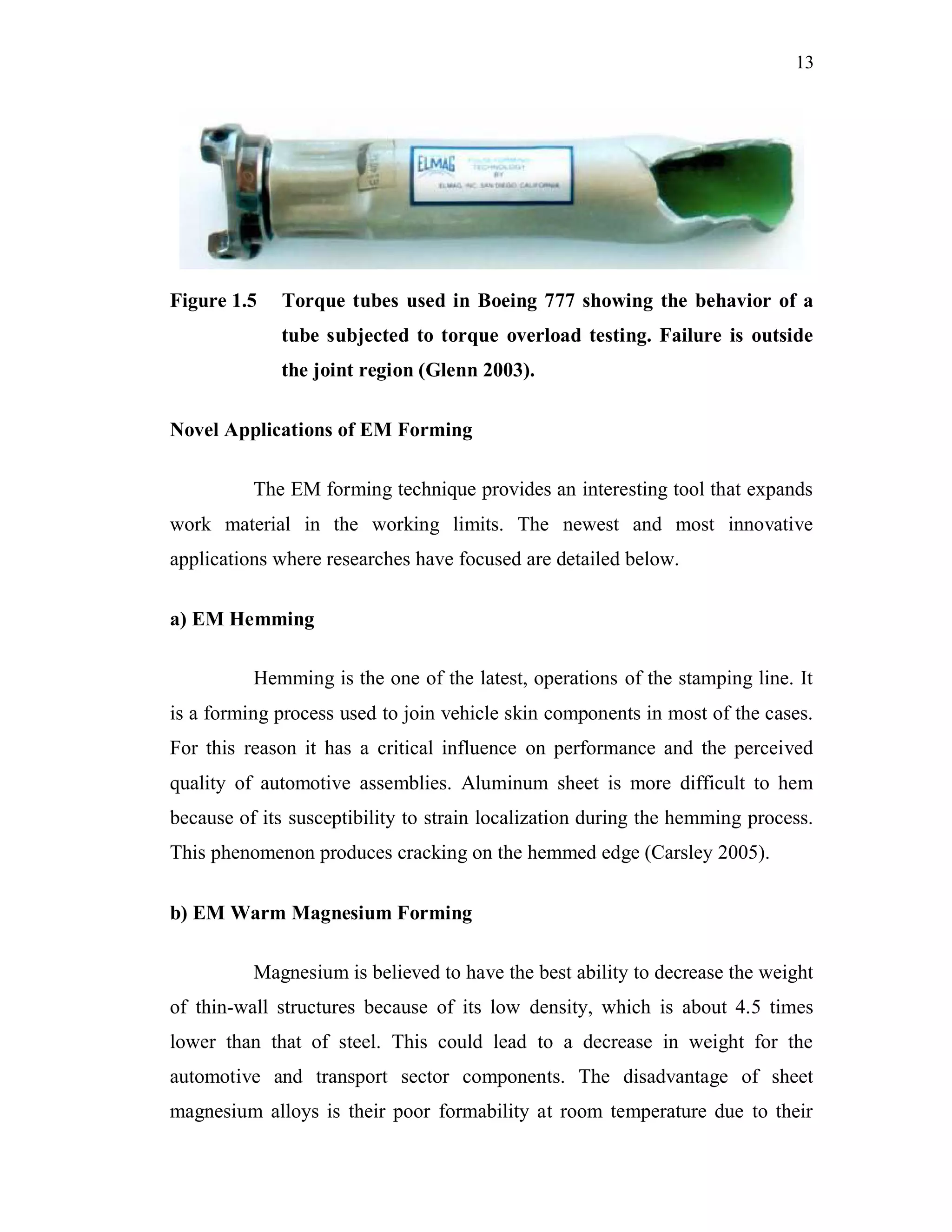
A recent industrial application of electromagnetic forming is shown
in Figure. 1.5. High-lift wing panels in the 777 (and retrofit in other Boeing
aircraft) are manufactured with EM forming. These products shown have
lifetime fatigue resistance and are manufactured with permanent coils (Glenn
2003).
13
Figure 1.5 Torque tubes used in Boeing 777 showing the behavior of a
tube subjected to torque overload testing. Failure is outside
the joint region (Glenn 2003).
Novel Applications of EM Forming
The EM forming technique provides an interesting tool that expands
work material in the working limits. The newest and most innovative
applications where researches have focused are detailed below.
a) EM Hemming
Hemming is the one of the latest, operations of the stamping line. It
is a forming process used to join vehicle skin components in most of the cases.
For this reason it has a critical influence on performance and the perceived
quality of automotive assemblies. Aluminum sheet is more difficult to hem
because of its susceptibility to strain localization during the hemming process.
This phenomenon produces cracking on the hemmed edge (Carsley 2005).
b) EM Warm Magnesium Forming
Magnesium is believed to have the best ability to decrease the weight
of thin-wall structures because of its low density, which is about 4.5 times
lower than that of steel. This could lead to a decrease in weight for the
automotive and transport sector components. The disadvantage of sheet
magnesium alloys is their poor formability at room temperature due to their
14
hexagonal microstructure. Magnesium alloys need to be heated to over 200°C
in order to increase their formability substantially. New approaches have been
developed on warm EM forming of magnesium by enhancing EM formability
with the warming effect (Kamal 2005 and Uhlmann 2004).
c) Magnetic Pulse Welding (MPW)
The magnetic pulse welding (MPW) is a cold welding process used
in conductive metals which may either be similar or dissimilar. The main
benefit it presents is its potential application onto many different materials
which is not attainable in some of the conventional material joining processes
(Aizawa 2005).
1.3 ROLL FORMING
Roll forming is one of the most common techniques used in the
forming process, to obtain a product as per the desired shape. The roll forming
process is mainly used due to its ease to be formed into useful shapes from
tubes, rods, and sheets. In this process, sheet metal, tubes, strips are fed
between successive pairs of rolls, that progressively bent and formed, until the
desired shape and cross section are attained. The roll forming process adds
strength and rigidity to lightweight materials, such as aluminum, brass, copper
and zinc, composites, some heavier ferrous metals, specialized alloys and other
exotic metals (Anne Marie Habrken 2007). Roll forming processes are
successfully used for materials that are difficult to form by other conventional
methods because of the spring back, as this process achieves plastic
deformation without the spring back. In addition, the roll forming improves the
mechanical properties of the material, especially, its hardness, grain size, and
also increases the corrosion rate. The deformation behaviour plays an
important role to achieve dimensional accuracy of the roll formed parts. The
purpose of conducting this roll forming process is to compare the results with
15
those of electromagnetic tube compression forming, through experiments and
simulations using the finite element analysis.
1.4 ADVANTAGES AND CHALLENGES ON USING
ALUMINUM ALLOYS
Conventional forming processes are often limited by ‘forming
window’ due to problems like wrinkling, spring back and low formability of
materials. Thin sheets are particularly difficult to form via the conventional
route as even small compressive stresses in the plane of the sheet produces
wrinkling. Thus difficult to form materials like high strength steels and some
aluminum alloys, create problems when formed conventionally.
1.4.1 Advantages of Using Al Alloys Vehicles
The use of aluminum alloys over some heavy steels, in the
automobile sector can lead to various advantages:
Aluminum parts can be twice as thick as steel but still 40%
lighter and 60% stiffer. Their lower mass leads to improved
fuel economy, acceleration, and braking performance. Up to
8% fuel savings can be realized for every 10% reduction in
weight from substituting aluminum for heavier metals (Graf
and Hosford 1989). For example, the Audi A2 has been
designed to use 3 liters of fuel per 100 kilometers. Its body
weight is 43% less than a conventional steel body (Gupta et al
2001).
Aluminum parts have excellent collision energy management
characteristics and can be designed to absorb the same energy
as steel at only 55% of the weight thereby leading to safety in
automobiles in the instance of a crash (Graf and Hosford 1989).
16
Aluminum’s unique combination of lightweight, high-strength
and corrosion- resistance characteristics make it the ideal alloy
for developing marine applications like high-speed aluminum
ferries, Bicycle frames, baseball bats, golf clubs etc. (Gurduru
et al 2002).
Aluminum alloys also have superior recycling ability which
becomes increasingly important in terms of the total life cost of
vehicles.
1.4.2 Challenges Associated with Using Al Alloys with Conventional
Forming
Formability of aluminum is poor in conventional stamping methods.
There is a cost penalty associated with using aluminum alloys compared to
steels. There is a 100% to 200% cost premium for weight reduction of 20% to
40% in vehicles (Han and Tvergaard 1995) due to the following:
• Al alloys have low formability (approximately 2/3
rd
) in
comparison to most steels. They have a tendency to neck and
tear at relatively low strain levels, making it difficult to use
them to make geometrically complex parts conventionally. It
also leads to high scrap rate expectancy.
• The press forming of aluminum alloys has problems in
comparison to steel principally due to material parameters like
low strain rate hardening, normal anisotropy, strain rate
sensitivity; and a high galling tendency.
• In addition to that, in conventional process the tryout with
mating male and female dies are generally slow and expensive.
Expensive tooling involving large number of press operations
17
adds to the cost. The typical die design and tryout time with Al
alloys is 50% higher than that of steel.
• Al alloys have high spring back due to a low elastic modulus
(approximately 1/3
rd
of steels). This in turn adds to the die
tryout time and cost.
Due to all these factors, virtually an all Al vehicle construction so far
has been of relatively low volume. Audi A2 and A8 are the only Al intensive
vehicles in mass production. Low volume vehicles include the Lotus Elise,
Acura NSX and Plymouth Prowler.
1.5 SIMULATION OF EMF AND ROLL FORMING
EMF is a complex process, which involves the interaction of
magnetic and structural analyses. Due to its complexity, the analytical and
numerical models are very useful to completely understand the process even
before conducting the experiments. The analytical method is carried out for the
electromagnetic tube compression process, using MATLAB 2010 to evaluate
the reduction in the diameter of the tube.
Numerical methods such as the finite difference, finite element and
finite volume methods are generally used to evaluate the deformation and Von
misses stresses. Among these, the finite element method is employed in
predicting the deformation of the tube. The finite element analysis is carried
out for electromagnetic forming, using the transient coupled magnetic
structural analysis, and also for roll forming using the transient structural
analysis.
18
1.6 OVERVIEW OF THE THESIS
The objective of this research is to study electromagnetic and roll
forming techniques under various energy and pressure levels through
numerical modelling and experimental investigation. The understanding and
designing of the forming process will be improved through finite element
modelling. Meanwhile, the forming feasibility and strength were tested through
experiments. The thesis is comprised of six chapters and the outline of each
chapter is detailed as follows.
Chapter 2 provides a comprehensive study of the literature on
electromagnetic and roll forming processes.
In Chapter 3, the electromagnetic tube compression and roll forming
experiments have been presented. Various tools are used to investigate the
effect of energy and pressure on the surface hardness, corrosion rate,
formability, surface roughness, micro structure and deformed grain size.
Chapter 4 deals with the numerical analysis of the electromagnetic
and roll forming processes. An optimization study is presented by considering
the energy level, number of turns, air gap between the work piece and the
electromagnetic coil as three variable process parameters. The mathematical
analysis of an electromagnetic tube compression forming was presented to
determine the deformation of the tube using MATLAB. The Finite Element
Analysis study was carried out correlating the experiments of Vivek et al
(2011).The APDL script was proposed to automate the entire preprocessing
activity in FEA. The simulations carried out for the transient analyses of
electromagnetic tube compression and roll forming processes are presented in
this chapter. Further, the simulations carried out for the transient analyses of
the electromagnetic and roll expansion of tubes are also included in this
chapter.
19
In Chapter 5, Results and discussions on the effects of the energy
levels used in EMF on tube compression, post electromagnetically formed
hardness, corrosion rate, formability, surface roughness, micro structure and
deformed grain size are presented. The effects of the pressure levels used in
roll forming on tube compression, post forming hardness, corrosion rate,
formability, surface roughness, micro structure and deformed grain size are
also presented. The results of the numerical analysis of the electromagnetic and
roll forming processes are also included.
Chapter 6 lists the conclusions of the different studies undertaken.
The scope for future work to be carried out is also included.
In the Annexure, the MATLAB Code to find the deformation of the
tube, and APDL Script used to automate the entire preprocessing activity in
FEA are included.
In the References part, all the publications referred to during the
course of study from International / National Journals, International / National
Conferences are included.

HERF

  • 1.
    1 CHAPTER 1 INTRODUCTION 1.1 GENERAL Allmodern manufacturing industries focus on a higher economy, increased productivity and enhanced quality in their manufacturing processes. To enhance the material performance, a high energy rate forming technique is of great importance to industry, which relies on a long and trouble free forming process. High energy rate forming (HERF) is the shaping of materials by rapidly conveying energy to them for short time durations. There are a number of methods of HERF, based mainly on the source of energy used for obtaining high velocities (Wilson Frank 1964). Common methods of HERF are explosive forming, electro hydraulic forming (EHF) and electromagnetic forming (EMF). Among these techniques, electromagnetic forming is a high-speed process, using a pulsed magnetic field to form the work piece, made of metals such as copper and aluminum alloys with high electrical conductivity, which results in increased deformation, higher hardness, reduced corrosion rate and good formability. Reduction of weight is one of the major concerns in the automotive industry. Aluminium and its alloys have a wide range of applications, especially in the fabrication industries, aerospace, automobile and other structural applications, due to their low density and high strength to weight ratio, higher ductility and good corrosive resistance (Kleiner et al 1993).
  • 2.
    2 Wrought aluminum alloysare of two types: non-heat treatable (i.e., the 1xxx, 3xxx, 4xxx, and 5xxx series) and heat treatable (the 2xxx, 6xxx, and 7xxx series). Aluminum alloys are either thermally treated or mechanically treated to obtain the desired balanced mechanical properties required for consistent component service performance (Polmear 1995). The heat treatable alloys achieve their strength by precipitation hardening after thermal treatment. The aluminum alloys corresponding to the 6xxx series are heat treatable. The mechanical strength of these alloys is increased by the addition of magnesium to accelerate the precipitation hardening as well as to achieve benefits from natural aging effects (ASM Handbook 1993). Aluminium alloys AA6101 are typically used in the automotive, aerospace, electrical and construction industries. 1.2 HIGH ENERGY RATE FORMING High energy rate forming methods are gaining popularity due to the various advantages associated with them. They overcome the limitations of conventional forming and make it possible to form metals with low formability into complex shapes. This, in turn, has high economic and environmental advantages linked due to potential weight savings in vehicles (Wilson Frank 1964). In conventional forming conditions, inertia is neglected, as the velocity of forming is typically less than 5 m/s, while typical high velocity forming operations are carried out at work-piece velocities of about 100 m/s (Daehn Glenn 2003). 1.2.1 Explosive Forming Explosive forming is distinguished from conventional forming in that the punch or diaphragm is replaced by an explosive charge. The explosives used are generally high – explosive chemicals, gaseous mixtures, or
  • 3.
    3 propellants. There aretwo type of techniques of high – explosive forming: (i) the stand – off technique (ii) the contact technique (Davis and Austin 1970). Standoff Technique: The sheet metal blank is clamped over a die and the assembly is lowered into a tank filled with water. The air in the die is pumped out. The explosive charge is placed at some predetermined distance from the work piece (Figure 1.1). On detonation of the explosive, a pressure pulse of very high intensity is produced. A gas bubble is also produced, which expands spherically and then collapses. When the pressure pulse impinges against the work piece, the metal is deformed into the die with a velocity as high as 120 m/s (ASTME 1964). The use of water as the energy transfer medium ensures a uniform transmission of energy and muffles the sound of the explosive blast. The process is versatile – a large variety of shape can be formed, there is virtually no limit to the size of the work piece, and it is suitable for low – quantity production as well (Ezra 1973). The process has been successfully used to form steel plates 0f 25 mm thick and 400 mm length and to bulge steel tubes with thickers as high as 25 mm. Figure 1.1 Sequence of underwater explosive forming operations. (i) explosive charge is set in position (ii) formation of pressure pulse during detonation of charge (iii) work piece deformation and (iv) gas bubbles vent at the surface of the water (nptel).
  • 4.
    4 Contact Technique: Theexplosive charge in the form of a cartridge is held in direct contact with the work piece while the detonation is initiated. The detonation builds up extremely high pressures (upto 30,000MPa) on the surface of the work piece, resulting in metal deformation, and possible fracture. The process is used for bulging tubes locally. (Figure 1.2). Figure 1.2 Schematic Illustration of contact technique of explosive forming (nptel) 1.2.2 Electro Hydraulic Forming Electro hydraulic forming (EHF), also known as electro spark forming, is a process in which electrical energy is converted into mechanical energy for the forming of metallic parts. A bank of capacitors is first charged with high voltage, and then discharged across a gap between two electrodes, causing explosions inside the hollow work piece, which is filled with some suitable medium, generally water, as shown in Figure 1.3. These explosions produce shock waves that travel radially in all directions at high velocity until they meet some obstruction. If the discharge energy is sufficiently high, the hollow work piece is deformed (Wilson Frank 1964 and Noland Micheal 1967). The rate of deformation can be controlled by applying external restraints in the form of die or by varying the amount of energy released.
  • 5.
    5 (a) (b) Figure 1.3Electro-hydraulic forming process (nptel) - (a) Unrestrained expansion (b) Restrained expansion 1.2.3 Gun Forming There is considerable evidence in the literature about the use of free flying projectiles to penetrate, perforate and even weld metal plates. However, there have been very few attempts to use this process as a practical metal forming process. G.G Corbett et al 1996 effectively summarized the recent research in the wide range of projectile-target configurations in the field of impact dynamics. The work of a large number of people in the area of dynamic loading of plates and shells has been reported. Typically they involve tests in which plates are struck by hard steel spheres at velocities ranging from 150-2700 m/s ; spot welding of different materials by high-speed water jets; use of polymeric projectiles for impact spot welding of thick and very high strength plates with an industrial stud driver gun at impact velocity around 750 m/s . The effect of projectile nose geometry on the weld interface has also been studied by the use of different nose geometries. High velocity projectiles
  • 6.
    6 launched with arifle gun have also been used for spot impact welding of aluminum – steel sheets wherein it has been demonstrated that the strength of the joint is even higher than parent material. Seth mala (2002), used the similar rifle for forming high strength steel sheets against a die with a hemispherical cavity. 1.2.4 Electro Magnetic Forming 1.2.4.1 Fundamental of electromagnetic forming The process is also called magnetic pulse forming, and is mainly used for swaging type operations, such as fastening fittings on the ends of tubes and crimping the terminal ends of cables. Other applications of the process are blanking, forming, embossing, and drawing. The work coils needed for different applications may vary although the same power source is be used. The principle of electromagnetic forming of a tubular work piece is shown in Figureb1.4. The work piece is placed into or enveloping a coil. A high charging voltage is supplied for a short time to a bank of capacitors connected in parallel. The amount of electrical energy stored in the bank can be increased either by adding capacitors to the bank or by increasing the voltage. When the charging is complete, which takes very little time, a high voltage switch triggers the stored electrical energy through the coil. A high – intensity magnetic field is established which induces eddy currents into the conductive work piece, resulting in the establishment of another magnetic field. The forces produced by the two magnetic fields oppose each other with the consequence, that there is a repelling force between the coil and the tubular work piece that causes permanent deformation of the work piece (nptel). Either permanent or expandable coils may be used. Since the repelling force acts on the coil as well the work, the coil itself and the insulation on it must be capable of withstanding the force, or else they will be
  • 7.
    7 destroyed. The expandablecoils are less costly, and are also preferred when a high energy level is needed (Daehn Glenn 1999). Electro Magnetic forming can be accomplished in any of the following three types of coils used, depending upon the operation and requirements. Figure 1.4 Various applications of electromagnetic forming process (nptel). (i) Compression (ii) Expansion and (iii) Sheet metal forming. A coil used for ring compression is shown in Figure 1.4. (i) This coil is similar in geometry to an expansion coil. However, during the forming operation, the coil is placed surrounding the tube to be compressed.
  • 8.
    8 A coil usedfor tube expansion is shown in Figure 1.4. (ii); for an expansion operation, the coil is placed inside the tube to be expanded. A flat coil which consists of a metal strip wound spirally in a plane is shown in Figure 1.4. (iii); Coils of this type are used for forming of sheet metal. Two types of deformations can be obtained generally in electromagnetic forming system: (i) compression (shrinking) and (ii) expansion (bulging) of hollow circular cylindrical work pieces. When the work piece is placed inside the forming coil, it is subjected to compression (shrinking) and its diameter decreases during the deformation process. When the work piece is placed outside the forming coil, it is subjected to expansion (bulging) and its diameter increases during the deformation process. Either compression, or expansion, and even a combination of both to attain final shapes can be obtained, with a typical electromagnetic forming system for shaping hollow cylindrical objects. In order to get more insight into the electromagnetic forming process that can lead to such shapes, an investigation is required of the electromagnetic forming of hollow circular cylindrical objects in detail. The electromagnetic forming technology has unique advantages in the forming, joining and assembly of light weight metals such as aluminum because of the improved formability and mechanical properties, strain distribution, reduction in wrinkling, active control of spring back, minimization of distortions at local features, local coining and simple die (Daehn et al 2003, Kamal 2005 and Seth et al 2005). The applications of electromagnetic tube compression include, shape joints between a metallic tube and an internal metallic mandrel for axial or torsional loading, friction joints between a metallic tube and a wire rope or a non-metallic internal mandrel, solid state welding between a tube and an internal mandrel of dissimilar metallic
  • 9.
    9 materials, tow poles,aircraft torque tubes, chassis components and dynamic compaction of many kinds of powders (Chelluri 1994 and Mamlis et al 2004). 1.2.4.2 Some important features of electromagnetic forming Some important characteristic process features that make the electromagnetic forming different from other forming processes are: (1) Sheet metal in electromagnetic forming must be conductive enough to allow the sufficient induced eddy currents. The efficiency of electromagnetic forming is directly related to the conductivity of the metal sheet. Metals with poor conductivity can only be formed effectively if an auxiliary driver sheet with high conductivity is used to push the metal sheet (George Dieter 1986 and Richard Gedney 2002). Aluminum alloys are good electrical conductors with higher conductivity compared to plain carbon steel (Lee and Huh 1997). Aluminum alloys are generally suitable for electromagnetic forming. (2) The discharge time of electromagnetic forming is very short, generally very short in the order of 10 microseconds (Vincent Vohnout 1998). The conventional sheet stamping usually takes a few seconds. The current in coil and sheet metal are damped sinusoidally, and the most deformation work is done within the first half cycle. Therefore, electromagnetic forming is a transient event compared with conventional sheet stamping. (3) As mentioned before, the distribution of electromagnetic pressure can be directly controlled by the spatial configuration of the coil. The magnitude of electromagnetic pressure can be controlled by the stored charge in the capacitor bank.
  • 10.
    10 Electromagnetic forming iseasy to apply and control, making it very suitable to be combined with conventional sheet stamping. The practical coil can be designed to deal with the different requirements of each forming operation. 1.2.4.3 Benefits of electromagnetic forming Electromagnetic forming usually is used to accelerate the sheet metal at velocities up to a few hundred meters per second, which are 100 to 1000 times greater than the deformation rates of conventional quasi-static forming such as the sheet metal stamping (~0.1m/s to ~100m/s). It is well known that high deformation velocity (over about 50m/s) can significantly increase the formability of metals by several times, compared with those obtained in conventional quasi-static forming (Glenn et al 1999 and Amit et al 1996). The extended formability is available over a broad range of deformation velocities, which is kind of material dependent but generally lies over 50m/s (Glenn et al 1999). A complete understanding of how formability is affected by high deformation velocity is still lacking. However, some issues about the improvement of formability are clear now and will be briefly discussed. The effect of inertia on a neck is the most straightforward way to explain the improved formability in high velocity forming. Several researchers have shown that failure in a tensile sample is delayed when inertial forces are relatively large (X.Hu and Glenn 1996). Hu and Daehn believed that the velocity gradient in the necking area leads to non-uniform inertia forces. Further the inertia forces produce the additional tensile stress and strain at the areas outside of necking. The second reason for improved formability is due to inertial ironing. The sheet metal with high velocity impacts the stationary hard die, and
  • 11.
    11 produces a verylarge through-thickness compressive stress. This is termed as inertial ironing (Glenn et al 1999). This compressive stress can be much larger than the flow stress of the metal, and produced significal effect on the deformation modes. There are some other issues on the formability in high velocity forming, such as boundary conditions, constitutive equation changes at high velocity. The EMF process has several advantages over conventional forming processes. Some of these advantages are common to all the high rate processes while some are unique to electromagnetic forming. The advantages include: Improved formability. Wrinkling can be greatly eliminated. Forming process can be combined with joining and assembling even with the dissimilar components including glass, plastic, composites and other metals. Close dimensional tolerances are possible as spring back can be significantly reduced. Use of single sided dies reduces the tooling costs. Applications of lubricants are greatly reduced or even unnecessary; so, forming can be used in clean room conditions. The process provides better reproducibility, as the current passing through the forming coils is the only variable need to be controlled for a given forming set-up. This is controlled by the amount of energy discharged.
  • 12.
    12 Since there isno physical contact between the work piece and die as compared to the use of a punch in conventional forming process, the surface finish can be improved. High production rates are possible. The attribute that essentially control the production rate would be the time taken for the capacitor bank to get charged. It is an environmentally clean process as no lubricants are necessary. 1.2.4.4 Applications of electromagnetic forming Electromagnetic forming is a process that has been applied since the 1960’s, but it is still to the developing stage. Its common applications include, the assembly operations to form axisymmetric parts, using compression or expansion solenoid type forming coils. Most of the applications are for the swaging of tubular components onto coaxial mating parts for assembly. The method is also used, though not commonly in forming of shallow shells from flat sheets using flat spiral coils (John A. Waller 1978, Paul 1966 and Bruno 1968). A recent industrial application of electromagnetic forming is shown in Figure. 1.5. High-lift wing panels in the 777 (and retrofit in other Boeing aircraft) are manufactured with EM forming. These products shown have lifetime fatigue resistance and are manufactured with permanent coils (Glenn 2003).
  • 13.
    13 Figure 1.5 Torquetubes used in Boeing 777 showing the behavior of a tube subjected to torque overload testing. Failure is outside the joint region (Glenn 2003). Novel Applications of EM Forming The EM forming technique provides an interesting tool that expands work material in the working limits. The newest and most innovative applications where researches have focused are detailed below. a) EM Hemming Hemming is the one of the latest, operations of the stamping line. It is a forming process used to join vehicle skin components in most of the cases. For this reason it has a critical influence on performance and the perceived quality of automotive assemblies. Aluminum sheet is more difficult to hem because of its susceptibility to strain localization during the hemming process. This phenomenon produces cracking on the hemmed edge (Carsley 2005). b) EM Warm Magnesium Forming Magnesium is believed to have the best ability to decrease the weight of thin-wall structures because of its low density, which is about 4.5 times lower than that of steel. This could lead to a decrease in weight for the automotive and transport sector components. The disadvantage of sheet magnesium alloys is their poor formability at room temperature due to their
  • 14.
    14 hexagonal microstructure. Magnesiumalloys need to be heated to over 200°C in order to increase their formability substantially. New approaches have been developed on warm EM forming of magnesium by enhancing EM formability with the warming effect (Kamal 2005 and Uhlmann 2004). c) Magnetic Pulse Welding (MPW) The magnetic pulse welding (MPW) is a cold welding process used in conductive metals which may either be similar or dissimilar. The main benefit it presents is its potential application onto many different materials which is not attainable in some of the conventional material joining processes (Aizawa 2005). 1.3 ROLL FORMING Roll forming is one of the most common techniques used in the forming process, to obtain a product as per the desired shape. The roll forming process is mainly used due to its ease to be formed into useful shapes from tubes, rods, and sheets. In this process, sheet metal, tubes, strips are fed between successive pairs of rolls, that progressively bent and formed, until the desired shape and cross section are attained. The roll forming process adds strength and rigidity to lightweight materials, such as aluminum, brass, copper and zinc, composites, some heavier ferrous metals, specialized alloys and other exotic metals (Anne Marie Habrken 2007). Roll forming processes are successfully used for materials that are difficult to form by other conventional methods because of the spring back, as this process achieves plastic deformation without the spring back. In addition, the roll forming improves the mechanical properties of the material, especially, its hardness, grain size, and also increases the corrosion rate. The deformation behaviour plays an important role to achieve dimensional accuracy of the roll formed parts. The purpose of conducting this roll forming process is to compare the results with
  • 15.
    15 those of electromagnetictube compression forming, through experiments and simulations using the finite element analysis. 1.4 ADVANTAGES AND CHALLENGES ON USING ALUMINUM ALLOYS Conventional forming processes are often limited by ‘forming window’ due to problems like wrinkling, spring back and low formability of materials. Thin sheets are particularly difficult to form via the conventional route as even small compressive stresses in the plane of the sheet produces wrinkling. Thus difficult to form materials like high strength steels and some aluminum alloys, create problems when formed conventionally. 1.4.1 Advantages of Using Al Alloys Vehicles The use of aluminum alloys over some heavy steels, in the automobile sector can lead to various advantages: Aluminum parts can be twice as thick as steel but still 40% lighter and 60% stiffer. Their lower mass leads to improved fuel economy, acceleration, and braking performance. Up to 8% fuel savings can be realized for every 10% reduction in weight from substituting aluminum for heavier metals (Graf and Hosford 1989). For example, the Audi A2 has been designed to use 3 liters of fuel per 100 kilometers. Its body weight is 43% less than a conventional steel body (Gupta et al 2001). Aluminum parts have excellent collision energy management characteristics and can be designed to absorb the same energy as steel at only 55% of the weight thereby leading to safety in automobiles in the instance of a crash (Graf and Hosford 1989).
  • 16.
    16 Aluminum’s unique combinationof lightweight, high-strength and corrosion- resistance characteristics make it the ideal alloy for developing marine applications like high-speed aluminum ferries, Bicycle frames, baseball bats, golf clubs etc. (Gurduru et al 2002). Aluminum alloys also have superior recycling ability which becomes increasingly important in terms of the total life cost of vehicles. 1.4.2 Challenges Associated with Using Al Alloys with Conventional Forming Formability of aluminum is poor in conventional stamping methods. There is a cost penalty associated with using aluminum alloys compared to steels. There is a 100% to 200% cost premium for weight reduction of 20% to 40% in vehicles (Han and Tvergaard 1995) due to the following: • Al alloys have low formability (approximately 2/3 rd ) in comparison to most steels. They have a tendency to neck and tear at relatively low strain levels, making it difficult to use them to make geometrically complex parts conventionally. It also leads to high scrap rate expectancy. • The press forming of aluminum alloys has problems in comparison to steel principally due to material parameters like low strain rate hardening, normal anisotropy, strain rate sensitivity; and a high galling tendency. • In addition to that, in conventional process the tryout with mating male and female dies are generally slow and expensive. Expensive tooling involving large number of press operations
  • 17.
    17 adds to thecost. The typical die design and tryout time with Al alloys is 50% higher than that of steel. • Al alloys have high spring back due to a low elastic modulus (approximately 1/3 rd of steels). This in turn adds to the die tryout time and cost. Due to all these factors, virtually an all Al vehicle construction so far has been of relatively low volume. Audi A2 and A8 are the only Al intensive vehicles in mass production. Low volume vehicles include the Lotus Elise, Acura NSX and Plymouth Prowler. 1.5 SIMULATION OF EMF AND ROLL FORMING EMF is a complex process, which involves the interaction of magnetic and structural analyses. Due to its complexity, the analytical and numerical models are very useful to completely understand the process even before conducting the experiments. The analytical method is carried out for the electromagnetic tube compression process, using MATLAB 2010 to evaluate the reduction in the diameter of the tube. Numerical methods such as the finite difference, finite element and finite volume methods are generally used to evaluate the deformation and Von misses stresses. Among these, the finite element method is employed in predicting the deformation of the tube. The finite element analysis is carried out for electromagnetic forming, using the transient coupled magnetic structural analysis, and also for roll forming using the transient structural analysis.
  • 18.
    18 1.6 OVERVIEW OFTHE THESIS The objective of this research is to study electromagnetic and roll forming techniques under various energy and pressure levels through numerical modelling and experimental investigation. The understanding and designing of the forming process will be improved through finite element modelling. Meanwhile, the forming feasibility and strength were tested through experiments. The thesis is comprised of six chapters and the outline of each chapter is detailed as follows. Chapter 2 provides a comprehensive study of the literature on electromagnetic and roll forming processes. In Chapter 3, the electromagnetic tube compression and roll forming experiments have been presented. Various tools are used to investigate the effect of energy and pressure on the surface hardness, corrosion rate, formability, surface roughness, micro structure and deformed grain size. Chapter 4 deals with the numerical analysis of the electromagnetic and roll forming processes. An optimization study is presented by considering the energy level, number of turns, air gap between the work piece and the electromagnetic coil as three variable process parameters. The mathematical analysis of an electromagnetic tube compression forming was presented to determine the deformation of the tube using MATLAB. The Finite Element Analysis study was carried out correlating the experiments of Vivek et al (2011).The APDL script was proposed to automate the entire preprocessing activity in FEA. The simulations carried out for the transient analyses of electromagnetic tube compression and roll forming processes are presented in this chapter. Further, the simulations carried out for the transient analyses of the electromagnetic and roll expansion of tubes are also included in this chapter.
  • 19.
    19 In Chapter 5,Results and discussions on the effects of the energy levels used in EMF on tube compression, post electromagnetically formed hardness, corrosion rate, formability, surface roughness, micro structure and deformed grain size are presented. The effects of the pressure levels used in roll forming on tube compression, post forming hardness, corrosion rate, formability, surface roughness, micro structure and deformed grain size are also presented. The results of the numerical analysis of the electromagnetic and roll forming processes are also included. Chapter 6 lists the conclusions of the different studies undertaken. The scope for future work to be carried out is also included. In the Annexure, the MATLAB Code to find the deformation of the tube, and APDL Script used to automate the entire preprocessing activity in FEA are included. In the References part, all the publications referred to during the course of study from International / National Journals, International / National Conferences are included.