WELCOME TO
OUR
PRESENTATION
FORGE WELDING
PRESENTATION ON
# FORGE WELDING
# PRINCIPLES
#CLASSIFICATION
# PROCESS PARAMETERS
# TEMPERATURE
# TOOLS NEEDED
# FORGEABLE METALS
# COMMON HAND TOOLS
# ADVANTAGE AND DISADVANTAGE
# APPLICATION
CONTENTS
FORGE WELDING
Forge welding is a solid-state welding
process that joins two pieces of metal by
heating them to a high temperature and
then hammering them together.
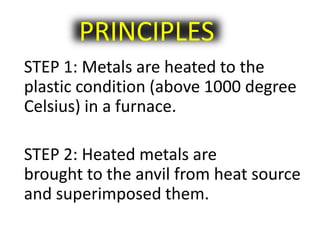
PRINCIPLES
STEP 1: Metals are heated to the
plastic condition (above 1000 degree
Celsius) in a furnace.
STEP 2: Heated metals are
brought to the anvil from heat source
and superimposed them.
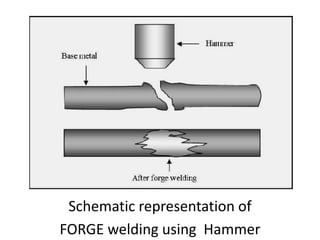
Schematic representation of
FORGE welding using Hammer
CLASSIFICATION
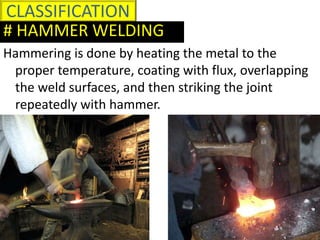
# HAMMER WELDING
Hammering is done by heating the metal to the
proper temperature, coating with flux, overlapping
the weld surfaces, and then striking the joint
repeatedly with hammer.
# ROLL WELDING
Here the heated metals are overlapped and passed
through rollers.
# DIE WELDING
Here the pieces of metal are heated and then forced
into a die.
Process parameters
• Forge-welding temperature
• Amount of deformation
• Forging speed
TEMPERATURE
*Typically 50 to 90 percent of the melting
temperature.
*Soft low carbon steel = 1250 to 1300
degree Celsius
*High carbon and alloy steel = 1100 to
1140 degree Celsius
*Wrought iron = little below 1290 degree
Celsius
TOOLS NEEDED
# Furnace

# Anvil
# Standard cross peen
hammer
# Flux (Borax / Silica sand)
FORGEABLE METALS
# Aluminium alloys
# Magnesium alloys
# Copper alloys
# Carbon and low alloy steels
# Martensitic stainless steel
# Austenitic stainless steel
# Nickel alloys
# Titanium alloys
# Tungsten alloys
COMMON HAND TOOLS
# Hammers
# Black-smith’s gauge
# Hot chisel
# Brass
ADVANTAGES
# Good quality welds obtained
# Parts of intricate shape welded
# No filler material required
# Required less matching after welding
# Welded joints have low initial cost
# Welded joints easily repaired
# Noiseless process
# High strength welded joints
DISADVANTAGES
# Low carbon steel is welded
# High level of the operator skill is required
# Slow welding process
# Weld is contaminated by the coke used in
heating furnace
# Welded joints can not used for collision and
vibration
# Can not be assembled and reassembled
APPLICATION
# Aerospace industry
# Production of crank shaft
# Shipbuilding, cycle industries
# Production of pattern-welded blades
# Manufacture of shotgun barrels
# Small tools like railroad equipments,
automobile and trucks, agricultural
machinery
PRESENTED BY:
145006 REFATI ZANNAT ANANNA
145016 MD. MUZADDID ALAM
145025 SOUVIK ROY
145034 MD.TASFIQUR RAHMAN
145044 KAZI AZHARUL ISLAM SAMIN
145053 SHARMIN AKTER URMEE
135030 A.S.M WAHID MURAD

FORGE WELDING

  • 1.
  • 2.
  • 3.
    # FORGE WELDING #PRINCIPLES #CLASSIFICATION # PROCESS PARAMETERS # TEMPERATURE # TOOLS NEEDED # FORGEABLE METALS # COMMON HAND TOOLS # ADVANTAGE AND DISADVANTAGE # APPLICATION CONTENTS
  • 4.
    FORGE WELDING Forge weldingis a solid-state welding process that joins two pieces of metal by heating them to a high temperature and then hammering them together.
  • 5.
    PRINCIPLES STEP 1: Metalsare heated to the plastic condition (above 1000 degree Celsius) in a furnace. STEP 2: Heated metals are brought to the anvil from heat source and superimposed them.
  • 6.
  • 7.
    CLASSIFICATION # HAMMER WELDING Hammeringis done by heating the metal to the proper temperature, coating with flux, overlapping the weld surfaces, and then striking the joint repeatedly with hammer.
  • 8.
    # ROLL WELDING Herethe heated metals are overlapped and passed through rollers.
  • 9.
    # DIE WELDING Herethe pieces of metal are heated and then forced into a die.
  • 10.
    Process parameters • Forge-weldingtemperature • Amount of deformation • Forging speed
  • 11.
    TEMPERATURE *Typically 50 to90 percent of the melting temperature. *Soft low carbon steel = 1250 to 1300 degree Celsius *High carbon and alloy steel = 1100 to 1140 degree Celsius *Wrought iron = little below 1290 degree Celsius
  • 12.
  • 13.
  • 14.
    # Standard crosspeen hammer # Flux (Borax / Silica sand)
  • 15.
    FORGEABLE METALS # Aluminiumalloys # Magnesium alloys # Copper alloys # Carbon and low alloy steels # Martensitic stainless steel # Austenitic stainless steel # Nickel alloys # Titanium alloys # Tungsten alloys
  • 16.
    COMMON HAND TOOLS #Hammers # Black-smith’s gauge # Hot chisel # Brass
  • 17.
    ADVANTAGES # Good qualitywelds obtained # Parts of intricate shape welded # No filler material required # Required less matching after welding # Welded joints have low initial cost # Welded joints easily repaired # Noiseless process # High strength welded joints
  • 18.
    DISADVANTAGES # Low carbonsteel is welded # High level of the operator skill is required # Slow welding process # Weld is contaminated by the coke used in heating furnace # Welded joints can not used for collision and vibration # Can not be assembled and reassembled
  • 19.
    APPLICATION # Aerospace industry #Production of crank shaft # Shipbuilding, cycle industries # Production of pattern-welded blades # Manufacture of shotgun barrels # Small tools like railroad equipments, automobile and trucks, agricultural machinery
  • 22.
    PRESENTED BY: 145006 REFATIZANNAT ANANNA 145016 MD. MUZADDID ALAM 145025 SOUVIK ROY 145034 MD.TASFIQUR RAHMAN 145044 KAZI AZHARUL ISLAM SAMIN 145053 SHARMIN AKTER URMEE 135030 A.S.M WAHID MURAD