Dr.R.Narayanasamy, B.E.,M.Tech.,M.Engg.,Ph.D.,(D.Sc)
Professor,
Department of Production Engineering ,
National Institute of Technology,
Tiruchirappalli - 620015,
Tamil Nadu,India.
Deep Drawing
By
Introduction
Deep drawing is a sheet metal forming
operation.
Punch forces a flat sheet metal into a deep die
cavity
Cylindrical, Conical, Rectangular shaped
components can be manufactured.
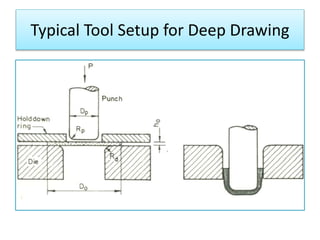
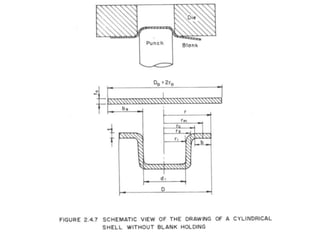
Typical Tool Setup for Deep Drawing
Round sheet metal block is placed over a
circular die opening and held in a place with
blank holder & punch forces down into the die
cavity
If h/d > 0.5, it is called Deep drawing.
If h/d <0.5, it is called Shallow drawing.
Introduction Cont….
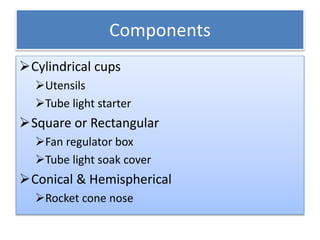
Components
Cylindrical cups
Utensils
Tube light starter
Square or Rectangular
Fan regulator box
Tube light soak cover
Conical & Hemispherical
Rocket cone nose
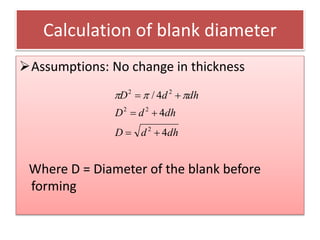
Calculation of blank diameter
Assumptions: No change in thickness
Where D = Diameter of the blank before
forming
dhdD
dhdD
dhdD
4
4
4/
2
22
22


 
Stress Pattern
Metal is subjected to three different types of
deformation in different regions namely
Flange region
Wall region
Punch bottom region.
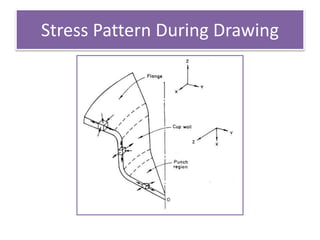
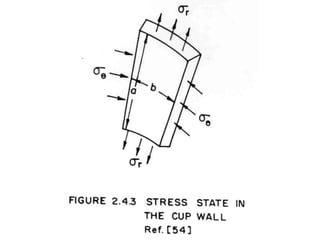
Stress Pattern During Drawing
Flange region
 In the radial direction it is subjected to Tensile stress.
 The outer circumferences continuously decreases.
 This means the circumference of the blank is
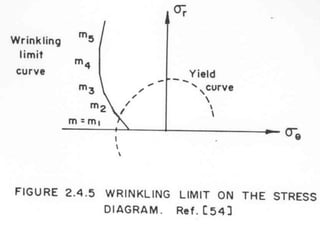
subjected to Compressive Hoop stress.
 It is a Plane stress deformation.
 Because, only two stresses are acting on the flange
region.
 Thickening takes place in the flange region.
Wall region
Here the sheet is subjected to Bi-axial Tensile
stress.
In the wall region the metal is bent and then
straightened
Punch Bottom
Here the metal is getting Thinned down, at
the bottom of the punch.
In the punch nose region sheet metal is
subjected to plane strain deformation.
Total Punch Force
Total punch force can be divided into three
components.
They are :
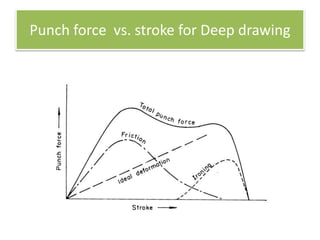
Force due to idle deformation (Fideal)
Force due to friction (Ff )
Force due to ironing ( Fironing )
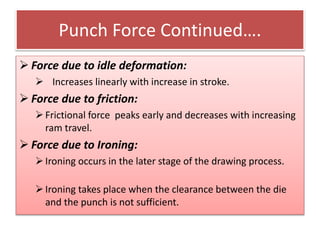
Punch Force Continued….
 Force due to idle deformation:
 Increases linearly with increase in stroke.
 Force due to friction:
Frictional force peaks early and decreases with increasing
ram travel.
 Force due to Ironing:
Ironing occurs in the later stage of the drawing process.
Ironing takes place when the clearance between the die
and the punch is not sufficient.
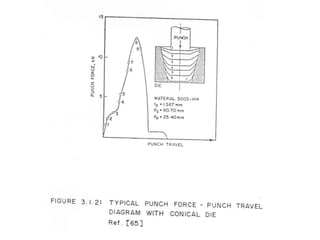
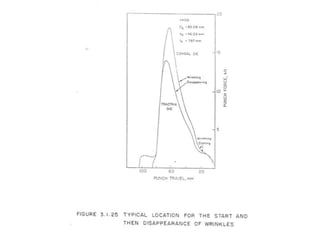
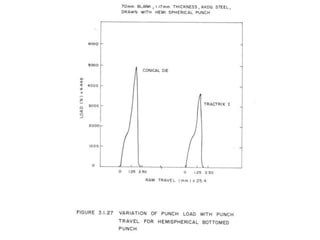
Punch force vs. stroke for Deep drawing
Clearance
Clearance > Sheet thickness.
Less clearance leads to ironing.
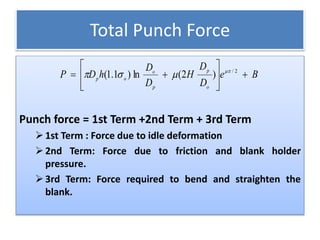
Total Punch Force
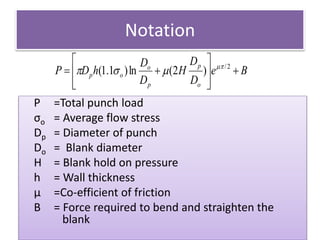
Punch force = 1st Term +2nd Term + 3rd Term
1st Term : Force due to idle deformation
2nd Term: Force due to friction and blank holder
pressure.
3rd Term: Force required to bend and straighten the
blank.
Be
D
D
H
D
D
hDP
o
p
p
o
op






 2/
)2(ln)1.1( 

Notation
P =Total punch load
σo = Average flow stress
Dp = Diameter of punch
Do = Blank diameter
H = Blank hold on pressure
h = Wall thickness
μ =Co-efficient of friction
B = Force required to bend and straighten the
blank
Be
D
D
H
D
D
hDP
o
p
p
o
op 








 2/
)2(ln)1.1( 

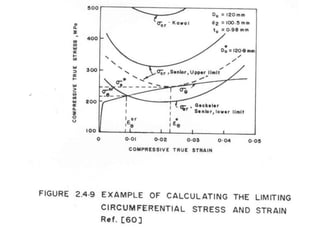
Fracture at the cup bottom
 Punch load is applied to the bottom of the cup.
 Punch load is transmitted to side wall of the cup.
 Usually failure occurs over the punch nose region
(Bent region of the cup).
 Metal in the wall is subjected to Tensile stress.
 It is plane strain stretching and thinning.
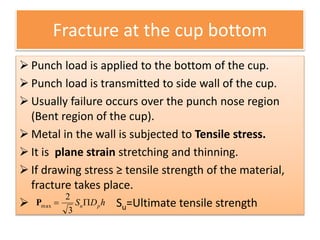
 If drawing stress ≥ tensile strength of the material,
fracture takes place.
 Su=Ultimate tensile strengthhDS pu
3
2
maxP
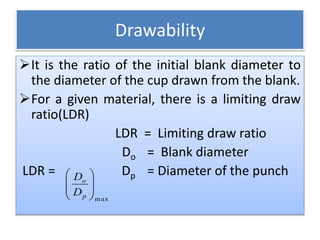
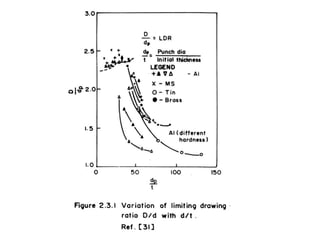
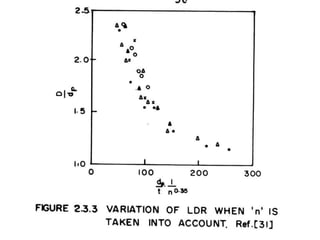
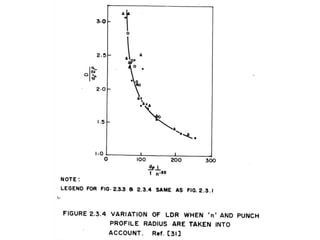
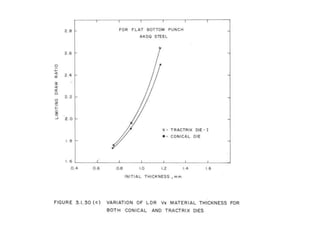
Drawability
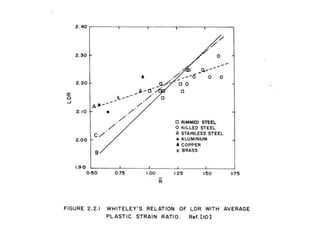
It is the ratio of the initial blank diameter to
the diameter of the cup drawn from the blank.
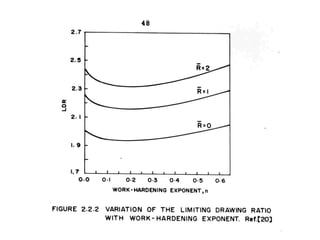
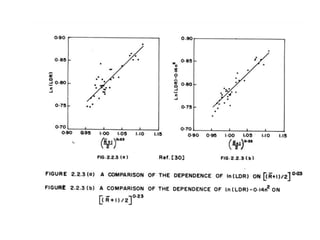
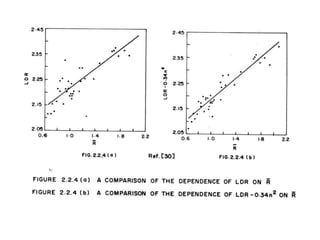
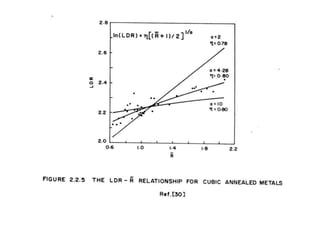
For a given material, there is a limiting draw
ratio(LDR)
LDR = Limiting draw ratio
Do = Blank diameter
LDR = Dp = Diameter of the punch
max








p
o
D
D
Factors affecting drawability
 Die radius: should be about 10 times of sheet
thickness
 Punch radius : A sharp radius leads to tearing and
thinning
 Clearance between punch and die: 20 to 40 %
greater than sheet thick ness
 Hold down pressure: about 2 % of average of σys
and σts
 Lubricate die side to reduce friction in drawing
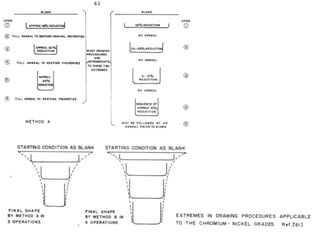
Redrawing
Reducing the cup part to smaller diameter and
increasing height is known as Redrawing
Methods of redrawing :
Direct redrawing
Reverse redrawing
Direct redrawing
The metal subjected to severe strain
hardening .
This is due to bending and unbending at
punch and die radii.
Reverse redrawing
 Cup is turned inside out, So the out side of the drawn cup
becomes the inside surface of the redrawn shell.
 The bending is always in the same direction.
 Less strain hardening of walls.
 Better control over wrinkling.
 Residual stresses are nullified.
 Increased drawability compared to direct redrawing.
 Greater reduction is possible if the metal is annealed in
between re draws.
 Most of the metal permit to a total reduction of 50 – 80 %
before annealing.
Methods to improve drawability
Cup nose wall region must be strengthened:
This can be done by using rubber pads in the tool
set up.
Drawability can be increased by roughening the
punch.
With hold the lubrication to the punch improves
drawability.
Heating the flange region may shift the failure.
By controlling the crystallographic texture,
drawability can be increased.
Texture
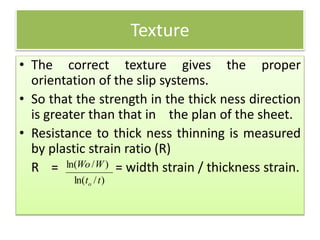
• The correct texture gives the proper
orientation of the slip systems.
• So that the strength in the thick ness direction
is greater than that in the plan of the sheet.
• Resistance to thick ness thinning is measured
by plastic strain ratio (R)
R = = width strain / thickness strain.
)/ln(
)/ln(
tt
WWo
o
Defects in formed components
 Bottom fracture
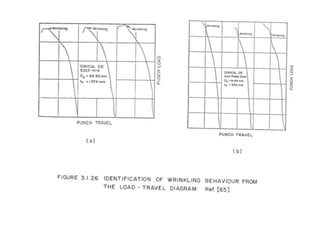
 Wrinkling
 Orange peeling
 Stretcher strain
 Earring
Bottom fracture
This is due to thinning near the punch
radius. It can be minimized by :
 Reducing the thinning by using a larger punch
radius
 Decreasing the punch load required for drawing
operations
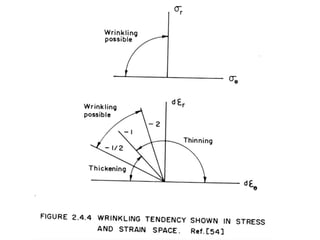
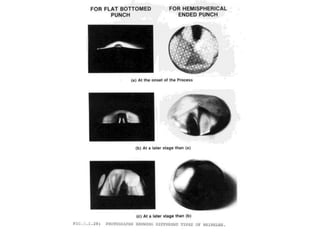
Wrinkling
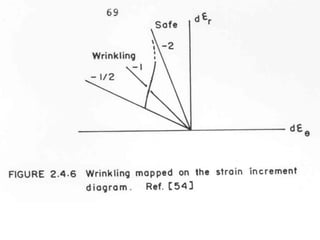
This is due to high compressive
circumferential stresses.
To prevent this defect, it is necessary to use
sufficient hold down pressure to suppress the
buckling.
Orange peeling
This occurs in sheet metal of relatively large
grain size.
The individual grains tend to deform
independently.
This can be minimized by using finer grain size
sheet metal
Stretcher strain
 It is commonly found in low carbon steels.
 This defect shows up a flame like pattern of depressions, on
the surfaces.
 As the deformation continues , they spread and join
together to produce uniform rough surface.
 The depressions appear along planes of maximum shear
stress.
 This is non uniform deformation which results from yield
point elongation.
 To avoid this problem , cold reduction of 1-2 % deformation
is given in rolling after annealing operation
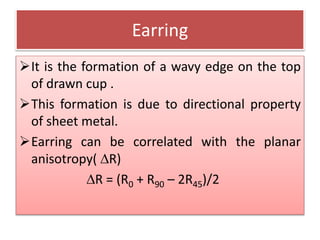
Earring
It is the formation of a wavy edge on the top
of drawn cup .
This formation is due to directional property
of sheet metal.
Earring can be correlated with the planar
anisotropy( R)
R = (R0 + R90 – 2R45)/2
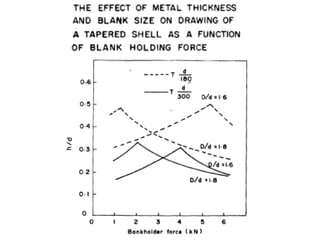
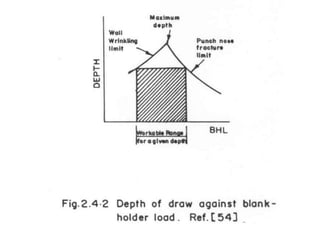
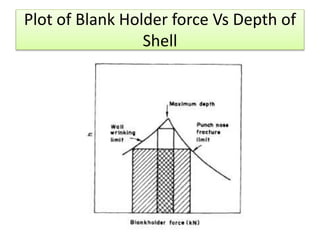
Plot of Blank Holder force Vs Depth of
Shell
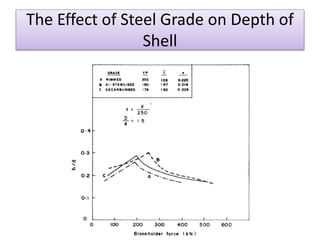
The Effect of Steel Grade on Depth of
Shell
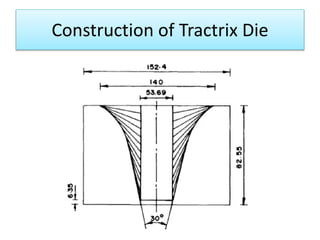
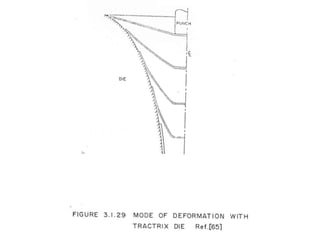
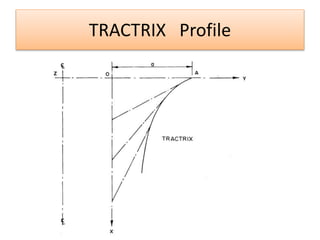
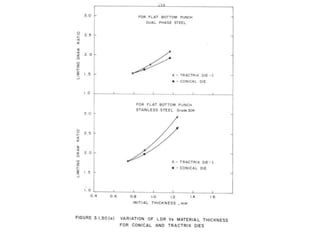
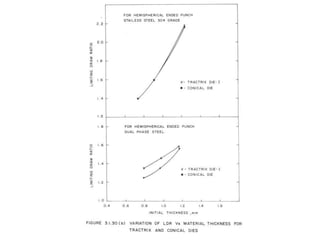
Construction of Tractrix Die
TRACTRIX Profile
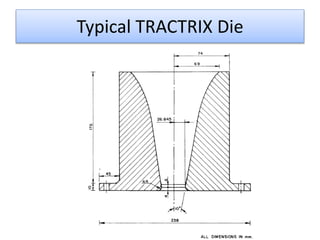
Typical TRACTRIX Die
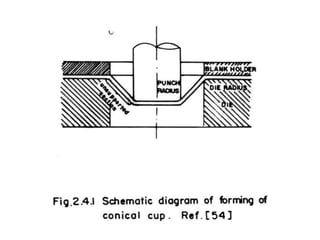
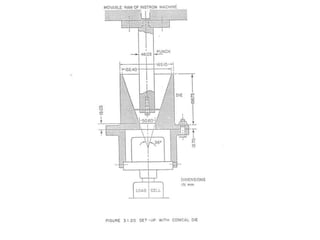
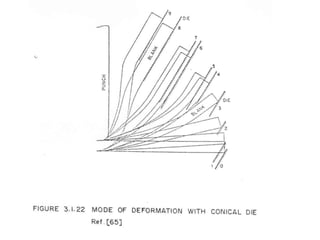
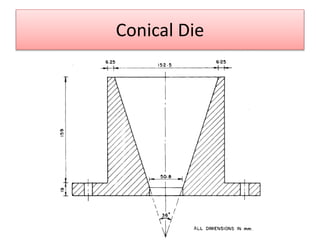
Conical Die
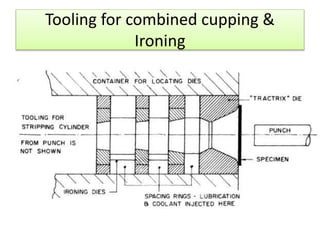
Tooling for combined cupping &
Ironing
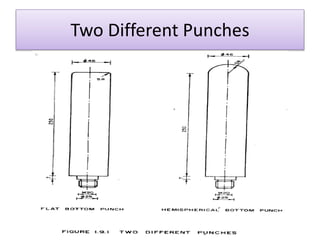
Two Different Punches
Reference
Dr.R.Narayanasamy, Ph.D. thesis on
“Drawability of sheet metals”, 1992,
National Institute of Technology,
Tiruchirappalli – 620 015, Tamil Nadu, India.
THANK YOU
Dr.R.Narayanasamy, B.E.,M.Tech.,M.Engg.,Ph.D.,(D.Sc)
Professor, Department of Production Engineering ,
National Institute of Technology, Tiruchirappalli - 620015,
Tamil Nadu,India.
Email id’s: narayan@nitt.edu
&
narayan10455@yahoo.co.in

Dr.R.Narayanasamy - Power Point on Deep Drawing

  • 1.
    Dr.R.Narayanasamy, B.E.,M.Tech.,M.Engg.,Ph.D.,(D.Sc) Professor, Department ofProduction Engineering , National Institute of Technology, Tiruchirappalli - 620015, Tamil Nadu,India. Deep Drawing By
  • 2.
    Introduction Deep drawing isa sheet metal forming operation. Punch forces a flat sheet metal into a deep die cavity Cylindrical, Conical, Rectangular shaped components can be manufactured.
  • 3.
    Typical Tool Setupfor Deep Drawing
  • 4.
    Round sheet metalblock is placed over a circular die opening and held in a place with blank holder & punch forces down into the die cavity If h/d > 0.5, it is called Deep drawing. If h/d <0.5, it is called Shallow drawing. Introduction Cont….
  • 5.
    Components Cylindrical cups Utensils Tube lightstarter Square or Rectangular Fan regulator box Tube light soak cover Conical & Hemispherical Rocket cone nose
  • 6.
    Calculation of blankdiameter Assumptions: No change in thickness Where D = Diameter of the blank before forming dhdD dhdD dhdD 4 4 4/ 2 22 22    
  • 7.
    Stress Pattern Metal issubjected to three different types of deformation in different regions namely Flange region Wall region Punch bottom region.
  • 8.
  • 9.
    Flange region  Inthe radial direction it is subjected to Tensile stress.  The outer circumferences continuously decreases.  This means the circumference of the blank is subjected to Compressive Hoop stress.  It is a Plane stress deformation.  Because, only two stresses are acting on the flange region.  Thickening takes place in the flange region.
  • 10.
    Wall region Here thesheet is subjected to Bi-axial Tensile stress. In the wall region the metal is bent and then straightened
  • 11.
    Punch Bottom Here themetal is getting Thinned down, at the bottom of the punch. In the punch nose region sheet metal is subjected to plane strain deformation.
  • 12.
    Total Punch Force Totalpunch force can be divided into three components. They are : Force due to idle deformation (Fideal) Force due to friction (Ff ) Force due to ironing ( Fironing )
  • 13.
    Punch Force Continued…. Force due to idle deformation:  Increases linearly with increase in stroke.  Force due to friction: Frictional force peaks early and decreases with increasing ram travel.  Force due to Ironing: Ironing occurs in the later stage of the drawing process. Ironing takes place when the clearance between the die and the punch is not sufficient.
  • 14.
    Punch force vs.stroke for Deep drawing
  • 15.
    Clearance Clearance > Sheetthickness. Less clearance leads to ironing.
  • 16.
    Total Punch Force Punchforce = 1st Term +2nd Term + 3rd Term 1st Term : Force due to idle deformation 2nd Term: Force due to friction and blank holder pressure. 3rd Term: Force required to bend and straighten the blank. Be D D H D D hDP o p p o op        2/ )2(ln)1.1(  
  • 17.
    Notation P =Total punchload σo = Average flow stress Dp = Diameter of punch Do = Blank diameter H = Blank hold on pressure h = Wall thickness μ =Co-efficient of friction B = Force required to bend and straighten the blank Be D D H D D hDP o p p o op           2/ )2(ln)1.1(  
  • 18.
    Fracture at thecup bottom  Punch load is applied to the bottom of the cup.  Punch load is transmitted to side wall of the cup.  Usually failure occurs over the punch nose region (Bent region of the cup).  Metal in the wall is subjected to Tensile stress.  It is plane strain stretching and thinning.  If drawing stress ≥ tensile strength of the material, fracture takes place.  Su=Ultimate tensile strengthhDS pu 3 2 maxP
  • 19.
    Drawability It is theratio of the initial blank diameter to the diameter of the cup drawn from the blank. For a given material, there is a limiting draw ratio(LDR) LDR = Limiting draw ratio Do = Blank diameter LDR = Dp = Diameter of the punch max         p o D D
  • 20.
    Factors affecting drawability Die radius: should be about 10 times of sheet thickness  Punch radius : A sharp radius leads to tearing and thinning  Clearance between punch and die: 20 to 40 % greater than sheet thick ness  Hold down pressure: about 2 % of average of σys and σts  Lubricate die side to reduce friction in drawing
  • 21.
    Redrawing Reducing the cuppart to smaller diameter and increasing height is known as Redrawing Methods of redrawing : Direct redrawing Reverse redrawing
  • 22.
    Direct redrawing The metalsubjected to severe strain hardening . This is due to bending and unbending at punch and die radii.
  • 23.
    Reverse redrawing  Cupis turned inside out, So the out side of the drawn cup becomes the inside surface of the redrawn shell.  The bending is always in the same direction.  Less strain hardening of walls.  Better control over wrinkling.  Residual stresses are nullified.  Increased drawability compared to direct redrawing.  Greater reduction is possible if the metal is annealed in between re draws.  Most of the metal permit to a total reduction of 50 – 80 % before annealing.
  • 24.
    Methods to improvedrawability Cup nose wall region must be strengthened: This can be done by using rubber pads in the tool set up. Drawability can be increased by roughening the punch. With hold the lubrication to the punch improves drawability. Heating the flange region may shift the failure. By controlling the crystallographic texture, drawability can be increased.
  • 25.
    Texture • The correcttexture gives the proper orientation of the slip systems. • So that the strength in the thick ness direction is greater than that in the plan of the sheet. • Resistance to thick ness thinning is measured by plastic strain ratio (R) R = = width strain / thickness strain. )/ln( )/ln( tt WWo o
  • 26.
    Defects in formedcomponents  Bottom fracture  Wrinkling  Orange peeling  Stretcher strain  Earring
  • 27.
    Bottom fracture This isdue to thinning near the punch radius. It can be minimized by :  Reducing the thinning by using a larger punch radius  Decreasing the punch load required for drawing operations
  • 28.
    Wrinkling This is dueto high compressive circumferential stresses. To prevent this defect, it is necessary to use sufficient hold down pressure to suppress the buckling.
  • 29.
    Orange peeling This occursin sheet metal of relatively large grain size. The individual grains tend to deform independently. This can be minimized by using finer grain size sheet metal
  • 30.
    Stretcher strain  Itis commonly found in low carbon steels.  This defect shows up a flame like pattern of depressions, on the surfaces.  As the deformation continues , they spread and join together to produce uniform rough surface.  The depressions appear along planes of maximum shear stress.  This is non uniform deformation which results from yield point elongation.  To avoid this problem , cold reduction of 1-2 % deformation is given in rolling after annealing operation
  • 31.
    Earring It is theformation of a wavy edge on the top of drawn cup . This formation is due to directional property of sheet metal. Earring can be correlated with the planar anisotropy( R) R = (R0 + R90 – 2R45)/2
  • 33.
    Plot of BlankHolder force Vs Depth of Shell
  • 34.
    The Effect ofSteel Grade on Depth of Shell
  • 35.
  • 36.
  • 37.
  • 38.
  • 39.
    Tooling for combinedcupping & Ironing
  • 40.
  • 103.
    Reference Dr.R.Narayanasamy, Ph.D. thesison “Drawability of sheet metals”, 1992, National Institute of Technology, Tiruchirappalli – 620 015, Tamil Nadu, India.
  • 104.
    THANK YOU Dr.R.Narayanasamy, B.E.,M.Tech.,M.Engg.,Ph.D.,(D.Sc) Professor,Department of Production Engineering , National Institute of Technology, Tiruchirappalli - 620015, Tamil Nadu,India. Email id’s: narayan@nitt.edu & narayan10455@yahoo.co.in