Force analysis of lathe tool
dynamometer
INTRODUCTION
In machining or metal cutting operation the device used for
determination of cutting forces is known as a Tool
Dynamometer or Force Dynamometer.
Hence, it is essential to study the metal cutting process for
economical aspects of the manufacture of the components.
Types of Dynamometers
The different types of commonly used dynamometers can
be broadly classified as
Mechanical dynamometers
 Strain Gauge type dynamometers
 Pneumatic and Hydraulic dynamometers
 Electrical Dynamometers
 Piezoelectric dynamometers
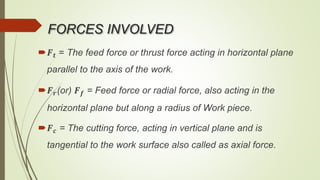
FORCES INVOLVED
𝑭 𝒕 = The feed force or thrust force acting in horizontal plane
parallel to the axis of the work.
𝑭 𝒓(or) 𝑭 𝒇 = Feed force or radial force, also acting in the
horizontal plane but along a radius of Work piece.
𝑭 𝒄 = The cutting force, acting in vertical plane and is
tangential to the work surface also called as axial force.
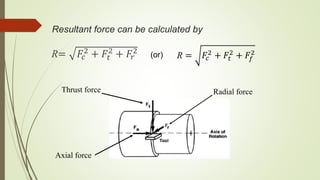
Resultant force can be calculated by
R= 𝐹𝑐
2
+ 𝐹𝑡
2
+ 𝐹𝑟
2
Radial forceThrust force
Axial force
(or) R = 𝐹𝑐
2
+ 𝐹𝑡
2
+ 𝐹𝑓
2
contents
Abstract
Literature review
Objectives
Working principle
Methodology
Problem identification
Results and discussion
conclusion
ABSTRACT
 A lathe tool dynamometer that can evaluate fixed cutting
forces by using level of strain gauges has been designed
and developed.
 The sensing system measures the deflection In strain
gauges and these signals are modified into other quantity
and computed in the form of forces on the display system.
Literature review
 Machining of metal comprises driving of cutting tool from end to end the
excess material of the work piece and the process factors in tool cutting
(Astakhov and Shvets 2001).
 This information provides the chance of fast determination of cutting
speed resultant to the highest possible produced area of work piece
before the selected wear restrict obtained, reducing with straight line
movement (Seker et al. 2002) allows us to assess the impact of tool life
and surface area roughness of the work piece.
objectives
save the time
cost of production
 to get the better output which cannot be obtained
with hand tools.
Working principle of lathe tool dynamo
meter?
Lathe tool dynamo meter is a equipment
which used for observing the amount of load
acting on the tool while operation.
METHODOLOGY
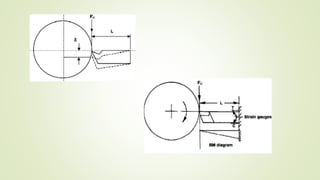
 Measurement of cutting force by using electrical strain
gauge is the best technique available.
 The natural frequency of the tool holder of lathe tool
dynamometer will be calculated.
 Stress calculation will be carried out for the safe design
of lathe tool dynamometer.
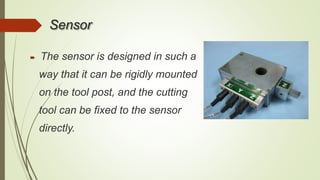
Sensor
 The sensor is designed in such a
way that it can be rigidly mounted
on the tool post, and the cutting
tool can be fixed to the sensor
directly.
Why Force Analysis is Important ?
In order to design of mechanical structure of cutting tool
which will withstand cutting force and thrust force
effectively
To determine power consumption during machining
process.
This will help in selecting suitable motor drive
To predict tool life.
To increase productivity
Requirement of a cutting force
dynamometer
The dynamometer should have sufficient mechanical rigidity to
avoid excessive deformation of the cutting edge under the action of
cutting forces.
It should have sufficient sensitivity to enable measurement of
cutting forces with sufficient accuracy.
It should have high stiffness and low mass, ensuring 100 percent
transmissibility of force by its very high natural frequency.
PROBLEM IDENTIFICATION
Due to large effect of cross sensitivity high variation
in the accuracy of horizontal and vertical force
components developed.
Variations in voltage supply and temperatures.
RESULTS AND DISCUSSION
As per observation recorded, the feed forces and depth
of cut is directly proportional to cutting forces.
 Cutting forces depend upon feed rate of tool so the
cutting forces increase as feed rate increases.
Thank you

Force analysis of lathe tool dynamometer

  • 1.
    Force analysis oflathe tool dynamometer
  • 2.
    INTRODUCTION In machining ormetal cutting operation the device used for determination of cutting forces is known as a Tool Dynamometer or Force Dynamometer. Hence, it is essential to study the metal cutting process for economical aspects of the manufacture of the components.
  • 3.
    Types of Dynamometers Thedifferent types of commonly used dynamometers can be broadly classified as Mechanical dynamometers  Strain Gauge type dynamometers  Pneumatic and Hydraulic dynamometers  Electrical Dynamometers  Piezoelectric dynamometers
  • 4.
    FORCES INVOLVED 𝑭 𝒕= The feed force or thrust force acting in horizontal plane parallel to the axis of the work. 𝑭 𝒓(or) 𝑭 𝒇 = Feed force or radial force, also acting in the horizontal plane but along a radius of Work piece. 𝑭 𝒄 = The cutting force, acting in vertical plane and is tangential to the work surface also called as axial force.
  • 5.
    Resultant force canbe calculated by R= 𝐹𝑐 2 + 𝐹𝑡 2 + 𝐹𝑟 2 Radial forceThrust force Axial force (or) R = 𝐹𝑐 2 + 𝐹𝑡 2 + 𝐹𝑓 2
  • 6.
  • 7.
    ABSTRACT  A lathetool dynamometer that can evaluate fixed cutting forces by using level of strain gauges has been designed and developed.  The sensing system measures the deflection In strain gauges and these signals are modified into other quantity and computed in the form of forces on the display system.
  • 8.
    Literature review  Machiningof metal comprises driving of cutting tool from end to end the excess material of the work piece and the process factors in tool cutting (Astakhov and Shvets 2001).  This information provides the chance of fast determination of cutting speed resultant to the highest possible produced area of work piece before the selected wear restrict obtained, reducing with straight line movement (Seker et al. 2002) allows us to assess the impact of tool life and surface area roughness of the work piece.
  • 9.
    objectives save the time costof production  to get the better output which cannot be obtained with hand tools.
  • 10.
    Working principle oflathe tool dynamo meter? Lathe tool dynamo meter is a equipment which used for observing the amount of load acting on the tool while operation.
  • 11.
    METHODOLOGY  Measurement ofcutting force by using electrical strain gauge is the best technique available.  The natural frequency of the tool holder of lathe tool dynamometer will be calculated.  Stress calculation will be carried out for the safe design of lathe tool dynamometer.
  • 12.
    Sensor  The sensoris designed in such a way that it can be rigidly mounted on the tool post, and the cutting tool can be fixed to the sensor directly.
  • 15.
    Why Force Analysisis Important ? In order to design of mechanical structure of cutting tool which will withstand cutting force and thrust force effectively To determine power consumption during machining process. This will help in selecting suitable motor drive To predict tool life. To increase productivity
  • 16.
    Requirement of acutting force dynamometer The dynamometer should have sufficient mechanical rigidity to avoid excessive deformation of the cutting edge under the action of cutting forces. It should have sufficient sensitivity to enable measurement of cutting forces with sufficient accuracy. It should have high stiffness and low mass, ensuring 100 percent transmissibility of force by its very high natural frequency.
  • 17.
    PROBLEM IDENTIFICATION Due tolarge effect of cross sensitivity high variation in the accuracy of horizontal and vertical force components developed. Variations in voltage supply and temperatures.
  • 18.
    RESULTS AND DISCUSSION Asper observation recorded, the feed forces and depth of cut is directly proportional to cutting forces.  Cutting forces depend upon feed rate of tool so the cutting forces increase as feed rate increases.
  • 19.