polayya chintada
Introduction
 Non-conventional machining system in which metalis
removed by electrochemicalprocess
 Characterized as ‘Reverse Electroplating’ meansit
removes metal instead of adding it
 Normallyused for mass productionand for hard
materials that are difficult to machine using
conventional processes
 Both external and internal geometriescan be
machined
 We can use both electrical energy and chemical energy
to remove the material
 ECM can be depends on faradays laws of electrolysis
process
 For removing of material electrolyte will play essential
role
 Here ,DC power supply is used i.e. 3-30 V
 Here, gap between tool and work piece is 0.5 mm
 Tool is -ve and work piece is +ve
 MRR is 1600 mm3/min
 Accuracy is +- 0.02mm and surface finish 0.4mm
Principle
 Faraday’s law of electrolysis:
The Weightof the substanceproduced during
electrolysis process is directly proportionalto
1.the current which passes
2.the length of time ofprocess
3.The equivalent weightof the material
 Twodissimilar metalsare in contactwith an electrolyte
and anode loses metal tocathode
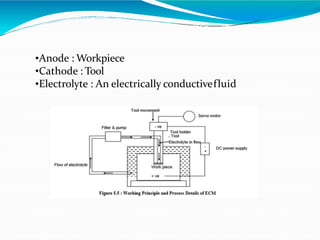
•Anode : Workpiece
•Cathode : Tool
•Electrolyte : An electrically conductivefluid
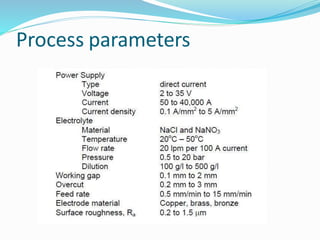
Process parameters
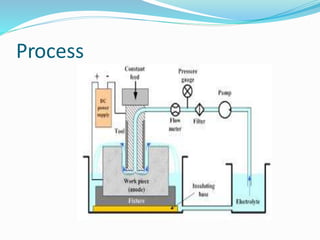
Process
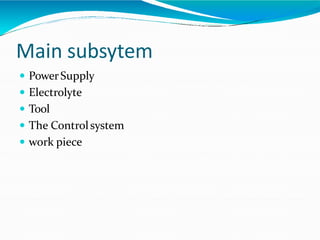
Main subsytem
 PowerSupply
 Electrolyte
 Tool
 The Controlsystem
 work piece
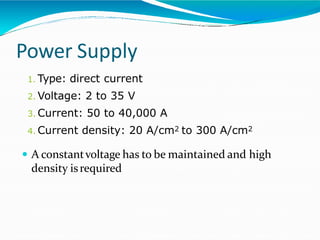
Power Supply
 A constantvoltage has to be maintained and high
density isrequired
1. Type: direct current
2. Voltage: 2 to 35 V
3. Current: 50 to 40,000 A
4. Current density: 20 A/cm2 to 300 A/cm2
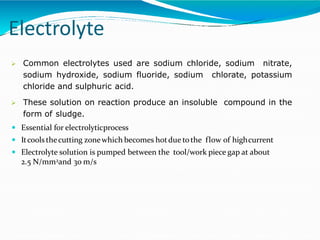
Electrolyte
 Common electrolytes used are sodium chloride, sodium nitrate,
sodium hydroxide, sodium fluoride, sodium chlorate, potassium
chloride and sulphuric acid.
 These solution on reaction produce an insoluble compound in the
form of sludge.
 Essential for electrolyticprocess
 Itcools thecutting zonewhich becomes hotdue tothe flow of highcurrent
 Electrolyte solution is pumped between the tool/work piece gap at about
2.5 N/mm2and 30 m/s
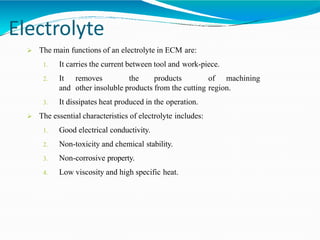
Electrolyte
 The main functions of an electrolyte in ECM are:
1. It carries the current between tool and work-piece.
2. It removes the products of machining
and other insoluble products from the cutting region.
3. It dissipates heat produced in the operation.
 The essential characteristics of electrolyte includes:
1. Good electrical conductivity.
2. Non-toxicity and chemical stability.
3. Non-corrosive property.
4. Low viscosity and high specific heat.
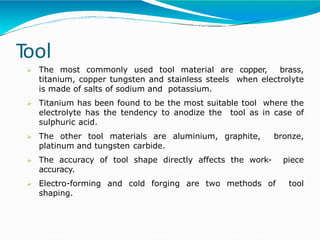
Tool
 The most commonly used tool material are copper, brass,
titanium, copper tungsten and stainless steels when electrolyte
is made of salts of sodium and potassium.
 Titanium has been found to be the most suitable tool where the
electrolyte has the tendency to anodize the tool as in case of
sulphuric acid.
 The other tool materials are aluminium, graphite, bronze,
platinum and tungsten carbide.
 The accuracy of tool shape directly affects the work- piece
accuracy.
 Electro-forming and cold forging are two methods of tool
shaping.
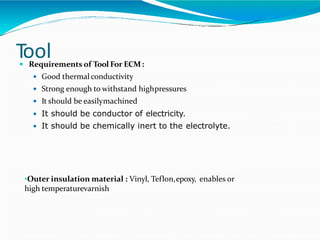
Tool Requirements of Tool For ECM:
 Good thermal conductivity
 Strong enough to withstand highpressures
 It should be easilymachined
 It should be conductor of electricity.
 It should be chemically inert to the electrolyte.
•Outer insulation material : Vinyl, Teflon,epoxy, enables or
high temperaturevarnish
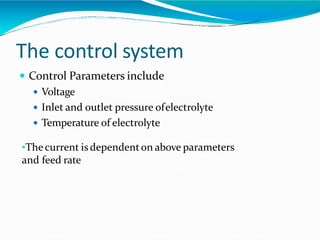
The control system
 Control Parameters include
 Voltage
 Inlet and outlet pressure ofelectrolyte
 Temperature of electrolyte
•Thecurrent isdependenton above parameters
and feed rate
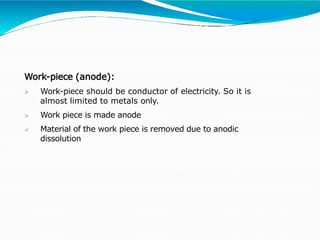
Work-piece (anode):
 Work-piece should be conductor of electricity. So it is
almost limited to metals only.
 Work piece is made anode
 Material of the work piece is removed due to anodic
dissolution
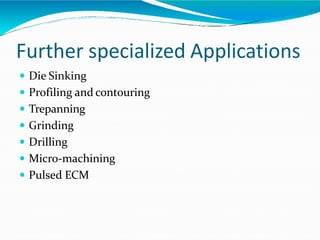
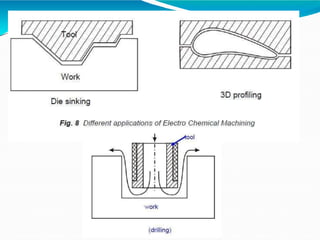
Further specialized Applications
 Die Sinking
 Profiling and contouring
 Trepanning
 Grinding
 Drilling
 Micro-machining
 Pulsed ECM
Economics & Products
 The process is economical when a large no. of complex
identical products are to bemade
 Large cavities are moreeconomical on ECM and can be
made in 1/10th time inEDM
 Two most common products:
 Turbine/compressor blades
 Rifle barrels
Advantages
 ECM is well suited for the
machining of complex
two-dimensional shapes
 Delicate parts maybe
made
 Difficult-to machine
 geometries
 Poorly machinable
materials may be
processed
 Little or no toolwear
 Disadvantages
 Initial tooling can be
 timely andcostly
 Environmentally
harmful by-products
 Complicated tool
design
 Large power
consumption
References
 Electrochemical machining – nptel
 Science Direct – ECM
 Wikipedia – electrochemical machining
 Wendt – electrochemical machining & miccromaching
Thank You …
yours…
polaiah chintada…

ELECTRO CHEMICAL MACHINING PPT.......

  • 1.
  • 2.
    Introduction  Non-conventional machiningsystem in which metalis removed by electrochemicalprocess  Characterized as ‘Reverse Electroplating’ meansit removes metal instead of adding it  Normallyused for mass productionand for hard materials that are difficult to machine using conventional processes  Both external and internal geometriescan be machined
  • 3.
     We canuse both electrical energy and chemical energy to remove the material  ECM can be depends on faradays laws of electrolysis process  For removing of material electrolyte will play essential role  Here ,DC power supply is used i.e. 3-30 V  Here, gap between tool and work piece is 0.5 mm  Tool is -ve and work piece is +ve  MRR is 1600 mm3/min  Accuracy is +- 0.02mm and surface finish 0.4mm
  • 4.
    Principle  Faraday’s lawof electrolysis: The Weightof the substanceproduced during electrolysis process is directly proportionalto 1.the current which passes 2.the length of time ofprocess 3.The equivalent weightof the material  Twodissimilar metalsare in contactwith an electrolyte and anode loses metal tocathode
  • 5.
    •Anode : Workpiece •Cathode: Tool •Electrolyte : An electrically conductivefluid
  • 6.
  • 7.
  • 8.
    Main subsytem  PowerSupply Electrolyte  Tool  The Controlsystem  work piece
  • 9.
    Power Supply  Aconstantvoltage has to be maintained and high density isrequired 1. Type: direct current 2. Voltage: 2 to 35 V 3. Current: 50 to 40,000 A 4. Current density: 20 A/cm2 to 300 A/cm2
  • 10.
    Electrolyte  Common electrolytesused are sodium chloride, sodium nitrate, sodium hydroxide, sodium fluoride, sodium chlorate, potassium chloride and sulphuric acid.  These solution on reaction produce an insoluble compound in the form of sludge.  Essential for electrolyticprocess  Itcools thecutting zonewhich becomes hotdue tothe flow of highcurrent  Electrolyte solution is pumped between the tool/work piece gap at about 2.5 N/mm2and 30 m/s
  • 11.
    Electrolyte  The mainfunctions of an electrolyte in ECM are: 1. It carries the current between tool and work-piece. 2. It removes the products of machining and other insoluble products from the cutting region. 3. It dissipates heat produced in the operation.  The essential characteristics of electrolyte includes: 1. Good electrical conductivity. 2. Non-toxicity and chemical stability. 3. Non-corrosive property. 4. Low viscosity and high specific heat.
  • 12.
    Tool  The mostcommonly used tool material are copper, brass, titanium, copper tungsten and stainless steels when electrolyte is made of salts of sodium and potassium.  Titanium has been found to be the most suitable tool where the electrolyte has the tendency to anodize the tool as in case of sulphuric acid.  The other tool materials are aluminium, graphite, bronze, platinum and tungsten carbide.  The accuracy of tool shape directly affects the work- piece accuracy.  Electro-forming and cold forging are two methods of tool shaping.
  • 13.
    Tool Requirements ofTool For ECM:  Good thermal conductivity  Strong enough to withstand highpressures  It should be easilymachined  It should be conductor of electricity.  It should be chemically inert to the electrolyte. •Outer insulation material : Vinyl, Teflon,epoxy, enables or high temperaturevarnish
  • 14.
    The control system Control Parameters include  Voltage  Inlet and outlet pressure ofelectrolyte  Temperature of electrolyte •Thecurrent isdependenton above parameters and feed rate
  • 15.
    Work-piece (anode):  Work-pieceshould be conductor of electricity. So it is almost limited to metals only.  Work piece is made anode  Material of the work piece is removed due to anodic dissolution
  • 16.
    Further specialized Applications Die Sinking  Profiling and contouring  Trepanning  Grinding  Drilling  Micro-machining  Pulsed ECM
  • 18.
    Economics & Products The process is economical when a large no. of complex identical products are to bemade  Large cavities are moreeconomical on ECM and can be made in 1/10th time inEDM  Two most common products:  Turbine/compressor blades  Rifle barrels
  • 19.
    Advantages  ECM iswell suited for the machining of complex two-dimensional shapes  Delicate parts maybe made  Difficult-to machine  geometries  Poorly machinable materials may be processed  Little or no toolwear  Disadvantages  Initial tooling can be  timely andcostly  Environmentally harmful by-products  Complicated tool design  Large power consumption
  • 20.
    References  Electrochemical machining– nptel  Science Direct – ECM  Wikipedia – electrochemical machining  Wendt – electrochemical machining & miccromaching
  • 21.