A Flexible Tile-Based Communication Infrastructure for Partial Reconfigurable Architectures BY Simone Corbetta [email_address] Thesis committee: Shantanu Dutt (chair), Donatella Sciuto, Ashfaq Ahmad Khokhar UIC Thesis Defense: May, 8th 2008
Aims [A1]  Define a communication infrastructure for partially  reconfigurable architectures [A2]  Design the communication protocol [A3]  Design network nodes [A4]  Implementation
Rationale and Innovation Problem statement Dynamic capabilities of modern devices demands for flexibility, reliability and adaptability Adaptability to dynamic context changes Innovative contributions Network-based communication infrastructure tailored for partial reconfigurable architectures Device-independent Resource-aware design Reliable communication  Adaptable communication schema
Outline Introduction Related works Proposed approach & implementation Experimental results Conclusions and future works
What’s next Introduction A bird’s eye-view on communication infrastructures Related works Proposed approach & implementation Experimental results Conclusions and future works
Communication-centric design Increasing complexity in modern Systems-on-Chips Increasing applications scenarios Communication requirements increase Communication-centric design  [1,2] Static  versus  dynamic environment Executing applications are not known a priori  Communication requirements cannot be specified prior to system execution “ Classical” widely-used communication approaches lack of flexibility and scalability Need to define a flexible, adaptable solution [1]  “ Communication Centric SoC Design for Nanoscale Domain ”. Ogras, U. Y.; Jingcao, Hu; Marculescu, R. 16th IEEE International Conference on Application-Specific Systems, Architecture and Processors. July 2005. pp.73-78. [2]  “ On-Chip Networks: a Scalable, Communication-Centric Embedded System Design Paradigm ”. Henkel, J.; Wolf, W.; Chakradhar, S. Proceedings of the 17th International Conference on VLSI Design, 2004. pp.845.851.
Communication infrastructure and dynamic features Dynamic reconfiguration can be used to effectively realize communication infrastructures that are Flexible Reliable Adaptable (at run-time) to communication requirements Dynamic reconfiguration as a specific feature of the communication infrastructure layer design
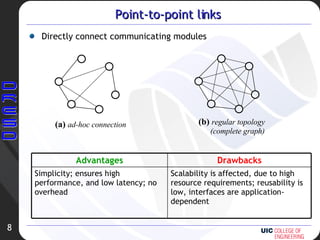
Point-to-point links Directly connect communicating modules (a)  ad-hoc connection (b)  regular topology  (complete graph)  Scalability is affected, due to high resource requirements; reusability is low, interfaces are application-dependent Simplicity; ensures high performance, and low latency; no overhead Drawbacks Advantages
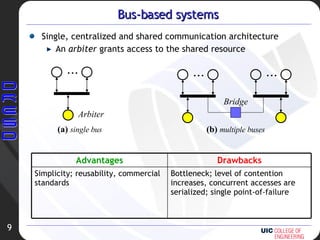
Bus-based systems Single, centralized and shared communication architecture An  arbiter  grants access to the shared resource ... Arbiter (a)  single bus ... ... Bridge (b)  multiple buses Bottleneck; level of contention increases, concurrent accesses are serialized; single point-of-failure Simplicity; reusability, commercial standards Drawbacks Advantages
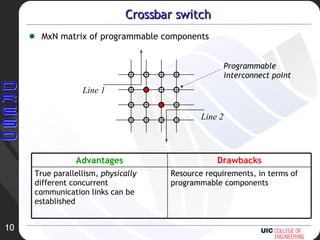
Crossbar switch MxN matrix of programmable components Line 1 Line 2 Programmable  interconnect point Resource requirements, in terms of programmable components True parallellism,  physically  different concurrent communication links can be established Drawbacks Advantages
Network-on-Chip Borrow main ideas from data-network (LANs, WANs) Based on distributed communication nodes ( switches )  [3,4] [3]  “ Networks-on-Chip: a New SoC Paradigm ”. De Micheli, G.; Benini, L. Computer. 2002, Volume 35. pp.70-78.  [4]  “ Networks-on-Chip: a New Paradigm for System-on-Chip Design ”. Nurmi, J. Proceedings of the International Symposium on System-on-Chip, Nov. 2005. pp.2-6. Computational overhead; high resource requirements Flexibility; scalability; reusability; reliability, no single point-of-failure Drawbacks Advantages
What’s next Introduction FPGAs and dynamic reconfiguration Brief overview of devices and dynamic features Related works Proposed approach & implementation Experimental results Conclusions and future works
Field Programmable Gate Arrays Programmable logic devices (Re)programmable logic blocks and interconnects Configuration is stored within the configuration memory architecture Image taken from “ Bebop to the Boolean Boogie: an Unconventional Guide to Electronics Fundamentals, Components and Processes ” by Clive Maxfield [Everyday Practical Electronics]
Reconfiguration and Reconfigurability Reconfiguration  is the process of alteration of the system configuration/behavior Reconfigurability  is the ability to support reconfiguration Which  is the granularity of the reconfiguration process Total versus partial reconfiguration Who  is the responsible of the reconfiguration task Internal versus external reconfiguration When  the reconfiguration is performed Dynamic versus static reconfiguration
What’s next Introduction FPGAs and dynamic reconfiguration Related works XPipes DyNoC CoNoChi Proposed approach & implementation Experimental results Conclusions and future works
XPipes  (1/2) Designed for multi-processors systems  [5] Ad-hoc network topology defined at synthesis-time XPipesCompiler Based on a layered approach:  Smart Stack  protocol [5]  Bertozzi, D.; Benini, L. “ XPipes: A Network-on-Chip Architecture for Gigascale Systems-on-Chip ”.  Circuits and Systems Magazine , IEEE, 2004, 4, pp.18-31. DATA-LINK LAYER NETWORK LAYER TRANSPORT LAYER physical link
XPipes  (2/2) Advantages  Layered stacked protocol allows for independent optimization of different aspects  Drawbacks Topology is fixed at synthesis-time No flexibility  Routing path is defined once for all at synthesis-time No reliability Resource requirements (See experimental results)
DyNoC  (1/2) Static NoC for heterogeneous systems  [6] Static 2D-mesh interconnection topology Static routing mechanism (modified  XY-Algorithm ) [6]  Bobda, C.; Ahmadinia, A.; Majer, M.; Teich, J.; Fekete, S.; Van der Veen, J. “ DyNoC: A Dynamic Infrastructure for Communicationin Dynamically Reconfigurable Devices ”.  International Conference on Field Programmable Logic and Applications , August 2005, pp.151-158. DyNoC Rule
DyNoC  (2/2) Advantages  2D-mesh topology guarantess high connectivity DyNoC Rule Drawbacks Static topology guarantees no flexibility High overhead  One network node for each “slot” in the architecture
CoNoChi  (1/2) Reconfigurable packet-switched communication architecture  [7] [7]  Pionteck, T.; Koch, R.; Albrecth, C. “ Applying Partial Reconfiguration to Networks-on-Chips ”.  International Conference on Field Programmable Logic and Applications , August 2006, pp.1-6.
CoNoChi  (2/2) Advantages  Network nodes can be added at run-time Flexibilty Drawbacks No multiple communication sessions are supported No clear distinction between communication and computational layer Hard to manage system complexity Resource requirements
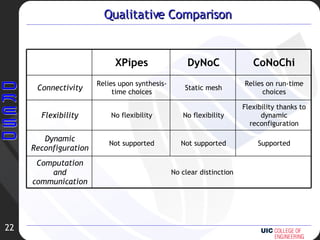
Qualitative Comparison No clear distinction Computation and communication Supported Not supported Not supported Dynamic Reconfiguration Flexibility thanks to dynamic reconfiguration No flexibility No flexibility Flexibility Relies on run-time choices Static mesh Relies upon synthesis-time choices Connectivity CoNoChi DyNoC XPipes
What’s next Introduction FPGAs and dynamic reconfiguration Related works Proposed approach & implementation Main features and implementation Experimental results Conclusions and future works
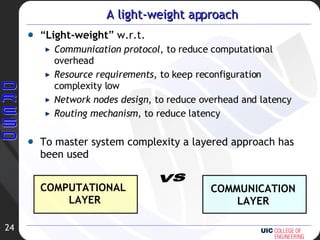
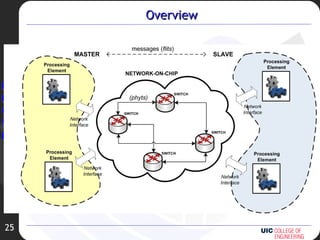
A light-weight approach “ Light-weight ” w.r.t. Communication protocol , to reduce computational overhead Resource requirements , to keep reconfiguration complexity low Network nodes design , to reduce overhead and latency Routing mechanism , to reduce latency To master system complexity a layered approach has been used COMPUTATIONAL  LAYER COMMUNICATION LAYER VS
Overview
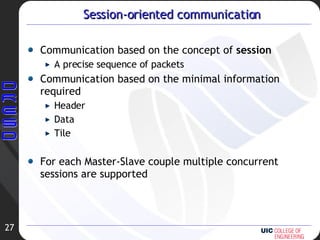
Packet-switched communication Packet-switching instead of circuit-switching  [8] General packet structure [8]  Dally, W.; Towles, B.  “Route packets, not wires: on-chip interconnection networks” . In proceedings of the Design and Automation Conference in Europe, 2001, pp.684-689. Contains communication-related information (route update, communication tail, replies…) Control  Contains data of the current communication request Data Contains preliminary information on the current communication session, useful for the recipient Header
Session-oriented communication Communication based on the concept of  session A precise sequence of packets Communication based on the minimal information required Header Data Tile For each Master-Slave couple multiple concurrent sessions are supported
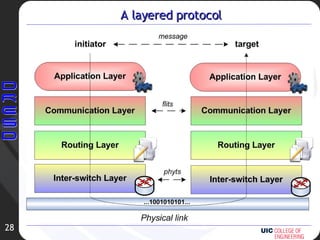
A layered protocol
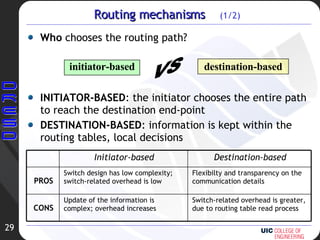
Routing mechanisms  (1/2) Who  chooses the routing path? INITIATOR-BASED : the initiator chooses the entire path to reach the destination end-point DESTINATION-BASED : information is kept within the routing tables, local decisions initiator-based destination-based VS Switch-related overhead is greater, due to routing table read process Update of the information is complex; overhead increases CONS PROS Flexibilty and transparency on the communication details Switch design has low complexity; switch-related overhead is low Destination-based Initiator-based
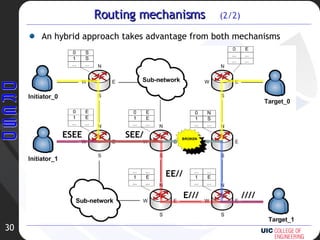
Routing mechanisms  (2/2) An hybrid approach takes  advantage from both mechanisms ESEE SEE/ E/// EE// ////
What’s next Introduction FPGAs and dynamic reconfiguration Related works Proposed approach & implementation Implementation Experimental results Conclusions and future works
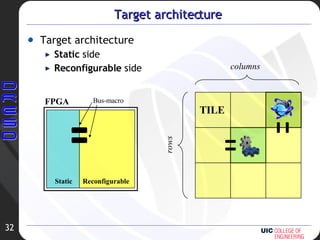
Target architecture Target architecture Static  side Reconfigurable  side Static Reconfigurable FPGA Bus-macro TILE columns rows
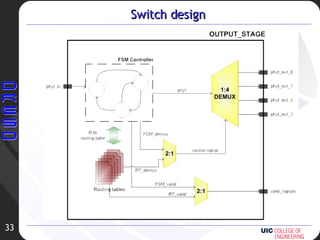
Switch design
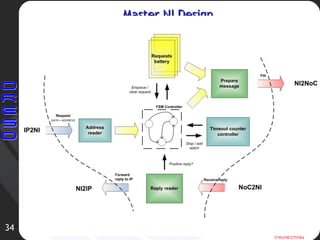
Master NI Design
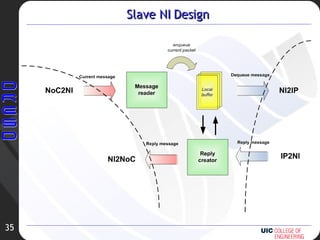
Slave NI Design
What’s next Introduction FPGAs and dynamic reconfiguration Related works Proposed approach & implementation Experimental results Case studies Conclusions and future works
Experimental Results Purpose is to demonstrate the validity of the proposed approach Resource requirements Switch design Master and Slave NI Virtex-II Pro Case Study  Comparison with XPipes Virtex-4 Case Study
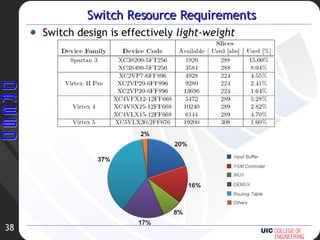
Switch Resource Requirements Switch design is effectively  light-weight
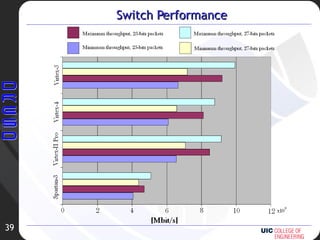
Switch Performance
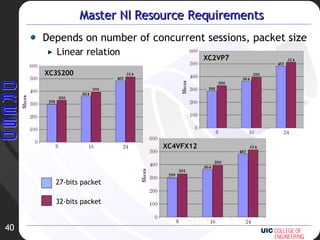
Master NI Resource Requirements Depends on number of concurrent sessions, packet size Linear relation XC3S200 XC2VP7 XC4VFX12 27-bits packet 32-bits packet
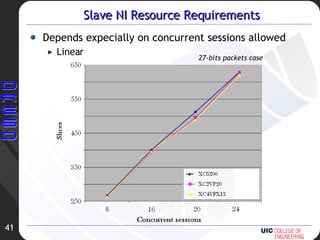
Slave NI Resource Requirements Depends expecially on concurrent sessions allowed Linear 27-bits packets case
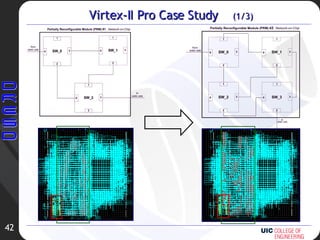
Virtex-II Pro Case Study  (1/3)
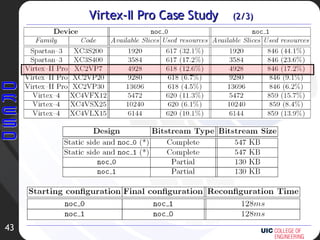
Virtex-II Pro Case Study  (2/3)
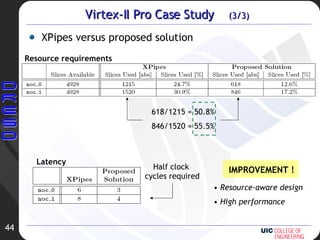
Virtex-II Pro Case Study  (3/3) XPipes versus proposed solution Resource requirements 618/1215 = 50.8% 846/1520 = 55.5% Half clock  cycles required Latency IMPROVEMENT ! Resource-aware design High performance
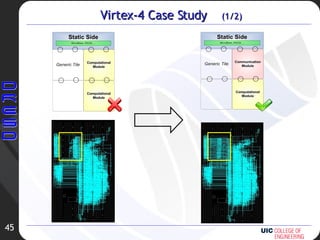
Virtex-4 Case Study  (1/2)
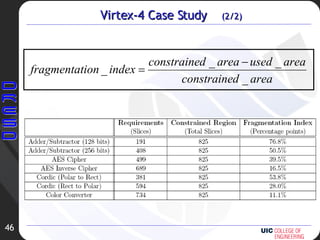
Virtex-4 Case Study  (2/2)
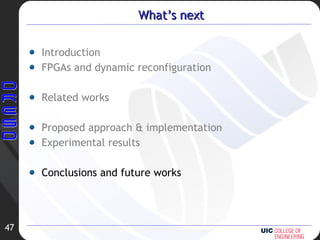
What’s next Introduction FPGAs and dynamic reconfiguration Related works Proposed approach & implementation Experimental results Conclusions and future works
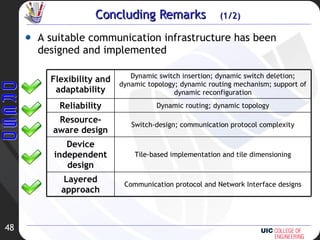
Concluding Remarks  (1/2) A suitable communication infrastructure has been designed and implemented Communication protocol and Network Interface designs Layered approach Tile-based implementation and tile dimensioning Device independent design Switch-design; communication protocol complexity Resource-aware design Dynamic routing; dynamic topology Reliability Dynamic switch insertion; dynamic switch deletion; dynamic topology; dynamic routing mechanism; support of dynamic reconfiguration Flexibility and adaptability
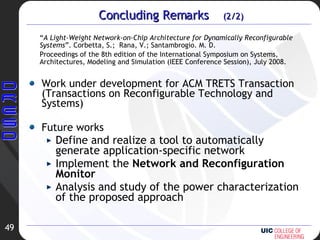
Concluding Remarks  (2/2) Work under development for ACM TRETS Transaction (Transactions on Reconfigurable Technology and Systems) Future works Define and realize a tool to automatically generate application-specific network Implement the  Network and Reconfiguration Monitor Analysis and study of the power characterization of the proposed approach “ A Light-Weight Network-on-Chip Architecture for Dynamically Reconfigurable Systems ”. Corbetta, S.;  Rana, V.; Santambrogio. M. D.  Proceedings of the 8th edition of the International Symposium on Systems, Architectures, Modeling and Simulation (IEEE Conference Session), July 2008.
Webpage www.dresd.org/?q=CITiES Mailing List [email_address] Contact To have more information regarding the CITiES Project: [email_address]   For a complete list of information on how to contact us: www.dresd.org/?q=contact_cities General Information
Questions Thanks for your attention. Any questions?

UIC Thesis Corbetta

  • 1.
    A Flexible Tile-BasedCommunication Infrastructure for Partial Reconfigurable Architectures BY Simone Corbetta [email_address] Thesis committee: Shantanu Dutt (chair), Donatella Sciuto, Ashfaq Ahmad Khokhar UIC Thesis Defense: May, 8th 2008
  • 2.
    Aims [A1] Define a communication infrastructure for partially reconfigurable architectures [A2] Design the communication protocol [A3] Design network nodes [A4] Implementation
  • 3.
    Rationale and InnovationProblem statement Dynamic capabilities of modern devices demands for flexibility, reliability and adaptability Adaptability to dynamic context changes Innovative contributions Network-based communication infrastructure tailored for partial reconfigurable architectures Device-independent Resource-aware design Reliable communication Adaptable communication schema
  • 4.
    Outline Introduction Relatedworks Proposed approach & implementation Experimental results Conclusions and future works
  • 5.
    What’s next IntroductionA bird’s eye-view on communication infrastructures Related works Proposed approach & implementation Experimental results Conclusions and future works
  • 6.
    Communication-centric design Increasingcomplexity in modern Systems-on-Chips Increasing applications scenarios Communication requirements increase Communication-centric design [1,2] Static versus dynamic environment Executing applications are not known a priori Communication requirements cannot be specified prior to system execution “ Classical” widely-used communication approaches lack of flexibility and scalability Need to define a flexible, adaptable solution [1] “ Communication Centric SoC Design for Nanoscale Domain ”. Ogras, U. Y.; Jingcao, Hu; Marculescu, R. 16th IEEE International Conference on Application-Specific Systems, Architecture and Processors. July 2005. pp.73-78. [2] “ On-Chip Networks: a Scalable, Communication-Centric Embedded System Design Paradigm ”. Henkel, J.; Wolf, W.; Chakradhar, S. Proceedings of the 17th International Conference on VLSI Design, 2004. pp.845.851.
  • 7.
    Communication infrastructure anddynamic features Dynamic reconfiguration can be used to effectively realize communication infrastructures that are Flexible Reliable Adaptable (at run-time) to communication requirements Dynamic reconfiguration as a specific feature of the communication infrastructure layer design
  • 8.
    Point-to-point links Directlyconnect communicating modules (a) ad-hoc connection (b) regular topology (complete graph) Scalability is affected, due to high resource requirements; reusability is low, interfaces are application-dependent Simplicity; ensures high performance, and low latency; no overhead Drawbacks Advantages
  • 9.
    Bus-based systems Single,centralized and shared communication architecture An arbiter grants access to the shared resource ... Arbiter (a) single bus ... ... Bridge (b) multiple buses Bottleneck; level of contention increases, concurrent accesses are serialized; single point-of-failure Simplicity; reusability, commercial standards Drawbacks Advantages
  • 10.
    Crossbar switch MxNmatrix of programmable components Line 1 Line 2 Programmable interconnect point Resource requirements, in terms of programmable components True parallellism, physically different concurrent communication links can be established Drawbacks Advantages
  • 11.
    Network-on-Chip Borrow mainideas from data-network (LANs, WANs) Based on distributed communication nodes ( switches ) [3,4] [3] “ Networks-on-Chip: a New SoC Paradigm ”. De Micheli, G.; Benini, L. Computer. 2002, Volume 35. pp.70-78. [4] “ Networks-on-Chip: a New Paradigm for System-on-Chip Design ”. Nurmi, J. Proceedings of the International Symposium on System-on-Chip, Nov. 2005. pp.2-6. Computational overhead; high resource requirements Flexibility; scalability; reusability; reliability, no single point-of-failure Drawbacks Advantages
  • 12.
    What’s next IntroductionFPGAs and dynamic reconfiguration Brief overview of devices and dynamic features Related works Proposed approach & implementation Experimental results Conclusions and future works
  • 13.
    Field Programmable GateArrays Programmable logic devices (Re)programmable logic blocks and interconnects Configuration is stored within the configuration memory architecture Image taken from “ Bebop to the Boolean Boogie: an Unconventional Guide to Electronics Fundamentals, Components and Processes ” by Clive Maxfield [Everyday Practical Electronics]
  • 14.
    Reconfiguration and ReconfigurabilityReconfiguration is the process of alteration of the system configuration/behavior Reconfigurability is the ability to support reconfiguration Which is the granularity of the reconfiguration process Total versus partial reconfiguration Who is the responsible of the reconfiguration task Internal versus external reconfiguration When the reconfiguration is performed Dynamic versus static reconfiguration
  • 15.
    What’s next IntroductionFPGAs and dynamic reconfiguration Related works XPipes DyNoC CoNoChi Proposed approach & implementation Experimental results Conclusions and future works
  • 16.
    XPipes (1/2)Designed for multi-processors systems [5] Ad-hoc network topology defined at synthesis-time XPipesCompiler Based on a layered approach: Smart Stack protocol [5] Bertozzi, D.; Benini, L. “ XPipes: A Network-on-Chip Architecture for Gigascale Systems-on-Chip ”. Circuits and Systems Magazine , IEEE, 2004, 4, pp.18-31. DATA-LINK LAYER NETWORK LAYER TRANSPORT LAYER physical link
  • 17.
    XPipes (2/2)Advantages Layered stacked protocol allows for independent optimization of different aspects Drawbacks Topology is fixed at synthesis-time No flexibility Routing path is defined once for all at synthesis-time No reliability Resource requirements (See experimental results)
  • 18.
    DyNoC (1/2)Static NoC for heterogeneous systems [6] Static 2D-mesh interconnection topology Static routing mechanism (modified XY-Algorithm ) [6] Bobda, C.; Ahmadinia, A.; Majer, M.; Teich, J.; Fekete, S.; Van der Veen, J. “ DyNoC: A Dynamic Infrastructure for Communicationin Dynamically Reconfigurable Devices ”. International Conference on Field Programmable Logic and Applications , August 2005, pp.151-158. DyNoC Rule
  • 19.
    DyNoC (2/2)Advantages 2D-mesh topology guarantess high connectivity DyNoC Rule Drawbacks Static topology guarantees no flexibility High overhead One network node for each “slot” in the architecture
  • 20.
    CoNoChi (1/2)Reconfigurable packet-switched communication architecture [7] [7] Pionteck, T.; Koch, R.; Albrecth, C. “ Applying Partial Reconfiguration to Networks-on-Chips ”. International Conference on Field Programmable Logic and Applications , August 2006, pp.1-6.
  • 21.
    CoNoChi (2/2)Advantages Network nodes can be added at run-time Flexibilty Drawbacks No multiple communication sessions are supported No clear distinction between communication and computational layer Hard to manage system complexity Resource requirements
  • 22.
    Qualitative Comparison Noclear distinction Computation and communication Supported Not supported Not supported Dynamic Reconfiguration Flexibility thanks to dynamic reconfiguration No flexibility No flexibility Flexibility Relies on run-time choices Static mesh Relies upon synthesis-time choices Connectivity CoNoChi DyNoC XPipes
  • 23.
    What’s next IntroductionFPGAs and dynamic reconfiguration Related works Proposed approach & implementation Main features and implementation Experimental results Conclusions and future works
  • 24.
    A light-weight approach“ Light-weight ” w.r.t. Communication protocol , to reduce computational overhead Resource requirements , to keep reconfiguration complexity low Network nodes design , to reduce overhead and latency Routing mechanism , to reduce latency To master system complexity a layered approach has been used COMPUTATIONAL LAYER COMMUNICATION LAYER VS
  • 25.
  • 26.
    Packet-switched communication Packet-switchinginstead of circuit-switching [8] General packet structure [8] Dally, W.; Towles, B. “Route packets, not wires: on-chip interconnection networks” . In proceedings of the Design and Automation Conference in Europe, 2001, pp.684-689. Contains communication-related information (route update, communication tail, replies…) Control Contains data of the current communication request Data Contains preliminary information on the current communication session, useful for the recipient Header
  • 27.
    Session-oriented communication Communicationbased on the concept of session A precise sequence of packets Communication based on the minimal information required Header Data Tile For each Master-Slave couple multiple concurrent sessions are supported
  • 28.
  • 29.
    Routing mechanisms (1/2) Who chooses the routing path? INITIATOR-BASED : the initiator chooses the entire path to reach the destination end-point DESTINATION-BASED : information is kept within the routing tables, local decisions initiator-based destination-based VS Switch-related overhead is greater, due to routing table read process Update of the information is complex; overhead increases CONS PROS Flexibilty and transparency on the communication details Switch design has low complexity; switch-related overhead is low Destination-based Initiator-based
  • 30.
    Routing mechanisms (2/2) An hybrid approach takes advantage from both mechanisms ESEE SEE/ E/// EE// ////
  • 31.
    What’s next IntroductionFPGAs and dynamic reconfiguration Related works Proposed approach & implementation Implementation Experimental results Conclusions and future works
  • 32.
    Target architecture Targetarchitecture Static side Reconfigurable side Static Reconfigurable FPGA Bus-macro TILE columns rows
  • 33.
  • 34.
  • 35.
  • 36.
    What’s next IntroductionFPGAs and dynamic reconfiguration Related works Proposed approach & implementation Experimental results Case studies Conclusions and future works
  • 37.
    Experimental Results Purposeis to demonstrate the validity of the proposed approach Resource requirements Switch design Master and Slave NI Virtex-II Pro Case Study Comparison with XPipes Virtex-4 Case Study
  • 38.
    Switch Resource RequirementsSwitch design is effectively light-weight
  • 39.
  • 40.
    Master NI ResourceRequirements Depends on number of concurrent sessions, packet size Linear relation XC3S200 XC2VP7 XC4VFX12 27-bits packet 32-bits packet
  • 41.
    Slave NI ResourceRequirements Depends expecially on concurrent sessions allowed Linear 27-bits packets case
  • 42.
    Virtex-II Pro CaseStudy (1/3)
  • 43.
    Virtex-II Pro CaseStudy (2/3)
  • 44.
    Virtex-II Pro CaseStudy (3/3) XPipes versus proposed solution Resource requirements 618/1215 = 50.8% 846/1520 = 55.5% Half clock cycles required Latency IMPROVEMENT ! Resource-aware design High performance
  • 45.
  • 46.
  • 47.
    What’s next IntroductionFPGAs and dynamic reconfiguration Related works Proposed approach & implementation Experimental results Conclusions and future works
  • 48.
    Concluding Remarks (1/2) A suitable communication infrastructure has been designed and implemented Communication protocol and Network Interface designs Layered approach Tile-based implementation and tile dimensioning Device independent design Switch-design; communication protocol complexity Resource-aware design Dynamic routing; dynamic topology Reliability Dynamic switch insertion; dynamic switch deletion; dynamic topology; dynamic routing mechanism; support of dynamic reconfiguration Flexibility and adaptability
  • 49.
    Concluding Remarks (2/2) Work under development for ACM TRETS Transaction (Transactions on Reconfigurable Technology and Systems) Future works Define and realize a tool to automatically generate application-specific network Implement the Network and Reconfiguration Monitor Analysis and study of the power characterization of the proposed approach “ A Light-Weight Network-on-Chip Architecture for Dynamically Reconfigurable Systems ”. Corbetta, S.; Rana, V.; Santambrogio. M. D. Proceedings of the 8th edition of the International Symposium on Systems, Architectures, Modeling and Simulation (IEEE Conference Session), July 2008.
  • 50.
    Webpage www.dresd.org/?q=CITiES MailingList [email_address] Contact To have more information regarding the CITiES Project: [email_address] For a complete list of information on how to contact us: www.dresd.org/?q=contact_cities General Information
  • 51.
    Questions Thanks foryour attention. Any questions?