H igh  P erformance   P rocessors   and  S ystems   PdM – UIC joint master 2007 Instructor: Prof. Donatella Sciuto HPPS @ PdM – March 2007
Outline DReAMS Alessandro Panella Matteo Murgida CITiES Alessio Montone Alessandro Meroni Simone Corbetta Operating System Ivan Beretta Design Flow Antonio Piazzi Polaris Massimo Morandi Marco Novati HLR Marco Maggioni
What’s next DReAMS Alessandro Panella Matteo Murgida CITiES Alessio Montone Alessandro Meroni Simone Corbetta Operating System Ivan Beretta Design Flow Antonio Piazzi Polaris Massimo Morandi Marco Novati HLR Marco Maggioni
D ynamic  Re configurability  A pplied   to  M ulti-FPGA  S ystems
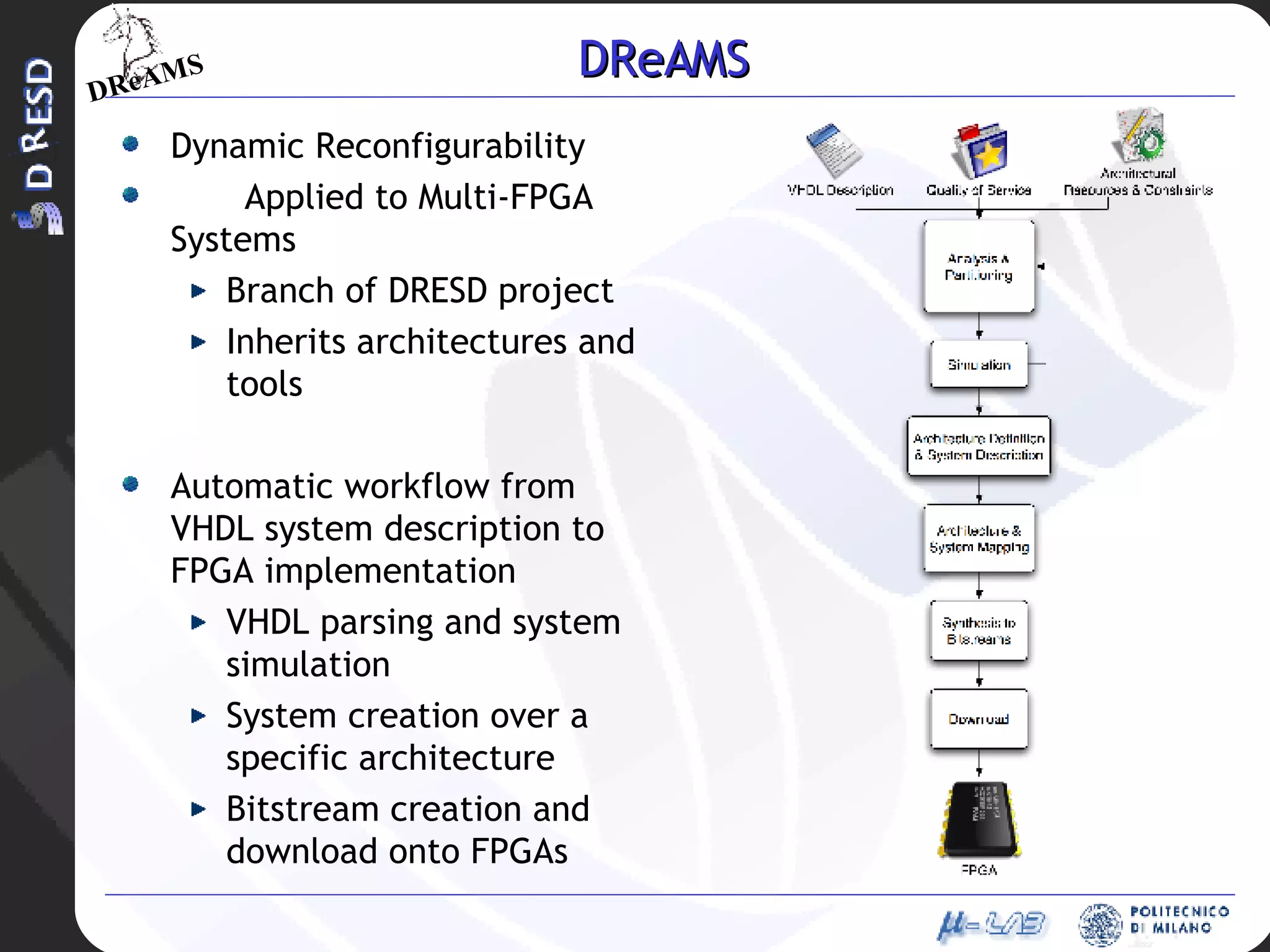
DReAMS Dynamic Reconfigurability Applied to Multi-FPGA Systems Branch of DRESD project Inherits architectures and tools Automatic workflow from VHDL system description to FPGA implementation VHDL parsing and system simulation System creation over a specific architecture Bitstream creation and download onto FPGAs
Multi-FPGA Partitioning Alessandro Panella [email_address]
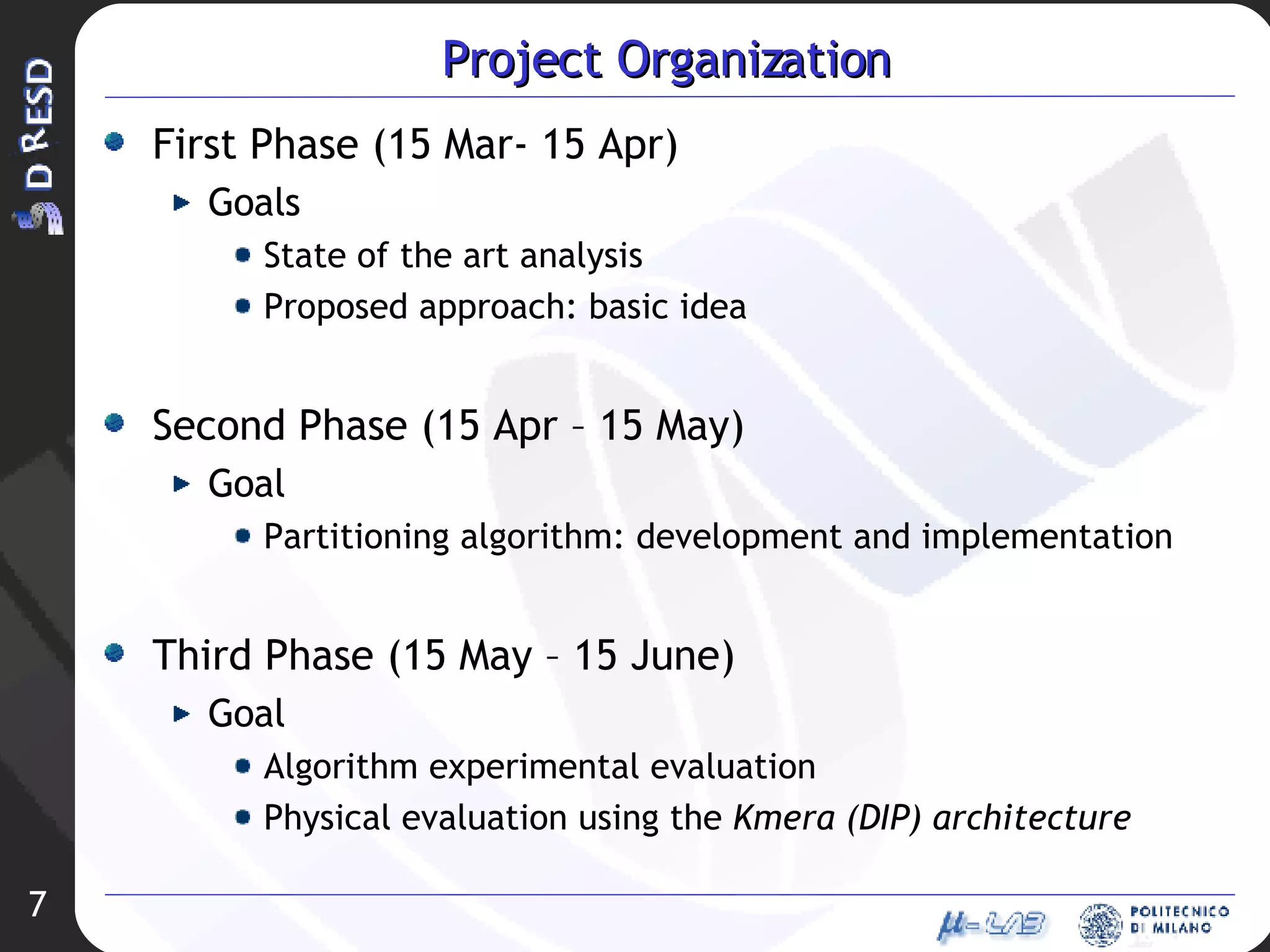
Project Organization First Phase (15 Mar- 15 Apr) Goals State of the art analysis Proposed approach: basic idea Second Phase (15 Apr – 15 May) Goal Partitioning algorithm: development and implementation  Third Phase (15 May – 15 June) Goal Algorithm experimental evaluation Physical evaluation using the  Kmera (DIP) architecture
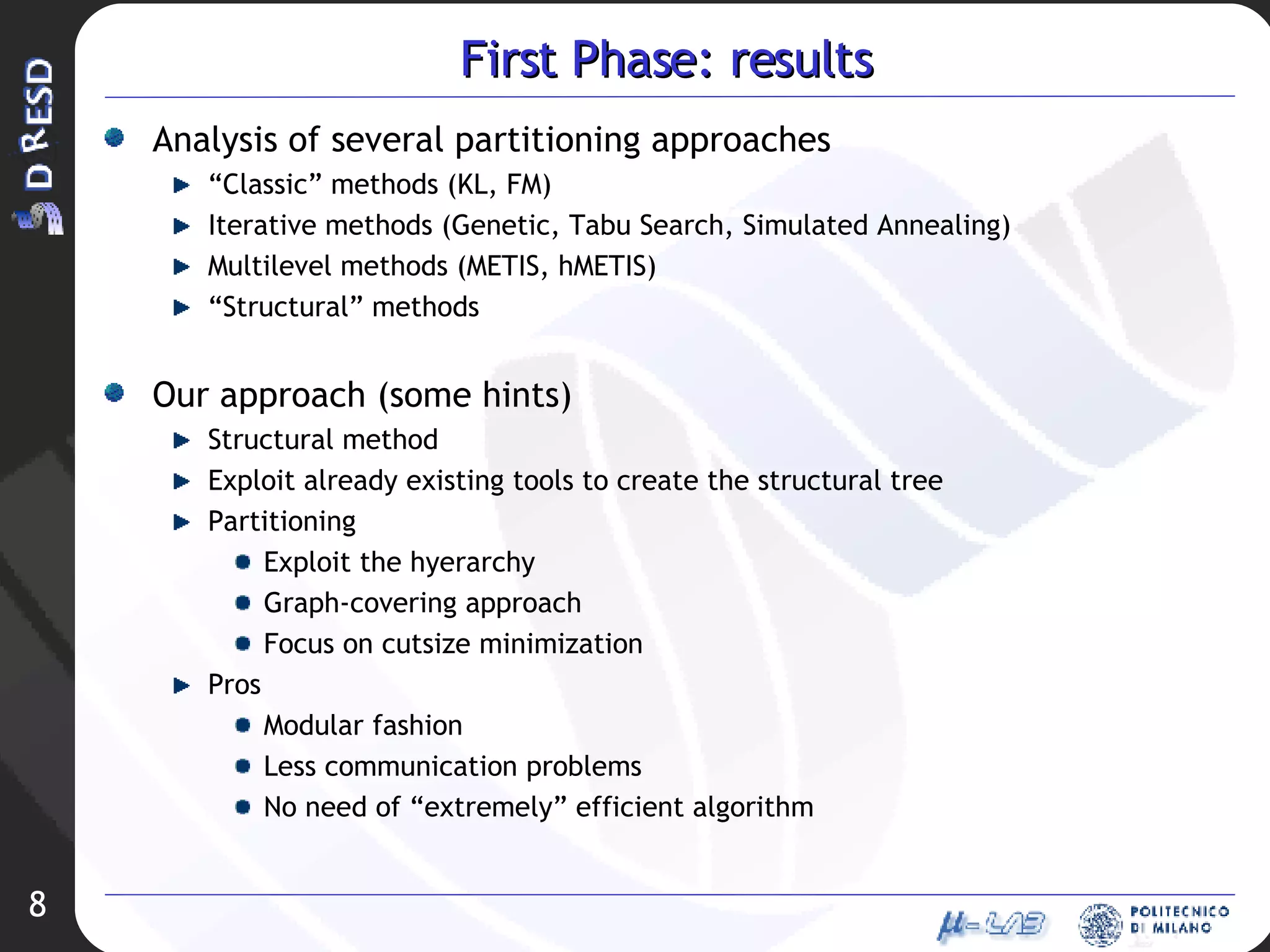
First Phase: results Analysis of several partitioning approaches “ Classic” methods (KL, FM) Iterative methods (Genetic, Tabu Search, Simulated Annealing) Multilevel methods (METIS, hMETIS) “ Structural” methods Our approach (some hints) Structural method Exploit already existing tools to create the structural tree Partitioning Exploit the hyerarchy Graph-covering approach Focus on cutsize minimization Pros Modular fashion Less communication problems No need of “extremely” efficient algorithm
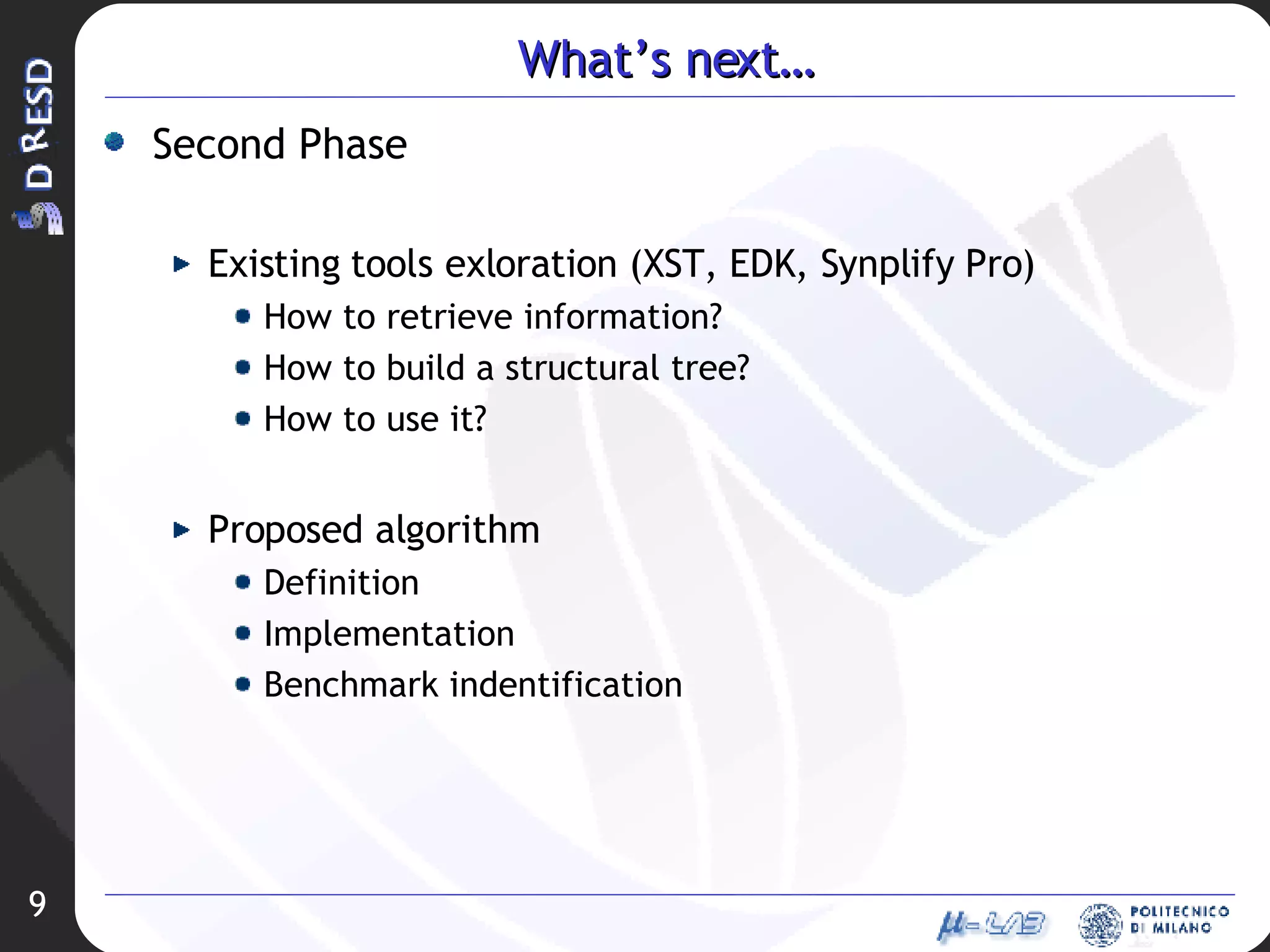
What’s next… Second Phase Existing tools exloration (XST, EDK, Synplify Pro) How to retrieve information? How to build a structural tree? How to use it? Proposed algorithm Definition Implementation Benchmark indentification
What’s next DReAMS Alessandro Panella Matteo Murgida CITiES Simone Corbetta Alessandro Meroni Alessio Montone Operating System Ivan Beretta Design Flow Antonio Piazzi Polaris Massimo Morandi Marco Novati HLR Marco Maggioni
Chimera Multi-FPGAs Architecture Definition Matteo Murgida [email_address]
Project Organization 1st Phase Goals: Digilent Spartan3- Starter Board study Boards connection 2nd Phase Goals:  Distributed architecture description  Communication protocol definition and implementation 3rd Phase Goal:  Design a simple distribuited application to verify the correctness of the proposed approach
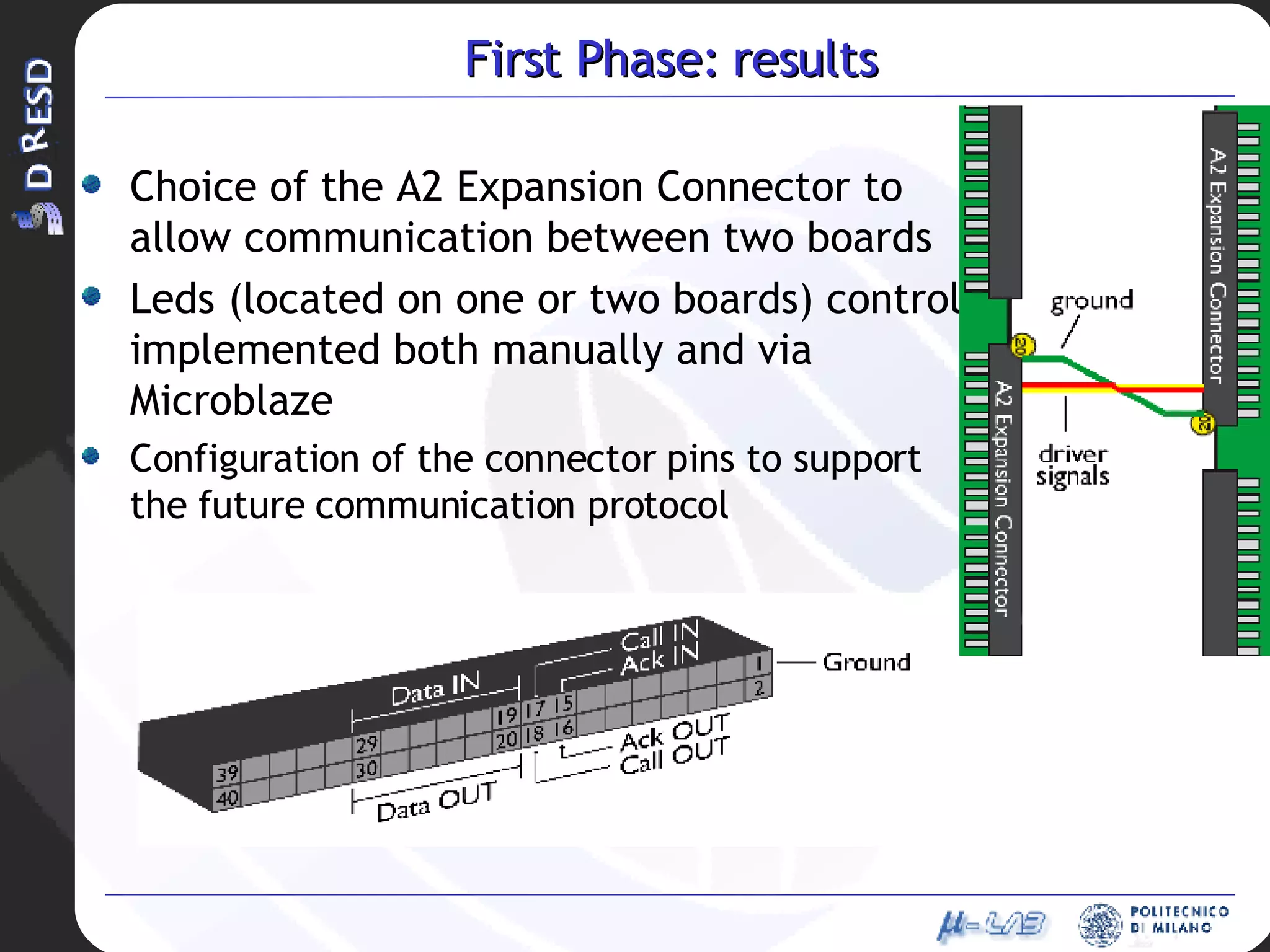
First Phase: results Choice of the A2 Expansion Connector to allow communication between two boards Leds (located on one or two boards) control implemented both manually and via Microblaze Configuration of the connector pins to support the future communication protocol
What’s next… Second phase organization… Communication protocol design Design the IP-Cores needed by the communication protocol Distributed core design methodology - first definition Reconstruction of the original data in the receiver Implementation of the Call/Ack mechanism Microblazes (one per board) data exchange Application design and development to validate the proposed approach
What’s next DReAMS Alessandro Panella Matteo Murgida CITiES Alessio Montone Alessandro Meroni Simone Corbetta Operating System Ivan Beretta Design Flow Antonio Piazzi Polaris Massimo Morandi Marco Novati HLR Marco Maggioni
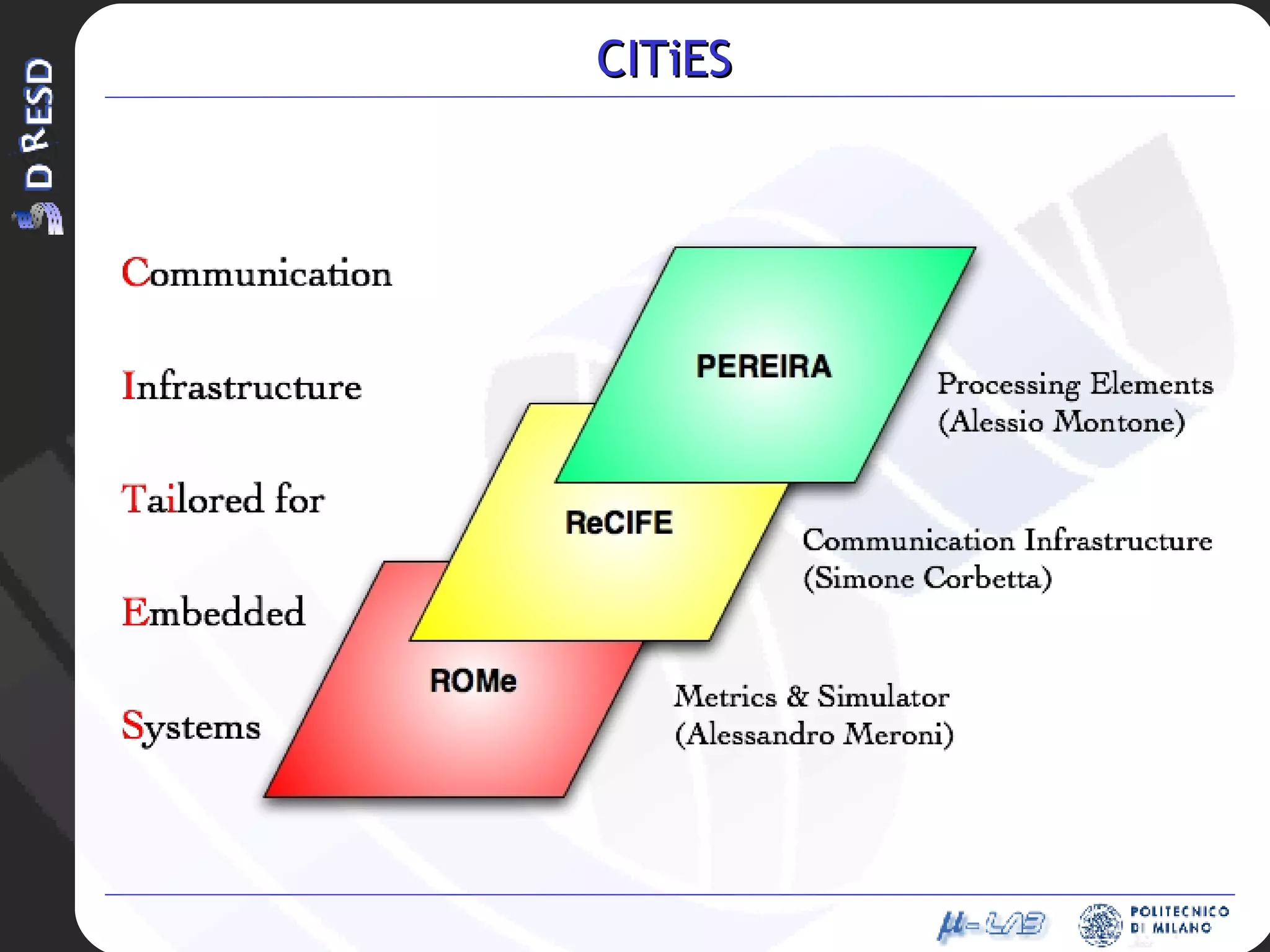
CITiES
CITiES
P rocessing  E lements  RE configuration  I n   R econfigurable  A rchitectures Alessio Montone [email_address]
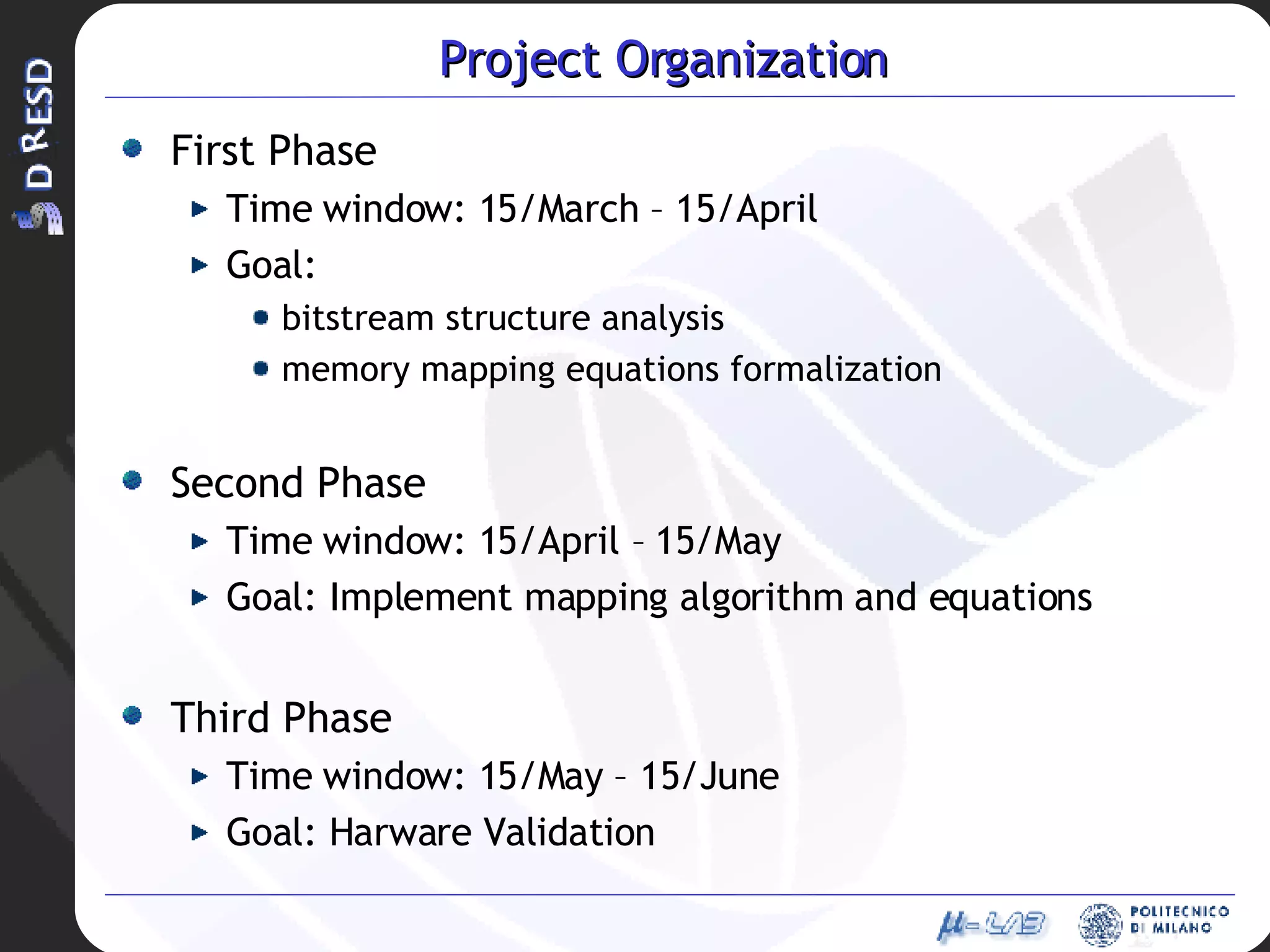
Project Organization First Phase Time window: 15/March – 15/April Goal:  bitstream structure analysis memory mapping equations formalization Second Phase Time window: 15/April – 15/May Goal: Implement mapping algorithm and equations Third Phase Time window: 15/May – 15/June Goal: Harware Validation
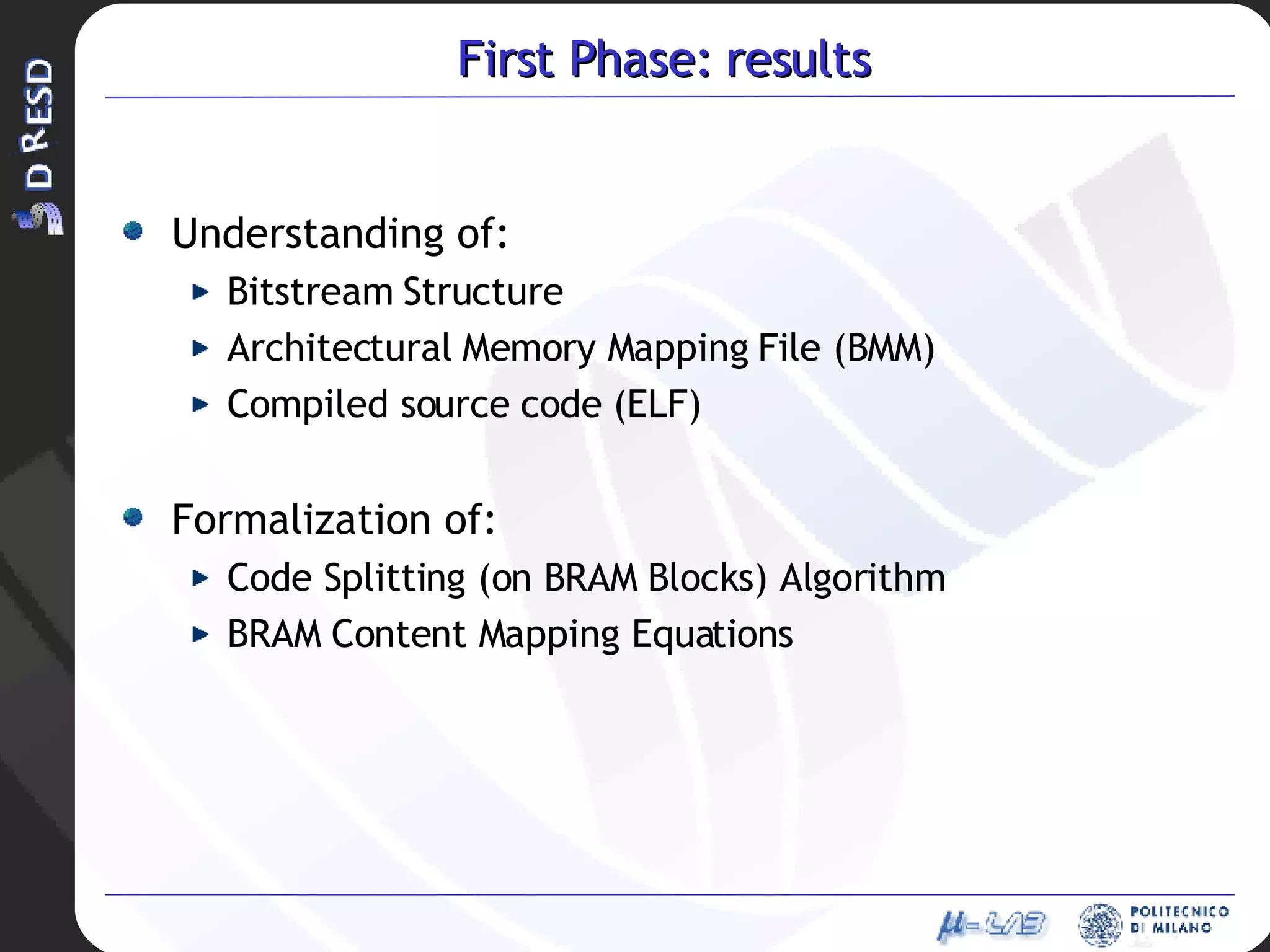
First Phase: results Understanding of: Bitstream Structure Architectural Memory Mapping File (BMM) Compiled source code (ELF) Formalization of: Code Splitting (on BRAM Blocks) Algorithm BRAM Content Mapping Equations
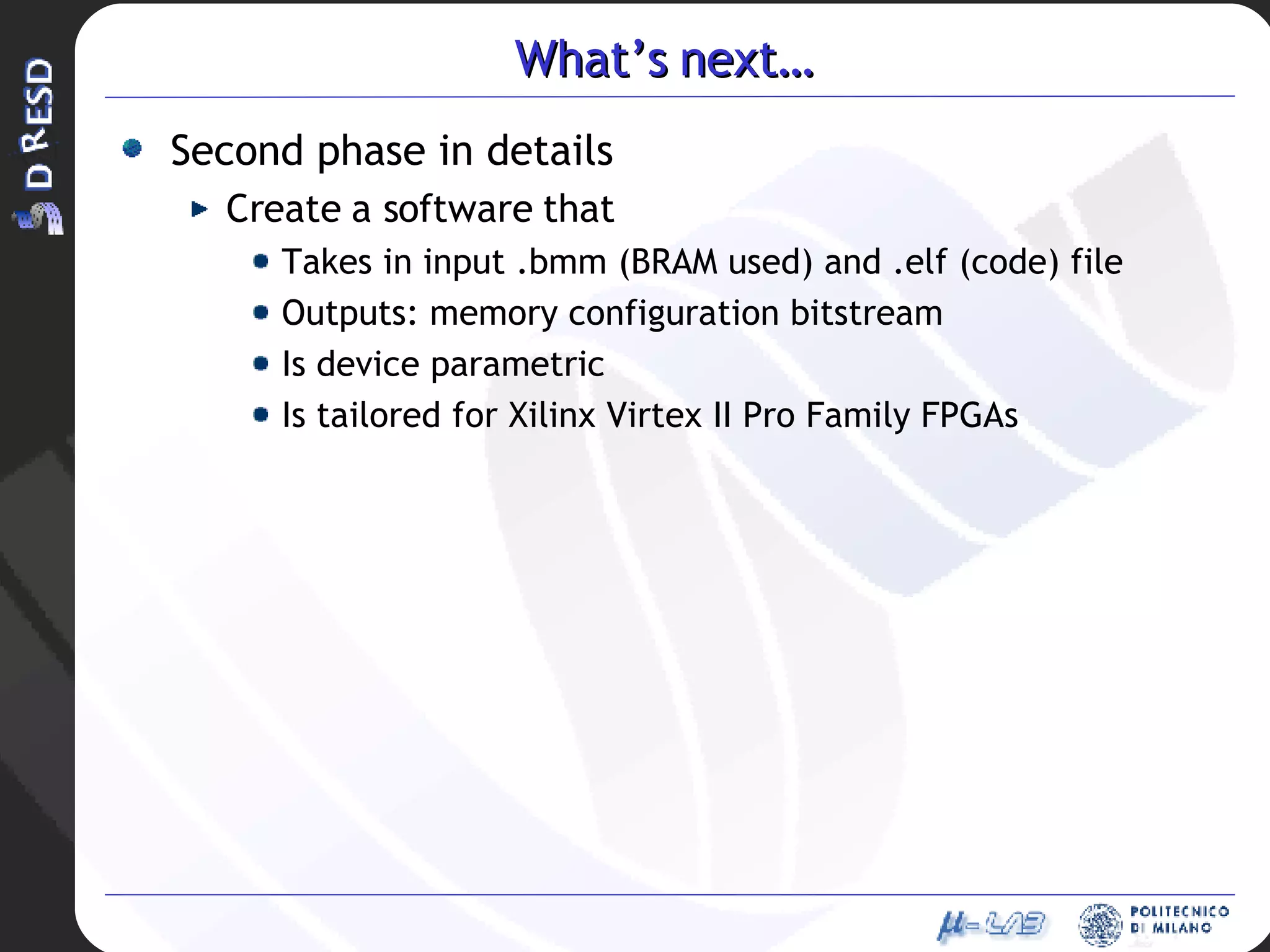
What’s next… Second phase in details Create a software that Takes in input .bmm (BRAM used) and .elf (code) file Outputs: memory configuration bitstream Is device parametric Is tailored for Xilinx Virtex II Pro Family FPGAs
What’s next DReAMS Alessandro Panella Matteo Murgida CITiES Alessio Montone Alessandro Meroni Simone Corbetta Operating System Ivan Beretta Design Flow Antonio Piazzi Polaris Massimo Morandi Marco Novati HLR Marco Maggioni
R econfiguration  O riented  Me trics Alessandro Meroni [email_address]
Project Organization First Phase Time Window: 15/March - 15/April Goal: Analysis of a well-known set of metrics Second Phase Time Window: 15/April - 15/May Goal: Metrics definition and implementation Third Phase Time Window: 15/May - 15/June Goal: Creation of a metrics Simulator
First Phase: Results Communication Achitectures analyzed Point-to-point Bus Network-on-Chip Performance Parameters evaluated Latency, Bandwidth, Throughput Topology Cost Factors evaluated Area usage Power Consumption Final Report that summerizes the results
What’s next… Second Phase Metrics implementation and rules definition: To improve the system performances Tailored for the dynamic reconfiguration of the communication infrastructure, e.g.: The creation of a new  Processing Element The change of the routing protocol exploited Study and analysis of different simulators NS2 …
What’s next DReAMS Alessandro Panella Matteo Murgida CITiES Alessandro Meroni Alessio Montone Simone Corbetta Operating System Ivan Beretta Design Flow Antonio Piazzi Polaris Massimo Morandi Marco Novati HLR Marco Maggioni
RE configurable  C ommunication  I nfrastructure  F or   E mbedded-systems Simone Corbetta [email_address]
Project Organization Goal : design a communication infrastructure tailored for reconfigurable FPGA-based embedded system Organization : three phases PHASE 1  (due to 12th  April):  literature analysis on communication infrastructure paradigms and design choices Survey PHASE 2  (due to 17th May) De Micheli architecture exploration PHASE 3  (due to 17th June) Communication infrastructure model definition
First Phase: results Literature analysis - Topics: Communication infrastructure definition CI design choices and trades-off Understanding different CI paradigms Advantages Pitfalls Improvements Existing applications and solutions (both academic and commercial) Survey : conveys study and analysis of different approaches.  The base for future work
Next Phase Networks-on-Chip  De Micheli state-of-the-art VHDL description Study, analysis  Improvements ( if any ...) Tailoring for dynamically reconfigurable systems Survey Extension to specific De Micheli's NoC architecture Communication infrastructure design methodology used in  ReCIFE
What’s next DReAMS Alessandro Panella Matteo Murgida CITiES Alessio Montone Alessandro Meroni Simone Corbetta Operating System Ivan Beretta Design Flow Antonio Piazzi Polaris Massimo Morandi Marco Novati HLR Marco Maggioni
Development of an OS architecture-independent layer for dynamic reconfiguration Ivan Beretta [email_address]
Project Organization First Phase Goal: State of the art and Boot process analysis Second Phase Goal: Implementation and comparison of the existing solutions Third Phase Goal: Definition of the new architecture-independent layer and testing
First Phase: results Analysis of the Caronte solution Reconfiguration controller driver IP-Core manager Analysis of the DRESD-SW solution Reconfiguration controller, MAC, LOL ,Reconfiguration Library ROTFL Architecture Caronte implementation study Boot process
What’s next… Second phase: Implementation of the DRESD operating system solution, based on ISE and EDK 9.1 version, on Xilinx Virtex II Pro VP7 and VP20 Previous solution comparison Dynamic reconfiguration OS support abstraction layer: basic idea
What’s next DReAMS Alessandro Panella Matteo Murgida CITiES Alessio Montone Alessandro Meroni Simone Corbetta Operating System Ivan Beretta Design Flow Antonio Piazzi Polaris Massimo Morandi Marco Novati HLR Marco Maggioni
Design FLow Antonio Piazzi [email_address]
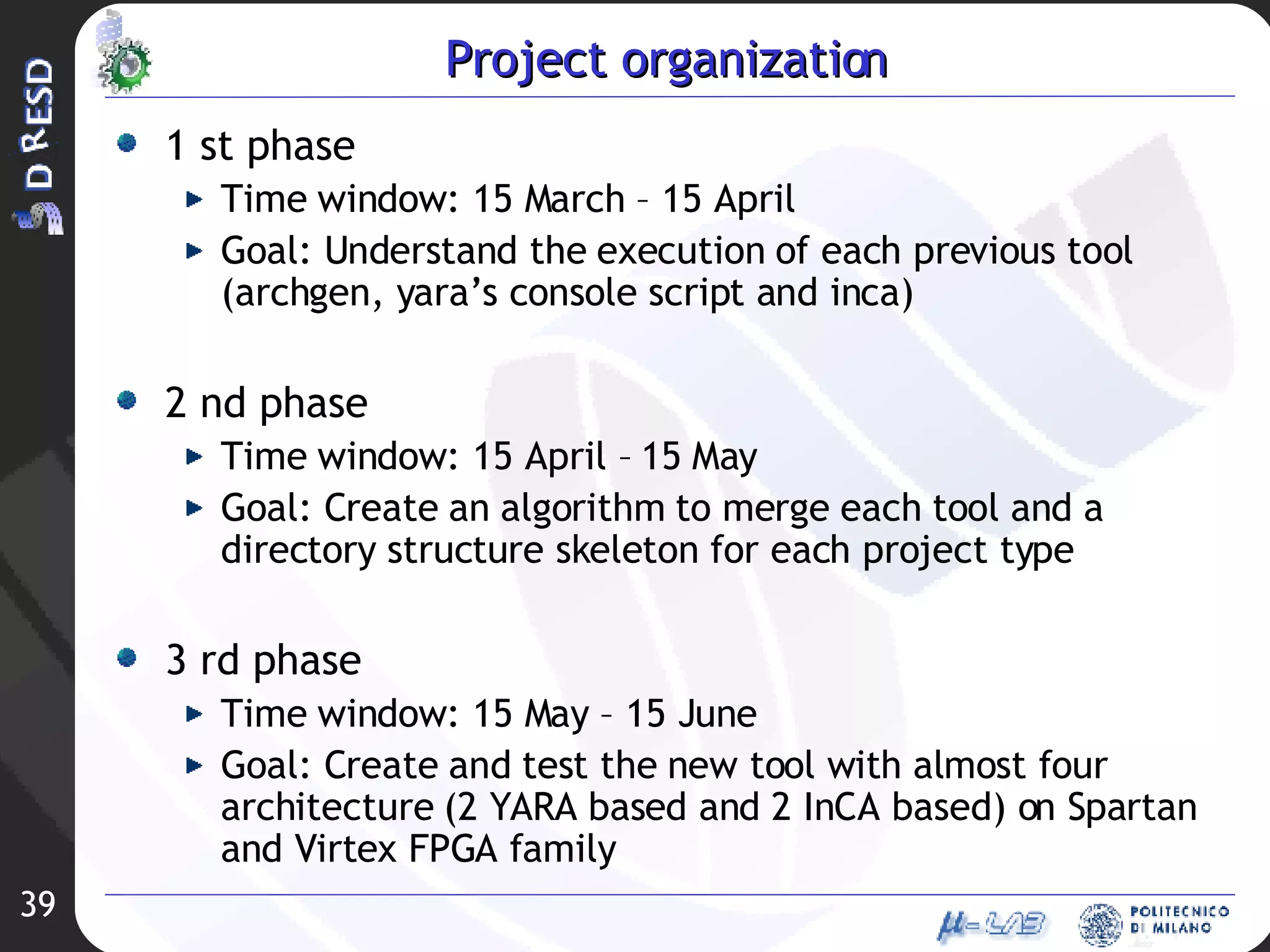
Project organization 1 st phase Time window: 15 March – 15 April Goal: Understand the execution of each previous tool (archgen, yara’s console script and inca) 2 nd phase Time window: 15 April – 15 May Goal: Create an algorithm to merge each tool and a directory structure skeleton for each project type 3 rd phase Time window: 15 May – 15 June Goal: Create and test the new tool with almost four architecture (2 YARA based and 2 InCA based) on Spartan and Virtex FPGA family
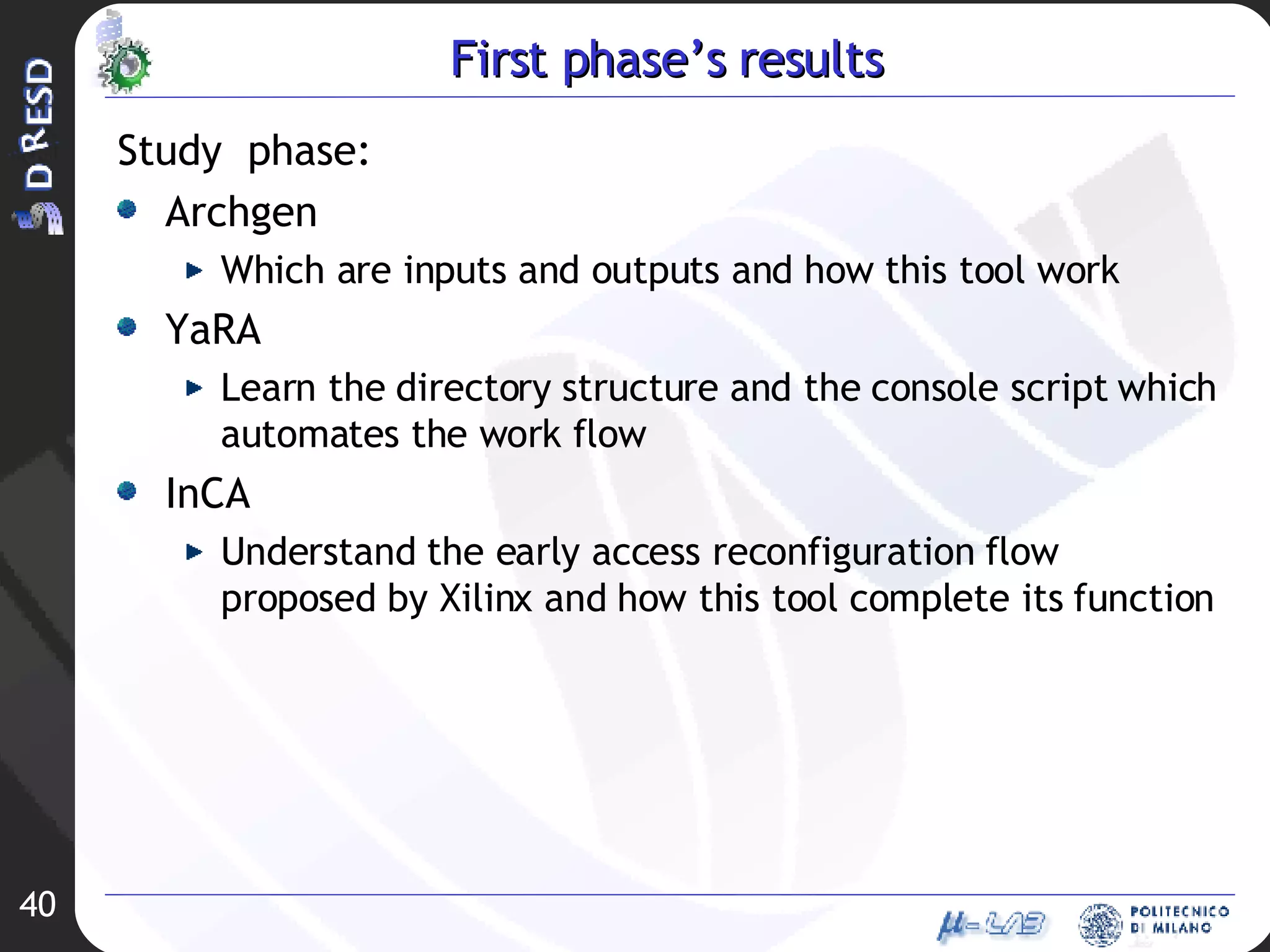
First phase’s results Study  phase: Archgen Which are inputs and outputs and how this tool work YaRA Learn the directory structure and the console script which automates the work flow InCA Understand the early access reconfiguration flow proposed by Xilinx and how this tool complete its function
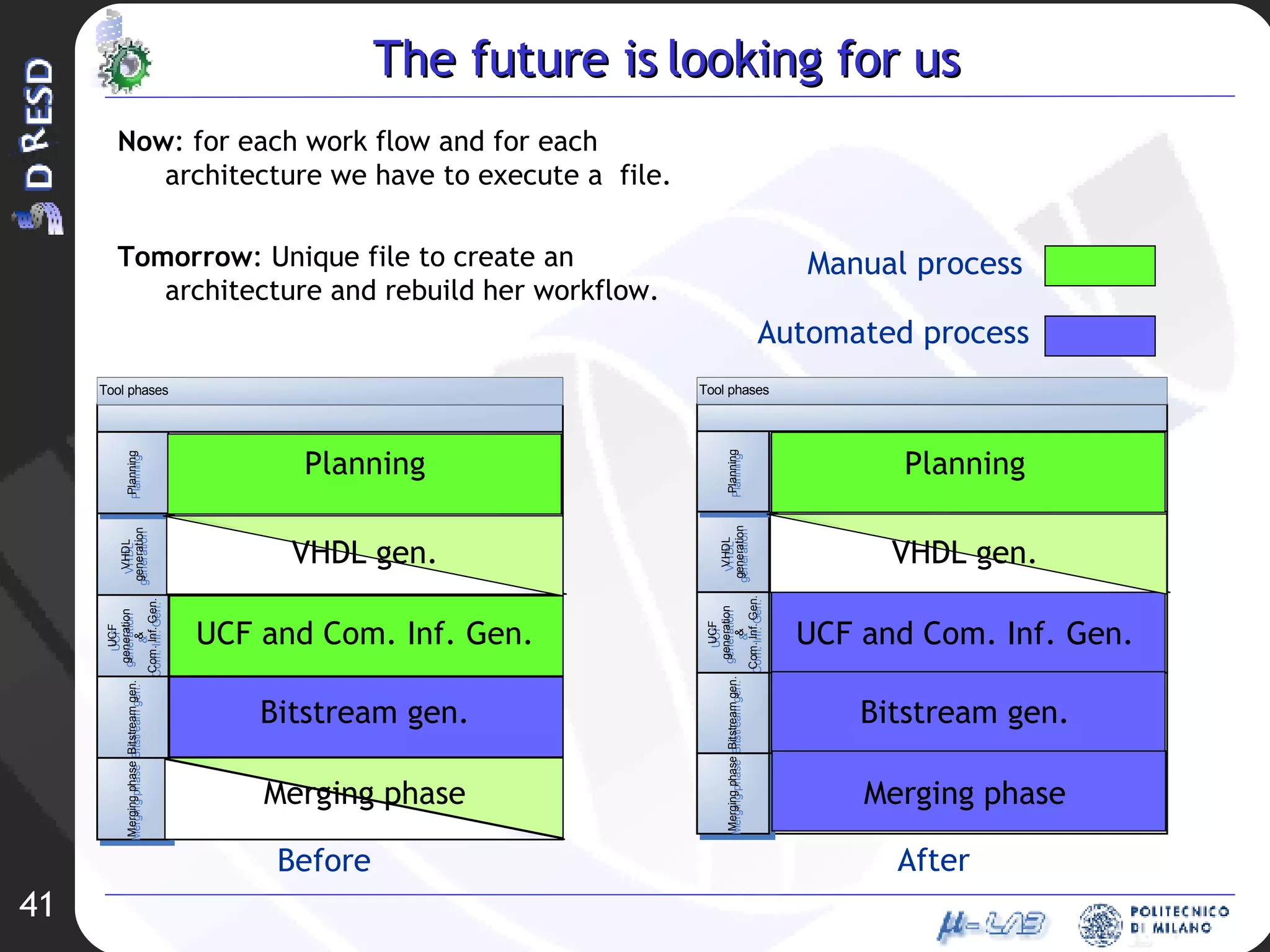
The future is looking for us Now : for each work flow and for each architecture we have to execute a  file. Tomorrow : Unique file to create an architecture and rebuild her workflow.  Manual process Automated process Before After Planning VHDL gen. UCF and Com. Inf. Gen. Bitstream gen. Merging phase Planning VHDL gen. UCF and Com. Inf. Gen. Bitstream gen. Merging phase
What’s next DReAMS Alessandro Panella Matteo Murgida CITiES Alessio Montone Alessandro Meroni Simone Corbetta Operating System Ivan Beretta Design Flow Antonio Piazzi Polaris Massimo Morandi Marco Novati HLR Marco Maggioni
Polaris
Effects of 2D Reconfiguration in a Reconfigurable System Massimo Morandi [email_address]
Project Organization First Phase: General analysis of 2D reconfiguration Detailed description of the new problems Second Phase: Analysis of possible solutions to those problems Evaluation of alternatives Third Phase: Propose a new combined solution to effectively handle problems of 2D reconfiguration
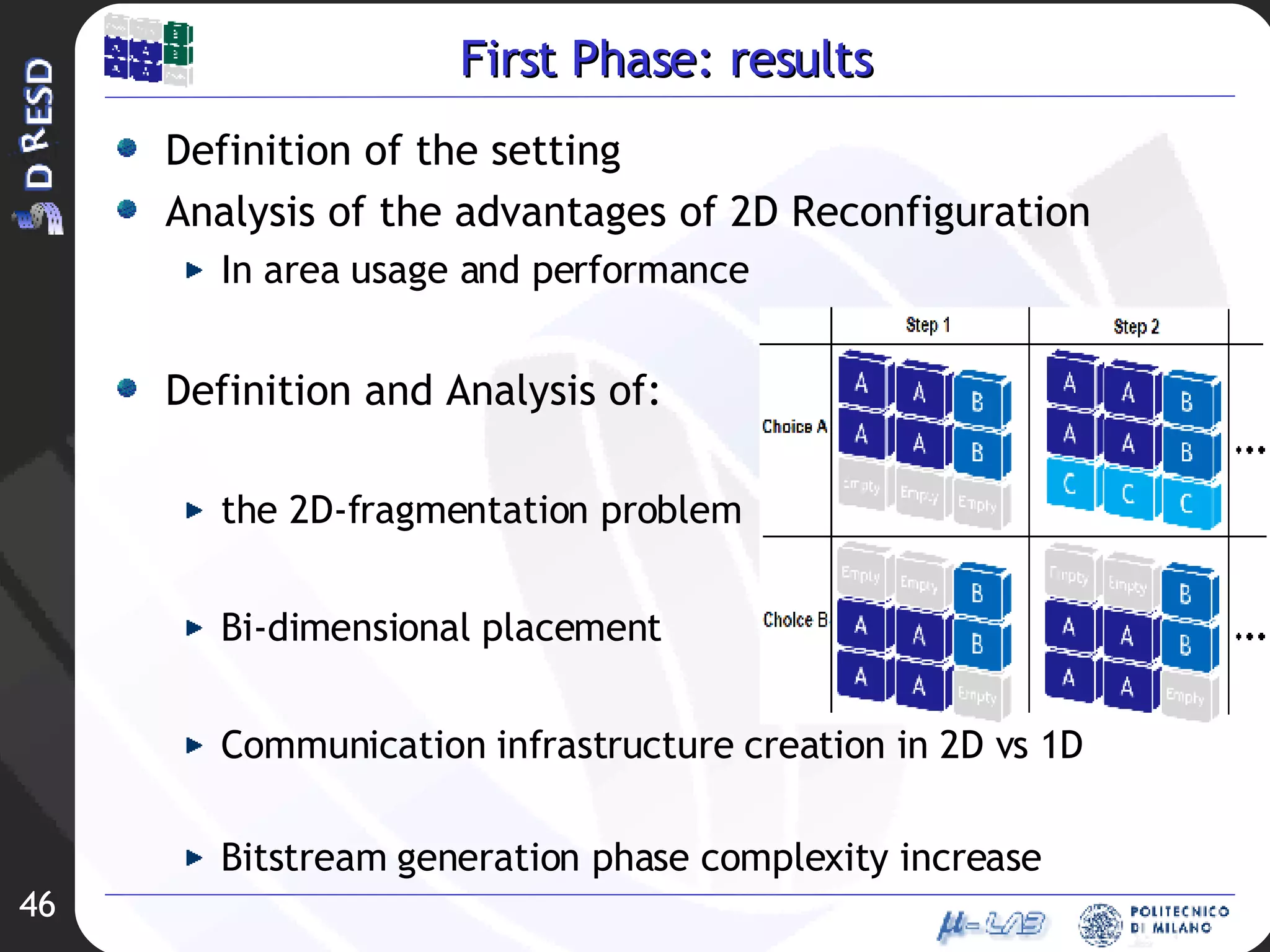
First Phase: results Definition of the setting Analysis of the advantages of 2D Reconfiguration In area usage and performance Definition and Analysis of: the 2D-fragmentation problem Bi-dimensional placement Communication infrastructure creation in 2D vs 1D Bitstream generation phase complexity increase
What’s next… Second phase: Analysis of literature for proposed solutions to the problems defined in current phase Selection of those that can be exploited in self partial dynamical run-time reconfiguration Evaluation of different solutions to choose what is best suited to our problem
What’s next DReAMS Alessandro Panella Matteo Murgida CITiES Alessio Montone Alessandro Meroni Simone Corbetta Operating System Ivan Beretta Design Flow Antonio Piazzi Polaris Massimo Morandi Marco Novati HLR Marco Maggioni
Relocation for 2D Reconfigurable Systems Marco Novati [email_address]
Project Organization First Phase: Examine Xilinx documentation of Virtex-4 and Virtex-5 Analyze the new bitstream structure Second Phase: Implement the new version of BiRF Third Phase: Test of BiRF² Validate the results
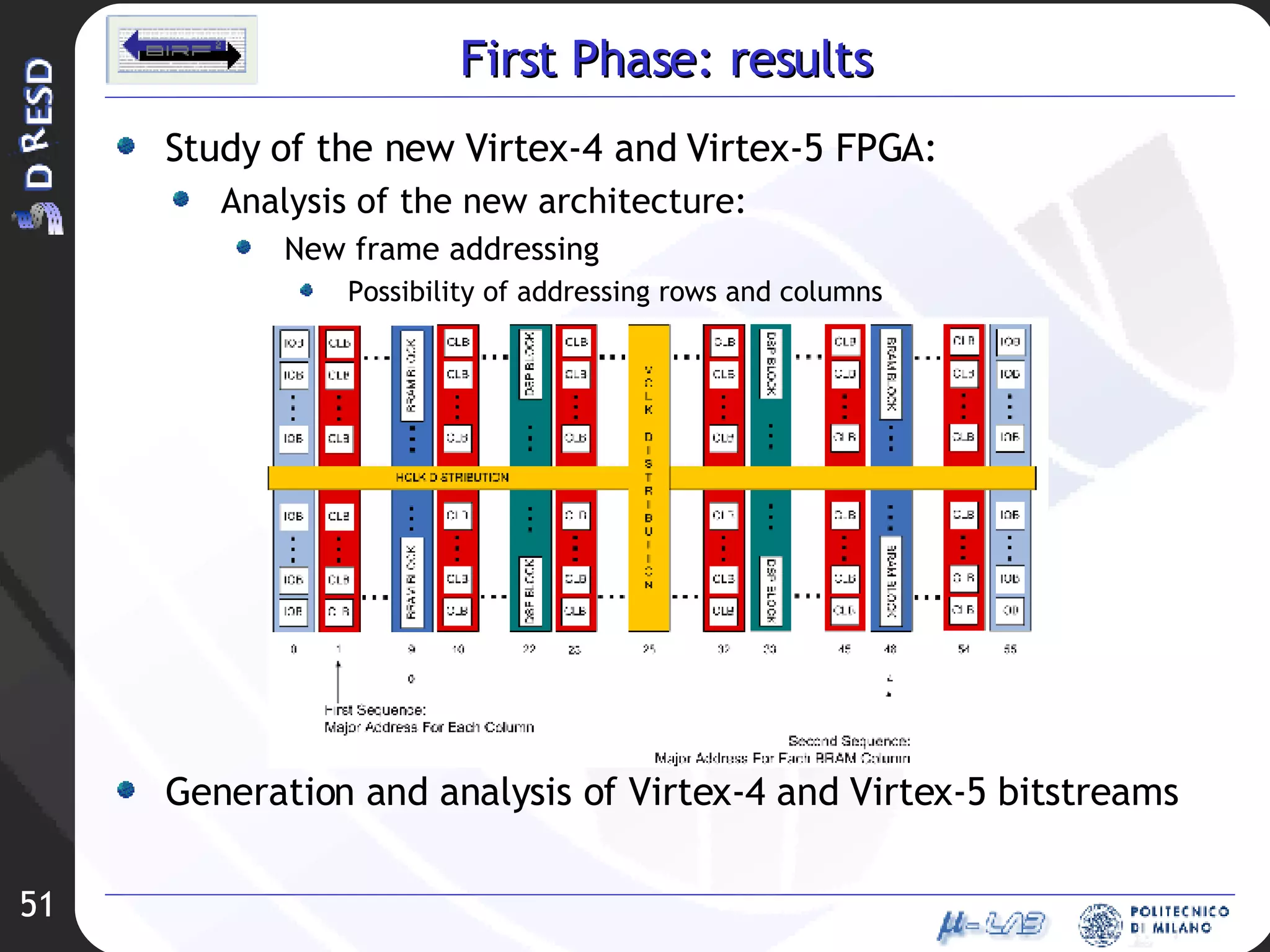
First Phase: results Study of the new Virtex-4 and Virtex-5 FPGA: Analysis of the new architecture: New frame addressing Possibility of addressing rows and columns  Generation  and  analysis of Virtex-4 and Virtex-5 bitstreams
What’s next… Implementation of BiRF²: Define  the functionality: Determine fomulae for: FAR calculation CRC calculation Create the new bitstream parser Design the structure BiRF² HW implementation
What’s next DReAMS Alessandro Panella Matteo Murgida CITiES Alessio Montone Alessandro Meroni Simone Corbetta Operating System Ivan Beretta Design Flow Antonio Piazzi Polaris Massimo Morandi Marco Novati HLR Marco Maggioni
H igh  L evel  R econfiguration Marco Maggioni marco.maggioni @dresd.org
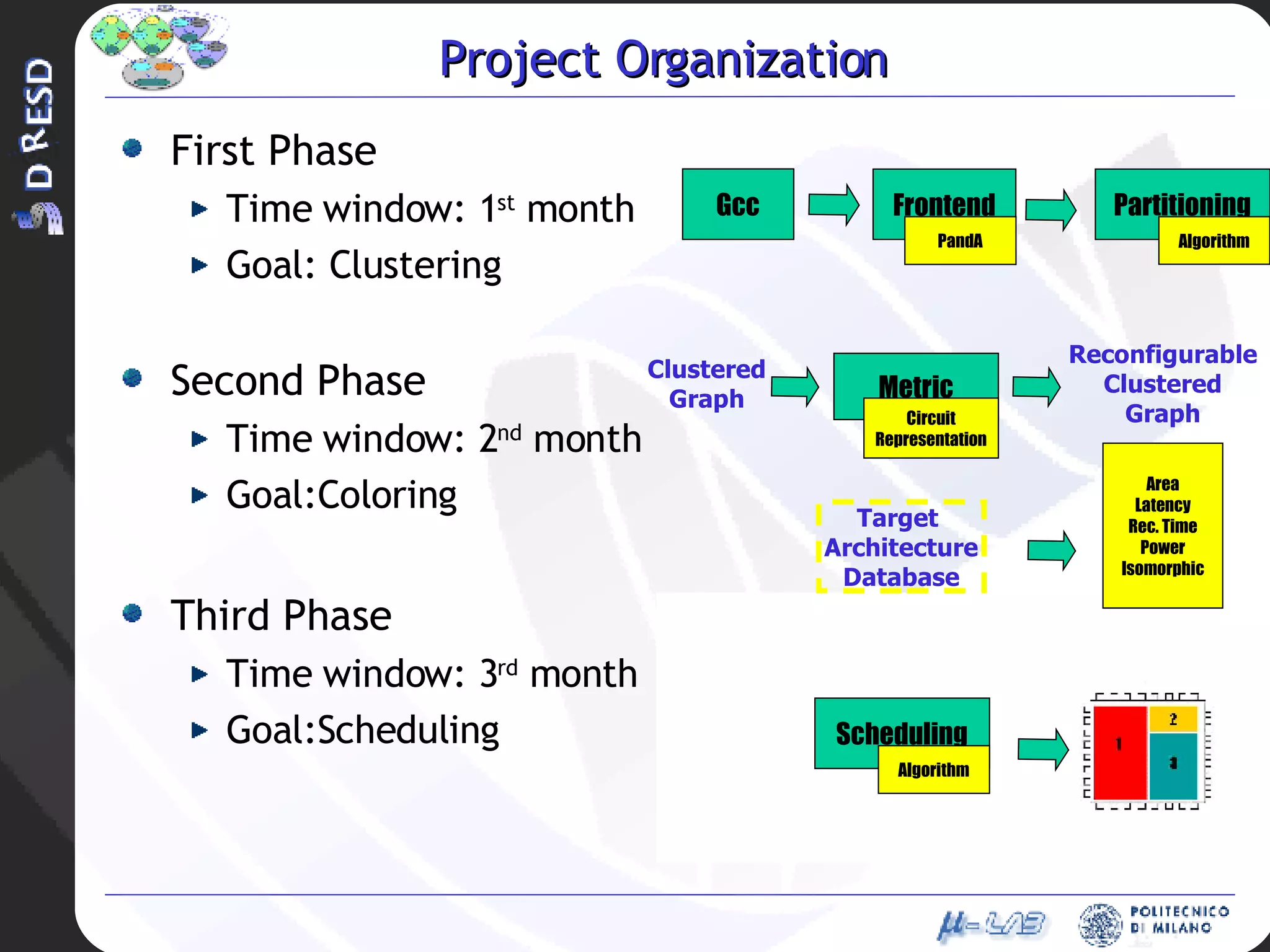
Project Organization First Phase Time window: 1 st  month Goal: Clustering Second Phase Time window: 2 nd  month Goal:Coloring Third Phase Time window: 3 rd  month Goal:Scheduling Clustered Graph Metric Circuit Representation Reconfigurable Clustered Graph Area Latency Rec. Time Power Isomorphic Target  Architecture Database Gcc Frontend Partitioning Algorithm PandA Scheduling Algorithm
First Phase: results Theoretical Work Redefinition of HLR workflow Interfaces between various phases Flexible clustering and scheduling algorithms  Suitable for future researches Implementation of the Clustering phase DFG Graph production  Used Panda --> 0.3 and 0.4 Clustering Algorithm  Used Isomorphic reconfigurable partitioning
What’s next… Second phase in details Add to clustered graph reconfigurable info Latency time Reconfiguration time Cluster area Etc… Definition of reconfigurable clustered graph structure Implement a simple evaluation metric for latency times Connect the flow with clustering phase

Rev1 HPPS Projects 2007

  • 1.
    H igh P erformance P rocessors and S ystems PdM – UIC joint master 2007 Instructor: Prof. Donatella Sciuto HPPS @ PdM – March 2007
  • 2.
    Outline DReAMS AlessandroPanella Matteo Murgida CITiES Alessio Montone Alessandro Meroni Simone Corbetta Operating System Ivan Beretta Design Flow Antonio Piazzi Polaris Massimo Morandi Marco Novati HLR Marco Maggioni
  • 3.
    What’s next DReAMSAlessandro Panella Matteo Murgida CITiES Alessio Montone Alessandro Meroni Simone Corbetta Operating System Ivan Beretta Design Flow Antonio Piazzi Polaris Massimo Morandi Marco Novati HLR Marco Maggioni
  • 4.
    D ynamic Re configurability A pplied to M ulti-FPGA S ystems
  • 5.
    DReAMS Dynamic ReconfigurabilityApplied to Multi-FPGA Systems Branch of DRESD project Inherits architectures and tools Automatic workflow from VHDL system description to FPGA implementation VHDL parsing and system simulation System creation over a specific architecture Bitstream creation and download onto FPGAs
  • 6.
    Multi-FPGA Partitioning AlessandroPanella [email_address]
  • 7.
    Project Organization FirstPhase (15 Mar- 15 Apr) Goals State of the art analysis Proposed approach: basic idea Second Phase (15 Apr – 15 May) Goal Partitioning algorithm: development and implementation Third Phase (15 May – 15 June) Goal Algorithm experimental evaluation Physical evaluation using the Kmera (DIP) architecture
  • 8.
    First Phase: resultsAnalysis of several partitioning approaches “ Classic” methods (KL, FM) Iterative methods (Genetic, Tabu Search, Simulated Annealing) Multilevel methods (METIS, hMETIS) “ Structural” methods Our approach (some hints) Structural method Exploit already existing tools to create the structural tree Partitioning Exploit the hyerarchy Graph-covering approach Focus on cutsize minimization Pros Modular fashion Less communication problems No need of “extremely” efficient algorithm
  • 9.
    What’s next… SecondPhase Existing tools exloration (XST, EDK, Synplify Pro) How to retrieve information? How to build a structural tree? How to use it? Proposed algorithm Definition Implementation Benchmark indentification
  • 10.
    What’s next DReAMSAlessandro Panella Matteo Murgida CITiES Simone Corbetta Alessandro Meroni Alessio Montone Operating System Ivan Beretta Design Flow Antonio Piazzi Polaris Massimo Morandi Marco Novati HLR Marco Maggioni
  • 11.
    Chimera Multi-FPGAs ArchitectureDefinition Matteo Murgida [email_address]
  • 12.
    Project Organization 1stPhase Goals: Digilent Spartan3- Starter Board study Boards connection 2nd Phase Goals: Distributed architecture description Communication protocol definition and implementation 3rd Phase Goal: Design a simple distribuited application to verify the correctness of the proposed approach
  • 13.
    First Phase: resultsChoice of the A2 Expansion Connector to allow communication between two boards Leds (located on one or two boards) control implemented both manually and via Microblaze Configuration of the connector pins to support the future communication protocol
  • 14.
    What’s next… Secondphase organization… Communication protocol design Design the IP-Cores needed by the communication protocol Distributed core design methodology - first definition Reconstruction of the original data in the receiver Implementation of the Call/Ack mechanism Microblazes (one per board) data exchange Application design and development to validate the proposed approach
  • 15.
    What’s next DReAMSAlessandro Panella Matteo Murgida CITiES Alessio Montone Alessandro Meroni Simone Corbetta Operating System Ivan Beretta Design Flow Antonio Piazzi Polaris Massimo Morandi Marco Novati HLR Marco Maggioni
  • 16.
  • 17.
  • 18.
    P rocessing E lements RE configuration I n R econfigurable A rchitectures Alessio Montone [email_address]
  • 19.
    Project Organization FirstPhase Time window: 15/March – 15/April Goal: bitstream structure analysis memory mapping equations formalization Second Phase Time window: 15/April – 15/May Goal: Implement mapping algorithm and equations Third Phase Time window: 15/May – 15/June Goal: Harware Validation
  • 20.
    First Phase: resultsUnderstanding of: Bitstream Structure Architectural Memory Mapping File (BMM) Compiled source code (ELF) Formalization of: Code Splitting (on BRAM Blocks) Algorithm BRAM Content Mapping Equations
  • 21.
    What’s next… Secondphase in details Create a software that Takes in input .bmm (BRAM used) and .elf (code) file Outputs: memory configuration bitstream Is device parametric Is tailored for Xilinx Virtex II Pro Family FPGAs
  • 22.
    What’s next DReAMSAlessandro Panella Matteo Murgida CITiES Alessio Montone Alessandro Meroni Simone Corbetta Operating System Ivan Beretta Design Flow Antonio Piazzi Polaris Massimo Morandi Marco Novati HLR Marco Maggioni
  • 23.
    R econfiguration O riented Me trics Alessandro Meroni [email_address]
  • 24.
    Project Organization FirstPhase Time Window: 15/March - 15/April Goal: Analysis of a well-known set of metrics Second Phase Time Window: 15/April - 15/May Goal: Metrics definition and implementation Third Phase Time Window: 15/May - 15/June Goal: Creation of a metrics Simulator
  • 25.
    First Phase: ResultsCommunication Achitectures analyzed Point-to-point Bus Network-on-Chip Performance Parameters evaluated Latency, Bandwidth, Throughput Topology Cost Factors evaluated Area usage Power Consumption Final Report that summerizes the results
  • 26.
    What’s next… SecondPhase Metrics implementation and rules definition: To improve the system performances Tailored for the dynamic reconfiguration of the communication infrastructure, e.g.: The creation of a new Processing Element The change of the routing protocol exploited Study and analysis of different simulators NS2 …
  • 27.
    What’s next DReAMSAlessandro Panella Matteo Murgida CITiES Alessandro Meroni Alessio Montone Simone Corbetta Operating System Ivan Beretta Design Flow Antonio Piazzi Polaris Massimo Morandi Marco Novati HLR Marco Maggioni
  • 28.
    RE configurable C ommunication I nfrastructure F or E mbedded-systems Simone Corbetta [email_address]
  • 29.
    Project Organization Goal: design a communication infrastructure tailored for reconfigurable FPGA-based embedded system Organization : three phases PHASE 1 (due to 12th April): literature analysis on communication infrastructure paradigms and design choices Survey PHASE 2 (due to 17th May) De Micheli architecture exploration PHASE 3 (due to 17th June) Communication infrastructure model definition
  • 30.
    First Phase: resultsLiterature analysis - Topics: Communication infrastructure definition CI design choices and trades-off Understanding different CI paradigms Advantages Pitfalls Improvements Existing applications and solutions (both academic and commercial) Survey : conveys study and analysis of different approaches. The base for future work
  • 31.
    Next Phase Networks-on-Chip De Micheli state-of-the-art VHDL description Study, analysis Improvements ( if any ...) Tailoring for dynamically reconfigurable systems Survey Extension to specific De Micheli's NoC architecture Communication infrastructure design methodology used in ReCIFE
  • 32.
    What’s next DReAMSAlessandro Panella Matteo Murgida CITiES Alessio Montone Alessandro Meroni Simone Corbetta Operating System Ivan Beretta Design Flow Antonio Piazzi Polaris Massimo Morandi Marco Novati HLR Marco Maggioni
  • 33.
    Development of anOS architecture-independent layer for dynamic reconfiguration Ivan Beretta [email_address]
  • 34.
    Project Organization FirstPhase Goal: State of the art and Boot process analysis Second Phase Goal: Implementation and comparison of the existing solutions Third Phase Goal: Definition of the new architecture-independent layer and testing
  • 35.
    First Phase: resultsAnalysis of the Caronte solution Reconfiguration controller driver IP-Core manager Analysis of the DRESD-SW solution Reconfiguration controller, MAC, LOL ,Reconfiguration Library ROTFL Architecture Caronte implementation study Boot process
  • 36.
    What’s next… Secondphase: Implementation of the DRESD operating system solution, based on ISE and EDK 9.1 version, on Xilinx Virtex II Pro VP7 and VP20 Previous solution comparison Dynamic reconfiguration OS support abstraction layer: basic idea
  • 37.
    What’s next DReAMSAlessandro Panella Matteo Murgida CITiES Alessio Montone Alessandro Meroni Simone Corbetta Operating System Ivan Beretta Design Flow Antonio Piazzi Polaris Massimo Morandi Marco Novati HLR Marco Maggioni
  • 38.
    Design FLow AntonioPiazzi [email_address]
  • 39.
    Project organization 1st phase Time window: 15 March – 15 April Goal: Understand the execution of each previous tool (archgen, yara’s console script and inca) 2 nd phase Time window: 15 April – 15 May Goal: Create an algorithm to merge each tool and a directory structure skeleton for each project type 3 rd phase Time window: 15 May – 15 June Goal: Create and test the new tool with almost four architecture (2 YARA based and 2 InCA based) on Spartan and Virtex FPGA family
  • 40.
    First phase’s resultsStudy phase: Archgen Which are inputs and outputs and how this tool work YaRA Learn the directory structure and the console script which automates the work flow InCA Understand the early access reconfiguration flow proposed by Xilinx and how this tool complete its function
  • 41.
    The future islooking for us Now : for each work flow and for each architecture we have to execute a file. Tomorrow : Unique file to create an architecture and rebuild her workflow. Manual process Automated process Before After Planning VHDL gen. UCF and Com. Inf. Gen. Bitstream gen. Merging phase Planning VHDL gen. UCF and Com. Inf. Gen. Bitstream gen. Merging phase
  • 42.
    What’s next DReAMSAlessandro Panella Matteo Murgida CITiES Alessio Montone Alessandro Meroni Simone Corbetta Operating System Ivan Beretta Design Flow Antonio Piazzi Polaris Massimo Morandi Marco Novati HLR Marco Maggioni
  • 43.
  • 44.
    Effects of 2DReconfiguration in a Reconfigurable System Massimo Morandi [email_address]
  • 45.
    Project Organization FirstPhase: General analysis of 2D reconfiguration Detailed description of the new problems Second Phase: Analysis of possible solutions to those problems Evaluation of alternatives Third Phase: Propose a new combined solution to effectively handle problems of 2D reconfiguration
  • 46.
    First Phase: resultsDefinition of the setting Analysis of the advantages of 2D Reconfiguration In area usage and performance Definition and Analysis of: the 2D-fragmentation problem Bi-dimensional placement Communication infrastructure creation in 2D vs 1D Bitstream generation phase complexity increase
  • 47.
    What’s next… Secondphase: Analysis of literature for proposed solutions to the problems defined in current phase Selection of those that can be exploited in self partial dynamical run-time reconfiguration Evaluation of different solutions to choose what is best suited to our problem
  • 48.
    What’s next DReAMSAlessandro Panella Matteo Murgida CITiES Alessio Montone Alessandro Meroni Simone Corbetta Operating System Ivan Beretta Design Flow Antonio Piazzi Polaris Massimo Morandi Marco Novati HLR Marco Maggioni
  • 49.
    Relocation for 2DReconfigurable Systems Marco Novati [email_address]
  • 50.
    Project Organization FirstPhase: Examine Xilinx documentation of Virtex-4 and Virtex-5 Analyze the new bitstream structure Second Phase: Implement the new version of BiRF Third Phase: Test of BiRF² Validate the results
  • 51.
    First Phase: resultsStudy of the new Virtex-4 and Virtex-5 FPGA: Analysis of the new architecture: New frame addressing Possibility of addressing rows and columns Generation and analysis of Virtex-4 and Virtex-5 bitstreams
  • 52.
    What’s next… Implementationof BiRF²: Define the functionality: Determine fomulae for: FAR calculation CRC calculation Create the new bitstream parser Design the structure BiRF² HW implementation
  • 53.
    What’s next DReAMSAlessandro Panella Matteo Murgida CITiES Alessio Montone Alessandro Meroni Simone Corbetta Operating System Ivan Beretta Design Flow Antonio Piazzi Polaris Massimo Morandi Marco Novati HLR Marco Maggioni
  • 54.
    H igh L evel R econfiguration Marco Maggioni marco.maggioni @dresd.org
  • 55.
    Project Organization FirstPhase Time window: 1 st month Goal: Clustering Second Phase Time window: 2 nd month Goal:Coloring Third Phase Time window: 3 rd month Goal:Scheduling Clustered Graph Metric Circuit Representation Reconfigurable Clustered Graph Area Latency Rec. Time Power Isomorphic Target Architecture Database Gcc Frontend Partitioning Algorithm PandA Scheduling Algorithm
  • 56.
    First Phase: resultsTheoretical Work Redefinition of HLR workflow Interfaces between various phases Flexible clustering and scheduling algorithms Suitable for future researches Implementation of the Clustering phase DFG Graph production Used Panda --> 0.3 and 0.4 Clustering Algorithm Used Isomorphic reconfigurable partitioning
  • 57.
    What’s next… Secondphase in details Add to clustered graph reconfigurable info Latency time Reconfiguration time Cluster area Etc… Definition of reconfigurable clustered graph structure Implement a simple evaluation metric for latency times Connect the flow with clustering phase