Reconfiguration: basic concepts P artial   D ynamic  R econfiguration  W orkshop DRESD Team [email_address]
Outline Reconfiguration, does stranger Reconfigurable computing Definitions 5W Reconfiguration in everyday life Reconfigurable Architectures Characterization brain to bit
What’s next Reconfiguration, does stranger Reconfigurable computing Definitions 5W Reconfiguration in everyday life Reconfigurable Architectures Characterization brain to bit
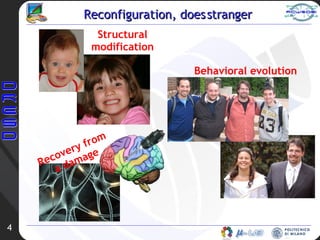
Reconfiguration, does stranger Recovery from a damage Structural modification Behavioral evolution
What’s next Reconfiguration, does stranger Reconfigurable computing Definitions 5W Reconfiguration in everyday life Reconfigurable Architectures Characterization brain to bit
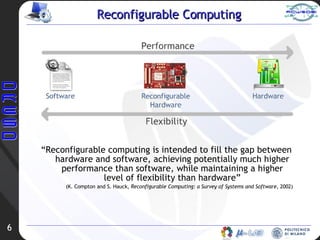
Reconfigurable Computing “ Reconfigurable computing is intended to fill the gap between hardware and software, achieving potentially much higher performance than software, while maintaining a higher level of flexibility than hardware” (K. Compton and S. Hauck,  Reconfigurable Computing: a Survey of Systems and Software , 2002)
Some Definitions Object Code : the executable active physical (either HW or SW) implementation of a given functionality Reconfigurable Computing : the ability of altering a concrete architecture (microarchitecture), once it has been deployed, to meet at the best the  execution mode of object code Reconfiguration Controller : the element that is responsible for the physical implementation of a reconfiguration process i.e., in Xilinx FPGA the ICAP controller Reconfiguration Manager : the element that is responsible for the management of a reconfiguration process i.e., in ATMEL the AVR microcontroller, in Xilinx the PPC405 Relocation : the ability of moving an  object code  from a location to a new one
5 W who  controls the reconfiguration where  the reconfiguration cotroller is located when  the configurations are generated which  is the granularity of the reconfiguration in  what  dimension the reconfiguration operates
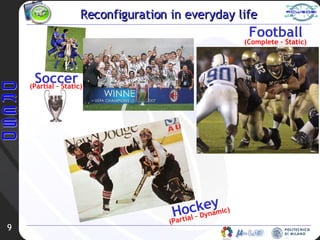
Reconfiguration in everyday life Soccer Hockey Football (Complete – Static) (Partial – Dynamic) (Partial – Static)
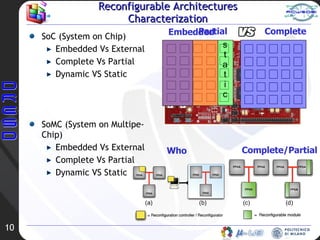
Reconfigurable Architectures Characterization SoC (System on Chip) Embedded Vs External Complete Vs Partial Dynamic VS Static SoMC (System on Multipe-Chip) Embedded Vs External  Complete Vs Partial Dynamic VS Static s t a t i c Partial Complete Embedded Complete/Partial Who
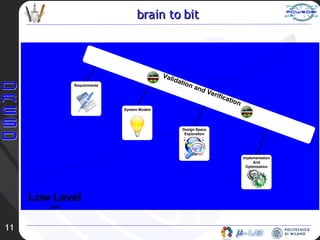
brain to bit
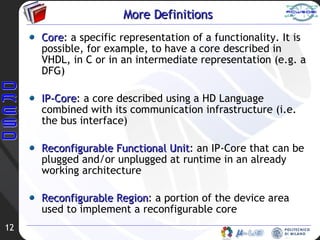
More Definitions Core : a specific representation of a functionality. It is possible, for example, to have a core described in VHDL, in C or in an intermediate representation (e.g. a DFG) IP-Core : a core described using a HD Language combined with its communication infrastructure (i.e. the bus interface) Reconfigurable Functional Unit : an IP-Core that can be plugged and/or unplugged at runtime in an already working architecture Reconfigurable Region : a portion of the device area used to implement a reconfigurable core
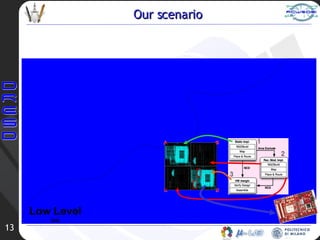
Our scenario
Questions

RCW@DEI - Basic Concepts

  • 1.
    Reconfiguration: basic conceptsP artial D ynamic R econfiguration W orkshop DRESD Team [email_address]
  • 2.
    Outline Reconfiguration, doesstranger Reconfigurable computing Definitions 5W Reconfiguration in everyday life Reconfigurable Architectures Characterization brain to bit
  • 3.
    What’s next Reconfiguration,does stranger Reconfigurable computing Definitions 5W Reconfiguration in everyday life Reconfigurable Architectures Characterization brain to bit
  • 4.
    Reconfiguration, does strangerRecovery from a damage Structural modification Behavioral evolution
  • 5.
    What’s next Reconfiguration,does stranger Reconfigurable computing Definitions 5W Reconfiguration in everyday life Reconfigurable Architectures Characterization brain to bit
  • 6.
    Reconfigurable Computing “Reconfigurable computing is intended to fill the gap between hardware and software, achieving potentially much higher performance than software, while maintaining a higher level of flexibility than hardware” (K. Compton and S. Hauck, Reconfigurable Computing: a Survey of Systems and Software , 2002)
  • 7.
    Some Definitions ObjectCode : the executable active physical (either HW or SW) implementation of a given functionality Reconfigurable Computing : the ability of altering a concrete architecture (microarchitecture), once it has been deployed, to meet at the best the execution mode of object code Reconfiguration Controller : the element that is responsible for the physical implementation of a reconfiguration process i.e., in Xilinx FPGA the ICAP controller Reconfiguration Manager : the element that is responsible for the management of a reconfiguration process i.e., in ATMEL the AVR microcontroller, in Xilinx the PPC405 Relocation : the ability of moving an object code from a location to a new one
  • 8.
    5 W who controls the reconfiguration where the reconfiguration cotroller is located when the configurations are generated which is the granularity of the reconfiguration in what dimension the reconfiguration operates
  • 9.
    Reconfiguration in everydaylife Soccer Hockey Football (Complete – Static) (Partial – Dynamic) (Partial – Static)
  • 10.
    Reconfigurable Architectures CharacterizationSoC (System on Chip) Embedded Vs External Complete Vs Partial Dynamic VS Static SoMC (System on Multipe-Chip) Embedded Vs External Complete Vs Partial Dynamic VS Static s t a t i c Partial Complete Embedded Complete/Partial Who
  • 11.
  • 12.
    More Definitions Core: a specific representation of a functionality. It is possible, for example, to have a core described in VHDL, in C or in an intermediate representation (e.g. a DFG) IP-Core : a core described using a HD Language combined with its communication infrastructure (i.e. the bus interface) Reconfigurable Functional Unit : an IP-Core that can be plugged and/or unplugged at runtime in an already working architecture Reconfigurable Region : a portion of the device area used to implement a reconfigurable core
  • 13.
  • 14.