Towards a New Architectural Framework  – The Nth Stratum Concept M. Johnsson, J. Huusko, T. Frantti, F-U Andersen, T.M.T Nguyen, M. Ponce de Leon [email_address] ,  [email_address] ,  [email_address] ,  [email_address] ,  [email_address] ,  [email_address]
Outline Introduction Problems with the Internet architecture Nth Stratum concept Concept overview Core Feature Integrity Signaling and QoS Management aspects Conclusion
Introduction The current Internet architecture is about to reach the limits of sustainable developments Ever-increasing diversity in applications, services, devices, and type of networks Infrastructures for connectivity, internetworking, and management remain fairly the same A new paradigm is needed to support innovations and interoperability between various solutions all residing within a global communication system The FP7 4WARD project working on “Architecture and Design for the Future Internet” Nth Stratum concept is a holistic approach to tackle these new needs and requirements on a future communication system
Problems with the Internet architecture Difficult to realize network enhancements with layered model IPv6, IPsec, MobileIP, or multicast Solutions to the problems of QoS, Mobility and Security are patchworks to fill architectural holes System has become complex Similar functionality re-appears in different protocols and layers jeopardizing the operation and performance of the communication system Examples: NAT is not interoperable with the end-to-end architecture, Ipsec is not interoperable with MobileIPv6 The Internet needs a new architecture more flexible, supporting cleaner cross-layer interaction and service composition
Related works Micro-protocol Role-Based Architecture FARA PlutArch ANA Conduits+, dynamic architecture, x-Kernel Ambient Networks
Nth stratum concept overview The Internet is a communication system The new architecture should allow a communication system to evolve in a well structured and controlled manner The Nth stratum concept is based on the following notions Architectural patterns and components to facilitate the design of a particular network Design patterns and other principles from Software Engineering Inheritance from the Object-Oriented Programming Invariants from Ambient Networks
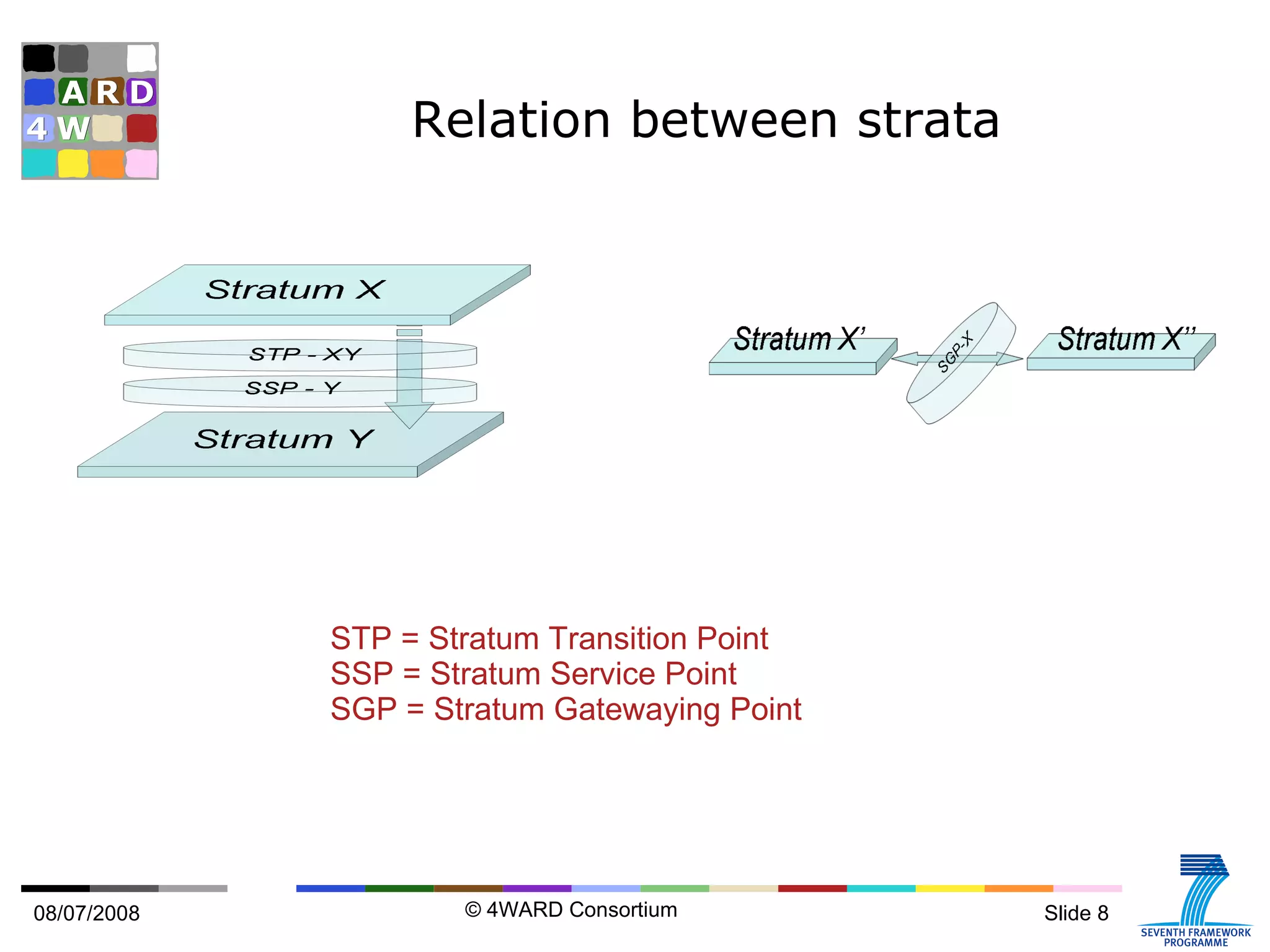
Stratum Stratum is an entity which inherently has characteristics of distribution and provides features/properties/functionality for a slice/layer/component/aspect of a communication system Stratum can be modeled as a set of nodes containing functionality for data processing, and a medium which defines how data can be transferred between the nodes. Figure . The nodes (N) and the Medium constituting the principal building blocks of a stratum.
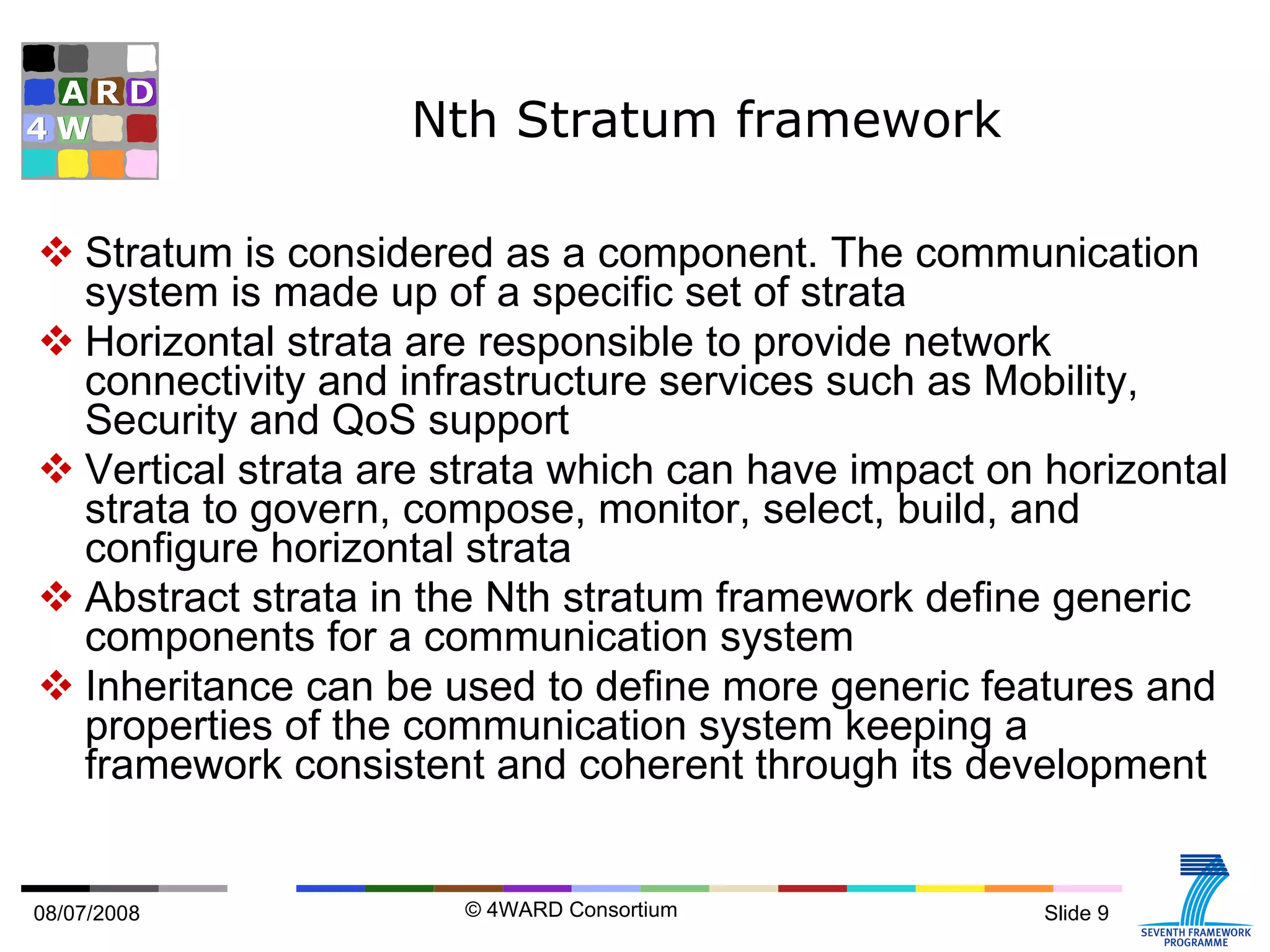
Relation between strata STP = Stratum Transition Point SSP = Stratum Service Point SGP = Stratum Gatewaying Point Figure . Relation between two strata.
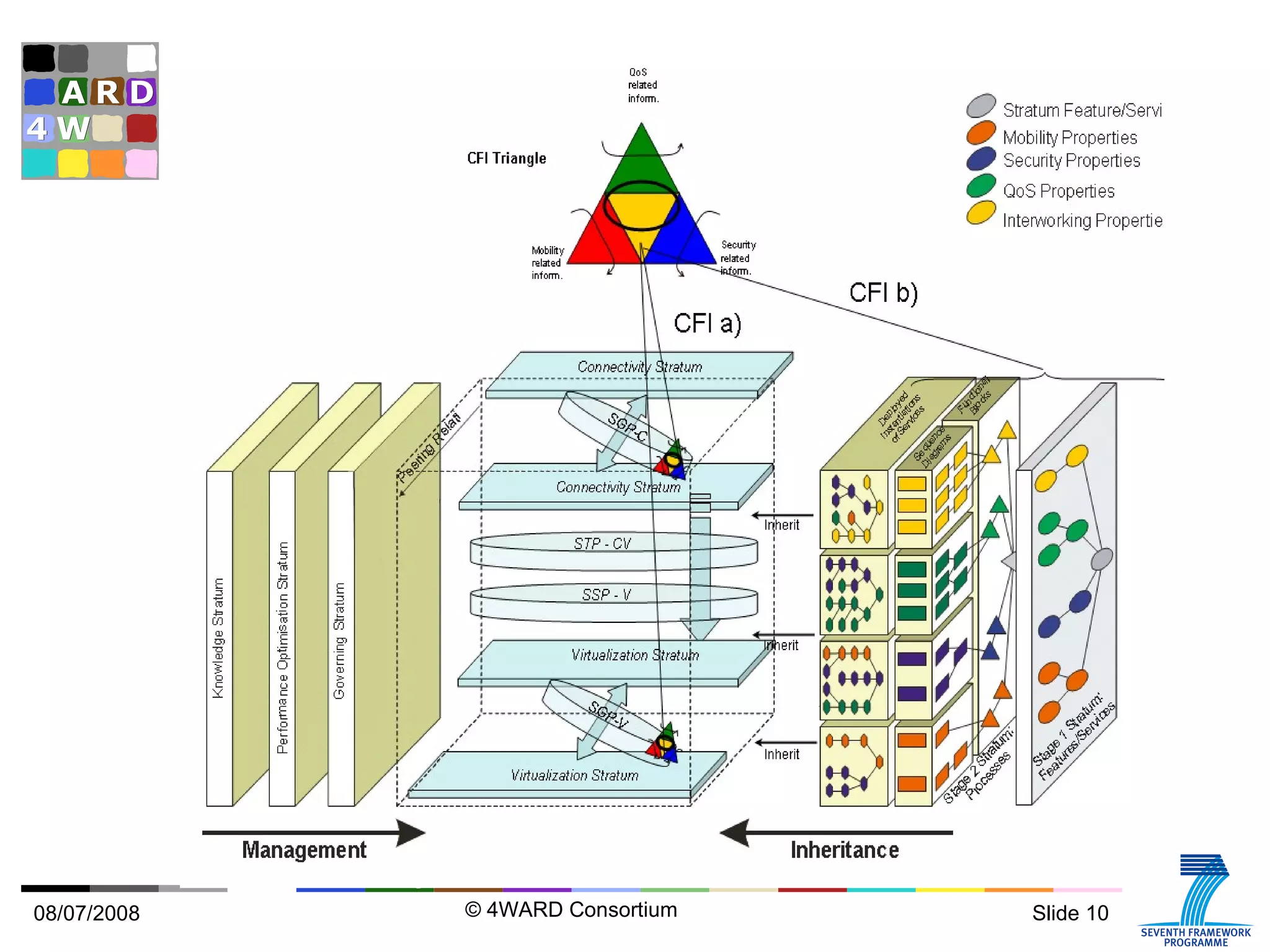
Nth Stratum framework Stratum is considered as a component. The communication system is made up of a specific set of strata Horizontal strata are responsible to provide network connectivity and infrastructure services such as Mobility, Security and QoS support Vertical strata are strata which can have impact on horizontal strata to govern, compose, monitor, select, build, and configure horizontal strata Abstract strata in the Nth stratum framework define generic components for a communication system Inheritance can be used to define more generic features and properties of the communication system keeping a framework consistent and coherent through its development
Figure . Nth stratum, horizontal and vertical strata, and CFI methods a) and b).
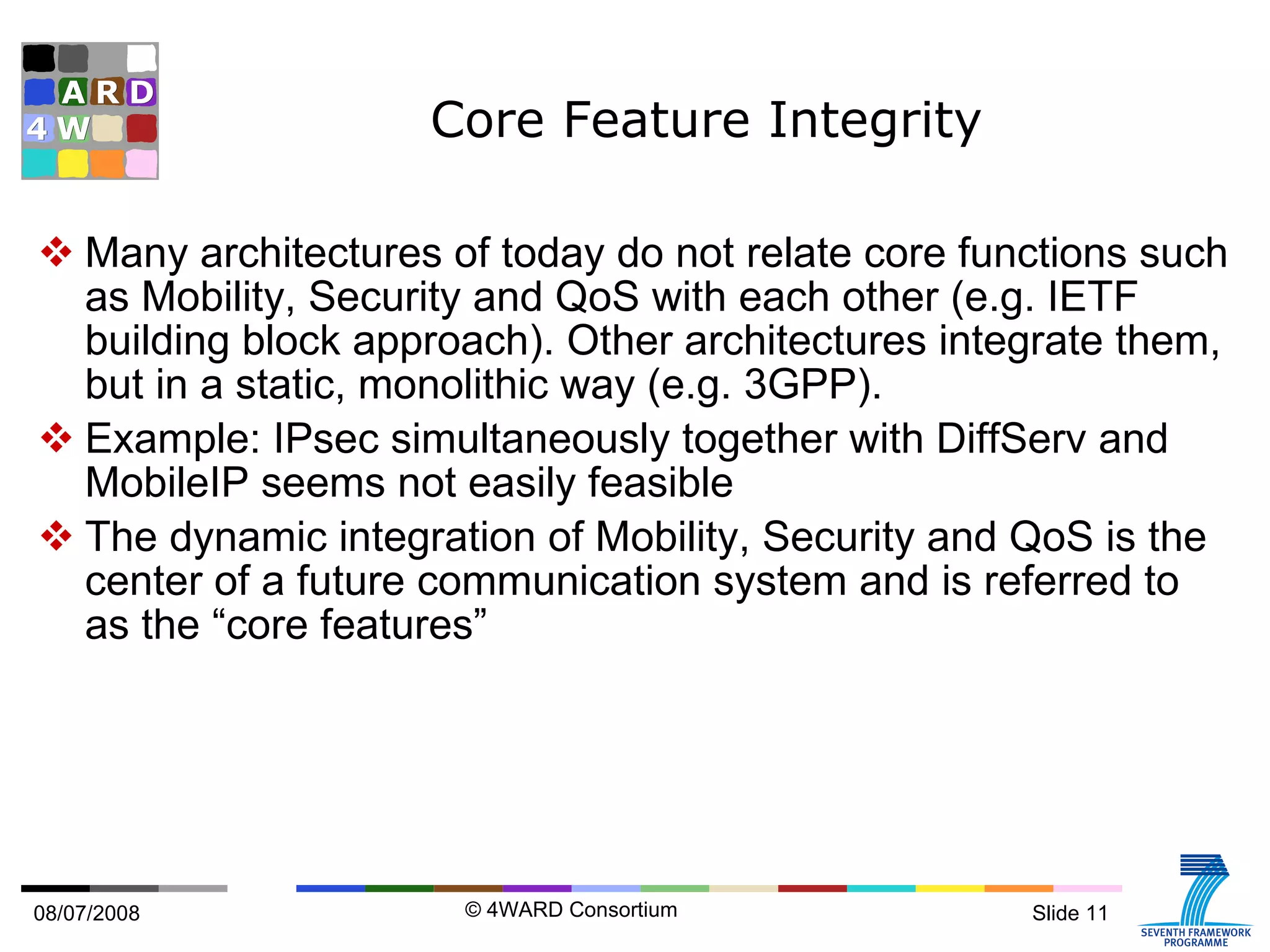
Core Feature Integrity Many architectures of today do not relate core functions such as Mobility, Security and QoS with each other (e.g. IETF building block approach). Other architectures integrate them, but in a static, monolithic way (e.g. 3GPP). Example: IPsec simultaneously together with DiffServ and MobileIP seems not easily feasible The dynamic integration of Mobility, Security and QoS is the center of a future communication system and is referred to as the “core features”
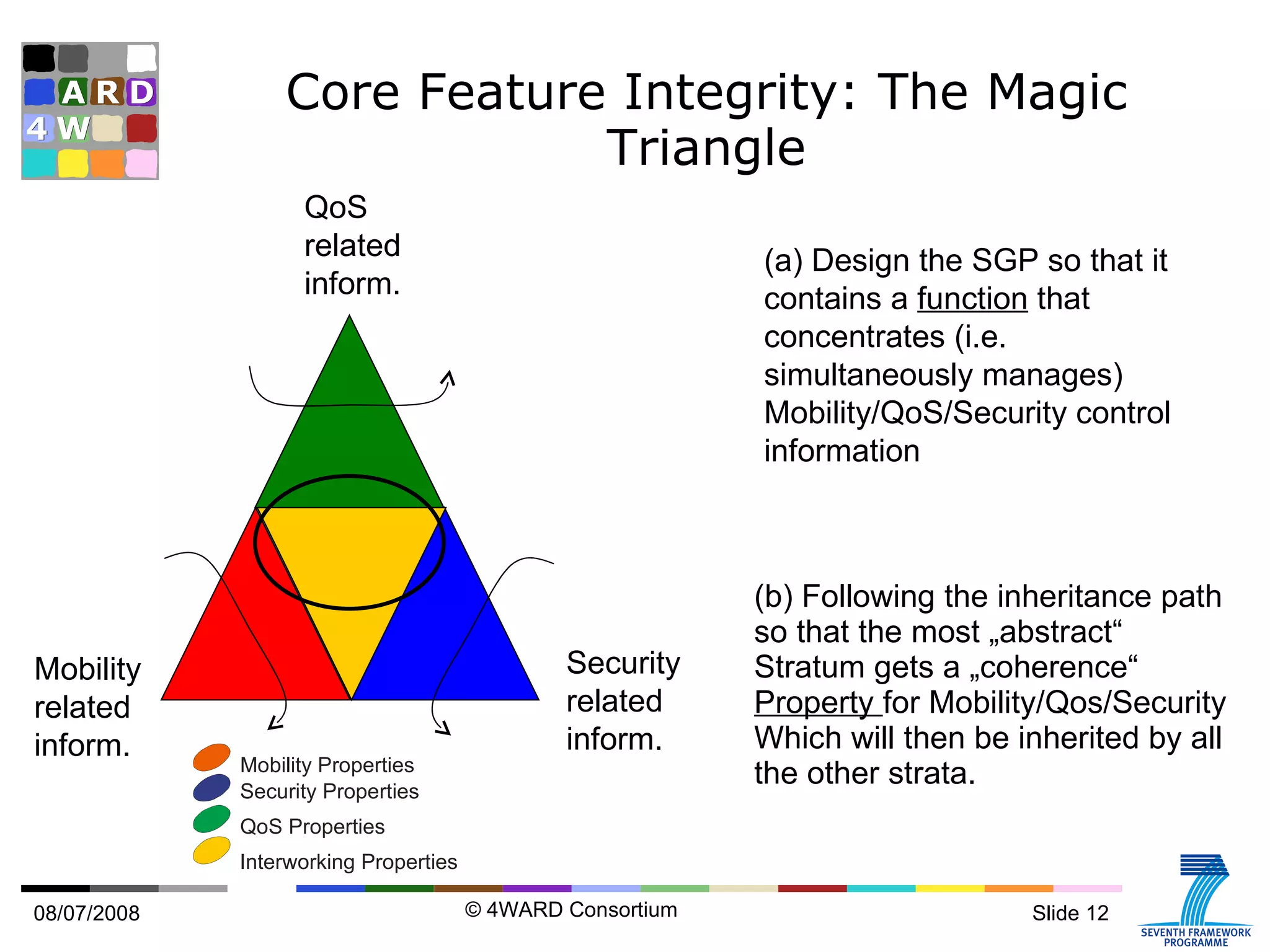
Core Feature Integrity: The Magic Triangle Mobility Properties Security Properties QoS Properties Interworking Properties (a) Design the SGP so that it contains a  function  that concentrates (i.e. simultaneously manages) Mobility/QoS/Security control information QoS related inform. Mobility related inform. Security related inform. (b) Following the inheritance path  so that t he most „abstract“  Stratum gets a „coherence“  Property  for Mobility/Qos/Security Which will then be inherited by all the other strata.
Signaling and QoS There would be a control channel “open” all the time for instant control information transmission Abstract strata design will enable overall improvement of the scalability and minimize the redundancy in a protocol stack Real-time signaling allows transmitting even one control bit at a time without conventionally collecting a bunch of them before transmission The separation of control bearers helps to minimize the total amount of control information by decreasing redundancy due to time delays
Management aspects Management aspects are realized by vertical strata Governance stratum is responsible to decide in real-time the set of strata needed for a communication system and how they are individually configured Knowledge stratum is responsible to provide the “network picture” Network state: round-trip delay, packet loss rate, network load… Network context: temperature over the wireless link, failure under way, security problems… Performance optimization is responsible to handle congestion and network delays, and load sharing to optimize the performance of the network
Conclusion Nth Stratum concept is a holistic approach to development and design of future communication systems Three types of strata are defined in the framework: horizontal, vertical and abstract strata The Nth stratum framework will support invariants, apply network design patterns, and inheritance principles from Software Engineering to deal with interoperability issues and keep the evolution of a communication system under controlled Future works:  Specification of stratum and stratum-based architecture (e.g. how to describe the structure, syntax, semantics, functions and features of a stratum) Design process and guiding principles for the development of strata Definition and specification of principle strata
Thank you !

Towards a New Architectural Framework – The Nth Stratum Concept Mobimedia 08

  • 1.
    Towards a NewArchitectural Framework – The Nth Stratum Concept M. Johnsson, J. Huusko, T. Frantti, F-U Andersen, T.M.T Nguyen, M. Ponce de Leon [email_address] , [email_address] , [email_address] , [email_address] , [email_address] , [email_address]
  • 2.
    Outline Introduction Problemswith the Internet architecture Nth Stratum concept Concept overview Core Feature Integrity Signaling and QoS Management aspects Conclusion
  • 3.
    Introduction The currentInternet architecture is about to reach the limits of sustainable developments Ever-increasing diversity in applications, services, devices, and type of networks Infrastructures for connectivity, internetworking, and management remain fairly the same A new paradigm is needed to support innovations and interoperability between various solutions all residing within a global communication system The FP7 4WARD project working on “Architecture and Design for the Future Internet” Nth Stratum concept is a holistic approach to tackle these new needs and requirements on a future communication system
  • 4.
    Problems with theInternet architecture Difficult to realize network enhancements with layered model IPv6, IPsec, MobileIP, or multicast Solutions to the problems of QoS, Mobility and Security are patchworks to fill architectural holes System has become complex Similar functionality re-appears in different protocols and layers jeopardizing the operation and performance of the communication system Examples: NAT is not interoperable with the end-to-end architecture, Ipsec is not interoperable with MobileIPv6 The Internet needs a new architecture more flexible, supporting cleaner cross-layer interaction and service composition
  • 5.
    Related works Micro-protocolRole-Based Architecture FARA PlutArch ANA Conduits+, dynamic architecture, x-Kernel Ambient Networks
  • 6.
    Nth stratum conceptoverview The Internet is a communication system The new architecture should allow a communication system to evolve in a well structured and controlled manner The Nth stratum concept is based on the following notions Architectural patterns and components to facilitate the design of a particular network Design patterns and other principles from Software Engineering Inheritance from the Object-Oriented Programming Invariants from Ambient Networks
  • 7.
    Stratum Stratum isan entity which inherently has characteristics of distribution and provides features/properties/functionality for a slice/layer/component/aspect of a communication system Stratum can be modeled as a set of nodes containing functionality for data processing, and a medium which defines how data can be transferred between the nodes. Figure . The nodes (N) and the Medium constituting the principal building blocks of a stratum.
  • 8.
    Relation between strataSTP = Stratum Transition Point SSP = Stratum Service Point SGP = Stratum Gatewaying Point Figure . Relation between two strata.
  • 9.
    Nth Stratum frameworkStratum is considered as a component. The communication system is made up of a specific set of strata Horizontal strata are responsible to provide network connectivity and infrastructure services such as Mobility, Security and QoS support Vertical strata are strata which can have impact on horizontal strata to govern, compose, monitor, select, build, and configure horizontal strata Abstract strata in the Nth stratum framework define generic components for a communication system Inheritance can be used to define more generic features and properties of the communication system keeping a framework consistent and coherent through its development
  • 10.
    Figure . Nthstratum, horizontal and vertical strata, and CFI methods a) and b).
  • 11.
    Core Feature IntegrityMany architectures of today do not relate core functions such as Mobility, Security and QoS with each other (e.g. IETF building block approach). Other architectures integrate them, but in a static, monolithic way (e.g. 3GPP). Example: IPsec simultaneously together with DiffServ and MobileIP seems not easily feasible The dynamic integration of Mobility, Security and QoS is the center of a future communication system and is referred to as the “core features”
  • 12.
    Core Feature Integrity:The Magic Triangle Mobility Properties Security Properties QoS Properties Interworking Properties (a) Design the SGP so that it contains a function that concentrates (i.e. simultaneously manages) Mobility/QoS/Security control information QoS related inform. Mobility related inform. Security related inform. (b) Following the inheritance path so that t he most „abstract“ Stratum gets a „coherence“ Property for Mobility/Qos/Security Which will then be inherited by all the other strata.
  • 13.
    Signaling and QoSThere would be a control channel “open” all the time for instant control information transmission Abstract strata design will enable overall improvement of the scalability and minimize the redundancy in a protocol stack Real-time signaling allows transmitting even one control bit at a time without conventionally collecting a bunch of them before transmission The separation of control bearers helps to minimize the total amount of control information by decreasing redundancy due to time delays
  • 14.
    Management aspects Managementaspects are realized by vertical strata Governance stratum is responsible to decide in real-time the set of strata needed for a communication system and how they are individually configured Knowledge stratum is responsible to provide the “network picture” Network state: round-trip delay, packet loss rate, network load… Network context: temperature over the wireless link, failure under way, security problems… Performance optimization is responsible to handle congestion and network delays, and load sharing to optimize the performance of the network
  • 15.
    Conclusion Nth Stratumconcept is a holistic approach to development and design of future communication systems Three types of strata are defined in the framework: horizontal, vertical and abstract strata The Nth stratum framework will support invariants, apply network design patterns, and inheritance principles from Software Engineering to deal with interoperability issues and keep the evolution of a communication system under controlled Future works: Specification of stratum and stratum-based architecture (e.g. how to describe the structure, syntax, semantics, functions and features of a stratum) Design process and guiding principles for the development of strata Definition and specification of principle strata
  • 16.