Download as PDF, PPTX


![8 9
• System of free enterprise; limited government involvement
• Government support for commercial projects, for a strong navy
to protect ships
• Cheap cotton produced by slaves in North America
• High literacy rates
• Rule of law; protection of assets
• Valuable immigrants (Dutch, Jews, Huguenots [French Protestants])
Possible reasons why industrialization did not begin in China include
• Location of China’s coal, which was in the north, while economic
activity was centered in the south
• Rapid growth of population in China, giving less incentive for
machines and more for labor-intensive methods
• Confucian ideals that valued stability and frowned upon
experimentation and change
• Lack of Chinese government support for maritime explorations,
thinking its empire seemed large enough to provide everything needed
• China’s focus on defending self from nomadic attacks from the
north and west
Global forces influencing the development of industrialization in Britain
include
• Britain’s location on the Atlantic Ocean
• British colonies in North America, which provided land, labor,
and markets
• Silver from the Americas, used in trade with China
• Social and ideological conditions in Britain, and new thoughts about
the economy, that encouraged an entrepreneurial spirit
By the way, if you’re wondering what oil and natural gas were doing while
coal was powering the Industrial Revolution, they had been discovered long
before and were in use, but mostly as fuels for lamps and other light sources.
It wasn’t until the mid-20th century that oil caught up — and surpassed —
coal in use.
The spread of the Industrial Revolution
Britain tried to keep secret how its machines were made, but people went
there to learn about them and took the techniques back home. Sometimes
they smuggled the machines out in rowboats to neighboring countries. The
first countries after Britain to develop factories and railroads were Belgium,
Switzerland, France, and the states that became Germany. Building a
national railroad system proved an essential part of industrialization. Belgium
began its railroads in 1834, France in 1842, Switzerland in 1847, and Germany
in the 1850s.
Industrialization began in the United States when Samuel Slater emigrated
from Britain to Rhode Island in 1789 and set up the first textile factory on
U.S soil. He did this from memory, having left Britain without notes or plans
that could have been confiscated by British authorities. Francis Cabot
Cowell, of Massachusetts, visited Britain from 1810 to 1812 and returned to
set up the first power loom and the first factory combining mechanical spin-
ning and weaving in the States. Railroad construction in America boomed
from the 1830s to 1870s. The American Civil War (1861–65) was the first
truly industrial war — the increasingly urbanized and factory-based North
fighting against the agriculture-focused South — and industrialization
grew explosively afterward. By 1900 the United States had overtaken Britain
in manufacturing, producing 24 percent of the world’s output.
After 1870 both Russia and Japan were forced by losing wars to abolish
their feudal systems and to compete in the industrializing world. In Japan,
the monarchy proved flexible enough to survive through early industrialization.
In Russia, a profoundly rural country, the czar and the nobility undertook
industrialization while trying to retain their dominance. Factory workers often](https://image.slidesharecdn.com/u9theindustrialrevolution18pages2013-140411120226-phpapp01/75/Unit-9-The-Industrial-Revolution-6-2048.jpg)


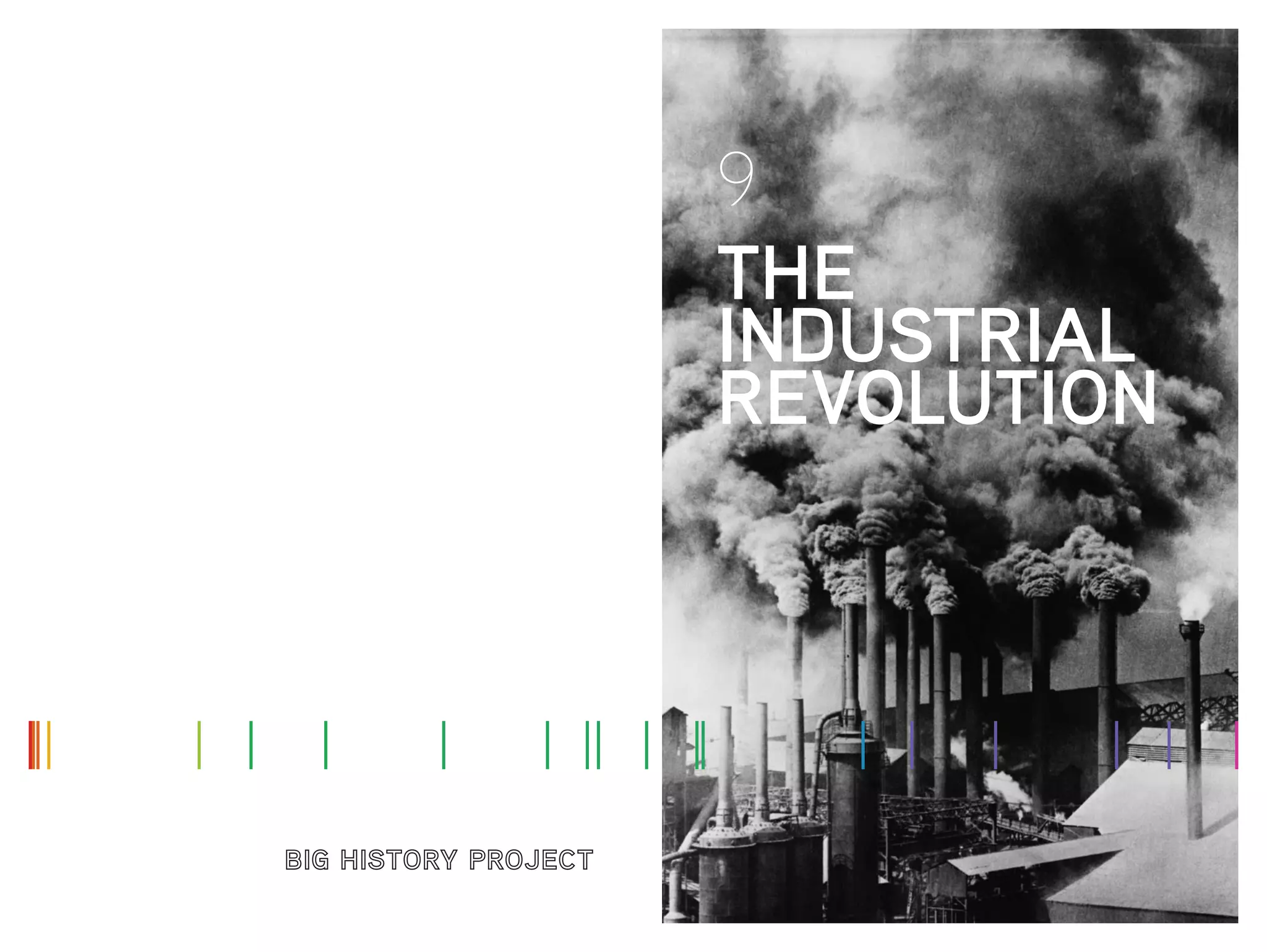
The Industrial Revolution began around 1750 in Great Britain and was powered by abundant fossil fuels like coal. James Watt's improvements to the steam engine in 1776 helped pump water out of coal mines and provided power to factories full of machines that could spin cotton and weave cloth more efficiently than manual labor. Britain's early adoption of steam power, infrastructure like railroads and canals, access to resources from colonies, and capitalist economic system allowed it to become the world's first industrialized nation and spread industrialization techniques globally over the following centuries. The rapid growth driven by fossil fuels increased the world's population tenfold and economic output over 14 times but also caused environmental damage and social disruption.


