z
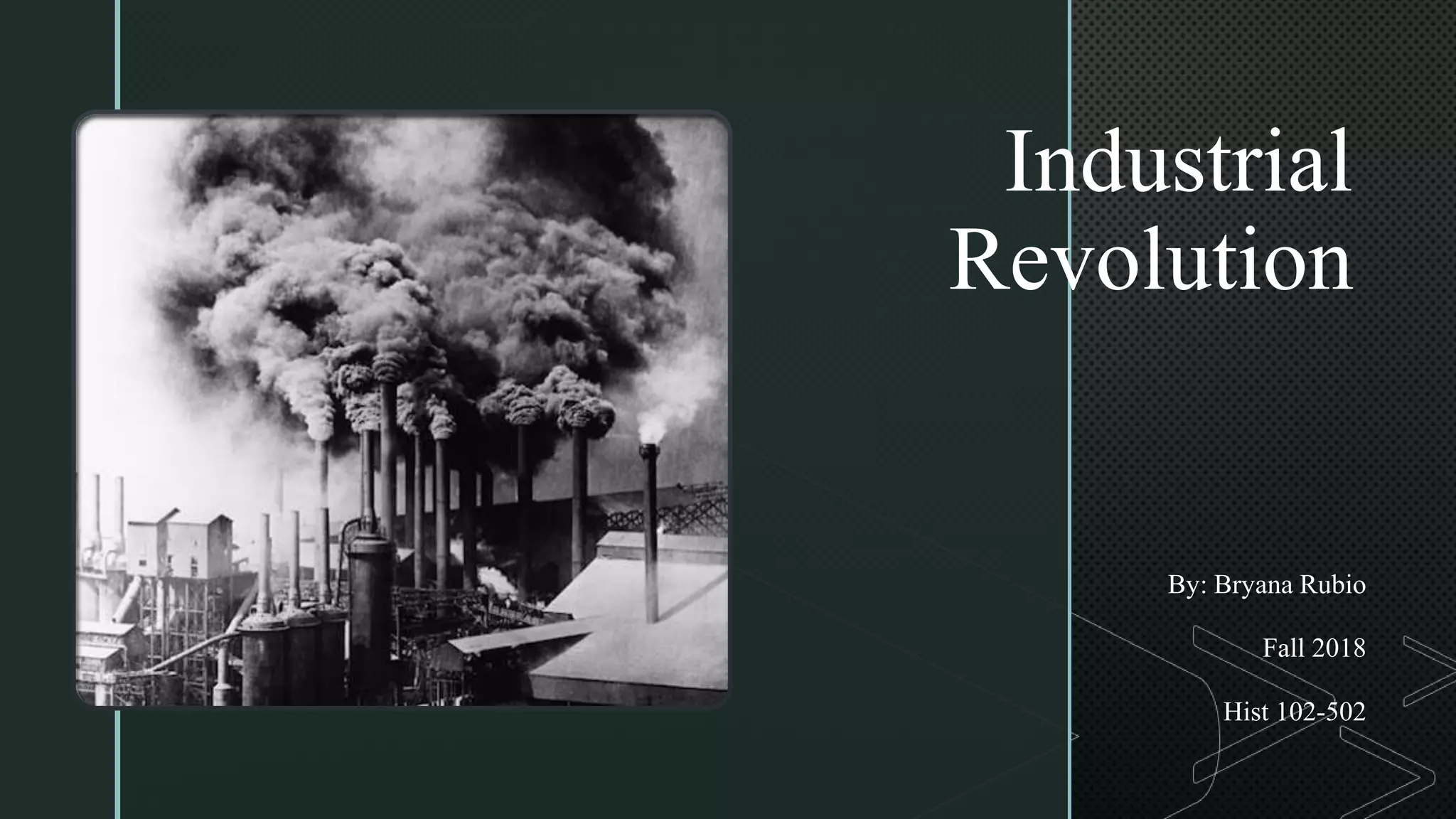
Industrial
Revolution
By: Bryana Rubio
Fall 2018
Hist 102-502
z
Resources
What were the important developments of the Industrial
Revolution and what incentives helped spread and encourage
new technology?
z
 Some important developments of the industrial revolution include many
new inventions and one important one being the steam engine which
helped trains run faster and help transportation grow. The industrial
revolution had a big impact on the environment and on people, and still
affects us today.
 The growth of science was a major importance on what helped technology
spread. New technology was created and this lead to new inventions. New
machinery was brought into factories and mass production shifted
industrialization. With brand new resources and trading goods these
resources were able to spread throughout the world to spread new
technology.
z
The Industrial Revolution
—Author: Green, John
—Link: https://www.khanacademy.org/partner-content/big-history-
project/acceleration/bhp-acceleration/v/bhp-industrial-revolution-
crashcourse
—Summary: This video covers information on how the industrial revolution
created big changes in our future. The increase in production produced a
larger amount of machine use. It also explains important segments on how
Britain was the where the industrial revolution started.
z —Quote: “ You have electricity? Industrial revolution. Blueberries in
February? Industrial revolution. You live somewhere other than a farm?
Industrial revolution. You drive a car? Industrial revolution. You get
twelve years of free, formal education? Industrial revolution. Tour bed,
your antibiotics, your toilet, your contraception's, your tap water, your
every waking and sleeping second: Industrial revolution.”
 —Evaluation of Source: This source is credible because its resources are
credited from textbooks themselves and carry the same information in a
shorter time frame.
z
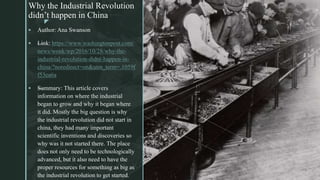
Why the Industrial Revolution
didn’t happen in China
z
 Author: Ana Swanson
 —Link: https://www.washingtonpost.com/
news/wonk/wp/2016/10/28/why-the-
industrial-revolution-didnt-happen-in-
china/?noredirect=on&utm_term=.1059f
f53ea6a
 —Summary: This article covers
information on where the industrial
began to grow and why it began where
it did. Mostly the big question is why
the industrial revolution did not start in
china, they had many important
scientific inventions and discoveries so
why was it not started there. The place
does not only need to be technologically
advanced, but it also need to have the
proper resources for something as big as
the industrial revolution to get started.
z
• Quote: “ Drawing on centuries of philosophy and scientific advancements,
Mokyr argues that there's a reason the Industrial Revolution occurred in
Europe and not, for example, in China, which had in previous centuries
shown signs of more scientific advancement: Europe developed a unique
culture of competitive scientific and intellectual advancement that was
unprecedented and not at all predestined. ”
• —Evaluation of Source: This source is written by a reporter who covers
economy, trade and the Federal Reserve for the Washington post, but it is a
new source, and some can contain bias in their stories.
z
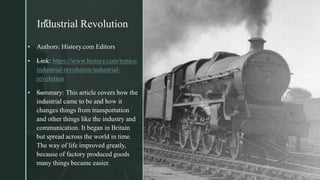
Industrial Revolutionz
 Authors: History.com Editors
 —Link: https://www.history.com/topics/
industrial-revolution/industrial-
revolution
 —Summary: This article covers how the
industrial came to be and how it
changes things from transportation
and other things like the industry and
communication. It began in Britain
but spread across the world in time.
The way of life improved greatly,
because of factory produced goods
many things became easier.
z
• Quote: “ A number of factors contributed to Britain’s role as the
birthplace of the Industrial Revolution. For one, it had great deposits
of coal and iron ore, which proved essential for industrialization.
Additionally, Britain was a politically stable society, as well as the
world’s leading colonial power, which meant its colonies could serve
as a source for raw materials, as well as a marketplace for
manufactured goods. ”
• —Evaluation of Source: This source is credible because it uses
historical knowledge and multiple sources such as books and other
articles are used as well.
z
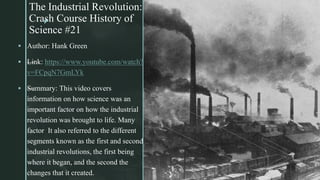
The Industrial Revolution:
Crash Course History of
Science #21
z
 Author: Hank Green
 —Link: https://www.youtube.com/watch?
v=FCpqN7GmLYk
 —Summary: This video covers
information on how science was an
important factor on how the industrial
revolution was brought to life. Many
factor It also referred to the different
segments known as the first and second
industrial revolutions, the first being
where it began, and the second the
changes that it created.
z
Quote: “ Factories appeared, creating new goods, new classes of
owners, and laborers, and new environmental problems. ”
Evaluation of Source: This source is credible because its resources
are credited from a textbook, the information on a textbook are
sources written by experts.
z
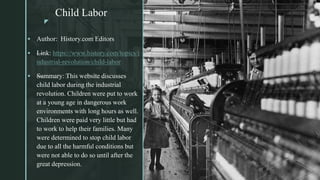
Child Labor
z
 Author: History.com Editors
 —Link: https://www.history.com/topics/i
ndustrial-revolution/child-labor
 —Summary: This website discusses
child labor during the industrial
revolution. Children were put to work
at a young age in dangerous work
environments with long hours as well.
Children were paid very little but had
to work to help their families. Many
were determined to stop child labor
due to all the harmful conditions but
were not able to do so until after the
great depression.
z Quote: “The minimal role of child labor in the United States today is one of
the more remarkable changes in the social and economic life of the nation
over the last two centuries. In colonial America, child labor was not a
subject of controversy. It was an integral part of the agricultural and
handicraft economy. ”
 —Evaluation of Source: This source is credible because their source was a
book called "Crusade for the Children: A History of the National Child
Labor Committee and Child Labor Reform in America." This was published
in the 1970's by Trattner Walter who was an associate professor and is a
member of the American History Association.
zThe Most Important Inventions of the Industrial Revolution
 Author: Martin Kelly
 —Link: https://www.thoughtco.com/industrial-revolution-inventors-
chart-4059637
 —Summary: This article describes the inventions that were made, with
new science and technology there were many new ideas. The main
topics it covers are the inventions created for transportation,
communication, and new machines for the industry. It also has listed
many of the inventions during the industrial revolution and the dates
they were created as well as who invented them.
z
 Quote: “The American Industrial Revolution began after the civil war
as the U.S. rebuilt its infrastructure. New forms of transportation such
as the steamboat and the railroad helped the nation expand trade.
Meanwhile, innovations such as the modern assembly line and electric
lightbulb revolutionized both business and personal life.”
 —Evaluation of Source: This is a credible source because the author is a
teacher who has wrote two other publication on history and developed
an Advance Placement American history course.
z The Workshop of the World
 Author: Professor Pat Hudson
 —Link: http://www.bbc.co.uk/history/british/victorians/workshop_of_
the_world_01.shtml
 —Summary: This article described how Britain was in charge for
most of the trade goods and other manufactured items were
originated there and how this changed the economy. Britain
had created a mass market. Their economy kept growing with the
new production of technology.
z Quote: “ An unprecedented range and variety of products thus came
within the grasp of a new mass market both within Britain and
overseas. No other country could at first compete, so Britain became
the workshop of the world. ”
 —Evaluation of Source: This source is credible because the author,
Pat Hudson is Professor of History at Cardiff University and is a
specialist in cultural information. She has also written a book called
'The Industrial Revolution (London, 1992)'.
z
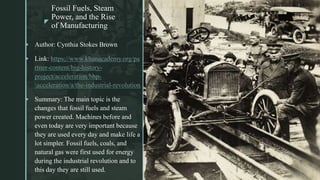
Fossil Fuels, Steam
Power, and the Rise
of Manufacturing
z
 Author: Cynthia Stokes Brown
 Link: https://www.khanacademy.org/pa
rtner-content/big-history-
project/acceleration/bhp-
acceleration/a/the-industrial-revolution
 Summary: The main topic is the
changes that fossil fuels and steam
power created. Machines before and
even today are very important because
they are used every day and make life a
lot simpler. Fossil fuels, coals, and
natural gas were first used for energy
during the industrial revolution and to
this day they are still used.
z Quote: “People found an extra source of energy with an incredible
capacity for work. That source was fossil fuels — coal, oil, and natural
gas, though coal led the way — formed underground from the remains
of plants and animals from much earlier geologic times. When these
fuels were burned, they released energy, originally from the Sun, that
had been stored for hundreds of millions of years. ”
 —Evaluation of Source: This source is credible because it was written
by a well-known historian who has written a couple of books including
"Big History" which was credited the American Book Award.
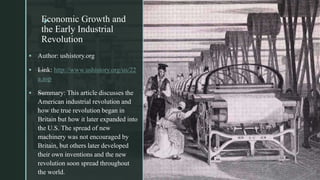
zEconomic Growth and
the Early Industrial
Revolution
z
 Author: ushistory.org
 —Link: http://www.ushistory.org/us/22
a.asp
 —Summary: This article discusses the
American industrial revolution and
how the true revolution began in
Britain but how it later expanded into
the U.S. The spread of new
machinery was not encouraged by
Britain, but others later developed
their own inventions and the new
revolution soon spread throughout
the world.
z
 Quote: “ However, the chief organizational breakthrough of the
Industrial Revolution was the "factory system" where work was
performed on a large scale in a single centralized location ”
 —Evaluation of Source: This source is credible because it uses
textbooks that cover U.S. History. This website is also run by the
organization called The Independence Hall Association (IHA) that
run this source to helped people get informed on history.
z Conclusion
 In conclusion the industrial revolution made a major impact and affects us till this very
day.
 New machinery brought faster transportation with a new rail system and a new
communication system called the telegraph.
 James Watt's invention of the steam engine(1775) was first used to pump water out of
coal mines but later was redesigned to burn coal and produce steam for fuel.
 New sources of fossil fuels were discovered like coal, oil, and natural gas. They were
retrieved from underground and were burned to release energy.
 The Industrial revolution was spread using science and available resources. People did
not only want to expand their ideas, but they also wanted to Improve their way of life.
z Work Cited
• Green, John. “Crash Course World History: The Industrial Revolution.” Khan Academy,
Khan Academy, 2012, www.khanacademy.org/partner-content/big-history-
project/acceleration/bhp-acceleration/v/bhp-industrial-revolution-crashcourse.
• Swanson, Ana. “Why the Industrial Revolution Didn't Happen in China.” The
Washington Post, WP Company, 28 Oct. 2016,
www.washingtonpost.com/news/wonk/wp/2016/10/28/why-the-industrial-revolution-
didnt-happen-in-china/?noredirect=on&utm_term=.1059ff53ea6a.
• History.com Editors. “Industrial Revolution .” History.com, A&E Television Networks,
2009, www.history.com/topics/industrial-revolution/industrial-revolution.
• Green, Hank. “The Industrial Revolution: Crash Course History of Science #21.”
YouTube, YouTube, 25 Sept. 2018, www.youtube.com/watch?v=FCpqN7GmLYk.
z History.com Editors. “Child Labor .” History.com, A&E Television Networks, 2009,
www.history.com/topics/industrial-revolution/child-labor.
 Kelly, Martin. “The Most Important Inventions of the Industrial Revolution.”
Thoughtco., Dotdash, 2018, www.thoughtco.com/industrial-revolution-inventors-
chart-4059637.
 Hudson, Professor Pat. “History - The Workshop of the World.” BBC, BBC, 29 Mar.
2011, www.bbc.co.uk/history/british/victorians/workshop_of_the_world_01.shtml.
 Brown, Cynthia Stokes. “The Industrial Revolution.” Khan Academy, Khan
Academy, www.khanacademy.org/partner-content/big-history-
project/acceleration/bhp-acceleration/a/the-industrial-revolution.
 ushistory.org. “Economic Growth and the Early Industrial Revolution.”
Ushistory.org, Independence Hall Association, www.ushistory.org/us/22a.asp.

History2018.project

  • 1.
  • 2.
    z Resources What were theimportant developments of the Industrial Revolution and what incentives helped spread and encourage new technology? z  Some important developments of the industrial revolution include many new inventions and one important one being the steam engine which helped trains run faster and help transportation grow. The industrial revolution had a big impact on the environment and on people, and still affects us today.  The growth of science was a major importance on what helped technology spread. New technology was created and this lead to new inventions. New machinery was brought into factories and mass production shifted industrialization. With brand new resources and trading goods these resources were able to spread throughout the world to spread new technology.
  • 3.
    z The Industrial Revolution —Author:Green, John —Link: https://www.khanacademy.org/partner-content/big-history- project/acceleration/bhp-acceleration/v/bhp-industrial-revolution- crashcourse —Summary: This video covers information on how the industrial revolution created big changes in our future. The increase in production produced a larger amount of machine use. It also explains important segments on how Britain was the where the industrial revolution started.
  • 4.
    z —Quote: “You have electricity? Industrial revolution. Blueberries in February? Industrial revolution. You live somewhere other than a farm? Industrial revolution. You drive a car? Industrial revolution. You get twelve years of free, formal education? Industrial revolution. Tour bed, your antibiotics, your toilet, your contraception's, your tap water, your every waking and sleeping second: Industrial revolution.”  —Evaluation of Source: This source is credible because its resources are credited from textbooks themselves and carry the same information in a shorter time frame.
  • 5.
    z Why the IndustrialRevolution didn’t happen in China z  Author: Ana Swanson  —Link: https://www.washingtonpost.com/ news/wonk/wp/2016/10/28/why-the- industrial-revolution-didnt-happen-in- china/?noredirect=on&utm_term=.1059f f53ea6a  —Summary: This article covers information on where the industrial began to grow and why it began where it did. Mostly the big question is why the industrial revolution did not start in china, they had many important scientific inventions and discoveries so why was it not started there. The place does not only need to be technologically advanced, but it also need to have the proper resources for something as big as the industrial revolution to get started.
  • 6.
    z • Quote: “Drawing on centuries of philosophy and scientific advancements, Mokyr argues that there's a reason the Industrial Revolution occurred in Europe and not, for example, in China, which had in previous centuries shown signs of more scientific advancement: Europe developed a unique culture of competitive scientific and intellectual advancement that was unprecedented and not at all predestined. ” • —Evaluation of Source: This source is written by a reporter who covers economy, trade and the Federal Reserve for the Washington post, but it is a new source, and some can contain bias in their stories.
  • 7.
    z Industrial Revolutionz  Authors:History.com Editors  —Link: https://www.history.com/topics/ industrial-revolution/industrial- revolution  —Summary: This article covers how the industrial came to be and how it changes things from transportation and other things like the industry and communication. It began in Britain but spread across the world in time. The way of life improved greatly, because of factory produced goods many things became easier.
  • 8.
    z • Quote: “A number of factors contributed to Britain’s role as the birthplace of the Industrial Revolution. For one, it had great deposits of coal and iron ore, which proved essential for industrialization. Additionally, Britain was a politically stable society, as well as the world’s leading colonial power, which meant its colonies could serve as a source for raw materials, as well as a marketplace for manufactured goods. ” • —Evaluation of Source: This source is credible because it uses historical knowledge and multiple sources such as books and other articles are used as well.
  • 9.
    z The Industrial Revolution: CrashCourse History of Science #21 z  Author: Hank Green  —Link: https://www.youtube.com/watch? v=FCpqN7GmLYk  —Summary: This video covers information on how science was an important factor on how the industrial revolution was brought to life. Many factor It also referred to the different segments known as the first and second industrial revolutions, the first being where it began, and the second the changes that it created.
  • 10.
    z Quote: “ Factoriesappeared, creating new goods, new classes of owners, and laborers, and new environmental problems. ” Evaluation of Source: This source is credible because its resources are credited from a textbook, the information on a textbook are sources written by experts.
  • 11.
    z Child Labor z  Author:History.com Editors  —Link: https://www.history.com/topics/i ndustrial-revolution/child-labor  —Summary: This website discusses child labor during the industrial revolution. Children were put to work at a young age in dangerous work environments with long hours as well. Children were paid very little but had to work to help their families. Many were determined to stop child labor due to all the harmful conditions but were not able to do so until after the great depression.
  • 12.
    z Quote: “Theminimal role of child labor in the United States today is one of the more remarkable changes in the social and economic life of the nation over the last two centuries. In colonial America, child labor was not a subject of controversy. It was an integral part of the agricultural and handicraft economy. ”  —Evaluation of Source: This source is credible because their source was a book called "Crusade for the Children: A History of the National Child Labor Committee and Child Labor Reform in America." This was published in the 1970's by Trattner Walter who was an associate professor and is a member of the American History Association.
  • 13.
    zThe Most ImportantInventions of the Industrial Revolution  Author: Martin Kelly  —Link: https://www.thoughtco.com/industrial-revolution-inventors- chart-4059637  —Summary: This article describes the inventions that were made, with new science and technology there were many new ideas. The main topics it covers are the inventions created for transportation, communication, and new machines for the industry. It also has listed many of the inventions during the industrial revolution and the dates they were created as well as who invented them.
  • 14.
    z  Quote: “TheAmerican Industrial Revolution began after the civil war as the U.S. rebuilt its infrastructure. New forms of transportation such as the steamboat and the railroad helped the nation expand trade. Meanwhile, innovations such as the modern assembly line and electric lightbulb revolutionized both business and personal life.”  —Evaluation of Source: This is a credible source because the author is a teacher who has wrote two other publication on history and developed an Advance Placement American history course.
  • 15.
    z The Workshopof the World  Author: Professor Pat Hudson  —Link: http://www.bbc.co.uk/history/british/victorians/workshop_of_ the_world_01.shtml  —Summary: This article described how Britain was in charge for most of the trade goods and other manufactured items were originated there and how this changed the economy. Britain had created a mass market. Their economy kept growing with the new production of technology.
  • 16.
    z Quote: “An unprecedented range and variety of products thus came within the grasp of a new mass market both within Britain and overseas. No other country could at first compete, so Britain became the workshop of the world. ”  —Evaluation of Source: This source is credible because the author, Pat Hudson is Professor of History at Cardiff University and is a specialist in cultural information. She has also written a book called 'The Industrial Revolution (London, 1992)'.
  • 17.
    z Fossil Fuels, Steam Power,and the Rise of Manufacturing z  Author: Cynthia Stokes Brown  Link: https://www.khanacademy.org/pa rtner-content/big-history- project/acceleration/bhp- acceleration/a/the-industrial-revolution  Summary: The main topic is the changes that fossil fuels and steam power created. Machines before and even today are very important because they are used every day and make life a lot simpler. Fossil fuels, coals, and natural gas were first used for energy during the industrial revolution and to this day they are still used.
  • 18.
    z Quote: “Peoplefound an extra source of energy with an incredible capacity for work. That source was fossil fuels — coal, oil, and natural gas, though coal led the way — formed underground from the remains of plants and animals from much earlier geologic times. When these fuels were burned, they released energy, originally from the Sun, that had been stored for hundreds of millions of years. ”  —Evaluation of Source: This source is credible because it was written by a well-known historian who has written a couple of books including "Big History" which was credited the American Book Award.
  • 19.
    zEconomic Growth and theEarly Industrial Revolution z  Author: ushistory.org  —Link: http://www.ushistory.org/us/22 a.asp  —Summary: This article discusses the American industrial revolution and how the true revolution began in Britain but how it later expanded into the U.S. The spread of new machinery was not encouraged by Britain, but others later developed their own inventions and the new revolution soon spread throughout the world.
  • 20.
    z  Quote: “However, the chief organizational breakthrough of the Industrial Revolution was the "factory system" where work was performed on a large scale in a single centralized location ”  —Evaluation of Source: This source is credible because it uses textbooks that cover U.S. History. This website is also run by the organization called The Independence Hall Association (IHA) that run this source to helped people get informed on history.
  • 21.
    z Conclusion  Inconclusion the industrial revolution made a major impact and affects us till this very day.  New machinery brought faster transportation with a new rail system and a new communication system called the telegraph.  James Watt's invention of the steam engine(1775) was first used to pump water out of coal mines but later was redesigned to burn coal and produce steam for fuel.  New sources of fossil fuels were discovered like coal, oil, and natural gas. They were retrieved from underground and were burned to release energy.  The Industrial revolution was spread using science and available resources. People did not only want to expand their ideas, but they also wanted to Improve their way of life.
  • 22.
    z Work Cited •Green, John. “Crash Course World History: The Industrial Revolution.” Khan Academy, Khan Academy, 2012, www.khanacademy.org/partner-content/big-history- project/acceleration/bhp-acceleration/v/bhp-industrial-revolution-crashcourse. • Swanson, Ana. “Why the Industrial Revolution Didn't Happen in China.” The Washington Post, WP Company, 28 Oct. 2016, www.washingtonpost.com/news/wonk/wp/2016/10/28/why-the-industrial-revolution- didnt-happen-in-china/?noredirect=on&utm_term=.1059ff53ea6a. • History.com Editors. “Industrial Revolution .” History.com, A&E Television Networks, 2009, www.history.com/topics/industrial-revolution/industrial-revolution. • Green, Hank. “The Industrial Revolution: Crash Course History of Science #21.” YouTube, YouTube, 25 Sept. 2018, www.youtube.com/watch?v=FCpqN7GmLYk.
  • 23.
    z History.com Editors.“Child Labor .” History.com, A&E Television Networks, 2009, www.history.com/topics/industrial-revolution/child-labor.  Kelly, Martin. “The Most Important Inventions of the Industrial Revolution.” Thoughtco., Dotdash, 2018, www.thoughtco.com/industrial-revolution-inventors- chart-4059637.  Hudson, Professor Pat. “History - The Workshop of the World.” BBC, BBC, 29 Mar. 2011, www.bbc.co.uk/history/british/victorians/workshop_of_the_world_01.shtml.  Brown, Cynthia Stokes. “The Industrial Revolution.” Khan Academy, Khan Academy, www.khanacademy.org/partner-content/big-history- project/acceleration/bhp-acceleration/a/the-industrial-revolution.  ushistory.org. “Economic Growth and the Early Industrial Revolution.” Ushistory.org, Independence Hall Association, www.ushistory.org/us/22a.asp.