





INDUSTRIAL REVOLUTION
ACKNOWLEDGEMENT 
FIRST I THANK GOD. 
I THANK MY SOCIAL TEACHER TO GIVE 
ME PPT PRESENTATION ON INDUSTRIAL 
REVOLUTION.
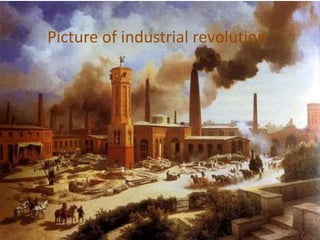
Picture of industrial revolution
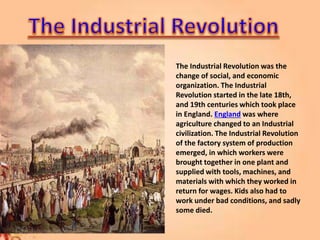
The Industrial Revolution was the 
change of social, and economic 
organization. The Industrial 
Revolution started in the late 18th, 
and 19th centuries which took place 
in England. England was where 
agriculture changed to an Industrial 
civilization. The Industrial Revolution 
of the factory system of production 
emerged, in which workers were 
brought together in one plant and 
supplied with tools, machines, and 
materials with which they worked in 
return for wages. Kids also had to 
work under bad conditions, and sadly 
some died.
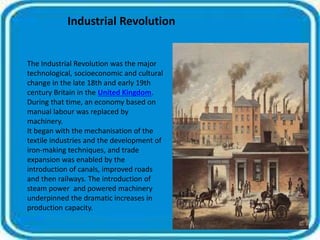
Industrial Revolution 
The Industrial Revolution was the major 
technological, socioeconomic and cultural 
change in the late 18th and early 19th 
century Britain in the United Kingdom. 
During that time, an economy based on 
manual labour was replaced by 
machinery. 
It began with the mechanisation of the 
textile industries and the development of 
iron-making techniques, and trade 
expansion was enabled by the 
introduction of canals, improved roads 
and then railways. The introduction of 
steam power and powered machinery 
underpinned the dramatic increases in 
production capacity.
The Industrial Revolution 
1.Machines were invented which replaced 
human labour 
2.New energy sources were developed to 
power the new machinery – water, steam, 
electricity, oil (gas, kerosene) 
3.Some historians place advances in 
atomic, solar, and wind energy at the later 
stages of the Industrial Revolution 
4.Increased use of metals and minerals 
such as aluminum, coal, copper, iron, etc.
England: Birthplace of the Industrial 
Revolution 
1.No concrete start date for the Industrial 
Revolution 
2.Marked by gradual, slow changes 
3.After 1750 – these changes were noticeable 
first in England
What was the Industrial Revolution? 
1.The Industrial Revolution was a 
fundamental change in the way goods 
were produced, from human labor to 
machines. 
2.The more efficient means of production 
and subsequent higher levels of 
production triggered far-reaching 
changes to industrialized societies.
Improvements of Industrial Revolution 
 Transportation improved 
 Ships 
○ Wooden ships → Iron ships → Steel ships 
○ Wind-powered sails → Steam-powered boilers 
 Trains 
 Automobiles 
 Communication improved 
 Telegraph 
 Telephone 
 Radio
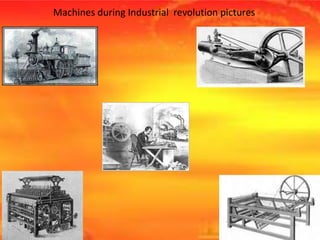
Machines during Industrial revolution pictures
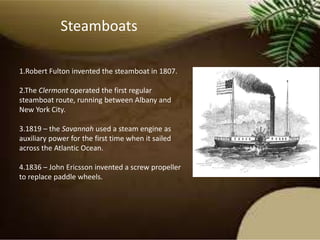
Steamboats 
1.Robert Fulton invented the steamboat in 1807. 
2.The Clermont operated the first regular 
steamboat route, running between Albany and 
New York City. 
3.1819 – the Savannah used a steam engine as 
auxiliary power for the first time when it sailed 
across the Atlantic Ocean. 
4.1836 – John Ericsson invented a screw propeller 
to replace paddle wheels.
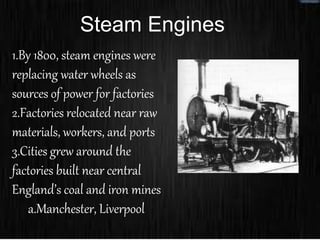
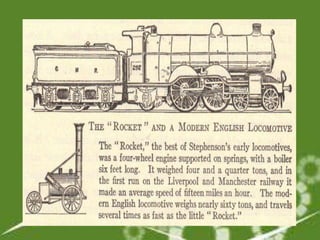
Steam Engines 
1.By 1800, steam engines were 
replacing water wheels as 
sources of power for factories 
2.Factories relocated near raw 
materials, workers, and ports 
3.Cities grew around the 
factories built near central 
England’s coal and iron mines 
a.Manchester, Liverpool
Development of Steam Engines 
1.Early water power involved mills built over fast-moving 
streams and rivers 
2.Early water power had problems 
A. Not enough rivers to provide the power 
needed to meet growing demand 
B. Rivers and streams might be far removed from 
raw materials, workers, and markets 
C. Rivers are prone to flooding and drying
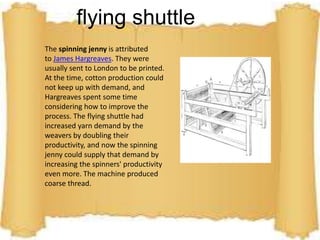
flying shuttle 
The spinning jenny is attributed 
to James Hargreaves. They were 
usually sent to London to be printed. 
At the time, cotton production could 
not keep up with demand, and 
Hargreaves spent some time 
considering how to improve the 
process. The flying shuttle had 
increased yarn demand by the 
weavers by doubling their 
productivity, and now the spinning 
jenny could supply that demand by 
increasing the spinners' productivity 
even more. The machine produced 
coarse thread.
Increases in Coal and Iron Production, 1770-1800 
1.Coal production doubled 
6 million to 12 million tons. 
2.Pig iron production increased 
250% 
1800 – 130,000 tons. 
3.Great Britain produced as much 
coal and iron as every other 
country combined.
Political Changes: 
Rise to Power of Businesspeople 
Along with the working classes, 
businesspeople gained political rights 
“Captains of industry” or “robber barons” – 
along with financiers 
Wealth brought political influence
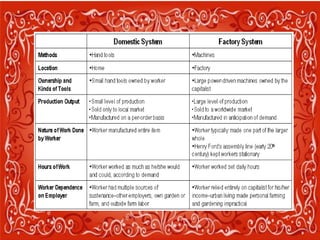
Development of the Domestic System 
of Production 
1.Domestic system developed in England 
2.Late 1600s-late 1800s 
3.Domestic system of production – “putting out” system 
A .Businesspeople delivered raw materials to workers’ homes 
B .Workers manufactured goods from these raw materials in their 
homes (typically articles of clothing) 
C .Businesspeople picked up finished goods and paid workers 
wages based on number of items 
4.Domestic system could not keep up with demand
England’s Resources: Raw Materials 
1.England itself possessed the necessary raw 
materials to create the means of production 
2.Coal – vast coal reserves powered steam 
engines 
3.Iron – basic building block of large 
machines, railroad tracks, trains, and ships
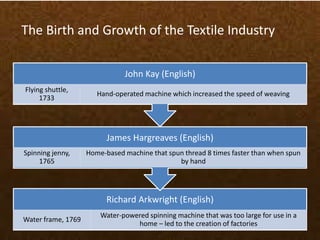
The Birth and Growth of the Textile Industry 
John Kay (English) 
James Hargreaves (English) 
Richard Arkwright (English) 
Water frame, 1769 
Water-powered spinning machine that was too large for use in a 
home – led to the creation of factories 
Spinning jenny, 
1765 
Home-based machine that spun thread 8 times faster than when spun 
by hand 
Flying shuttle, 
1733 
Hand-operated machine which increased the speed of weaving
Background of the Industrial Revolution 
Commercial Revolution 
A. 15th, 16th, and 17th centuries 
B. Europeans expanded their power worldwide 
C. Increased geographic knowledge 
D. Colonies in the Americas and Asia 
E. Increased trade and commerce 
F. Guild system could not meet the demands of 
increasing numbers goods
England’s Resources: Workers 
1.Serfdom and guilds ended earlier in 
England than other countries 
2.English people could freely travel 
from the countryside to the cities 
3.Enclosure Acts – caused many small 
farmers to lose their lands, and these 
former farmers increased the labor 
supply
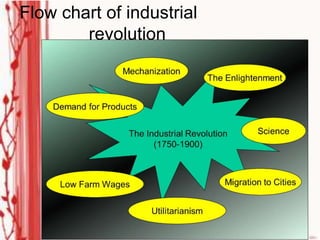
Flow chart of industrial 
revolution
Result if industrial revolution 
Economic changes: (i)Expansion of world trade, (ii) Mass production of goods 
(iii)Unemployment (iv) Industrial capitalism 
Political changes:(i) Decline of world aristocracy,(ii)Growth and expansion of 
democracy ,(iii)Increased power of industrialized nation,(iv)Rise to power 
business people 
Social changes:(i) Increase in leisure time,(ii) Population increased,(iii) Science 
and Research stimulated,(iv) Problems
Thank you 
The end
PRESENTED 
BY 
S.SWASHIKHA 
X STD

Industrial revolution

  • 2.
  • 3.
    ACKNOWLEDGEMENT FIRST ITHANK GOD. I THANK MY SOCIAL TEACHER TO GIVE ME PPT PRESENTATION ON INDUSTRIAL REVOLUTION.
  • 4.
  • 6.
    The Industrial Revolutionwas the change of social, and economic organization. The Industrial Revolution started in the late 18th, and 19th centuries which took place in England. England was where agriculture changed to an Industrial civilization. The Industrial Revolution of the factory system of production emerged, in which workers were brought together in one plant and supplied with tools, machines, and materials with which they worked in return for wages. Kids also had to work under bad conditions, and sadly some died.
  • 7.
    Industrial Revolution TheIndustrial Revolution was the major technological, socioeconomic and cultural change in the late 18th and early 19th century Britain in the United Kingdom. During that time, an economy based on manual labour was replaced by machinery. It began with the mechanisation of the textile industries and the development of iron-making techniques, and trade expansion was enabled by the introduction of canals, improved roads and then railways. The introduction of steam power and powered machinery underpinned the dramatic increases in production capacity.
  • 8.
    The Industrial Revolution 1.Machines were invented which replaced human labour 2.New energy sources were developed to power the new machinery – water, steam, electricity, oil (gas, kerosene) 3.Some historians place advances in atomic, solar, and wind energy at the later stages of the Industrial Revolution 4.Increased use of metals and minerals such as aluminum, coal, copper, iron, etc.
  • 9.
    England: Birthplace ofthe Industrial Revolution 1.No concrete start date for the Industrial Revolution 2.Marked by gradual, slow changes 3.After 1750 – these changes were noticeable first in England
  • 10.
    What was theIndustrial Revolution? 1.The Industrial Revolution was a fundamental change in the way goods were produced, from human labor to machines. 2.The more efficient means of production and subsequent higher levels of production triggered far-reaching changes to industrialized societies.
  • 12.
    Improvements of IndustrialRevolution  Transportation improved  Ships ○ Wooden ships → Iron ships → Steel ships ○ Wind-powered sails → Steam-powered boilers  Trains  Automobiles  Communication improved  Telegraph  Telephone  Radio
  • 13.
    Machines during Industrialrevolution pictures
  • 14.
    Steamboats 1.Robert Fultoninvented the steamboat in 1807. 2.The Clermont operated the first regular steamboat route, running between Albany and New York City. 3.1819 – the Savannah used a steam engine as auxiliary power for the first time when it sailed across the Atlantic Ocean. 4.1836 – John Ericsson invented a screw propeller to replace paddle wheels.
  • 15.
    Steam Engines 1.By1800, steam engines were replacing water wheels as sources of power for factories 2.Factories relocated near raw materials, workers, and ports 3.Cities grew around the factories built near central England’s coal and iron mines a.Manchester, Liverpool
  • 16.
    Development of SteamEngines 1.Early water power involved mills built over fast-moving streams and rivers 2.Early water power had problems A. Not enough rivers to provide the power needed to meet growing demand B. Rivers and streams might be far removed from raw materials, workers, and markets C. Rivers are prone to flooding and drying
  • 17.
    flying shuttle Thespinning jenny is attributed to James Hargreaves. They were usually sent to London to be printed. At the time, cotton production could not keep up with demand, and Hargreaves spent some time considering how to improve the process. The flying shuttle had increased yarn demand by the weavers by doubling their productivity, and now the spinning jenny could supply that demand by increasing the spinners' productivity even more. The machine produced coarse thread.
  • 19.
    Increases in Coaland Iron Production, 1770-1800 1.Coal production doubled 6 million to 12 million tons. 2.Pig iron production increased 250% 1800 – 130,000 tons. 3.Great Britain produced as much coal and iron as every other country combined.
  • 20.
    Political Changes: Riseto Power of Businesspeople Along with the working classes, businesspeople gained political rights “Captains of industry” or “robber barons” – along with financiers Wealth brought political influence
  • 21.
    Development of theDomestic System of Production 1.Domestic system developed in England 2.Late 1600s-late 1800s 3.Domestic system of production – “putting out” system A .Businesspeople delivered raw materials to workers’ homes B .Workers manufactured goods from these raw materials in their homes (typically articles of clothing) C .Businesspeople picked up finished goods and paid workers wages based on number of items 4.Domestic system could not keep up with demand
  • 23.
    England’s Resources: RawMaterials 1.England itself possessed the necessary raw materials to create the means of production 2.Coal – vast coal reserves powered steam engines 3.Iron – basic building block of large machines, railroad tracks, trains, and ships
  • 24.
    The Birth andGrowth of the Textile Industry John Kay (English) James Hargreaves (English) Richard Arkwright (English) Water frame, 1769 Water-powered spinning machine that was too large for use in a home – led to the creation of factories Spinning jenny, 1765 Home-based machine that spun thread 8 times faster than when spun by hand Flying shuttle, 1733 Hand-operated machine which increased the speed of weaving
  • 25.
    Background of theIndustrial Revolution Commercial Revolution A. 15th, 16th, and 17th centuries B. Europeans expanded their power worldwide C. Increased geographic knowledge D. Colonies in the Americas and Asia E. Increased trade and commerce F. Guild system could not meet the demands of increasing numbers goods
  • 26.
    England’s Resources: Workers 1.Serfdom and guilds ended earlier in England than other countries 2.English people could freely travel from the countryside to the cities 3.Enclosure Acts – caused many small farmers to lose their lands, and these former farmers increased the labor supply
  • 27.
    Flow chart ofindustrial revolution
  • 28.
    Result if industrialrevolution Economic changes: (i)Expansion of world trade, (ii) Mass production of goods (iii)Unemployment (iv) Industrial capitalism Political changes:(i) Decline of world aristocracy,(ii)Growth and expansion of democracy ,(iii)Increased power of industrialized nation,(iv)Rise to power business people Social changes:(i) Increase in leisure time,(ii) Population increased,(iii) Science and Research stimulated,(iv) Problems
  • 29.
  • 30.