You can’t get too far in a discussion about the
nation’s electric power sector without running into
the question of costs.
9
COMPARING THE
COSTS OF
RENEWABLE AND
CONVENTIONAL
ENERGY SOURCES
BIG HISTORY PROJECT	 COMPARING THE COSTS OF RENEWABLE AND CONVENTIONAL ENERGY SOURCES	 2
How do renewable sources, such as solar and wind, stack up against fossil
fuels, such as coal and natural gas?
How much will it cost utilities and ratepayers to build—and operate—a new
power plant?
To illustrate how the various energy technologies compare, we’ve created a
set of interactive dashboards that summarize how much it costs to
generate power. The data show that utility-scale solar and wind
installations are now competitive with conventional coal- and gas-fired
power plants. Moreover, wind and solar costs are projected to steeply
decline in the years ahead.
Before delving into the data, it’s worth noting that the number of dollars it
takes to build and operate a power plant is a somewhat narrow definition
of costs. It doesn’t, for example, include what economists call externalities,
such as the cost of air pollution or climate change impacts. With a broader
definition of costs, low-carbon technologies would perform even better
than fossil fuels.
COMPONENTS OF LEVELIZED COST OF ENERGY
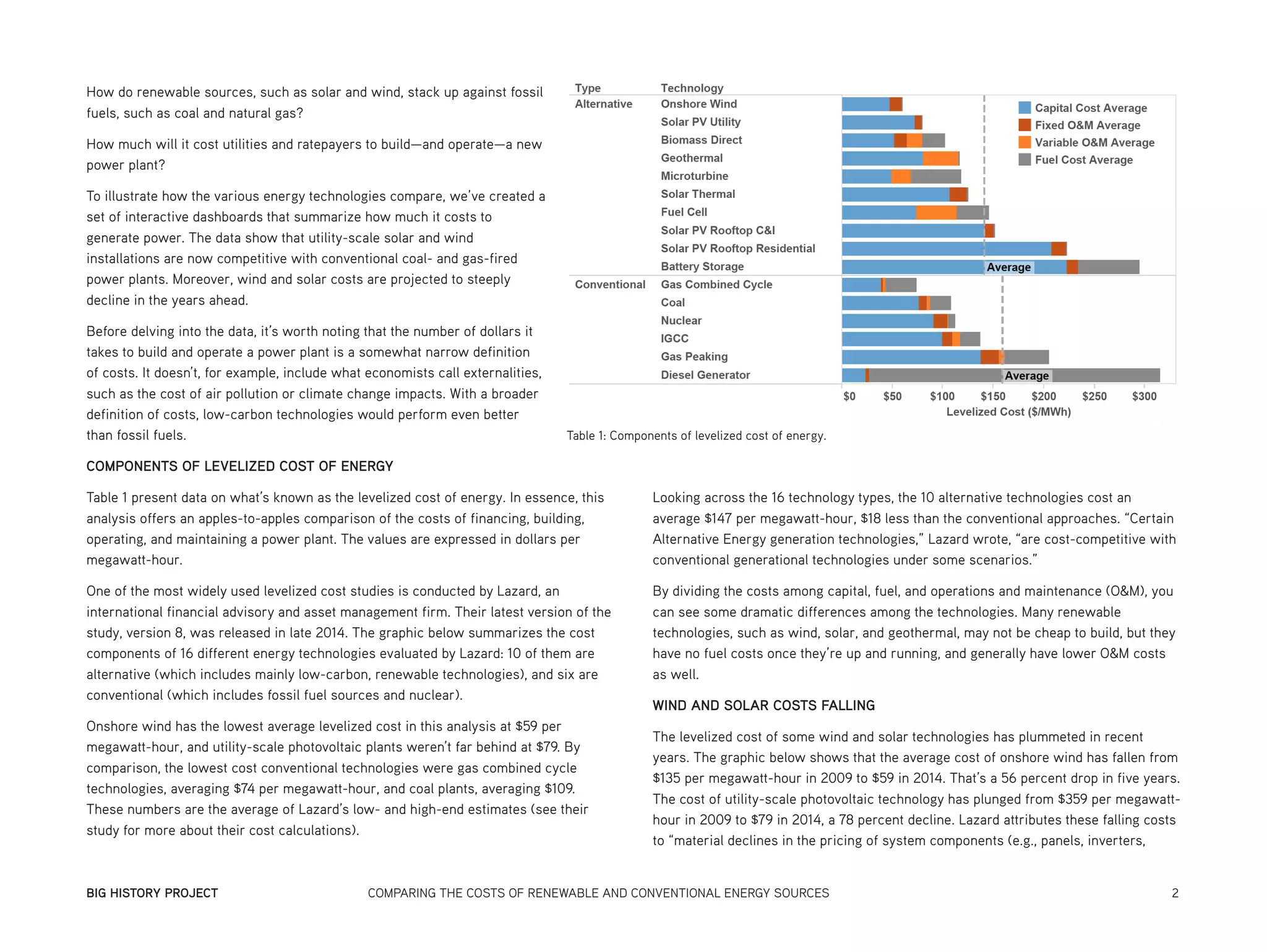
Table 1 present data on what’s known as the levelized cost of energy. In essence, this
analysis offers an apples-to-apples comparison of the costs of financing, building,
operating, and maintaining a power plant. The values are expressed in dollars per
megawatt-hour.
One of the most widely used levelized cost studies is conducted by Lazard, an
international financial advisory and asset management firm. Their latest version of the
study, version 8, was released in late 2014. The graphic below summarizes the cost
components of 16 different energy technologies evaluated by Lazard: 10 of them are
alternative (which includes mainly low-carbon, renewable technologies), and six are
conventional (which includes fossil fuel sources and nuclear).
Onshore wind has the lowest average levelized cost in this analysis at $59 per
megawatt-hour, and utility-scale photovoltaic plants weren’t far behind at $79. By
comparison, the lowest cost conventional technologies were gas combined cycle
technologies, averaging $74 per megawatt-hour, and coal plants, averaging $109.
These numbers are the average of Lazard’s low- and high-end estimates (see their
study for more about their cost calculations).
Looking across the 16 technology types, the 10 alternative technologies cost an
average $147 per megawatt-hour, $18 less than the conventional approaches. “Certain
Alternative Energy generation technologies,” Lazard wrote, “are cost-competitive with
conventional generational technologies under some scenarios.”
By dividing the costs among capital, fuel, and operations and maintenance (O&M), you
can see some dramatic differences among the technologies. Many renewable
technologies, such as wind, solar, and geothermal, may not be cheap to build, but they
have no fuel costs once they’re up and running, and generally have lower O&M costs
as well.
WIND AND SOLAR COSTS FALLING
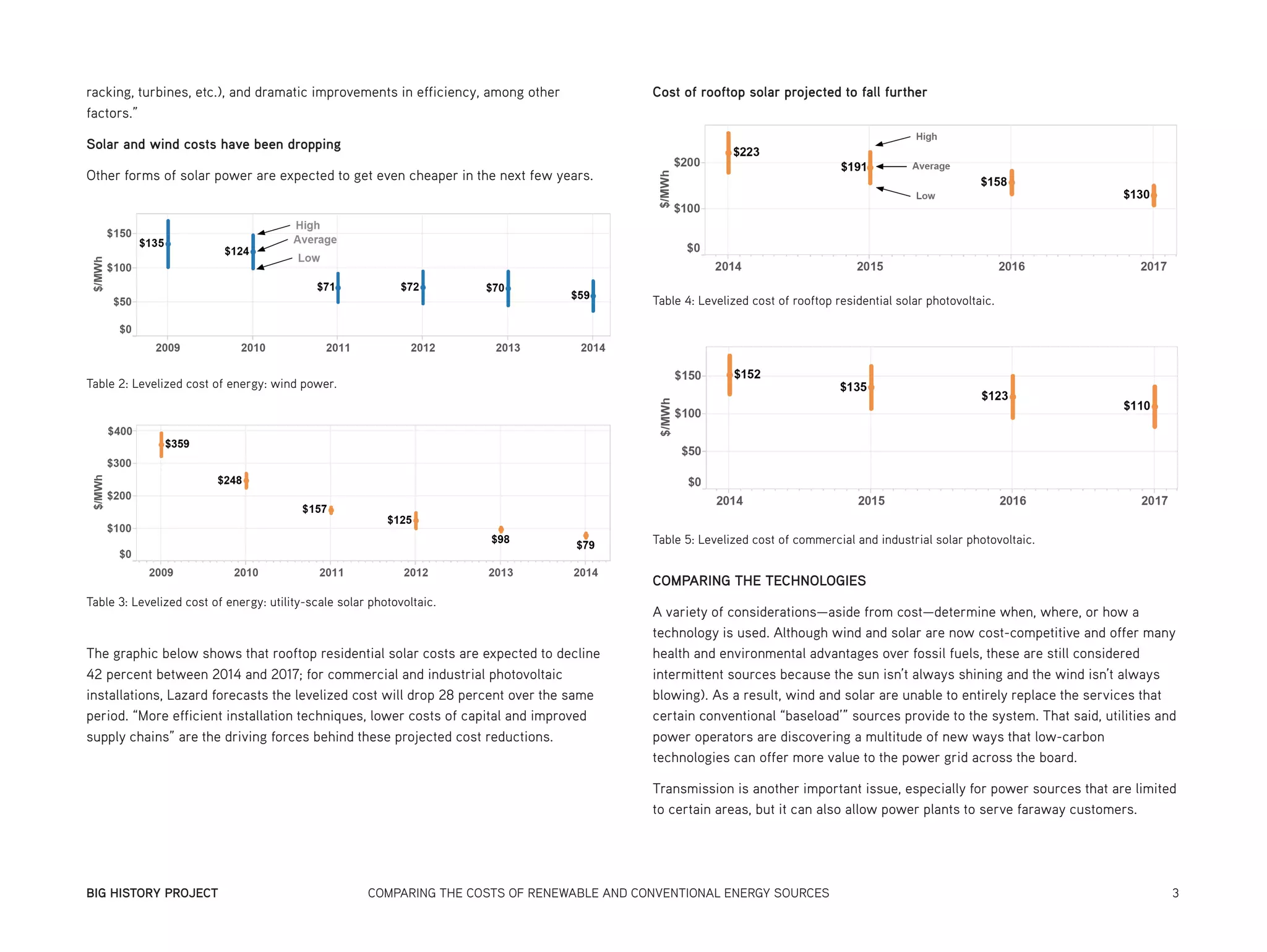
The levelized cost of some wind and solar technologies has plummeted in recent
years. The graphic below shows that the average cost of onshore wind has fallen from
$135 per megawatt-hour in 2009 to $59 in 2014. That’s a 56 percent drop in five years.
The cost of utility-scale photovoltaic technology has plunged from $359 per megawatt-
hour in 2009 to $79 in 2014, a 78 percent decline. Lazard attributes these falling costs
to “material declines in the pricing of system components (e.g., panels, inverters,
Table 1: Components of levelized cost of energy.
BIG HISTORY PROJECT	 COMPARING THE COSTS OF RENEWABLE AND CONVENTIONAL ENERGY SOURCES	 3
racking, turbines, etc.), and dramatic improvements in efficiency, among other
factors.”
Solar and wind costs have been dropping
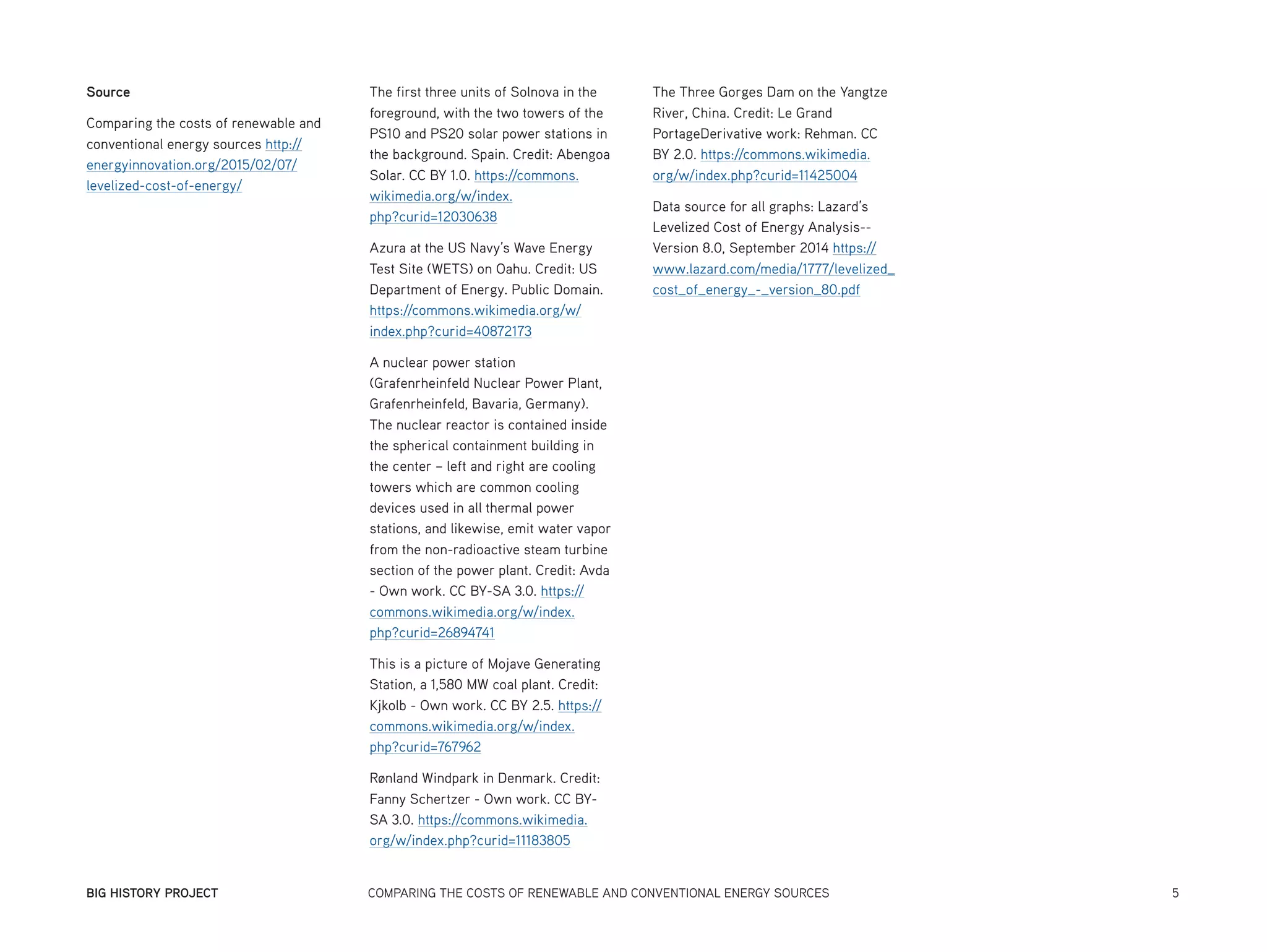
Other forms of solar power are expected to get even cheaper in the next few years.
The graphic below shows that rooftop residential solar costs are expected to decline
42 percent between 2014 and 2017; for commercial and industrial photovoltaic
installations, Lazard forecasts the levelized cost will drop 28 percent over the same
period. “More efficient installation techniques, lower costs of capital and improved
supply chains” are the driving forces behind these projected cost reductions.
Cost of rooftop solar projected to fall further
COMPARING THE TECHNOLOGIES
A variety of considerations—aside from cost—determine when, where, or how a
technology is used. Although wind and solar are now cost-competitive and offer many
health and environmental advantages over fossil fuels, these are still considered
intermittent sources because the sun isn’t always shining and the wind isn’t always
blowing). As a result, wind and solar are unable to entirely replace the services that
certain conventional “baseload’” sources provide to the system. That said, utilities and
power operators are discovering a multitude of new ways that low-carbon
technologies can offer more value to the power grid across the board.
Transmission is another important issue, especially for power sources that are limited
to certain areas, but it can also allow power plants to serve faraway customers.
Table 2: Levelized cost of energy: wind power.
Table 3: Levelized cost of energy: utility-scale solar photovoltaic.
Table 4: Levelized cost of rooftop residential solar photovoltaic.
Table 5: Levelized cost of commercial and industrial solar photovoltaic.
BIG HISTORY PROJECT	 COMPARING THE COSTS OF RENEWABLE AND CONVENTIONAL ENERGY SOURCES	 4
OTHER RESOURCES
There are many other resources on the web for analyzing energy costs:
•	 The U.S. Energy Information Administration’s Annual Energy Outlook 2014
provides a different set of levelized cost figures for a variety of technologies.
•	 The National Renewable Energy Laboratory also offers an online calculator
that lets you plug in variables, such as capital and fuel costs, to generate
LCOE estimates.
•	 The Department of Energy’s OpenEI offers a Transparent Cost Database that
compares the results from dozens of cost studies.
To learn more about Energy Innovation’s work on clean energy, visit our power sector
transformation and smart energy policy pages.
BIG HISTORY PROJECT	 COMPARING THE COSTS OF RENEWABLE AND CONVENTIONAL ENERGY SOURCES	 5
Source
Comparing the costs of renewable and
conventional energy sources http://
energyinnovation.org/2015/02/07/
levelized-cost-of-energy/
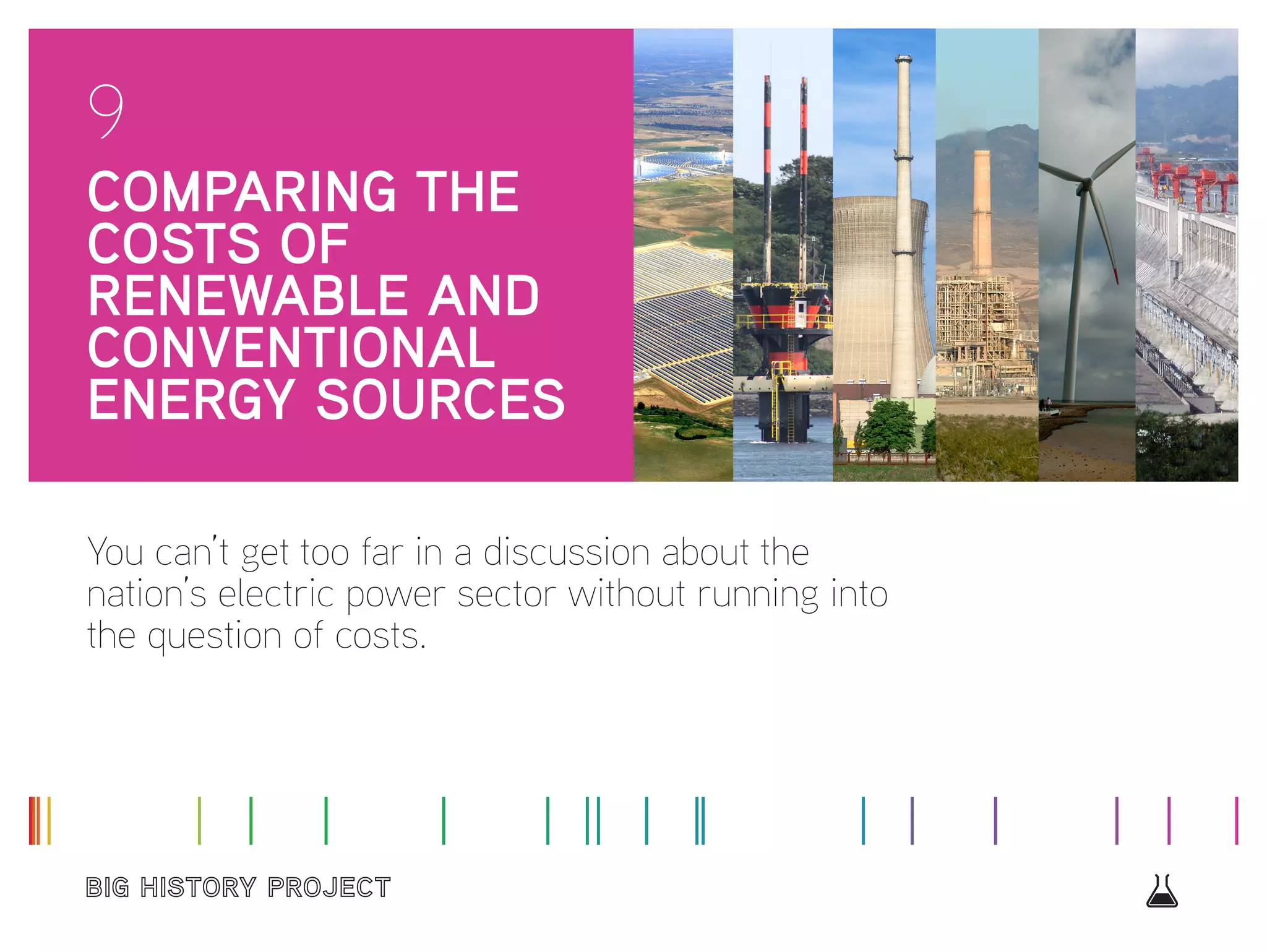
The first three units of Solnova in the
foreground, with the two towers of the
PS10 and PS20 solar power stations in
the background. Spain. Credit: Abengoa
Solar. CC BY 1.0. https://commons.
wikimedia.org/w/index.
php?curid=12030638
Azura at the US Navy’s Wave Energy
Test Site (WETS) on Oahu. Credit: US
Department of Energy. Public Domain.
https://commons.wikimedia.org/w/
index.php?curid=40872173
A nuclear power station
(Grafenrheinfeld Nuclear Power Plant,
Grafenrheinfeld, Bavaria, Germany).
The nuclear reactor is contained inside
the spherical containment building in
the center – left and right are cooling
towers which are common cooling
devices used in all thermal power
stations, and likewise, emit water vapor
from the non-radioactive steam turbine
section of the power plant. Credit: Avda
- Own work. CC BY-SA 3.0. https://
commons.wikimedia.org/w/index.
php?curid=26894741
This is a picture of Mojave Generating
Station, a 1,580 MW coal plant. Credit:
Kjkolb - Own work. CC BY 2.5. https://
commons.wikimedia.org/w/index.
php?curid=767962
Rønland Windpark in Denmark. Credit:
Fanny Schertzer - Own work. CC BY-
SA 3.0. https://commons.wikimedia.
org/w/index.php?curid=11183805
The Three Gorges Dam on the Yangtze
River, China. Credit: Le Grand
PortageDerivative work: Rehman. CC
BY 2.0. https://commons.wikimedia.
org/w/index.php?curid=11425004
Data source for all graphs: Lazard’s
Levelized Cost of Energy Analysis--
Version 8.0, September 2014 https://
www.lazard.com/media/1777/levelized_
cost_of_energy_-_version_80.pdf

Unit 9: Comparing the Costs of Renewable and Conventional Energy Sources

  • 1.
    You can’t gettoo far in a discussion about the nation’s electric power sector without running into the question of costs. 9 COMPARING THE COSTS OF RENEWABLE AND CONVENTIONAL ENERGY SOURCES
  • 2.
    BIG HISTORY PROJECT COMPARING THE COSTS OF RENEWABLE AND CONVENTIONAL ENERGY SOURCES 2 How do renewable sources, such as solar and wind, stack up against fossil fuels, such as coal and natural gas? How much will it cost utilities and ratepayers to build—and operate—a new power plant? To illustrate how the various energy technologies compare, we’ve created a set of interactive dashboards that summarize how much it costs to generate power. The data show that utility-scale solar and wind installations are now competitive with conventional coal- and gas-fired power plants. Moreover, wind and solar costs are projected to steeply decline in the years ahead. Before delving into the data, it’s worth noting that the number of dollars it takes to build and operate a power plant is a somewhat narrow definition of costs. It doesn’t, for example, include what economists call externalities, such as the cost of air pollution or climate change impacts. With a broader definition of costs, low-carbon technologies would perform even better than fossil fuels. COMPONENTS OF LEVELIZED COST OF ENERGY Table 1 present data on what’s known as the levelized cost of energy. In essence, this analysis offers an apples-to-apples comparison of the costs of financing, building, operating, and maintaining a power plant. The values are expressed in dollars per megawatt-hour. One of the most widely used levelized cost studies is conducted by Lazard, an international financial advisory and asset management firm. Their latest version of the study, version 8, was released in late 2014. The graphic below summarizes the cost components of 16 different energy technologies evaluated by Lazard: 10 of them are alternative (which includes mainly low-carbon, renewable technologies), and six are conventional (which includes fossil fuel sources and nuclear). Onshore wind has the lowest average levelized cost in this analysis at $59 per megawatt-hour, and utility-scale photovoltaic plants weren’t far behind at $79. By comparison, the lowest cost conventional technologies were gas combined cycle technologies, averaging $74 per megawatt-hour, and coal plants, averaging $109. These numbers are the average of Lazard’s low- and high-end estimates (see their study for more about their cost calculations). Looking across the 16 technology types, the 10 alternative technologies cost an average $147 per megawatt-hour, $18 less than the conventional approaches. “Certain Alternative Energy generation technologies,” Lazard wrote, “are cost-competitive with conventional generational technologies under some scenarios.” By dividing the costs among capital, fuel, and operations and maintenance (O&M), you can see some dramatic differences among the technologies. Many renewable technologies, such as wind, solar, and geothermal, may not be cheap to build, but they have no fuel costs once they’re up and running, and generally have lower O&M costs as well. WIND AND SOLAR COSTS FALLING The levelized cost of some wind and solar technologies has plummeted in recent years. The graphic below shows that the average cost of onshore wind has fallen from $135 per megawatt-hour in 2009 to $59 in 2014. That’s a 56 percent drop in five years. The cost of utility-scale photovoltaic technology has plunged from $359 per megawatt- hour in 2009 to $79 in 2014, a 78 percent decline. Lazard attributes these falling costs to “material declines in the pricing of system components (e.g., panels, inverters, Table 1: Components of levelized cost of energy.
  • 3.
    BIG HISTORY PROJECT COMPARING THE COSTS OF RENEWABLE AND CONVENTIONAL ENERGY SOURCES 3 racking, turbines, etc.), and dramatic improvements in efficiency, among other factors.” Solar and wind costs have been dropping Other forms of solar power are expected to get even cheaper in the next few years. The graphic below shows that rooftop residential solar costs are expected to decline 42 percent between 2014 and 2017; for commercial and industrial photovoltaic installations, Lazard forecasts the levelized cost will drop 28 percent over the same period. “More efficient installation techniques, lower costs of capital and improved supply chains” are the driving forces behind these projected cost reductions. Cost of rooftop solar projected to fall further COMPARING THE TECHNOLOGIES A variety of considerations—aside from cost—determine when, where, or how a technology is used. Although wind and solar are now cost-competitive and offer many health and environmental advantages over fossil fuels, these are still considered intermittent sources because the sun isn’t always shining and the wind isn’t always blowing). As a result, wind and solar are unable to entirely replace the services that certain conventional “baseload’” sources provide to the system. That said, utilities and power operators are discovering a multitude of new ways that low-carbon technologies can offer more value to the power grid across the board. Transmission is another important issue, especially for power sources that are limited to certain areas, but it can also allow power plants to serve faraway customers. Table 2: Levelized cost of energy: wind power. Table 3: Levelized cost of energy: utility-scale solar photovoltaic. Table 4: Levelized cost of rooftop residential solar photovoltaic. Table 5: Levelized cost of commercial and industrial solar photovoltaic.
  • 4.
    BIG HISTORY PROJECT COMPARING THE COSTS OF RENEWABLE AND CONVENTIONAL ENERGY SOURCES 4 OTHER RESOURCES There are many other resources on the web for analyzing energy costs: • The U.S. Energy Information Administration’s Annual Energy Outlook 2014 provides a different set of levelized cost figures for a variety of technologies. • The National Renewable Energy Laboratory also offers an online calculator that lets you plug in variables, such as capital and fuel costs, to generate LCOE estimates. • The Department of Energy’s OpenEI offers a Transparent Cost Database that compares the results from dozens of cost studies. To learn more about Energy Innovation’s work on clean energy, visit our power sector transformation and smart energy policy pages.
  • 5.
    BIG HISTORY PROJECT COMPARING THE COSTS OF RENEWABLE AND CONVENTIONAL ENERGY SOURCES 5 Source Comparing the costs of renewable and conventional energy sources http:// energyinnovation.org/2015/02/07/ levelized-cost-of-energy/ The first three units of Solnova in the foreground, with the two towers of the PS10 and PS20 solar power stations in the background. Spain. Credit: Abengoa Solar. CC BY 1.0. https://commons. wikimedia.org/w/index. php?curid=12030638 Azura at the US Navy’s Wave Energy Test Site (WETS) on Oahu. Credit: US Department of Energy. Public Domain. https://commons.wikimedia.org/w/ index.php?curid=40872173 A nuclear power station (Grafenrheinfeld Nuclear Power Plant, Grafenrheinfeld, Bavaria, Germany). The nuclear reactor is contained inside the spherical containment building in the center – left and right are cooling towers which are common cooling devices used in all thermal power stations, and likewise, emit water vapor from the non-radioactive steam turbine section of the power plant. Credit: Avda - Own work. CC BY-SA 3.0. https:// commons.wikimedia.org/w/index. php?curid=26894741 This is a picture of Mojave Generating Station, a 1,580 MW coal plant. Credit: Kjkolb - Own work. CC BY 2.5. https:// commons.wikimedia.org/w/index. php?curid=767962 Rønland Windpark in Denmark. Credit: Fanny Schertzer - Own work. CC BY- SA 3.0. https://commons.wikimedia. org/w/index.php?curid=11183805 The Three Gorges Dam on the Yangtze River, China. Credit: Le Grand PortageDerivative work: Rehman. CC BY 2.0. https://commons.wikimedia. org/w/index.php?curid=11425004 Data source for all graphs: Lazard’s Levelized Cost of Energy Analysis-- Version 8.0, September 2014 https:// www.lazard.com/media/1777/levelized_ cost_of_energy_-_version_80.pdf