The Industrial Revolution The Rostow Model Reflections on the roles of science
But first  –additional comments on the definitions of science Last time I talked about the political or rhetorical functions served by several different definitions of science --- this does not mean that I think that most people who accept those definitions are aware of those functions or the circumstances that gave rise to them. A good example of how historians can help in understanding aspects of what we believe but are not conscious about.
Definitions of science -- continued Definitions not “arbitrary” in 2 senses 1. As historians we want to know how those engaged in knowledge producing activities in the past thought that they were doing –i.e. preamble of charter of Royal society of London says “The business of the Royal Society is: to improve the knowledge of natural things, and all useful arts, Manufactures, Mechanic practices, Engynes, and Inventions by experiment.” So some definitions may be more reflective of past experiences than others.  2. Important to recognize what “linguistic community” subscribes to what definitions & why.
Objectivity, value neutrality, and the logical positivist “normative” definition of science. “ normative” vs “descriptive” understandings of science –logical positivism & its descendents vs Thomas Kuhn’s  Structure of Scientific Revolutions  (1962) and its descendents. “ German Science” & the Vienna Circle –how would science have to be done to make its knowledge claims independent of the context in which they were produced—i.e. to make them universally valid and to ensure the progressive nature of science. –”build the wall brick by brick” notion. Has tremendous appeal for scientists –they have a uniquely progressive approach to the world –use Sarton.
The Kuhnian “revolution” in history of science Kuhn’s problem –science is progressive  but  revolutions frequently force scientists to reject older knowledge claims –i.e Copernican rev,  rejection of phlogiston chemistry, etc. How can this happen– Kuhn’s emphasis on “Paradigms,” “normal science,” “anomalies,” the  incommensurability  of competing paradigms. Emphasizes both the way that authority is exercised in science, and The ultimately social processes which lead to the domination of new paradigms.
Back now to the Industrial Revolution My views come primarily from 3 sources 1. David Landes,  The Unbound Prometeus: Technological Change and Industrial Development in Western Europe from 1750 to the Present  (1970) Still widely held to be the best historical account of European industrialization. 2. W. W. Rostow  The Stages of Economic Growth: A Non-Communist Manifesto  (1961) – has critics –but still often used as 1 st  approximation by modernization theorists 4. A.E. Musson & Eric Robinson,  Science and Technology in the Industrial Revolution  (1969).
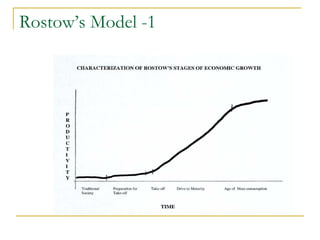
Rostow’s Model -1
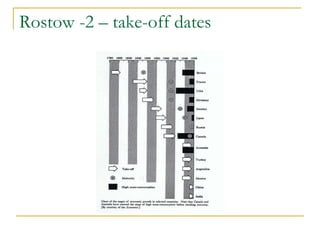
Rostow -2 – take-off dates
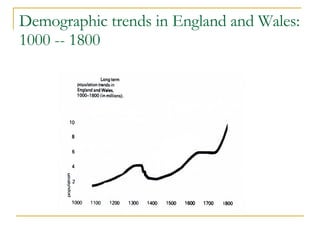
Demographic considerations Industrialization depends, among other things on the growth of a labor force not engaged in primary food production (in pre-industrial societies typically 75-95% of labor force is food producing –in advanced industrial societies i.e. U.S. today  ~3%. “Green revolution” of early 18 th  c in England allows for dramatic sustained population growth with little change in agricultural labor force.
Demographic trends in England and Wales: 1000 -- 1800
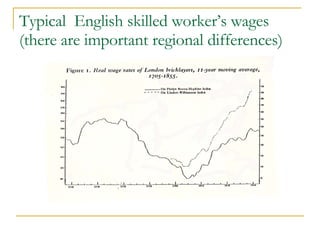
Other considerations related to agriculture Green revolution produces capital accumulation for investment. i.e. Coke of Upham raises annual income from his farm from  £2,000 to £20,000 from 1750-1790 – much of increase he invests. More typically, Phyllis Deane reports average farmer’s income  £8 in 1700, £15 in 1750, £22 in 1790,  with constant or lowered expenses. Increased disposable income creates a market for goods;  but Depresses worker’s wages as unemployment soars.
Typical  English skilled worker’s wages  (there are important regional differences)
Science & Green Revolution Green revolution produces conditions to prepare for take off –was there a connection to “science”? Certainly technological innovations are important. Scientific attitudes and practices more important than conceptual content –emphasis on experiments with breeding, new crops, new fertilizers & rotation systems, new plows, Tull’s seed drill. Institutionalized in organizations like The Honourable the Society for Improvers of Agriculture (1723).
Take-off Growth of commerce stimulated both by increase in ag. productivity and by exploitation of colonies –rapid increase in persons Defoe called “the middling sort” –i.e. middle class –with some cash and aspirations. (Landes -48) Technological innovations in transportation (initially canals), Later in RRs Social overhead capital –large capital/low but steady return
Canal Building Key role of “projectors”, we now call entrepreneurs— i.e Duke of Bridgewater, FRS, enthusiast for improving projects –hires James Brindley to build canal from coal mine on his property to Manchester (1759) –price of coal in Manchester drops 90% Grand trunk canal begun 1766 –investors include Erasmus Darwin, Josiah Wedgewood, Matthew Boulton, James Watt– all members of the  Lunar Society of Birmingham
Take-off -- 2 Technological innovations in textiles allows production of cheap cotton cloth Most first generation mechanical improvements –Kay’s flying shuttle(1733), Hargreve’s Spinning Jenny (1770), Arkwright’s water frame (1769) and Carding engine (1775) –done by “mechanics” But some by persons with demonstrated mathematical and scientific training: Crompton, inventor of the “mule” for spinning up to 350 spindles at a time educated by mathematician Wm Barlow Edmund Cartwright –inventor of power loom an Oxford educated clergyman –also trained in medicine –interested in agricultural improvements & mechanics—designed new loom then hired a carpenter and smith to construct it
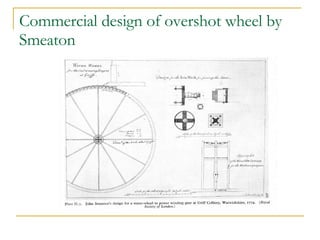
Take-off –3 –relations to science Improvements in Power sources – Clearly driven by scientific practices and theories—i.e Smeaton’s theoretically informed experiments on over/undershot waterwheels—led to widespread use. Watt’s work on separate condenser steam engine—theoretically informed, systematically carried out –by person informally but thoroughly educated in contemporary sciences
Commercial design of overshot wheel by Smeaton
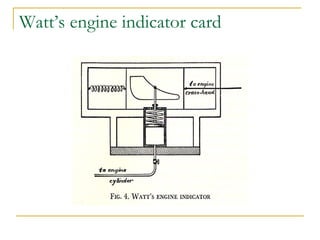
Watt --1 Grandfather taught mathematics; father a shipwright who studies math and natural philosophy as a hobby;  James educated at Greenock Academy –strong in math.; he studies major Newtonian text, S’Gravesande’s  Mathematical Elements of Natural Philosophy  by age 15, learns German and Italian to read works in mechanics and instrument making –reads widely then experiments extensively –inventing new, theoretically informed measuring instruments (engine indicator card) to study efficiency of steam engines
Watt’s engine indicator card
Intended Upshot of Take-off Productivity of yarn maker increases  ~100 fold Price of yarn drops from 38p/lb. to 6p/lb. between 1760 and 1800 Value of British cotton production: £ .5 million in 1760 £ 5 million in 1800 £ 50 million in 1835
Some unintended consequences Deskilling of jobs, dramatic increase in employment of women, children, depression of wages –longer hours. The Luddite response. Social dislocations –i.e. incidences of first conception out of wedlock  ~12% 1700, ~50% in 1780; more than half of these ended with single mothers on poor relief (huge welfare burden) leads to tax rebellions. Sanitation can’t keep up with urban growth –diseases –temporary dramatic  increase in mortality rates. Typhoid epidemics.
Science and Drive to Maturity Fueled heavily  by chemical processes Bleaching story told in reading Wedgewood story told in reading One begins to see scientific knowledge as well as attitudes and practices playing a greater role Soda production story: Soda (NaCO 3 ) needed for baking & for mgfr. of soaps & glass –traditionally produced by burning kelp, but demand grows too rapidly for supply to keep up French Academie des Sciences offers 12,000 livre prize for invention of commercially feasible method.  Chemist Joseph LeBlanc wins (heat salt with sulphuric acid, creates sodium sulphate; heat with limestone & coal [carbon], sodium carbonate[soda] leached out with water & collected by evaporating water) Eban Horsford story in U.S.
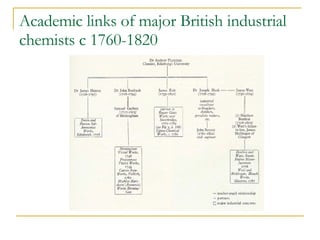
Academic links of major British industrial chemists c 1760-1820

Industrial Revolution

  • 1.
    The Industrial RevolutionThe Rostow Model Reflections on the roles of science
  • 2.
    But first –additional comments on the definitions of science Last time I talked about the political or rhetorical functions served by several different definitions of science --- this does not mean that I think that most people who accept those definitions are aware of those functions or the circumstances that gave rise to them. A good example of how historians can help in understanding aspects of what we believe but are not conscious about.
  • 3.
    Definitions of science-- continued Definitions not “arbitrary” in 2 senses 1. As historians we want to know how those engaged in knowledge producing activities in the past thought that they were doing –i.e. preamble of charter of Royal society of London says “The business of the Royal Society is: to improve the knowledge of natural things, and all useful arts, Manufactures, Mechanic practices, Engynes, and Inventions by experiment.” So some definitions may be more reflective of past experiences than others. 2. Important to recognize what “linguistic community” subscribes to what definitions & why.
  • 4.
    Objectivity, value neutrality,and the logical positivist “normative” definition of science. “ normative” vs “descriptive” understandings of science –logical positivism & its descendents vs Thomas Kuhn’s Structure of Scientific Revolutions (1962) and its descendents. “ German Science” & the Vienna Circle –how would science have to be done to make its knowledge claims independent of the context in which they were produced—i.e. to make them universally valid and to ensure the progressive nature of science. –”build the wall brick by brick” notion. Has tremendous appeal for scientists –they have a uniquely progressive approach to the world –use Sarton.
  • 5.
    The Kuhnian “revolution”in history of science Kuhn’s problem –science is progressive but revolutions frequently force scientists to reject older knowledge claims –i.e Copernican rev, rejection of phlogiston chemistry, etc. How can this happen– Kuhn’s emphasis on “Paradigms,” “normal science,” “anomalies,” the incommensurability of competing paradigms. Emphasizes both the way that authority is exercised in science, and The ultimately social processes which lead to the domination of new paradigms.
  • 6.
    Back now tothe Industrial Revolution My views come primarily from 3 sources 1. David Landes, The Unbound Prometeus: Technological Change and Industrial Development in Western Europe from 1750 to the Present (1970) Still widely held to be the best historical account of European industrialization. 2. W. W. Rostow The Stages of Economic Growth: A Non-Communist Manifesto (1961) – has critics –but still often used as 1 st approximation by modernization theorists 4. A.E. Musson & Eric Robinson, Science and Technology in the Industrial Revolution (1969).
  • 7.
  • 8.
    Rostow -2 –take-off dates
  • 9.
    Demographic considerations Industrializationdepends, among other things on the growth of a labor force not engaged in primary food production (in pre-industrial societies typically 75-95% of labor force is food producing –in advanced industrial societies i.e. U.S. today ~3%. “Green revolution” of early 18 th c in England allows for dramatic sustained population growth with little change in agricultural labor force.
  • 10.
    Demographic trends inEngland and Wales: 1000 -- 1800
  • 11.
    Other considerations relatedto agriculture Green revolution produces capital accumulation for investment. i.e. Coke of Upham raises annual income from his farm from £2,000 to £20,000 from 1750-1790 – much of increase he invests. More typically, Phyllis Deane reports average farmer’s income £8 in 1700, £15 in 1750, £22 in 1790, with constant or lowered expenses. Increased disposable income creates a market for goods; but Depresses worker’s wages as unemployment soars.
  • 12.
    Typical Englishskilled worker’s wages (there are important regional differences)
  • 13.
    Science & GreenRevolution Green revolution produces conditions to prepare for take off –was there a connection to “science”? Certainly technological innovations are important. Scientific attitudes and practices more important than conceptual content –emphasis on experiments with breeding, new crops, new fertilizers & rotation systems, new plows, Tull’s seed drill. Institutionalized in organizations like The Honourable the Society for Improvers of Agriculture (1723).
  • 14.
    Take-off Growth ofcommerce stimulated both by increase in ag. productivity and by exploitation of colonies –rapid increase in persons Defoe called “the middling sort” –i.e. middle class –with some cash and aspirations. (Landes -48) Technological innovations in transportation (initially canals), Later in RRs Social overhead capital –large capital/low but steady return
  • 15.
    Canal Building Keyrole of “projectors”, we now call entrepreneurs— i.e Duke of Bridgewater, FRS, enthusiast for improving projects –hires James Brindley to build canal from coal mine on his property to Manchester (1759) –price of coal in Manchester drops 90% Grand trunk canal begun 1766 –investors include Erasmus Darwin, Josiah Wedgewood, Matthew Boulton, James Watt– all members of the Lunar Society of Birmingham
  • 16.
    Take-off -- 2Technological innovations in textiles allows production of cheap cotton cloth Most first generation mechanical improvements –Kay’s flying shuttle(1733), Hargreve’s Spinning Jenny (1770), Arkwright’s water frame (1769) and Carding engine (1775) –done by “mechanics” But some by persons with demonstrated mathematical and scientific training: Crompton, inventor of the “mule” for spinning up to 350 spindles at a time educated by mathematician Wm Barlow Edmund Cartwright –inventor of power loom an Oxford educated clergyman –also trained in medicine –interested in agricultural improvements & mechanics—designed new loom then hired a carpenter and smith to construct it
  • 17.
    Take-off –3 –relationsto science Improvements in Power sources – Clearly driven by scientific practices and theories—i.e Smeaton’s theoretically informed experiments on over/undershot waterwheels—led to widespread use. Watt’s work on separate condenser steam engine—theoretically informed, systematically carried out –by person informally but thoroughly educated in contemporary sciences
  • 18.
    Commercial design ofovershot wheel by Smeaton
  • 19.
    Watt --1 Grandfathertaught mathematics; father a shipwright who studies math and natural philosophy as a hobby; James educated at Greenock Academy –strong in math.; he studies major Newtonian text, S’Gravesande’s Mathematical Elements of Natural Philosophy by age 15, learns German and Italian to read works in mechanics and instrument making –reads widely then experiments extensively –inventing new, theoretically informed measuring instruments (engine indicator card) to study efficiency of steam engines
  • 20.
  • 21.
    Intended Upshot ofTake-off Productivity of yarn maker increases ~100 fold Price of yarn drops from 38p/lb. to 6p/lb. between 1760 and 1800 Value of British cotton production: £ .5 million in 1760 £ 5 million in 1800 £ 50 million in 1835
  • 22.
    Some unintended consequencesDeskilling of jobs, dramatic increase in employment of women, children, depression of wages –longer hours. The Luddite response. Social dislocations –i.e. incidences of first conception out of wedlock ~12% 1700, ~50% in 1780; more than half of these ended with single mothers on poor relief (huge welfare burden) leads to tax rebellions. Sanitation can’t keep up with urban growth –diseases –temporary dramatic increase in mortality rates. Typhoid epidemics.
  • 23.
    Science and Driveto Maturity Fueled heavily by chemical processes Bleaching story told in reading Wedgewood story told in reading One begins to see scientific knowledge as well as attitudes and practices playing a greater role Soda production story: Soda (NaCO 3 ) needed for baking & for mgfr. of soaps & glass –traditionally produced by burning kelp, but demand grows too rapidly for supply to keep up French Academie des Sciences offers 12,000 livre prize for invention of commercially feasible method. Chemist Joseph LeBlanc wins (heat salt with sulphuric acid, creates sodium sulphate; heat with limestone & coal [carbon], sodium carbonate[soda] leached out with water & collected by evaporating water) Eban Horsford story in U.S.
  • 24.
    Academic links ofmajor British industrial chemists c 1760-1820