
Industrial Revolution
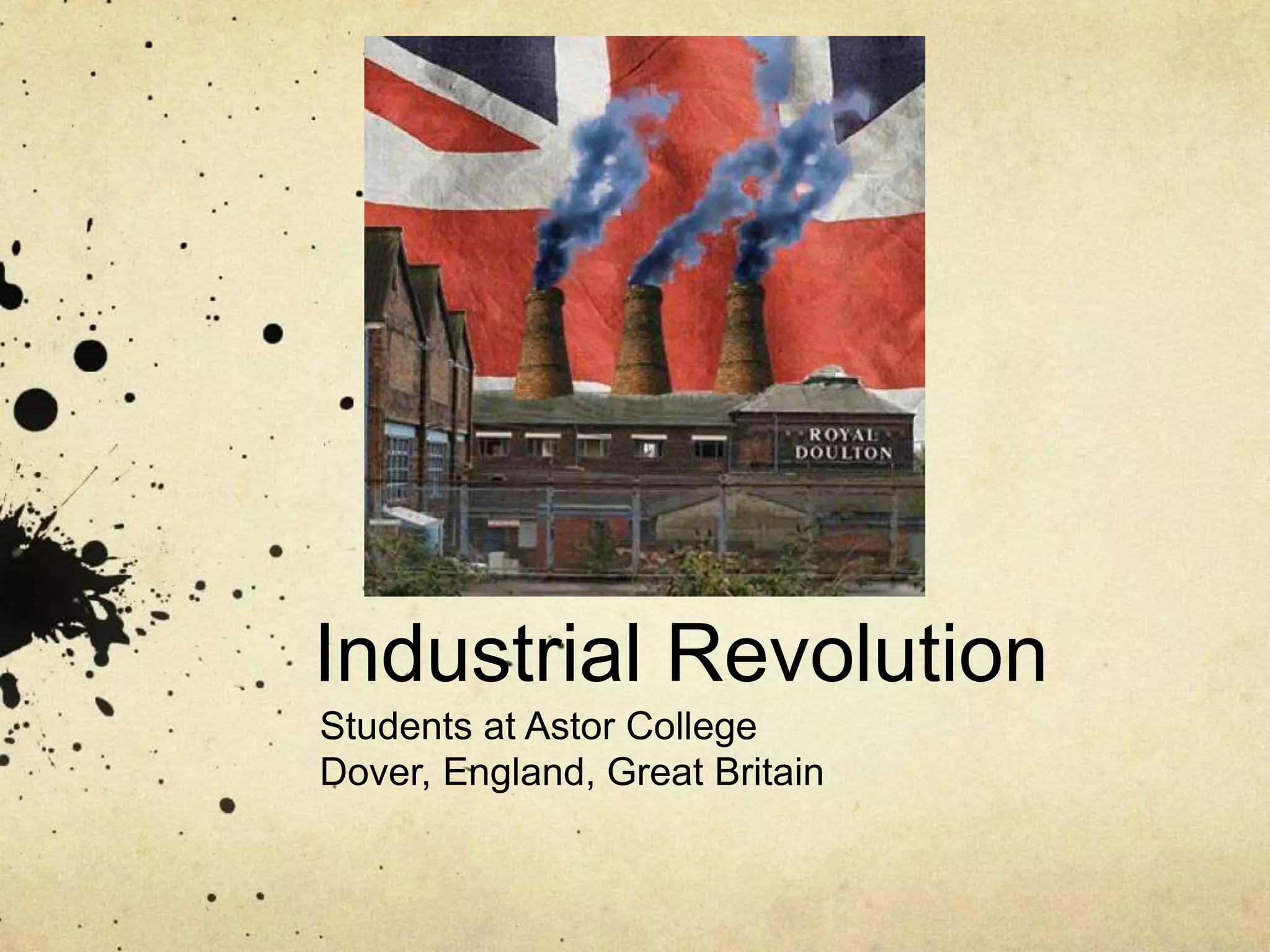
Students at Astor College
Dover, England, Great Britain
Industrial Revolution
The Industrial Revolution was a period in time
which the world and the way we live went
through a lot of changes very quickly. Some of
the changes included…
Economic changes
Technological changes
Social changes
Cultural changes
Before the Industrial
Revolution
Most people resided in small, rural communities.
Daily lives revolved around farming.
Life for the average person was difficult.
Family income was small.
Many people were malnourished.
Disease was common.
People produced the bulk of their own food, clothing,
furniture and tools.
Manufacturing was done in homes or small, rural shops,
using hand tools or simple machines.
Why did it start in Britain?
Britain’s Coal
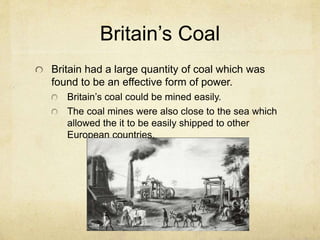
Britain had a large quantity of coal which was
found to be an effective form of power.
Britain’s coal could be mined easily.
The coal mines were also close to the sea which
allowed the it to be easily shipped to other
European countries.
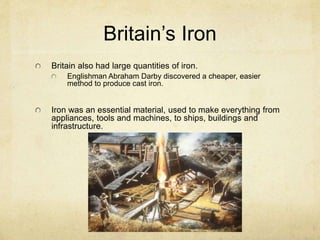
Britain’s Iron
Britain also had large quantities of iron.
Englishman Abraham Darby discovered a cheaper, easier
method to produce cast iron.
Iron was an essential material, used to make everything from
appliances, tools and machines, to ships, buildings and
infrastructure.
Britain’s Intellectual
Climate
Britain allowed its scientists, inventors and free thinkers
to work, discuss and debate openly without the threat of
the church or state.
This provided the atmosphere for a cascade of scientific
breakthroughs.
However, this was not the case across Europe where
people were censored by their church and state.
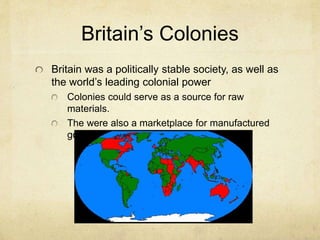
Britain’s Colonies
Britain was a politically stable society, as well as
the world’s leading colonial power
Colonies could serve as a source for raw
materials.
The were also a marketplace for manufactured
goods.
How did the Industrial
Revolution change Britain,
Europe and THE WORLD!
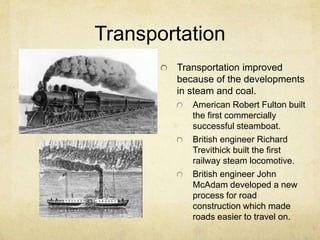
Transportation
Transportation improved
because of the developments
in steam and coal.
American Robert Fulton built
the first commercially
successful steamboat.
British engineer Richard
Trevithick built the first
railway steam locomotive.
British engineer John
McAdam developed a new
process for road
construction which made
roads easier to travel on.
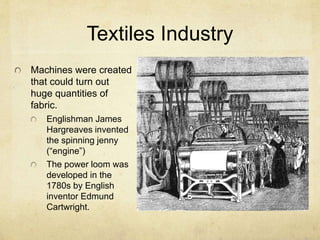
Textiles Industry
Machines were created
that could turn out
huge quantities of
fabric.
Englishman James
Hargreaves invented
the spinning jenny
(“engine”)
The power loom was
developed in the
1780s by English
inventor Edmund
Cartwright.
Effects of the Industrial
Revolution
The factories created more jobs.
The scientific advancements resulted in better
health.
Children weren’t needed in the family business
as often which made time for education.
Capitalism allowed people to move social
classes and helped to create a middle class.
The spread of Industrialism
The British wanted to prevent their technology
and skilled workers from leaving Britain.
However, Industrialization spread from Britain to
other European countries, including Belgium,
France and Germany, and to the United States.
By the mid-19th century, industrialization was
well-established throughout the western part of
Europe and America’s northeastern region.

Industrial revolution (1)

  • 1.
    Industrial Revolution Students atAstor College Dover, England, Great Britain
  • 2.
    Industrial Revolution The IndustrialRevolution was a period in time which the world and the way we live went through a lot of changes very quickly. Some of the changes included… Economic changes Technological changes Social changes Cultural changes
  • 3.
    Before the Industrial Revolution Mostpeople resided in small, rural communities. Daily lives revolved around farming. Life for the average person was difficult. Family income was small. Many people were malnourished. Disease was common. People produced the bulk of their own food, clothing, furniture and tools. Manufacturing was done in homes or small, rural shops, using hand tools or simple machines.
  • 4.
    Why did itstart in Britain?
  • 5.
    Britain’s Coal Britain hada large quantity of coal which was found to be an effective form of power. Britain’s coal could be mined easily. The coal mines were also close to the sea which allowed the it to be easily shipped to other European countries.
  • 6.
    Britain’s Iron Britain alsohad large quantities of iron. Englishman Abraham Darby discovered a cheaper, easier method to produce cast iron. Iron was an essential material, used to make everything from appliances, tools and machines, to ships, buildings and infrastructure.
  • 7.
    Britain’s Intellectual Climate Britain allowedits scientists, inventors and free thinkers to work, discuss and debate openly without the threat of the church or state. This provided the atmosphere for a cascade of scientific breakthroughs. However, this was not the case across Europe where people were censored by their church and state.
  • 8.
    Britain’s Colonies Britain wasa politically stable society, as well as the world’s leading colonial power Colonies could serve as a source for raw materials. The were also a marketplace for manufactured goods.
  • 9.
    How did theIndustrial Revolution change Britain, Europe and THE WORLD!
  • 10.
    Transportation Transportation improved because ofthe developments in steam and coal. American Robert Fulton built the first commercially successful steamboat. British engineer Richard Trevithick built the first railway steam locomotive. British engineer John McAdam developed a new process for road construction which made roads easier to travel on.
  • 11.
    Textiles Industry Machines werecreated that could turn out huge quantities of fabric. Englishman James Hargreaves invented the spinning jenny (“engine”) The power loom was developed in the 1780s by English inventor Edmund Cartwright.
  • 12.
    Effects of theIndustrial Revolution The factories created more jobs. The scientific advancements resulted in better health. Children weren’t needed in the family business as often which made time for education. Capitalism allowed people to move social classes and helped to create a middle class.
  • 13.
    The spread ofIndustrialism The British wanted to prevent their technology and skilled workers from leaving Britain. However, Industrialization spread from Britain to other European countries, including Belgium, France and Germany, and to the United States. By the mid-19th century, industrialization was well-established throughout the western part of Europe and America’s northeastern region.